


Key Takeaways
- Regional Ecommerce Marketplace Revenue is usually built from a mix of seller commissions, delivery fees, subscription plans, promotional placements, payment-related charges, and value-added seller services.
- Commission is often the first monetization layer because it connects platform earnings directly to completed seller transactions.
- Delivery fees can support revenue, but fulfilment, failed deliveries, returns, courier costs, and support pressure must be included in margin calculations.
- Seller plans become more effective after merchants see clear value from marketplace traffic, tools, analytics, visibility, and operational support.
- Promotional revenue should usually be introduced after buyer traffic and product discovery are strong enough to make paid visibility valuable to sellers.
Revenue Signals
- Commission rates should reflect category margins, seller economics, platform demand, fulfilment responsibility, and competitive pressure.
- Delivery pricing can use buyer-paid fees, free-delivery thresholds, seller subsidies, express charges, subscriptions, or zone-based rules.
- Seller subscriptions can monetize higher listing limits, analytics, campaign access, advanced catalog tools, priority support, and settlement features.
- Sponsored listings, category placements, banners, campaign slots, product boosts, and seller-funded promotions can monetize marketplace attention.
- Payment, refund, commission, payout, cash collection, and settlement records should remain transparent so revenue growth does not create seller or finance disputes.
Real Insights
- The strongest marketplace revenue model is not the one with the most fees; each charge should have a clear value exchange for buyers or sellers.
- Charging commissions, subscriptions, promotions, delivery fees, and service fees too early can make seller acquisition harder before demand is proven.
- Admin control is central to monetization because commission rates, delivery pricing, promotions, payouts, refunds, and seller eligibility need regular adjustment.
- Value-added services can create additional income, but they should be packaged carefully so manual seller support does not become difficult to scale.
- The strongest revenue sequence is: validate transactions → establish commission and delivery logic → improve seller retention → add seller plans → monetize buyer attention → expand fulfilment and seller services → optimize revenue per order and seller as the marketplace matures.
Regional Ecommerce Marketplaces earn revenue from more than product sales. Their business model usually depends on a mix of seller commissions, delivery fees, subscription plans, sponsored visibility, payment flows, and value-added seller services.
For founders, understanding these revenue streams is important before choosing what to build. A marketplace may look simple on the customer side, but behind every order there are seller margins, delivery costs, refund risks, promotional controls, payout rules, and admin decisions that directly affect profitability.
This guide explains how ecommerce marketplace revenue models work, how commissions, delivery, seller plans, and promotions fit together, and what founders should consider before launching or scaling their own commerce platform.
If you are already planning to build a marketplace-style ecommerce business, Miracuves can help you move faster with a ready-made, white-label platform foundation designed for seller workflows, admin control, monetization settings, and source-code ownership.
Why Marketplace Revenue Models Matter Before You Build
A localized ecommerce marketplace does not earn only because products are listed online. It earns when sellers, buyers, logistics, payments, promotions, and platform controls work together without creating operational leakage.
Many founders look at a marketplace and assume the revenue model is simple: onboard sellers, take a commission, and scale orders. In reality, the strongest ecommerce marketplace models usually depend on multiple income streams. Commission may be the foundation, but delivery margin, seller plans, promotional placements, payment-related fees, catalog services, and fulfillment support can all contribute to the business.
The important decision is not “Which revenue stream looks attractive?” The better question is: “Which revenue stream can the platform actually support without damaging seller trust, buyer conversion, or operational control?”
That is where marketplace planning becomes strategic. A founder needs to understand when to charge sellers, when to charge buyers, when to subsidize delivery, when to monetize visibility, and when to keep the model simple until transaction volume improves.
For founders who already understand the revenue logic and now want to evaluate a launch-ready product foundation, Miracuves offers a multi-market commerce platform foundation that can support seller onboarding, product catalogs, commissions, delivery workflows, promotions, and operator control.
The Core Revenue Streams in a Local Ecommerce Marketplace
A strong marketplace revenue model is usually layered. Each revenue stream has a different role in the business.
| Revenue Stream | Who Usually Pays? | What It Monetizes | Founder Risk If Poorly Managed |
|---|---|---|---|
| Marketplace commissions | Sellers | Completed product transactions | High rates can reduce seller participation |
| Delivery fees and delivery margins | Buyers, sellers, or both | Fulfilment, routing, last-mile delivery, returns | Poor cost control can turn growth into losses |
| Seller subscription plans | Sellers | Access to better tools, visibility, limits, analytics, or support | Weak plan value can increase churn |
| Promotional placements | Sellers and brands | Featured listings, sponsored products, banner slots, campaign visibility | Over-promotion can reduce buyer trust |
| Payment and settlement fees | Sellers or buyers depending on model | Payment processing, cash handling, refunds, wallet flows, settlement operations | Unclear fees can create disputes |
| Value-added seller services | Sellers | Catalog support, photography, logistics support, analytics, account management | Manual services can become hard to scale |
For a deeper look at how these revenue lines connect inside a launch-ready commerce platform, explore Miracuves’ business model for a commerce marketplace platform.
The most sustainable model is not necessarily the one with the most fees. It is the one where each fee has a clear business reason and a visible value exchange.
1. Commission Revenue: The Marketplace Foundation
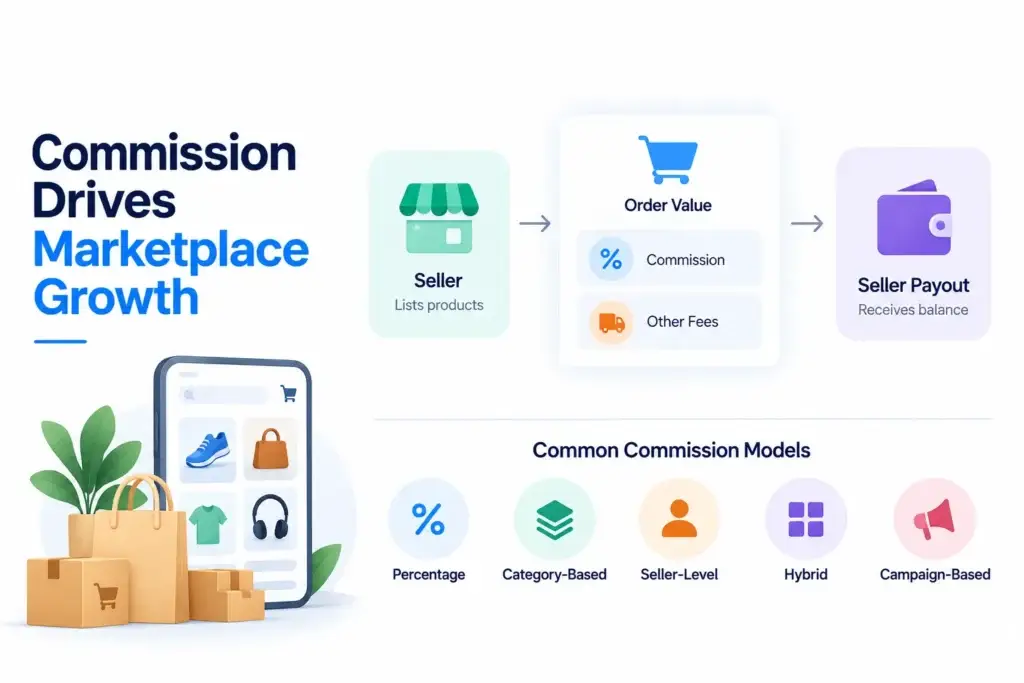
Commission is usually the first revenue stream founders think about because it connects directly to sales. When a seller receives an order through the marketplace, the platform takes a percentage or fixed amount from the transaction.
This model works because the platform is helping sellers access demand, payment infrastructure, catalog visibility, buyer trust, order management, and sometimes delivery support. The seller pays because the marketplace reduces the cost of finding and converting buyers independently.
However, commission needs careful category logic. A single commission rate across every product category may look simple, but it can create problems. Low-margin categories may not survive high fees. Premium categories may allow higher rates because sellers have more pricing flexibility. Fast-moving essentials may require lower commissions to keep prices competitive.
Common Commission Models
- Percentage commission: The platform takes a fixed percentage of every completed order.
- Category-based commission: Different product categories have different commission rates.
- Seller-level commission: High-performing or premium sellers may receive custom rates.
- Hybrid commission: The platform combines a lower percentage fee with fixed platform charges.
- Campaign-based commission: Special promotional events may carry different commercial terms.
Founder Decision Logic
A founder should not set commission only by asking, “How much can we charge?” A better approach is to ask:
- How much margin does the seller have?
- How competitive is the category?
- Is the platform bringing real demand?
- Does the marketplace also handle delivery or payment risk?
- Will sellers still list products actively after the commission is applied?
Commission revenue is strongest when sellers feel the platform helps them sell more, not when they feel the platform is simply taxing every order.
2. Delivery Fees and Delivery Margins: Where Revenue Meets Operations
Delivery monetization is powerful but risky. It can create a meaningful revenue stream, but it also exposes the marketplace to routing costs, courier capacity, failed deliveries, returns, refund issues, and customer support pressure.
A platform can charge delivery in several ways. It may collect a delivery fee from buyers, charge sellers for fulfilment, build delivery into the product price, or offer free delivery above a certain basket value. Some marketplaces also use delivery subscriptions, priority delivery, express delivery, or region-based delivery pricing.
The challenge is that delivery revenue is not pure revenue. It has direct costs. If the platform charges too little, it loses money on every order. If it charges too much, buyers abandon checkout. If sellers are asked to absorb too much delivery cost, they may raise prices or reduce participation.
Delivery Revenue Models
| Delivery Model | How It Works | Best Used When |
|---|---|---|
| Buyer-paid delivery fee | Buyer pays a visible delivery charge at checkout | Useful when buyers understand delivery cost clearly |
| Free delivery threshold | Delivery becomes free above a cart value | Useful for increasing average order value |
| Seller-subsidized delivery | Seller absorbs part of delivery cost | Useful for competitive categories or promotional campaigns |
| Express delivery fee | Buyer pays more for faster fulfilment | Useful in metro or high-demand zones |
| Delivery subscription | Buyer pays recurring fee for reduced or free delivery | Useful when repeat purchase behavior is strong |
| Zone-based delivery pricing | Charges vary by distance, city, or serviceability zone | Useful for local and cross-region commerce operations |
Delivery margins improve when the admin system can manage serviceable areas, courier assignment, delivery pricing, cash collection, refunds, returns, and delivery performance from one place.
This is why marketplace software should not treat delivery as a small add-on. Delivery is one of the areas where poor backend control can quietly damage unit economics.
3. Seller Plans: Turning Sellers Into Recurring Revenue
Seller subscription plans can give the marketplace a more predictable revenue layer. Instead of relying only on transaction commissions, the platform can charge sellers for access to better tools, larger listing limits, improved visibility, analytics, account support, or operational features.
This revenue stream works especially well when sellers see the platform as a serious sales channel rather than a side experiment.
A basic seller may only need catalog listing and order management. A growing seller may want campaign access, promoted slots, sales analytics, bulk upload tools, faster settlement, advanced inventory controls, or priority support. A larger merchant may need multi-user access, custom reporting, API access, or fulfilment support.
Seller Plan Examples
| Seller Plan Layer | Possible Inclusions | Business Purpose |
|---|---|---|
| Starter seller access | Basic listings, order dashboard, payout history | Helps new sellers join easily |
| Growth seller plan | More listings, basic analytics, campaign access | Encourages sellers to invest in platform growth |
| Premium seller plan | Featured placement eligibility, advanced reporting, priority support | Monetizes serious sellers without raising commission for everyone |
| Enterprise seller support | Bulk uploads, API access, dedicated workflows, custom settlement support | Supports high-volume sellers and complex catalogs |
The mistake founders make is charging sellers before the platform offers enough value. Seller plans should not feel like a gatekeeping fee. They should feel like a business upgrade.
4. Promotions and Sponsored Visibility: Monetizing Marketplace Attention
Promotional revenue becomes valuable when the marketplace has traffic, search activity, category browsing, and repeat buyers. Sellers are willing to pay for visibility when visibility can realistically lead to more orders.
This can include sponsored listings, homepage banners, category placements, search result boosts, campaign participation, seasonal sale slots, push notification campaigns, email placement, and product spotlight sections.
However, promotional revenue must be handled carefully. If every result becomes paid placement, buyers may stop trusting discovery. If sponsored products are irrelevant, conversion drops. If organic sellers never get visibility, seller satisfaction declines.
Promotional Revenue Options
- Featured product placement
- Sponsored search listings
- Category banner slots
- Homepage campaign cards
- Flash sale participation fees
- Seasonal campaign packages
- Push notification sponsorships
- Email campaign inclusion
- Seller-funded coupons
- Product boost credits
The best promotion systems give the admin team control over what appears, where it appears, how long it runs, which sellers are eligible, and how performance is measured.
For founders, promotional revenue should usually come after marketplace basics are working. First build supply, demand, trust, checkout, delivery, and repeat purchase behavior. Then monetize attention.
5. Payment, Settlement, and Cash Handling Fees
Payments are not just checkout buttons. In a marketplace, payment flows affect trust, reconciliation, refunds, seller payouts, commission deductions, delivery fees, cash collection, and accounting visibility.
Depending on the operating model, a marketplace may generate revenue from payment convenience fees, cash handling fees, wallet-related flows, settlement services, or seller payout processing. These fees should be transparent and carefully documented because money movement is one of the fastest ways to create seller disputes.
A strong admin system should show:
- Order value
- Platform commission
- Delivery fee
- Taxes where applicable
- Seller payable amount
- Refund deductions
- Cash collection records
- Settlement status
- Payment gateway reference
- Payout history
- Dispute notes
When payment and settlement records are unclear, even a growing marketplace can become difficult to operate. Sellers need confidence that payouts are accurate. Buyers need confidence that refunds are handled. Admin teams need audit trails to resolve issues quickly.
This is also where security matters. Marketplaces should use secure payment gateway integration, encrypted data transfer, role-based access control, activity logs, refund approval workflows, and permission-based dashboards. Final compliance requirements depend on market, payment providers, operating structure, and legal review.
6. Value-Added Seller Services
Once a marketplace has sellers who depend on it for revenue, the platform can offer value-added services. These services can create additional income while helping sellers improve product quality, conversion, and operational performance.
Examples include:
- Product photography support
- Catalog upload support
- Product description optimization
- Inventory setup support
- Sponsored campaign management
- Seller onboarding support
- Fulfilment support
- Returns management
- Data and analytics reports
- Dedicated account assistance
This revenue layer should be added carefully because many services require human effort. If the platform sells manual services too aggressively, operations can become heavy. The better approach is to productize these services into clear packages, define what is included, and use admin workflows to track delivery.
For founders, value-added services are useful when they improve seller success and platform quality. They are risky when they become scattered custom work for every seller.
Founder Decision Signals: Which Revenue Stream Should Come First?
Speed
Start with commission, delivery rules, and basic seller controls first. These are easier to validate early because they connect directly to completed orders and marketplace operations.
Cost
Avoid adding too many monetization layers before supply and demand are stable. Complex seller plans, ad modules, and custom fulfilment logic can increase operational load if launched too early.
Scalability
Choose revenue streams that can be managed through admin rules, not manual spreadsheets. Commissions, delivery pricing, promotions, refunds, and payouts should be configurable from the backend.
Market Fit
Match monetization to local buyer and seller behavior. A market with high repeat orders may support delivery subscriptions, while a seller-dense category may support promoted listings and premium seller plans.
Before adding advanced seller plans, ad modules, fulfilment logic, and custom workflows, founders should understand the cost factors behind marketplace app development.
How Admin Control Affects Marketplace Revenue
Revenue streams are only useful when the platform operator can control them without developer dependency for every change.
For example, commission rates may need to change by category. Delivery fees may need to change by city, zone, distance, order value, or seller type. Promotional campaigns may need start dates, end dates, budgets, placements, and eligibility rules. Seller plans may need feature limits and upgrade logic.
This is why the admin dashboard becomes the control center of monetization. It should help the platform operator manage revenue settings, not just view orders.
A monetization-ready admin layer should support:
- Category-wise commission setup
- Seller onboarding and approval
- Product and catalog moderation
- Delivery fee configuration
- Zone and serviceability rules
- Coupon and campaign control
- Featured listing management
- Sponsored placement settings
- Seller payout tracking
- Refund and dispute workflows
- Revenue reporting
- Buyer and seller activity logs
- Role-based admin access
Founders should treat the admin system as a business tool, not only a backend screen. A marketplace without strong admin controls can grow in traffic while becoming harder to manage.
Commission vs Subscription vs Promotion: Which Model Is Better?
There is no single “best” model. Each revenue stream has a different purpose.
| Model | Strength | Weakness | Best Stage |
|---|---|---|---|
| Commission | Scales with orders and is easy to understand | Can reduce seller margin if rates are too high | Early and growth stage |
| Delivery fees | Helps cover fulfilment and last-mile operations | Can hurt checkout conversion if poorly priced | Early stage onward |
| Seller subscriptions | Creates recurring revenue and seller segmentation | Requires clear seller value and enough platform trust | Growth stage |
| Promotional placements | Monetizes buyer attention and seller competition | Requires meaningful traffic and strong discovery controls | Growth and scale stage |
| Value-added services | Improves seller success and adds service revenue | Can become operationally heavy if not packaged well | Growth stage onward |
A practical launch path is to start with commission and delivery logic, then add seller plans once sellers see value, and finally introduce promotional revenue when buyer traffic becomes meaningful.
Mistakes Founders Should Avoid
Charging Too Many Fees Too Early
Early sellers need trust, visibility, and order flow. If the platform charges commission, subscription, promotion, delivery, and service fees before proving demand, seller onboarding becomes harder.
Using One Commission Rate for Every Category
Different categories have different margins, return rates, delivery costs, and price sensitivity. A single commission rate can damage seller economics in low-margin categories.
Treating Delivery as Pure Revenue
Delivery has real operational costs. Without clear routing, serviceability, failed delivery handling, and return workflows, delivery fees can create losses instead of margin.
Launching Sponsored Placements Without Buyer Trust
Paid visibility works only when discovery remains useful. If irrelevant promoted products dominate the shopping experience, buyers may trust search and category pages less.
What a Monetization-Ready Marketplace Platform Should Include
A marketplace that wants to earn from commissions, delivery, seller plans, and promotions needs more than a storefront. It needs a connected operating system.
The customer side should make discovery, checkout, tracking, refunds, and support easy. The seller side should make catalog management, order handling, promotions, analytics, and payouts clear. The delivery side should support assignment, status updates, proof of delivery, and route visibility where relevant. The admin side should control pricing rules, commissions, campaigns, seller approvals, disputes, and reporting.
Founders can also review the marketplace feature modules that support monetization to understand how seller dashboards, admin controls, catalog tools, payments, delivery logic, and promotional workflows fit together.
A monetization-ready foundation usually needs:
- Buyer app or storefront
- Seller dashboard
- Admin dashboard
- Product catalog system
- Category and variant management
- Cart and checkout
- Payment gateway integration
- Commission engine
- Delivery fee rules
- Order management
- Seller payout workflows
- Coupon and promotion tools
- Featured listing controls
- Review and rating workflows
- Refund and dispute management
- Reports and analytics
- Role-based access controls
- Activity logs and secure admin permissions
Technical readers can also explore this developer guide to building a commerce marketplace app for a deeper look at architecture, panels, and development logic.
For founders planning a faster launch, Miracuves can help with a ready-made and white-label ecommerce foundation that supports core marketplace flows, admin control, monetization settings, branding, and source-code ownership. For ready-made solution scopes, Miracuves can support a 6-day launch path based on selected modules and final customization requirements.
You can also explore Miracuves’ ecommerce app development services for broader storefront, vendor, payment, and logistics workflows, or review white-label marketplace software options if you are comparing marketplace launch paths.
How to Sequence Revenue Streams for a New Marketplace
Founders often want every monetization feature from day one. That is understandable, but it is not always the strongest launch decision.
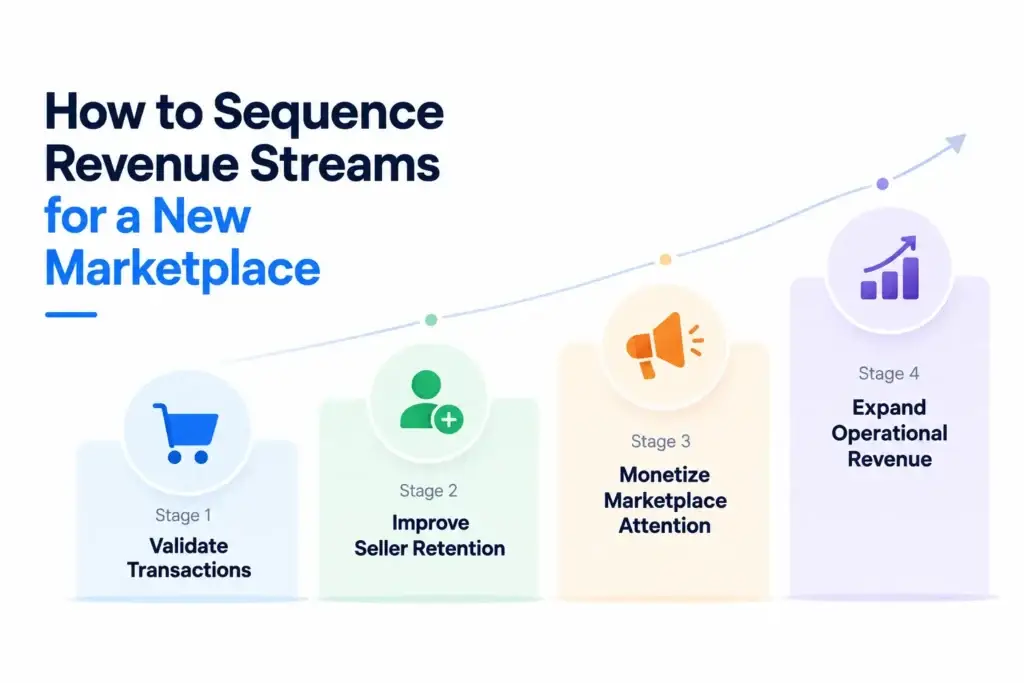
A better sequencing model looks like this:
Stage 1: Validate Transactions
Start with seller onboarding, buyer checkout, commission rules, delivery fee setup, payments, and basic reporting. The goal is to prove that sellers can list, buyers can purchase, and orders can be fulfilled reliably.
Stage 2: Improve Seller Retention
Add seller dashboards, analytics, better catalog tools, payout clarity, product moderation, seller support, and plan-based upgrades. The goal is to make sellers see the marketplace as a serious channel.
Stage 3: Monetize Marketplace Attention
Introduce featured listings, sponsored products, category placements, campaign slots, and seller-funded coupons. The goal is to monetize visibility without hurting buyer trust.
Stage 4: Expand Operational Revenue
Add fulfilment support, value-added seller services, advanced delivery options, subscription delivery, priority seller services, and deeper reporting. The goal is to increase revenue per seller and per order while keeping operations controlled.
For readers who want to study the wider operating logic behind seller onboarding, buyer demand, delivery, and marketplace economics, this deeper business model guide for seller-led ecommerce platforms is a useful next read.
This sequence helps founders avoid overbuilding before the marketplace proves basic transaction behavior.
Miracuves Perspective: Build the Revenue Engine, Not Just the Storefront
A marketplace storefront may attract attention, but the revenue engine lives behind the scenes.
The real business layer includes commission setup, seller rules, delivery pricing, promotional controls, payment settlement, refund handling, campaign management, and admin visibility. Without these systems, a marketplace can look good on the front end but fail operationally as soon as order volume grows.
If you are deciding whether to build from zero or start with a ready-made foundation, read this guide on the ready-made versus custom development decision.
Miracuves helps founders move faster by starting with a ready-made, white-label marketplace foundation that can be customized around branding, categories, payment flows, delivery logic, seller workflows, and monetization rules. Instead of spending months building every basic marketplace module from zero, founders can use a launch-ready foundation and focus more attention on seller acquisition, category strategy, buyer trust, and revenue model validation.
For commerce operators comparing build options, the next step is not only choosing features. It is deciding which monetization controls must exist from day one and which revenue streams should be activated after market validation.
Final Thoughts
Localized ecommerce marketplace revenue is not built from one fee. It is built from a controlled mix of commissions, delivery pricing, seller plans, promotional placements, payment workflows, and value-added services.
For founders, the strongest path is to avoid copying every monetization stream at once. Start with the revenue levers that match current marketplace maturity. Commission and delivery logic usually come first. Seller plans work when sellers see value. Promotional revenue works when buyer attention becomes meaningful. Value-added services work when they improve seller success without overwhelming operations.
When the revenue model is clear, the next step is choosing the right execution path. Founders can evaluate how to choose the right ecommerce marketplace development partner or explore custom mobile app development services if their idea needs highly unique workflows beyond a ready-made foundation.
The smarter build decision is to create a marketplace foundation where these revenue streams can be configured, tested, and adjusted over time. That is where admin control, source-code ownership, secure payment flows, seller dashboards, delivery logic, and reporting become business-critical.
Miracuves helps founders launch faster with a white-label, source-code-owned marketplace foundation that supports monetization-ready workflows and can be tailored to the target market.
FAQs
How do ecommerce marketplaces make money?
Ecommerce marketplaces usually make money through seller commissions, delivery fees, seller subscription plans, featured listings, sponsored product placements, payment-related charges, fulfilment support, and value-added seller services. The exact mix depends on the category, seller density, buyer demand, delivery model, and operating region.
What is marketplace commission revenue?
Marketplace commission revenue is the fee a platform earns from completed seller transactions. It may be a percentage of the order value, a fixed fee, or a category-based rate. Commission works best when sellers receive real value through buyer traffic, checkout infrastructure, order management, and marketplace trust.
Are delivery fees profitable for ecommerce platforms?
Delivery fees can support revenue, but they are not automatically profitable. Delivery has costs such as courier payout, routing, failed delivery, returns, fuel, packaging, and support. A marketplace needs strong delivery rules, serviceability controls, and reporting to protect margins.
How do seller subscription plans work in a marketplace?
Seller subscription plans allow merchants to pay recurring fees for better tools, higher listing limits, improved visibility, analytics, campaign access, priority support, or advanced catalog controls. These plans work best when sellers already trust the marketplace as a serious sales channel.
What are promotional placements in ecommerce marketplaces?
Seller subscription plans allow merchants to pay recurring fees for better tools, higher listing limits, improved visibility, analytics, campaign access, priority support, or advanced catalog controls. These plans work best when sellers already trust the marketplace as a serious sales channel.
What are promotional placements in ecommerce marketplaces?
Promotional placements are paid visibility options such as featured listings, sponsored products, homepage banners, category placements, campaign slots, and product boosts. They help sellers reach more buyers while giving the marketplace another revenue stream.
When should a new marketplace start monetizing promotions?
A new marketplace should usually introduce promotional revenue after it has meaningful buyer traffic, trusted search results, active sellers, and stable order flows. If promotions are introduced too early, sellers may not see results and buyers may lose trust in product discovery.
What features are needed to support marketplace monetization?
A monetization-ready marketplace needs commission settings, seller dashboards, product catalog tools, delivery fee controls, payment gateway integration, payout workflows, refund handling, promotion management, reporting, admin permissions, and secure activity logs.
How can Miracuves help founders launch a monetization-ready marketplace?
Miracuves helps founders build ready-made and white-label marketplace apps with source-code ownership, branded design, admin dashboards, seller workflows, payment integration, delivery logic, and monetization controls. For ready-made solution scopes, Miracuves can support a 6-day launch path based on the selected modules and customization requirements.
Miracuves is an independent software development company. We are not affiliated with, connected to, sponsored by, or endorsed by any company or product named in this article.
Terms such as “X Clone” are used descriptively. It is how the software industry refers to building a platform with functionality comparable to a known service, and how clients search for it.
The entire design and codebase of our products is built by our own team. Our products contain no code, design, graphics, or content originating from any third-party website or applications.
All third-party names and marks referenced in this article are the property of their respective owners, referenced solely to identify the services discussed.



