Launching a social app sounds exciting until the real work begins.
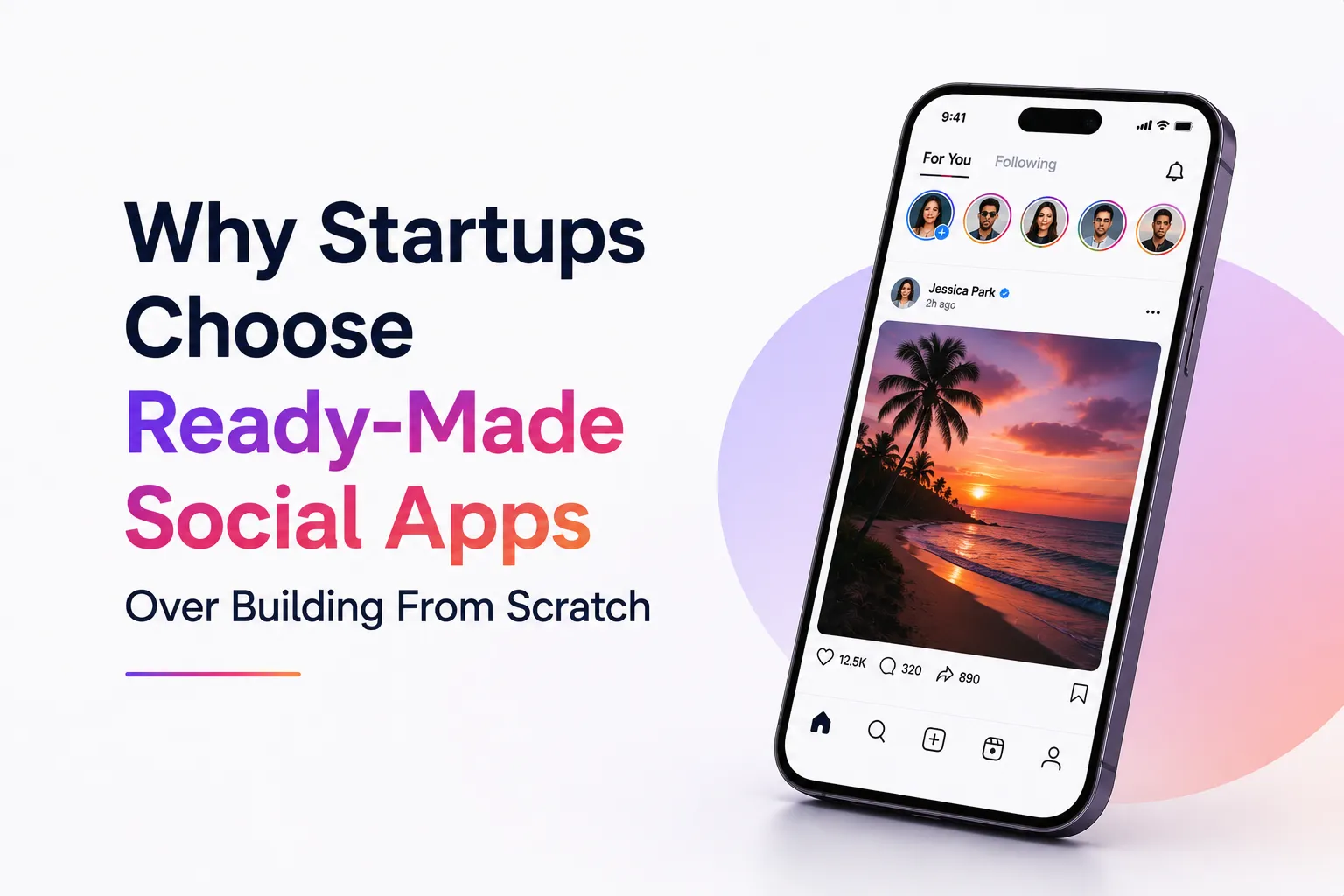
A founder may start with a simple idea: users should be able to create profiles, post photos or videos, follow others, message friends, receive notifications, and discover new content. On paper, it feels manageable. In development, however, every feature opens another layer of product, backend, design, moderation, storage, analytics, and scalability decisions.
That is why many startups now choose ready-made social apps instead of building every module from scratch.
A ready-made social app gives founders a launch-ready foundation with core user flows already structured. The brand, design, feature priorities, monetization logic, and market positioning can still be customized, but the startup does not need to spend its earliest budget rebuilding common social platform infrastructure.
For early-stage founders, this decision is not about taking shortcuts. It is about reducing avoidable development risk, launching faster, and learning from real users before committing to a long custom roadmap.
Key Takeaways
- Ready-made social apps help startups launch faster by starting with a prebuilt product foundation instead of an empty development backlog.
- Building from scratch gives full flexibility, but it often requires more time, planning, budget, testing, and technical coordination.
- Founders should compare speed, customization, source-code ownership, admin control, scalability, and post-launch flexibility before choosing a build approach.
- A launch-ready social app works best when the startup needs faster validation, branded design, core social features, and room for future customization.
- Miracuves helps founders move from idea to launch faster with ready-made and white-label app solutions.
Why Building a Social App From Scratch Is Harder Than It Looks
A social app is not just a feed with a login screen.
The real product includes user identity, profiles, content creation, media upload, likes, comments, sharing, search, discovery, messaging, notifications, reporting, content moderation, admin controls, and analytics. Each feature also needs backend logic, database planning, interface design, testing, and performance optimization.
For a startup, this creates a heavy early workload.
Building from scratch usually means the team must define every detail before the product can go live. The founder has to make decisions about user roles, content formats, privacy rules, storage, media compression, app store readiness, push notification behavior, reporting flows, and future monetization before seeing how real users behave.
That can be useful for a heavily unique product, but it can also slow down early validation.
The biggest risk is not only development cost. It is spending months building assumptions that the market has not yet confirmed.
What a Ready-Made Social App Actually Gives a Startup
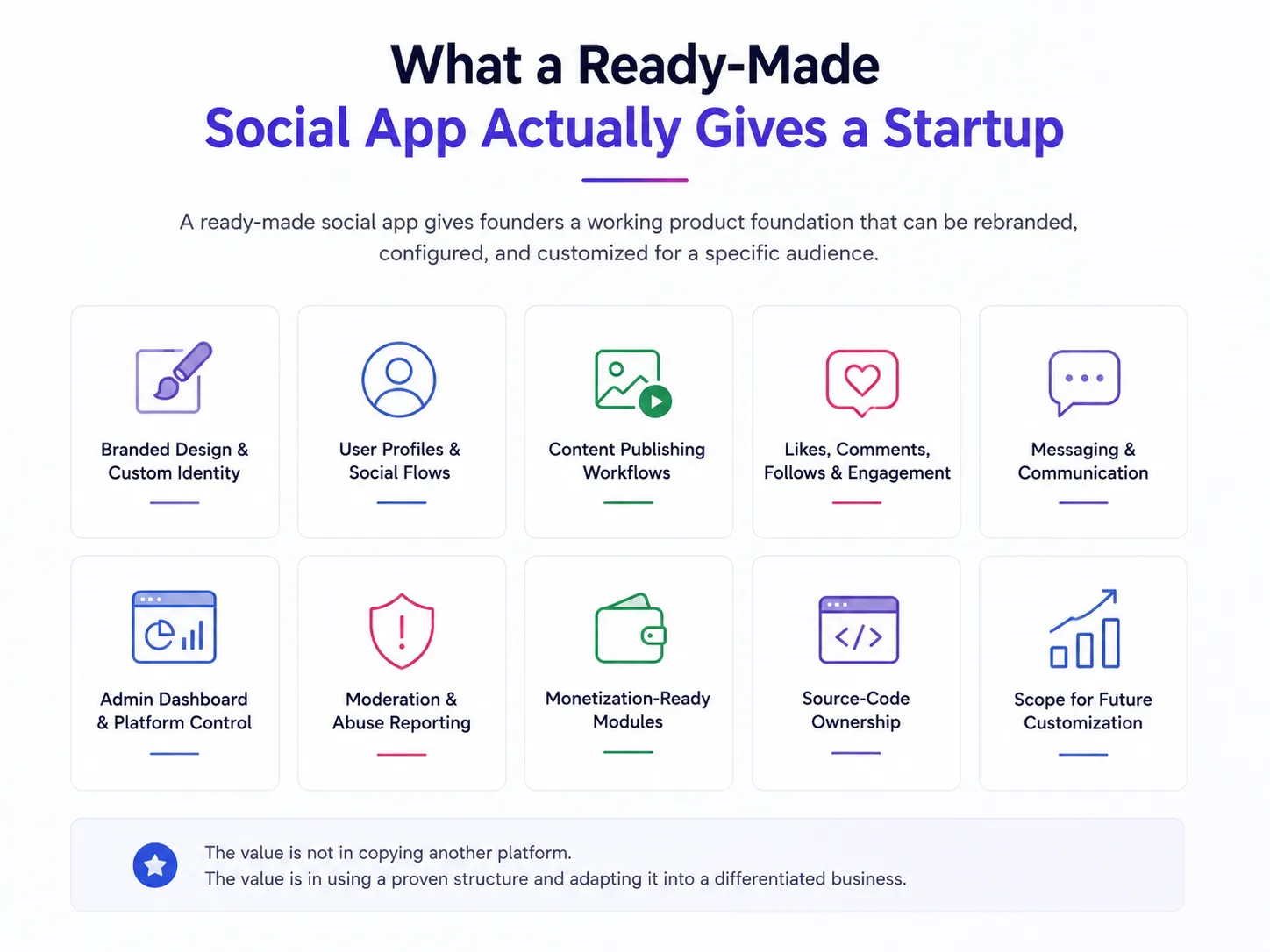
A ready-made social app gives founders a working product foundation that can be rebranded, configured, and customized for a specific audience.
Instead of beginning with blank wireframes and a long engineering backlog, the startup starts with existing app flows such as profiles, feeds, posts, media sharing, comments, messaging, notifications, and admin management. This allows the founder to focus on positioning, audience strategy, creator onboarding, community design, and growth experiments.
A strong ready-made foundation should support:
- Branded design and custom visual identity
- User profiles and social interaction flows
- Photo, video, or content publishing workflows
- Likes, comments, follows, and engagement actions
- Messaging or communication features where required
- Admin dashboard for user, content, and platform control
- Moderation and abuse reporting workflows
- Monetization-ready modules where relevant
- Source-code ownership for long-term flexibility
- Scope for future customization after launch
The value is not in copying another platform. The value is in using a proven interaction structure and adapting it into a differentiated business. Founders exploring broader community-based products can also review Miracuves’ social network app solutions for different platform models.
Ready-Made Social App vs Building From Scratch
| Decision Factor | Ready-Made Social App | Build From Scratch | Founder Impact |
|---|---|---|---|
| Launch Speed | Core modules are already available and can be customized for the brand. | Every module must be planned, designed, developed, and tested separately. | Ready-made apps help founders enter the market faster. |
| Initial Budget Control | Scope is easier to estimate because the foundation already exists. | Costs can increase as new requirements appear during development. | Startups can protect early budget for marketing, onboarding, and operations. |
| Customization | Customization happens on top of an existing product structure. | Customization starts from the first line of development. | Custom builds suit highly unique models, while ready-made apps suit faster validation. |
| Technical Risk | Common flows are already structured, reducing early execution uncertainty. | Architecture, workflows, and integrations must be proven during the build. | Founders spend less time solving basic product infrastructure problems. |
| Admin Control | Admin dashboards can help manage users, content, reports, and platform settings from launch. | Admin tools may be delayed if the team prioritizes user-facing features first. | Operators get better control over the platform earlier. |
| Best Fit | Startups, agencies, creators, communities, and niche social platforms. | Enterprises or startups with deeply original product logic and larger budgets. | The better choice depends on speed, uniqueness, budget, and validation goals. |
1. Startups Need Faster Market Validation
The first version of a social app should answer a business question:
Will users join, engage, post, return, and invite others?
A startup does not always need a fully custom build to answer that question. It needs a stable product foundation that allows real people to interact with the idea.
A ready-made social app helps founders test the market earlier. They can launch with core features, observe user behavior, collect feedback, and decide what should be improved based on real engagement instead of assumptions.
This matters because social products depend on momentum. A platform with no users cannot prove community value. The faster the founder gets the first audience inside the product, the faster they can understand what people actually want.
For startups evaluating a launch-ready visual social app foundation, Miracuves can help connect the decision stage with the right product path.
2. Ready-Made Apps Reduce the Cost of Rebuilding Common Features
Many social app features are expected by users. Profiles, feeds, media uploads, comments, follows, notifications, and reporting tools are no longer experimental ideas. They are baseline experiences.
When a startup builds from scratch, it spends time and money creating these common modules before it can even test its unique angle.
A ready-made app changes the cost logic.
Instead of paying only for foundational development, the founder can put more focus into customization, branding, onboarding, content strategy, user acquisition, and community growth. These are the areas that often decide whether a social platform gains traction after launch.
This does not mean custom development has no value. Custom development is useful when the product requires unusual workflows, new interaction models, or deeply specialized architecture. But for many early-stage founders, the smarter first decision is to launch with a reliable foundation and customize after the market responds.
3. Founders Get a Clearer Product Foundation From Day One
One of the hardest parts of building a social app is deciding what should exist in the first release.
If the team starts from zero, the founder has to answer dozens of questions before development begins:
- What should users see after signup?
- What content formats should the app support?
- How should users follow or connect with each other?
- Should messaging be available from launch?
- What should the admin dashboard control?
- How should reports and moderation be handled?
- What data should the operator track?
- Which monetization feature should come first?
A ready-made social app gives founders a practical base for these decisions. They can review existing flows, remove unnecessary features, prioritize key modules, and adapt the product for their target audience.
This is especially helpful for non-technical founders who need a structured product path before committing to a larger build. Read more on app development for non-technical founders.
4. Admin Control Matters More Than Founders Realize
Many startups focus heavily on the user app and forget the operator side.
But once the product is live, the admin dashboard becomes one of the most important parts of the business. It helps the platform owner manage users, content, reports, settings, revenue logic, access controls, and operational decisions.
Without a strong admin layer, even a beautiful user app can become difficult to run.
A social platform needs control over:
- User account status
- Reported content
- Blocked or flagged users
- Content visibility
- Featured content or creator promotion
- Notifications
- App settings
- Platform analytics
- Monetization controls
- Support and dispute workflows
A ready-made social app with admin control allows founders to manage the platform from the beginning instead of depending on developers for every small operational change.
That control becomes more important as the user base grows.
5. White-Label Branding Helps Startups Launch With Their Own Identity
A common misunderstanding is that ready-made means generic.
That should not be the goal.
A strong white-label social app should allow the startup to apply its own brand identity, colors, logo, content positioning, audience focus, app name, and market-specific messaging. The product foundation may be ready-made, but the business identity should be unique.
This matters because users do not join a platform because it has common features. They join because the platform feels relevant to their interests, community, identity, or goals.
Branding gives the app a reason to exist beyond functionality.
For example, a startup may position its social app around fitness creators, local artists, regional communities, student networks, private clubs, hobby groups, or professional creators. The foundation supports the product, but the brand gives it meaning.
Founders who need broader platform services can also explore social media app development services or white-label app development depending on how much customization they need.
6. Source-Code Ownership Protects Long-Term Flexibility
A startup should not only ask, “Can we launch fast?”
It should also ask, “Will we control the product after launch?”
Source-code ownership matters because the startup may need to change features, add integrations, improve performance, modify workflows, or scale the product later. If the business does not control the codebase, it may become dependent on restrictive licensing, limited customization, or vendor-controlled updates.
A source-code-owned app foundation gives the founder more flexibility.
It allows the business to:
- Customize the product roadmap
- Improve features after launch
- Add integrations when needed
- Work with internal or external developers later
- Avoid restrictive vendor dependency
- Adapt the platform as the business model changes
This is one reason founders should evaluate ready-made app providers carefully. Speed is useful, but speed without ownership can create long-term limitations.
7. Ready-Made Apps Help Preserve Budget for Growth
A social app does not succeed only because it is developed.
It succeeds when the right users join, interact, return, and bring others with them.
That means the founder needs budget beyond development. The startup may need spending for brand positioning, creator onboarding, paid campaigns, influencer partnerships, referral programs, content seeding, community management, and analytics.
If the entire early budget goes into building the basic app infrastructure, the founder may launch with no serious growth plan.
A ready-made social app can help preserve more budget for the activities that create traction after launch. This does not remove the need for marketing, but it helps the founder avoid spending too much too early on features that are already standard.
For post-launch planning, the team can also connect this article to social networking app marketing strategy.
8. Security, Moderation, and Trust Should Not Be Added Later
Social apps rely on user trust.
If users can post, message, comment, upload media, or interact with strangers, the platform needs moderation and safety workflows from the beginning. This does not mean every advanced system must be present in the first release, but basic trust controls should not be ignored.
A strong social app foundation should consider:
- Abuse reporting
- Content moderation workflows
- User blocking
- Admin review queues
- Role-based access control
- Secure authentication
- Privacy-conscious data handling
- Activity logs
- Secure media handling
- Permission-based dashboards
These controls matter because community problems usually appear after users begin interacting. If the platform has no operational control layer, small issues can quickly become user trust problems.
A ready-made foundation can help founders start with practical safety workflows instead of treating them as future add-ons.
Read more: A Founder’s Guide to Building a Visual Social App Without Starting From Zero
Founder Decision Signals
Speed
Choose a ready-made social app when you need to test the market quickly and avoid spending months rebuilding common platform features.
Cost
Choose a ready-made foundation when early budget should be protected for branding, user acquisition, creator onboarding, and community growth.
Scalability
Check whether the app foundation supports future customization, admin control, media handling, and source-code ownership.
Market Fit
Use the first release to validate whether users post, engage, return, and invite others before investing in deeper custom development.
When Building From Scratch Still Makes Sense
Ready-made is not always the right answer.
A fully custom build may be better when the startup has a highly unique product model, complex intellectual property, unusual interaction logic, deep AI workflows, specialized compliance requirements, or a funded roadmap that supports a longer development cycle.
Custom development gives the founder maximum control from the beginning. It can be the right path when differentiation depends on architecture, not only branding or feature configuration.
However, many startups are not at that stage on day one.
They first need to prove that the audience wants the product, understands the value, and returns after the first experience. In that situation, a ready-made social app can be a stronger first market version.
The better question is not “Which option is better?”
The better question is:
“What level of custom development does this startup actually need before launch?”
Mistakes Founders Should Avoid
Trying to Build Every Feature Before Launch
Too many features can delay validation. Start with the core interaction loop, then improve based on real user behavior.
Ignoring the Admin Dashboard
The operator needs control over users, content, reports, settings, and analytics. A weak admin layer can create operational problems after launch.
Choosing Speed Without Ownership
A fast launch is useful only when the business also has enough flexibility to customize and scale the product later.
Spending the Entire Budget on Development
A social app still needs marketing, onboarding, content seeding, and community management. Preserve budget for growth, not only engineering.
How Miracuves Helps Startups Launch Faster
Miracuves helps founders build ready-made, white-label, source-code-owned app solutions that can be customized for brand identity, user workflows, admin control, and monetization strategy.
For startups building a social platform, this approach can reduce the time spent on common product infrastructure and give the team more room to focus on market positioning, community growth, and product learning.
A ready-made solution from Miracuves can be a practical fit when the founder wants:
- Faster launch
- Branded app experience
- Admin control
- Source-code ownership
- Customizable workflows
- Monetization-ready structure
- A foundation that can evolve after launch
If the startup needs a wider network category view, editors can also link to social network app solutions.
Final Thoughts: Build Faster, Validate Smarter
Startups do not win by spending the longest time in development. They win by making clear decisions, launching at the right time, learning from users, and improving the product with evidence.
Building from scratch gives full control, but it can also delay validation and increase early risk. A ready-made social app gives founders a faster way to launch the first market version, test the audience, manage core operations, and preserve budget for growth.
The strongest decision is not always the most complex build.
For many founders, the better move is to start with a launch-ready foundation, customize it around a clear audience, and invest energy into the community experience that makes the app worth returning to.
FAQs
What is a ready-made social app?
A ready-made social app is a prebuilt app foundation with core social features such as profiles, feeds, content posting, engagement actions, messaging, notifications, and admin control. It can be customized with branding, workflows, and monetization logic based on the startup’s business model.
Why do startups choose ready-made social apps?
Startups choose ready-made social apps because they help reduce development time, control early costs, lower execution risk, and launch faster for market validation. This allows founders to focus more on audience building and user feedback.
Is a ready-made social app the same as a generic template?
No. A serious ready-made app should not feel like a generic template. It should support white-label branding, custom design adjustments, source-code ownership, admin controls, and feature customization based on the founder’s launch goals.
When should a startup build a social app from scratch?
A startup should consider building from scratch when the product has highly unique interaction logic, deep technical differentiation, specialized architecture, or a funded roadmap that supports a longer development timeline.
Can a ready-made social app be customized after launch?
Yes, if the solution includes source-code ownership and customization support. Founders should confirm what can be changed, who controls the codebase, and how future feature updates will be handled.
What features should a startup look for in a ready-made social app?
Founders should look for user profiles, content posting, media sharing, follows, likes, comments, messaging, notifications, admin dashboard, moderation tools, reporting workflows, analytics, and monetization-ready modules where relevant.
How does a ready-made app help with validation?
It helps founders launch the first market version faster, observe real user behavior, collect feedback, and identify which features or community loops matter before investing in deeper custom development.
Miracuves is an independent software development company. We are not affiliated with, connected to, sponsored by, or endorsed by any company or product named in this article.
Terms such as “X Clone” are used descriptively. It is how the software industry refers to building a platform with functionality comparable to a known service, and how clients search for it.
The entire design and codebase of our products is built by our own team. Our products contain no code, design, graphics, or content originating from any third-party website or applications.
All third-party names and marks referenced in this article are the property of their respective owners, referenced solely to identify the services discussed.