

A creator commerce platform does not become valuable only because users can post content. It becomes valuable when content, community, shopping, fan payments, brand campaigns, and platform control work together as one revenue system.
For founders, the real question is not simply, “How will the app make money?” The stronger question is, “Which revenue streams should be designed into the product before launch so the business can monetize without damaging user trust?”
Creator commerce is growing because audiences no longer only watch creators. They buy from them, subscribe to them, support them during live sessions, join their communities, and respond to product recommendations inside content-led experiences. BCG highlights virtual gifting, subscriptions, live commerce, creator-platform stakeholders, brand safety, and ROI measurement as important parts of the creator-driven commerce ecosystem.
This guide explains how a White-Label Social Commerce & Creator Platform earns through shops, subscriptions, gifts, paid reach, platform commissions, and payout systems. It is written for founders who want to plan revenue before development starts, not after the product is already live.
Key Takeaways
- Creator commerce revenue model planning helps founders connect content, creators, products, payments, and platform earnings before launch.
- Shops, subscriptions, digital gifts, paid reach, and commissions work best when they are designed as connected revenue layers.
- Early-stage platforms should avoid depending only on ads because ad revenue usually needs scale, targeting data, and consistent engagement.
- Payout rules, refund handling, commission settings, and admin dashboards matter as much as user-facing monetization features.
- Miracuves helps founders move from monetization planning to a launch-ready, white-label social media app foundation with source-code ownership and admin control.
Why Creator Commerce Needs More Than Ad Revenue
Advertising is often the first revenue model founders think about, but it is rarely the only model a creator-led platform should depend on.
Ads need traffic, audience data, targeting logic, brand demand, placement controls, campaign reporting, and moderation quality. If ads are introduced too aggressively, they can hurt the user experience before the platform has built loyalty.
Creator commerce gives founders more flexible revenue paths because monetization can happen through direct value exchange. A user may subscribe to a creator, buy a product from a shoppable post, send a digital gift during a live session, or pay to boost content. Each behavior creates a different revenue signal.
That is why a stronger platform does not treat monetization as one feature. It treats monetization as a product architecture decision.
How the Creator Commerce Revenue Model Works
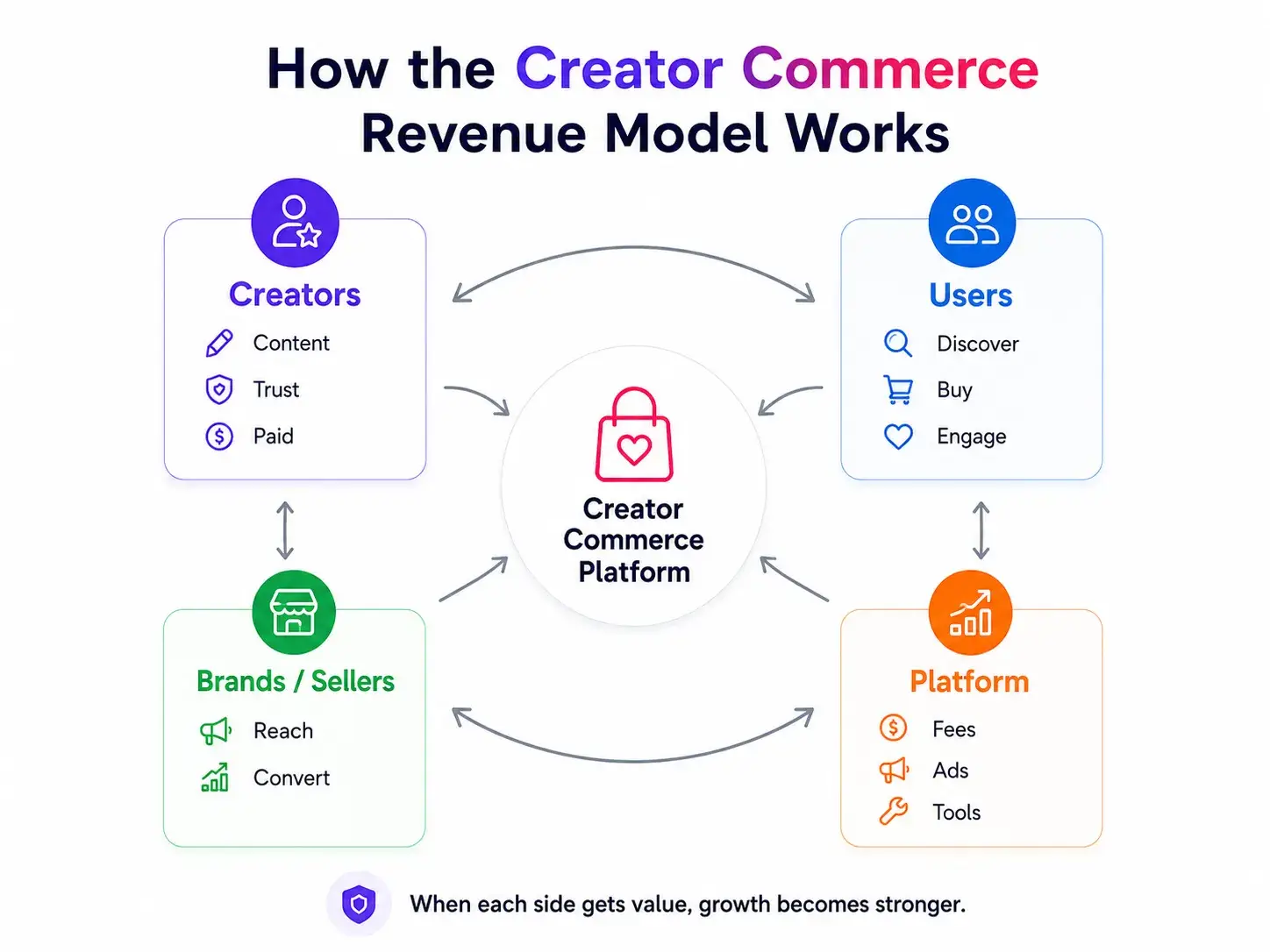
A social media app monetization model connects four sides of the platform:
- Creators produce content, build trust, recommend products, host live sessions, and offer paid experiences.
- Users discover content, follow creators, buy products, subscribe, gift, and engage.
- Brands or sellers use creators and platform tools to reach relevant audiences.
- The platform operator earns through commissions, fees, premium tools, ads, subscriptions, or paid visibility.
This model works best when each side receives clear value. Creators need earnings, visibility, dashboards, and payout transparency. Users need content quality, trust, safe payments, and easy discovery. Brands need measurable reach and conversion signals. The platform operator needs revenue controls, reporting, moderation, and scalable infrastructure.
If one side is ignored, monetization becomes fragile.
Core Creator Commerce Revenue Streams Founders Should Plan
Creator Commerce Revenue Streams
| Revenue Stream | How It Works | Founder Impact |
|---|---|---|
| Creator Shops | Creators or sellers list products that users can discover through content, profiles, live sessions, or shoppable posts. | Creates transaction-based revenue and helps turn attention into purchases. |
| Platform Commission | The platform takes a percentage or fixed fee from sales, bookings, subscriptions, or paid creator interactions. | Builds a scalable revenue layer tied directly to platform activity. |
| Creator Subscriptions | Users pay monthly or periodically for exclusive content, private communities, special posts, or creator access. | Creates recurring revenue and improves creator retention. |
| Digital Gifts and Tips | Users buy coins, credits, or virtual items and send them to creators during live sessions or content interactions. | Monetizes fandom, participation, and real-time engagement. |
| Paid Reach | Creators, sellers, or brands pay to boost posts, products, live sessions, or campaigns to a relevant audience. | Turns discovery into a monetization layer without relying only on external ad networks. |
| Brand Campaign Tools | Brands pay to collaborate with creators, run sponsored campaigns, access reporting, or manage creator partnerships. | Supports commercial growth once the platform has creator supply and audience trust. |
| Premium Creator Tools | Creators pay for analytics, storefront upgrades, profile customization, scheduling, CRM tools, or advanced monetization features. | Adds SaaS-style revenue without taking too much from creator earnings. |
Creator Shops: Turning Discovery Into Transactions
Creator shops are one of the strongest commerce layers because they connect content discovery with purchase intent.
A user may watch a styling video, food tutorial, fitness routine, home decor post, beauty demo, or travel recommendation and want to buy the product immediately. If the platform forces that user to leave the app, the founder loses control over checkout data, attribution, and future monetization.
A built-in creator shop can support:
- Product catalogues
- Creator storefronts
- Shoppable posts
- Product tagging
- Seller dashboards
- Order tracking
- Commission rules
- Refund workflows
- Sales analytics
For founders, the key decision is whether the platform should own the checkout or simply redirect users to sellers. Owning checkout gives stronger control over revenue and data, but it also requires payment integration, seller verification, tax logic, refund handling, and support workflows.
A lighter version can start with tracked outbound commerce. A stronger version can later move toward native checkout once purchase behavior is validated.
Subscriptions and Membership Tiers: Building Recurring Value
Subscriptions work when creators offer ongoing value, not just locked content.
A paid membership can include private posts, exclusive videos, community spaces, early access, live sessions, downloadable resources, direct replies, or premium creator updates. X’s creator subscription documentation shows that subscription systems involve eligibility, price management, payout processing, refund handling, and chargeback rules, which proves that subscriptions are not only a front-end feature. They require operational logic behind the scenes.
Founders who want a deeper breakdown of paid content, creator earnings, and platform-led monetization can also read Miracuves’ guide on building a creator monetization platform.
- What does the user get every month?
- Can creators set their own pricing?
- Will the platform take a commission or charge creators separately?
- Are subscriptions monthly, annual, tiered, or bundled?
- What happens when a user cancels?
- How are refunds and chargebacks handled?
- What earnings dashboard will creators see?
A subscription model can become powerful because it creates predictable revenue. But it only works when creators can consistently deliver enough value to keep subscribers engaged.
Digital Gifts and Live Support: Monetizing Participation
Digital gifts work because they turn passive viewing into active support.
During live sessions, users often want to react in public, show appreciation, get attention from the creator, or participate in the moment. Google’s 2026 launch of Gifts in India shows how live gifting uses virtual items that viewers send during live streams, with users buying bundles and creators receiving earning value through the platform.
A gift-based revenue model usually needs:
- Coin or credit wallet
- Gift catalogue
- Live gift overlays
- Creator earnings ledger
- Platform commission settings
- Refund and fraud controls
- Payout thresholds
- Admin reporting
- Abuse monitoring
This model can be especially useful for entertainment, gaming, education, devotional, coaching, lifestyle, and fan-community platforms where live interaction matters.
The founder risk is overdesigning gifts before understanding audience behavior. Start with a simple gift catalogue, clear pricing, and transparent creator earnings. Once users show spending behavior, add seasonal gifts, creator-specific gifts, badges, streaks, and campaign-based gifting.
Paid Reach: Monetizing Discovery Without Damaging Trust
Paid reach lets creators, sellers, or brands pay for better visibility.
This can include boosted posts, promoted live sessions, featured products, sponsored creator campaigns, premium profile placements, or recommended content slots. The model is attractive because it allows the platform to monetize discovery without waiting for massive ad inventory.
But paid reach must be handled carefully. If users feel the feed is filled with irrelevant promoted content, trust drops. If creators feel paid posts always outrank organic value, creator motivation drops.
A healthy paid reach system should include:
- Budget controls
- Audience targeting rules
- Sponsored labels
- Campaign approval workflows
- Category exclusions
- Frequency caps
- Performance analytics
- Admin moderation
- Clear refund rules
Paid reach works best after the platform has enough content, engagement, and audience segmentation to promote relevant content instead of random placements.
Brand Campaigns and Creator Marketplaces
Once the platform has enough creators and audience activity, brand campaigns can become a strong revenue stream.
Brands may pay to:
- Discover creators
- Run sponsored content campaigns
- Track creator performance
- Manage product seeding
- Promote shoppable content
- Access campaign analytics
- Pay creators through the platform
- Run affiliate or commission-based partnerships
For the platform operator, this creates revenue through marketplace fees, subscription access, campaign management fees, or commission on creator-brand transactions.
However, brand campaigns require trust. The platform should support creator verification, audience quality signals, engagement reporting, sponsored content disclosure, and dispute workflows. Without these controls, founders risk fake engagement, unclear campaign performance, and brand dissatisfaction.
Founders planning brand collaborations, sponsored campaigns, creator discovery, and influencer-led monetization can explore Miracuves’ influencer platform solutions for a more focused creator marketplace direction.
Platform Commission and Payout Logic: The Backend Layer Founders Cannot Ignore
Many founders focus on the user-facing monetization features but underestimate payout infrastructure.
A creator commerce platform needs a clean financial system behind every sale, subscription, gift, boost, refund, and commission. If this is not planned early, the platform may grow into a messy operation where the admin team manually reconciles earnings.
A reliable payout system should define:
- Platform commission percentage
- Creator earnings share
- Seller earnings share
- Payment gateway fees
- Refund adjustments
- Chargeback adjustments
- Minimum payout threshold
- Payout schedule
- Tax or invoice records where applicable
- Wallet ledger history
- Admin approval rules
This is where source-code ownership and admin control matter. A founder should be able to adjust commission logic, review suspicious transactions, manage creator payouts, and audit platform earnings without depending on manual spreadsheets.
Revenue Sequencing: What Founders Should Monetize First
Not every revenue stream should launch on day one. The right sequence depends on audience behavior, creator supply, product depth, and operational capacity.
| Launch Stage | Best Revenue Streams | Why It Fits |
|---|---|---|
| Early validation | Creator subscriptions, paid boosts, simple digital gifts | Easier to test without building a full ad network or marketplace engine. |
| Creator onboarding | Premium creator profiles, creator dashboards, early shop tools | Gives creators a reason to join and stay active. |
| Engagement growth | Live gifts, memberships, community access | Converts loyalty and participation into revenue. |
| Commerce readiness | Shoppable posts, creator shops, product commissions | Works when users already trust creators and respond to product-led content. |
| Brand expansion | Sponsored campaigns, paid reach, creator marketplace fees | Works after the platform has enough creators, audience data, and reporting quality. |
| Scale phase | Ads, advanced analytics, seller tools, premium business accounts | Requires stronger traffic, segmentation, admin systems, and measurement. |
The mistake is not choosing the “wrong” revenue model. The mistake is launching too many monetization layers before the audience behavior supports them.
Admin Controls Needed for Creator Commerce Monetization
A creator commerce platform cannot rely only on front-end features. The admin dashboard decides whether the business can manage growth safely.
Founders should plan admin controls for:
- User management
- Creator approval
- Seller verification
- Product approval
- Content moderation
- Gift catalogue management
- Subscription tier settings
- Commission settings
- Campaign approvals
- Payment and payout tracking
- Refund workflows
- Dispute management
- Abuse reporting
- Analytics and revenue reports
- Role-based access control
- Activity logs
These backend and dashboard requirements are also why many founders choose professional social media app development services instead of treating monetization as a simple front-end feature.
This is especially important when money flows between users, creators, sellers, and the platform. Every earning event should be traceable. Every payout should have a record. Every dispute should be manageable from the admin layer.
Founder Decision Signals
Speed
If the goal is fast revenue validation, start with creator subscriptions, simple gifts, or paid boosts before building complex advertising systems.
Cost
Commerce, payouts, subscriptions, and campaigns affect backend scope. Planning them early prevents expensive rebuilds after launch.
Scalability
A scalable revenue model needs wallet records, payout rules, admin reports, moderation queues, and transaction history from the start.
Market Fit
The strongest model depends on user behavior. A fan community may monetize through gifts, while a shopping-led creator platform may need product commissions first.
Security, Trust, and Moderation in Creator Commerce
Creator commerce platforms handle content, payments, creators, sellers, products, personal data, and user interactions. That makes trust a business requirement, not just a technical layer.
Important trust features include:
- Secure payment gateway integration
- Encrypted data transfer
- Role-based admin access
- Creator verification
- Seller verification
- Abuse reporting
- Content moderation queues
- Product review workflows
- Refund and dispute management
- Activity logs
- Payout monitoring
- Fraud signals
- Clear platform policies
For founders, trust controls protect revenue. If users do not trust products, creators do not trust payouts, or brands do not trust performance data, monetization weakens.
Mistakes Founders Should Avoid
Mistakes Founders Should Avoid
Depending Only on Advertising
Ads usually need scale, targeting data, brand demand, and careful placement. For early platforms, subscriptions, gifts, paid reach, or commerce commissions may create faster revenue validation.
Adding Monetization After Development
Revenue features affect database design, wallet logic, payment flows, admin reports, creator dashboards, and moderation. Treating them as a later add-on can increase rebuild costs.
Ignoring Creator Payout Transparency
Creators need to understand how much they earned, what fees were deducted, when payouts happen, and how refunds or chargebacks affect earnings.
Launching Too Many Revenue Streams at Once
More monetization options do not always mean more revenue. Founders should sequence revenue streams based on audience behavior and operational readiness.
How Miracuves Helps Founders Build Creator Commerce Platforms Faster
A creator commerce platform needs more than profiles, posts, and likes. It needs creator tools, shop flows, subscriptions, gifting, paid reach, payment logic, payout tracking, moderation, analytics, and admin control working together.
Miracuves helps founders turn this planning into a launch-ready platform foundation with white-label branding, source-code ownership, admin dashboards, monetization modules, and scalable backend workflows.
If you are planning a branded visual social platform, explore Miracuves’ visual social commerce app solution to understand how creator tools, commerce, monetization, and admin control can be structured into one launch-ready platform.
Related reading: social networking platform revenue model breakdown and creator seeding strategy for a new social app.
Final Thoughts: Build the Revenue System Before the Platform Scales
Social media app monetization succeeds when it’s planned as a system, not a last-minute feature.
Shops help creators turn recommendations into sales. Subscriptions build recurring value. Digital gifts monetize live participation. Paid reach helps creators and brands gain visibility. Platform commissions connect revenue to real activity. Admin dashboards keep the business manageable as transactions grow.
For founders, the strongest approach is to choose the first revenue layer based on user behavior, then expand carefully as creators, sellers, brands, and audiences become more active.
The goal is not to copy another social platform. The goal is to build a creator commerce ecosystem where engagement, trust, payments, and admin control work together from day one.
FAQs
What is a creator commerce revenue model?
A creator commerce revenue model explains how a platform earns by connecting creators, users, sellers, and brands. Common revenue streams include product commissions, creator subscriptions, digital gifts, paid reach, brand campaigns, premium creator tools, and transaction fees.
How do creator commerce platforms make money?
Creator commerce platforms make money through shop commissions, subscription cuts, virtual gifts, paid promotions, sponsored campaigns, seller tools, creator analytics, and premium account features. The best model depends on audience behavior and creator activity.
Are subscriptions better than ads for a new creator platform?
Subscriptions may work earlier than ads if creators already have loyal followers or exclusive content. Ads usually become stronger later when the platform has enough traffic, targeting data, and campaign reporting.
How do digital gifts help creator platforms earn revenue?
Digital gifts allow users to support creators during live sessions or content interactions. Users buy coins or credits, send gifts, and the platform can earn through transaction margins or commission rules.
What is paid reach in creator commerce?
Paid reach allows creators, sellers, or brands to pay for better visibility. This can include boosted posts, featured products, promoted live sessions, sponsored slots, or campaign placements.
Why is payout logic important in creator commerce?
Payout logic controls how creator earnings, seller earnings, platform commissions, refunds, chargebacks, and payment gateway fees are calculated. Without clear payout rules, founders may struggle with reconciliation and creator trust.
What admin features are needed for creator commerce monetization?
A monetization-ready admin panel should include creator management, seller verification, payment tracking, payout records, commission settings, campaign approvals, refund workflows, moderation queues, role-based access, and revenue analytics.
How can Miracuves help launch a creator commerce platform?
Miracuves helps founders build white-label creator commerce platforms with source-code ownership, branded design, admin control, creator monetization workflows, shop modules, payment logic, and faster deployment options based on the selected business model.
Miracuves is an independent software development company. We are not affiliated with, connected to, sponsored by, or endorsed by any company or product named in this article.
Terms such as “X Clone” are used descriptively. It is how the software industry refers to building a platform with functionality comparable to a known service, and how clients search for it.
The entire design and codebase of our products is built by our own team. Our products contain no code, design, graphics, or content originating from any third-party website or applications.
All third-party names and marks referenced in this article are the property of their respective owners, referenced solely to identify the services discussed.