


Key Takeaways
- A ready-made digital banking platform gives startups an existing foundation for onboarding, accounts, cards, transfers, FX, payments, security, compliance workflows, and admin management.
- Compared with building from scratch, a prebuilt foundation can reduce repeated engineering across ledger logic, transaction workflows, user management, integrations, notifications, and operational dashboards.
- Founders should still evaluate customization depth, source-code ownership, banking integrations, security architecture, scalability, regulatory dependencies, and long-term product control before choosing a platform.
Ready-Made Platform Signals
- Prebuilt modules can include KYC onboarding, multi-currency accounts, virtual or physical cards, beneficiaries, domestic and international transfers, FX conversion, transaction history, and user controls.
- Startups can customize branding, fee structures, account types, card rules, supported currencies, transfer flows, business finance features, user permissions, and operational workflows.
- Modular architecture makes it easier to add savings, subscriptions, expense management, business accounts, advanced fraud controls, analytics, new payment partners, and additional markets over time.
Startup Decision Insights
- Startups should compare development effort, integration complexity, security requirements, compliance workflows, available technical resources, maintenance needs, and total ownership cost.
- Building from scratch may suit highly differentiated banking products, while a customizable ready-made foundation can help teams validate onboarding, transactions, feature adoption, and user retention without recreating standard modules.
- Miracuves develops customizable digital banking platforms with accounts, cards, transfers, FX, payment integrations, security controls, transaction monitoring, analytics, compliance workflows, and admin management.
Launching a fintech product is not just a design or development decision. It is a business decision that affects speed, cost, compliance preparation, user trust, monetization, and investor confidence.
Many startups begin with the idea of building a digital banking app from scratch because it feels more flexible. But once they enter product discovery, they quickly realise that modern fintech platforms require more than attractive screens. They need account workflows, wallet logic, transaction history, card controls, multi-currency support, identity verification, admin dashboards, reporting, security layers, and integration readiness. For founders comparing product directions, a ready-made digital banking platform can offer a faster starting point without forcing the team to rebuild every core workflow from zero.
That is why many founders now choose a ready-made digital banking platform as their starting point. Instead of rebuilding every core fintech workflow from zero, they begin with a launch-ready foundation and focus their energy on branding, market fit, compliance planning, user acquisition, and revenue strategy.
For startups that want to move faster, Miracuves provides a white-label fintech foundation that can be customized for branded digital banking, wallet, neobank, and multi-currency finance use cases, with standard ready-made delivery available in 6 days depending on scope.
The Real Startup Question: Build From Scratch or Launch With a Proven Foundation?
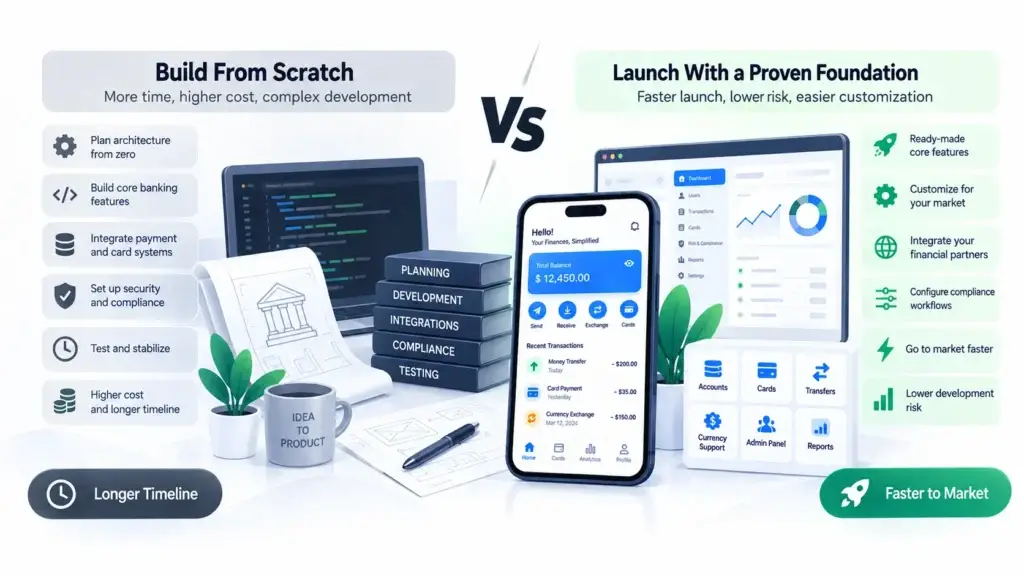
When founders plan a fintech product, the first question is usually, “How much will it cost to build?” But the better question is, “What should we build from zero, and what should already be ready?”
A digital banking platform has several standard workflows that most users already expect. Users want simple onboarding, account access, transaction visibility, card controls, transfers, currency support, notifications, and secure login. Admin teams need user management, transaction oversight, risk controls, fee settings, reporting, dispute handling, and operational dashboards.
Building all of this from scratch can make sense when the business model is highly unique or heavily enterprise-specific. But for many startups, the early challenge is not inventing a completely new banking interface. The challenge is launching a credible product fast enough to test market demand.
A ready-made digital banking platform changes the starting point. It gives the founder a working structure, then allows customization around brand, geography, financial partners, features, compliance workflows, and monetization.
For founders still exploring the broader fintech opportunity, Miracuves’ fintech app development solutions can also help them understand how digital wallets, neobanking platforms, payment apps, and finance products fit into a larger product strategy.
Why Building a Digital Banking App From Scratch Takes Longer Than Founders Expect
Custom development often sounds attractive because it promises complete control. But in fintech, “complete control” also means complete responsibility for every product layer.
A from-scratch build usually requires decisions around user experience, backend architecture, wallet logic, transaction flows, database structure, admin roles, security policies, third-party integrations, compliance workflow design, testing, deployment, and post-launch support.
The difficulty is not only the number of features. It is the dependency between features.
For example, user onboarding affects KYC workflows. KYC status affects account access. Account access affects transaction permissions. Transaction permissions affect wallet balance updates. Wallet logic affects reporting. Reporting affects admin decisions. Admin decisions affect risk control.
If these workflows are not planned correctly from the beginning, the product can become expensive to revise later.
This is why startups often prefer a ready-made fintech foundation. It helps them avoid spending months on basic product infrastructure before they can even test whether users want the product.
What a Ready-Made Digital Banking Platform Actually Means
A ready-made digital banking platform is not just a template or visual design. It is a structured fintech product foundation with common banking and wallet workflows already planned. Founders who want to understand the deeper product modules can explore the digital banking feature set before deciding which flows should be included in their launch version.
Depending on the product scope, it can include:
- User onboarding and profile management
- Digital wallet or account dashboard
- Transaction history
- Money transfer workflows
- Multi-currency account support
- Card-related workflows
- Fee and commission settings
- Admin dashboard
- User verification workflows
- Role-based access control
- Notifications and alerts
- Reports and activity logs
- Payment gateway or BaaS integration readiness
- Branding and UI customization options
The main value is that the startup does not begin from a blank screen. The founder can review existing flows, identify what needs to change, and move toward launch with clearer cost and timeline expectations.
Ready-Made Digital Banking Platform vs Building From Scratch
| Decision Factor | Ready-Made Digital Banking Platform | Building From Scratch | Startup Impact |
|---|---|---|---|
| Launch speed | Faster because core workflows already exist | Slower because every module must be planned, designed, built, and tested | Ready-made platforms help founders validate demand sooner |
| Cost control | More predictable starting scope | Scope can expand during discovery and development | Startups get better early budgeting clarity |
| Product clarity | Founders can review working flows before customization | Founders may rely on wireframes and assumptions for longer | Reduces confusion during early planning |
| Customization | Branding, workflows, integrations, and modules can be customized | Everything can be built uniquely | Ready-made works well when speed and proven structure matter |
| Technical risk | Core architecture is already structured | Architecture decisions must be made from zero | Reduces early execution uncertainty |
| Admin control | Dashboard workflows can already be part of the foundation | Admin tools must be scoped separately | Helps operators manage users, transactions, and reports faster |
| Compliance preparation | Can support KYC, AML, audit, and verification workflows | Must be designed and developed from scratch | Helps founders prepare operational controls earlier |
| Best fit | Startups validating fintech demand quickly | Complex, highly custom financial products | The right choice depends on business model and launch urgency |
Why Startups Prefer Ready-Made Fintech Foundations
Startups rarely have unlimited time or unlimited development budgets. They need to prove that the idea can attract users, support real workflows, and create a path toward monetization.
A ready-made digital banking platform helps founders move faster in five important ways.
1. Faster Launch Without Waiting Months for Core Workflows
Speed matters in fintech because timing affects fundraising, market entry, partner conversations, and user acquisition. If a startup spends too long building the first version, the market may change before the product goes live.
A ready-made platform allows the team to begin with existing banking workflows and customize from there. This does not remove the need for planning, testing, or compliance review. But it can reduce the amount of time spent rebuilding standard features.
Miracuves’ ready-made fintech approach can support a 6-day launch for standard deployment scopes, making it useful for founders who want to review, brand, and launch faster instead of waiting through a long custom development cycle.
2. Better Cost Visibility Before Development Expands
Custom fintech development can become expensive because the product scope often grows during planning. A founder may begin with a simple wallet idea, then add currency conversion, card controls, business accounts, user verification, analytics, payment integrations, referrals, subscriptions, and admin reports.
Each added workflow affects design, backend logic, testing, and security review.
With a ready-made platform, founders can start from a clearer base. They can see what already exists, decide which modules are required, and separate must-have launch features from later-stage enhancements. This also makes it easier to review the fintech launch cost breakdown before expanding the product roadmap.
This helps startups avoid one of the most common early mistakes: trying to build a complete financial ecosystem before validating the first market version.
3. A Stronger Admin Dashboard From Day One
In digital banking, the admin dashboard is not a secondary feature. It is the control center of the business.
A fintech operator needs visibility into users, verification status, transactions, wallet activity, fees, disputes, limits, reports, and system settings. Without a strong admin layer, even a good user-facing app can become difficult to manage.
A ready-made digital banking platform gives startups a faster path to operational control. Instead of treating the admin dashboard as an afterthought, founders can make it part of the product foundation from the beginning.
This matters because fintech businesses must manage trust, risk, support, and financial workflows carefully after launch.
4. Easier Planning for BaaS, Payment, and Verification Integrations
A digital banking product usually depends on external systems. These may include Banking-as-a-Service providers, payment gateways, card issuing partners, identity verification tools, fraud monitoring systems, notification services, and analytics platforms.
When a product is built from scratch, integration readiness must be planned carefully. API structure, transaction states, user permissions, error handling, callback logic, and admin visibility all affect how reliable the product feels.
A ready-made fintech foundation can make this easier because the platform already expects integration-driven workflows. Founders can then focus on choosing the right partners for their market instead of first designing every internal system from zero.
At this stage, many founders also start comparing technology partners. Working with a digital banking development company can help clarify which modules, integrations, admin controls, and launch workflows should be prioritized first.
5. Faster Market Validation With Room for Customization
The goal of a startup launch is not to build the biggest possible product. The goal is to learn what users need, what they trust, and what they are willing to use repeatedly.
A ready-made digital banking platform supports this by giving founders a faster path to market while still allowing customization. Branding, user flows, supported services, fee models, onboarding logic, and integrations can be adjusted around the startup’s target audience.
This creates a practical balance: launch with a proven foundation, then improve based on real market feedback.
Once the first version is ready, user acquisition becomes the next major priority. A structured fintech app marketing strategy can help founders plan positioning, referrals, onboarding campaigns, retention loops, and growth channels before launch.
Founder Decision Signals
Speed
Choose a ready-made platform when you need to launch, test user demand, or show a working product faster than a from-scratch build allows.
Cost
Choose a ready-made foundation when you want clearer early scope and fewer unknowns before investing in deeper custom features.
Scalability
Look for a platform that supports modular growth, admin controls, integration readiness, and future workflow expansion.
Market Fit
Use the first launch to validate onboarding, wallet usage, transfers, fees, retention, and trust before expanding the product roadmap.
What Features Should a Ready-Made Digital Banking Platform Include?
A startup should not choose a fintech platform only because it looks modern. The stronger question is whether the platform includes the operational and technical layers needed to run a financial product responsibly.
Important modules include:
| Feature Area | What It Should Support | Why It Matters |
|---|---|---|
| User onboarding | Registration, profile setup, verification status, secure access | Builds the entry point for trust and compliance workflows |
| Account dashboard | Balances, account details, activity overview, quick actions | Helps users understand and manage their money |
| Wallet and transactions | Transfers, transaction records, wallet updates, status tracking | Creates the financial activity layer of the platform |
| Multi-currency workflows | Currency balances, exchange flow readiness, transaction visibility | Useful for cross-border and international finance use cases |
| Card workflows | Card request, card status, spending controls, related settings | Supports a fuller digital banking experience |
| Admin dashboard | User management, transaction oversight, reporting, settings | Gives the operator control after launch |
| Security controls | Encrypted data handling, role-based access, audit logs | Supports safer platform operations |
| Integration readiness | BaaS, payment gateway, identity verification, notifications | Helps connect the product to real fintech infrastructure |
| Monetization settings | Fees, subscriptions, premium tools, business accounts | Supports commercial planning from the beginning |
Security and Compliance Workflows Should Not Be Added Later
Fintech startups must treat security as a product foundation, not a last-minute add-on. A banking or wallet platform deals with sensitive user data, transaction records, identity workflows, and financial activity.
A serious digital banking platform should support encrypted data transfer, secure API integration, role-based admin access, audit logs, user verification workflows, transaction monitoring, suspicious activity flags, and clear activity records. For a deeper security-focused view, founders can review this white-label banking app security guide before finalizing their technical scope.
Compliance also depends on the target market. KYC, AML, licensing, payment partner rules, data privacy requirements, and financial regulations vary by jurisdiction and operating model. A ready-made platform can support compliance-ready workflows, but final compliance depends on legal review, selected providers, geography, and business structure.
This distinction is important. A platform can help prepare the technical and operational foundation, but the startup still needs the right legal, financial, and compliance partners.
Where Ready-Made Platforms Fit Best
A ready-made digital banking platform is especially useful when the startup wants to launch a structured fintech product without spending months building standard workflows.
It works well for:
- Neobank-style startup launches
- Multi-currency wallet products
- Digital account platforms
- Remittance-focused fintech products
- Business banking tools
- Card-enabled finance apps
- BaaS-powered banking platforms
- Founder-led fintech validation projects
- Agencies launching fintech solutions for clients
A founder who wants to launch a branded digital banking experience can start with a Miracuves-powered fintech foundation and review product-specific details when they are ready to compare features, launch scope, admin control, branding, and customization options.
When Building From Scratch Still Makes Sense
Ready-made platforms are not the right answer for every fintech business.
A fully custom build may make more sense when the company has unusual financial workflows, complex enterprise architecture, heavy legacy system dependencies, proprietary financial logic, or a long-term roadmap that requires a completely unique product architecture from day one.
However, many startups are not at that stage during early launch. They are still proving demand, identifying their audience, securing partners, and testing the business model.
For those founders, building everything from scratch can delay learning. A ready-made platform gives them a faster way to enter the market, collect feedback, and decide what deserves deeper investment.
Monetization Models a Digital Banking Startup Can Explore
A fintech product should not be built only around features. It also needs a clear revenue model. Before launch, founders should map how subscriptions, transfer fees, FX margins, card-related fees, and business account plans connect to the wider digital banking business model.
A ready-made digital banking platform can support different monetization paths depending on the target market and integrations.
Common options include:
| Monetization Model | How It Works | Best For |
|---|---|---|
| Subscription plans | Users pay monthly or yearly for premium access | Neobank, business banking, or premium wallet products |
| Transfer fees | The platform charges fees on selected money movement flows | Remittance or payment-driven products |
| FX margin | Revenue comes from currency conversion spread | Multi-currency finance platforms |
| Card-related fees | Fees apply to card issuance, replacement, or premium card features | Card-enabled banking products |
| Business account plans | Companies pay for advanced finance tools | SME banking or business finance apps |
| Partner commissions | Revenue comes from integrated financial products or services | Marketplace-style fintech ecosystems |
| Premium features | Users pay for limits, analytics, reports, or advanced controls | Consumer or business finance platforms |
The right model depends on the startup’s geography, user segment, payment partners, regulatory structure, and product scope.
Common Mistakes Founders Should Avoid
Building Too Much Before Validating Demand
Many fintech founders try to launch with every possible feature. This increases cost and delays market learning. A focused launch with the right core workflows is often more practical.
Treating the Admin Dashboard as Optional
The admin dashboard controls users, transactions, verification states, fees, reports, disputes, and risk settings. Without it, the business becomes harder to operate after launch.
Ignoring Compliance Workflow Planning
Compliance cannot be solved by design alone. Founders need verification flows, audit records, role-based access, transaction visibility, and legal guidance based on their operating market.
Choosing a Platform Only by Interface Design
A fintech app must be judged by backend logic, security, integration readiness, source-code control, admin workflows, and scalability, not only by screen design.
These mistakes are easier to avoid when founders plan the product around launch scope, admin control, security workflows, and user validation. For a deeper checklist, read this guide on common fintech startup mistakes before finalizing your product roadmap.
Why Source-Code Ownership Matters for Fintech Startups
Fintech products evolve quickly. A startup may begin with wallet features, then add cards, business accounts, international transfers, premium plans, BaaS integrations, or advanced reporting.
If the founder does not control the source code, future customization can become difficult. Every change may depend on the vendor’s limitations, roadmap, pricing, or access policies.
Source-code ownership gives founders more flexibility. It allows the product to be extended, audited, customized, and adapted as the business grows.
For fintech startups, this matters because the product is not just a marketing asset. It becomes the operational backbone of the business.
How Miracuves Helps Startups Launch Faster
Miracuves helps founders launch ready-made and white-label fintech platforms with branded design, admin control, source-code ownership, and customization support.
For startups exploring digital banking, wallet, neobank, or multi-currency finance use cases, this approach can reduce the time spent building standard fintech workflows from scratch. Instead, the founder can focus on market positioning, compliance preparation, payment partners, customer acquisition, and monetization.
Miracuves’ standard ready-made solution delivery can support a 6-day launch, depending on the selected scope and customization requirements. More complex integrations, BaaS partner requirements, compliance-heavy workflows, or deep product changes may require additional planning.
To review the product-specific fintech foundation, readers can visit Miracuves’ white-label digital banking platform and see how a ready-made solution can support faster launch, branded design, admin control, source-code ownership, and future customization.
Final Thoughts
Startups choose ready-made digital banking platforms because they want to reduce avoidable development risk, launch faster, and focus on market validation instead of rebuilding standard fintech workflows from zero.
Custom development still has value for highly specialized financial products. But for many early-stage fintech founders, a ready-made foundation offers a more practical first step. It provides structure, speed, operational control, and room for future customization.
The strongest decision is not always the longest build. It is the build that helps the startup reach the market with clarity, test demand, and improve based on real user behavior.
FAQs
What is a ready-made digital banking platform?
A ready-made digital banking platform is a pre-built fintech foundation that includes common banking, wallet, account, transaction, admin, and integration workflows. It helps startups launch faster without building every core module from scratch.
Why do startups choose ready-made fintech platforms over custom development?
Startups choose ready-made fintech platforms because they can reduce development time, improve cost clarity, review working product flows earlier, and validate market demand faster. Custom development may still be useful for highly specialized products.
Can a ready-made digital banking platform be customized?
Yes. A ready-made platform can be customized with brand identity, UI changes, user workflows, supported services, integrations, fee structures, verification settings, and additional modules depending on the project scope.
Is a ready-made banking platform suitable for neobank app development?
Yes, it can be suitable for neobank app development when the startup needs account workflows, wallet features, transfers, card-related functions, admin dashboards, user verification, and integration readiness. The final setup should match the target market and legal requirements.
How fast can Miracuves deliver a ready-made fintech solution?
Miracuves can support standard ready-made fintech solution delivery in 6 days, depending on the selected scope. Deeper customization, third-party integrations, compliance workflows, and advanced requirements may need additional time.
Does a ready-made fintech platform include security features?
A serious fintech platform should support secure login, encrypted data handling, role-based access control, audit logs, transaction monitoring, user verification, and admin risk controls. Final security and compliance requirements depend on the target market, integrations, and operating model.
How does a ready-made digital banking platform make money?
A digital banking platform can support revenue through subscriptions, transfer fees, FX margins, card-related fees, business account plans, partner commissions, and premium financial tools. The right model depends on users, geography, financial partners, and product scope.
Should I build a banking app from scratch or use a ready-made platform?
Use a ready-made platform if your goal is faster launch, market validation, controlled scope, and a proven fintech foundation. Consider custom development if your product requires highly unique architecture, proprietary workflows, or complex enterprise integrations from day one.
Miracuves is an independent software development company. We are not affiliated with, connected to, sponsored by, or endorsed by any company or product named in this article.
Terms such as “X Clone” are used descriptively. It is how the software industry refers to building a platform with functionality comparable to a known service, and how clients search for it.
The entire design and codebase of our products is built by our own team. Our products contain no code, design, graphics, or content originating from any third-party website or applications.
All third-party names and marks referenced in this article are the property of their respective owners, referenced solely to identify the services discussed.



