
Key Takeaways
- A credit card bill payment and rewards app can generate revenue through partner campaigns, affiliate commissions, premium memberships, financial product referrals, and value-added services.
- Rewards, cashback, bill reminders, card management, offers, and financial insights help create recurring engagement around monthly credit card payment activity.
- A sustainable fintech business model combines frequent user activity with diversified monetization instead of depending on a single transaction-based revenue stream.
Revenue Model Signals
- Partner brands can pay for sponsored offers, reward campaigns, voucher placements, targeted promotions, and visibility within the credit card payment ecosystem.
- Affiliate revenue can come from referrals to credit cards, loans, insurance, investments, subscriptions, and other financial products matched to eligible users.
- Premium plans, convenience services, financial tools, advertising, API partnerships, and merchant collaborations can add further revenue layers as platform engagement grows.
Founder Monetization Insights
- Founders should track active payers, payment frequency, reward redemption, partner conversions, referral revenue, repeat usage, and revenue per user to evaluate monetization quality.
- The strongest model connects rewards with useful financial behavior while keeping payment flows transparent, secure, reliable, and easy to understand.
- Miracuves develops customizable credit card payment and rewards platforms with bill payments, card management, rewards, partner offers, referrals, subscriptions, analytics, security, and admin controls.
Credit card bill payment apps look simple from the outside. A user adds their cards, tracks due dates, pays bills, earns rewards, and returns every month to repeat the same action.
But the real business model is much deeper.
A strong credit card bill payment and rewards app is not just a payment utility. It is a fintech engagement platform. It uses a recurring financial habit to build user trust, increase retention, understand financial behavior, and open multiple monetization paths across lending, rewards, premium offers, financial products, and partner services.
For founders, this model is interesting because bill payments create natural repeat usage. Unlike many apps that must manufacture engagement, credit card bills already happen every month. The platform’s job is to make that behavior easier, more rewarding, and more valuable for both users and partners.
What Is a Credit Card Bill Payment and Rewards App?
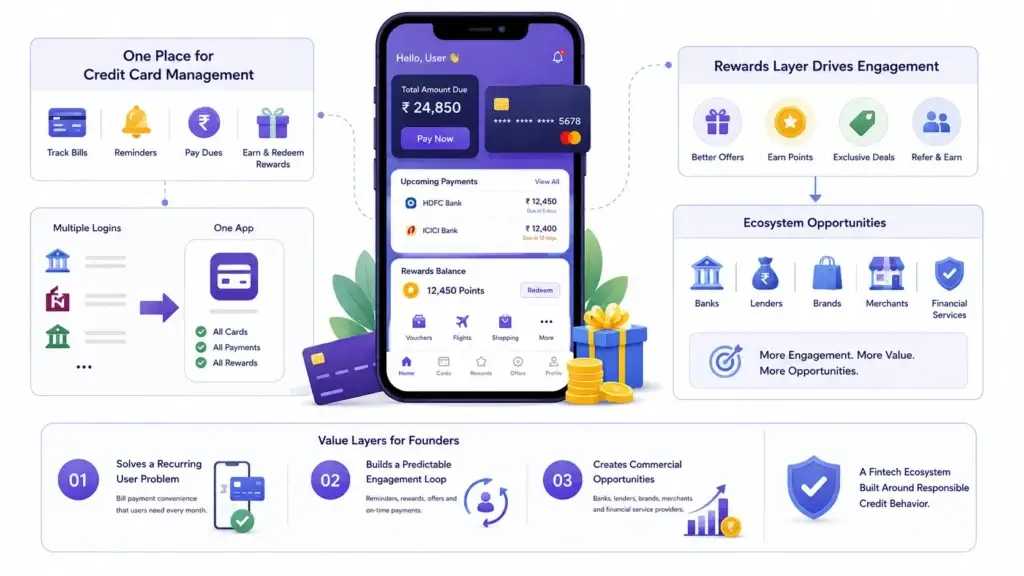
A credit card bill payment and rewards app allows users to manage credit card payments from one place. Instead of logging into multiple banking apps or card portals, users can track bills, receive payment reminders, pay dues, earn points, and redeem rewards through a single platform.
Readers who want a simpler explanation of the app flow can first explore how a credit card bill payment and rewards platform works, including bill tracking, reward points, reminders, and user engagement journeys.
The rewards layer is what makes the model more powerful.
A basic bill payment app solves convenience. A rewards-led bill payment app adds motivation. It gives users a reason to return, complete payments on time, explore offers, refer friends, and engage with financial products.
For a founder, this creates three layers of value:
- First, the app solves a recurring user problem.
- Second, it builds a predictable engagement loop.
- Third, it creates commercial opportunities with banks, lenders, brands, merchants, and financial service providers.
That is why this category should not be understood only as a payment app. It is better viewed as a fintech ecosystem built around responsible credit behavior.
Why Bill Payments Create a Strong Fintech Engagement Loop
The biggest challenge in fintech is not always acquisition. It is repeat engagement.
Many financial apps are opened only when users need a specific service. A loan app may be used occasionally. An insurance app may be ignored after purchase. A budgeting app may lose attention if users do not build a habit.
Credit card bill payment apps have a natural advantage because bills are recurring.
Every month, users need to check due dates, confirm statement amounts, avoid late fees, and make payments. When an app becomes part of that routine, it earns a valuable position in the user’s financial life.
This creates a strong engagement loop:
- User adds one or more credit cards.
- The app reminds the user about upcoming bills.
- The user pays through the platform.
- The platform rewards the action.
- The user returns to track rewards, offers, score, or future bills.
- The platform introduces relevant financial products or premium services.
This loop matters because monetization becomes easier when users already trust the platform with sensitive financial behavior.
How Credit Card Bill Payment and Rewards Apps Make Money
Most successful fintech platforms do not depend on one revenue source. They stack multiple revenue streams around the same user base.
For credit card bill payment and rewards apps, the direct bill payment action may not always be the biggest profit center. In many cases, bill payment is the entry point. The larger revenue opportunity comes from what the platform can offer once users are active, verified, and financially engaged.
1. Lending Partnerships and Credit Product Distribution
Lending is one of the most important monetization opportunities for this category.
Users who regularly pay credit card bills are already credit-active. They may need short-term credit, personal loans, credit lines, balance transfer options, or card upgrade offers. A rewards-led fintech app can connect eligible users with lending partners such as banks, NBFCs, or licensed financial institutions.
The platform may earn through referral fees, lead generation fees, distribution commissions, or performance-based payouts when a user completes a lending application.
This model works because the platform is not approaching cold users. It is reaching users who already understand credit products and interact with the app around financial obligations.
For founders, the important lesson is simple: lending should not feel like a forced upsell. It should appear at the right moment, based on user behavior, eligibility, and financial need.
2. Payment Processing and Transaction-Based Revenue
Payment-related revenue can come from bill payments, rent payments, utility payments, merchant payments, or other financial transactions added around the core experience.
This revenue may include payment gateway margins, partner commissions, convenience fees where legally and commercially appropriate, merchant service fees, or transaction-based incentives from payment partners.
However, founders should be careful here. Payment margins can be thin. If the entire business depends only on small payment fees, the economics may become difficult unless the platform has high transaction volume.
That is why payment revenue should usually be treated as one layer of the business model, not the whole business model.
The better approach is to use payments as the frequency engine. Once the user returns regularly, the platform can monetize through higher-value services such as lending, subscriptions, partner offers, premium financial products, and marketplace commissions.
3. Rewards Marketplace and Brand Partnerships
Rewards are not only a user acquisition tool. They can also become a monetization channel. For founders studying loyalty-led fintech models, Miracuves’ fintech rewards app insights can help connect reward strategy with retention, engagement, and monetization planning.
A rewards marketplace allows brands to reach financially active consumers through offers, vouchers, discounts, experiences, cashback campaigns, and exclusive deals. Brands may pay the platform for visibility, sponsored placement, campaign participation, conversions, or customer acquisition.
This works especially well when the app attracts a premium or financially responsible audience. Brands often want to reach users with higher spending power, better repayment behavior, or stronger lifestyle purchase intent.
The platform benefits in two ways.
It gives users something valuable after each bill payment, and it gives brands a curated channel to reach relevant customers.
The founder risk is reward inflation. If rewards are too expensive and not connected to monetization, the platform can become costly to sustain. A smarter model balances user delight with partner-funded rewards, sponsored offers, limited-time campaigns, and redemption rules that protect margins.
4. Premium Subscriptions and Membership Plans
A credit card rewards app can also monetize through premium memberships.
Instead of charging for basic bill payment, the platform can keep the core utility free and charge for advanced benefits. These may include premium rewards, higher redemption value, exclusive offers, credit score insights, bill automation, priority support, financial planning tools, or special partner deals.
The subscription model works best when users see clear ongoing value.
A founder should not add a paid plan only because subscriptions look attractive on paper. The premium layer must answer a real question: why would a user pay every month when the basic payment function is free?
Strong premium plans usually combine convenience, status, savings, and better access.
For example, a premium user may receive better reward multipliers, access to curated financial products, exclusive brand offers, or advanced insights into spending and credit behavior.
5. Financial Product Marketplace Revenue
Once users trust a fintech app with bill payments and financial reminders, the platform can become a marketplace for related financial products.
This may include credit cards, personal loans, insurance, investment products, savings products, wealth tools, tax services, or budgeting solutions.
The platform can earn commissions when users apply for or purchase partner products.
This model is powerful because it expands revenue beyond payment activity. The app becomes a discovery layer for financial services.
However, trust is critical. If the marketplace becomes too aggressive, users may feel that the platform is pushing products rather than helping them make better financial decisions.
A good financial marketplace should be personalized, transparent, and relevant. It should recommend products based on user needs, not only partner payouts.
6. Merchant Offers and Commerce Commissions
Many rewards apps eventually move into commerce.
This can include curated product deals, lifestyle offers, travel benefits, dining discounts, partner stores, or limited-time campaigns. The platform can earn through affiliate commissions, merchant-funded discounts, sponsored placements, or revenue sharing.
Commerce works well when the user base has strong purchasing power and the offers feel exclusive.
The challenge is focus. A bill payment app should not become a random shopping app. Commerce should support the brand promise. If users joined the platform for financial discipline and premium rewards, the marketplace should feel relevant, curated, and trustworthy.
Founders should prioritize partner quality over offer quantity.
A smaller set of high-fit partners often creates more value than a large catalog of low-relevance discounts.
7. Data-Driven Personalization Without Breaking Trust
Financial behavior creates useful product signals.
A platform may understand payment frequency, bill cycles, card usage patterns, reward preferences, redemption behavior, and interest in financial products. These insights can improve personalization, risk controls, offer targeting, and user experience.
But this is also where founders need to be careful.
Users trust fintech apps with sensitive financial information. That trust should not be abused. The platform should follow privacy-conscious data handling, permission-based workflows, encrypted data transfer, secure storage, role-based admin access, and clear user consent practices.
Data should improve the experience, not become the product.
For a sustainable fintech business model, personalization should help users find better rewards, avoid missed payments, understand financial habits, and discover relevant services.
Revenue Stream Comparison Table
| Revenue Stream | How It Works | Business Value | Founder Risk |
|---|---|---|---|
| Lending partnerships | Users are matched with loans or credit products from financial partners | High-value monetization opportunity | Must avoid irrelevant or aggressive lending offers |
| Payment transaction revenue | Platform earns through payment-related fees, commissions, or partner incentives | Supports recurring usage monetization | Margins may be thin without scale |
| Rewards marketplace | Brands fund offers, vouchers, sponsored campaigns, or redemptions | Converts rewards into a partner-funded channel | Reward costs can rise if not controlled |
| Premium subscriptions | Users pay for advanced benefits, insights, or exclusive rewards | Creates recurring revenue | Paid value must be clearly differentiated |
| Financial product marketplace | Platform distributes cards, insurance, investments, or finance products | Expands revenue beyond bill payments | Trust can fall if recommendations feel biased |
| Commerce commissions | Platform earns from curated partner purchases or offer redemptions | Adds lifestyle-led monetization | Poor partner fit can dilute the app’s positioning |
| Referral programs | Users invite others and unlock rewards | Reduces acquisition cost over time | Fraud prevention and reward abuse controls are needed |
The Real Business Model Is Built Around Trust
The biggest mistake founders make is thinking the business model is only about rewards.
Rewards may attract attention, but trust creates the long-term business.
Users will not add cards, track payments, complete verification, or explore financial products unless they believe the platform is safe and useful. That is why the product foundation matters as much as the monetization strategy.
A strong credit card bill payment and rewards app needs:
- Secure onboarding
- User verification workflows
- Card management
- Bill reminders
- Payment history
- Rewards ledger
- Redemption tracking
- Fraud monitoring
- Dispute handling
- Admin controls
- Partner offer management
- Audit logs
- Secure payment gateway integration
These are not just product features. They are the operational systems that help the platform manage users, payments, rewards, partners, risk, and backend control. Founders can review the features needed to run a credit rewards platform before deciding which modules should be included in the first launch version.
Without these systems, the platform may generate signups but struggle to retain serious users.
Founder Decision Signals Before Building This Model
Audience Quality
This model works better when the platform attracts users with active credit behavior, recurring bill cycles, and clear financial intent.
Reward Economics
Rewards should improve retention without creating unsustainable acquisition costs or redemption liabilities.
Partner Fit
Banks, lenders, merchants, and brands should match the audience profile instead of turning the app into a generic offer marketplace.
Control Layer
The admin dashboard should let the operator manage users, rewards, campaigns, partners, transactions, disputes, and risk workflows without relying on developers for every change.
Why Rewards Alone Cannot Carry the Business
Rewards can bring users into the app, but they cannot be the only reason users stay.
If the app gives points but does not solve real financial problems, users may leave once the rewards become less exciting. If rewards are too generous, the cost may grow faster than revenue. If rewards are too weak, users may not care.
The stronger strategy is to make rewards part of a larger financial engagement system.
That means the app should help users:
- Remember bill due dates
- Avoid missed payments
- Understand spending behavior
- Track credit-related insights
- Discover useful financial products
- Access relevant offers
- Redeem rewards clearly
- Build a habit around responsible payments
When the app becomes useful first and rewarding second, retention becomes healthier.
How the Admin Dashboard Supports Monetization
A rewards-led fintech platform needs strong operator control.
The admin dashboard is where the business model becomes manageable. Without it, the founder may struggle to adjust reward rules, approve partners, monitor transactions, manage disputes, control campaigns, or review suspicious activity.
For this type of app, the admin layer should support:
- User and verification management
- Card and bill activity overview
- Reward point rules
- Redemption inventory
- Partner offer management
- Sponsored campaign controls
- Payment and transaction monitoring
- Referral abuse checks
- Dispute workflows
- Reports and analytics
- Role-based access control
- Audit logs
This matters because fintech monetization changes over time. A founder may start with bill payments and rewards, then add lending partners, premium subscriptions, insurance offers, or merchant campaigns later.
The platform should be flexible enough to support that evolution.
Security and Compliance Considerations
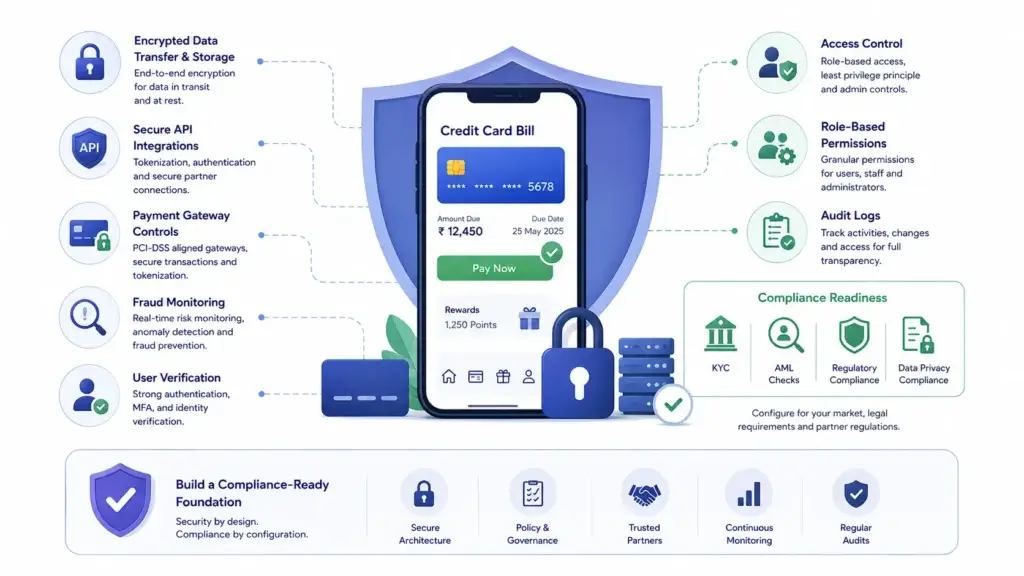
Credit card bill payment and rewards apps handle sensitive user data, payment flows, and financial behavior. Security cannot be treated as a feature added later. This is why broader fintech technology expertise matters when founders are planning payment flows, verification, user trust, admin controls, and compliance-ready workflows.
A fintech platform should be designed with encrypted data transfer, encrypted storage, secure API integrations, payment gateway controls, fraud monitoring, user verification, admin access controls, role-based permissions, and audit logs.
Depending on the target market, the app may also need workflows that support KYC, AML checks, payment regulations, data privacy requirements, and financial partner compliance.
Founders should avoid assuming that software alone guarantees compliance. Final compliance depends on jurisdiction, legal review, payment partners, financial licenses, integrations, and the operating model.
The safer way to think about it is this: build a compliance-ready foundation, then configure it for the market you plan to enter.
Mistakes Founders Should Avoid
Mistake 1: Treating Bill Payment as the Only Revenue Source
Bill payment creates frequency, but it may not create enough revenue by itself. A stronger model uses bill payment as the entry point and adds monetization layers such as lending, subscriptions, partner offers, financial product distribution, and premium rewards.
Mistake 2: Overspending on Rewards Without Partner Funding
Rewards can become expensive if every benefit is funded by the platform. Founders should look for partner-funded offers, sponsored campaigns, redemption controls, and reward rules that protect long-term margins.
Mistake 3: Adding Too Many Financial Products Too Early
A crowded marketplace can confuse users. Start with the products most relevant to the user’s financial behavior. Expand only when the platform has enough trust, engagement, and operational control.
Mistake 4: Ignoring the Admin and Risk Layer
Fintech apps need more than user-facing screens. The operator must be able to manage disputes, users, campaigns, partners, reward abuse, payment issues, and suspicious activity from the backend.
Mistake 5: Building Without a Clear Monetization Sequence
The platform should not launch with every revenue stream at once. A better sequence is usually: bill payment utility, rewards engagement, partner offers, financial marketplace, premium features, then advanced monetization.
Suggested Monetization Sequence for Founders
A practical rollout can look like this:
| Stage | Product Focus | Monetization Focus |
|---|---|---|
| Stage 1 | Card management, bill reminders, payments, rewards | Build trust and recurring usage |
| Stage 2 | Reward catalog, referral system, partner offers | Brand partnerships and engagement growth |
| Stage 3 | Lending and financial product discovery | Partner commissions and lead revenue |
| Stage 4 | Premium membership and advanced insights | Recurring subscription revenue |
| Stage 5 | Marketplace, commerce, insurance, wealth tools | Ecosystem expansion |
Founders who want to move from a category-level overview to a more product-specific monetization structure can explore this product-specific credit rewards revenue model. It shows how different earning lines can work together inside a launch-ready fintech platform.
This sequence helps founders avoid overbuilding before validating the core user habit.
Once the monetization sequence is clear, the next practical question is cost. Founders can review the cost factors behind launching a credit rewards app to understand how features, integrations, infrastructure, branding, and deployment scope affect the final investment.
Turning the Business Model Into a Product
Understanding the business model is the first step. The next step is translating it into product modules.
A monetization-ready credit rewards platform needs the right foundation from the beginning. Bill reminders, card management, rewards, partner offers, payments, referrals, verification, user dashboards, admin controls, and reporting should work together.
This is where Miracuves can support founders who want to move faster without starting from zero. A ready-made, white-label launch-ready consumer credit and rewards app solution can help founders validate the model with source-code ownership, branded design, admin control, rewards workflows, and a faster launch path.
Final Thoughts
Credit card bill payment and rewards apps make money by turning a recurring financial habit into a larger fintech ecosystem.
The strongest platforms do not depend only on payment fees or reward gimmicks. They build trust, increase monthly engagement, personalize financial offers, support partner revenue, and create multiple monetization paths around an active user base.
For founders, the opportunity is not simply to build another bill payment tool. The better opportunity is to build a credit engagement platform where payments, rewards, financial products, subscriptions, and partner campaigns work together.
The smarter execution path is to start with a strong product foundation, validate the user habit, control reward economics, and expand monetization only when the platform has enough trust and activity. Miracuves helps founders take this step with ready-made, white-label fintech app foundations that can be customized around their business model, branding, admin control, and launch goals.
FAQs
How do credit card bill payment apps make money?
Credit card bill payment apps make money through payment-related commissions, lending partnerships, financial product distribution, premium subscriptions, sponsored rewards, merchant offers, referral programs, and marketplace commissions.
Are bill payment fees enough to build a profitable app?
Usually, bill payment fees alone may not be enough unless the platform has significant transaction volume. Many apps use bill payments as the engagement engine and monetize through lending, subscriptions, partner offers, and financial marketplaces.
Why do rewards matter in credit card payment apps?
Rewards give users a reason to return after every bill payment. They help increase retention, encourage referrals, improve brand recall, and create opportunities for partner-funded campaigns.
What is the most important revenue stream for a rewards-based fintech app?
The most valuable revenue stream depends on the audience and market. Lending partnerships, financial product distribution, subscriptions, and premium brand campaigns often create stronger revenue potential than basic transaction fees.
Can a credit rewards app charge users directly?
Yes, but it usually works better when the core bill payment feature remains free and users pay only for premium benefits, advanced insights, better rewards, exclusive offers, or convenience features.
What features are needed to monetize a bill payment rewards app?
Important features include card management, bill reminders, payment tracking, reward points, redemption catalog, referral system, partner offer dashboard, payment gateway integration, user verification, fraud monitoring, admin controls, and analytics.
Is compliance important for this type of fintech app?
Yes. A credit card bill payment and rewards app may need secure data handling, payment controls, user verification, audit logs, fraud monitoring, and workflows that support market-specific compliance requirements. Final compliance depends on jurisdiction, legal review, partners, and operating model.
Miracuves is an independent software development company. We are not affiliated with, connected to, sponsored by, or endorsed by any company or product named in this article.
Terms such as “X Clone” are used descriptively. It is how the software industry refers to building a platform with functionality comparable to a known service, and how clients search for it.
The entire design and codebase of our products is built by our own team. Our products contain no code, design, graphics, or content originating from any third-party website or applications.
All third-party names and marks referenced in this article are the property of their respective owners, referenced solely to identify the services discussed.