A regional travel booking platform is more than a website where users search for flights, hotels, buses, cabs, holiday packages, or local experiences. It is a connected booking system that brings travelers, suppliers, agents, corporate buyers, payments, availability, pricing, confirmations, cancellations, and support into one controlled digital workflow.
For travelers, the platform feels simple. They enter a destination, compare options, check prices, pay, and receive a confirmation. For the platform operator, however, every booking depends on multiple moving parts: supplier inventory, real-time availability, pricing rules, payment verification, confirmation status, refund logic, notification delivery, and admin visibility.
This is why founders should not study travel apps only from the screen level. The real value sits behind the interface. A strong regional travel booking platform must connect search, availability, booking, payment, and confirmation in a way that protects trust and gives the operator enough control to manage local suppliers, regional routes, booking categories, customer support, and revenue rules.
For founders exploring travel-tech, this guide explains how the core workflow works from the inside: what users see, what the backend checks, what suppliers need, what the admin panel controls, and where a ready-made platform foundation can reduce avoidable launch delays.
Key Takeaways
- A regional travel booking platform connects traveler search, supplier inventory, availability, pricing, payment, confirmation, support, and admin control.
- The search screen is only the first layer. The real platform value depends on how accurately the system checks live availability and booking status.
- Booking confirmation must be handled carefully because payment success does not always mean supplier confirmation is complete.
- Regional travel businesses need flexible category control, local supplier onboarding, cancellation rules, agent workflows, and customer support visibility.
- Miracuves helps founders move from idea to launch faster with ready-made and white-label travel platform solutions where the rollout scope fits.
What Is a Regional Travel Booking Platform?
A regional travel booking platform is an online marketplace built around a specific geography, traveler segment, supplier network, or travel category mix. Instead of trying to serve every destination equally, it focuses on a region where the business can create stronger supply, better local relevance, and more reliable booking operations.
For example, a regional platform may focus on domestic flights, intercity buses, boutique hotels, local homestays, spiritual tours, adventure activities, weekend packages, corporate travel inside a state, or curated destination bundles. The advantage is not only convenience. The advantage is control: the operator can prioritize local suppliers, feature region-specific inventory, set category-level margins, manage booking rules, and build a travel brand around a clear market.
At a product level, the platform usually connects four important sides:
- Travelers who search, compare, book, pay, cancel, review, and return for future trips.
- Suppliers such as hotels, bus operators, activity providers, cab partners, package sellers, and other inventory owners.
- Operators who manage categories, pricing, margins, promotions, refunds, support, reporting, and platform rules.
- Sales channels such as travel agents, corporate buyers, offline booking teams, or regional partners who bring additional demand.
A regional platform works well when these sides are not treated separately. Search must understand supplier inventory. Pricing must follow margin rules. Payment must connect with booking status. Confirmation must trigger tickets, vouchers, invoices, notifications, and support records. The more connected the workflow is, the more reliable the traveler experience becomes.
Why Regional Travel Platforms Need a Different Operating Logic
A broad travel app usually depends on scale, large supplier networks, and wide category coverage. A regional travel booking platform depends on local depth. That means the product must be designed around specific routes, seasonal demand, language preferences, payment habits, local partners, refund expectations, customer support behavior, and destination discovery patterns.
This difference matters for founders because a regional platform is not just a smaller version of a national travel app. It needs stronger control over local supply and operational exceptions. A hotel in a regional destination may update rooms manually. A local activity provider may accept bookings only for certain days. A bus operator may change departure availability close to travel time. A tour package may require manual confirmation before final approval. These cases must be reflected in the platform workflow.
Founders should therefore ask a practical question before building: will the platform only display travel options, or will it actually manage the full booking lifecycle? The second approach is stronger because it gives the business visibility from search to payment, confirmation, support, refund, and repeat booking.
Regional Travel Platform Workflow at a Glance
| Workflow Layer | What the Traveler Sees | What the Platform Must Handle | Founder Impact |
|---|---|---|---|
| Search | Destination, date, category, guest, route, or package search | Query logic, filters, supplier routing, location mapping, cached and live results | Better discovery improves booking intent and reduces user drop-offs |
| Availability | Available rooms, seats, vehicles, slots, packages, or activities | Inventory validation, live supplier checks, blackout dates, cut-off rules, overbooking prevention | Accurate availability protects trust and support workload |
| Pricing | Final fare, room rate, taxes, service fee, discount, coupon, or package price | Supplier price, margin rules, markups, taxes, promo codes, wallet balance, add-ons | Pricing control decides whether bookings remain profitable |
| Booking | Passenger details, guest details, itinerary review, and checkout | Booking hold, traveler records, supplier request, payment order, booking status tracking | The platform must prevent duplicate bookings and incomplete records |
| Confirmation | Ticket, voucher, booking ID, invoice, trip dashboard, and notification | Supplier confirmation, payment verification, document generation, email, SMS, push, and support records | Reliable confirmation turns search intent into real revenue |
How Search Works in a Regional Travel Booking Platform
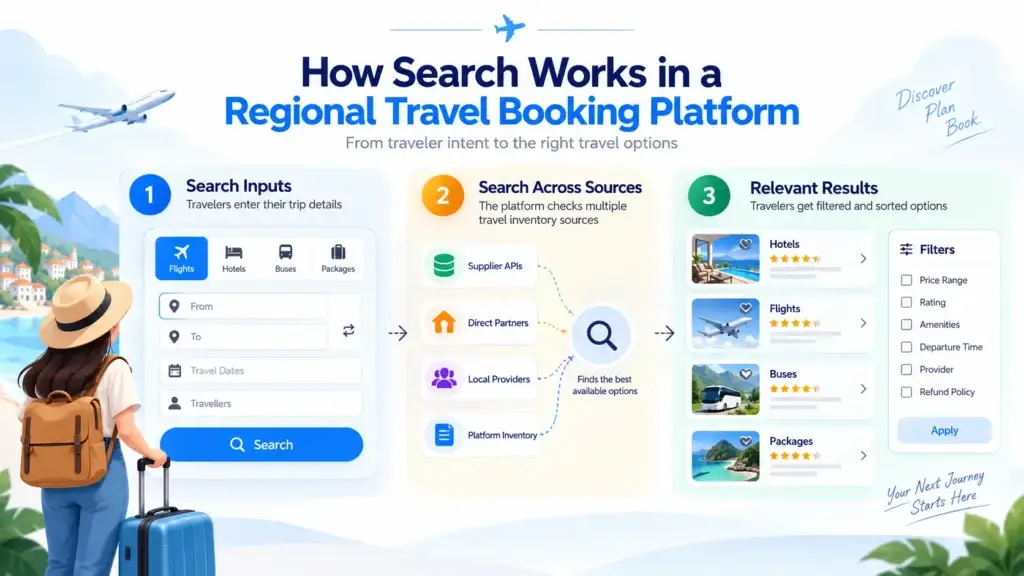
Search is where the traveler expresses intent. They may search for a hotel in a hill station, a bus between two cities, a flight for a business trip, a holiday package for a family, or a local activity for a weekend plan. The platform’s job is to turn that intent into relevant, bookable results.
A basic search screen collects inputs. A stronger travel booking engine interprets them. It understands date, location, passenger count, room count, route, category, budget, trip type, refund preference, and sometimes traveler profile. The system then decides where to search: direct supplier inventory, connected APIs, manually listed inventory, preferred vendors, regional partners, or cached data that must be refreshed before booking.
1. Search Inputs Capture Traveler Intent
The first step is input design. A flight search needs origin, destination, date, travelers, cabin class, and trip type. A hotel search needs destination, check-in, check-out, rooms, guests, and sometimes property type. A bus search needs route, date, departure time, operator, seat type, and boarding point. A holiday package search may need destination, number of travelers, travel month, duration, budget, and theme.
For regional platforms, search should also support local behavior. Some users may search by pilgrimage destination, nearby weekend route, railway station, event location, district, tourist circuit, or local language terms. When the platform understands these search patterns, it can show more useful results than a generic listing directory.
2. Search Results Are Pulled From Multiple Supply Sources
Travel inventory can come from different sources. Some inventory may come through API integrations. Some may come from directly onboarded hotels, transport providers, package sellers, or activity partners. Some may be maintained by the operator’s internal team. Some may be listed by regional agents or supply partners.
The platform should not simply show everything in random order. It should apply business logic: which supplier is preferred, which result is available, which listing has reliable confirmation, which route has higher conversion, which package has strong margin, which property has better reviews, and which option fits the traveler’s filters.
3. Filters Help Users Move From Browsing to Decision
Travel decisions involve comparison. A traveler rarely books the first result without checking price, timing, cancellation policy, rating, amenities, distance, route convenience, or inclusion details. Filters reduce decision fatigue and help the user move toward a booking faster.
Useful filters vary by category:
- Hotels: price, rating, amenities, location, room type, meal plan, refund policy, family suitability, and property type.
- Flights: airline, departure time, arrival time, stops, baggage, refundability, fare class, and duration.
- Buses: operator, seat type, boarding point, drop point, departure time, rating, and cancellation policy.
- Activities: date, duration, age suitability, language, private/group option, location, and confirmation type.
- Packages: destination, nights, hotel category, inclusions, transfers, meals, activities, and customization option.
This is where a regional platform can create a stronger user experience. Instead of only copying broad filters, it can add region-specific filters such as local route type, festival season, nearby attractions, verified homestays, family-friendly operators, language-supported guides, or pickup from specific local points.
How Availability Works Before a Booking Is Accepted
Availability is one of the most sensitive layers in any travel booking platform. A result can appear attractive, but if the room, seat, slot, cab, or package is not truly available at the moment of booking, the user experience breaks. The traveler may pay and then wait for support. The supplier may reject the request. The operator may need to process a refund. Trust drops quickly.
That is why a serious booking platform should treat availability as a live validation layer, not just a label on the search results page.
Inventory Can Be Instant, Request-Based, or Manually Confirmed
Not every travel category confirms in the same way. Flights and many bus routes usually depend on real-time supplier systems. Hotels may offer instant booking for contracted rooms but request-based confirmation for limited inventory. Activities and regional packages may require manual approval from the provider, especially when the product depends on guide availability, weather, vehicle allocation, or minimum group size.
A regional travel booking platform should therefore support different confirmation modes:
- Instant confirmation: The supplier confirms immediately after successful booking and payment validation.
- Hold and confirm: The platform temporarily holds inventory while the traveler completes payment.
- Request to book: The traveler submits a request, and the supplier or operator confirms before payment capture or final booking.
- Manual approval: The admin or vendor reviews availability and accepts or rejects the booking request.
- Fallback routing: If one supplier cannot confirm, the platform can route the booking to another source where available.
Availability Rules Protect Both Travelers and Operators
Availability is not only about whether something exists. It also depends on rules. Hotels may block dates during maintenance. Bus operators may close seat selection near departure. Activity providers may limit bookings during weather-sensitive periods. Packages may have blackout dates during peak demand. Corporate travel may require approval before confirmation.
The platform should allow the operator or supplier to define rules such as:
- Minimum and maximum booking windows
- Cut-off time before travel
- Blackout dates and seasonal pricing
- Room, seat, vehicle, or slot inventory limits
- Cancellation deadline by category or supplier
- Advance payment or full payment requirement
- Manual approval for high-value or group bookings
- Corporate policy checks before checkout
When these rules are missing, the platform may generate bookings that operations cannot fulfill. When they are built into the booking engine, the business can scale with fewer manual corrections.
How Pricing, Margins, Coupons, and Add-Ons Fit Into the Booking Flow
Pricing in travel platforms is rarely a single number. The final amount shown to the traveler may include supplier price, platform margin, service fee, taxes, convenience fee, package markup, payment surcharge, discount, wallet balance, loyalty benefit, add-ons, or insurance. If the platform does not calculate this clearly, the user may feel misled at checkout.
For founders, pricing control is not only a finance issue. It is a business model issue. A regional travel platform may earn through commissions, margins, service fees, sponsored listings, package markups, agent commissions, corporate plans, cancellation charges, add-ons, or loyalty-driven repeat bookings. The platform must calculate these without making every price change dependent on a developer.
Readers who want a deeper business-side breakdown can review this guide on the regional travel booking platform business model, while this article stays focused on how the booking workflow operates.
Why Transparent Fare Breakdowns Improve Trust
Travelers do not only compare prices. They compare confidence. A lower price can still lose the booking if the user does not understand what is included, what is refundable, what is charged later, or what happens if the supplier rejects the request.
A strong checkout page should show:
- Base fare or room/package price
- Taxes and statutory charges where applicable
- Platform service fee or convenience fee
- Discount, coupon, wallet, or loyalty adjustment
- Add-ons such as insurance, meals, transfers, activities, or priority support
- Refund and cancellation terms before payment
- Total payable amount with no hidden last-step surprise
For operators, this transparency also reduces support tickets. When users understand what they paid for and what refund rules apply, fewer disputes come from unclear checkout communication.
Read more: What Features and Cost Factors Matter Most When Planning a Regional Travel Booking Platform?
How the Booking Process Works From Selection to Confirmation
Once the traveler selects an option, the platform moves from discovery to transaction. This is the most important part of the workflow because the system must create a booking record, validate the amount, collect traveler details, communicate with suppliers, process payment, and issue confirmation without creating duplicate charges or incomplete reservations.
A typical travel booking process includes these stages:
1. Traveler Selects an Option
The traveler chooses a flight, hotel, bus seat, cab, activity, or package. At this point, the system should refresh critical details: price, availability, cancellation terms, inclusions, and booking conditions. This prevents the user from checking out with outdated information from an earlier search session.
2. Platform Creates a Temporary Booking Record
Before payment, the platform should create a pending booking record. This record connects the traveler, selected inventory, supplier, price, applied discount, chosen add-ons, cancellation policy, and payment order. Without this record, the platform may struggle to trace what happened if payment succeeds but supplier confirmation fails.
3. Availability and Price Are Revalidated
Travel inventory changes quickly. The same room, seat, or slot may be viewed by multiple users. Revalidation ensures the selected option is still available at the quoted price before the platform accepts payment or sends the final booking request to the supplier.
4. Payment Is Initiated and Verified
The traveler pays through the available payment methods. The platform should verify payment status on the server side instead of trusting only the front-end success screen. This matters because payment gateways may show pending, failed, successful, reversed, or delayed statuses depending on the transaction response.
5. Supplier Confirmation Is Requested
After payment validation or payment hold, the platform requests confirmation from the supplier system or internal inventory module. Depending on the category, this may generate a ticket, voucher, booking ID, room reservation, seat assignment, package request, or vendor approval task.
6. Confirmation Is Issued to the Traveler
Once the booking is confirmed, the platform updates the booking status and sends confirmation through the traveler dashboard, email, SMS, push notification, or messaging channel. The traveler should also receive all relevant documents: booking ID, ticket, voucher, invoice, itinerary, cancellation policy, support contact, and next-step instructions.
7. Failed Confirmation Moves Into Refund or Support Workflow
Sometimes payment may succeed but supplier confirmation may fail. This is where platform design becomes critical. The system should not leave the traveler confused. It should clearly update the status, trigger refund handling where applicable, notify support, and give the traveler a next action.
This is one of the reasons a travel booking platform should be designed around the full transaction lifecycle instead of just attractive search screens.
Founder Decision Signals
Speed
If your market opportunity depends on launching quickly, avoid spending months rebuilding standard booking workflows that already exist in proven platform foundations.
Control
Choose a platform where categories, supplier rules, margins, coupons, refunds, and booking statuses can be managed from the admin panel.
Trust
Traveler trust depends on accurate availability, secure payments, clear cancellation rules, and confirmation messages that arrive without confusion.
Regional Fit
A regional platform should support local suppliers, local travel behavior, preferred routes, agent-assisted bookings, and geography-specific promotions.
Why Confirmation Is More Than a Thank-You Screen
In travel booking, confirmation is not just a final message. It is proof that the booking exists, the supplier has accepted it, the payment has been recorded, and the traveler can proceed with confidence.
A confirmation workflow usually needs to complete several actions:
- Update booking status from pending to confirmed
- Store supplier confirmation reference
- Generate ticket, voucher, itinerary, invoice, or booking summary
- Send confirmation through email, SMS, push, or in-app notification
- Update traveler dashboard and booking history
- Notify supplier or vendor dashboard
- Record payment reference and settlement details
- Prepare cancellation, refund, or modification rules
- Attach booking details to customer support records
For a regional travel platform, this is especially important because suppliers may not all operate with the same digital maturity. Some may have API-driven confirmation. Some may use manual dashboard approval. Some may require operator-side verification. The platform should make these differences invisible to the traveler while still giving the operator clear control behind the scenes.
How Cancellations, Refunds, and Changes Should Work
A travel platform does not become reliable only by accepting bookings. It becomes reliable by handling what happens after the booking. Travel plans change. Suppliers cancel. Weather affects local activities. Users enter wrong details. Payment issues happen. Corporate approvals may be rejected. Refund timelines may vary by category.
The platform should make cancellation and refund rules visible before checkout and manageable after booking. A strong post-booking workflow should include:
- Booking modification requests
- Cancellation eligibility checks
- Supplier-specific refund rules
- Partial refund calculations
- Wallet refunds or original payment refunds
- Support ticket creation
- Admin approval for exceptional cases
- Refund status tracking for users and finance teams
- Notification updates when refund status changes
This is also where strong platform security matters. Travel platforms handle personal details, payment references, booking history, supplier data, and support conversations. Founders can explore the related guide on travel booking platform security for a deeper look at access control, payment protection, fraud signals, and admin safeguards.
What Admin Controls a Regional Travel Booking Platform Needs
The admin panel is where the travel platform becomes a business system. Without admin control, every operational change becomes a developer task. With admin control, the platform operator can adjust categories, margins, vendors, promotions, bookings, cancellations, support, and reporting without slowing down daily operations.
A regional travel platform should give operators practical control over:
- Travel categories: flights, hotels, buses, cabs, activities, packages, homestays, or custom regional categories.
- Supplier onboarding: approval workflows, documents, listings, inventory rules, vendor dashboards, and payout records.
- Availability settings: inventory limits, blackout dates, booking windows, cut-off times, and manual confirmation rules.
- Pricing and margins: category markups, flat fees, supplier-specific margins, coupons, wallet rules, and add-on pricing.
- Booking management: pending, confirmed, cancelled, failed, refunded, modified, and disputed bookings.
- Agent workflows: agent accounts, client records, commission logic, wallet balance, credit limits, and settlement reporting.
- Corporate travel: company accounts, approval flows, employee permissions, spend limits, and reporting.
- Customer support: tickets, booking-linked conversations, refund requests, escalation rules, and response tracking.
- Analytics: bookings, revenue, margin, category performance, supplier performance, cancellation trends, and repeat users.
Founders comparing feature depth can review the dedicated travel booking platform features page to understand which modules are usually required when a platform moves beyond simple search and listing.
How Agent and Corporate Travel Workflows Expand the Platform

Many regional travel businesses do not sell only through direct consumer bookings. They also work with offline agents, local tour planners, corporate clients, group booking teams, or destination partners. A strong regional platform should support these sales channels instead of forcing every booking through the same consumer flow.
Agent Booking Workflows
An agent portal allows travel agents to search inventory, book for their customers, manage client records, apply permitted markups, track commissions, and view settlement history. This is valuable in regions where travelers still trust local agents for family trips, group travel, religious tours, honeymoon packages, visa support, or assisted booking decisions.
For the platform operator, agent workflows can extend distribution without hiring a large internal sales team. The important requirement is control: agent permissions, commission rules, wallet balance, credit limits, cancellation handling, and booking visibility should all be manageable.
Corporate Travel Workflows
Corporate travel workflows are different from individual leisure bookings. Companies often need employee profiles, approval steps, travel policies, spending limits, invoices, reports, and expense documentation. The platform should support these requirements without mixing company users, finance teams, approvers, and travelers into one generic account type.
For regional travel operators, corporate travel can create recurring booking demand. However, it also requires stronger admin control, reporting clarity, and support workflows because companies expect predictable service and transparent records.
What Makes a Regional Travel Platform Scalable?
Scalability in travel booking is not only about handling more users. It is about handling more booking categories, more suppliers, more rules, more payment cases, more cancellations, more support tickets, and more reporting requirements without breaking the traveler experience.
A scalable regional travel platform should be able to expand in layers:
- Start with one or two high-demand regional categories.
- Add supplier dashboards as direct inventory grows.
- Introduce agent-assisted bookings when offline demand is strong.
- Add corporate travel workflows after the platform can manage approvals and reports.
- Expand add-ons such as transfers, activities, insurance, visa assistance, or destination packages.
- Improve retention with wallet, loyalty, referral, and personalized offers.
- Use analytics to decide which category or location should scale next.
The mistake many founders make is trying to launch every travel category at once without confirming supplier readiness. A stronger approach is to build on a platform foundation that can support multiple categories, then activate the categories that match the region, supplier strength, and operational capacity.
Common Mistakes Founders Should Avoid While Planning the Booking Flow
Mistakes Founders Should Avoid
Building Only the Search Screen
A travel app can look complete when search and listings work, but the business breaks if availability, booking, payment, confirmation, cancellation, and support are not connected.
Ignoring Failed Confirmation Cases
Payment success does not always mean the supplier has confirmed the booking. Founders should plan what happens when payment succeeds but booking confirmation fails.
Using One Rule for Every Category
Flights, hotels, buses, cabs, activities, packages, and homestays all have different booking and cancellation behavior. The platform should allow category-specific rules.
Leaving Suppliers Without Control
Regional suppliers need dashboards or managed workflows to update availability, pricing, booking status, cancellation requests, and payout information.
Forgetting Support and Refund Visibility
Travel users expect quick clarity when something changes. Admin teams need booking-linked support, refund tracking, and status visibility to resolve issues faster.
How Miracuves Helps Founders Build Regional Travel Booking Platforms
Miracuves helps founders, travel agencies, tour operators, and regional travel businesses create ready-made and white-label booking platforms with branded design, source-code ownership, admin dashboards, supplier workflows, booking logic, payment integrations, agent workflows, and customization support.
The main advantage of using a ready-made foundation is that founders do not need to rebuild every standard travel workflow from zero. Search, booking records, supplier logic, payment verification, confirmation handling, dashboards, and admin controls can be shaped around the business model instead of being developed as disconnected screens.
For readers moving from education to execution, Miracuves’ travel booking platform foundation explains how a complete travel booking ecosystem can support flights, hotels, buses, holidays, agents, corporate travel, and operator control. If the goal is broader brand ownership, the white-label travel portal page is also relevant.
Where the ready-made scope fits the project requirement, Miracuves can support 6-day solution delivery. For custom modules, regional supplier logic, advanced integrations, or special approval workflows, the final rollout should be scoped based on the selected categories, integrations, and operational needs.
Final Thoughts: A Travel Booking Platform Works When the Whole Journey Connects
A regional travel booking platform succeeds when it does more than display travel options. It must help users search with confidence, check accurate availability, understand pricing, complete secure payment, receive reliable confirmation, manage changes, and get support when something goes wrong.
For founders, the biggest lesson is simple: do not treat travel booking as a front-end project. The search screen matters, but the real business value sits in the backend workflow: supplier inventory, booking records, payment verification, confirmation logic, cancellation rules, refund visibility, agent access, corporate workflows, analytics, and admin control.
A regional platform does not need to copy every large travel marketplace from day one. It needs to understand its region deeply, onboard reliable supply, keep the booking journey transparent, and use technology to connect demand with confirmed reservations. That is where the product becomes more than an app. It becomes the operating system for a travel business.
FAQs
What is a regional travel booking platform?
A regional travel booking platform is a digital marketplace that helps travelers search, compare, book, pay, and manage travel services within a specific geography or travel segment. It connects travelers, suppliers, agents, payments, availability, confirmations, support, and admin controls in one system.
How does search work in a travel booking platform?
Search works by collecting traveler inputs such as destination, date, route, guests, category, and budget. The platform then checks connected suppliers, direct inventory, listed packages, or internal records and displays relevant options with filters such as price, rating, timing, location, and cancellation policy.
Why is availability important in travel booking?
Availability is important because travelers should only pay for rooms, seats, slots, vehicles, or packages that can actually be booked. A strong platform validates inventory before checkout and again before confirmation to reduce failed bookings, refunds, and support issues.
What happens after a traveler makes a payment?
After payment, the platform should verify the transaction on the server side, update the booking record, request supplier confirmation, generate the ticket or voucher if confirmed, and notify the traveler through the dashboard, email, SMS, push notification, or other selected channels.
Can payment succeed but booking confirmation fail?
Yes. In travel booking, payment success and supplier confirmation are separate events. A well-designed platform should handle this by tracking the booking status, notifying support, triggering refund logic where applicable, and giving the traveler a clear status update.
What admin controls should a regional travel booking platform include?
A regional travel booking platform should include controls for categories, suppliers, availability, pricing, margins, coupons, booking statuses, cancellations, refunds, agents, corporate accounts, customer support, reports, permissions, and audit logs.
How can regional travel platforms manage agents and corporate users?
Regional platforms can manage agents through agent dashboards, client records, commission rules, wallet limits, and settlement reports. Corporate users can be managed through company accounts, employee profiles, spend limits, approval workflows, invoices, and travel policy controls.
Can Miracuves help build a regional travel booking platform?
Yes. Miracuves helps founders and travel businesses build ready-made and white-label travel booking platforms with branded design, supplier workflows, payment logic, admin dashboards, source-code ownership, and customization support. A 6-day launch may apply when the ready-made scope matches the rollout requirement.
Miracuves is an independent software development company. We are not affiliated with, connected to, sponsored by, or endorsed by any company or product named in this article.
Terms such as “X Clone” are used descriptively. It is how the software industry refers to building a platform with functionality comparable to a known service, and how clients search for it.
The entire design and codebase of our products is built by our own team. Our products contain no code, design, graphics, or content originating from any third-party website or applications.
All third-party names and marks referenced in this article are the property of their respective owners, referenced solely to identify the services discussed.