Key Takeaways
- A Regional Travel Booking Platform Business Model. connects travelers, hotels, local suppliers, travel agents, booking inventory, payments, commissions, and reservation operations within one marketplace.
- Travelers search and book regional stays and experiences, while suppliers manage availability, pricing, inventory, confirmations, cancellations, and settlement through dedicated workflows.
- The platform coordinates traveler demand, supplier inventory, agent distribution, booking payments, commissions, customer support, and operational reporting across the complete reservation journey.
Traveler & Supplier Signals
- Travelers need destination search, filters, maps, accommodation and activity listings, availability, pricing, reviews, secure checkout, booking confirmation, and itinerary management.
- Suppliers need onboarding, inventory management, availability calendars, seasonal pricing, reservation updates, cancellation rules, payment records, settlements, and performance analytics.
- Travel agents can use negotiated inventory, customer booking tools, commission rules, reservation management, payment tracking, vouchers, and reporting to serve regional travelers efficiently.
Business Model & Operations Insights
- Regional travel platforms can monetize through booking commissions, supplier fees, agent margins, service charges, promoted listings, packages, and other travel-related marketplace services.
- Operators need centralized control over inventory, bookings, commissions, payments, refunds, supplier settlements, agent activity, disputes, support requests, and marketplace analytics.
- Miracuves develops customizable regional travel booking platforms with traveler journeys, supplier and agent management, inventory, reservations, payments, commissions, settlements, analytics, and admin controls.
A regional travel booking platform is not only a website or app where users search for hotels, flights, buses, packages, or activities. It is a marketplace that connects travelers, suppliers, agents, payments, availability, pricing, support, refunds, and booking operations inside one controlled system.
For travelers, the value is convenience. They want to compare options, see availability, pay securely, receive confirmation, manage changes, and trust that the booking will work.
For suppliers, the value is distribution. Hotels, transport providers, activity operators, package sellers, and local travel partners want access to demand without manually handling every booking request.
For agents and corporate buyers, the value is workflow. They need negotiated inventory, markup control, approvals, invoices, statements, and booking records.
For founders, the business model is about connecting all these layers while earning through commissions, service fees, margins, add-ons, advertising, loyalty, and partner-led revenue.
That is why a regional travel booking platform business model should be planned as an operating system, not just a booking interface.
What Is a Regional Travel Booking Platform Business Model?
A regional travel booking platform business model explains how the platform creates value, who participates in the ecosystem, how bookings are processed, and where revenue is generated.
A strong model usually connects four sides:
- Travelers who search, compare, book, pay, cancel, review, and return.
- Suppliers who provide inventory such as hotels, stays, buses, cabs, tours, activities, and packages.
- Agents or partners who sell bookings through their own customer relationships.
- Operators who control categories, commissions, pricing, refunds, support, payments, content, and reporting.
The platform earns by helping these groups transact more efficiently.
A traveler gets convenience. A supplier gets bookings. An agent gets inventory and commission. The platform operator earns from the transaction, margin, or relationship.
That is the core business logic.
Why Regional Travel Platforms Need a Clear Market Focus
A regional travel platform does not need to serve every country, every category, and every traveler type from the first day.
A stronger approach is to begin with a focused market angle, such as:
- One region with strong domestic travel demand
- One destination cluster with hotels and local experiences
- One travel category such as stays, buses, packages, or activities
- One audience such as families, pilgrims, students, business travelers, or weekend tourists
- One supplier base such as boutique stays, homestays, tour operators, or local transport providers
- One B2B segment such as agents, corporate travel teams, or local travel resellers
Regional focus helps founders solve a clearer problem.
A destination-focused platform may need curated stays and activities. A bus-first platform may need route inventory and seat availability. A corporate travel platform may need approvals, invoice records, policy controls, and reporting. A tour operator marketplace may need package builders and supplier coordination.
The business model should follow the market problem, not the other way around.
The Four Main Participants in the Travel Booking Ecosystem
A travel booking platform becomes valuable when each participant gets a clear reason to use it.
How Each Participant Creates Value in the Platform
| Participant | What They Need | How the Platform Creates Value |
|---|---|---|
| Travelers | Search, comparison, secure payment, confirmation, support, cancellations, and trip records. | The platform reduces booking friction and keeps the travel journey organized. |
| Suppliers | Demand, inventory control, pricing control, booking visibility, reviews, and payout tracking. | The platform gives suppliers distribution without needing to build their own booking system. |
| Agents | Inventory access, markup control, booking tools, customer records, and commission visibility. | The platform helps agents sell travel products faster with controlled margins and records. |
| Corporate Users | Travel policies, approvals, employee bookings, invoices, reports, and spending visibility. | The platform supports organized business travel instead of scattered manual bookings. |
| Platform Operator | Category control, pricing rules, commissions, refunds, supplier approvals, reports, and support workflows. | The operator manages marketplace quality, revenue, and user trust from the admin layer. |
The platform becomes stronger when these groups work together without operational confusion.
How Travelers Create Revenue and Retention
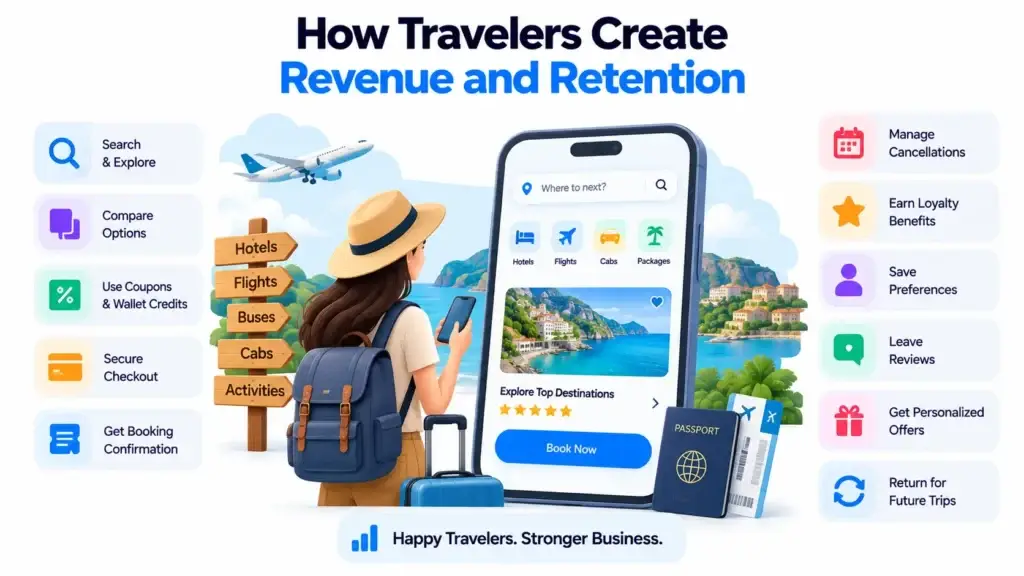
Travelers are usually the visible demand side of the business model. Their actions generate bookings, repeat usage, reviews, wallet activity, loyalty engagement, and referral growth.
A traveler may use the platform to:
- Search by destination, date, price, category, or rating
- Compare hotels, buses, cabs, packages, activities, or local experiences
- Apply coupons or wallet credits
- Pay through a secure checkout
- Receive booking confirmation
- Manage cancellations or refunds
- Save preferences
- Earn loyalty benefits
- Review suppliers after the trip
- Return for future bookings
For founders, the goal is not only to get one booking. The goal is to create repeat behavior.
Retention can be supported through wallet balance, saved traveler profiles, loyalty tiers, app-only offers, seasonal campaigns, last-minute deals, trip reminders, and personalized recommendations.
However, retention only works when the first booking experience feels reliable. If the traveler sees wrong availability, unclear pricing, delayed confirmation, or poor refund support, the platform loses trust.
How Suppliers Fit Into the Business Model
Suppliers are the supply side of the travel marketplace.
They may include:
- Hotels
- Homestays
- Bus operators
- Cab providers
- Activity operators
- Tour guides
- Package sellers
- Local destination partners
- Insurance or visa partners
- Transport and transfer providers
Suppliers join because the platform can bring demand. But they also need control.
A supplier dashboard should help manage listings, availability, prices, booking status, cancellation rules, photos, descriptions, customer messages, and payout visibility.
If suppliers cannot manage their inventory properly, the platform may face overbooking, wrong pricing, support pressure, refund disputes, and poor traveler reviews.
That is why supplier operations are not just backend features. They directly affect revenue.
How Agents and B2B Partners Expand Distribution
Regional travel markets often include offline agents, local resellers, corporate travel managers, and destination management partners. A strong platform can support these groups instead of competing with them.
Agents can help the platform reach travelers who still prefer assisted booking, local relationships, phone-based planning, group trips, pilgrimage tours, or customized packages.
A travel agent portal may support:
- Agent login
- Inventory access
- Markup control
- Customer booking records
- Quotes and confirmations
- Wallet or credit balance
- Commission tracking
- Agent-specific offers
- Booking modification requests
- Statements and reports
Corporate users may need a different workflow:
- Employee traveler profiles
- Approval rules
- Travel policy controls
- Invoice records
- Department-wise reporting
- Business payment methods
- Admin roles
- Booking history
- Expense visibility
This B2B layer can make a regional travel platform stronger because it creates more than direct consumer bookings. It adds distribution depth.
Booking Operations: Where the Business Model Becomes Real
The business model looks simple on paper: list travel services, take bookings, earn commission. In real operations, every booking has multiple moving parts.
A booking flow may include:
- Search and category filtering
- Availability check
- Pricing calculation
- Margin or commission application
- Coupon or loyalty adjustment
- Traveler information collection
- Payment processing
- Supplier confirmation
- Voucher or ticket generation
- Booking record creation
- Modification, cancellation, or refund handling
- Supplier payout and reconciliation
Each step affects trust and revenue.
If pricing is wrong, margin suffers. If availability is outdated, the customer experience breaks. If payment succeeds but confirmation fails, support teams need visibility. If refunds are not tracked, finance operations become messy.
Founders planning category flows, supplier dashboards, checkout, coupons, loyalty, refunds, and admin workflows can review the travel booking platform features needed to operate a scalable booking marketplace.
For readers moving from business model planning into product execution, this guide explains how to build a regional travel booking app from architecture, APIs, booking flows, and launch planning.
Revenue Streams in a Regional Travel Booking Platform
A strong regional travel booking platform should not depend on only one revenue stream. Different travel categories behave differently across seasons, locations, and customer segments.
Common revenue streams include:
| Revenue Stream | How It Works | Best Fit |
|---|---|---|
| Supplier commission | The platform earns a percentage from each confirmed booking. | Hotels, homestays, activities, tours, buses, and cabs |
| Service fee | Traveler pays a convenience or platform fee during checkout. | High-demand routes, premium support, last-minute bookings |
| Package margin | Operator earns markup on curated bundles. | Holiday packages, pilgrimage tours, destination packages, group trips |
| Agent commission split | Agents sell through the platform and receive a controlled commission. | Offline agent networks and assisted booking markets |
| Corporate travel plans | Businesses pay for managed booking workflows, approvals, reporting, or account support. | SMEs, corporate travel teams, and business travel agencies |
| Advertising and featured listings | Suppliers pay for better visibility or campaign placement. | Hotels, local experiences, packages, and seasonal deals |
| Ancillary services | Platform earns from add-ons such as insurance, visa support, forex, transfers, or activities. | Travel packages and high-value bookings |
| Loyalty and wallet activity | Rewards and wallet credits encourage repeat transactions. | Mobile-first users and repeat travelers |
The right mix depends on your market. A hotel-heavy platform may prioritize supplier commission and featured listings. A tour package platform may rely more on bundle margins. A corporate travel platform may focus on recurring plans and reporting.
To connect commissions, service fees, package margins, agent markups, corporate plans, wallet activity, and supplier visibility with monetization strategy, review the travel booking platform business model.
Why Multi-Category Booking Can Increase Order Value
Travel rarely happens in one isolated transaction.
A traveler booking a hotel may also need a cab, activity, local guide, travel insurance, or return bus. A family booking a package may need rooms, transfers, meals, sightseeing, and support. A corporate traveler may need hotel, transport, approval, and invoice records.
A multi-category platform can increase order value by connecting related needs.
Common category combinations include:
- Hotel plus airport transfer
- Bus plus hotel
- Holiday package plus activities
- Cab plus local sightseeing
- Homestay plus guided tour
- Flight plus insurance
- Corporate hotel plus invoice workflow
- Group tour plus meal plan and transport
This is where the marketplace becomes more valuable than a single-category booking tool. The platform can earn from multiple points in the travel journey while giving the user one place to manage the trip.
Margin Engine: The Operator’s Control Layer
A travel booking platform needs more than a payment gateway. It needs a margin engine.
A margin engine helps the operator define how revenue is added across different categories, suppliers, agents, and campaigns.
For example, the platform may apply:
- Percentage-based commission on hotels
- Flat service fee on bus bookings
- Markup on holiday packages
- Agent-specific margin
- Corporate pricing rules
- Coupon limits
- Supplier promotional discounts
- Seasonal pricing adjustments
- Minimum platform fee by category
Without margin control, the founder cannot adapt to market conditions. Every small change becomes a developer dependency or manual workaround.
A strong admin layer should allow the operator to control margins, categories, offers, supplier status, refunds, payouts, and reports from one dashboard.
Founder Decision Signals for Travel Platform Business Models
Market Focus
Start with the traveler segment, destination, category, or supplier base where you can create the clearest value. Broad platforms are harder to operate without a focused entry point.
Revenue Mix
Combine commissions, service fees, package margins, add-ons, agent markups, and corporate plans based on how your users actually book travel.
Supplier Readiness
Confirm that suppliers can manage inventory, pricing, availability, booking status, and payout expectations before you scale demand.
Operational Control
Your admin dashboard should control categories, margins, coupons, refunds, agents, supplier approvals, payments, reports, and support workflows.
How Payments, Refunds, and Payouts Affect the Business Model
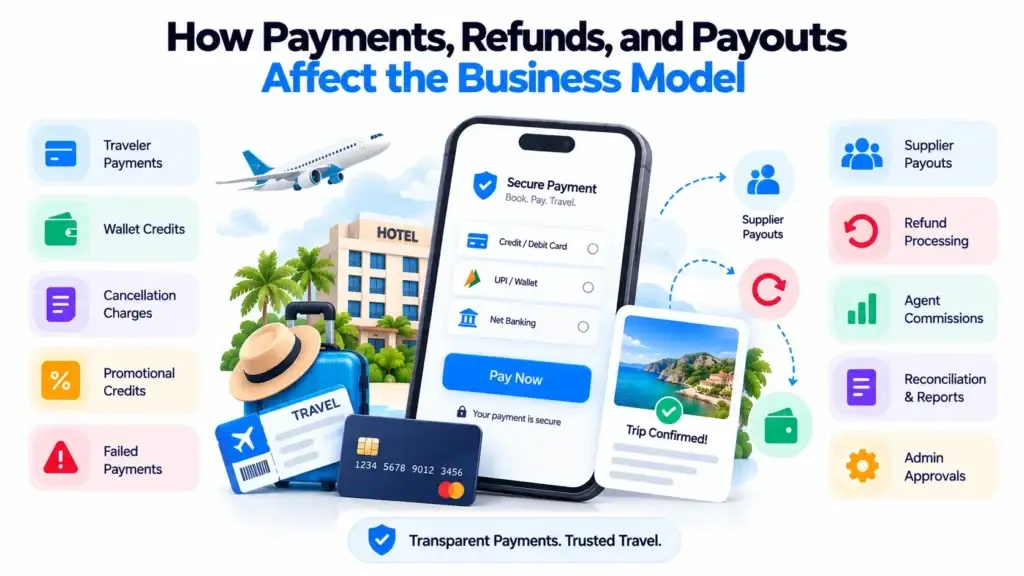
Travel platforms often deal with partial payments, full payments, wallet credits, cancellation charges, refunds, supplier payouts, agent commissions, and promotional credits.
That creates financial complexity.
A strong booking operation should define:
- When the traveler is charged
- When the supplier is paid
- Whether the platform holds margin before payout
- How refunds are calculated
- Which cancellation rules apply
- How failed payments are handled
- How agent commissions are tracked
- How wallet credits are issued
- How finance teams reconcile booking records
- Which admin roles can approve refunds or payouts
Payment trust directly affects repeat bookings. If travelers cannot understand charges or refunds, support issues increase. If suppliers cannot see payout status, marketplace confidence drops.
For travel platforms where payment flow, booking confirmation, wallet, refunds, or supplier payouts are central to the model, Miracuves’ payment gateway development service can support the transaction layer behind the platform.
Common Mistakes Founders Should Avoid
Starting With Too Many Categories
Flights, hotels, buses, cabs, packages, and activities all have different suppliers, pricing rules, confirmation flows, cancellation rules, and support needs. Start with the categories your market can operate well.
Ignoring Supplier Operations
A travel marketplace is only as reliable as its supply side. Weak inventory, unclear payout rules, poor listing control, and delayed confirmations can damage traveler trust.
Copying Revenue Streams Without Matching User Behavior
A commission model may work for one category, while package margins, service fees, agent markups, or corporate plans may work better for another. Revenue should match booking behavior.
Launching Without Admin Margin Control
If operators cannot adjust margins, commissions, coupons, supplier status, refunds, and reports from the admin dashboard, the business becomes difficult to scale.
Founders should also plan how they will attract travelers, suppliers, agents, and early bookings. This guide on travel booking platform launch marketing explains what to prioritize before and after going live.
Startup Checklist for a Regional Travel Booking Platform Business Model
Before launch, founders should confirm:
- Target region and traveler segment are clear
- First travel categories are selected
- Supplier onboarding flow is mapped
- Agent or B2B partner role is defined
- Corporate travel workflow is included only if needed
- Commission and margin rules are configurable
- Checkout flow supports the selected categories
- Booking confirmation process is reliable
- Cancellation and refund rules are documented
- Wallet, loyalty, and coupon logic are clear
- Supplier payout process is planned
- Agent commissions can be tracked
- Admin roles and permissions are defined
- Support team can see booking status
- Reports show bookings, revenue, margins, refunds, and category performance
- Marketing plan matches the platform’s real launch scope
If you are comparing launch approaches, this guide on ready-made travel booking platform options explains how scripts, features, pricing, and rollout scope should be evaluated before development.
The goal is not to launch the biggest travel platform on day one. The goal is to launch a model that can earn, operate, and improve without breaking user trust.
How Miracuves Helps Founders Launch Travel Booking Platforms
Miracuves helps founders, travel agencies, tour operators, and regional travel businesses launch ready-made and white-label booking platforms with branded design, admin dashboards, source-code ownership, supplier workflows, payment integrations, agent portals, and customization support.
For founders evaluating a launch-ready travel product, Miracuves’ travel booking platform foundation can help review traveler flows, supplier connections, booking categories, payments, margins, agent workflows, corporate travel, loyalty, and operator controls.
Businesses exploring broader travel and hospitality launch paths can also review Miracuves’ travel booking solutions for related platform models.
If you are comparing budget and rollout scope, review Miracuves’ guide on travel booking platform development cost. For vendor evaluation, this page on choosing a travel booking development partner can help you understand what to check before selecting a team.
When the ready-made scope fits the rollout requirement, Miracuves can support 6-day solution delivery, helping founders move faster without building every search, booking, supplier, payment, margin, agent, refund, loyalty, and admin workflow from zero.
Final Thoughts: A Travel Platform Business Model Works When Operations Connect
A regional travel booking platform succeeds when travelers, suppliers, agents, corporate users, payments, and operators are connected through clear workflows.
Travelers need reliable booking experiences. Suppliers need distribution and payout visibility. Agents need inventory access and commission control. Corporate users need approvals and reporting. Operators need margin control, admin visibility, refund management, and performance data.
The business model is not just commission plus service fee. It is the full system that turns travel demand into confirmed bookings, repeat usage, supplier participation, and controlled revenue.
For founders, the smartest path is to start with a focused region, category, or audience, build strong supplier operations, keep payments and refunds transparent, and expand only when the first model works reliably.
FAQs
What is a regional travel booking platform business model?
A regional travel booking platform business model explains how the platform connects travelers, suppliers, agents, corporate users, payments, bookings, refunds, and operator controls while earning through commissions, fees, margins, add-ons, advertising, loyalty, and partner workflows.
How does a travel booking platform make money?
A travel booking platform can earn through supplier commissions, traveler service fees, package margins, agent commission splits, corporate travel plans, featured listings, advertising, insurance, visa support, forex, transport add-ons, wallet activity, and loyalty programs.
Who are the main users in a regional travel booking platform?
The main users are travelers, suppliers, agents, corporate users, and platform operators. Each group needs different workflows, dashboards, permissions, records, and value propositions.
Why are suppliers important in the travel booking model?
Suppliers provide the inventory that travelers book. Hotels, transport providers, activity operators, and package sellers need listing control, availability management, pricing tools, booking visibility, and payout transparency.
How do agents help a travel booking platform grow?
Agents help the platform reach travelers who prefer assisted booking, local relationships, group planning, or offline support. Agent portals can support inventory access, markup control, booking records, commissions, and statements.
What is a margin engine in a travel booking platform?
A margin engine lets the operator define commissions, markups, service fees, category margins, supplier-specific pricing, coupon rules, and minimum platform fees. It helps the business control revenue without developer dependency.
Should a travel startup launch with every booking category?
Not always. A focused launch is usually safer. Start with the categories your market needs most and your operations can support well, then expand after validating demand, supplier reliability, and booking workflows.
Can Miracuves help launch a regional travel booking platform?
Yes. Miracuves helps founders launch ready-made and white-label travel booking platforms with branded design, supplier workflows, booking engine logic, payment integrations, admin dashboards, source-code ownership, and customization support. A 6-day launch may apply when the ready-made scope matches the rollout requirement.
Miracuves is an independent software development company. We are not affiliated with, connected to, sponsored by, or endorsed by any company or product named in this article.
Terms such as “X Clone” are used descriptively. It is how the software industry refers to building a platform with functionality comparable to a known service, and how clients search for it.
The entire design and codebase of our products is built by our own team. Our products contain no code, design, graphics, or content originating from any third-party website or applications.
All third-party names and marks referenced in this article are the property of their respective owners, referenced solely to identify the services discussed.