Key Takeaways
- A direct restaurant ordering platform connects customer ordering, restaurant operations, payments, preparation, pickup, delivery, notifications, and fulfillment status through one coordinated workflow.
- Customers place orders through restaurant-controlled channels, while restaurants receive, prepare, and update those orders before pickup or last-mile delivery begins.
- Reliable fulfillment depends on synchronized menus, order details, payment confirmation, preparation times, delivery assignments, tracking events, customer communication, and final order completion.
Order & Fulfillment Signals
- Customers can browse menus, select modifiers, add items to cart, apply offers, choose pickup or delivery, enter order details, complete payment, and receive confirmation.
- Restaurant systems can manage order acceptance, POS synchronization, kitchen routing, preparation timing, item availability, status updates, cancellations, refunds, and ready-for-pickup signals.
- Centralized order states help customers, restaurant staff, delivery partners, and support teams see the correct stage of fulfillment without relying on disconnected updates.
Delivery & Operations Insights
- Delivery workflows can support driver assignment, pickup confirmation, route details, live tracking, estimated arrival times, customer notifications, proof of delivery, and failed-delivery handling.
- Operators should monitor order acceptance, preparation time, payment success, pickup delays, delivery duration, cancellations, refunds, fulfillment errors, repeat orders, and customer satisfaction.
- Miracuves develops customizable direct restaurant ordering platforms with online ordering, restaurant operations, POS integrations, payments, pickup and delivery workflows, tracking, analytics, and admin controls.
Online restaurant ordering looks simple from the customer’s side. A diner opens a website or mobile app, chooses a restaurant, adds food to the cart, pays, and waits for the order to arrive or become ready for pickup.
Behind that experience, however, several operational workflows have to stay synchronized.
Menu availability must reflect what the restaurant can actually prepare. Customizations need to reach the kitchen correctly. Payments have to be confirmed. Restaurant staff need a clear order queue. Delivery or pickup instructions must be assigned to the right fulfillment path. Customers need timely status updates, while the business operator needs visibility across transactions, restaurants, users, and exceptions.
That is why a direct restaurant ordering platform should be understood as more than a digital menu or checkout interface. It is an operational layer connecting customer demand with restaurant preparation and order fulfillment.
For founders and restaurant businesses evaluating this model, understanding that connection is important before choosing technology. The quality of the ordering experience ultimately depends on how effectively the platform moves information from discovery → order → restaurant acceptance → preparation → fulfillment → completion.
What Is a Direct Restaurant Ordering Platform?
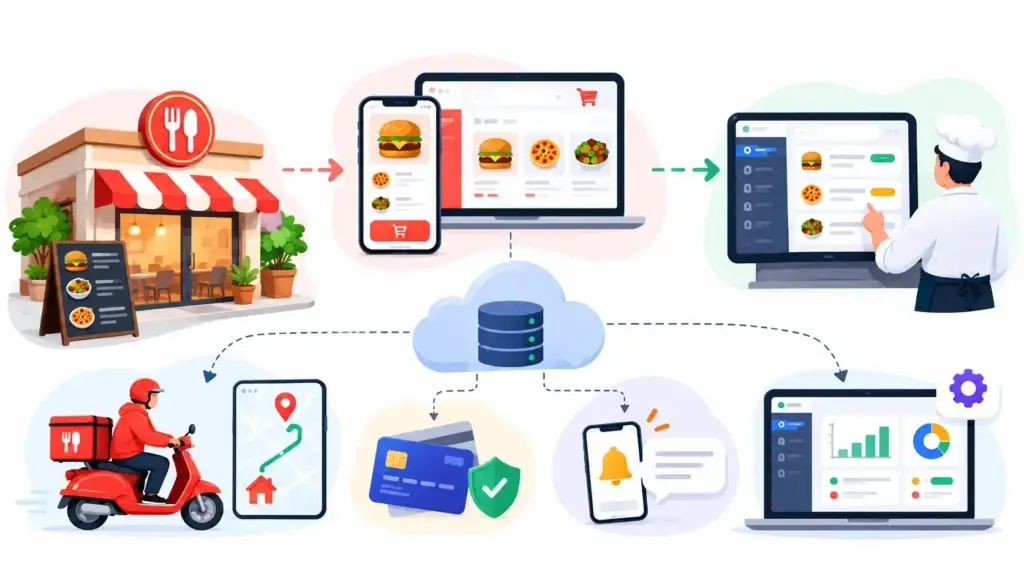
A direct restaurant ordering platform gives restaurants a digital channel through which customers can browse menus, configure items, place orders, pay, and select a fulfillment option.
The important word is direct.
Instead of treating the restaurant merely as a listing inside a broad discovery marketplace, the system can become part of the restaurant’s own digital ordering relationship. Depending on the operating model, customers may order through a branded website, mobile application, or another connected ordering interface while the restaurant manages those orders through its operational dashboard.
This direct relationship also influences how the platform creates value for restaurants and the operator behind it. Founders evaluating this approach should understand the direct restaurant ordering business model, including how restaurant ownership, ordering channels, platform control, and recurring operations fit together.
From a technical perspective, this creates multiple connected layers rather than a single customer-facing application.
The customer layer handles discovery and checkout. The restaurant layer manages menu information and incoming orders. The fulfillment layer handles pickup or delivery. Payment services process transactions. Notifications keep participants informed, while an administrative layer gives the platform operator control over the broader ecosystem.
The business value therefore comes from how well these layers communicate with each other.
A useful real-world model for understanding these connected layers is ChowNow, where restaurant-controlled ordering sits at the center of the customer relationship. Founders who want additional context can explore how direct restaurant ordering works before examining the individual operational workflows in more detail.
The Restaurant Ordering Workflow From Customer Intent to Completed Order
A reliable online ordering workflow begins before the customer presses the checkout button.
The platform first needs accurate restaurant information, operating hours, menu categories, item prices, modifiers, availability, service zones, and fulfillment options. That information shapes what the customer is allowed to order.
Once an order is submitted, the system starts coordinating several different participants.
A typical operational flow looks like this:
- The customer discovers a restaurant and opens its current menu.
- Menu and availability rules determine which products can be ordered.
- The customer selects items, quantities, add-ons, and special instructions.
- The system validates the cart, serviceability, pricing, taxes, and applicable charges.
- The customer chooses delivery or pickup and completes payment.
- The restaurant receives the order through its operational interface.
- Staff accept and begin preparing the order.
- Order status changes are communicated back through the platform.
- Pickup orders move toward customer collection, while delivery orders enter a delivery workflow.
- The order is completed and retained in the platform’s transaction and order history.
Each stage depends on the previous one being accurate. A poor menu configuration creates checkout problems. Delayed restaurant acceptance affects estimated fulfillment time. Incorrect delivery information creates problems after preparation has already begun.
The real challenge is therefore not simply receiving an online order. It is preserving reliable information throughout the complete order lifecycle.
Customer Experience Begins With Accurate Restaurant and Menu Data
Customers make ordering decisions based on the information presented to them. Restaurant status, menu availability, pricing, item options, delivery availability, and estimated fulfillment information all influence whether they continue toward checkout.
This makes menu management an operational capability rather than a purely visual feature.
Restaurants should be able to manage categories, products, prices, availability, add-ons, and relevant ordering information without requiring technical intervention for routine changes. If an item sells out during a busy period, the digital menu should not continue creating demand for something the kitchen cannot prepare.
Menu control is only one part of the wider feature set. When evaluating restaurant ordering platform features, founders should consider how menu management connects with checkout, payments, restaurant operations, order status, pickup or delivery, notifications, and administrative control.
Item customization deserves particular attention. Food orders frequently involve size choices, extras, ingredient preferences, special requests, or combinations. The customer interface has to capture these choices clearly, but the restaurant interface also needs to receive them in an actionable format.
The goal is consistency: what the customer believes they ordered should match what the restaurant believes it needs to prepare.
Cart and Checkout Turn Menu Choices Into an Executable Order
The cart is where customer intent becomes structured order data.
It needs to retain selected products, quantities, add-ons, instructions, pricing, and the chosen restaurant. At checkout, the platform may also need to validate whether the customer address is serviceable, whether the restaurant remains open, whether items are still available, and whether the selected fulfillment method can be supported.
A well-designed checkout should make the transaction understandable before payment. Customers should be able to review the items they selected, applicable charges, delivery or pickup choice, address or collection details, and final amount.
This stage also illustrates why frontend design cannot be separated from backend logic. A polished checkout screen is valuable only when the platform can validate the underlying order conditions correctly.
Payments Need to Stay Connected to Order Status
Payment processing is another point where multiple workflows intersect.
The customer needs confirmation that payment has been processed appropriately, while the restaurant and platform need the transaction associated with the correct order. The administrative system may also require payment records for reconciliation, refunds, disputes, reporting, and operational review.
This makes the relationship between payment state and order state important.
An order should not accidentally enter restaurant preparation because the interface displayed a success screen while the underlying transaction failed. Similarly, payment records should not become disconnected from cancellations or refund workflows.
Secure payment gateway integration, appropriate transaction records, role-based access, and activity logs can therefore form part of a stronger restaurant ordering infrastructure.
Restaurant Acceptance Is the Operational Handoff Point
Once checkout is complete, responsibility begins shifting from customer interaction to restaurant execution.
The restaurant needs an interface that makes new orders immediately understandable. Staff should be able to see the ordered products, item modifications, customer instructions, fulfillment method, relevant timing information, and payment status.
Order acceptance is particularly important because it confirms that the restaurant has received the request and can begin fulfillment.
From there, status management creates a shared operational language between the restaurant, customer, and delivery workflow. Depending on the platform configuration, states may distinguish between an order that has been received, accepted, is being prepared, is ready for collection, has entered delivery, or has been completed.
These statuses are not merely cosmetic progress indicators. They can trigger notifications, delivery actions, customer expectations, and administrative records.
Delivery and Pickup Create Two Different Fulfillment Paths
The ordering journey begins to diverge after food preparation.
For pickup, the operational goal is relatively direct: prepare the order, communicate when it is ready, and support an efficient handoff to the customer.
For delivery, another operational participant enters the workflow.
The system may need to manage delivery availability, customer addresses, service zones, driver or delivery-partner assignment, order handoff, location updates, delivery status, and completion confirmation.
| Workflow Area | Pickup Order | Delivery Order |
|---|---|---|
| Customer location | Collection instructions matter | Delivery address must be serviceable |
| Restaurant handoff | Restaurant → customer | Restaurant → delivery partner |
| Coordination | Preparation and collection timing | Preparation, dispatch, and delivery timing |
| Tracking need | Primarily readiness status | Preparation plus delivery progress |
| Completion | Customer collects order | Delivery reaches customer |
| Operational complexity | Lower | Higher due to additional fulfillment layer |
This distinction matters when founders define the scope of a restaurant ordering system. Supporting delivery is not simply adding another button at checkout. It introduces another operational workflow that must stay coordinated with restaurant preparation.
Why Restaurant Preparation and Delivery Timing Must Work Together
Delivery efficiency can break down even when individual parts of the platform work correctly.
Consider an order assigned for delivery before the kitchen is close to finishing it. The delivery partner may arrive too early and wait. If assignment happens too late, prepared food may sit at the restaurant while the customer waits.
This is why restaurant status data can be valuable to fulfillment coordination.
Preparation progress, readiness signals, delivery assignment, and customer notifications should operate as connected events rather than isolated features. The objective is not merely to move the order through predefined statuses; it is to reduce unnecessary waiting between operational handoffs.
For founders, this is an important design principle: optimize the complete fulfillment chain rather than individual screens.
Real-Time Order Visibility Reduces Uncertainty for Everyone
After an order is placed, customers expect clear updates. They want to know whether the restaurant has accepted the order, when preparation begins, when it is ready, and whether it is out for delivery.
Restaurants need the same visibility from an operational perspective. Staff should be able to quickly identify new, active, delayed, ready, and completed orders without manually checking different systems.
For delivery teams, accurate order status helps coordinate pickup with restaurant preparation. It reduces unnecessary waiting and gives drivers the information needed to complete the final handoff.
A centralized order-status system connects these workflows. Each participant sees the information relevant to their role, while automated notifications keep customers informed as the order moves from acceptance to fulfillment.
The Admin Dashboard Connects the Wider Restaurant Ordering Ecosystem
Customer and restaurant applications handle daily interactions, but the administrative layer determines how effectively the overall platform can be governed.
The operator may need visibility across users, restaurants, orders, payments, delivery activity, service configurations, promotions, disputes, and reporting. Permission-based controls are particularly useful where different operational roles should not have unrestricted access to sensitive information.
This is why platform evaluation should extend beyond the customer ordering interface. The broader set of online restaurant ordering capabilities should be considered across customer, restaurant, fulfillment, and administrative workflows because weaknesses in one layer can create operational problems elsewhere.
A strong administrative layer can help the business answer questions such as:
- Which restaurants are currently active?
- Where are orders failing or being cancelled?
- Which transactions require attention?
- Are menu or availability problems creating customer complaints?
- Which service areas are active?
- Which orders are waiting too long at a particular stage?
- Are refund or dispute cases being resolved?
- Which operational settings need adjustment?
This is one reason a restaurant ordering platform should not be evaluated only through screenshots of its customer application. Backend control directly affects how manageable the business becomes as order volume and restaurant participation increase.
Four Connected Layers That Keep Direct Restaurant Ordering Working
Although implementations differ, founders can evaluate the platform around four operational layers.
| Platform Layer | Primary Responsibility | Business Value |
|---|---|---|
| Customer ordering | Discovery, menu browsing, cart, checkout, payment, order visibility | Makes ordering convenient and understandable |
| Restaurant operations | Menu control, order acceptance, preparation, availability | Connects digital demand with kitchen execution |
| Fulfillment | Pickup readiness or delivery coordination | Moves prepared orders to customers |
| Administration | Platform settings, monitoring, payments, users, restaurants, reporting | Gives the operator visibility and control |
These layers should not become separate technology islands.
The customer interface needs restaurant data. The restaurant interface needs order and payment information. Delivery needs restaurant readiness and customer destination data. Administration needs enough visibility to monitor the overall workflow.
That integration is what turns several individual applications into one functioning restaurant-ordering ecosystem.
How these layers exchange order, payment, restaurant, and fulfillment data becomes an important architecture decision as the platform grows. Founders planning the technical foundation can explore this restaurant ordering app development guide for a deeper look at how the different product components can be structured and connected.
Where Automation Can Reduce Manual Restaurant Operations
Automation becomes valuable when it removes repetitive coordination without taking necessary control away from restaurant teams.
Order notifications, status-triggered customer messages, availability rules, transaction records, delivery updates, and administrative alerts can all reduce manual communication when implemented appropriately.
For example, a customer should not need to telephone a restaurant simply to learn that an accepted order is being prepared. Similarly, restaurant staff should not need to manually communicate routine status information separately to every customer.
Automation is most useful when the platform has reliable underlying data. Automating an inaccurate order state simply distributes incorrect information faster.
Founders should therefore think about automation after defining clear operational states and responsibilities.
Operational Problems a Direct Ordering Platform Should Be Designed to Handle
Restaurant ordering systems operate in a physical environment where exceptions are unavoidable. Products sell out. Customers enter incorrect addresses. Restaurants become overloaded. Payments fail. Orders are cancelled. Delivery can be delayed.
A scalable platform needs workflows for these less-than-perfect situations, not just the ideal order journey.
Important areas include:
- unavailable items and changing menus
- unsuccessful or interrupted payments
- restaurant rejection or delayed acceptance
- customer cancellation requests
- delivery address and service-zone issues
- refunds and disputes
- delayed preparation
- failed delivery attempts
- order-history and transaction review
- administrative intervention
This is where operational architecture often becomes more important than adding another customer-facing feature. Founders should ask not only, “Can a user place an order?” but also, “What happens when the order does not go according to plan?”
Founder Decision Signals
Ordering Ownership
Choose between a branded ordering experience, marketplace model, or a combination of both.
Restaurant Control
Ensure restaurants can manage menus, pricing, availability, and incoming orders easily.
Fulfillment Model
Decide whether the platform supports pickup, delivery, or both based on your operating model.
Admin Visibility
Choose a system that provides clear control over restaurants, users, orders, payments, and fulfillment.
Customization
Keep room for branding, integrations, workflow changes, and future business requirements.
Source-Code Ownership
Source-code ownership provides greater flexibility for future customization and platform expansion.
Launch Speed
A ready-made foundation can reduce development effort and help move the platform toward launch faster.
Ready-Made Foundation vs Building Every Ordering Workflow From Zero
A custom build can make sense when the business model depends on highly specialized processes or unusual integrations. It provides substantial architectural freedom, but that freedom also means common restaurant-ordering workflows must be designed, developed, integrated, and tested.
A ready-made foundation takes a different approach.
That development scope directly influences the investment required to launch the platform. Menu management, payment integrations, restaurant operations, pickup and delivery workflows, administrative controls, and business-specific customization can all affect restaurant ordering platform development cost.
Core workflows such as customer ordering, restaurant management, delivery participation, administration, menu management, checkout, and order status can already exist as a product foundation. Development effort can then focus more heavily on branding, configuration, integrations, and business-specific customization.
For founders, the decision therefore comes down to whether those standard workflows need to be engineered from the beginning or adapted from an existing product foundation. A deeper ready-made vs custom restaurant ordering development comparison can help clarify the trade-offs between customization freedom, development effort, and speed to launch.
Miracuves offers a ready-made direct restaurant ordering solution for founders who want to explore this route. Its current product setup includes user, restaurant, delivery, web, and administrative interfaces, alongside source-code delivery and white-label customization.
For the ready-made configuration, Miracuves currently highlights a 6-day go-live timeline, allowing founders to move toward market deployment without rebuilding standard ordering and fulfillment modules from the beginning.
The important distinction is that launch speed should not replace operational planning. Even with an existing technology foundation, founders still need to define restaurant onboarding, service areas, fulfillment responsibilities, payment configuration, branding, menu setup, customer support, and market-specific requirements.
Why Source-Code Ownership Matters as Restaurant Operations Evolve
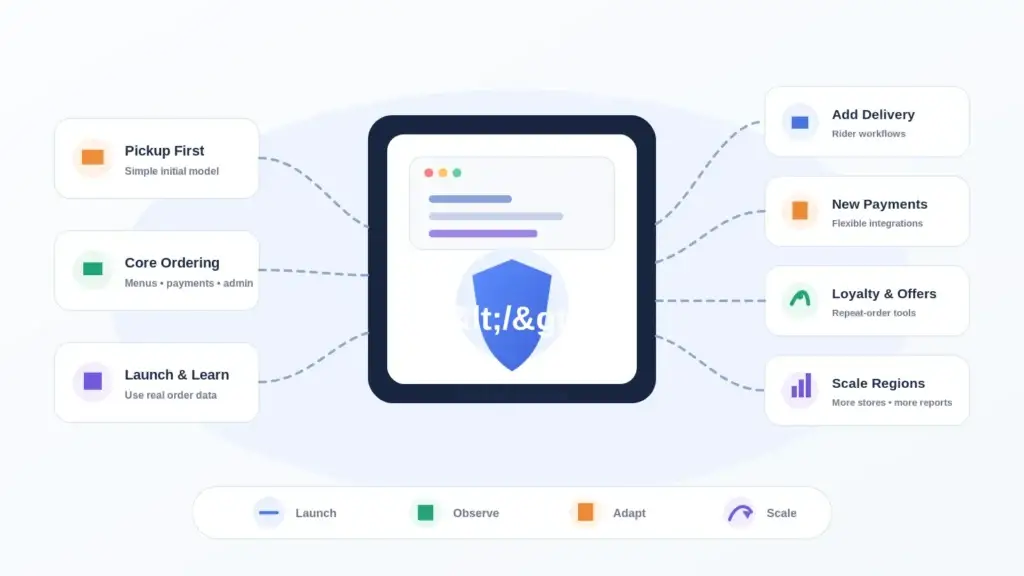
The requirements of an ordering business can change after launch.
A platform may initially focus on restaurant pickup and later introduce delivery. Another may begin with a limited service area before expanding geographically. Businesses may introduce loyalty mechanisms, promotional workflows, different payment integrations, new restaurant controls, or additional administrative reporting.
Source-code ownership gives the platform operator greater technical flexibility to adapt the product foundation as those requirements change.
That does not mean every business needs immediate heavy customization. In many cases, the stronger approach is to launch with the workflows necessary for the initial operating model, learn from real orders, and prioritize changes based on actual operational evidence.
The technology should provide a foundation for that evolution rather than forcing the business to predict every future requirement before launch.
Mistakes Founders Should Avoid When Planning Restaurant Order Fulfillment
One common mistake is concentrating too heavily on the customer application while treating restaurant operations as a secondary concern. An attractive ordering interface cannot compensate for inaccurate menus, unclear kitchen instructions, or weak order management.
Another mistake is treating delivery as a simple extension of checkout. Delivery introduces service areas, assignment, handoffs, tracking, delays, and exception handling that should be considered as their own operational layer.
Founders should also avoid designing only for successful orders. Failed payments, unavailable items, cancellations, refunds, delayed preparation, and delivery exceptions will occur. Defining these workflows early creates a stronger operational foundation.
Finally, adding too many features before understanding the basic order lifecycle can increase complexity without improving fulfillment. The first priority should be making the core journey—from menu discovery through completed fulfillment—reliable and understandable for every participant.
Building a Restaurant Ordering Ecosystem Around the Complete Order Lifecycle
The strongest restaurant ordering experience is not necessarily the one with the largest feature list. It is the one in which information moves reliably between customers, restaurants, fulfillment operations, payments, and platform administration.
Customers should understand what they are ordering and what is happening afterward. Restaurants should receive clear, actionable orders and maintain control over their digital menu. Delivery workflows should connect preparation with final handoff. Platform operators should have the visibility required to manage exceptions and keep the ecosystem functioning.
For founders, that shifts the technology conversation away from simply “building a food ordering app” toward designing a complete digital order lifecycle.
Miracuves supports this approach with a ready-made, customizable restaurant ordering foundation designed to connect customer, restaurant, delivery, and administrative workflows. Businesses evaluating a faster path to deployment can review the restaurant ordering solution and its operating flow before deciding which modules and customizations match their model.
Final Thoughts: Design the Fulfillment Journey, Not Just the Ordering Screen
A customer pressing Place Order is not the end of digital restaurant ordering. Operationally, it is the beginning.
The order still needs to reach the correct restaurant, carry accurate item information, connect with payment status, move through preparation, follow the appropriate pickup or delivery path, generate meaningful updates, and ultimately reach completion.
That complete chain is what founders should evaluate when planning a direct restaurant ordering platform.
The technology becomes valuable when customers, restaurant teams, fulfillment participants, and platform operators can all act on the same order without unnecessary manual coordination. A ready-made foundation can shorten the path to that operating model, while thoughtful customization allows the platform to reflect the business rather than forcing the business to work around the software.
For founders who want to move from workflow planning to implementation, Miracuves provides a white-label, source-code-owned restaurant ordering foundation that can be configured around the required business model and prepared for deployment in as little as 6 days.
FAQs
What is a direct restaurant ordering platform?
A direct restaurant ordering platform connects customers with restaurants through digital ordering interfaces such as web or mobile applications. It can manage menus, carts, payments, restaurant acceptance, preparation status, pickup or delivery, notifications, and administrative oversight as part of one connected order lifecycle.
How does an online restaurant order move from checkout to fulfillment?
After checkout, the order and payment information are passed into the restaurant’s operational workflow. The restaurant accepts and prepares the order, while platform statuses communicate progress. A pickup order moves toward customer collection, whereas a delivery order requires an additional fulfillment workflow involving delivery coordination and final handoff.
What components are important in a restaurant ordering system?
Important components can include customer ordering interfaces, restaurant menu and order management, checkout and payment integration, delivery or pickup workflows, notifications, administrative controls, order history, transaction records, and exception-management processes.
Why is menu synchronization important for online ordering?
Customers need to see information that reflects what a restaurant can actually fulfill. Accurate pricing, item availability, add-ons, operating hours, and menu changes reduce the risk of customers paying for unavailable or incorrectly configured items.
How are pickup and delivery workflows different?
Pickup primarily coordinates restaurant preparation with customer collection. Delivery introduces another operational participant and may require address validation, service zones, assignment, restaurant-to-driver handoff, tracking, and delivery completion.
Why does an admin dashboard matter for a restaurant ordering business?
The administrative dashboard gives the platform operator centralized visibility and control. Depending on the configuration, it can support restaurant and user management, orders, payments, operational settings, disputes, service areas, reports, and other workflows needed to manage the platform.
Should founders build a restaurant ordering platform from scratch or use a ready-made foundation?
The right approach depends on the required workflows and level of specialization. Custom development offers greater freedom for unusual requirements, while a ready-made foundation can reduce the need to rebuild standard ordering, restaurant, delivery, and administrative modules. Miracuves’ ready-made approach is designed for businesses that want customization and source-code ownership while reducing initial development time.
How quickly can a ready-made restaurant ordering platform be launched?
Miracuves currently offers a 6-day launch timeline for its ready-made solution, subject to the required configuration and customization scope. More extensive custom requirements can affect implementation planning.
Miracuves is an independent software development company. We are not affiliated with, connected to, sponsored by, or endorsed by any company or product named in this article.
Terms such as “X Clone” are used descriptively. It is how the software industry refers to building a platform with functionality comparable to a known service, and how clients search for it.
The entire design and codebase of our products is built by our own team. Our products contain no code, design, graphics, or content originating from any third-party website or applications.
All third-party names and marks referenced in this article are the property of their respective owners, referenced solely to identify the services discussed.