Key Takeaways
- A restaurant discovery app is the only model in this category where inventory exists before the relationship does, and that single asymmetry restructures supply, revenue and responsibility.
- Supply acquisition inverts: instead of selling a hypothesis to an empty product, you open the conversation with a month of view counts the restaurant can check against its own till.
- The claim flow is the most important funnel in the business, because every commercial event sits above it, yet most operators instrument orders and never instrument claims.
- Publishing a page about a business that never agreed creates a real duty of care: a correction route reachable without an account, a written removal policy and a free right of reply.
- Riders are optional in this model rather than foundational, which means the catalogue is the product and delivery is a feature bolted onto part of it.
Unclaimed Inventory Signals
- Store source, last confirmed date and confidence per field, not per listing, before the catalogue reaches five figures.
- Put a one-tap correction control on every listing that works with no account and no login.
- Instrument the claim funnel end to end, from owner-attributable views through to first published menu.
- Gate low-risk edits on a phone code and require document verification before any payout destination changes.
- Keep unverified prices out of the order path by enforcing the rule in the data layer, not the interface.
Real Insights
- The restaurants generating the most unmonetized attention sort themselves to the top of your prospect list, which makes the catalogue both the lead list and the pitch deck.
- Fusing the claim with the commercial agreement collapses conversion and costs you the accurate catalogue data the claim would have handed over for free.
- Permanent closure is the most damaging kind of data drift, because the diner travels to a shuttered door and blames the platform rather than the restaurant.
- Because advertising and store subscriptions are charged against attention rather than transactions, the platform can earn from a restaurant that never processes a single order.
- Miracuves builds restaurant discovery and delivery platforms with claim flows, per-field provenance and mixed fulfilment already in place, and eligible ready-made scopes follow a 6-day deployment path for the build itself.
A woman walks into a small biryani place and tells the owner she found it on her phone. She shows him the screen. There is his restaurant, his address, a photograph of his counter that he did not take, a rating of four point one from sixty-three people, and a tag reading “Hyderabadi, Family Dining”.
He has never heard of the company whose name sits at the top of that screen. He has no account with them, has signed nothing and has spoken to nobody. The page has apparently been there eleven months.
Run the same scene on a logistics-led delivery platform, or on a restaurant’s own branded ordering surface. It cannot happen. Nothing exists there until somebody signs. A food discovery app is the only one of the three where inventory arrives before the relationship does.
That asymmetry restructures everything downstream: how supply is acquired, what the funnel actually is, where money comes from, and what duty you take on the moment you publish a page about a business that never asked. This article traces those consequences through a food delivery and restaurant discovery app from the listing outward.
Zomato built a catalogue of restaurants that had not signed anything, and turned presence into partnership from there.
How Restaurant Discovery Sends Customers Before Any Contract
A listing on Zomato can exist, rank and send customers long before the restaurant has agreed to anything.
Most founders meet this fact partway through a build. It belongs on the whiteboard first, because it is the load-bearing wall.
The Listing Arrived Before the Relationship
A restaurant is a public business. Its name, its address, the fact that it is open to anyone who walks in, and the kind of food it serves are all observable from the pavement. None of that is private property and none of it needs permission to write down.
Ratings and reviews are a second category. They are the diner’s account of their own evening, not the restaurant’s information at all. The restaurant is the subject, not the author, and has no more veto than a film has over a review of itself.
Completeness Is the Product
Discovery is a reading product. A diner arrives with no decision made and asks the catalogue a question. It answers well only if it is near-complete for the area, which means including the places with no commercial interest in you yet.
A catalogue containing only your paying restaurants is a list of advertisers, and diners work that out inside two sessions. Completeness is achievable only if listings can exist without consent.
Why Supply Acquisition Runs Backwards in Restaurant Discovery
Every other model in this category has to sell before it has anything to sell. A restaurant discovery app has the thing first and sells into it afterwards, which inverts the supply function.
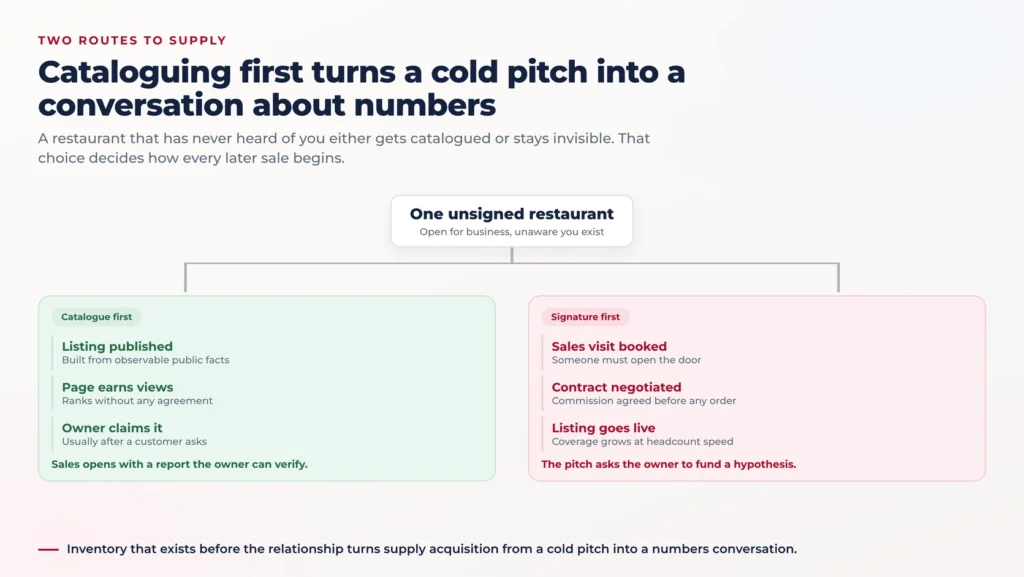
Image Source: AI-generated visual by Miracuves
The Conversation Starts With Evidence, Not a Hypothesis
A representative for a logistics-led platform walks in carrying a hypothesis. Sign here, and orders may follow. The owner is asked to believe in demand that does not yet exist and to accept a commission against it in advance.
A representative for a food discovery app walks in carrying a report. Your page had two hundred and forty views last month. Forty-one people tapped the phone number. Nine asked for directions. Here is the search query that brought most of them.
That is not a better version of the same conversation. The burden of proof has moved, and the owner’s next question stops being “will this work” and becomes “how do I get more of it”.
The Catalogue Is the Lead List and the Pitch Deck
Because every listing carries its own performance data, your prospect list ranks itself. The restaurants generating the most unmonetized attention sort to the top by view count, with no sales hours spent qualifying them. Inbound works the same way: owners find their listing and arrive wanting control of it.
That stream is free supply acquisition, and it is one reason this business model behaves so differently from a logistics-led one that must field a team to open every door.
What Sits Inside an Unclaimed Listing, and What It May Not Say
An unclaimed listing is a particular kind of record: assembled from outside, unconfirmed by its subject, published anyway. Each source carries its own reliability, and the contents have to be chosen with that in mind.
Where the Data Comes From
- Public business registries and municipal licensing records
- The restaurant’s own website and public social accounts
- Licensed commercial place and mapping data feeds
- Diner submissions, corrections and uploaded photographs
- Your own field team walking a neighborhood with a phone
- Ratings and reviews written by diners on your platform
The Line Between Observed Fact and Asserted Fact
An unclaimed listing may safely state what can be observed: name, address, map position, published phone number, cuisine tags, a diner-reported price band, and the ratings your users wrote. It must not imply a commercial relationship. No partner badge. No claim that the menu is current or correctly priced. No delivery estimate for capacity you do not control. Above all, no live order control on a restaurant that cannot receive the order.
The first failure is operational rather than legal. A diner who orders from a restaurant that has no idea your platform exists produces a refund, a furious owner, and a review you never fully undo.
So every attribute needs three things beside it: source, last confirmed date, confidence. At the field level, because a listing can have a verified address and hours nobody has checked since last winter. Retrofitting per-field provenance into a live catalogue of thirty thousand records is a painful migration, and the platform feature set is worth examining against that question first.
The Duty of Care in Publishing Unclaimed Restaurant Listings
You published information about a business that did not ask, and you are directing customers on the strength of it. That is a responsibility with product consequences, not a paragraph in the terms.
A Correction Route a Non-User Can Reach
The owner in the opening scene has no account. If your only correction path sits behind a login he cannot use it, and the wrong address stays wrong while you keep sending people to it.
Put a report control on the listing itself, one tap, open to anybody, asking only for a description and a way to reply. Give it a turnaround you can meet, then meet it. It is the cheapest trust you will ever buy.
Removal, and the Answer You Need Before You Are Asked
Sooner or later an owner asks you to take the page down. Write the policy before that call. Remove without argument: closed businesses, duplicates, private residences mistagged as venues, wrong addresses, anything factually false. Decline politely and consistently: a truthful listing of an open public business, and reviews an owner dislikes. Escalate anything alleging defamation to counsel, because those rules differ by jurisdiction.
An owner should also be able to answer a review publicly without buying anything. Charging for the right to respond to criticism reads exactly as badly as it sounds. Keep reply free at the claimed rung: it is the most persuasive single reason to complete a claim, and it turns a grievance into an account.
The Claim Flow Is the Key Restaurant Discovery Funnel
Every commercial event in this model sits downstream of one moment: a restaurant proving it is itself and taking control of its listing. Nothing is sold before that, yet most operators instrument the order funnel obsessively and never instrument this one.
Where a Claim Actually Starts
Four entry points matter: an “Is this your restaurant?” control on the listing, the same prompt in search results for a branded query, outbound contact on the listed phone or email, and a card left on the counter by a field representative.
The listing control outperforms the rest in most markets. The owner is already looking at the page, usually because a customer just showed it to them, and motivation peaks in that minute.
Instrument It Like a Checkout
- Listing views attributable to an owner rather than a diner
- Claim starts, and where on the page they started
- Verification attempts, and which method was chosen
- Verification passes, and the reason for every failure
- First login, and time elapsed since the claim
- First substantive edit, and first published menu
A drop between verification attempt and verification pass is a supply problem in a technical costume. If half the owners who try to prove they own their restaurant fail, you are losing catalogue quality, menu depth and every revenue line above the claim.
Proving Representation Without a Contract
Verification here is unusual. You are not checking a credential the person holds with you, because they hold nothing with you. You are establishing that a stranger speaks for a business you wrote about.
Match the Proof to the Power You Are Granting
The methods, roughly by friction: read a code to whoever answers the listed phone, send a code to an email on the restaurant’s own domain, post a card to the street address, ask for a registration or licence document, send a field representative, or match a merchant account on a processor the restaurant already uses.
The phone method wins on completion almost everywhere, because the number is in the listing and somebody is standing next to it. It is also the weakest proof, since anyone in the building can answer. So gate actions separately. Editing hours or uploading a photo should clear on a phone code. Changing the payout bank account is the highest-risk action in the system and deserves document verification or a second factor.
When Two People Claim the Same Restaurant
This happens more than founders expect. A business changes hands. A franchisee and head office both want the page. A manager who set up the account leaves on bad terms and keeps the login.
You need a contested state that freezes commercial changes while keeping the listing visible, an evidence hierarchy, and an audit log of who changed what and when. Never transfer control silently on a second successful phone code. The person who loses that transfer will be the honest one often enough to matter.
The Ladder From Presence to Partnership
Presence and partnership are not the same thing. The distance between them is a ladder with five rungs, each a separate commercial event, each separately reversible, and the platform earns differently at every step.
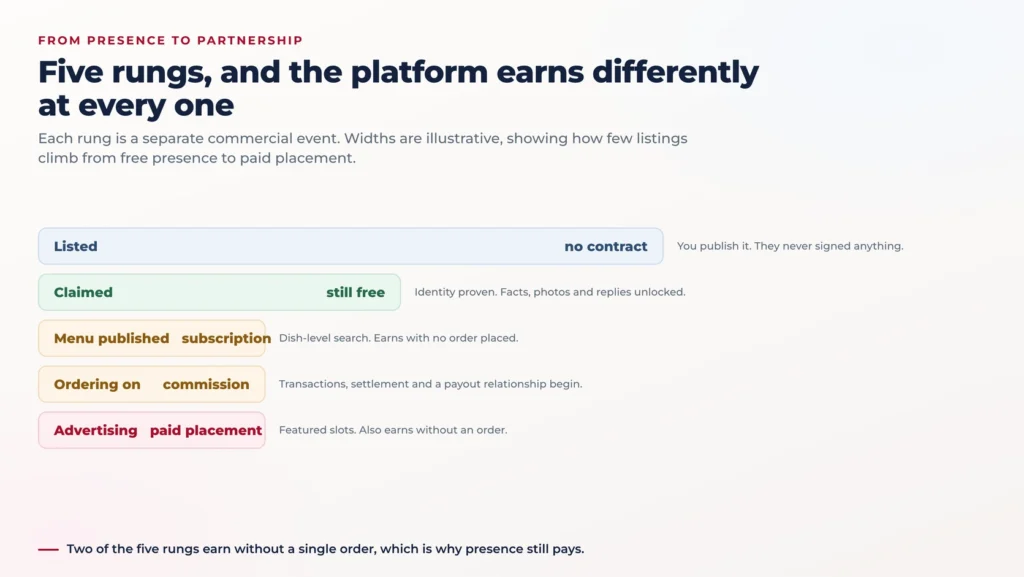
Image Source: AI-generated visual by Miracuves
Five Rungs, Five Different Earnings
The Five Rungs of a Restaurant discovery and delivery app Relationship
| Rung | What the platform gains | How the platform earns |
|---|---|---|
| Listed | Catalogue completeness and an indexable page | Indirectly, through traffic and nearby ad inventory |
| Claimed | A named contact and an accountable owner | Nothing yet, and that is deliberate |
| Menu published | Deep, searchable dish-level catalogue data | Store subscription tiers, which earn without an order |
| Ordering enabled | Transactions, settlement and a payout relationship | Commission on completed orders |
| Advertising | A buyer for placement in a ranking you control | Featured placement, which also earns without an order |
Compressing the Ladder Costs You Supply
The common mistake is fusing the claim and the commercial agreement, so proving you own your restaurant requires accepting a commission rate in the same flow. Conversion collapses, and you lose the free accurate data the claim would have handed you.
Keep them apart. The claim is an identity event. Commercial terms are a separate decision made later, with a month of view counts in front of the owner, which is a far better moment to ask.
The ladder has to work downwards too. A restaurant should be able to switch ordering off for a month and stay listed, claimed and searchable, because refits and staff shortages are ordinary. Operators who punish a step down by demoting the listing find owners stop climbing at all.
What the Restaurant Gets at Each Rung, Stated Honestly
Founders struggle to describe the free rungs without sounding evasive, because the honest description is uncomfortable. Say it plainly anyway. The alternative is being caught out later.
The Rungs Where They Get Something for Nothing
At the listed rung the restaurant receives traffic it did not pay for and often did not know about. In many markets the platform page outranks the restaurant’s own website, so your page does work their web developer never managed.
At the claimed rung they get control of the facts, the photographs and the description, plus the right to answer reviews. Still free, still worth real money. Not a loss leader you tolerate: the reason your catalogue is accurate.
Say the Quiet Part in the Pitch
Above them, three paid rungs buy three different things. A published menu buys long-tail discovery, the diner searching for a dish rather than a cuisine. Ordering buys transactions, settled and reconciled, against a commission. Advertising buys reach beyond what the ranking would have granted organically.
The owner’s real question about the free rungs is what the catch is. The answer: you own the ranking and sell placement inside it, so being visible is free and being prominent is not. Saying that out loud buys credibility. Concealing it produces an owner who works it out in month three and turns adversarial, and the retention patterns in How to Keep Restaurants, Riders, and Customers Happy Simultaneously apply from there.
Founder Decision Signals
Speed
A catalogue can be published before a single restaurant is contacted, so a restaurant discovery app reaches usable size while a logistics-led model is still hiring its first sales team.
Cost
The expensive parts are the catalogue and the traffic. Adding the ten thousandth listing costs a page render and some verification attention, not a sales visit and a contract.
Scalability
Growth is bounded by catalogue coverage and search traffic, not fleet capacity, so a new city is catalogued and indexed long before anyone is hired to operate it.
Market Fit
The model suits markets where diners browse before deciding and restaurants have weak web presence, because that is where your page becomes the restaurant’s front door.
Data Accuracy When Nobody Is Obliged to Tell You
A partner platform has a contractual channel for updates. You do not. An unclaimed restaurant can change its hours, its number, its prices or its entire existence with no reason to tell you.
What Drifts, and How Fast
Menu prices drift fastest and continuously. Hours drift seasonally and around festivals. Numbers drift when a business changes provider. Addresses drift rarely but catastrophically. Permanent closure is worst of all, because a diner travels to a shuttered door and blames you, not the restaurant.
Stale menu data causes conflict even where a signed relationship exists, and The Out-of-Stock Trap: Why Cheap Delivery Scripts Ruin Restaurant Relationships shows that failure from the kitchen’s side. Without a relationship, the same problem arrives with nobody to call.
Corrections and Re-verification You Can Afford
Your diners are standing in front of the restaurant, which makes them a better sensor network than anything you could buy, provided reporting is one tap and not a support ticket. Treat independent agreement as signal strength: three unrelated people reporting the same closed shutter inside a fortnight is near conclusive. Weight reporters by history, auto-apply low-risk corrections past a threshold, and queue anything touching money or identity.
You cannot phone every listing every month, so prioritize by traffic. Heavy weekly views justify frequent confirmation. A tail listing with a handful of views a year gets checked when somebody reports it or a cheap signal fires.
Build the cheap signals early: a number that stops connecting, a website returning an error, a social account quiet for months, a run of reports saying the place looks shut. None proves closure. All justify a check, and together they cover far more of the catalogue than a calling team could.
Showing Confidence, and Degrading Gracefully When It Drops
The instinct is to hide uncertainty, because it looks unprofessional. That is the wrong instinct. Diners tolerate stated uncertainty and punish confident wrongness severely.
Last Updated Is a Feature, Not a Footnote
Show the date a field was last confirmed, beside the field, for hours and menu at minimum. “Hours confirmed three days ago” and “hours last confirmed in March” are different products. It converts owners too: nothing motivates a claim faster than a stale-data notice customers can read.
Low confidence has three responses, chosen per field rather than per listing. Annotate when a phone call resolves the doubt. Demote in the feed and in ranked results when it is material. Suppress when the listing may not exist. Suppression needs a review path, because a wrongly suppressed restaurant loses real customers and never knows why.
Low Confidence Must Never Reach a Checkout
Display data and transactional data are different classes and the boundary is absolute. A price gathered from a photograph, a website or a diner report may be shown, labelled indicative. It may never become the amount a card is charged.
Only a price the restaurant published through its own verified account belongs in the order path. That rule is easy to erode under pressure to launch ordering faster, which is why it belongs in the architecture rather than a policy document. A white label platform should enforce it at the data layer, not the interface.
The Four Parties and What Actually Flows Between Them
Every article in this category says four parties connect. Almost none say what moves. Here is the concrete version, and note how much moves before any money does.
Diners Give Attention First, Money Occasionally
What a diner hands over on a typical visit: a session, a query, a location, filter choices, some taps on listings, and possibly a rating or a photograph. Payment is the rarest item on that list.
That is not a leak in the funnel. Browsing outnumbers ordering by design, and the non-purchasing majority is what makes advertising inventory worth anything. A visitor who reads three listings and leaves has paid you in the currency this model runs on.
Restaurants Give Inventory, Then Pay for Reach
At the unclaimed rung the restaurant gives you something without knowing it: the fact of its existence, which is what makes your catalogue complete enough to be useful. After a claim it gives menu data, hours, photographs and capacity signals, and later a commission or an advertising budget.
In return diners get an answer to a question they arrived with no plan for, and restaurants get rank order, traffic and, higher up, a checkout and settlement. Rank order is the largest of those and the easiest to undervalue. It is the product, the revenue mechanism and the conflict of interest at once.
Riders Are Optional Here, and That Changes the Build
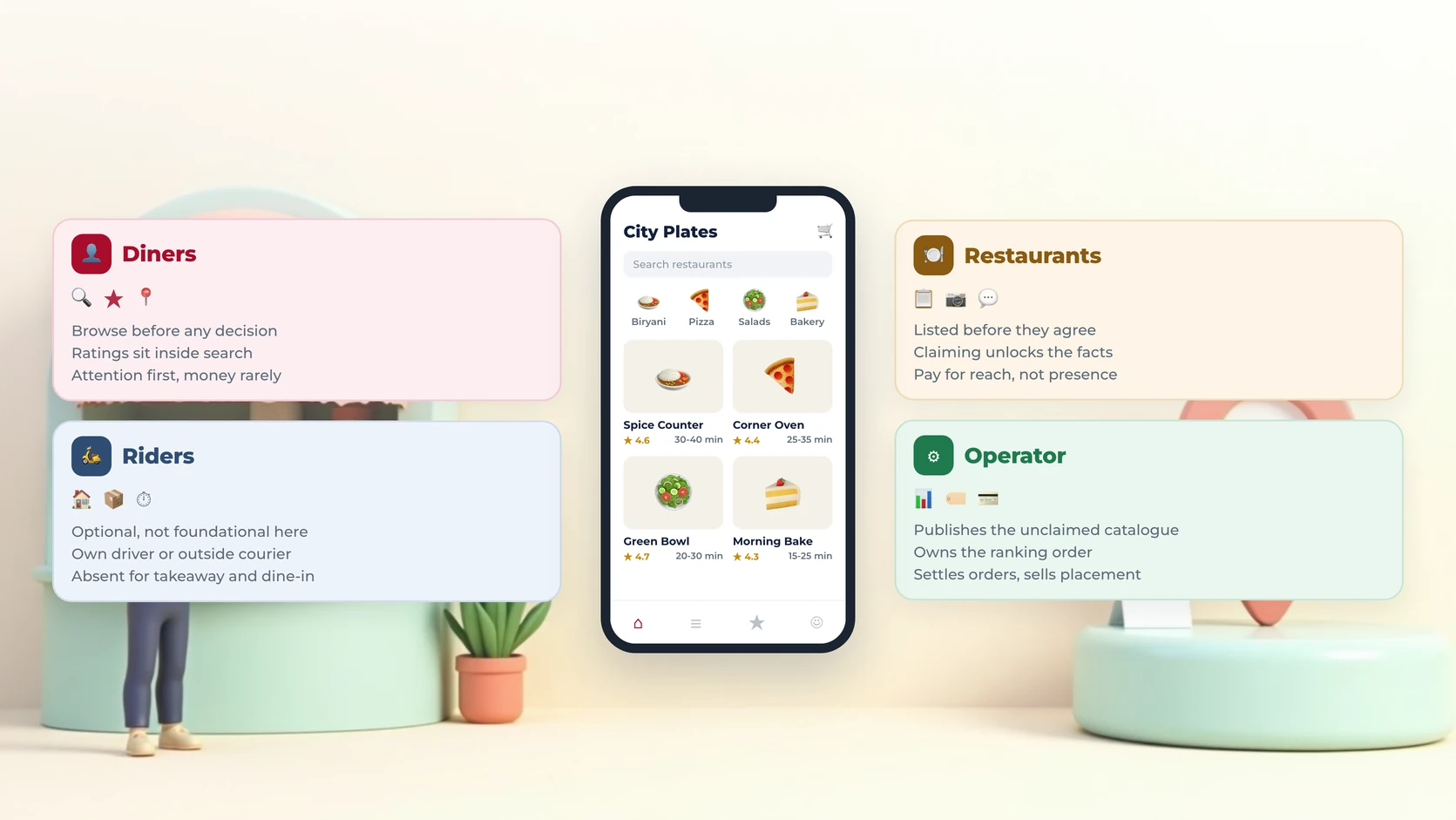
On a logistics-led platform the fleet is the company. Take the riders away and there is no product. Here riders are one fulfilment option among several, and plenty of operators in this category run with none at all.
Three Sources of Delivery Capacity
The restaurant’s own driver, which many already have. An outsourced courier, integrated properly or, at small scale, dispatched by phone. Or nothing at all, because the order is takeaway and the diner is collecting, or the listing is a dine-in venue and your job ended at the booking.
One listing frequently carries all three at once: two streets away on its own scooter, longer runs handed to a courier, collection orders from anywhere. Your order record needs a fulfilment-source field in the first schema, because retrofitting it means rewriting every status flow you have.
A delivery estimate is a promise, and you may only make it for capacity you direct. When the restaurant’s own driver carries the order, the honest interface shows its stated window and names who to contact instead of inventing a countdown you cannot influence. Where you run tracking yourself, Sub-2 Second Tracking: Load-Testing GPS Delivery Updates on Flutter and Laravel is a useful check on what that costs to run properly.
What Optional Delivery Does to the Hiring Plan
A logistics-led operator hires operations people first, because the fleet will not run itself. A discovery operator hires catalogue, content and search people first, because the catalogue is the product and delivery is bolted onto part of it.
That is a different company with a different cost shape. Founders who copy the logistics-led playbook here tend to build an operations team before they have anything for it to operate. The food delivery solution range spans both shapes, and choosing between them is a strategy decision, not a feature comparison.
The Economics of a Catalogue You Never Had to Sign
This model reaches sustainability along a different curve, and the reason is structural rather than clever.
The Marginal Listing Costs Almost Nothing
Two things are genuinely expensive: assembling a catalogue complete enough that diners trust it, and earning the traffic that makes it worth something. Both are front-loaded and both take longer than founders plan for.
Once they exist, the marginal listing is close to free. It costs storage, a page render, an index entry and a small share of verification attention. It does not cost a sales visit, a negotiation or a contract, which is exactly the cost that dominates any model needing a signature per unit of inventory.
Where the Cost Actually Hides
Verification labor, moderation, corrections handling, support for people with no account, and the engineering behind a search index that stays fast as the catalogue grows. All of it scales with catalogue size, not order volume, so founders who model only orders meet a cost base that grows while revenue sits still. The development cost breakdown covers the build; the operating side needs modelling separately.
Against that sits the compensation. Advertising and store subscriptions are charged against attention rather than transactions, so a food discovery app can earn from a restaurant that never processes a single order. A slow ordering ramp is survivable in a way it is not for a commission-only operator.
Three Operator Shapes, and Which One You Are Actually Building
Everything above applies to all three shapes, but the weighting changes sharply, and most founders have not decided which one they are building when they start writing specifications.
Guide, Marketplace or Vertical
A city guide that also delivers puts the catalogue first and ordering on a minority of listings. The unclaimed base stays enormous, claim rates are modest, and revenue leans toward advertising and subscriptions. This shape needs editorial judgement, photography and search competence far more than operations.
An ordering marketplace with a catalogue treats ordering as the point. The unclaimed catalogue fills the map and wins search while the funnel pushes restaurants to the ordering rung fast. Settlement, payouts and support dominate the build, and the claim flow gets the most engineering attention.
A niche vertical catalogue covers a few thousand listings in one category: bakeries, vegetarian kitchens, late-night food, a single regional cuisine. Nearly all of it can be catalogued without a signature, and claim rates run high because the referral is obvious and the audience unmistakably relevant.
The Choice Decides What You Verify
Deciding which shape you are is not a branding exercise. It sets what you verify and how often, how hard you push the claim, which revenue line you build first and who you hire. Working through the full solution catalogue against your own market reaches that decision faster than specifying features in the abstract.
Showing an order button on a listing that cannot receive orders
The diner pays, nothing reaches a kitchen, and you refund a customer while apologizing to an owner who never knew you existed. Ordering controls belong only on listings at the ordering rung.
Fusing the claim with the commercial agreement
Requiring a commission decision inside identity verification collapses claim conversion and costs you the free, accurate data the claim would have delivered. Keep identity and commerce separate.
Hiding corrections behind a login
The people most likely to spot a wrong address are the owner without an account and the diner standing outside. If reporting requires signing in, both give up and the error stays live.
One verification standard for every action
A phone code is right for editing opening hours and badly wrong for changing a payout bank account. One standard is either too heavy at the bottom of the ladder or too light at the top.
Letting unverified prices into the order path
A price scraped from a photograph or submitted by a diner is display data. The moment it becomes the amount charged to a card you have a dispute you cannot win and a relationship you cannot repair.
Modelling costs on order volume alone
Verification, moderation, corrections and search infrastructure scale with catalogue size, not transactions. A plan built around order economics misses the costs that grow first.
Final Thoughts: Presence Is Not Permission
Zomato did not begin by selling to restaurants. It began by already having them.
The owner in the opening scene ended up claiming his listing, correcting his hours, uploading better photographs and eventually buying placement. That is the model working as designed. He climbed a ladder whose first rung existed before he did anything at all.
But publishing a page about a business that never agreed does not end the obligations. You are ranking a restaurant with no account and no obvious route back to you. Accuracy, a correction path a stranger can reach, a written removal policy and an honest description of what you sell are the price of that position, and they are what makes owners climb rather than complain. Choosing a development partner matters here mainly because those rules have to live in the data model, not a policy page.
If you are weighing this against a logistics-led or direct ordering build, settle one question first: does your market reward a complete catalogue or a fast delivery promise. Our food delivery app development service covers both routes, the published facts page sets out what a ready-made deployment does and does not include, and a short consultation is the quickest way to find which shape fits.
FAQs
How does the Zomato business model use unclaimed restaurant listings?
Yes, and it is the structural basis of the model. A restaurant is a public business, so its name, address, cuisine and the fact that it is open are observable facts rather than private property. Ratings and reviews are the diner’s own account of their evening, not the restaurant’s information. Together those build a findable, rankable listing. What the listing may not do is imply a commercial relationship that does not exist.
What must an unclaimed restaurant discovery listing never show?
Anything implying a partnership or a transaction you cannot honor. No partner badge, no claim that the menu shown is current or correctly priced, no delivery time estimate for capacity you do not direct, and above all no live ordering control on a restaurant that cannot receive the order. The first failure there is operational rather than legal: a diner pays, nothing reaches a kitchen, and you refund a customer while apologizing to an owner who never knew you existed.
Why is the claim flow the most important restaurant discovery funnel?
Because every commercial event sits above it. A restaurant cannot publish a priced menu, accept orders, receive a payout or buy placement until it has proven it represents the business. If half the owners who attempt verification fail, you are not losing conversions, you are losing catalogue quality, menu depth and every revenue line on the ladder. Instrument claim starts, verification attempts, passes, failure reasons, first login and first published menu.
How should a restaurant discovery app verify a listing claim?
Match the strength of proof to the power being granted. A code read to whoever answers the listed phone wins on completion rate and is fine for editing hours or uploading a photo. It is weak proof, because anyone in the building can answer, so the payout bank account and bulk review deletion need document verification or a second factor. One standard applied to everything is too heavy at the bottom of the ladder or too light at the top.
What are the five rungs from presence to partnership?
Listed, claimed, menu published, ordering enabled, advertising. Each is a separate commercial event and the platform earns differently at each. Listed and claimed are free to the restaurant. A published menu can sit behind a store subscription, ordering earns commission, and featured placement earns without an order at all. Every rung is separately reversible, so a restaurant should be able to switch ordering off for a month and stay listed.
How do you keep data accurate when nobody is obliged to tell you?
Three mechanisms working together. Make diner corrections one tap and treat independent agreement as signal strength, since three unrelated closure reports inside a fortnight is near conclusive. Prioritize re-verification by traffic rather than trying to phone everything. And build cheap automatic signals: a number that stops connecting, a website returning an error, a social account quiet for months. None proves closure, but all justify a check.
What should happen when confidence in a listing drops?
Show it rather than hide it. Display the last confirmed date beside hours and menu, because diners tolerate stated uncertainty and punish confident wrongness. Then pick a response per field: annotate when a phone call resolves the doubt, demote in the feed when it is material, suppress when the listing may not exist. Keep suppressed listings reachable by direct search with a notice, and give suppression a review path.
Do you need riders to run a discovery platform?
No, and that is the largest structural difference from a logistics-led model. Delivery can come from the restaurant’s own driver, an outsourced courier, or not exist at all for takeaway and dine-in. One listing frequently carries all three modes, so the order record needs a fulfilment-source field in the first schema. It also changes hiring: catalogue, content and search people come before operations people.
Miracuves is an independent software development company. We are not affiliated with, connected to, sponsored by, or endorsed by any company or product named in this article.
Terms such as “X Clone” are used descriptively. It is how the software industry refers to building a platform with functionality comparable to a known service, and how clients search for it.
The entire design and codebase of our products is built by our own team. Our products contain no code, design, graphics, or content originating from any third-party website or applications.
All third-party names and marks referenced in this article are the property of their respective owners, referenced solely to identify the services discussed.