
A regional travel booking platform looks simple from the outside. A traveler enters a destination, selects a date, compares results, pays, and receives a confirmed itinerary. But behind that smooth experience is a layered system of supplier connections, pricing rules, payment verification, booking confirmation, refund logic, admin controls, traveler notifications, and support workflows.
For founders, travel agencies, destination management companies, and regional travel brands, understanding this behind-the-scenes flow matters because the visible app is only one part of the business. The real strength of a travel platform comes from how reliably it handles search, inventory, booking, payment, cancellation, support, and repeat customer engagement.
This guide explains how a regional travel booking platform works from the moment a traveler searches to the moment a confirmed itinerary appears in their account. It also shows what founders should plan before launching a travel platform, what operational layers matter most, and how a ready-made foundation from Miracuves can help reduce the time spent building every workflow from zero.
Key Takeaways
- A regional travel booking platform workflow connects traveler search, supplier inventory, pricing, payment, confirmation, itinerary delivery, and post-booking support.
- The strongest platforms are not just booking screens. They need supplier orchestration, booking records, cancellation logic, refund handling, and admin visibility.
- Regional travel brands need localization, local payment methods, language support, agent workflows, and market-specific inventory control.
- Payment should be verified before supplier confirmation to reduce failed bookings, duplicate charges, and support disputes.
- Miracuves helps founders launch travel booking platforms faster with white-label branding, source-code ownership, admin control, and 6-day delivery for ready-made solution deployments where the scope fits.
Why Regional Travel Booking Platforms Need More Than a Search Screen
Many founders begin with the visible side of the product: flight search, hotel listings, attractive destination pages, payment options, coupons, and booking history. These are important, but they do not define whether the platform can operate reliably. A travel booking business succeeds when the backend can manage unpredictable supplier responses, changing inventory, payment delays, cancellations, policy rules, and customer support requests without breaking the traveler experience.
Regional travel platforms face an additional challenge. They are not always competing only on inventory volume. They often compete on local relevance. A regional platform may need to support weekend routes, bus-heavy markets, local hotel partners, pilgrimage travel, group tours, destination packages, regional languages, agent-assisted bookings, and support teams familiar with local traveler behaviour.
That is why the platform should be designed as a travel commerce system, not just a listing app. Search brings the traveler in, but booking logic, itinerary generation, support handling, and repeat engagement decide whether the traveler comes back.
Read more : Why Startups Choose a Ready-Made Regional Travel Booking Platform Over Custom Development
The Complete Journey: From Search to Confirmed Itinerary
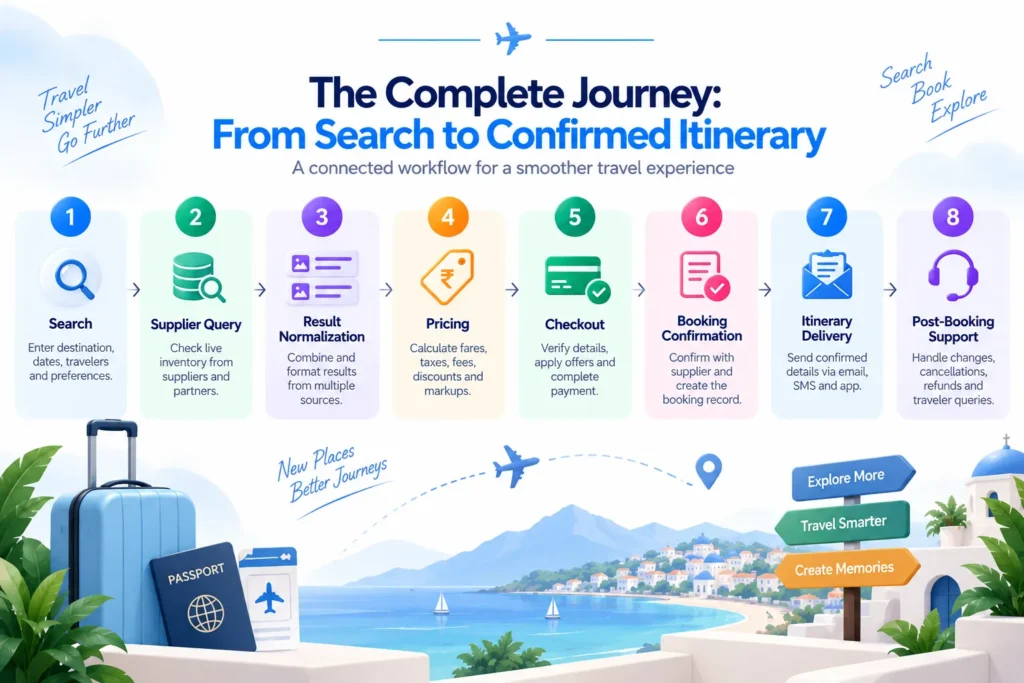
A strong travel booking platform usually follows a connected workflow. Each step passes information to the next one, and every handoff must be controlled carefully. If search is fast but pricing is inaccurate, the traveler loses trust. If payment succeeds but supplier confirmation fails, support teams face complaints. If itinerary details are scattered across emails, travelers struggle during the trip.
The goal is to create one reliable journey where the traveler knows what they are booking, what they are paying, what is confirmed, and where to go if plans change.
Travel Booking Platform Workflow Map
| Workflow Stage | What Happens Behind the Scenes | Why It Matters for Founders |
|---|---|---|
| Search | The system reads traveler intent, dates, locations, guests, routes, filters, and category-specific rules. | Accurate search creates the first layer of trust and reduces irrelevant results. |
| Supplier Query | The platform checks connected suppliers, internal inventory, hotel listings, package data, or local partners. | Supplier speed and reliability directly affect conversion. |
| Result Normalization | Different supplier responses are converted into one consistent format for display. | Travelers can compare options clearly instead of seeing confusing mixed data. |
| Pricing | Base rates, taxes, convenience fees, commissions, markups, discounts, and wallet rules are calculated. | The platform protects margin while showing transparent pricing. |
| Checkout | The system verifies user details, creates a payment order, applies discounts, and locks payable amount. | A controlled checkout reduces failed payments and double-charge disputes. |
| Booking Confirmation | After payment verification, the platform confirms with the supplier and creates the booking record. | This is where the platform becomes operationally reliable or risky. |
| Itinerary Delivery | Confirmed travel details are sent through email, SMS, app notification, and user dashboard. | Clear itinerary delivery reduces support tickets and traveler anxiety. |
| Post-Booking Support | Cancellations, refunds, changes, disputes, and support conversations are linked to the booking record. | Support quality determines repeat trust and brand reputation. |
Step 1: Travel Search Starts With Intent, Not Just Destination
When a traveler searches for a trip, the platform does more than match a destination keyword. It must understand the category being searched, the route or location, date flexibility, number of travelers, room occupancy, fare type, budget, cancellation preference, and sometimes purpose of travel.
For flights, the system may process departure city, arrival city, one-way or return route, cabin class, passenger mix, stops, baggage rules, and fare families. For hotels, it may process destination, check-in and check-out dates, room count, guest count, amenities, star rating, review score, meal plan, and cancellation terms. For packages, it may handle nights, activities, transfers, inclusions, group size, and custom requests.
This matters because regional travel platforms often serve travelers with very specific needs. A family booking a holiday package is not searching the same way as a business traveler booking a same-day flight. A student looking for a low-cost bus route is not behaving like a corporate user booking within a travel policy. The platform should capture these differences early so the rest of the workflow can respond correctly.
Search Filters Should Match the Category
A common mistake is using generic filters across all travel categories. Flights need airline, stops, time, duration, baggage, and fare type. Hotels need price, star rating, amenities, locality, room type, and cancellation policy. Buses need boarding point, dropping point, seat type, operator, and departure time. Packages need destination theme, duration, inclusions, transport, meal plan, and activity type.
When category-specific filters are missing, users may still see results, but those results feel less useful. That reduces confidence and increases drop-offs before checkout.
Step 2: Supplier APIs and Inventory Sources Power the Results
Once the traveler submits a search, the platform must check one or more inventory sources. These may include flight suppliers, hotel wholesalers, direct hotel inventory, bus operators, rail partners, cab providers, activity vendors, package inventory, or manually managed local listings.
In a regional platform, supplier strategy is especially important. Founders may not start with every category connected to live supplier inventory. Some may begin with directly listed hotels, curated holiday packages, local activities, regional cab operators, or agent-assisted bookings. Others may begin with high-demand categories like hotels and buses before adding more complex supplier integrations.
The platform should support this phased approach. It should allow the operator to activate or deactivate categories, connect supplier accounts, manage fallback sources, add direct listings, and decide which inventory appears in which market.
Why Supplier Orchestration Matters
Supplier orchestration means the platform knows which supplier to query, how to handle slow responses, how to merge results, how to identify duplicate inventory, and how to continue operating if one supplier fails. Without this layer, a single supplier issue can make a whole category appear broken.
A practical travel booking platform should support primary suppliers, fallback suppliers, direct inventory, and admin visibility. The founder should know which categories are live, which suppliers are responding, where errors are happening, and how many searches are converting into confirmed bookings.
Step 3: Results Must Be Normalized Before Travelers Compare Options
Different suppliers may return data in different formats. One hotel supplier may structure room rates differently from another. One flight source may return baggage information in a separate field. One activity provider may use different age groups for pricing. If this raw data is shown directly, the platform becomes confusing.
Result normalization solves this problem. The backend converts different supplier responses into a consistent format before showing them in the app or website. Travelers then see comparable names, prices, images, policies, ratings, inclusions, availability, and booking rules.
For founders, this layer is easy to underestimate. But it affects every part of the booking experience. Clean result data improves filtering, sorting, price comparison, itinerary creation, support resolution, and reporting.
Ranking Results Should Support Business Goals
Search results should not be ranked only by the lowest price. A regional travel business may want to prioritize high-margin packages, trusted local hotels, preferred partners, verified vendors, refundable fares, or inventory with better confirmation reliability. This does not mean hiding choice from travelers. It means using ranking logic that balances user relevance with business sustainability.
Good ranking logic can consider price, availability, popularity, margin, cancellation terms, review quality, supplier reliability, and user behaviour. Over time, this helps the platform show better options without depending only on discounts.
Step 4: Pricing Logic Protects Both Traveler Trust and Platform Margin
Travel pricing is rarely a simple base rate. The final amount may include supplier cost, platform markup, taxes, convenience fee, payment fee, coupon discount, wallet balance, gift card value, loyalty benefit, add-on services, and cancellation protection. If these rules are not organized clearly, the platform can either lose margin or surprise users with fees late in checkout.
A regional booking platform should show clear pricing before payment. Travelers should understand what is included, what is optional, what is refundable, and what will be charged immediately. This is especially important for categories like hotels, holidays, and activities, where inclusions and cancellation terms affect the decision.
For operators, pricing logic should be configurable. The admin team may need category-wise margins, supplier-wise margins, route-based fees, package markups, agent commissions, coupon limits, wallet rules, and corporate pricing. Without a control layer, even small pricing changes require developer involvement, which slows down operations.
Step 5: Traveler Profiles Reduce Friction During Checkout
When a traveler chooses an option, the platform should make checkout faster by reusing saved traveler information. This may include passenger names, age, gender, identity details where required, phone number, email, billing details, loyalty profile, wallet balance, preferred payment method, and past booking data.
For regional travel platforms, saved traveler profiles are useful because many bookings are repeat or family-based. A user may book for parents, children, employees, or group members. If the platform forces repeated manual entry, checkout becomes slower and mistakes become more likely.
Good profile logic also supports support teams. When a traveler raises a cancellation request or asks about a booking, the support team should see the booking, passenger details, payment status, supplier status, and communication history in one place.
Step 6: Checkout Should Verify Payment Before Confirming the Booking
The most sensitive moment in a travel booking platform is checkout. The user has selected an option, entered details, applied offers, and decided to pay. If payment succeeds but the supplier does not confirm, the platform must handle the situation quickly and clearly. If payment fails but the system still attempts booking, the operator faces reconciliation problems.
A reliable workflow usually follows a controlled sequence: create payment order, lock payable amount, collect payment, verify gateway response, confirm booking with supplier, create booking record, generate itinerary, and notify the traveler. If supplier confirmation fails after payment, the platform should trigger a clear refund or support workflow instead of leaving the traveler uncertain.
This is one of the biggest differences between a simple listing website and a serious travel booking platform. The platform must treat payment, supplier confirmation, booking status, and itinerary generation as one connected transaction flow.
Why Double-Charge Protection Matters
Travelers may tap the payment button twice, refresh the checkout page, switch networks, or return from a payment screen after a delay. Payment gateways may also retry callbacks. The platform should process every transaction safely so the same booking is not created twice and the user is not charged multiple times for one trip.
Double-charge disputes create immediate trust issues. They also consume support time, finance time, and refund processing effort. For founders, checkout reliability should be treated as a core business feature, not a technical detail hidden in the backend.
Step 7: Booking Confirmation Creates the Single Source of Truth
After successful payment and supplier confirmation, the platform creates a booking record. This record becomes the single source of truth for the traveler, support team, finance team, supplier, agent, and admin. It should include booking ID, category, traveler details, supplier reference, payment status, fare details, taxes, cancellation terms, itinerary data, refund status, support tickets, and notification history.
Without a strong booking record, every operational task becomes harder. Support agents struggle to answer questions. Finance teams struggle to reconcile payments. Travelers struggle to find trip details. Admin teams struggle to understand which categories are performing and which suppliers are creating issues.
A confirmed itinerary is not only a PDF or email. It is the visible output of a structured booking record that powers trip management, cancellation, refund, support, loyalty, and reporting.
What a Confirmed Itinerary Should Include
- Traveler name and contact details
- Booking reference and supplier confirmation reference
- Travel category and trip details
- Date, time, location, route, stay, or activity information
- Passenger or guest details where applicable
- Payment summary and invoice information
- Cancellation and refund terms
- Support contact or help center link
- Important instructions for check-in, boarding, pickup, or arrival
The itinerary should also remain available in the traveler dashboard, not only in email. Many travelers search for trip details while moving, often with limited time, poor network, or urgent support needs. Keeping everything in one dashboard improves trust and lowers support pressure.
Step 8: Notifications Keep the Traveler Informed After Booking
A travel platform should not go silent after payment. Travelers expect confirmation messages, itinerary emails, app notifications, reminders, support updates, cancellation alerts, refund updates, and trip-related instructions. These messages should be timely, accurate, and connected to the booking record.
Notifications may go through email, SMS, push notification, WhatsApp-style messaging, or in-app alerts depending on the market and available integrations. Regional platforms should choose channels based on traveler behaviour. In some markets, SMS and phone support may still be important. In others, app notifications and email may be enough.
The important part is consistency. If the payment is confirmed, the traveler should know. If the booking is pending, the traveler should know. If a refund is initiated, the traveler should know. Silence creates anxiety, and anxiety creates support tickets.
Step 9: Cancellations, Refunds, and Changes Need Clear Rules
Travel plans change often. A platform that handles only new bookings but struggles with cancellations will create operational problems quickly. Cancellations and refunds should be connected to category rules, supplier rules, payment method, cancellation window, user role, and admin approval where required.
For example, a hotel cancellation may depend on check-in date and room policy. A package cancellation may depend on vendor terms and activity inclusions. A cab booking may have a different cancellation window. A corporate booking may require approval before changes. A booking made through an agent may need commission adjustment during refund processing.
This is why cancellation logic should not be treated as an afterthought. The platform should show cancellation terms before booking, store those terms in the booking record, and guide the traveler through the request without hiding key information.
Refund Visibility Builds Trust
Travelers do not only want refunds processed. They want to know what is happening. A good refund workflow shows request status, expected timeline, deduction details, original payment method, wallet credit where applicable, and support history. This keeps the traveler informed and reduces repeated follow-ups.
For operators, refund visibility also helps finance teams. They can review refund queues, failed refund attempts, supplier deductions, gateway status, and manual exceptions from the admin side.
Step 10: The Admin Dashboard Controls the Platform Behind the Scenes
The admin dashboard is where the travel business actually runs. It is not just a user-management screen. It should give the operator control over categories, suppliers, bookings, users, agents, vendors, payments, coupons, margins, refunds, support, reports, permissions, and platform settings.
For a regional travel booking platform, admin control is especially important because markets change quickly. A founder may need to add a new local hotel partner, pause a supplier, adjust margins on packages, create a festival campaign, assign support tickets, approve vendor listings, review refund requests, or track agent performance.
If the admin dashboard is weak, the business becomes dependent on developers for routine operational changes. That slows execution and increases cost. A strong control layer allows the operator to manage the platform like a business, not just a software project.
Admin Modules Founders Should Prioritize
- Booking management: View, update, cancel, refund, and support bookings across categories.
- Supplier management: Connect suppliers, manage credentials, define fallback rules, and monitor errors.
- Inventory management: Add hotels, activities, packages, transfers, or manually controlled regional listings.
- Margin control: Set category-wise, supplier-wise, route-wise, or package-wise pricing rules.
- User and role management: Give different access to admins, support teams, finance teams, agents, vendors, and corporate users.
- Promotions and wallet: Manage coupons, cashback, wallet credits, gift cards, and loyalty rules.
- Support dashboard: Link tickets and chat history to booking records.
- Reports and analytics: Track searches, bookings, revenue, cancellations, refunds, supplier performance, and repeat users.
Founders should treat admin control as a core part of the product. The traveler app may create demand, but the admin layer decides whether the business can fulfil that demand profitably.
Read more: What Mistakes Should Startups Avoid When Launching a Regional Travel Booking Platform?
Regional Localization: The Layer That Makes the Platform Market-Ready
A regional travel platform should not feel like a generic booking site with a local logo. It should reflect how people in the target market search, pay, ask questions, compare options, and make travel decisions.
Localization can include language support, regional payment methods, local taxes, market-specific cancellation rules, popular routes, destination guides, local holiday calendars, support hours, travel agent workflows, and curated package inventory. For some markets, local buses and short-stay hotels may drive repeat traffic. For others, pilgrimage packages, weekend holidays, corporate travel, or activities may matter more.
This is where regional brands can create an advantage. Large generic platforms may offer broad inventory, but regional platforms can build deeper relevance around local routes, local support, local packages, and local travel behaviour.
Agent, Vendor, and Corporate Workflows Expand the Platform Beyond Direct Bookings
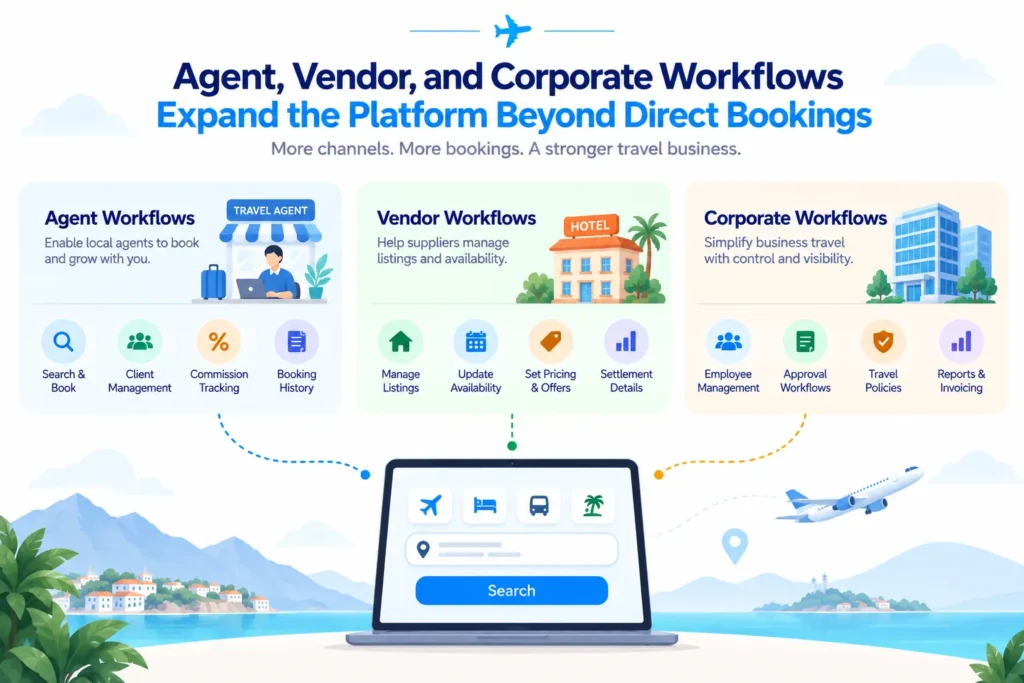
A regional travel platform does not have to depend only on direct consumer bookings. It can also support travel agents, hotel partners, activity providers, transport vendors, and corporate travel accounts. These channels can increase distribution and reduce dependency on paid acquisition.
An agent portal allows local travel agents to book for their customers, manage commissions, view booking history, and serve offline demand through a digital system. A vendor portal allows hotels, homestays, activity providers, or package partners to manage listings, pricing, availability, documents, and settlement details. A corporate portal allows companies to manage employee travel, approval flows, spend policies, and trip records.
These workflows matter because travel is often assisted, especially in regional markets. Not every customer wants to complete every booking alone. Some want help from an agent, family member, support team, or company travel desk. A flexible platform should support both self-service and assisted booking.
Security and Access Control Should Be Built Into Every Workflow
Travel platforms handle personal details, payment status, trip information, identity-related documents in some cases, supplier credentials, refund records, and admin decisions. That makes security a foundation, not an optional add-on.
The platform should use secure sign-in, encrypted data transfer, role-based access control, audit logs, secure payment gateway integration, protected supplier credentials, input validation, and permission-based dashboards. Admin and finance roles should have stricter access controls because they can view sensitive operational and payment information.
Security should also support operational trust. If a refund was approved, the system should show who approved it. If supplier credentials changed, the system should log the change. If a support agent accessed a booking, the action should be traceable. These records help the business investigate issues and improve accountability.
For a deeper security-focused guide, founders can review Miracuves’ travel booking platform security guide to understand trust, access controls, payments, APIs, and operational safeguards in more detail.
Revenue Logic: How the Workflow Connects to Monetization
Behind every booking workflow is a revenue model. A regional travel platform may earn from category margins, hotel commissions, package markups, service fees, convenience fees, vendor subscriptions, agent commissions, corporate travel plans, insurance or visa assistance, advertising placements, loyalty programs, and wallet-driven repeat bookings.
The important point is that monetization should be connected to the workflow, not pasted on top later. If the platform has no margin engine, the operator cannot control profitability by category. If the platform has no agent commission logic, it becomes harder to build a distribution network. If the platform has no wallet or loyalty system, repeat bookings may depend too heavily on discounts.
Founders who want to go deeper into the revenue side can use the regional travel booking platform business model guide as a supporting reference for how bookings, suppliers, agents, and operations connect commercially.
Ready-Made Foundation vs. Building Every Workflow From Zero
Building a travel booking platform from zero gives full flexibility, but it also means every search, supplier, booking, payment, refund, dashboard, notification, and support workflow must be planned, developed, tested, and maintained. For founders trying to validate a regional travel business quickly, that can delay market entry.
A ready-made foundation can shorten the path because the core workflows already exist. The founder can focus on branding, market selection, supplier relationships, categories, pricing, operations, and launch strategy instead of spending months only on base platform mechanics.
Ready-Made vs. Custom Travel Platform Build
| Decision Area | Ready-Made Foundation | Custom Build From Zero |
|---|---|---|
| Launch Speed | Faster when the required modules match the existing platform scope. | Slower because every module must be planned, designed, built, and tested. |
| Core Booking Flow | Search, checkout, booking records, and itinerary logic are already structured. | Booking logic must be developed and tested from the ground up. |
| Founder Focus | More time can go toward suppliers, marketing, regional positioning, and operations. | More early time goes toward product specifications and engineering decisions. |
| Customization | Best for founders who need a proven foundation with market-specific adjustments. | Best for unusual business models or highly specialized workflows. |
| Operational Risk | Reduced if the existing modules already cover the booking categories and control layers needed. | Higher early risk because reliability depends on new development and testing. |
Miracuves supports founders with a ready-made travel booking platform foundation that can be adapted for branded regional travel businesses, supplier workflows, agent operations, and multi-category booking. For ready-made deployments where the final scope matches the solution boundary, Miracuves can support a 6-day delivery path.
Founder Decision Signals Before Building a Regional Travel Booking Platform
Founder Decision Signals
Market Focus
Start with the routes, categories, and traveler segments you can serve better than a generic booking platform. Regional relevance matters more than copying every possible category from day one.
Supplier Readiness
Decide which inventory can go live immediately and which supplier agreements will take time. Your launch plan should match supplier availability, not assumptions.
Operational Control
Make sure admins can manage bookings, refunds, margins, agents, vendors, coupons, and support without depending on developers for every small change.
Customer Trust
Transparent pricing, accurate itinerary delivery, responsive support, secure payments, and visible refund status are essential for repeat bookings.
Common Mistakes Founders Should Avoid
Mistakes Founders Should Avoid
Starting With Too Many Categories Without Supplier Clarity
It is tempting to launch flights, hotels, buses, cabs, activities, packages, and more at once. But if supplier relationships are not ready, the platform may look complete while live booking reliability remains weak. Start with categories you can fulfil properly and expand with control.
Treating Payment and Booking as Separate Problems
Payment success does not automatically mean booking success. The workflow should verify payment, confirm with the supplier, create the booking record, and handle failures clearly. Otherwise, failed confirmations can become refund and support problems.
Ignoring Refund and Cancellation Workflows
Travel plans change often. If cancellation rules, refund status, supplier deductions, and support history are not connected, the team will spend too much time resolving avoidable confusion.
Launching Without Admin Visibility
Founders need to see searches, bookings, failed payments, supplier errors, refunds, support tickets, and revenue reports. Without admin visibility, operational problems stay hidden until customers complain.
Depending Only on Discounts for Growth
Discounts may bring first-time users, but they do not build long-term loyalty on their own. Wallet credits, service quality, reliable support, curated inventory, agent networks, and regional trust are more durable retention levers.
How Miracuves Helps Founders Move From Workflow Planning to Launch
Miracuves helps founders turn travel platform planning into a launch-ready product by starting with the core workflows that matter: search, supplier connections, checkout, booking records, itinerary delivery, wallet, admin control, agent workflows, vendor management, support, and reporting.
Instead of treating the platform as a collection of screens, Miracuves focuses on the operational journey behind those screens. That includes how the traveler searches, how inventory appears, how pricing is calculated, how payment is verified, how the booking is confirmed, how support sees the booking, and how the operator manages the business from the backend.
For founders evaluating a broader travel technology stack, the white-label travel portal page is a useful next step because it explains how branded travel portals can support flights, hotels, holidays, agents, and platform control under one business identity.
Final Thoughts: The Real Platform Starts After the Search Button
A regional travel booking platform is not successful because it displays travel options. It is successful when it turns search intent into a reliable confirmed itinerary, supports the traveler after payment, gives the operator control, and creates a repeatable business workflow.
The journey from travel search to confirmed itinerary involves supplier orchestration, result normalization, pricing logic, payment verification, booking records, itinerary delivery, support workflows, refund handling, and admin reporting. Each layer protects trust and improves the founder’s ability to scale.
For founders, the smarter question is not only “How do we build the app?” The better question is “How will the platform behave when real travelers search, pay, cancel, ask for help, and book again?” When that workflow is planned well, the travel brand has a stronger foundation for regional growth.
FAQs
What is a regional travel booking platform workflow?
A regional travel booking platform workflow is the complete process that connects traveler search, supplier inventory, result comparison, pricing, payment, supplier confirmation, itinerary delivery, cancellation handling, refunds, support, and admin reporting. It explains what happens behind the scenes after a traveler searches and before the itinerary is confirmed.
How does a travel booking platform confirm an itinerary?
A travel booking platform confirms an itinerary by verifying the payment, sending the booking request to the selected supplier or inventory source, receiving confirmation, creating a booking record, generating itinerary details, and notifying the traveler through email, app notification, SMS, or the user dashboard.
Why is supplier API integration important in travel booking platforms?
Supplier API integration is important because it connects the platform to live or managed travel inventory such as flights, hotels, buses, activities, cabs, or packages. Strong supplier integration helps the platform show availability, pricing, booking rules, confirmation status, and cancellation terms more reliably.
What should founders prioritize when building a regional travel booking platform?
Founders should prioritize reliable search, supplier readiness, transparent pricing, secure checkout, booking confirmation logic, itinerary delivery, admin control, cancellation handling, refund visibility, and support workflows. Regional localization, agent operations, local payment methods, and market-specific inventory should also be planned early.
How does the admin dashboard help a travel booking business?
The admin dashboard helps the platform operator manage bookings, users, suppliers, agents, vendors, payments, refunds, margins, promotions, support tickets, reports, and platform settings. It gives the business team operational control without requiring developers for every routine change.
Can a ready-made travel booking platform support regional travel startups?
Yes, a ready-made travel booking platform can support regional travel startups when it includes the core workflows required for search, booking, payments, itinerary delivery, admin control, agents, vendors, support, and reporting. The final fit depends on the founder’s target market, supplier relationships, required categories, branding needs, and customization scope.
Miracuves is an independent software development company. We are not affiliated with, connected to, sponsored by, or endorsed by any company or product named in this article.
Terms such as “X Clone” are used descriptively. It is how the software industry refers to building a platform with functionality comparable to a known service, and how clients search for it.
The entire design and codebase of our products is built by our own team. Our products contain no code, design, graphics, or content originating from any third-party website or applications.
All third-party names and marks referenced in this article are the property of their respective owners, referenced solely to identify the services discussed.