


























Key Takeaways
- Property-Level SPVs vs Pooled Real Estate Funds represent two different investment and platform models: one focuses on specific assets, while the other provides exposure to a broader managed portfolio.
- Property-level SPVs give investors clearer asset-level visibility, ownership records, property-specific reporting, distributions, and exit information.
- Pooled real estate funds emphasize diversification, manager discretion, portfolio-level performance, and centralized capital allocation.
- The structure affects the entire platform, including investor dashboards, ownership records, distribution logic, reporting, compliance workflows, admin controls, and monetization.
- The right model depends on the investor promise, deal pipeline, operational capacity, regulatory pathway, and whether investors want to choose individual properties or trust a broader investment strategy.
Structure Signals
- Property-level SPVs require asset-specific investment memos, funding targets, ownership registers, share classes, documents, distributions, updates, and exit histories.
- Pooled funds require fund-level subscriptions, capital commitments, portfolio allocation, NAV reporting, investor classes, management fees, distribution schedules, and redemption processes.
- SPV platforms generally emphasize property-level performance and ownership, while pooled funds emphasize portfolio composition, strategy, manager performance, and aggregate reporting.
- Distribution logic differs because SPV income can be tied to a specific asset, while pooled-fund distributions generally reflect broader portfolio-level rules.
- Both models require KYC, investor eligibility, role-based access, audit logs, secure payments, ownership or allocation records, and appropriate reporting controls.
Real Insights
- A property-level SPV may be the stronger fit when investors want to answer, “Which property am I investing in?” and see asset-specific ownership and performance.
- A pooled fund may be stronger when investors want to answer, “Which strategy or manager do I trust?” rather than selecting individual properties.
- Neither structure is automatically simpler. SPVs increase asset-level administration, while pooled funds introduce fund-level governance, valuation, allocation, and reporting complexity.
- Founders should define the investment structure before designing the application because the legal and operational model determines the required dashboards, ledgers, documents, distributions, and admin workflows.
- The strongest decision path is: define investor promise → assess deal pipeline → choose property-level or portfolio exposure → map ownership and distribution logic → design compliance and admin workflows → define monetization → build the platform around the selected structure.
Choosing between a property-level SPV and a pooled Real Estate Crowdfunding Platform is not just a legal structuring decision. For a founder, it shapes the entire product experience.
It decides whether investors choose specific properties or invest into a broader strategy. It affects how dashboards are designed, how income is distributed, how performance is reported, how exits are explained, and how much operational control the admin team needs behind the scenes.
For founders building a property investment product, this question usually appears early:
Should every property have its own structure, or should investor money flow into one pooled fund?
There is no universal answer. A property-level SPV can create clarity around one asset, one ownership record, and one distribution path. A pooled fund can support diversification, manager discretion, and portfolio-level investing. The right choice depends on your investor promise, regulatory path, deal pipeline, operational capacity, and long-term monetization model.
This guide breaks down the difference from a founder and platform-architecture perspective.
What Is a Property-Level SPV?
A property-level SPV is a separate investment vehicle created for one specific property or project. The SPV typically holds the asset or the economic interest in that asset, and investors participate in that particular opportunity.
In a platform context, this means each property listing can have its own:
- Investment memo
- Funding target
- Investor cap table or ownership register
- Share class or participation record
- Rental income distribution logic
- Asset-level documents
- Exit history
- Property-specific updates
This structure works well when the investor experience is deal-by-deal. The user browses individual properties, compares expected yields, reviews documents, checks location details, and decides where to invest.
A property-level SPV becomes easier to understand when investors can see how each asset is structured, funded, tracked, and reported. For readers who want a deeper explanation of the legal and operational logic behind this model, you can read Miracuves’ guide on how SPVs work in real estate crowdfunding.
From a founder’s perspective, the benefit is clarity. Investors know what they are funding. The platform can show property-level performance. Admin teams can manage income, expenses, distributions, ownership changes, and exit events at the asset level.
The tradeoff is operational weight. More properties can mean more records, documents, approvals, bank/payment flows, reports, and investor communications to manage.
What Is a Pooled Real Estate Fund?
A pooled real estate fund collects investor money into a broader vehicle that invests across multiple assets according to a defined strategy. Instead of selecting one specific property, investors usually buy into the fund’s overall mandate.
That mandate might be:
- Commercial rental income
- Residential redevelopment
- Short-term rental assets
- Debt-backed property opportunities
- Mixed real estate income strategy
- Region-specific property exposure
- Opportunistic acquisition strategy
In this model, investors typically care less about one property and more about the manager’s ability to source, allocate, manage, and exit assets across a portfolio.
For a platform, this changes the product experience. The dashboard may focus on fund NAV, portfolio composition, performance summaries, distribution history, risk exposure, and manager updates rather than individual property ownership records.
The benefit is diversification and strategic simplicity for investors. The tradeoff is lower deal-level control and more dependence on trust in the manager.
Property-Level SPVs vs Pooled Funds: The Practical Comparison
Property-Level SPV vs Pooled Fund Comparison
| Decision Area | Property-Level SPV | Pooled Real Estate Fund |
|---|---|---|
| Investor Choice | Investors choose specific properties or projects. | Investors join a broader strategy managed by the fund operator. |
| Transparency | High asset-level visibility with property-specific documents and updates. | Portfolio-level visibility, usually focused on aggregate performance. |
| Diversification | Depends on how many separate properties the investor selects. | Built into the fund if the portfolio holds multiple assets. |
| Admin Complexity | More asset-level records, distribution runs, documents, and ownership tracking. | More fund-level governance, reporting, valuation, and allocation management. |
| Investor Education | Requires explaining each property, risk, yield, holding period, and exit plan. | Requires explaining the fund strategy, manager discretion, fees, and portfolio risk. |
| Reporting Model | Property-level reports, documents, ownership records, and distribution history. | Fund-level statements, portfolio updates, NAV reports, and strategy commentary. |
| Best Fit | Deal-by-deal fractional property platforms. | Portfolio-style property investment products. |
When a Property-Level SPV Makes More Sense
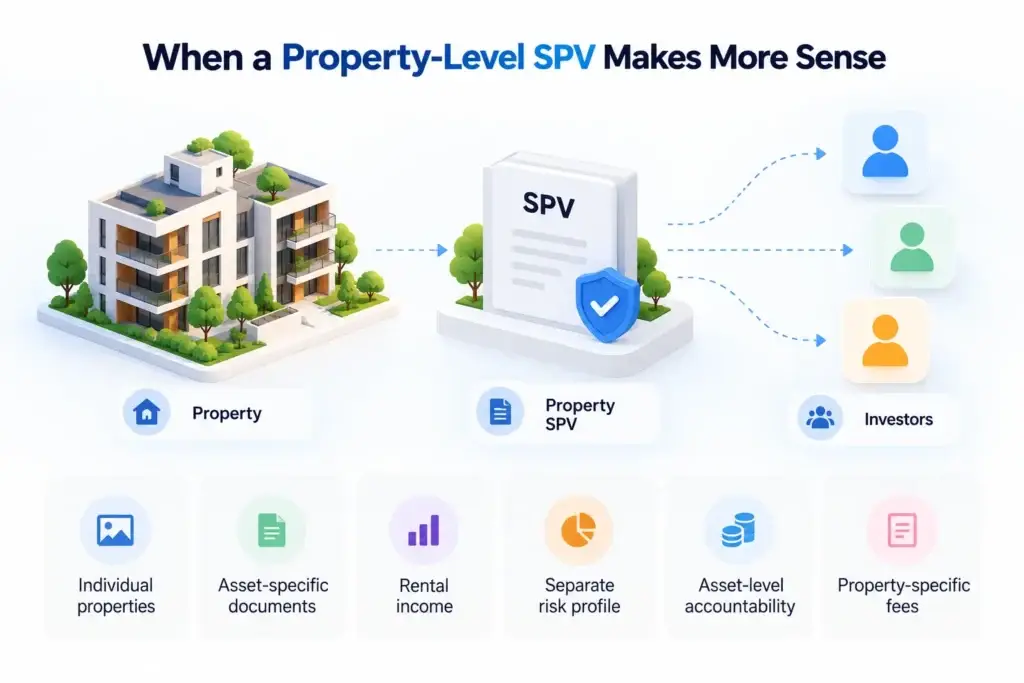
A property-level SPV is usually a stronger fit when the platform’s promise is specific asset access.
This model works well when users want to ask:
Which property am I investing in?
What documents support this deal?
What income does this asset generate?
What percentage or share do I hold?
What happens if this property is sold?
How are rental distributions calculated?
For a founder, this model is useful when each property is part of the product story. The listing page matters. The investment memo matters. The property photos, location, occupancy, rental assumptions, capital stack, and exit logic all become conversion assets.
A property-level SPV may fit when:
- The platform lists individual commercial or residential properties.
- Investors expect to choose deals manually.
- Each property has a separate risk profile.
- Rental income and capital returns should be tracked per asset.
- The platform wants clearer asset-level accountability.
- The admin team can manage property-specific documents and reporting.
- The business model includes listing fees, acquisition fees, management fees, exit fees, or secondary-market fees per asset.
This structure is often attractive for early platforms because it gives founders a focused launch path. Instead of building a broad fund product immediately, the platform can begin with a small number of well-documented property opportunities and validate investor appetite.
When a Pooled Real Estate Fund Makes More Sense
A pooled fund makes more sense when the platform’s promise is not “choose this property” but “trust this strategy.”
In this model, the user invests into a managed portfolio. The founder’s job is to communicate the strategy clearly: what assets the fund will buy, how risk is managed, how returns are distributed, how fees work, and how investors can understand performance over time.
A pooled fund may fit when:
- The platform has a strong investment-management thesis.
- Investors prefer diversification over deal selection.
- The operator has a repeatable acquisition pipeline.
- The fund manager needs flexibility to allocate capital quickly.
- The product is positioned around portfolio exposure.
- Reporting can be handled at the fund and portfolio level.
- Investors are comfortable with manager discretion.
The major benefit is scalability of strategy. A pooled vehicle can support multiple assets without asking investors to approve or select every property. The tradeoff is that the product must work harder to build trust in the manager, governance, reporting discipline, and investment policy.
The Investor Experience Is Completely Different
The structure you choose decides what your platform interface should emphasize.
In a property-level SPV model, investors need detailed deal pages. They expect to see documents, property data, projected income, ownership terms, funding progress, holding period, exit assumptions, and updates tied to that asset.
In a pooled fund model, investors need fund-level clarity. They expect a clear strategy, portfolio breakdown, risk disclosure, manager commentary, fund documents, historical performance reporting, and distribution statements.
This matters because a platform should not make a pooled fund look like a deal-by-deal marketplace if investors cannot actually choose the underlying assets. It should also not make property-level SPVs feel like a generic fund if ownership, distributions, and exits are tied to specific assets.
Clarity reduces confusion. Confusion increases support tickets, legal review pressure, investor hesitation, and conversion friction.
How Structure Affects Admin Workflows
Founders often compare SPVs and funds from the investor side, but the bigger operational impact appears in the admin console.
A property-level SPV model needs strong asset-level controls. Admins may need to manage:
- Property creation and approval
- Document uploads
- Funding rounds
- Investor allocations
- Ownership records
- KYC status
- Payment confirmation
- Rental income entries
- Distribution approvals
- Capital returns
- Exit events
- Secondary transfer requests
- Investor statements per property
A pooled fund model needs strong fund-level controls. Admins may need to manage:
- Fund subscriptions
- Capital commitments
- Capital calls where applicable
- Portfolio allocation
- NAV updates
- Fund reports
- Investor classes
- Distribution schedules
- Management fees
- Performance fees where applicable
- Redemption windows
- Fund document updates
The platform backend must support more than property listings. It needs ownership records, investor status, payment tracking, distribution history, document access, and approval controls. Miracuves explains these core modules in its SPV, ledger, and investor workflow features, which is useful for founders planning the operational layer behind a property investment product.
Neither model is “simple.” They are complex in different ways. The founder’s real question is:
Which complexity matches the business we are trying to build?
Founder Decision Signals
Speed
If you want to validate with a few property opportunities, a property-level SPV model may be easier to explain to early investors because each deal has a clear asset story.
Cost
SPVs can increase operational and documentation work per asset, while pooled funds can increase governance, reporting, and fund administration complexity.
Scalability
Pooled funds can scale strategy-wide capital allocation, while SPV platforms can scale through repeatable property onboarding and automated investor operations.
Market Fit
If users want control and transparency, SPVs may fit better. If users want diversified exposure with less decision-making, pooled funds may be stronger.
Compliance and Trust: Do Not Treat Structure as Just a Product Feature
Real estate investing is usually a regulated activity. The exact requirements depend on the jurisdiction, investor type, offering structure, marketing rules, securities laws, fund rules, tax treatment, and the legal documents used.
This is where founders should be careful. A software platform can support compliance workflows, but software does not replace legal advice, authorization, licensing, exemptions, or jurisdiction-specific review.
At the product level, your platform should be designed to support trust-building workflows such as:
- KYC and investor verification
- Investor eligibility checks
- Role-based admin access
- Audit logs
- Document acceptance records
- Investment memo access
- Payment confirmation records
- Distribution history
- Ownership records
- Admin approval workflows
- Dispute and support history
- Secure payment gateway integration
- Encrypted data transfer and storage
For property-level SPVs, trust depends heavily on proving who owns what in each asset. For pooled funds, trust depends heavily on proving how capital is allocated, how the fund is governed, and how performance is reported.
Trust depends on how well the platform controls investor verification, document acceptance, role-based access, audit logs, and transaction visibility. Founders can strengthen this layer by reviewing the key platform risk controls needed for a more reliable property investment workflow.
Both models need a serious control layer.
How Distributions Differ Between SPVs and Pooled Funds
Distribution logic is one of the most important differences.
In a property-level SPV model, income can be tied to a specific property. If Property A generates rental income, the distribution can be calculated for investors who participated in Property A. If Property B has a vacancy, that issue should affect Property B investors, not everyone across the platform.
This creates a clean investor narrative, but it requires precise ledgers and ownership records.
In a pooled fund model, income is usually distributed according to fund-level rules. The investor may not receive income from one specific property. Instead, distributions reflect the fund’s broader portfolio results, after expenses, reserves, fees, and allocation rules.
This can be easier for investors who want simplicity, but it requires clear reporting so users understand why distributions move up or down.
For founders, the lesson is simple: distribution logic should be designed before the interface is designed. Otherwise, the dashboard may promise clarity the backend cannot support.
How Liquidity and Exits Should Be Explained
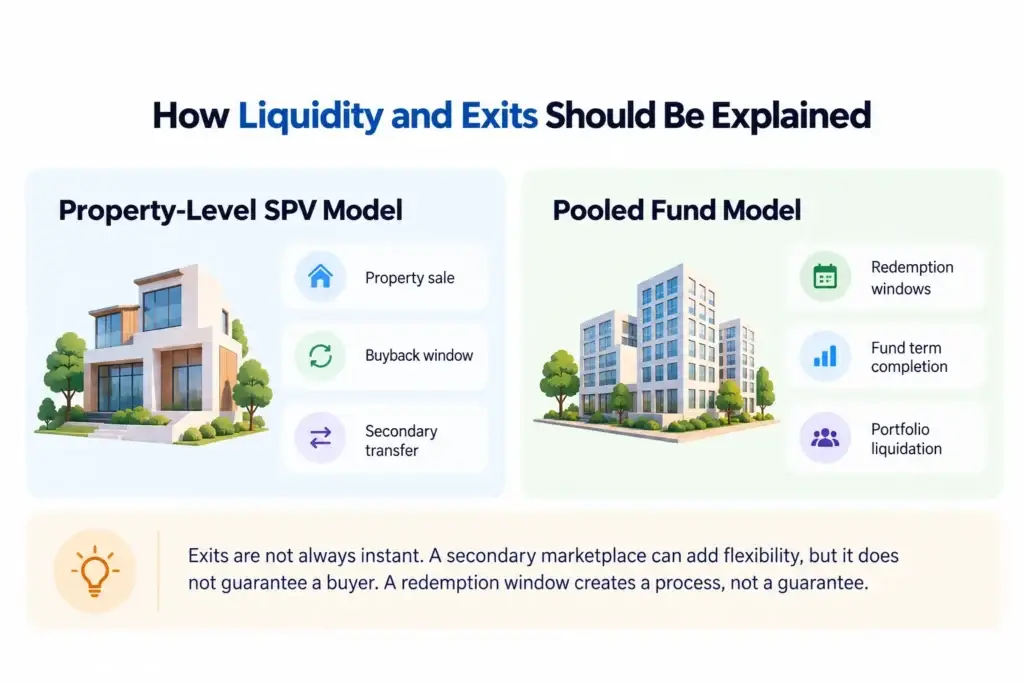
Liquidity is one of the easiest areas to overpromise and one of the hardest to execute.
In a property-level SPV model, exits may happen through:
- Property sale
- Buyback window
- Internal secondary transfer
- Redemption process, if permitted
- Hold-to-maturity strategy
- Refinancing event, where applicable
In a pooled fund model, exits may happen through:
- Redemption windows
- Fund term completion
- Portfolio liquidation
- Secondary transfer, where permitted
- Manager-led liquidity events
The platform should never make exits look instant unless the operating model genuinely supports it. A secondary marketplace can improve flexibility, but it does not guarantee that a buyer will be available. A redemption window can create a process, but it does not always mean liquidity is guaranteed.
A better platform explains liquidity honestly. That protects investor trust and reduces future disputes.
Monetization Differences Founders Should Consider
The investment structure also affects revenue design.
A property-level SPV platform can monetize around each deal or asset. Common revenue logic may include:
- Listing or onboarding fees
- Acquisition or sourcing fees
- Asset management fees
- Distribution processing fees
- Exit or sale-related fees
- Secondary transfer fees
- Document or reporting service fees where appropriate
A pooled fund model usually monetizes at the fund level. Common revenue logic may include:
- Management fees
- Performance-based fees where legally permitted
- Subscription or platform access fees
- Administration fees
- Redemption or transfer processing fees
- Portfolio reporting service fees
The investment structure also influences how the platform earns revenue. A property-level SPV model may support deal-based fees, asset management charges, exit-related fees, or secondary transfer fees, while a pooled model may rely more on fund-level management or performance-based fees. For a deeper revenue breakdown, see Miracuves’ guide to crowdfunding business model and revenue streams.
The key is alignment. Fees should match the value the platform provides and should be explained clearly before investors commit.
Mistakes Founders Should Avoid
Choosing a structure only because it sounds simpler
A pooled fund may sound simpler to users, but it can be more complex in governance and reporting. A property-level SPV may sound more transparent, but it can create more asset-level administration.
Designing the app before defining the investment model
The dashboard, ledger, documents, investor statements, and admin workflows should reflect the legal and operational structure. Product design should follow the investment model, not the other way around.
Overpromising liquidity
Investors should understand whether exits depend on buyer demand, redemption windows, property sales, or fund-level policies. Liquidity language must be realistic.
Ignoring admin workload
More properties, investors, documents, payouts, and compliance checks require strong admin controls. A weak backend can make a promising investment product difficult to operate.
Which Structure Fits Your Platform?
A property-level SPV may be the better starting point if your platform is built around transparency, asset selection, property-level storytelling, and deal-by-deal investor participation.
A pooled fund may be the better choice if your platform is built around manager expertise, diversification, portfolio strategy, and centralized allocation.
Here is the simplest decision logic:
Choose property-level SPVs when the investor asks, “Which property do I want to invest in?”
Choose a pooled fund when the investor asks, “Which strategy or manager do I trust?”
That difference should guide your product architecture, compliance workflows, admin controls, reporting design, and monetization model.
Where Miracuves Fits Into the Decision
Miracuves helps founders move from structure clarity to product execution. For property investment products, the real challenge is not only building a clean frontend. The backend needs investor onboarding, admin approval flows, ownership records, payment workflows, distribution logic, reporting, and compliance-ready controls.
If you are planning a deal-by-deal property investing platform, you can explore Miracuves’ ready-made property investment platform as a launch-ready foundation. It is designed for founders who want to move faster with white-label branding, source-code ownership, admin control, and a 6-day delivery timeline for ready-made deployment.
You can also review Miracuves’ Real Estate & PropTech software development expertise if your idea needs a custom structure, hybrid model, or broader property-tech ecosystem.
Final Thoughts: Choose the Structure Before You Build the Platform
Property-level SPVs and pooled real estate funds solve different problems.
SPVs help investors understand one property at a time. They support transparency, asset-level reporting, deal-specific ownership, and clearer property-level distributions.
For founders still comparing execution paths, the right decision is not only SPV vs pooled fund. It is also whether to build from zero or start with a proven software foundation. This comparison of a ready-made vs custom crowdfunding platform can help you evaluate speed, control, cost, and long-term flexibility before development begins.
Pooled funds help investors access a broader strategy. They support diversification, manager discretion, portfolio-level reporting, and centralized capital allocation.
For founders, the stronger decision is not the structure that sounds more sophisticated. It is the structure that matches your investor promise, operational capacity, legal pathway, and product roadmap.
Once the structure is clear, the next question is usually budget. Founders comparing build options can review the real estate crowdfunding development cost to understand how pricing changes based on modules, customization, integrations, and launch scope.
Once that decision is clear, the platform can be built with the right workflows from the beginning.
FAQs
What is the main difference between a property-level SPV and a pooled real estate fund?
A property-level SPV is usually tied to one specific property or project, while a pooled real estate fund invests across multiple assets under a broader strategy. The SPV model gives investors more deal-level visibility, while the pooled fund model gives investors broader portfolio exposure.
Is a property-level SPV better for fractional property investing?
It can be a strong fit when investors want to choose specific properties and track asset-level ownership, income, and exits. However, the right structure depends on jurisdiction, legal advice, investor type, and operating model.
Is a pooled fund easier to scale?
A pooled fund can scale capital allocation across multiple assets more efficiently, but it also requires strong governance, fund reporting, valuation logic, and investor communication. It is not automatically simpler.
Which model is better for a new founder?
A property-level SPV model may be easier to explain when launching with a small number of specific properties. A pooled fund may fit better when the founder has a strong investment strategy, reliable deal pipeline, and fund-management capability.
How does the structure affect investor reporting?
SPV-based platforms usually need property-level reports, ownership records, document access, and distribution history. Pooled funds usually need fund-level statements, portfolio summaries, NAV reporting, and manager updates
Can a platform support both SPVs and pooled funds?
Yes, but supporting both models increases product, legal, reporting, and admin complexity. Founders should usually validate one clear structure first before adding a hybrid model.
Does software make a property investment platform compliant?
No. Software can support compliance workflows such as KYC, audit logs, access controls, document records, and investor verification. Final compliance depends on jurisdiction, legal review, licensing or exemptions, integrations, and the operating model.
What should founders decide before development starts?
Founders should decide whether investors are choosing individual properties or investing into a managed strategy. That decision affects the dashboard, ledger, documents, distributions, exit workflows, admin panel, and monetization model.
Miracuves is an independent software development company. We are not affiliated with, connected to, sponsored by, or endorsed by any company or product named in this article.
Terms such as “X Clone” are used descriptively. It is how the software industry refers to building a platform with functionality comparable to a known service, and how clients search for it.
The entire design and codebase of our products is built by our own team. Our products contain no code, design, graphics, or content originating from any third-party website or applications.
All third-party names and marks referenced in this article are the property of their respective owners, referenced solely to identify the services discussed.