


























Key Takeaways
- International investor onboarding for UAE property investment platforms requires a structured process covering identity verification, investment eligibility, payment arrangements and regulatory compliance.
- Know Your Customer (KYC) and Anti-Money Laundering (AML) procedures help platforms verify investor identities, assess financial crime risks and identify potentially suspicious activities.
- Foreign investor eligibility depends on the investment structure, property location, applicable ownership restrictions and regulatory requirements rather than nationality alone.
- A reliable onboarding experience should combine transparent currency conversion, secure payment processing, clear investment disclosures and ongoing compliance monitoring.
KYC Verification and International Investor Eligibility
- Investor registration should collect relevant identification details, residency information, contact details and supporting documents according to the platform’s applicable KYC requirements.
- Identity verification workflows should support document authentication, sanctions screening, risk assessment and enhanced due diligence where investor circumstances require additional checks.
- Eligibility checks should evaluate investor categories, minimum investment requirements, permitted ownership structures and restrictions associated with specific UAE property opportunities.
- Onboarding systems should clearly communicate verification status, missing documentation, approval decisions and any restrictions preventing an investor from completing a transaction.
Currency Management, Payments and UAE Compliance
- International payment workflows should distinguish the investor’s funding currency from the property’s investment currency and disclose exchange rates, conversion charges and settlement amounts.
- Property investment platforms should use appropriately authorized payment providers and maintain accurate records of deposits, refunds, investment allocations and distributions.
- Regulatory compliance should consider the platform’s legal structure, applicable UAE financial authorities, investor protection requirements, AML obligations and relevant property registration rules.
- A scalable international onboarding system should combine secure document storage, audit trails, ongoing investor reviews and transparent reporting to support compliant cross-border property investments.
The UAE continues to attract international interest in real estate, with digital investment platforms making it easier for overseas investors to explore property opportunities without needing to complete every administrative step in person. However, welcoming investors from different countries involves significantly more than providing property listings, account registration, and online payment options.
Every international investor brings a combination of identity, residency, banking, ownership, and regulatory considerations. A person may be eligible to acquire an interest in a particular property but still require additional verification before investing through a digital platform. Similarly, an investor may complete identity verification successfully but face restrictions relating to the investment product, source of funds, or payment arrangements.
For property investment businesses, international investor onboarding is therefore both a compliance responsibility and an operational challenge. A well-structured process must establish who the investor is, whether they qualify for the investment, how their funds will move, and what monitoring is required after the transaction.
This guide explains the essential components of onboarding international investors into UAE property investment platforms, including KYC documentation, investor eligibility, cross-border payments, regulatory requirements, and practical workflow design.
Why International Investor Onboarding Matters for UAE Property Investment Platforms
Property investment platforms increasingly serve people who live, work, and hold bank accounts outside the country where the underlying assets are located. This creates opportunities for broader investor participation, but it also introduces more complicated verification and transaction processes.
A UAE-based investment operator may receive registrations from residents, expatriates, international professionals, corporate investors, and individuals investing through overseas legal entities. Although these investors may access the same digital platform, their documentation requirements and eligibility assessments may differ substantially.
For example, an individual investing from Europe may need to provide a foreign passport, residential address evidence, tax residency details, and banking information. An investment through a company may require incorporation documents, ownership declarations, and identification of the individuals who ultimately control the entity.
The challenge becomes more significant when the platform provides fractional ownership, recurring distributions, or investment transfers. These activities create ongoing relationships that require controls beyond initial registration.
Effective onboarding helps businesses reduce incomplete applications, identify high-risk transactions, maintain reliable investor records, and provide clearer expectations about when an investor can begin participating.
Just as importantly, it helps prevent a common operational mistake: treating the creation of a user account as equivalent to approval to invest.
Understanding KYC Requirements for International Property Investors
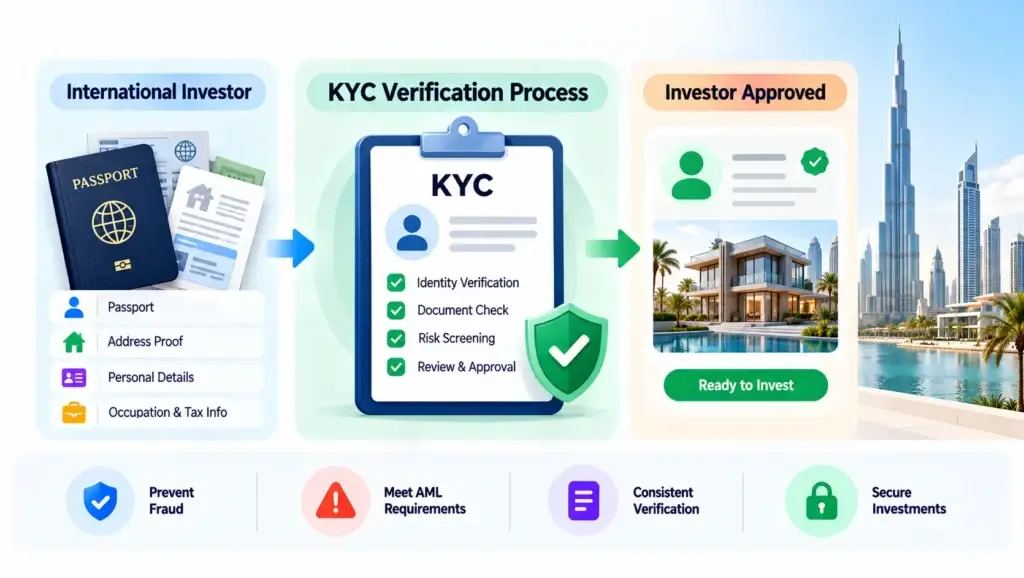
Know Your Customer (KYC) verification is one of the most important steps in onboarding international investors into UAE property investment platforms. It helps businesses establish an investor’s identity, evaluate potential compliance risks, and determine whether additional verification is necessary before permitting investment activities. For platforms accepting investors from multiple countries, KYC is closely connected to customer due diligence (CDD), anti-money laundering (AML) obligations, beneficial ownership verification, and ongoing transaction monitoring.
The UAE’s anti-money laundering framework includes Federal Decree-Law No. 10 of 2025 and its implementing regulations, which establish relevant obligations for entities operating within the applicable regulatory framework. However, the precise requirements depend on the nature of the investment activity, the operator’s regulatory classification, and the jurisdiction in which the business operates. Property investment platforms must therefore develop onboarding procedures that reflect their specific business model rather than assuming that a single verification checklist will satisfy every regulatory requirement.
A structured KYC process should establish what information must be collected, how documents will be verified, which applications require additional review, and who has authority to approve an investor. This helps operators maintain consistent verification standards while making the onboarding experience more understandable for legitimate international investors.
Identity Verification for Individual Investors
Individual investor verification begins with collecting reliable information that establishes the applicant’s identity and supports the platform’s applicable due diligence requirements. Depending on the investor’s circumstances, this may include a valid passport, residential address documentation, nationality, date of birth, and contact details. Additional information concerning tax residency, occupation, expected investment activity, and the purpose of the investment relationship may also be necessary.
International investors can present additional verification challenges because identification formats, address documents, and official records vary across jurisdictions. Platforms should therefore establish procedures for evaluating document authenticity, checking consistency between submitted information, and identifying cases that require clarification or supplementary evidence. Where remote identity verification is used, the selected verification methods should be appropriate for the operator’s regulatory obligations and assessed risks.
Digital onboarding can simplify the collection of investor information through guided document uploads, identity verification integrations, and automated completeness checks. However, uploading a passport or completing an electronic identity check does not necessarily mean that all required customer due diligence procedures have been satisfied. Depending on the circumstances, further screening, risk assessment, or manual review may be required before an investor is approved.
For platform operators, maintaining accurate verification records is equally important. Investor profiles should reflect the documentation received, checks performed, outstanding requirements, approval outcomes, and relevant review history. This provides a more reliable foundation for subsequent investment eligibility assessments and ongoing compliance monitoring.
Additional Verification Requirements for Corporate Investors
Corporate investor onboarding requires a more detailed assessment because the organization making an investment may be legally separate from the individuals who own, control, or represent it. A company may register as the investing entity, but the platform still needs to understand the ownership and control relationships relevant to the applicable customer due diligence requirements.
Depending on the regulatory framework and the company’s structure, verification may involve collecting incorporation certificates, business registration information, ownership records, organizational documents, and evidence of authorized signatories. Operators may also need to identify and verify ultimate beneficial owners and establish whether the individual submitting the investment application has the legal authority to act for the organization.
Corporate structures can become more complex when ownership is distributed across multiple entities or jurisdictions. For example, an investing company may be owned by another corporate entity, which is ultimately controlled by one or more individuals. In such circumstances, compliance personnel may need additional documentation to understand the ownership chain, assess relevant risks, and establish the commercial purpose of the proposed investment relationship.
A suitable corporate onboarding workflow should therefore provide a clear process for reviewing business documentation, mapping beneficial ownership, verifying authorized representatives, and resolving discrepancies. Treating corporate verification as a separate process helps businesses avoid the limitations of standard individual registration forms and improves the consistency of organizational investor assessments.
Source-of-Funds Verification and Enhanced Due Diligence
Confirming an investor’s identity is an essential part of KYC, but it does not necessarily establish whether the funds intended for investment originate from legitimate and sufficiently understood sources. Depending on the applicable obligations and assessed risk, investment operators may also need to examine the financial background of a transaction and obtain supporting information about where the invested money originated.
Source-of-funds verification focuses on the origin of the money being used for a particular investment. Supporting evidence may include employment income records, business earnings, property sale documentation, investment proceeds, inheritance records, or relevant banking information. The type and extent of evidence required should be proportionate to the investor’s circumstances, transaction characteristics, and applicable regulatory requirements.
Source of wealth is a related but distinct consideration. While source of funds explains how a particular investment is financed, source of wealth concerns how an individual accumulated their overall financial position. Understanding this distinction is important because certain higher-risk relationships may require a broader assessment of the investor’s financial background rather than verification of a single transfer.
Enhanced due diligence may be necessary where an investor presents elevated financial crime risks, complex ownership arrangements, unusual transaction characteristics, or other relevant indicators. Additional measures can involve requesting supplementary documents, conducting more detailed investigations, applying closer monitoring, or requiring approval from appropriately authorized personnel.
For international property investment platforms, the key operational requirement is to support verification outcomes beyond simple acceptance or rejection. Applications may need to remain pending while information is reviewed, supporting documents are requested, or compliance personnel complete further assessments. A controlled review process helps founders balance investor accessibility with responsible risk management.
How Foreign Investor Eligibility Works in UAE Real Estate
Foreign investor eligibility in UAE real estate involves more than confirming an applicant’s nationality or completing identity verification. The ability to acquire an interest in a property depends on the applicable ownership laws, the location of the underlying asset, the legal structure of the transaction, and any additional requirements governing the investment arrangement.
This distinction is particularly important for digital investment platforms that make property opportunities accessible to investors living outside the UAE. An overseas investor may be legally eligible to own certain real estate interests but may not automatically qualify to participate in every fractional ownership arrangement or regulated investment offering.
In Dubai, non-UAE nationals may acquire specified real estate ownership rights in designated areas under the emirate’s applicable property legislation. However, available rights and registration requirements depend on the relevant property and legal structure, while other emirates operate under their own ownership frameworks.
Property investment platforms must therefore evaluate two separate questions: whether the underlying property or ownership interest is available to the intended investor and whether the investor satisfies the conditions governing the particular investment product.
Property Ownership Restrictions for Foreign Investors
The first eligibility consideration is whether the underlying property can legally be acquired through the proposed ownership arrangement by the intended investor. UAE real estate ownership rules can differ between emirates, designated property areas, and transaction structures, making it important for operators to verify the legal status of an investment opportunity before offering it to international participants.
For properties located in Dubai, this may involve confirming that the asset falls within an area where the relevant foreign ownership rights are permitted and understanding how the ownership interest must be registered. Businesses should also consider whether the investor is acquiring direct title to the property or an interest in another legal entity that holds the underlying asset.
This distinction becomes particularly important when property investments are structured through special-purpose vehicles (SPVs), where investors may acquire shares or contractual interests rather than holding direct ownership of the underlying real estate. These arrangements can create different legal rights and responsibilities concerning ownership, rental income distributions, transfer restrictions, and investment returns. For operators onboarding international investors, clearly defining these rights and verifying the applicable ownership structure is essential to maintaining transparency, ensuring accurate investor records, and meeting relevant regulatory requirements.
Founders should ensure that proposed investment structures receive appropriate legal review and that investors are given clear information about the nature of the interests they acquire. Transparent ownership documentation reduces misunderstandings and supports better-informed investment decisions.
Investor Classification and Suitability Requirements
Even when a foreign investor is eligible to participate in a particular property ownership arrangement, additional conditions may apply to the investment product itself. Depending on the applicable regulatory framework, a platform may need to distinguish between retail investors, professional investors, or other recognized investor categories before granting access to certain opportunities.
Investor classification can influence the types of products available, applicable investment restrictions, required disclosures, and the assessments an operator must conduct before permitting participation. Some regulated activities may also require suitability or appropriateness evaluations to determine whether an investment is consistent with the investor’s relevant circumstances, experience, or knowledge.
These requirements should be treated separately from identity verification. Completing KYC establishes information about who the investor is, but it does not automatically demonstrate that the person meets every condition attached to a particular investment offering.
For property investment platforms, maintaining distinct records for identity status, regulatory classification, geographic eligibility, and product-specific approvals can provide greater operational clarity. This approach enables authorized teams to understand why an investor has been permitted or restricted from participating in a particular opportunity.
It also supports more efficient ongoing administration because changes to investment eligibility can be reviewed independently of existing identity records where permitted by applicable regulations and internal compliance policies.
Country-Based Investment Restrictions and Cross-Border Eligibility
International property investment platforms may attract applicants from jurisdictions with different rules concerning investment solicitation, financial promotions, international payments, sanctions, and participation in foreign investment products. These differences can influence whether an operator is permitted to offer services to a particular investor and what checks must be completed before establishing a business relationship.
An investor’s nationality alone does not provide a complete picture of their jurisdictional status. A person may hold citizenship in one country, reside in another, maintain tax residency elsewhere, and fund an investment through an account located in a different jurisdiction. Each of these factors may have a distinct relevance to the platform’s legal, financial, and operational obligations.
For example, a platform may be able to verify an applicant’s passport successfully while remaining unable to offer the intended investment product to residents of the applicant’s country. Similarly, banking or payment restrictions may affect the practical ability to receive or distribute funds even where the underlying property investment is otherwise legally permissible.
Operators should therefore establish jurisdiction-based eligibility procedures that consider the applicable offering rules, investor residence, relevant sanctions requirements, and supported financial arrangements. Restrictions should be communicated as early as reasonably possible so applicants do not complete extensive verification steps for investment opportunities that are unavailable to them.
For founders planning international expansion, a clear understanding of regional investor onboarding requirements is essential when adapting identity verification, residency checks, supporting documentation, and payment arrangements across GCC markets. Rather than applying identical onboarding rules to every country, property investment platforms should maintain jurisdiction-specific eligibility procedures that account for local regulations, investor classifications, and operational restrictions. This approach supports responsible cross-border participation while allowing businesses to expand without compromising their verification standards.
Ultimately, successful international investor onboarding depends on connecting accurate identity verification with a clear understanding of legal investment eligibility. By treating these as complementary but separate responsibilities, UAE property investment platforms can build a more reliable process for evaluating overseas investors, maintaining transparent records, and supporting compliant investment operations as their international reach grows.
Managing Currency Conversion and Cross-Border Payments
International property investment commonly involves a mismatch between the currency an investor holds and the currency used to price or settle an investment.
An overseas investor might hold funds in euros, pounds, or another local currency while the property opportunity and its reporting are denominated in UAE dirhams.
This creates questions about exchange rates, processing costs, settlement timing, payment verification, and future distributions.
Making Currency Conversion Transparent
The investor should understand how their intended contribution translates into the currency required for the investment.
Where currency conversion is offered, the platform should make the applicable exchange rate, conversion charges, transaction fees, and final amount clear before the investor confirms funding.
If exchange rates are indicative rather than guaranteed, the interface should explain when the final conversion amount will be determined.
Without this clarity, an investor may assume that the displayed investment amount is identical to the amount eventually settled, even when intermediary bank charges or foreign exchange adjustments apply.
Supporting International Funding Arrangements
Cross-border funding can involve banks, licensed payment service providers, and other authorized financial intermediaries. The appropriate arrangement depends on the operator’s permissions, account structure, payment partners, and the countries it serves.
A platform must also establish whether funds can be accepted from third-party accounts, how the payer is verified, and what happens when a transfer originates from an unexpected source.
These decisions belong in the payment acceptance policy rather than being left entirely to the payment interface.
Operators should maintain a clear distinction between initiating a payment, receiving confirmation from an authorized partner, reconciling funds, and marking an investment as funded.
Handling Rental Income and Investor Distributions
Currency management remains important after the initial investment, particularly when the platform distributes rental income or proceeds from an asset sale. The underlying property investment revenue and distribution model also influences how operators account for investment proceeds, applicable platform fees, and investor entitlements. Clearly separating investor distributions from platform-generated revenue helps businesses maintain transparent financial records and avoid confusion over payment calculations.
Investors should be informed about the distribution currency, available withdrawal methods, applicable conversion conditions, and possible intermediary charges.
The platform’s records must distinguish investment proceeds from exchange-rate movements so investors receive understandable statements and administrators can reconcile transactions accurately.
For multi-currency operations, this requires consistent transaction references and a well-defined record of amounts, currencies, exchange rates, and settlement events.
Building a Compliance-Aware International Investor Onboarding Workflow
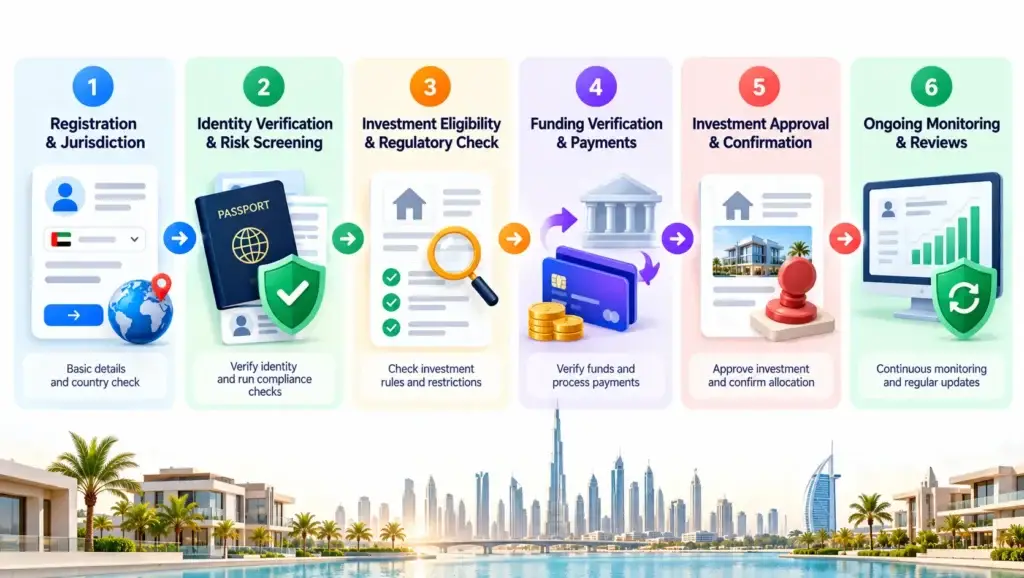
International investor onboarding for UAE property investment platforms requires a structured process that connects identity verification, regulatory eligibility, payment authorization, and investment approval. Rather than treating onboarding as a single registration form, platform operators should establish a sequence of verification and approval stages that determine whether an investor can legally and operationally participate in a particular investment opportunity.
This approach is especially important for platforms serving investors from multiple countries, where differences in residency, documentation, ownership restrictions, and financial regulations can influence the onboarding process. A structured workflow helps businesses identify potential compliance issues early, reduce unnecessary application delays, and maintain consistent oversight throughout the investor relationship.
Each onboarding stage should have a clearly defined purpose, required documentation, approval responsibility, and completion status. Investors should only progress to activities for which the necessary checks and permissions have been satisfied, while incomplete or higher-risk applications should be directed to the appropriate review process.
Stage 1: Investor Registration and Jurisdiction Identification
The onboarding process begins with collecting essential information about the prospective investor, including their full name, country of residence, nationality, contact details, and intended account type. For corporate investors, the platform may also need preliminary information about the registered business, its country of incorporation, and the individual authorized to act on its behalf.
Identifying the investor’s jurisdiction at this early stage allows the operator to assess whether the proposed investment services can be offered to that person. Certain countries may be subject to investment solicitation restrictions, additional verification requirements, sanctions considerations, or limitations associated with available banking and payment services.
Instead of requesting extensive documentation from every applicant immediately, platforms can use the initial registration information to identify supported jurisdictions and explain the next steps. This reduces unnecessary administrative work while giving prospective investors a clearer understanding of their eligibility before proceeding further.
Stage 2: Identity Verification and Risk Screening
Once the investor’s preliminary information has been collected, the next stage focuses on verifying their identity and assessing relevant compliance risks. Individual applicants may need to provide identity documents, residential address evidence, and other information required by the applicable customer due diligence procedures. Corporate investors may require additional verification of company registration, ownership structures, authorized representatives, and ultimate beneficial owners.
Identity verification should be supported by appropriate screening procedures, which may include sanctions checks, politically exposed person assessments, and other risk indicators relevant to the business’s regulatory obligations. Depending on the investor’s circumstances, additional information about the purpose of the investment relationship or the origin of the investment funds may also be necessary.
Applications containing inconsistent records, missing documents, or elevated risk indicators should move into a controlled review process instead of receiving automatic approval. Effective investor protection and risk control workflows should connect identity verification, eligibility assessments, compliance approvals, and transaction monitoring rather than treating these activities as isolated administrative tasks. This allows compliance personnel to request clarification, conduct enhanced due diligence where required, and document the reasoning behind individual onboarding decisions.
For founders, this stage establishes the foundation of a trustworthy investor relationship by ensuring that identity verification is treated as an evidence-based approval process rather than a basic document upload requirement.
Stage 3: Investment Eligibility and Regulatory Assessment
Successful identity verification does not automatically establish that an investor can participate in every property investment opportunity. Platforms must also determine whether the individual or legal entity satisfies the eligibility requirements associated with the underlying property, investment structure, and applicable regulatory framework.
For example, eligibility may depend on foreign property ownership rules, the investor’s country of residence, investment classification, relevant financial promotion restrictions, or the legal structure through which ownership interests are offered. Certain investment arrangements may require additional assessments of investor experience, financial circumstances, or suitability, depending on the regulations governing the product.
Platforms should therefore maintain a clear distinction between identity verification and investment eligibility. An investor might complete KYC successfully while still requiring additional approval before participating in a particular fractional property investment or another regulated offering.
A structured eligibility assessment helps operators apply consistent investment restrictions, prevent unauthorized participation, and ensure that investors receive access only to opportunities appropriate for their regulatory classification and jurisdiction.
Stage 4: Funding Verification and Cross-Border Payment Controls
After an investor satisfies the relevant identity and eligibility requirements, the platform can begin the permitted funding process. For international investors, this stage requires particular attention because the currency, banking jurisdiction, payment provider, and source of funds may differ from those associated with the underlying UAE property investment.
The operator should establish which funding methods are supported, what currencies can be accepted, and whether additional documentation is necessary to verify the origin of the funds. Where currency conversion is involved, investors should receive clear information about exchange rates, transaction charges, settlement conditions, and any restrictions affecting the transfer.
Payment verification should also distinguish between an initiated transfer, a transaction acknowledged by a payment provider, and funds that have actually been received and reconciled. Treating these events as equivalent can create accounting discrepancies and lead to investment allocations being recorded before the required funding conditions have been satisfied.
A reliable funding workflow should maintain traceable transaction references, support permitted payment channels, and provide administrators with sufficient information to investigate failed, delayed, or unusual transfers. These controls help protect investors while improving the accuracy of financial operations.
Stage 5: Investment Approval, Confirmation, and Recordkeeping
Once the applicable identity, eligibility, documentation, and funding requirements have been satisfied, the operator can proceed with the final investment approval process. This stage connects the verified investor with the specific investment opportunity and establishes the formal transaction record.
Depending on the investment structure, the process may involve presenting legal agreements, obtaining investor acknowledgments, confirming the subscription or ownership allocation, and recording the relevant transaction details. Any additional product-specific conditions should be completed before the investment is considered finalized.
Accurate recordkeeping is particularly important for fractional ownership arrangements, where multiple investors may hold interests connected to the same underlying property. The architecture of fractional real estate investment platforms must support consistent ownership records, investor allocations, transaction histories, and financial reconciliation processes. Maintaining these connections helps operators preserve reliable investment information, support regulatory reviews, and reduce discrepancies between investor entitlements and recorded transactions.
For operators, the objective is to maintain an understandable and traceable investment history. This supports investor reporting, internal reconciliation, dispute resolution, and regulatory review while reducing dependence on disconnected spreadsheets or manually maintained records.
Stage 6: Ongoing Investor Monitoring and Compliance Reviews
International investor onboarding does not end when the initial investment is completed. Property investment platforms may maintain investor relationships over extended periods, particularly when they distribute rental income, support additional investments, or facilitate permitted ownership transfers.
Throughout this relationship, operators may need to update investor information, review changes in risk profiles, perform sanctions rescreening, monitor relevant transactions, and reassess documentation when circumstances change. The frequency and depth of these activities should reflect the applicable regulatory requirements and the investor’s assessed risk.
For example, a change in beneficial ownership, a new country of residence, unusual transaction activity, or an expired identification document may require additional verification. Such events should be handled through defined review procedures, with appropriate personnel authorized to request information, investigate concerns, and make documented decisions.
Continuous monitoring enables businesses to maintain reliable investor records while responding to regulatory and operational changes. For platforms planning international expansion, this creates a more sustainable compliance foundation than relying exclusively on verification conducted at the point of initial registration.
UAE Regulations That Property Investment Platforms Must Consider
Operating a UAE property investment platform requires an understanding of the legal and regulatory responsibilities associated with real estate ownership, financial services, anti-money laundering obligations, and investor data protection. These requirements become particularly important when platforms serve international investors, facilitate fractional property investments, or manage financial transactions involving several jurisdictions.
The applicable regulatory obligations depend on the platform’s actual activities, legal structure, operating location, and the nature of the investment interests being offered. A business facilitating direct real estate purchases may be subject to different requirements from a platform arranging fractional ownership through a special-purpose vehicle (SPV) or providing access to regulated investment products.
For founders, the priority is to establish which regulatory frameworks apply before launching investment offerings or accepting investor funds. A clear understanding of these obligations helps businesses develop appropriate onboarding policies, assign compliance responsibilities, and avoid building operational processes around incorrect assumptions.
Anti-Money Laundering and Customer Due Diligence Requirements
Anti-money laundering compliance is a significant consideration for UAE property investment businesses, particularly those facilitating property-related transactions, handling investor relationships, or conducting activities involving the movement of funds. Depending on their regulatory classification, operators may be required to implement controls that identify customers, assess financial crime risks, and support the detection of suspicious activity.
The UAE’s federal anti-money laundering framework includes Federal Decree-Law No. 10 of 2025 and Cabinet Resolution No. 134 of 2025. Certain real estate businesses, including brokers and agents, fall within the designated non-financial businesses and professions framework, while businesses carrying out regulated financial services activities may be supervised under other applicable requirements.
Relevant customer due diligence measures can include identity verification, ultimate beneficial ownership identification, risk assessments, sanctions screening, and source-of-funds inquiries. Higher-risk investor relationships may require enhanced due diligence, additional supporting documentation, or closer transaction monitoring. Operators subject to suspicious transaction reporting requirements must also maintain appropriate reporting and escalation procedures.
For international property investment platforms, these responsibilities should be incorporated into the investor onboarding journey instead of being managed entirely through disconnected administrative processes. Document verification, compliance review queues, risk classifications, and audit records can help authorized teams evaluate applications more consistently while maintaining evidence of their decisions.
However, technology can only support the implementation of a compliance framework. The legal responsibility for meeting applicable AML obligations remains with the businesses and individuals subject to those requirements. Founders must therefore establish appropriate policies, staff responsibilities, and professional oversight alongside their digital verification workflows.
Financial Services Authorization and Investment Activities
A fundamental regulatory consideration for property investment platforms is the distinction between providing software infrastructure and conducting regulated investment activities. Although a digital platform may provide tools for investor registration, property discovery, transaction processing, and reporting, these capabilities do not automatically authorize its operator to offer financial products or accept investment funds.
Depending on the underlying business model, activities involving investment crowdfunding, fractional ownership arrangements, collective investment structures, or the arrangement and management of financial products may fall within a regulated financial services framework. The classification depends on how the investment interests are structured, how funds and assets are handled, and which services the operator actually performs.
Within the Dubai International Financial Centre (DIFC), relevant regulated financial activities are supervised by the Dubai Financial Services Authority (DFSA). In Abu Dhabi Global Market (ADGM), the Financial Services Regulatory Authority (FSRA) oversees activities within its jurisdiction. Businesses operating outside these financial free zones may fall under other relevant UAE federal or emirate-level regulatory authorities, depending on their activities.
Founders should not assume that every fractional property investment or real estate crowdfunding arrangement follows the same authorization process. Different structures can create distinct requirements concerning investor classification, financial promotions, investment limits, custody arrangements, disclosures, and the management of client funds.
Before making investment opportunities available, platform operators should obtain an appropriate legal and regulatory assessment to establish whether authorization is necessary, which authority has jurisdiction, and what conditions must be fulfilled. These findings should then inform investor eligibility rules, onboarding procedures, transaction restrictions, and administrative approval processes.
Defining the regulatory classification early can prevent costly operational adjustments later, particularly when a business intends to serve investors from several countries or introduce additional investment products.
Investor Data Protection and Privacy Requirements
International investor onboarding involves collecting and processing sensitive personal and financial information, including identification documents, residential addresses, banking records, corporate ownership details, and supporting financial documentation. Protecting this information is an essential part of maintaining investor confidence and meeting applicable privacy obligations.
The UAE’s Federal Decree-Law No. 45 of 2021 concerning the Protection of Personal Data establishes an important federal framework for personal data protection. Its application depends on the relevant entity, processing activity, and statutory exceptions. Separate data protection requirements may also apply to organizations operating within certain financial free zones.
Property investment businesses should establish clear procedures governing how investor information is collected, processed, stored, accessed, retained, and disclosed. These procedures should also define the legitimate purposes for using personal information and identify the employees, compliance personnel, or authorized service providers permitted to access specific records.
Appropriate technical safeguards may include encrypted data transmission, secure document storage, role-based administrative permissions, authentication controls, activity logs, and documented incident response procedures. Compliance teams should have access to the records required for legitimate reviews, while sensitive information should remain protected from unnecessary or unauthorized disclosure.
Cross-border operations can introduce additional complexity when investor documentation is processed or stored through service providers located in different countries. Operators should assess any applicable international data transfer requirements, contractual safeguards, and third-party data processing responsibilities before introducing such arrangements.
For founders, privacy protection should be considered during the design of investor onboarding workflows rather than treated as a separate technical requirement after launch. Effective data governance supports more reliable compliance reviews, stronger administrative accountability, and a more trustworthy investment experience.
Translating Regulatory Requirements Into Practical Platform Operations
Understanding the regulatory framework is only one part of establishing an international property investment business. Operators must also convert applicable legal obligations into procedures that can be followed consistently by compliance teams, financial administrators, and other authorized personnel.
This involves defining how investor applications are reviewed, who can approve or reject verification outcomes, how unusual payment activity is escalated, and how documentation is maintained throughout the investor relationship. When additional information is required, the system should support a controlled review process rather than allowing unresolved compliance concerns to progress unnoticed.
As platforms expand into new countries, introduce additional property investment structures, or establish relationships with new payment providers, their compliance requirements may also change. Regular assessments help businesses determine whether existing verification rules, investor classifications, and operational controls remain appropriate for the expanded activities.
A well-managed compliance framework combines qualified legal guidance, clearly documented policies, appropriate technical safeguards, and ongoing operational oversight. For founders, the objective is not simply to accelerate investor registration, but to create a reliable investment environment where eligibility decisions, financial transactions, and regulatory responsibilities remain consistent, transparent, and properly controlled as the platform grows.
Common International Investor Onboarding Challenges and How to Address Them
Even when an investment platform has a documented compliance policy, operational problems can arise when the user journey does not reflect that policy.
These problems often involve incomplete information, unclear eligibility decisions, delayed verification, inconsistent currency records, or ineffective communication between compliance and finance teams.
| Onboarding challenge | Potential business impact | Practical response |
|---|---|---|
| Incomplete KYC documents | Approval delays and repeated support requests | Contextual upload instructions and review queues |
| Unclear investor eligibility | Applications progressing toward unsuitable investments | Country- and product-specific eligibility checks |
| Corporate ownership complexity | Difficulty identifying ultimate beneficial owners | Dedicated corporate verification workflows |
| Currency conversion uncertainty | Investor confusion and reconciliation differences | Transparent FX disclosures and settlement records |
| Source-of-funds exceptions | Delayed funding or heightened compliance risk | Risk-based documentation and specialist reviews |
| Outdated investor records | Weaknesses in ongoing due diligence | Scheduled and event-driven reassessments |
| Unclear approval responsibilities | Inconsistent decisions and limited accountability | Defined roles, escalation rules and audit trails |
A common mistake is to respond to these challenges by adding more fields to the registration form. Excessively detailed forms can discourage legitimate investors without necessarily improving the quality of compliance decisions.
A better approach is to collect information in stages, explain why documents are required, and request additional evidence when the investor’s circumstances or risk profile justify it.
This improves the experience without weakening verification standards.
Why Compliance Controls and Investor Experience Must Work Together
Compliance and user experience are sometimes treated as competing priorities. In reality, a well-designed onboarding process should make regulatory requirements easier for legitimate investors to understand and complete.
An international investor should be able to see whether their application is awaiting identification documents, undergoing review, restricted by eligibility rules, or approved for the next stage.
Clear status messages reduce uncertainty and can help operations teams avoid repetitive support inquiries.
For platform operators, the important distinction is between simplifying the investor’s experience and weakening the underlying controls. Automated document collection can reduce administrative work, but high-risk cases still require the appropriate level of human judgment.
A reliable onboarding experience depends on how well investor verification and compliance management features work together across registration, eligibility assessments, document reviews, and investment approvals. Configurable verification workflows, clear application statuses, role-based administrative permissions, and documented compliance decisions can help operators manage international investor applications consistently while maintaining the controls required for their business activities.
The Importance of an Integrated Investor Record
Where investors participate in several permitted products through the same platform, disconnected onboarding records can create duplication and inconsistent risk assessments.
A central investor record can help authorized teams maintain a consistent view of verified identity information, relevant documents, restrictions, and review history.
However, this does not mean that one identity verification automatically authorizes every type of investment. Different products may require additional eligibility checks, suitability assessments, or updated documentation.
A unified record should therefore support controlled reuse of verified information while preserving product-specific restrictions.
For businesses evaluating the operational foundation behind these processes, Miracuves offers a multi-product property investment platform with investor management, financial administration, and compliance workflows that can be assessed against their specific operational requirements. A connected platform foundation can help authorized teams maintain consistent investor records while managing verification outcomes, investment restrictions, payment histories, and ongoing review responsibilities across different property investment activities.
The important decision is whether the system can support the intended regulatory and operational processes, rather than whether an onboarding screen exists.
Practical Considerations Before Onboarding Investors Across Multiple Countries
Expanding into international investor markets requires more than translating the interface or accepting additional payment currencies.
Each target market introduces potential differences in customer verification, investment solicitation, investor classification, payment access, and compliance procedures.
Before entering a new jurisdiction, operators should evaluate whether investors can legally access the offering, whether the required documents can be verified, and whether suitable payment arrangements are available.
This assessment should also address the ongoing relationship. For example, a business may be able to accept an initial investment from an overseas customer but still need a reliable method to distribute income, process permitted transfers, or return funds when required.
Founder Decision Signals
Regulatory Readiness
Before onboarding international investors, determine which UAE regulatory requirements apply to your investment structure, target jurisdictions, and business activities. Define KYC, AML, investor classification, and approval responsibilities before allowing investors to fund property investments.
Investor Eligibility
International investors may face different ownership, residency, and investment restrictions depending on their country and the underlying property structure. Prioritize jurisdiction-based eligibility checks, beneficial ownership verification, and product-specific approvals rather than treating successful identity verification as automatic permission to invest.
Cross-Border Payments
If investors contribute funds in different currencies, establish clear processes for foreign exchange conversion, payment verification, settlement reconciliation, and rental income distributions. Transparent exchange rates, authorized payment channels, and accurate transaction records help reduce funding delays and investor disputes.
Operational Scalability
As the platform expands across international markets, investor documentation, compliance reviews, and payment requirements become more complex. Choose configurable onboarding workflows, centralized investor records, role-based approvals, and ongoing monitoring controls so additional jurisdictions and investment products can be supported without rebuilding the entire onboarding process.
What to Validate Before International Expansion
Expanding a UAE property investment platform into international markets requires careful planning across regulatory compliance, investor eligibility, payment infrastructure, and operational management. Founders must ensure that their platform can accommodate investors from different jurisdictions while maintaining consistent verification standards and transparent investment processes. Before entering new markets, businesses should evaluate four essential areas that directly influence investor trust, regulatory readiness, and long-term scalability.
Regulatory Readiness
Before accepting international investors, platform operators must identify the regulatory requirements applicable to their investment activities, ownership structures, and target jurisdictions. This includes determining which authorities oversee the business, understanding relevant anti-money laundering obligations, and identifying restrictions on marketing or offering investments to residents of particular countries. Establishing these requirements early helps founders design appropriate compliance procedures and avoid expanding into markets where the necessary permissions or operational arrangements are not yet in place.
Investor Eligibility
International investors may be subject to different identification requirements, investment classifications, and ownership restrictions depending on their residency, nationality, and the underlying investment structure. Platforms should establish clear procedures for verifying investor identities, reviewing supporting documentation, assessing beneficial ownership where applicable, and confirming eligibility for specific investment opportunities. A structured eligibility process helps prevent unsuitable applications from progressing while reducing unnecessary verification delays for qualified investors.
Payment Readiness
Cross-border property investment requires reliable arrangements for receiving funds, managing currency conversions, reconciling transactions, and distributing investment returns. Before expanding internationally, founders should verify which funding channels and currencies are supported, how exchange rates and transaction charges will be disclosed, and whether the chosen payment providers can serve investors in the intended jurisdictions. Clear payment procedures help minimize settlement errors, improve financial transparency, and give investors greater confidence throughout the investment lifecycle.
Operational Control
Managing international investors becomes increasingly complex as a platform expands across countries, investment products, and regulatory environments. Businesses need clearly defined responsibilities for compliance reviews, investor approvals, document management, transaction monitoring, and exception handling. Centralized investor records, permission-based administrative access, and documented escalation procedures can help teams maintain consistent oversight while accommodating additional markets without unnecessarily rebuilding existing operational workflows.
Aligning Expansion Plans With Platform Readiness
For founders planning to launch or expand quickly, regulatory and operational considerations should influence technology selection from the beginning. Evaluating different real estate investment platform models can help businesses distinguish between fractional ownership, investment crowdfunding, and other property investment structures while identifying the investor verification, financial administration, and compliance workflows each model requires. A ready-made software foundation may reduce technical implementation time, but legal assessments, financial service arrangements, and operational readiness remain separate responsibilities.
For founders preparing to launch internationally, selecting an experienced property investment platform development partner involves evaluating more than deployment timelines. The technical implementation should account for investor identity verification, eligibility rules, secure payment integrations, administrative permissions, and compliance-related workflows. Miracuves offers a ready-made software foundation with a stated six-day delivery timeline, subject to the agreed scope, while regulatory authorization, financial service approvals, and permission to accept investor funds remain separate responsibilities.
Final Thoughts: Build International Investor Trust Through Better Onboarding
International investor onboarding is one of the most important operational foundations of a UAE property investment platform. It determines how businesses establish investor identity, assess legal eligibility, manage international funding, document decisions, and maintain trustworthy records throughout the investment relationship.
For founders and investment operators, the objective should not be to remove every verification step. It should be to make each step understandable, proportionate, and operationally manageable without compromising the controls required by the applicable regulatory framework.
A successful international onboarding strategy combines clear eligibility policies, risk-based verification, transparent currency handling, reliable records, and continuing oversight. When those processes are established before scaling into additional markets, businesses are better positioned to support investors responsibly.
FAQs
Can non-residents invest in UAE real estate through digital platforms?
Non-residents may be eligible to acquire certain UAE real estate interests, but eligibility depends on the emirate, property location, ownership structure, and applicable laws. Participation through a digital investment platform can also be subject to separate regulatory, jurisdictional, and investor classification requirements. Investors should verify the legal nature of the offered interest before committing funds.
What KYC documents are required for overseas property investors?
Common documentation can include a valid passport, residential address evidence, personal identification details, and information about the purpose and source of investment funds. Corporate investors may need company registration documents, beneficial ownership information, and authorized signatory records. The final requirements depend on the applicable law, investor profile, product, and assessed risk.
Is KYC sufficient to approve an international property investment?
No. KYC establishes and verifies identity, while investment approval may require additional assessments involving eligibility, suitability, jurisdictional restrictions, source of funds, and the specific investment structure. A verified investor is not automatically authorized to participate in every property investment opportunity available on a platform.
How should UAE property investment platforms handle foreign currencies?
Platforms should clearly disclose the investment currency, permitted payment methods, applicable conversion terms, fees, and expected settlement procedures. They should maintain reliable transaction and reconciliation records and use appropriately authorized financial service providers where required. Investors should also understand how any income distributions or withdrawals will be processed.
Do fractional property investment platforms require regulatory approval in the UAE?
Regulatory requirements depend on the activities performed, how investment interests are structured, and the jurisdiction in which the business operates. Certain investment crowdfunding or financial services activities may require authorization from the relevant regulator. A platform operator should obtain a legal assessment before inviting investments or receiving customer funds.
What is enhanced due diligence for international investors?
Enhanced due diligence involves additional risk-based verification and scrutiny for higher-risk relationships. Depending on the circumstances, it may include deeper examination of source of funds or wealth, additional identity checks, investigation of relevant risk indicators, more frequent monitoring, and approval by appropriately authorized personnel.
Can one investor verification process support several investment products?
A central identity record can reduce unnecessary duplication where the legal framework allows verified information to be reused. However, each investment product may have distinct eligibility, suitability, or compliance requirements. Operators should maintain product-specific approval controls rather than assuming that one completed identity check grants unrestricted access to every offering.
Miracuves is an independent software development company. We are not affiliated with, connected to, sponsored by, or endorsed by any company or product named in this article.
Terms such as “X Clone” are used descriptively. It is how the software industry refers to building a platform with functionality comparable to a known service, and how clients search for it.
The entire design and codebase of our products is built by our own team. Our products contain no code, design, graphics, or content originating from any third-party website or applications.
All third-party names and marks referenced in this article are the property of their respective owners, referenced solely to identify the services discussed.