























Creator subscription platforms are no longer simple content spaces where creators upload premium posts and wait for fans to subscribe. As creator-led businesses become more structured, many founders now need platforms that support creator managers, agencies, assistants, chat teams, support staff, and campaign operators.
This changes the product requirement completely.
A platform that works for one independent creator may break when multiple creators, managers, assistants, and campaign teams need access to the same business environment. Without proper agency tools, founders end up depending on shared passwords, manual spreadsheets, untracked fan outreach, and unclear revenue attribution.
That is where creator subscription platform agency tools become important. Delegated access, fan segmentation, and campaign management help platform operators create a safer, more scalable, and more monetization-ready ecosystem for creators and the teams supporting them.
For founders planning to build a branded creator subscription platform, Miracuves helps create a launch-ready product foundation with creator workflows, fan monetization, admin control, and white-label flexibility. The goal is not just to launch a content app. The goal is to launch an operating system for creator-led revenue.
Key Takeaways
- Creator subscription platform agency tools help founders support creator managers, assistants, chat teams, campaign operators, and admin teams without unsafe access sharing.
- Delegated access protects creator accounts by giving each team member only the permissions needed for their role.
- Fan segmentation helps creators and agencies target subscribers based on spending behavior, engagement level, renewal status, interests, and campaign activity.
- Campaign management tools help teams plan, schedule, track, and optimize fan outreach instead of running promotions manually.
- Miracuves helps founders move from idea to launch faster with ready-made and white-label app solutions.
Why Agency Tools Matter in Creator Subscription Platforms
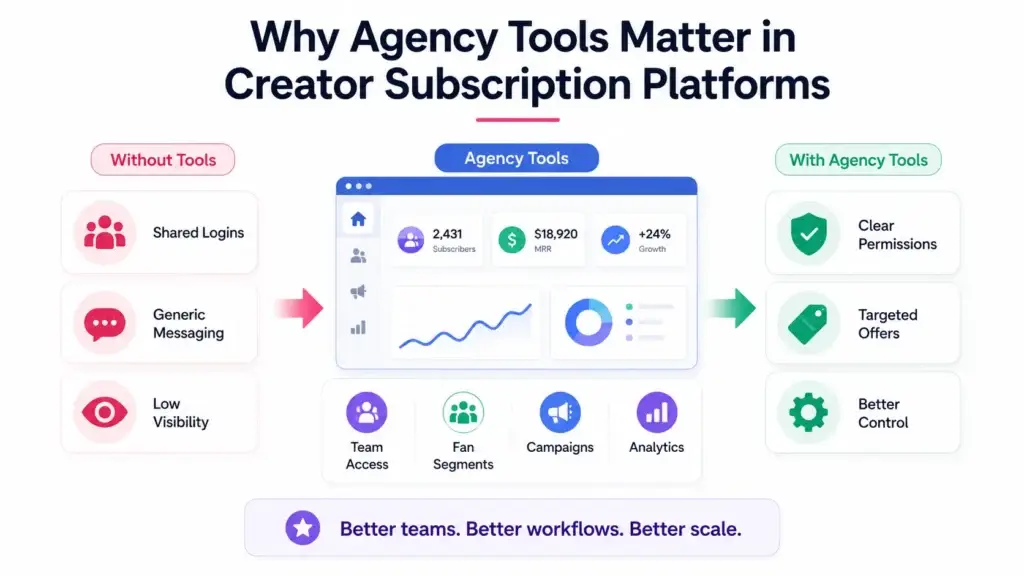
A creator subscription platform usually starts with a simple relationship: a creator publishes premium content, and fans pay for access. But once creators grow, the business becomes more operationally complex.
Creators may need help with scheduling content, replying to messages, sending fan offers, managing campaigns, checking analytics, handling support requests, monitoring payouts, and enforcing platform rules. If the product does not support these workflows, teams begin creating workarounds outside the platform.
Those workarounds may feel fast in the beginning, but they create long-term business risks:
- Shared logins make it hard to know who made a change.
- Manual audience lists become outdated quickly.
- Campaign performance is difficult to track across creators.
- Managers may access sensitive payout or personal information unnecessarily.
- Fans receive generic messages instead of relevant, behavior-based offers.
- Platform operators lose visibility into what is working.
For founders, this is a product strategy issue. The stronger creator platform is not always the one with the most content features. It is often the one that gives creators and agencies enough control to operate professionally without compromising safety, data quality, or revenue visibility.
Read more: Creator Subscription Platform Membership Tiers: Free Access, Premium Plans, and Content Entitlements
Delegated Access: The Control Layer Agencies Need First
Delegated access allows creators, agencies, and platform operators to give selected team members limited access to specific workflows. Instead of sharing a creator’s full account, a manager can assign permissions based on role.
This matters because creator businesses often involve multiple people, but not everyone needs the same level of control.
Common Roles Inside a Creator Subscription Platform
| Role | Typical Access Needed | Access That Should Usually Be Restricted |
|---|---|---|
| Creator | Profile, content, pricing, messages, earnings, campaigns | Platform-wide admin settings |
| Creator Manager | Content calendar, performance reports, campaign planning, fan insights | Banking details, master admin settings |
| Chat Assistant | Fan messaging, templates, approved scripts, assigned inboxes | Payout settings, creator verification data, platform controls |
| Campaign Operator | Audience segments, campaign scheduling, offer tracking, analytics | Creator account ownership settings |
| Support Staff | Tickets, reports, account issues, refund or dispute workflows | Revenue configuration and payout changes |
| Platform Admin | User governance, moderation, payment monitoring, platform configuration | Creator-private actions unless required for policy enforcement |
Delegated access is not only about convenience. It improves accountability. When every action is tied to a role and user identity, the platform operator can review activity logs, identify misuse, and reduce operational confusion.
For a creator subscription business, access control should be designed before scale begins. Adding it later can be more difficult because team workflows, data visibility, and admin permissions may already be scattered across different tools.
How Fan Segmentation Turns Audience Data Into Revenue Decisions
Fan segmentation is the process of grouping subscribers based on behavior, value, preferences, and lifecycle stage. In a creator subscription platform, segmentation helps creators and agencies send the right offer to the right fan instead of treating every subscriber the same.
This is important because not all fans behave equally. Some subscribe and never engage. Some purchase premium content frequently. Some respond to live events. Some join during discounts and churn quickly. Others renew month after month and become high-value supporters.
A platform that cannot separate these groups will struggle to improve retention and revenue per fan.
Useful Fan Segments for Creator Platforms
| Fan Segment | What It Shows | Campaign Opportunity |
|---|---|---|
| New subscribers | Fans who recently joined a creator’s tier | Welcome messages, onboarding offers, first premium unlock |
| High spenders | Fans with strong purchase or tip history | Exclusive drops, VIP offers, private live access |
| Inactive subscribers | Fans who pay but rarely engage | Reactivation messages and personalized content reminders |
| At-risk renewals | Fans near renewal with low activity | Retention campaigns, limited-time bonuses, renewal nudges |
| Campaign responders | Fans who opened, clicked, unlocked, or replied to past campaigns | Follow-up offers and personalized campaign paths |
| Content preference groups | Fans who engage with specific content categories | Targeted drops based on interest patterns |
The founder benefit is clear: segmentation gives the platform a smarter monetization layer. Instead of relying only on new subscriptions, creators can grow revenue through renewals, premium unlocks, campaigns, tips, live interactions, and targeted fan engagement.
Campaign Management Helps Agencies Move From Manual Promotion to Repeatable Growth
Campaign management is the operational layer that helps creator teams plan and execute fan engagement at scale. Without it, agencies may rely on manual messages, external calendars, spreadsheets, and disconnected performance reports.
A strong campaign system should allow teams to create targeted campaigns, choose fan segments, schedule communication, attach premium content or offers, track engagement, and review results. This helps creators understand which campaigns actually drive revenue and which messages create noise.
Campaign workflows worth building into a creator subscription platform include:
- Welcome campaigns: Automatically guide new subscribers toward their first engagement or premium unlock.
- Renewal campaigns: Remind subscribers why their membership is valuable before billing renewal.
- Win-back campaigns: Reach expired or inactive subscribers with a relevant reason to return.
- Premium content drops: Promote time-sensitive content to fans most likely to unlock it.
- Live event campaigns: Notify interested fans before live sessions, paid calls, or exclusive events.
- VIP fan campaigns: Reward high-value supporters with priority access or special offers.
Campaign management is also useful for agencies because it creates a repeatable playbook across multiple creators. Instead of reinventing campaigns every week, managers can use templates, compare results, and improve strategy based on real platform data.
Why Agency Dashboards Should Connect Access, Segments, Campaigns, and Reporting
An agency dashboard should not be a decorative reporting page. It should be the place where managers understand what is happening across creators, fans, campaigns, revenue, and team activity.
The best dashboards connect operational control with business insight. For example, an agency owner may want to see which creators are growing, which campaigns are underperforming, which fans are becoming inactive, which staff members are handling messages, and which revenue streams are improving.
When this data lives in separate tools, decisions become slower. When it lives inside the creator platform, teams can act faster.
Founder Decision Signals
Speed
If agencies need to manage multiple creators from day one, access roles, creator dashboards, campaign templates, and reporting should be part of the initial platform scope.
Cost
Manual agency operations look inexpensive at first, but they create hidden costs through support load, reporting gaps, repeated admin work, and missed retention opportunities.
Scalability
A platform can support more creators only when permissions, campaigns, analytics, and moderation workflows are structured instead of improvised.
Market Fit
If your target market includes agencies, creator collectives, fan clubs, or managed creator teams, agency tooling can become a product differentiator rather than a later add-on.
Core Agency Tool Features Founders Should Consider
Every creator subscription platform does not need the same agency feature set. A solo creator product may only need basic assistant access, while a multi-creator agency product may need roster management, staff permissions, campaign reporting, and revenue visibility across accounts.
The right feature scope depends on your business model. But for most agency-supported creator platforms, these modules create a stronger product foundation.
Agency Tool Features and Business Value
| Feature | Business Value | Founder Impact |
|---|---|---|
| Delegated access | Allows creators and agencies to assign limited permissions to managers, chat teams, and support staff. | Reduces unsafe account sharing and improves operational accountability. |
| Role-based dashboards | Shows each user only the workflows and data needed for their role. | Keeps the product cleaner and protects sensitive platform areas. |
| Fan segmentation | Groups fans by spend, activity, subscription status, engagement, and campaign behavior. | Improves targeting, retention, and premium content monetization. |
| Campaign templates | Helps teams reuse proven messaging flows for renewals, reactivation, content drops, and VIP offers. | Saves time and improves consistency across creators. |
| Scheduled outreach | Allows campaign messages and content promotions to be planned ahead. | Supports professional campaign execution without constant manual work. |
| Activity logs | Tracks key actions taken by staff, managers, creators, and admins. | Improves trust, reviewability, and issue resolution. |
| Revenue reporting | Connects subscriptions, premium unlocks, tips, campaigns, and renewal activity. | Helps founders understand which creator workflows drive monetization. |
| Moderation workflow | Supports reports, review queues, content checks, account actions, and safety controls. | Protects platform reputation and helps teams manage user-generated content responsibly. |
Security and Governance Should Be Built Into Agency Workflows
Agency tools can create risk if they are added without proper security thinking. When more people access creator accounts, the platform must clearly define what each person can see, change, export, send, approve, or delete.
Security should not be positioned as a marketing add-on. It should be part of the product foundation.
Important governance layers include:
- Role-based access control
- Permission-based dashboards
- Activity logs for sensitive actions
- Creator verification workflows
- Content moderation queues
- Abuse reporting and dispute management
- Encrypted data transfer
- Secure payment gateway integration
- Payout monitoring and transaction history
- Admin access controls for platform operators
For creator platforms, governance also affects trust. Creators need confidence that assistants cannot misuse their account. Fans need confidence that payments and private interactions are handled safely. Platform owners need confidence that teams can scale without creating avoidable security gaps.
For a deeper look at platform safety, editors can internally link to the existing Miracuves security guide using the anchor creator subscription platform security guide.
How Agency Tools Support Better Monetization
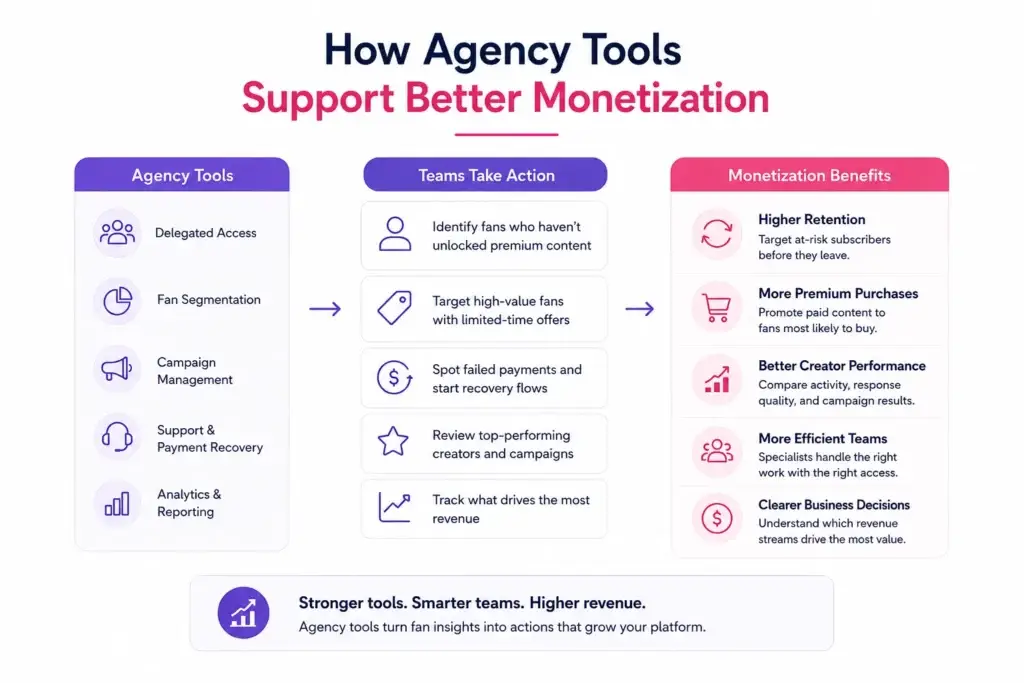
Agency tools are not only backend utilities. They directly influence revenue because they help teams act on fan behavior faster.
For example, a creator manager can identify fans who joined but never unlocked premium content. A campaign operator can target high-value fans with a limited-time offer. A support team can notice repeated failed payments and route users into a recovery flow. An admin can review which creators generate strong renewal rates and which campaigns need improvement.
This creates multiple monetization advantages:
- Higher retention: Fan segments help creators target at-risk subscribers before they leave.
- More premium purchases: Campaigns can promote paid content to fans most likely to buy.
- Better creator performance: Agencies can compare creator activity, response quality, and campaign outcomes.
- More efficient teams: Delegated access allows specialists to handle the right work without exposing the whole account.
- Clearer business model decisions: Reporting shows whether revenue is coming from subscriptions, paid content, tips, live sessions, or campaigns.
Founders who want to plan monetization carefully should also review the platform’s creator subscription business model page to understand how recurring revenue, premium unlocks, creator commissions, and campaign-led monetization can work together.
Ready-Made Foundation vs Building Agency Tools From Zero
Founders usually have two paths. They can build every agency module from scratch, or they can start with a ready-made solutions foundation and customize the agency workflows around their market.
Custom development gives full flexibility, but it can be slower when the team needs to build subscriptions, content access, fan accounts, creator dashboards, payments, reporting, admin controls, moderation, and agency workflows at the same time.
A ready-made foundation can be more practical when the goal is faster validation. The key is choosing a foundation that can be branded, extended, and owned instead of locked into a rigid hosted tool.
| Build Path | Best For | Founder Consideration |
|---|---|---|
| Fully custom build | Highly unique products with unusual workflows or enterprise-level requirements | More control, but higher planning, development, QA, and timeline responsibility. |
| Ready-made white-label foundation | Founders who want core subscription, content, fan, creator, admin, and monetization flows already structured | Faster market entry with room for custom modules and branding. |
| External SaaS tools stitched together | Temporary operations before building a dedicated product | Quick to start, but can create data silos, access gaps, and platform dependency. |
Miracuves helps founders build with a white-label, source-code-owned approach, so the platform can be adapted around creator teams, fan monetization, agency dashboards, and admin workflows. This is especially useful when the business needs speed without giving up long-term ownership.
Read more: Creator Subscription Platform Business Model: Memberships, PPV, Live Access, and Fan Engagement
What Founders Should Decide Before Adding Agency Tools
Before adding every possible feature, founders should define the agency model clearly. Agency workflows can mean different things depending on the market.
Some platforms support creator collectives. Others support professional management agencies. Some allow creators to add personal assistants. Some use internal campaign teams to help creators grow. Each model needs a different access and reporting structure.
Questions to clarify before development:
- Will each creator manage their own staff, or will the platform owner control agency access?
- Should agencies manage multiple creators from one dashboard?
- Can assistants send messages, or only prepare drafts for approval?
- Can campaign teams attach paid content to messages?
- Should managers see earnings, payouts, and fan spending details?
- Will fan segments be created manually, automatically, or both?
- Which activities need audit logs?
- Which workflows should trigger admin approval?
- How will campaign success be measured?
These decisions affect product architecture, permissions, database structure, analytics, notification flows, and admin design. The earlier they are defined, the cleaner the platform becomes.
Mistakes Founders Should Avoid With Creator Agency Tools
Using shared logins instead of delegated access
Shared logins may seem simple, but they remove accountability. When something goes wrong, the platform cannot clearly identify who changed settings, sent messages, or accessed sensitive data.
Building campaigns without segmentation
Campaigns become weak when every fan receives the same message. Segmentation helps teams match offers with real fan behavior, which improves relevance and reduces noise.
Giving managers too much data access
Agency teams need visibility, but not unlimited control. Sensitive payout, verification, and admin settings should be restricted based on responsibility.
Ignoring reporting until after launch
If campaign, renewal, and fan revenue data are not tracked from the beginning, founders lose the ability to understand what is driving growth.
Where Miracuves Fits Into This Product Strategy
Agency tooling is strongest when it is connected to the core creator platform instead of bolted on later. Delegated access needs role-aware interfaces. Fan segmentation needs clean data. Campaign management needs messaging, content, wallet, subscription, and reporting logic to work together.
Miracuves helps founders create a branded creator subscription platform foundation that can support fan monetization, creator workflows, admin governance, and scalable agency operations. Instead of starting from a blank repository, founders can begin with a ready-made structure and customize the parts that matter for their business model.
Explore the branded creator subscription platform foundation if you are planning to launch a fan monetization product with subscriptions, premium content, messaging, wallets, campaign workflows, and admin control.
For a deeper feature-level view, review the creator platform features page. If budgeting is part of your planning stage, the creator platform development cost page can help you understand the scope factors that influence final pricing.
Related reading: Creator Subscription Platform Growth Strategy.
Final Thoughts: Agency Tools Turn a Creator Platform Into an Operating System
Creator subscription platforms become more valuable when they support real business operations. Delegated access protects accounts. Fan segmentation improves monetization decisions. Campaign management helps teams run repeatable growth workflows. Reporting gives founders the visibility needed to improve retention, revenue, and creator performance.
For founders, the decision is not simply whether to add agency tools. The stronger question is whether the platform is being built for individual creator publishing or for scalable creator business operations.
If your target market includes creator agencies, managed creators, fan communities, or professional creator teams, agency tooling should be treated as a core product layer, not an afterthought. Miracuves can help you build that foundation with the right balance of speed, branding, admin control, and source-code ownership.
FAQs
What are creator subscription platform agency tools?
Creator subscription platform agency tools are features that help agencies, managers, assistants, and campaign teams manage creator operations. They usually include delegated access, role-based dashboards, fan segmentation, campaign management, reporting, activity logs, and admin controls.
Why is delegated access important for creator platforms?
Delegated access prevents unsafe account sharing. It allows creators and agencies to assign limited permissions to team members based on their responsibilities, such as messaging, campaign planning, support, analytics, or content scheduling.
How does fan segmentation improve monetization?
Fan segmentation helps creators group subscribers by behavior, spending, engagement, renewal status, and content preferences. This allows teams to send more relevant offers, improve retention, and increase premium content sales.
What should an agency dashboard include?
An agency dashboard should include creator performance, fan activity, campaign results, revenue breakdowns, assigned team members, access permissions, moderation alerts, and reporting views. The dashboard should help teams make decisions, not just display numbers.
Can campaign management help reduce churn?
Yes. Campaign management can support renewal reminders, reactivation campaigns, welcome flows, and personalized fan offers. When connected with segmentation, campaigns can target fans who are likely to lapse or become inactive.
Should agency tools be added after launch?
Basic agency requirements should be planned early if your platform targets managed creators or creator teams. Adding access control, segmentation, and reporting later can be more complex because the platform’s data and permission structure may already be fixed.
What is the safest way to give assistants access to creator accounts?
The safest approach is permission-based access. Assistants should only access the workflows they need, such as assigned messages or content scheduling, while sensitive areas like payouts, verification data, and admin settings remain restricted.
Miracuves is an independent software development company. We are not affiliated with, connected to, sponsored by, or endorsed by any company or product named in this article.
Terms such as “X Clone” are used descriptively. It is how the software industry refers to building a platform with functionality comparable to a known service, and how clients search for it.
The entire design and codebase of our products is built by our own team. Our products contain no code, design, graphics, or content originating from any third-party website or applications.
All third-party names and marks referenced in this article are the property of their respective owners, referenced solely to identify the services discussed.