

Key Takeaways
- Credit rewards platform user engagement grows when bill payments are connected with useful reminders, clear payment status, rewards, credit insights, offers, and next-cycle triggers.
- Monthly credit card bills create a natural retention opportunity because users have a recurring reason to return to the platform.
- Rewards, streaks, tiers, partner offers, and personalized insights can turn routine bill payments into repeat engagement loops.
- Payment transparency and trust are critical because users need to clearly understand payment status, reward eligibility, and financial records.
- Strong engagement depends on combining utility, trust, and motivation instead of relying only on cashback or promotional rewards.
Engagement Signals
- Useful triggers include bill-generated alerts, due-date reminders, payment updates, reward expiry notices, credit insights, and streak notifications.
- Immediate rewards such as points, cashback, vouchers, tier progress, and partner benefits create value after successful payments.
- Card history, reward balances, credit trends, saved payment methods, and tier progress increase profile value and product stickiness.
- Personalized offers should reflect user behavior and preferences instead of overwhelming users with irrelevant promotions.
- Operators should track repeat payments, reward redemption, offer engagement, referral conversion, payment failures, and next-cycle return rates.
Real Insights
- Rewards can attract users, but retention depends on whether the platform remains useful and trustworthy between payment cycles.
- Payment status is itself an engagement feature because clear confirmation reduces uncertainty and builds confidence for the next transaction.
- Reward rules should remain simple, visible, and financially controlled so users understand what they earned and why.
- Too many generic notifications can create fatigue, so every reminder or promotion should have clear relevance to the user.
- The strongest engagement loop is: reminder → bill review → payment → confirmation → reward → insight → re-trigger for the next billing cycle.
A credit rewards platform user engagement does not become valuable only because it helps users pay bills. It becomes valuable when users return every billing cycle, trust the payment flow, understand their credit behavior, and feel rewarded after taking action.
That is where credit rewards platforms become more than financial utilities.
A normal payment app solves a task. A well-designed credit rewards platform builds a habit. It reminds users before due dates, simplifies card management, confirms payments clearly, offers rewards after successful actions, gives credit insights, and keeps users engaged through personalized offers, tiers, streaks, and partner benefits.
For founders, the real question is not just “Can users pay their bills?” The stronger question is: “Can the platform turn a monthly payment action into a repeat engagement loop?”
This guide explains how credit card bill payment platforms create user retention, what engagement mechanics matter, how rewards should be designed, and why trust is the foundation of every successful fintech engagement model.
Why Bill Payments Are a Strong Retention Trigger
Credit card bills return every month. That gives fintech founders something most apps struggle to create: a natural reason for users to come back.
Users may forget many apps after installation, but they cannot ignore card due dates. A bill payment platform can use that recurring financial need to create consistent engagement through reminders, payment tracking, rewards, offers, and credit behavior insights.
The strongest platforms do not wait for users to remember the app. They create useful moments:
- A due-date reminder before the bill becomes urgent
- A clear bill summary when the statement is generated
- A payment nudge when the due date is near
- A confirmation after payment succeeds
- A reward moment after payment completion
- A credit insight after the transaction
- A personalized offer based on user activity
- A streak or tier update that encourages the next action
This turns bill payment from a one-time transaction into a repeat engagement cycle.
The Difference Between a Payment Utility and an Engagement Platform
A payment utility helps users complete a transaction. An engagement platform helps users build a financial habit.
| Layer | Basic Payment Utility | Credit Rewards Engagement Platform |
|---|---|---|
| Primary Action | Pay a bill | Manage cards, pay bills, earn rewards, track credit behavior |
| User Return Reason | Due date only | Reminders, insights, rewards, offers, streaks, and tiers |
| Emotional Hook | Convenience | Progress, savings, control, trust, and status |
| Business Value | Transaction volume | Retention, partner monetization, premium features, user loyalty |
| Product Depth | Payment screen | Card vault, reward engine, offer marketplace, admin console, analytics |
A founder building this category should not think only in terms of payment processing. The stronger product strategy is to build repeat value around every payment moment.
Read more- How Credit Card Bill Payment and Rewards Apps Work: User Journey, Trust Logic, and Engagement Model
The Repeat Engagement Loop of a Credit Card Bill Payment Platform
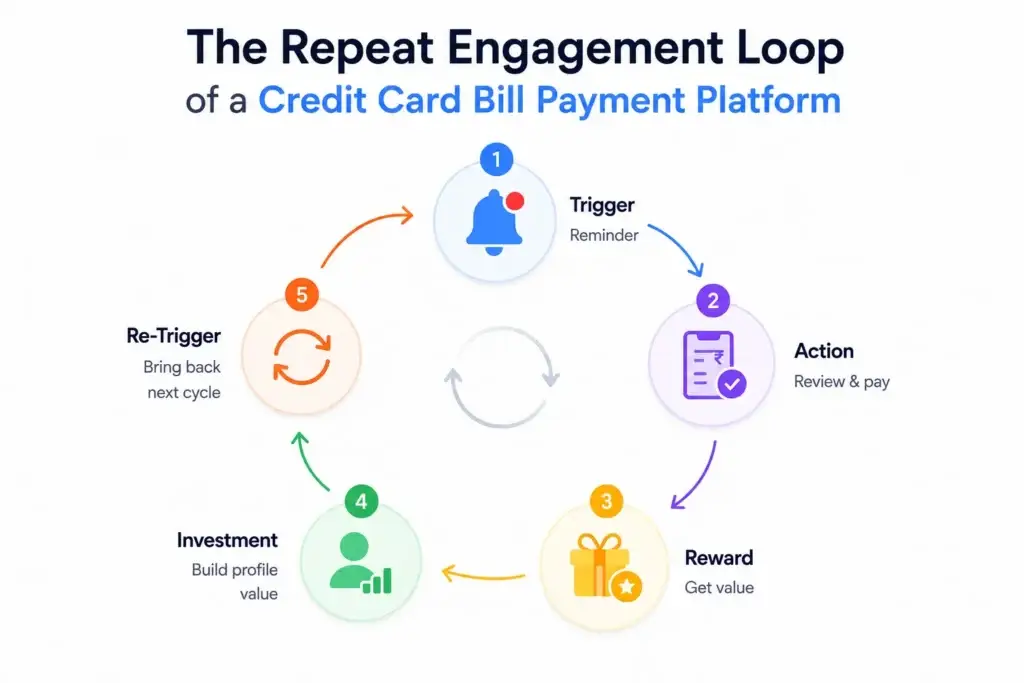
A strong engagement loop usually has five stages.
1. Trigger: The User Receives a Useful Reminder
The loop starts with a reason to return.
Useful triggers include:
- Bill generated alert
- Due date reminder
- Minimum payment reminder
- High utilization alert
- Payment pending notification
- Reward expiry reminder
- Offer expiry reminder
- Streak continuation nudge
The reminder should feel helpful, not noisy. If the app sends too many generic notifications, users may disable alerts. A strong notification system should use timing, user behavior, and card cycles to send relevant messages.
2. Action: The User Opens the App and Reviews the Bill
Once the user opens the app, the interface should make the next step obvious.
The user should quickly see:
- Which card has a bill due
- Total amount due
- Minimum amount due
- Due date
- Available payment methods
- Payment status
- Reward eligibility
- Any applicable offer or cashback condition
This screen should reduce anxiety. Financial apps lose trust when users cannot understand what they owe, when they need to pay, or what happens after payment.
3. Reward: The User Receives Immediate Value
After payment, the app should create a clear value moment.
That value may be:
- Points
- Coins
- Cashback
- Voucher unlock
- Tier progress
- Streak continuation
- Partner offer access
- Referral benefit
- Credit behavior insight
- Personalized saving opportunity
The reward does not always need to be large. It needs to feel visible, fair, and connected to the action the user just completed.
4. Investment: The User Builds Profile Value
The more useful the user’s profile becomes, the more likely they are to return.
Profile value may include:
- Linked cards
- Payment history
- Reward balance
- Redemption history
- Credit score trend
- Preferred offers
- Saved payment methods
- Tier progress
- Referral status
- Spending behavior insights
This creates product stickiness. If the user can see history, progress, and benefits in one place, the platform becomes harder to abandon.
5. Re-Trigger: The Platform Brings the User Back Next Cycle
After the reward moment, the platform should prepare the next engagement.
That may include:
- Next bill cycle reminder
- Reward expiry reminder
- New offer based on past activity
- Tier progress notification
- Credit score refresh alert
- Referral milestone update
- Monthly credit behavior summary
This is how the platform turns one payment into a repeat habit.
Core Engagement Features That Keep Users Returning
Credit Rewards Platform Engagement Features
| Feature | User Value | Founder Impact |
|---|---|---|
| Card vault | Lets users manage multiple cards in one place | Improves repeat usage and product stickiness |
| Bill reminders | Helps users avoid missed due dates | Creates monthly return moments |
| Payment status tracking | Shows whether a payment is pending, successful, failed, or reversed | Reduces support tickets and builds trust |
| Reward engine | Gives users points, cashback, coins, vouchers, or tier progress | Turns payment completion into an engagement moment |
| Tier system | Gives users a sense of progress and status | Encourages repeat payments and deeper engagement |
| Partner offer marketplace | Gives users relevant discounts, deals, and redemption options | Creates monetization and brand partnership opportunities |
| Credit insight layer | Helps users understand utilization, payment behavior, and score trends | Adds financial value beyond rewards |
| Referral system | Rewards users for inviting verified users | Supports lower-cost acquisition and network growth |
| Admin campaign console | Allows operators to manage offers, rewards, tiers, and notifications | Gives the business control without developer dependency |
For founders comparing product scope, these credit card rewards app features show how card management, reminders, rewards, tiers, and operator controls can support the engagement model.
Reward Design: Why Users Come Back After the First Payment
Rewards create the first spark. Retention comes from reward consistency, perceived value, and clear rules.
A rewards system may include:
- Points for successful payments
- Cashback on eligible transactions
- Coins for app engagement
- Referral rewards
- Payment streak bonuses
- Partner vouchers
- Tier-based benefits
- Limited-time campaigns
- Reward multipliers
- Redemption milestones
The key is to avoid random reward logic. Users should understand what they earned, why they earned it, and how they can use it.
A strong reward experience answers:
- What did I earn?
- When will it appear?
- Where can I redeem it?
- Will it expire?
- What action unlocks more?
- Why did I not qualify for a reward?
- Can the reward be reversed if payment fails?
Reward clarity is part of user trust.
Streaks, Tiers, and Progress Mechanics
Streaks and tiers are powerful because they add momentum.
A user may return to avoid breaking a payment streak. Another user may return to move from one tier to the next. A third user may engage more because a higher tier unlocks better offers.
Useful progress mechanics include:
- On-time payment streaks
- Monthly bill payment milestones
- Tier ladders based on verified activity
- Premium benefit unlocks
- Referral progress bars
- Reward multipliers for consistent usage
- Exclusive partner access for higher tiers
But progress systems should not encourage risky financial behavior. The platform should reward responsible actions such as paying on time, tracking bills, maintaining healthy utilization, and using offers transparently.
Personalization: Making Rewards Feel Relevant
A generic reward catalog can become boring. Personalization makes engagement more meaningful.
A credit rewards platform can personalize based on:
- Card usage patterns
- Payment history
- Bill cycle
- Reward redemption history
- Preferred categories
- Location
- Tier level
- Referral behavior
- App engagement frequency
- Offer clicks
- User consent and preference settings
For example, a frequent traveler may see travel vouchers. A user who shops online may see ecommerce offers. A premium user may see exclusive brand campaigns.
Personalization should be helpful, not invasive. Users should understand why they receive certain recommendations and should have control over notification preferences.
Credit Insights: Engagement Beyond Discounts
Rewards can bring users back, but financial insights can create deeper trust.
A credit card bill payment platform can show users:
- Card-wise outstanding balance
- Credit utilization pattern
- Payment history
- Due date calendar
- Credit score trend where available
- Spending categories
- High bill alerts
- Minimum payment warnings
- Payment habit summaries
- Monthly credit behavior reports
This helps the app move beyond cashback and vouchers. It becomes a financial management companion.
For founders, this matters because offers alone may not retain users long term. Useful insights create a stronger reason to keep the app installed.
Trust Logic: The Hidden Driver of Repeat Engagement
Users do not return to fintech apps they do not trust.
Trust is built through small moments:
- Secure login
- Clear consent
- Accurate bill data
- Transparent payment status
- Fast confirmation
- Clean receipt history
- Visible reward ledger
- Clear redemption rules
- Simple support access
- Payment failure clarity
- Privacy-conscious data handling
- Role-based admin access
- Activity logs
A reward-heavy product without trust will not retain serious users. If users worry about whether a payment succeeded or whether their reward was calculated correctly, engagement drops.
Security should be positioned as the foundation of the product, not a marketing add-on.
Payment Status Is an Engagement Feature
Many founders treat payment status as a backend detail. Users see it as trust.
A strong payment status system should show:
| Payment State | What the User Needs to Know | Why It Supports Retention |
| Initiated | Payment has started | Prevents duplicate attempts |
| Pending | Confirmation is still processing | Reduces panic during delays |
| Successful | Payment is confirmed | Builds confidence |
| Failed | Payment did not go through | Enables retry without confusion |
| Reversed | Payment was returned or cancelled | Keeps records transparent |
| Reward Pending | Reward eligibility is being checked | Sets expectations |
| Reward Credited | Reward has been added | Creates a positive loop |
If users know exactly what happened after every action, they are more likely to use the platform again.
Offer Marketplace: Turning Payments Into Partner Engagement
Partner offers can extend engagement beyond bill payment day.
A user may pay a bill once a month, but they may return during the month to browse deals, redeem rewards, check offers, or track expiring benefits.
A useful offer marketplace can include:
- Shopping deals
- Lifestyle offers
- Travel discounts
- Food and dining vouchers
- Subscription benefits
- Wellness offers
- Premium brand campaigns
- Limited-time promotions
- Card-linked campaigns
- Tier-exclusive rewards
The offer marketplace should stay curated. Too many irrelevant offers can reduce trust. The strongest catalogs feel aligned with the user’s spending behavior and reward level.
For founders planning monetization, partner offers can support revenue through campaign fees, affiliate revenue, featured placements, and premium brand partnerships.
For a deeper monetization view, explore the credit and rewards platform business model.
Referral Loops: Turning Loyal Users Into Growth Channels
Referral systems work well when users already trust the product.
A referral loop may include:
- Invite link generation
- Verified signup tracking
- First payment condition
- Reward release rule
- Fraud prevention checks
- Referral milestone badges
- Bonus multipliers
- Tier-linked referral benefits
The important rule is to reward quality, not only signups. If referrals are rewarded before verification or meaningful activity, the platform may attract fake accounts.
A strong referral model rewards verified users, successful first payments, and long-term engagement.
Read more- What Go-to-Market Strategy Works Best for a Credit Card Rewards and Bill Payment Platform?
Notification Strategy: Helpful Nudges Without Fatigue
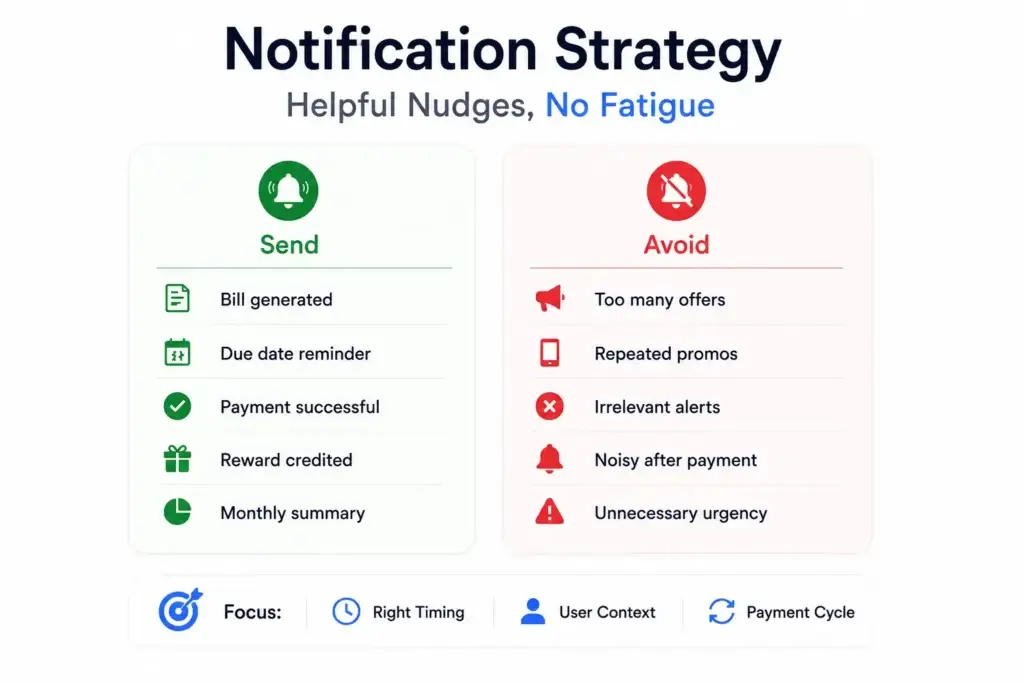
Notifications can build retention or destroy it.
Useful notifications include:
- Bill generated
- Due date approaching
- Payment pending
- Payment successful
- Reward credited
- Offer expiring
- Tier upgraded
- Referral reward unlocked
- Credit insight available
- Monthly summary ready
Poor notifications include:
- Too many generic offers
- Repeated promotional pushes
- Irrelevant reward alerts
- Noisy reminders after payment completion
- Urgent language when nothing is urgent
A strong notification strategy should consider timing, user context, payment cycle, and action relevance. Every push should help the user do something useful.
Admin Control: Why Engagement Needs an Operator Console
Engagement cannot be managed only through code.
Business teams need control over:
- Reward rules
- Campaign start and end dates
- Partner offers
- User tiers
- Referral conditions
- Notification templates
- Redemption inventory
- Cashback limits
- Suspicious activity flags
- Payment issue review
- User support cases
- Campaign performance
- Reward liability reports
Without admin control, every campaign update becomes a development task. That slows experimentation and makes engagement harder to optimize.
A strong operator console lets founders test new campaigns, adjust rewards, monitor user segments, and refine retention without rebuilding the app.
Business Model: Engagement Should Support Revenue, Not Just Activity
Repeat engagement is valuable only when it supports business outcomes.
A credit rewards platform may earn through:
| Revenue Stream | How Engagement Helps | Founder Consideration |
| Partner campaigns | Active users create value for brands | Offer relevance matters |
| Premium membership | Engaged users may pay for better benefits | Premium value must be clear |
| Payment-related service fees | Repeat transactions create volume | Fees must be transparent |
| Referral partnerships | Qualified users may explore financial products | Suitability and consent matter |
| Merchant promotions | Brands pay to reach targeted segments | Targeting should be privacy-conscious |
| Offer marketplace | Users redeem vouchers or deals | Inventory and redemption rules matter |
| Subscription tiers | Users pay for exclusive rewards or insights | Needs recurring value |
For a deeper informational view, this rewards fintech business model explains how rewards, payments, offers, and partnerships can connect inside a financial product ecosystem.
Founder Decision Signals
Retention
If users pay once and never return, improve reminders, rewards, insights, and next-cycle triggers before adding more acquisition spend.
Trust
If users ask whether payment succeeded or rewards were credited correctly, strengthen payment status tracking, receipts, reward ledgers, and support flows.
Monetization
If reward costs rise faster than revenue, review cashback limits, partner campaigns, redemption rules, and premium membership value.
Scalability
If campaign updates require developers every time, build stronger admin control for offers, tiers, notifications, and reward rules.
Engagement Metrics Founders Should Track
Founders should not measure only app downloads. Retention depends on repeat behavior.
Important metrics include:
- Monthly active users
- Bill reminder open rate
- Payment completion rate
- Repeat payment rate
- Linked cards per user
- Reward redemption rate
- Offer click-through rate
- Referral conversion rate
- Tier progression rate
- Payment failure rate
- Support ticket rate
- Reward liability
- Notification opt-out rate
- Churn after first payment
- Return rate before next billing cycle
The most important question is simple: are users returning because the platform is useful, trusted, and rewarding?
Mistakes Founders Should Avoid
Thinking Rewards Alone Create Retention
Rewards can attract users, but retention depends on reminders, payment trust, credit insights, offer relevance, and a clear reason to return every billing cycle.
Making Reward Rules Confusing
If users do not understand why they earned or missed a reward, trust drops. Reward rules should be visible, simple, and connected to user actions.
Ignoring Payment Failure Moments
A failed or pending payment is a critical trust moment. The app should explain what happened, whether money was debited, and what the user should do next.
Sending Too Many Promotional Notifications
Notification fatigue can reduce engagement. Push messages should be timely, useful, and tied to bill cycles, rewards, credit insights, or relevant offers.
Build From Scratch or Start With a Ready-Made Fintech Foundation?
Founders can build a credit rewards platform from scratch, but the product is deeper than it appears. The platform needs card management, payment reminders, gateway workflows, reward ledgers, offer catalogs, partner campaigns, referral rules, notification jobs, credit insights, admin dashboards, and security controls.
That is why many founders compare custom development with a ready-made fintech foundation.
A custom build may make sense when the business model needs unusual payment rails, unique reward rules, custom bureau integrations, or highly specific partner workflows.
A ready-made foundation may make sense when the goal is to launch faster, validate demand, and customize core modules around branding, partnerships, and market requirements.
Founders estimating the build can review these fintech rewards app development cost factors to understand how integrations, security, engagement modules, and customization influence scope.
If the product requires deeper technical planning, this guide on choosing a credit card bill payment app development company can help founders evaluate fit before starting development.
Miracuves Perspective: Engagement Starts With Product Architecture
A credit card bill payment platform can only retain users when the product architecture supports repeat behavior. Bill reminders, payment status, rewards, offers, tiers, credit insights, referrals, and admin controls must work together as one engagement system.
Miracuves helps founders build fintech and rewards platforms with ready-made workflows, white-label branding, admin dashboards, payment integration support, reward logic, and source-code ownership. For founders who want to explore a launch-ready product foundation, the Miracuves credit and rewards app solution is the most relevant next step.
The advantage of starting with a structured foundation is that founders can focus on partner strategy, reward design, user acquisition, compliance workflows, and retention experiments instead of rebuilding every core fintech module from zero.
When Custom App Development Makes Sense
Some founders need a product experience that goes beyond standard bill payment and rewards workflows.
Custom development may be useful when the platform requires:
- Unique payment rails
- Region-specific verification
- Custom reward rules
- Premium membership logic
- Credit bureau integrations
- Merchant campaign dashboards
- Partner API integrations
- Advanced referral fraud checks
- AI-based offer personalization
- Custom analytics
- Enterprise admin roles
- Multi-brand fintech operations
Miracuves’ clone app development services can support founders who want to launch faster using proven app patterns while still customizing the product for their business model.
For broader fintech ecosystem planning, founders can also explore Miracuves’ banking and insurance app solutions.
Related reading: how credit rewards platforms combine cards, bills and loyalty.
Final Thoughts
A credit rewards platform turns bill payments into repeat engagement by combining utility, trust, and motivation.
Utility brings the user back because bills must be paid. Trust keeps the user confident because payments, rewards, and financial records need to be clear. Motivation adds the engagement layer through points, tiers, streaks, offers, referrals, and credit insights.
For founders, the stronger product decision is not to build a payment screen first and add rewards later. The stronger approach is to design the full engagement loop from the beginning: reminder, payment, confirmation, reward, insight, offer, and next-cycle trigger.
When those layers work together, a credit card bill payment platform becomes more than a financial tool. It becomes a recurring fintech habit.
FAQs
How does a credit card bill payment platform increase repeat engagement?
A credit card bill payment platform increases repeat engagement through bill reminders, payment status updates, reward points, cashback, tiers, streaks, partner offers, credit insights, and next-cycle notifications.
Why are rewards important in bill payment apps?
Rewards make a routine financial task feel valuable. They encourage users to return, complete payments on time, redeem offers, refer other users, and continue using the platform across billing cycles.
What features help users return every month?
Important features include card vault, due-date reminders, payment tracking, reward engine, offer marketplace, credit score insights, referral system, user tiers, and personalized notifications.
How should founders design reward rules?
Reward rules should be clear, visible, and financially controlled. Founders should define earning conditions, expiry rules, redemption limits, reversal logic, fraud checks, and reward liability before launch.
Can credit insights improve app retention?
Yes. Credit insights can improve retention because users receive value beyond payments and rewards. Insights such as utilization trends, due-date calendars, payment history, and credit behavior summaries create a stronger reason to keep returning.
What mistakes reduce engagement in credit rewards apps?
Common mistakes include confusing reward rules, hidden conditions, weak payment status tracking, irrelevant offers, too many notifications, poor support flows, and rewards that do not connect to meaningful user behavior.
How can a fintech rewards app monetize repeat engagement?
It can monetize through partner campaigns, premium membership, payment-related service fees, offer marketplace revenue, merchant promotions, referral partnerships, and value-added financial products.
Should founders build a credit rewards platform from scratch?
A custom build can work when the product requires unique workflows, integrations, or compliance processes. A ready-made fintech foundation can help founders launch faster when they want core payment, reward, admin, and engagement modules already structured.
Miracuves is an independent software development company. We are not affiliated with, connected to, sponsored by, or endorsed by any company or product named in this article.
Terms such as “X Clone” are used descriptively. It is how the software industry refers to building a platform with functionality comparable to a known service, and how clients search for it.
The entire design and codebase of our products is built by our own team. Our products contain no code, design, graphics, or content originating from any third-party website or applications.
All third-party names and marks referenced in this article are the property of their respective owners, referenced solely to identify the services discussed.