Key Takeaways
- Ready-Made vs Custom Crowdfunding should be evaluated based on launch speed, business stage, customization needs, operational control, compliance workflows, scalability, and long-term product ownership.
- A ready-made crowdfunding platform can help startups launch and validate investor demand faster when their core property investment workflows are already well understood.
- Custom development provides greater control when the business requires proprietary underwriting, complex investment structures, specialized reporting, unique payout rules, or deep enterprise integrations.
- Source-code ownership is an important consideration because a ready-made solution with ownership can provide faster deployment without permanently limiting future customization.
- The right decision should consider total launch cost, including development, integrations, legal and compliance preparation, hosting, testing, marketing, and the opportunity cost of a longer development cycle.
Decision Signals
- Choose ready-made when faster market validation, familiar investment workflows, branded customization, admin control, and source-code ownership are priorities.
- Choose custom when the investment model cannot fit standard workflows or differentiation depends heavily on proprietary architecture and product logic.
- Review investor onboarding, KYC workflow support, property listings, payments, ownership records, distributions, reporting, audit logs, and role-based access before selecting a platform foundation.
- A strong ready-made foundation should be extensible so the startup can add deeper customization after real investor and operator feedback.
- Scalability depends more on code quality, backend architecture, hosting, and extensibility than simply whether the platform is labeled ready-made or custom.
Real Insights
- Custom development is not automatically the better option; building standard investment workflows from zero can delay market validation without creating meaningful differentiation.
- A ready-made platform can become a poor choice when its backend cannot support the required ownership, payment, compliance, reporting, or administrative workflows.
- The biggest hidden cost is often rebuilding weak backend architecture later, so founders should evaluate operational foundations rather than judging only the frontend.
- Many startups can use a phased approach: launch with a source-code-owned ready-made foundation, validate the model, then invest in custom modules based on actual business requirements.
- The strongest decision path is: define the investment model → identify standard and proprietary requirements → compare ready-made capabilities → assess source-code ownership → estimate total launch cost → evaluate scalability → choose the build route that best supports validation and long-term control.
Choosing between a real Estate Crowdfunding Platform ready-made platform and custom development is one of the first serious decisions for any founder entering property-backed investing, fractional ownership, or digital capital-raising.
At first, the choice may look simple. A ready-made solution helps you launch faster. A custom build gives you more control. But in investment products, the real question is deeper: which route helps you validate demand, manage investor trust, support compliance workflows, control transactions, and avoid rebuilding the product later?
Founders exploring broader digital finance products can also review Miracuves’ investment platform solutions to understand how different investment software categories are structured.
This guide breaks down the decision from a founder’s perspective. It does not treat the platform as just a website with property listings. It looks at investor onboarding, KYC workflows, ownership records, admin control, payment flows, reporting, source-code ownership, and long-term scalability.
Why This Decision Matters More in Property Investment Than in Normal Apps
A food delivery app, rental marketplace, or booking platform can often improve after launch through user feedback and feature iterations. Property investment software is different because every workflow touches money, identity, ownership, documents, investor expectations, and operational accountability.
That means the platform must support more than attractive screens. It needs a reliable structure for onboarding investors, verifying users, presenting property opportunities, tracking commitments, issuing ownership records, managing distributions, and maintaining admin visibility across the business.
For founders, the wrong development route can create three major risks:
| Risk Area | What Can Go Wrong | Founder Impact |
|---|---|---|
| Speed risk | Spending months building before testing investor demand | Delayed validation and higher upfront burn |
| Architecture risk | Launching with weak backend workflows | Expensive rebuilding later |
| Control risk | Depending on rented or closed systems | Limited branding, customisation, or source-code flexibility |
| Compliance workflow risk | Treating KYC, documents, approvals, and audit trails as later tasks | Operational gaps and trust issues |
This is why the ready-made vs custom decision should not be made only on upfront cost. It should be made around business stage, launch urgency, compliance workflow needs, investor experience, and the level of product control required.
What Is a Ready-Made Property Investment Software Foundation?
A ready-made property investment software foundation is a pre-built platform that already includes core workflows required to run a digital property-backed investment business. It can usually be rebranded, configured, customised, and deployed faster than a ground-up build.
The goal is not to copy another platform blindly. The goal is to avoid rebuilding common modules from scratch when the business needs to validate its investment model, investor acquisition strategy, and operational workflows quickly.
A strong ready-made foundation may include:
- Investor registration and profile management
- KYC and verification workflow support
- Property listing and deal presentation modules
- Investment calculator or projection display
- Wallet or payment gateway integration layer
- Ownership record or certificate workflow
- Admin dashboard for users, properties, documents, and transactions
- Role-based access controls for internal teams
- Reporting, activity logs, and operational visibility
- Branding, design customisation, and source-code ownership where offered
Before choosing any ready-made foundation, review whether the platform already supports SPVs, ledger workflows, investor dashboards, and property investment features that matter for your operating model.
For a startup, this route can reduce the time between idea and market feedback. Instead of spending months building every workflow, the founder starts with a working product foundation and focuses on the business model, property supply, investor trust, compliance preparation, and go-to-market execution.
If your model uses property-specific legal structures, this guide on how SPVs work in real estate crowdfunding can help you understand why legal structure and platform workflows must align.
What Is a Custom Property Investment Software Build?
A custom build is developed from scratch around a startup’s exact requirements. It gives the founder deeper control over architecture, product logic, data model, integrations, investor workflows, admin roles, compliance processes, and user experience.
This route can be powerful when the business model is highly differentiated. For example, a startup may need a unique underwriting engine, institutional reporting layer, multi-entity fund structure, proprietary risk scoring model, complex payout rules, or deep integration with internal finance systems.
However, custom development requires more planning, more budget, more technical oversight, and more time before the platform is ready for meaningful market validation. Founders also need to manage product scope carefully, because investment platforms can easily expand into a long list of “must-have” modules before launch.
Ready-Made vs Custom: Side-by-Side Founder Comparison
Ready-Made vs Custom Property Investment Software
| Decision Area | Ready-Made Foundation | Custom Development | Founder Impact |
|---|---|---|---|
| Launch Speed | Faster because core workflows already exist. | Longer because discovery, design, development, testing, and integrations start from zero. | Ready-made is stronger for founders who need faster validation. |
| Customisation | Good for branding, workflows, modules, and business-specific configuration. | Highest flexibility for unique architecture and non-standard investment models. | Custom wins when differentiation depends on proprietary product logic. |
| Cost Logic | More cost-efficient for common investment workflows. | Higher initial investment due to full product discovery and build effort. | Ready-made helps preserve capital during early validation. |
| Operational Control | Strong if source code, admin dashboard, and deployment control are included. | Strong if the startup owns the code and architecture. | Ownership matters more than whether the product starts ready-made or custom. |
| Compliance Workflow Support | Can include KYC, audit logs, role permissions, and verification workflows as a foundation. | Can be built exactly around legal, jurisdictional, and internal policy needs. | Neither route guarantees legal approval; legal review and provider setup still matter. |
| Scalability | Depends on code quality, backend structure, hosting, and ability to extend. | Can be designed for scale from the beginning if budget and expertise allow. | The right architecture matters more than the label “ready-made” or “custom.” |
When a Ready-Made Investment Platform Makes More Sense
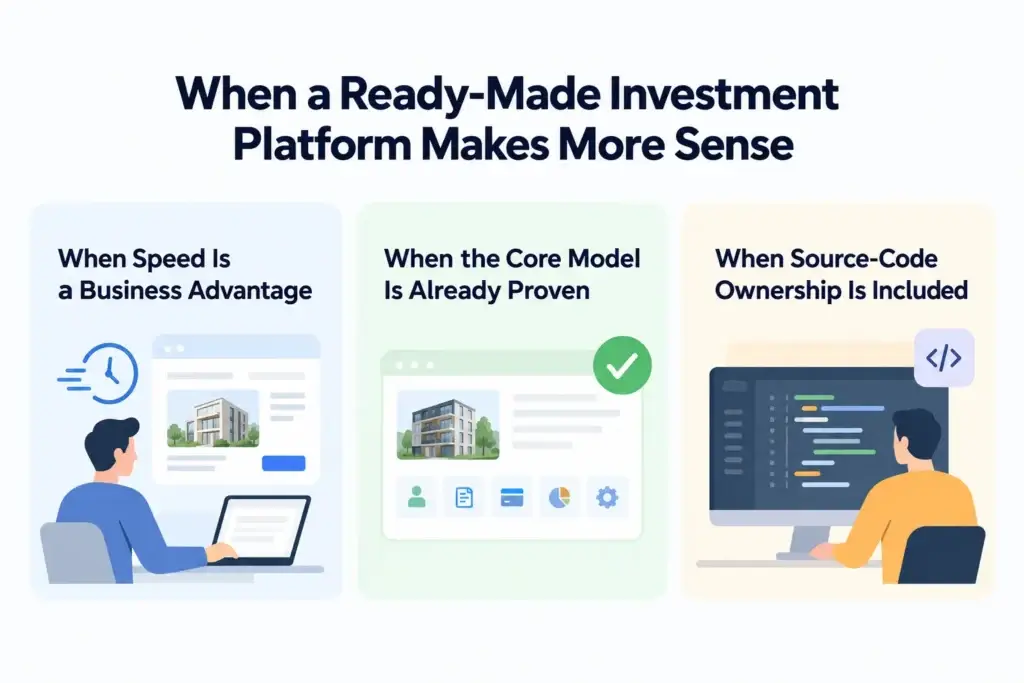
A ready-made platform is usually the stronger choice when the startup needs to move from idea to launch without waiting for a long custom build. This is especially true when the first business objective is market validation.
Founders often assume that custom development is automatically more serious. In reality, a ready-made foundation can be the more disciplined choice when the business model is still being tested. It gives the team a working product, admin layer, investor journey, and operational structure before they spend heavily on deeper custom modules.
Choose a Ready-Made Foundation When Speed Is a Business Advantage
If property partners, investors, or internal stakeholders are already waiting, a long development cycle can slow momentum. A ready-made solution helps founders start conversations with a working product instead of static wireframes.
This matters because investment trust is easier to build when users can see the actual investor journey, property detail pages, onboarding flow, and dashboard experience. A live product gives the startup something tangible to demonstrate.
Choose Ready-Made When the Core Model Is Already Proven
If the startup’s core model involves property listings, investor onboarding, KYC support, subscriptions, ownership records, distribution visibility, and admin management, much of the workflow is not experimental. It is operationally necessary.
Building these common workflows from zero may not create strategic differentiation. Differentiation may instead come from property sourcing, investor education, geographic focus, yield strategy, brand positioning, and trust-building.
Choose Ready-Made When Source-Code Ownership Is Included
Not all ready-made products are equal. A rented platform can limit control if the founder cannot modify workflows, extend modules, or move infrastructure later. A source-code-owned ready-made solution is different because the startup can begin faster while still keeping technical control.
This is where a Miracuves-style white-label approach is useful for founders who want branded design, admin control, and ownership of the product foundation instead of depending entirely on a closed SaaS system.
When Custom Development Is the Better Choice
Custom development becomes the better choice when the platform’s uniqueness is not just branding or configuration, but the product logic itself.
If the startup has a very specific operating model, complex investment structures, unusual payout rules, proprietary analytics, institutional-grade reporting, or a new financial product category, a full custom build may be worth the longer timeline.
If your model needs deeper customisation, working with an experienced investment platform development team can help you plan the right architecture from the beginning.
Choose Custom When Your Business Model Cannot Fit Standard Workflows
Some investment businesses cannot be adapted cleanly into a standard platform foundation. They may involve multiple asset classes, advanced fund administration, private investor clubs, custom compliance review paths, unique capital call logic, or deep back-office integrations.
In these cases, forcing a ready-made foundation to behave like a different product can create future complexity. A custom build may be more practical because the architecture can be planned around the model from the beginning.
Choose Custom When Product Differentiation Depends on Proprietary Systems
If the startup’s competitive advantage comes from its own underwriting engine, AI-assisted property scoring, portfolio analytics, or investor intelligence layer, custom development gives more room to design the product around that advantage.
However, even in this case, founders should separate what must be proprietary from what can be standard. User login, document storage, admin permissions, notifications, and basic investor dashboards may not need to be reinvented.
The Hidden Cost Most Founders Miss: Rebuilding the Backend Later
The biggest mistake is not choosing ready-made or custom. The biggest mistake is launching with a weak foundation that cannot support investment operations.
A property investment platform needs a dependable backend because money movement, ownership records, investor status, documents, approvals, and reporting all connect. If these parts are handled manually or stored across disconnected tools, the team may face operational confusion as soon as investors and properties increase.
Founders should look closely at the backend before choosing any development route. Ask whether the platform supports:
- Role-based admin access
- Investor verification status
- Document management
- Transaction history
- Ownership records
- Distribution tracking
- Audit logs
- Approval workflows
- Payment gateway integration
- Operational reporting
A weak backend can create expensive rebuilding later, which is why founders should understand platform architecture for property investment products before choosing a build path.
If these modules are missing, the frontend may look launch-ready while the business remains operationally fragile.
Founder Decision Signals
Speed
Choose a ready-made foundation if you need to validate investor interest, property supply, and operational workflows quickly.
Cost
Choose ready-made if you want to preserve capital for legal review, property acquisition, marketing, and investor trust-building.
Scalability
Choose custom development if your future scale requires proprietary architecture that cannot be adapted from a launch-ready foundation.
Market Fit
Choose ready-made when the business still needs evidence that investors, partners, and operators will adopt the model.
Compliance Readiness Should Influence the Build Path
Investment platforms operate in a sensitive category. The software itself does not make the business legally approved. Final compliance depends on jurisdiction, legal review, payment providers, KYC partners, operating structure, investor eligibility, disclosures, and the way funds are handled.
That said, the software should support compliance-ready workflows from the beginning. This means the platform should be able to support identity checks, approval queues, role-based access, audit logs, investor classifications, document records, and admin oversight.
For founders, this is where platform quality becomes important. A weak build may force compliance work into spreadsheets and email chains. A stronger foundation gives internal teams a more structured way to manage user verification, approvals, documents, and activity history.
Custom development can design these workflows in detail. A ready-made foundation can be faster if it already includes the core control layers and can be configured around the startup’s target market.
Investor Experience: What Must Work From Day One?
Investors do not judge a platform only by the investment opportunity. They also judge the clarity of the digital experience.
The first version should make it easy for investors to understand the property, review documents, complete onboarding, see investment terms, track commitments, and access their dashboard after investing.
At minimum, founders should think through:
- How investors discover opportunities
- How property details and financial assumptions are presented
- How risk information and documents are accessed
- How onboarding and verification happen
- How investment commitments are recorded
- How investors track ownership or participation
- How updates, distributions, and exit information are communicated
A custom platform can create a highly tailored investor journey. A ready-made platform can help founders avoid delaying launch while still providing a structured and branded experience.
Admin Control: The Part Founders Should Not Underestimate
Most founders focus on the investor-facing interface first. That is understandable, but the admin side often decides whether the platform can actually operate.
The admin dashboard should give the internal team control over users, properties, verification status, documents, payments, reports, support issues, and role permissions. Without this layer, the platform may depend too heavily on developers for routine business changes.
A strong admin layer helps the operator:
- Add and manage property opportunities
- Review investor onboarding progress
- Track transactions and distributions
- Manage documents and disclosures
- Assign internal team permissions
- Handle support and operational issues
- Review audit trails and platform activity
This is one reason ready-made platforms with strong admin control can be practical for startups. They allow the business team to operate the platform without waiting for engineering support for every small update.
Cost Logic: Do Not Compare Only Development Price
Many founders compare ready-made and custom development only by the quoted build price. That is too narrow.
The better comparison is total launch cost. This includes development, design, integrations, compliance preparation, content, legal review, hosting, testing, internal training, marketing, and the opportunity cost of waiting.
A custom build may offer maximum flexibility, but it also delays validation. A ready-made foundation may reduce development time, but founders still need to budget for branding, provider accounts, legal documents, integrations, security hardening, and market launch.
Founders comparing ready-made and custom routes should also review the development cost breakdown to understand how pricing changes with modules, integrations, and customisation scope.
The practical question is:
Will custom development create enough strategic advantage before launch to justify the extra time and cost?
If the answer is yes, custom development may be right. If the answer is no, a ready-made foundation may be a smarter first move.
Recommended Decision Framework for Investment Startups
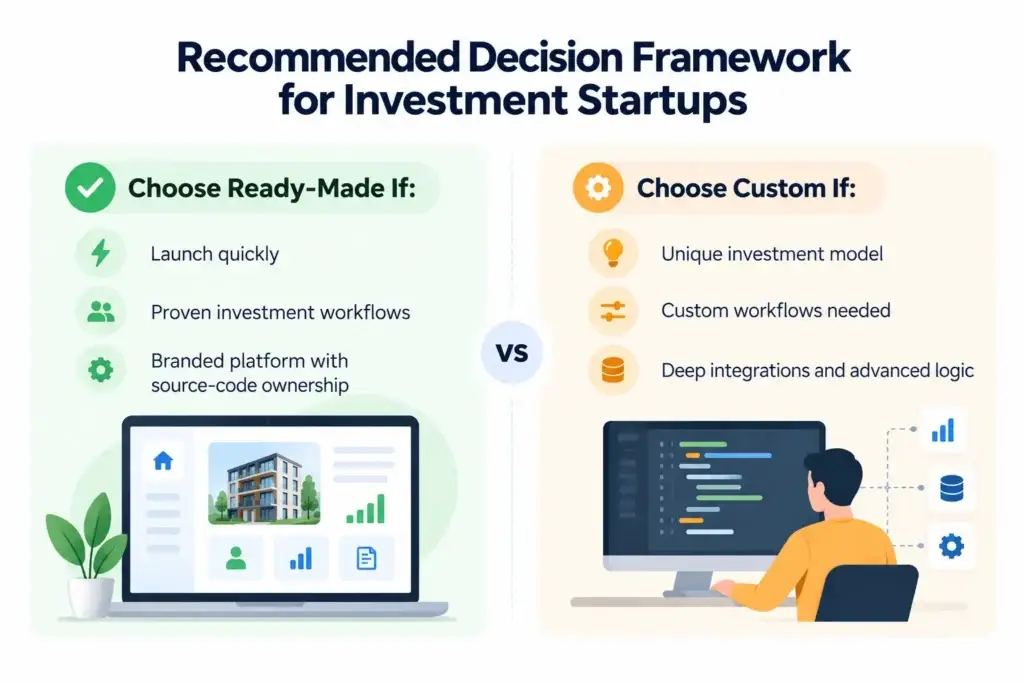
Use this simple framework before choosing a build path.
Choose Ready-Made If:
- You need to launch or demonstrate quickly.
- Your initial model follows familiar property investment workflows.
- You want a branded platform without starting from zero.
- You need admin control, investor workflows, and source-code ownership.
- You want to validate market demand before funding a long custom build.
- You prefer to customise after real user feedback.
Choose Custom If:
- Your investment model is highly unique.
- Your workflows cannot fit a standard foundation.
- You need proprietary underwriting, reporting, analytics, or fund logic.
- You already have validated demand and a larger development budget.
- You have internal product leadership to manage a longer build.
- You need deep integrations with existing enterprise systems.
Once the platform route is clear, founders should also study the revenue streams in a Fundrise-style model to plan monetization before launch.
Common Mistakes Founders Should Avoid
Choosing Custom Development Before Validating Demand
A long custom build can consume budget before the startup has proven investor trust, property supply, or acquisition channels. A faster launch foundation may be more practical when the founder still needs real market feedback.
Choosing a Ready-Made Product Without Source-Code Control
A fast launch is less valuable if the founder cannot extend, modify, or move the platform later. Source-code ownership matters because it gives the startup more control over future product direction.
Treating Compliance Workflows as a Later Problem
KYC support, audit logs, role permissions, and document records should be planned early because they affect operations and trust. The software does not replace legal review, but it should support structured compliance workflows.
Overbuilding Before the First Investor Conversation
Founders often add advanced modules too early. The first goal should be a credible, operable launch version that supports real market learning.
Where Miracuves Fits Into This Decision
Miracuves is useful for founders who want the speed of a ready-made product without losing the control needed for a serious investment platform. Its white-label approach helps startups begin with branded design, admin control, source-code ownership, and a launch-ready foundation instead of building every workflow from zero.
For founders evaluating a Fundrise-style launch path, Miracuves’ launch-ready property investment solution shows how investor onboarding, property workflows, operator control, and source-code ownership can work together.
For founders evaluating a property-backed investing idea, the practical path is often to launch with a strong foundation, validate the business model, then customise deeper modules based on real user behaviour. This avoids the common trap of spending months on assumptions before seeing how investors and operators actually use the product.
Launch Faster With Miracuves
Miracuves helps founders build ready-made and white-label app solutions with source code, branded design, admin control, and faster deployment. If you want to validate a property investment idea without waiting months, a launch-ready foundation can help you move faster.
For suitable ready-made scopes, Miracuves offers a 6-day launch timeline, with final deployment depending on branding assets, hosting access, integrations, provider accounts, security hardening, and the selected customisation scope.
After launch, acquisition and investor trust become the next challenge, so this real estate crowdfunding growth strategy can support your go-to-market planning.
Final Verdict: What Should Investment Startups Choose?
For most early-stage investment startups, a ready-made platform is the better first step when the goal is faster validation, controlled spending, and a credible launch experience. It helps the founder focus on investor trust, property supply, compliance preparation, and go-to-market execution rather than rebuilding standard platform workflows from scratch.
Custom development is the better choice when the startup has a validated model, complex proprietary workflows, or a business structure that cannot be supported by a configurable foundation.
If your product direction extends beyond property-backed investing into trading or portfolio products, Miracuves’ white-label trading platform may be a useful related solution to explore.
The strongest decision is not always ready-made or custom forever. Many founders should think in phases: start with a launch-ready, source-code-owned foundation, validate the model, then customise deeper once the business has real traction and clearer requirements.
FAQs
Is ready-made property investment software suitable for startups?
Yes, it can be suitable when the startup needs a faster launch, branded platform, investor onboarding, admin controls, and a working foundation for market validation. The key is choosing a solution that allows customisation and source-code ownership.
When should I choose custom development instead?
Choose custom development when your investment model requires unique architecture, proprietary underwriting, complex reporting, unusual payout rules, or deep integrations that cannot be handled by a ready-made foundation.
Does a ready-made platform mean less control?
Not always. A rented closed platform may limit control, but a source-code-owned ready-made solution can give founders faster launch speed while still allowing future customisation and technical ownership.
What features should a property investment platform include?
Important features include investor onboarding, KYC workflow support, property listings, investment details, document management, payment integration, ownership records, distribution tracking, admin dashboards, role-based access, and audit logs.
Is compliance included in the software?
Software can support compliance-ready workflows such as KYC, audit logs, investor classifications, document records, and admin approvals. However, legal compliance depends on jurisdiction, legal counsel, operating model, payment providers, and regulatory requirements.
Can I start ready-made and customise later?
Yes. This is often a practical approach for founders. A ready-made foundation helps you launch faster, while source-code ownership allows your team to extend workflows and add custom modules as the business grows.
How fast can Miracuves help launch a ready-made platform?
For suitable ready-made scopes, Miracuves offers a 6-day launch timeline. Final deployment timing depends on branding assets, hosting access, integrations, provider accounts, security hardening, and the selected customisation scope.
Miracuves is an independent software development company. We are not affiliated with, connected to, sponsored by, or endorsed by any company or product named in this article.
Terms such as “X Clone” are used descriptively. It is how the software industry refers to building a platform with functionality comparable to a known service, and how clients search for it.
The entire design and codebase of our products is built by our own team. Our products contain no code, design, graphics, or content originating from any third-party website or applications.
All third-party names and marks referenced in this article are the property of their respective owners, referenced solely to identify the services discussed.