Key Takeaways
- Live Streaming Entertainment Platform Cost depends on more than software development, with cloud hosting, video delivery, creator operations, payments, moderation, support, marketing, and maintenance affecting the total budget.
- Initial software and implementation expenses should be separated from recurring operating costs so founders can understand the true first-year investment.
- Video bandwidth can become a major variable expense because costs increase with viewer activity, session duration, bitrate, and the pricing model of the selected media provider.
- Creator acquisition, virtual gifts, creator payouts, payment processing, moderation, customer support, and marketing can significantly affect retained revenue and contribution margin.
- A realistic budget should use actual usage assumptions, multiple growth scenarios, cash-flow timing, and contingency planning rather than relying only on an initial software quotation.
Cost Signals
- Cloud hosting, databases, storage, monitoring, and application maintenance create the technical operating baseline.
- Viewer-hours, average bitrate, simultaneous activity, and media quality should be monitored to understand streaming delivery expenses.
- Creator acquisition should be measured through active creators, broadcasting hours, retention, viewing activity, and creator-generated revenue rather than registrations alone.
- Gross user spending is not the same as retained platform revenue because creator payouts, agency commissions, payment fees, refunds, taxes, and other obligations reduce the amount available to the business.
- Moderation, security, customer support, and dispute resolution should be treated as core operating expenses rather than optional costs.
Real Insights
- More registered users do not automatically mean higher costs; active viewing and broadcasting behavior are more important drivers of infrastructure consumption.
- Reducing every technical expense is not necessarily the right strategy because poor playback quality or inadequate support can damage retention and revenue.
- A ready-made platform can reduce initial engineering work, but founders still need to budget for infrastructure, integrations, customization, security testing, support, and operational readiness.
- The first 90 days should be used to replace assumptions with actual data on viewer-hours, media usage, creator activity, payment volume, support demand, and contribution margin.
- The strongest budgeting path is: calculate setup costs → estimate audience activity → model media consumption → budget creator and operating expenses → account for payment deductions → prepare conservative and growth scenarios → monitor actual unit economics → adjust spending based on evidence.
Launching a Live Streaming Entertainment Platform business involves more than paying for software. Cloud hosting, video bandwidth, creator earnings, payment processing, content moderation, customer support, and maintenance all contribute to the actual cost of operating the business.
For founders entering the creator economy in 2026, understanding these expenses is essential before committing to a launch budget.
A small community of broadcasters may generate manageable infrastructure expenses during the initial launch. However, as viewers spend more time watching broadcasts, participating in interactive rooms, purchasing virtual gifts, and engaging with creators, operating expenses can increase significantly.
The challenge is not simply predicting how many users will register. It is understanding how user activity translates into financial obligations.
This guide breaks down the main live streaming app operating costs, explains how to estimate monthly infrastructure usage, identifies frequently overlooked business expenses, and provides a practical framework for preparing a sustainable first-year budget.
What Determines the Total Cost of Launching a Live-Video Business?
When founders research the investment needed for a live broadcasting application, they often focus on software development or acquisition. That is understandable because purchasing technology is usually one of the earliest financial decisions.
However, the initial software cost and the total cost of ownership are different figures.
The real investment includes three categories.
Initial software and implementation expenses
These are expenses associated with preparing the product for its intended market.
They may include software acquisition, branding, application configuration, payment integrations, deployment, security testing, and launch preparation.
The amount depends on the starting point.
Before calculating recurring expenses, founders should establish a clear upfront investment baseline. Software acquisition, deployment, integrations, and customization can influence the initial financial commitment, while hosting and operational spending continue after launch. Businesses evaluating their implementation options can review the software development pricing considerations separately from the monthly operating expenses discussed in this guide.
A business creating an entirely custom product generally needs to fund additional engineering and testing. A business using existing software may reduce the amount of foundational development required, although customization and operational readiness can still create additional work.
Technical operating expenses
These are costs incurred while keeping the service available to users.
They include cloud hosting, databases, real-time video delivery, storage, media processing, monitoring, and infrastructure maintenance.
Some expenses remain relatively predictable. Others fluctuate depending on audience behavior.
The financial requirements of a live-video business also depend on the broader entertainment ecosystem it operates within. Creator engagement, audience retention, content distribution, and monetization all influence long-term spending decisions. Founders exploring different digital entertainment opportunities can review Miracuves’ media and entertainment software solutions to understand how different product categories shape infrastructure and operational requirements.
For example, a database may have a stable monthly baseline, while video consumption increases as more viewers participate in live broadcasts.
Business growth and operational expenses
These are expenses required to attract and retain the people who make the service valuable.
They include creator recruitment, marketing campaigns, moderation, customer support, payment administration, and other operating activities.
A founder might launch with functional software and reliable infrastructure but still struggle commercially because there are too few active broadcasters or returning viewers.
This is why a realistic budget needs to address technology, content supply, and demand together.
A useful financial formula is:
\[ \text{First-Year Budget} = \text{Setup Costs} + \text{Annual Operations} + \text{Growth Budget} + \text{Contingency} \]
This framework provides a more meaningful foundation for decision-making than relying on an initial software quotation alone.
What Are the Main Monthly Expenses of Running a Streaming App?
Recurring spending generally includes a combination of fixed, usage-based, and activity-driven expenses.
A founder should identify which costs remain stable and which become larger as the audience grows.
| Expense | Cost Behavior | What to Monitor |
|---|---|---|
| Cloud hosting | Baseline + scaling | Compute usage and availability |
| Video delivery | Usage-based | Viewer-minutes and media traffic |
| Database and storage | Capacity-based | Data volume and retention |
| Payment processing | Transaction-based | Fees, refunds, and chargebacks |
| Creator operations | Activity-based | Incentives and recruitment |
| Content moderation | Workload-based | Reports and review volume |
| Support and maintenance | Recurring + variable | Tickets, updates, and incidents |
| Marketing | Campaign-based | Acquisition and retention |
These expenses do not affect every product in the same way.
An audio-focused service typically has a different media consumption profile from one supporting multiple high-quality video broadcasts. A creator community funded by subscriptions has different payment flows from a virtual-gifting business.
Therefore, founders should build financial estimates around their intended audience behavior and revenue model.
How Does Video Bandwidth Affect Monthly Running Costs?
Media delivery is one of the most important usage-related expenses in a live-video business.
Each viewer consumes data while watching a broadcast. Higher video bitrates generally increase data consumption, while longer sessions increase the total amount delivered.
However, video infrastructure providers do not all charge in the same way.
Some services bill based on participant-minutes. Others charge for data transfer, media processing, or a combination of factors.
It is important to understand the relevant provider’s billing model before preparing an estimate.
A simple way to calculate streaming bandwidth
For a service where outbound traffic is an important billing variable, an approximate calculation is:
\[ \text{Data (GB)} \approx \text{Bitrate (Mbps)} \times \text{Viewer-Hours} \times 0.45 \]
This estimates decimal gigabytes of media data delivered. It does not include every potential overhead or provider charge.
Consider an illustrative startup that expects 1,000 viewer-hours per month at an average delivered bitrate of 2 Mbps.
Its estimated monthly media delivery volume would be:
\[ 2 \times 1{,}000 \times 0.45 = 900 \text{ GB} \]
That is approximately 900 GB of outbound media traffic.
It is not a hosting quotation.
The amount billed will depend on the architecture, region, provider, included usage allowance, and other applicable charges.
Bandwidth consumption at different audience levels
| Monthly viewer-hours | At 1 Mbps | At 2 Mbps | At 3 Mbps |
|---|---|---|---|
| 1,000 | 450 GB | 900 GB | 1,350 GB |
| 5,000 | 2,250 GB | 4,500 GB | 6,750 GB |
| 10,000 | 4,500 GB | 9,000 GB | 13,500 GB |
| 50,000 | 22,500 GB | 45,000 GB | 67,500 GB |
These are illustrative media-volume calculations, not provider pricing. Real-time communication services may use entirely different billable units.
The central lesson is that streaming activity can increase infrastructure expenses even when the application itself does not change.
How to manage media consumption efficiently
The objective should not be to reduce video quality indiscriminately. Poor playback experiences can damage audience retention.
Instead, founders should focus on matching media quality to actual viewing conditions.
Practical measures include adaptive bitrate settings where supported, appropriate resolutions for smaller screens, usage monitoring, and alerts when media consumption exceeds expected levels.
It is also useful to distinguish between the cost of publishing a stream and the cost of distributing it to viewers.
For a deeper technical explanation, see Miracuves’ guide to streaming bandwidth costs and adaptive delivery.
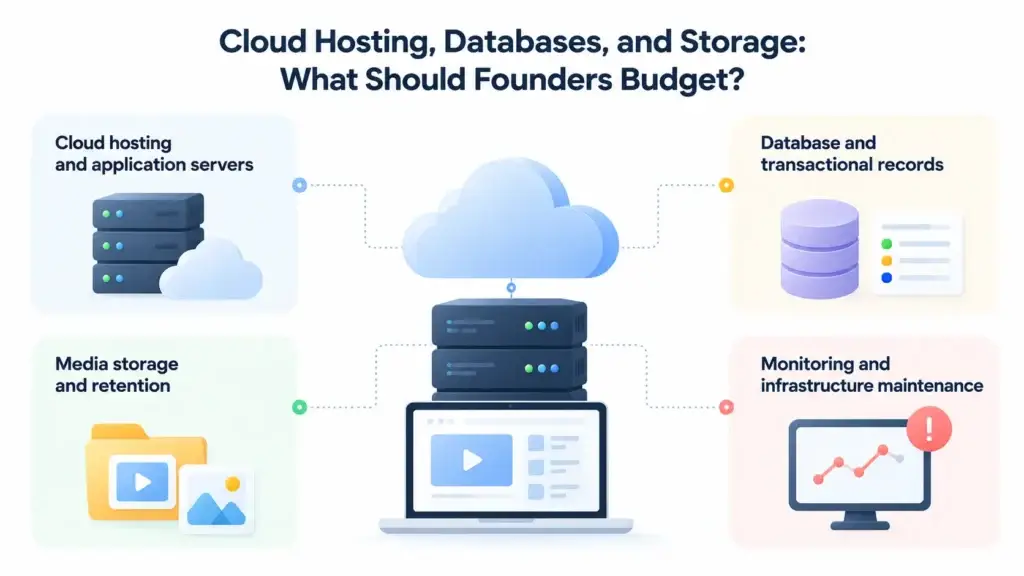
Cloud Hosting, Databases, and Storage: What Should Founders Budget?
Video delivery is only one component of the technical infrastructure.
A functioning service also needs application logic, databases, secure storage, monitoring, backups, and the ability to respond to failures.
Cloud hosting and application servers
Application servers manage user authentication, account profiles, administrative workflows, and communication with other services.
In the initial stages, a small deployment may be sufficient for many supporting functions.
However, increasing activity can require additional computing resources, caching, database optimization, or more sophisticated infrastructure.
Infrastructure expenses are closely connected to the functionality a business chooses to support. Interactive broadcasting, audience participation, virtual gifting, administrative controls, and user management can create different technical demands. Before estimating infrastructure requirements, founders should understand the available broadcasting and engagement capabilities and identify which functions are essential for their initial launch rather than investing in unnecessary complexity.
One important distinction is that scaling the application servers does not automatically solve the separate challenge of scaling real-time media delivery.
Database and transactional records
A creator-led business may maintain user profiles, account balances, purchase history, earnings allocations, gift transactions, moderation records, and other operational data.
These records must remain accurate and accessible.
Founders should consider backups, transaction integrity, access controls, and the cost of maintaining a reliable data layer.
For businesses involving virtual balances and withdrawals, database accuracy becomes a financial control requirement rather than merely a technical preference.
Media storage and retention
Saved recordings, short videos, profile images, and moderation evidence can accumulate over time.
Storage costs are influenced by upload activity, file sizes, retention periods, and retrieval patterns.
Keeping every recording indefinitely can create ongoing expenses without necessarily delivering equivalent value.
A clear retention policy can help control storage usage while supporting legitimate operational, safety, and legal requirements.
Monitoring and infrastructure maintenance
Founders also need visibility into service failures, unusual traffic spikes, payment errors, and security incidents.
Monitoring, logging, alerting, backups, and testing should be included in the operating plan.
A lower infrastructure bill is not a meaningful saving if the business cannot reliably detect and resolve failures.
Why Creator Recruitment Is an Important Operating Expense
A successful creator-led business needs two groups: people who broadcast and people who watch.
Software can connect those groups, but it does not automatically attract either one.
This is why creator acquisition often deserves a dedicated budget.
Recruitment expenses may include promotional campaigns, onboarding programs, incentive arrangements, account management, and creator-support activities.
Some businesses recruit talent individually. Others work with agencies that manage groups of broadcasters.
These arrangements affect spending and revenue distribution differently.
For example, an agency-based model might reduce the amount of direct recruitment work required from the operator but introduce additional contractual payouts or management obligations.
The appropriate model depends on the target audience, geography, and commercial strategy.
How to measure creator acquisition efficiency
Instead of focusing only on the number of registered broadcasters, founders should monitor active creators, total broadcasting hours, creator retention, average viewing activity, and revenue associated with participating creators.
These figures help answer a more important question: Is the business spending money to acquire creators who generate lasting audience engagement?
A creator who registers but never broadcasts offers little ongoing value.
A creator who consistently attracts returning viewers may have greater business impact even if their initial acquisition cost was higher.
For further operational insight, read the Miracuves article on agency management, host earnings, and revenue-sharing arrangements.
Payment Processing, Virtual Gifts, and Creator Payouts
Financial planning becomes more complex when users purchase virtual currency, send gifts, or pay for premium interactions.
Gross spending is not the same as retained revenue.
A business may need to account for payment processing, applicable app-store billing charges, refunds, promotional credits, creator payouts, agency commissions, taxes, and transaction-related administration.
These deductions influence how much money remains available to fund operations.
An illustrative revenue calculation
Suppose users make $10,000 in eligible purchases during a month.
Under a hypothetical payout arrangement, 60% of this amount is allocated to creators and agencies, leaving 40% before other deductions.
That means the business initially retains $4,000 before applicable transaction fees, refunds, infrastructure expenses, staff costs, and other obligations.
The final contribution to operating profit may be considerably lower.
Virtual currencies and creator reward systems require careful financial planning because user purchases, wallet balances, creator earnings, and platform revenue are not necessarily the same amounts. Clear transaction records and payout rules help operators understand their actual financial obligations. For a more detailed explanation, founders can explore the economics of virtual gifts, creator earnings, and platform revenue.
This example is not a recommendation for a particular payout ratio. It illustrates why founders should model their own commercial arrangements.
Why contribution margin matters
A useful financial measure is contribution margin:
\[ \text{Contribution Margin} = \text{Net Revenue Retained} – \text{Associated Variable Costs} \]
If increasing audience activity brings more revenue but also produces disproportionately higher media and payout expenses, growth may not be financially sustainable.
Operators should therefore track both engagement and the associated costs.
Operating expenses should always be evaluated alongside the revenue structure. Virtual gifts, paid interactions, creator earnings, and platform commissions can influence how much revenue remains after financial obligations are met. Founders comparing monetization approaches can explore the revenue-sharing and monetization framework to understand how different earning mechanisms affect financial planning and long-term profitability.
Another important distinction is between customer payments, virtual wallet balances, earned rewards, and actual cash available to the business.
These figures should be clearly separated in financial reporting.
Miracuves explores these operational relationships in its live streaming virtual-economy guide.
Content Moderation, Trust, and Support Costs
Live user-generated content creates operational responsibilities that are different from those of a website publishing only prerecorded or editorial content.
A harmful broadcast, payment dispute, or account-security issue can affect users immediately.
Founders should therefore treat community safety as part of the core operating budget.
Human and automated moderation
Moderation spending may include review staff, reporting systems, automated risk detection, creator verification, enforcement workflows, and appeals.
Automated systems can help identify potentially harmful behavior, but they may not be sufficient for making every enforcement decision.
Human review remains important when context, fairness, or complex disputes are involved.
The required staffing level depends on audience size, usage patterns, operating hours, and the risks associated with the target market.
Customer support and dispute resolution
Typical support requests may involve account access, failed purchases, missing wallet balances, creator withdrawals, abusive conduct, and refunds.
These interactions create operational work and can also affect customer retention.
A founder should determine how users will submit complaints, how urgent issues will be escalated, and who is responsible for resolving payment-related disputes.
Security and privacy obligations
Businesses handling user-generated media and financial transactions should plan for encrypted communication, access controls, security monitoring, payment safeguards, and appropriate privacy practices.
Age-related protections and local content requirements may also be relevant.
Specific legal and regulatory obligations depend on the operating market and should be reviewed before launch.
A technically functional product is not automatically ready for unrestricted commercial operation.
How to Prepare a Realistic First-Year Operating Budget
A useful financial forecast starts with measurable assumptions rather than arbitrary monthly estimates.
Founders should first estimate active viewers, average viewing time, broadcasting activity, transaction volume, and planned creator recruitment.
These assumptions can then be translated into expected usage and operational workloads.
Build three forecasting scenarios
A conservative scenario should reflect slower adoption and limited engagement.
An expected scenario should represent the founder’s most reasonable assumptions based on available evidence.
A high-growth scenario should reflect stronger-than-expected participation and the additional expenses associated with it.
The objective is not to predict the future perfectly. It is to understand how the business’s financial requirements change under different conditions.
Example: A founder’s monthly budgeting model
The figures below are hypothetical planning assumptions, not current market quotations. They demonstrate how to organize a budget once actual supplier rates have been obtained.
| Monthly expense | Illustrative allocation |
|---|---|
| Cloud hosting and databases | $400 |
| Media delivery | $700 |
| Storage and monitoring | $150 |
| Creator acquisition and support | $900 |
| Moderation and customer support | $600 |
| Maintenance and security | $350 |
| Audience marketing | $1,000 |
| Total before variable payment charges | $4,100 |
In this fictional example, the monthly baseline is $4,100. Annualizing it produces $49,200 before initial implementation, payment deductions, taxes, additional growth-related spending, and contingency reserves.
That is not a recommendation to allocate those amounts. A small private community or a larger professional broadcasting business could have a substantially different expense structure.
The important step is to replace each illustrative figure with a quotation, staffing estimate, or usage-based calculation.
Include cash-flow timing in the budget
Founders should also consider when money arrives and when financial obligations become due.
Payment settlements, creator withdrawals, agency payments, supplier invoices, and marketing spending may occur on different schedules.
A business can appear financially healthy in a revenue report while experiencing cash-flow pressure because obligations are due before expected receipts become available.
This is why operating reserves matter.
A contingency reserve should reflect the business’s specific uncertainty, contractual commitments, and financial capacity rather than an arbitrary universal percentage.
Founder Decision Signals for Live Streaming Platform Costs
Launch Speed
Start with essential features such as live rooms, user profiles, chat, and basic gifting. Validate audience demand before investing in advanced features, helping control initial development costs and shorten time to market.
Cost Visibility
Track video streaming minutes, bandwidth consumption, cloud infrastructure, payment fees, and creator payouts. Understanding these recurring expenses helps founders protect margins and avoid unexpected operating costs.
Scalability
Plan infrastructure around concurrent viewers, stream quality, regional traffic, and peak usage. A scalable architecture should support audience growth while keeping bandwidth, server, and real-time communication costs predictable.
Market Validation
Measure creator retention, returning viewers, average watch time, gifting activity, and revenue per paying user. These signals help founders determine whether the platform is ready for further development investment.
When Does Ready-Made Software Make Financial Sense?
The decision between using an existing software foundation and commissioning a fully custom application affects the initial investment, engineering effort, and time required to begin market validation.
For founders experimenting with a familiar creator-led business model, building every foundational component from scratch may create unnecessary initial work.
For founders looking to reduce initial engineering expenses, starting with an existing software foundation can make financial planning more predictable. Instead of developing broadcasting rooms, creator management, virtual gifting, and administrative workflows individually, businesses can evaluate a ready-made streaming app that supports custom branding. This approach can help reduce foundational development work while allowing founders to budget separately for integrations, infrastructure, customization, and ongoing operations.
A ready-made product can provide a faster starting point for establishing user workflows, administrative control, and commercial operations.
However, software acquisition is only one component of the overall business plan.
Even when the application is available quickly, founders still need to arrange appropriate infrastructure, define creator agreements, configure payments, complete necessary testing, and prepare safety and support processes.
Miracuves offers a ready-made option for interactive broadcasting businesses that founders can evaluate when comparing software acquisition with custom development.
Its six-working-day deployment timeline relates to the standard, agreed ready-made scope. Additional customization, production hardening, security testing, and integration requirements may need separate work.
Choosing the right technology partner is another important financial decision. Founders should evaluate deployment responsibilities, customization flexibility, documentation, maintenance arrangements, and long-term technical support rather than comparing initial quotations alone. Understanding what to assess in a streaming software development partner can help businesses identify implementation risks and avoid unexpected ownership expenses.
The existing solution documentation also identifies production-readiness work that should be budgeted explicitly rather than assumed to be complete with the initial deployment.
Questions to ask before finalizing your technology budget
Ask your software provider what is included in the initial scope and what will require separate funding.
Clarify who is responsible for cloud infrastructure, media provider accounts, software updates, testing, monitoring, third-party services, and post-launch support.
Also establish whether the source code is included and whether your team can maintain and adapt the product independently.
These details can have a substantial impact on long-term ownership costs.
An attractive initial quotation becomes a better investment when the founder understands the full operational responsibility associated with it.
Miracuves Bigo Live-Like Platform Solution Cost and Tech Stack
Miracuves Pricing for a Bigo Live-Like Live Streaming Entertainment Platform developed in JavaScript For $4,299 USD (One-Time Price) in just 6 days
Get a fully developed, deployment-ready live streaming entertainment platform modeled after Bigo Live. Built on a modern JavaScript foundation, this complete package includes everything you need to launch and scale:
Core Workflows: User registration, live video broadcasting, multi-host streaming, viewer interactions, real-time chat, virtual gifting, creator profiles, follower management, live notifications, and streaming room controls.
Built-in Revenue Logic: Virtual coins, digital gifts, creator earnings, platform commissions, VIP memberships, paid live sessions, in-app purchases, promotional placements, and creator payout management.
Management Hub: Centralized admin dashboard, streamer management, user management, live room monitoring, content moderation, virtual gift controls, coin transaction records, creator payouts, report handling, and streaming analytics.
Launch-Ready: Fully prepared for your custom branding, configuration, payment gateway setup, live streaming API integration, virtual gift setup, creator onboarding, and immediate market entry.
Why Is Bigo Live-Like Platform Development More Affordable?
Most live streaming entertainment platforms become expensive when businesses choose fully custom development from scratch. Building separate workflows for streamers, viewers, admins, video broadcasting, real-time chat, virtual gifting, monetization, moderation, payments, and analytics can increase cost, timeline, and technical complexity.
We took a smarter, more practical approach:
You Aren’t Paying for Ground-Up Development: Our live streaming platform engine is already developed, tested, and ready to deploy. You skip the inflated cost and long waiting period usually required to build a Bigo Live-style entertainment platform from scratch.
The Power of JavaScript: We built this solution on a modern JavaScript architecture that supports interactive streaming interfaces, real-time user engagement, scalable creator workflows, virtual gifting operations, API-driven integrations, and smooth admin management.
You get a launch-ready Bigo Live-like entertainment platform with practical live streaming, creator monetization, virtual gifting, audience engagement, and management features, source code access, and faster deployment without the high custom development price tag.
Five Budgeting Mistakes Founders Should Avoid
1. Forecasting from downloads alone
Registered users do not determine media consumption. Use active viewer-hours and broadcaster activity.
2. Ignoring creator acquisition costs
Recruitment and retention incentives can become significant expenses without a measurable return in engagement.
3. Confusing transactions with profit
Account for payouts, payment fees, refunds, and operational expenses before assessing profitability.
4. Underfunding moderation and security
Safety, abuse management, and incident response need real operating resources.
5. Assuming usage bills stay constant
More viewing time, simultaneous activity, and higher media quality can change costs even without additional software features.
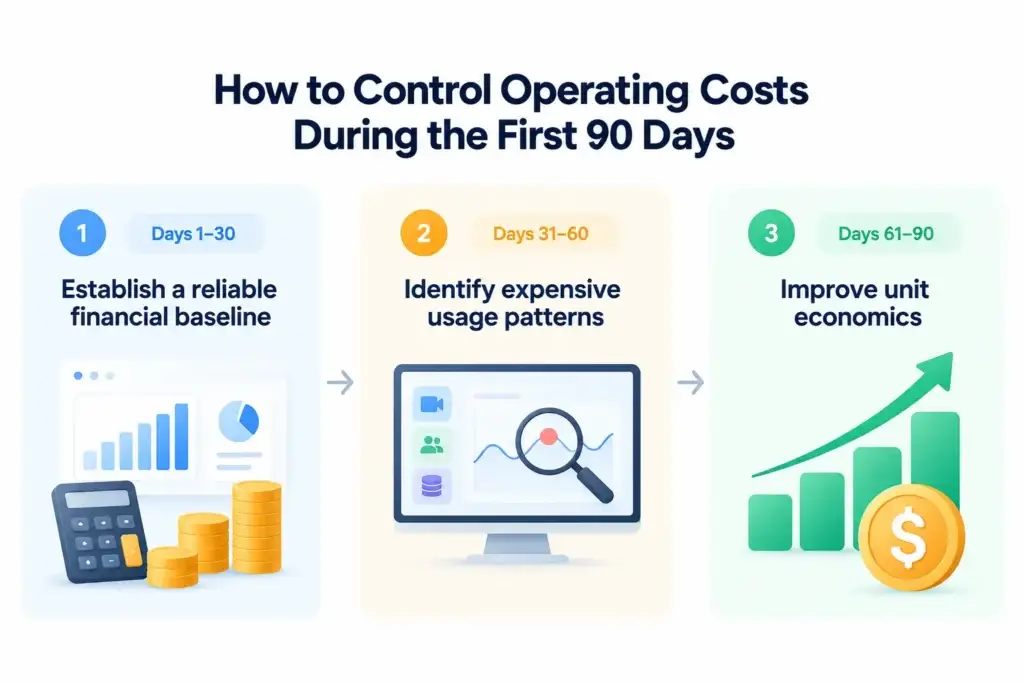
How to Control Operating Costs During the First 90 Days
The first three months after launch should be treated as a period for collecting meaningful operational data.
Instead of making large infrastructure and marketing commitments based entirely on projections, founders can use actual product activity to improve future planning.
Days 1–30: Establish a reliable financial baseline
Begin by tracking active broadcasters, viewer-hours, media usage, infrastructure expenses, payment activity, and operational support requests.
Confirm that your financial reports separate revenue, creator obligations, transaction fees, and operating expenses.
A well-planned launch strategy can also help founders control unnecessary spending. Recruiting broadcasters without an audience acquisition plan, or spending heavily on marketing before building a reliable creator community, can weaken early financial performance. A structured go-to-market strategy for live-video startups helps connect creator onboarding, audience growth, retention, and launch activities with realistic financial priorities.
Record the assumptions behind your initial budget so actual results can be compared against them.
Days 31–60: Identify expensive usage patterns
Review which types of broadcasts generate the most consumption and which creator groups produce sustained engagement.
Investigate unusually expensive sessions, unnecessary storage growth, and avoidable infrastructure usage.
At the same time, assess whether creator incentives are generating repeat activity rather than only short-term participation.
Days 61–90: Improve unit economics
Use the first two months of data to refine your forecast.
Adjust marketing allocations, creator programs, and infrastructure configurations where justified by the evidence.
Measure whether additional audience activity produces sustainable retained revenue after associated costs.
The objective is to reach a point where the founder can explain how increased engagement affects both revenue and expenses.
A business with reliable cost visibility is better positioned to make sensible scaling decisions.
What Financial Metrics Should You Monitor After Launch?
A monthly report should do more than show total revenue and overall spending.
Founders should track a small set of operating metrics that explain what is changing and why.
Cost per viewer-hour measures the relationship between relevant media expenses and total watching time. It helps identify whether streaming delivery is becoming more or less efficient.
Net revenue per active paying user shows how much money the business retains from its paying audience after applicable deductions.
Creator retention helps determine whether the effort spent recruiting broadcasters produces ongoing supply.
Customer acquisition cost measures the spending associated with acquiring users and should be evaluated against retention and financial contribution.
Contribution margin helps reveal whether the service generates sufficient retained revenue to cover the variable costs associated with its activity.
These metrics work best when examined together.
For example, reducing media quality might improve cost per viewer-hour in the short term but harm retention if it leads to poor playback experiences.
Likewise, increasing creator incentives might attract more content but reduce contribution margin if viewer spending does not increase accordingly.
The goal is not simply minimizing every expense. It is ensuring that spending creates measurable business value.
Final Thoughts: Budget for a Sustainable Streaming Business, Not Just Software
The true financial commitment behind a live-video business in 2026 extends well beyond purchasing or developing the application.
Cloud infrastructure, real-time media delivery, creator operations, payments, safety, customer support, and acquisition all influence long-term sustainability.
Founders should separate initial implementation from recurring costs, forecast audience consumption, and understand the financial relationship between engagement and retained revenue.
A ready-made product foundation can help reduce the amount of initial engineering work required, but it cannot replace a credible operating plan.
For businesses looking to move faster, Miracuves provides customizable software foundations with source-code ownership and administrative control, helping founders concentrate more of their planning effort on creator participation, market validation, and ongoing economics.
Ultimately, the strongest launch budget is not necessarily the smallest. It is the one that accounts for the real cost of operating the business and provides enough visibility to support informed growth decisions.
FAQs
How much does it cost to run a live streaming app each month?
Monthly running expenses depend on active viewing hours, media provider charges, cloud hosting, creator operations, moderation, transaction activity, and maintenance. A reliable estimate requires projected usage and actual supplier rates rather than a generic fixed figure.
What is the largest recurring expense for a live-video business?
Video delivery can become a major usage-related expense, particularly when viewers spend long periods watching broadcasts. However, creator acquisition, payouts, staffing, and marketing may be equally important or more expensive depending on the business model.
How can startups estimate streaming bandwidth requirements?
Founders can estimate delivered data using viewer-hours and average media bitrate. They should then apply the actual pricing model of their chosen provider, including any participant-minute charges or other applicable costs.
Is a ready-made application more economical than custom development?
It can reduce initial engineering effort when the existing product meets the intended business requirements. However, founders must also evaluate customization, production readiness, infrastructure, maintenance, ownership terms, and support before comparing total costs.
What hidden expenses should founders consider?
Frequently overlooked expenses include payment chargebacks, creator incentives, moderation staffing, security testing, application updates, logging, backups, support operations, and unexpected media-consumption increases.
Do creator payouts count as operating expenses?
Creator payouts are financial obligations that affect retained revenue and profitability. Their precise accounting treatment depends on the business’s contractual and accounting arrangements, but they must be included when assessing unit economics and cash-flow requirements.
Can a streaming business reduce costs without compromising viewer experience?
Yes. Usage monitoring, sensible quality defaults, efficient infrastructure configuration, appropriate storage policies, and provider-billing reviews may reduce unnecessary spending without indiscriminately lowering playback quality.
How should founders prepare their first-year streaming budget?
Start with confirmed initial implementation expenses, estimate monthly technical consumption and staffing requirements, include creator acquisition and marketing, account for applicable transaction deductions, and prepare multiple adoption scenarios with a reasonable financial reserve.
Miracuves is an independent software development company. We are not affiliated with, connected to, sponsored by, or endorsed by any company or product named in this article.
Terms such as “X Clone” are used descriptively. It is how the software industry refers to building a platform with functionality comparable to a known service, and how clients search for it.
The entire design and codebase of our products is built by our own team. Our products contain no code, design, graphics, or content originating from any third-party website or applications.
All third-party names and marks referenced in this article are the property of their respective owners, referenced solely to identify the services discussed.