

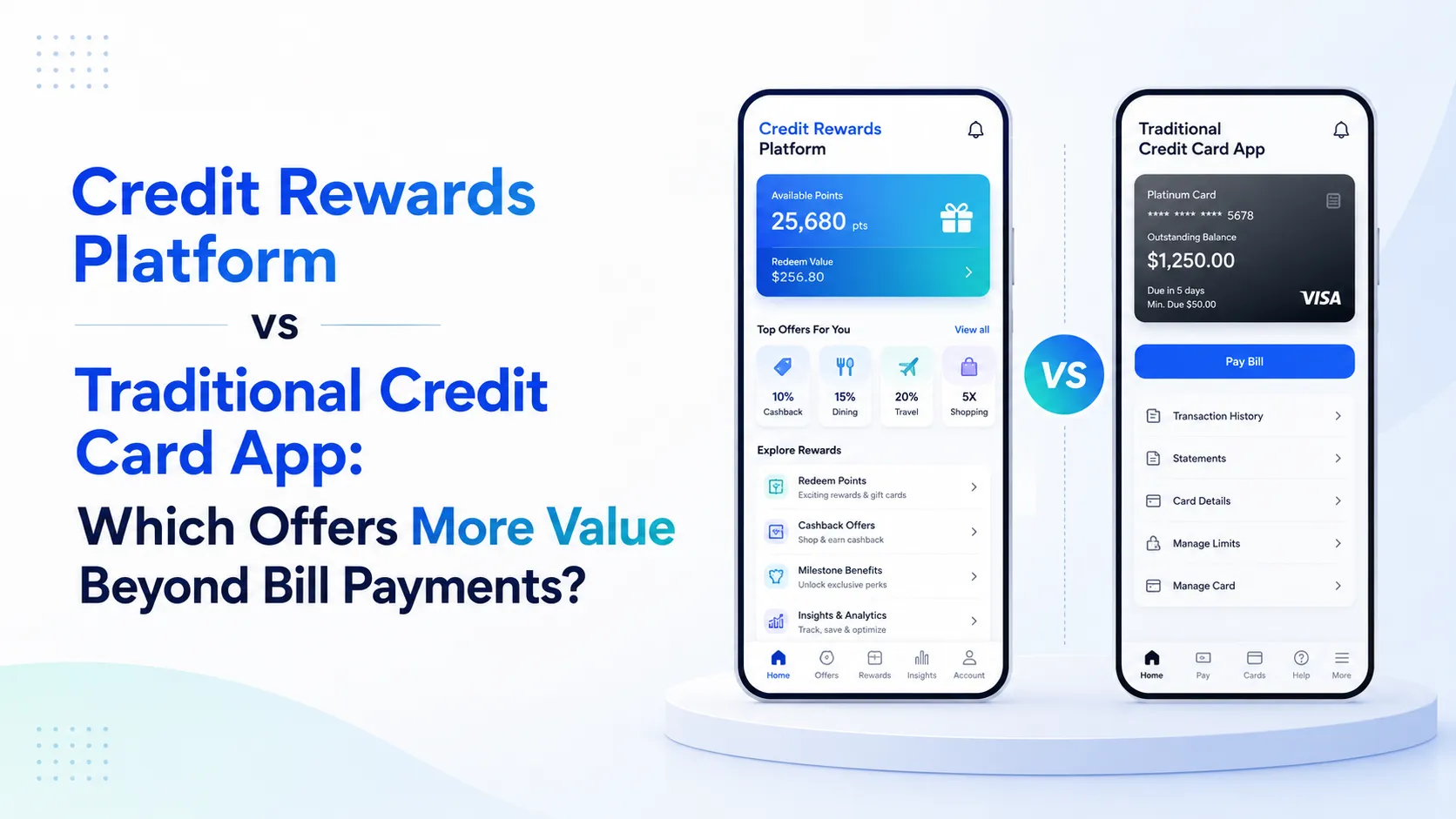
For many users, a credit card app is still a utility: check the outstanding amount, view statements, pay the bill, track due dates, and maybe redeem points from one issuer. It solves an important need, but it usually stays limited to the relationship between one bank and one cardholder.
A credit rewards platform takes a wider view. Instead of focusing only on one card account, it can bring multiple cards, bill reminders, reward points, credit insights, partner offers, gamification, referrals, and redemption experiences into one ecosystem.
That difference matters for fintech founders.
If the goal is only to help users pay bills, a simple credit card payment app may be enough. But if the goal is to build a high-engagement fintech product that users open repeatedly, share with friends, and use to discover financial value, a credit rewards platform can offer stronger business potential.
Key Takeaways
- A traditional credit card app is usually built around account servicing, bill payments, statements, limits, and issuer-specific rewards.
- A credit rewards platform can create more value by combining multi-card management, reward discovery, gamification, credit insights, and partner offers.
- Bill payment is the habit loop, but rewards, analytics, referrals, and redemption journeys create deeper retention.
- Founders should avoid building a thin payment utility without reward inventory, admin controls, fraud workflows, and monetization logic.
- Miracuves helps founders launch credit rewards and fintech app platforms faster with ready-made, white-label, source-code-owned app foundations.
Why This Comparison Matters for Fintech Founders
Credit card users are not just looking for a payment button. They want clarity, savings, control, reminders, rewards, and confidence that they are using their cards intelligently.
That is where the founder opportunity begins.
A traditional credit card app is controlled by the card issuer. It works well for that issuer’s card, but it does not always help users compare multiple cards, optimize rewards across spending categories, track redemption value, or understand their complete credit behavior.
A credit rewards platform can sit above that fragmented experience. It can become the user’s credit command center, where bill payment is only one action inside a broader engagement loop.
For founders, the real question is not “Can users pay a credit card bill?” The stronger question is:
Can the platform create enough repeat value that users return even when no bill is due?
That is the difference between a payment utility and a monetization-ready fintech ecosystem.
What a Traditional Credit Card App Actually Does
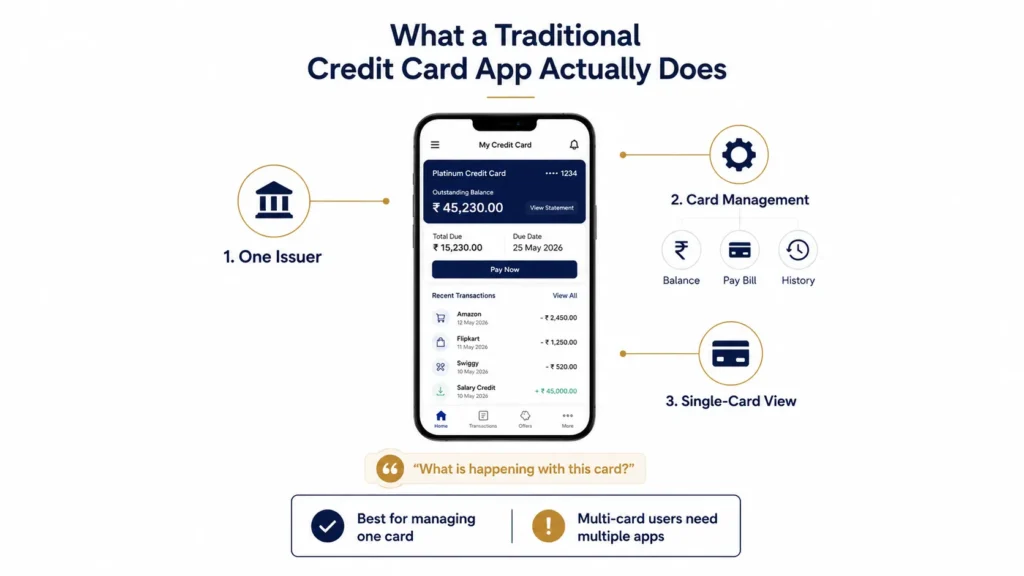
A traditional credit card app is usually designed by a bank, card issuer, or financial institution to manage its own customer relationship.
The core purpose is account servicing. The user opens the app to manage one card or a small set of cards from the same issuer.
Common features include:
- Outstanding balance
- Minimum due and total due
- Statement download
- Bill payment
- Transaction history
- Card limit visibility
- Card blocking or replacement
- EMI conversion
- Issuer-specific reward points
- Customer support
- Dispute or chargeback request
- Offers linked to the issuer’s partner network
This is useful, but the experience is usually narrow. A user with four credit cards may need four different issuer apps. Each app knows only its own card, its own offers, its own reward rules, and its own payment due date.
That creates a fragmented experience for multi-card users.
A traditional credit card app answers:
“What is happening with this card?”
A credit rewards platform answers:
“How can I manage and maximize my entire credit life from one place?”
What a Credit Rewards Platform Adds Beyond Bill Payment
A credit rewards platform is not just a bill payment layer. It is an engagement ecosystem built around financial behavior.
It can combine:
- Multi-card bill tracking
- Payment reminders
- Credit score insights
- Spending categorization
- Reward points
- Tier-based loyalty
- Streaks and achievements
- Referral rewards
- Partner brand offers
- Gift cards and vouchers
- Premium memberships
- Redemption catalogues
- Fraud and dispute workflows
- Admin-controlled campaigns
The biggest product difference is that a credit rewards platform can create value before, during, and after bill payment.
Before payment, it reminds the user, highlights due dates, and helps them avoid missed payments.
During payment, it can reward the user, trigger a streak, update loyalty status, or unlock partner benefits.
After payment, it can show points earned, next milestone, credit utilization changes, upcoming bills, and redemption options.
This creates a stronger habit loop.
For founders exploring this model, Miracuves offers a credit rewards app solution that supports multi-card management, rewards, gamification, credit insights, and admin control from a ready-made product foundation.
Credit Rewards Platform vs Traditional Credit Card App: Side-by-Side Comparison
| Comparison Area | Traditional Credit Card App | Credit Rewards Platform |
|---|---|---|
| Primary purpose | Manage one issuer’s card relationship | Manage credit behavior and rewards across cards |
| User value | Bill payment, statements, card servicing | Rewards, insights, bill tracking, offers, and engagement |
| Card coverage | Usually issuer-specific | Can support multiple card issuers |
| Rewards | Limited to issuer reward program | Can combine points, partner offers, vouchers, cashback, and tiers |
| Engagement depth | Mostly transactional | Habit-driven and reward-led |
| Monetization | Mostly issuer-owned | Merchant partnerships, premium plans, sponsored offers, referrals, and financial product distribution |
| Admin control | Bank-controlled backend | Platform operator can manage campaigns, rewards, users, referrals, and partner inventory |
| Differentiation | Convenience for existing customers | Broader user experience and ecosystem value |
| Founder opportunity | Limited unless you are the issuer | Stronger for fintech startups, loyalty businesses, and reward-led financial platforms |
The traditional credit card app wins on direct issuer control. The credit rewards platform wins on user engagement and ecosystem monetization.
Where Traditional Credit Card Apps Still Win
A traditional credit card app is not weak. It has clear advantages because it is directly connected to the issuer.
It can offer:
- Direct card account servicing
- Real-time issuer-side account data
- Official transaction controls
- Card lock and replacement flows
- Dispute handling through the issuing bank
- EMI conversion controlled by the issuer
- Native reward redemption for that card program
- Customer support tied to the bank
For users who have only one credit card and do not care much about reward optimization, the issuer app may be enough.
For banks, this model also makes sense because the app is part of customer servicing. The goal is not always broad engagement. Sometimes the goal is simply to reduce support load, digitize payments, and keep the cardholder connected to the issuer.
So the traditional credit card app is better when the product goal is narrow account management.
But for founders building an independent fintech product, that narrowness can become a limitation.
Read more: How Credit Card Bill Payment and Rewards Apps Work: User Journey, Trust Logic, and Engagement Model
Where Credit Rewards Platforms Create Stronger User Value
A credit rewards platform becomes more valuable when users want more than account servicing.
This is especially true for users who:
- Hold multiple credit cards
- Want all due dates in one place
- Compare card usage by category
- Look for better reward value
- Prefer reminders and nudges
- Want cashback, vouchers, or partner offers
- Track credit score changes
- Enjoy gamified financial habits
- Respond to referral rewards or loyalty tiers
The platform creates value by simplifying the user’s decision-making.
Instead of asking, “Which issuer app should I open?” the user can open one platform to understand what needs attention, what payment is due, what reward is available, and what financial action makes sense next.
That is where value moves beyond bill payment.
The bill is the trigger. The reward ecosystem is the retention engine.
Founder Decision Signals: Which Product Should You Build?
Speed
If your goal is to validate a credit rewards concept quickly, a ready-made fintech app foundation can reduce the time spent rebuilding common flows such as login, bill tracking, rewards, referrals, and admin controls.
Cost
A thin bill-payment app may look cheaper at first, but missing reward inventory, analytics, fraud workflows, and admin tools can create expensive rebuilds later.
Scalability
A rewards platform needs scalable backend logic for points, tiers, redemption, partner campaigns, ledgers, user activity, and payment references.
Market Fit
If users only need payment reminders, a simple utility can work. If users want savings, rewards, offers, and credit insights, a broader platform has stronger retention potential.
Core Features That Make a Credit Rewards Platform Valuable
A credit rewards platform should not be built as a payment screen with a few coupons attached. The strongest platforms combine financial utility, behavioral engagement, and business control.
1. Multi-Card Vault
The card vault allows users to add and manage multiple credit cards in one place.
A strong card vault should show:
- Card issuer
- Card network
- Limit
- Available credit
- Statement date
- Due date
- Minimum amount due
- Total amount due
- Utilization status
- Payment history
This matters because traditional issuer apps cannot always provide a complete multi-card view. A platform that helps users see all cards together becomes more useful for planning payments and avoiding missed due dates.
2. Bill Payment and Reminder Engine
Bill payment is the core habit loop. Users return because payment due dates are recurring.
The platform should support:
- Bill fetch
- Upcoming bills
- Paid bills
- Payment references
- Autopay preferences
- Reminder jobs
- Push notifications
- Email alerts
- Failed payment handling
For founders, this is not just a feature. It is the recurring engagement mechanism that keeps users connected to the app.
3. Rewards and Redemption Catalogue
Rewards are where the product becomes more than a utility.
A strong rewards system should include:
- Points accrual
- Redemption rules
- Voucher catalogue
- Partner offers
- Inventory management
- Expiry rules
- Redemption history
- Offer eligibility
- Campaign-level controls
The key point is reconciliation. A points balance should not be treated as a random number. It should be traceable, auditable, and connected to redemption logic.
This is where the feature breakdown for a credit rewards app becomes useful for founders who want to understand what product depth is needed beyond a payment screen.
4. Gamification Layer
Gamification helps turn responsible financial behavior into repeat engagement.
Examples include:
- Payment streaks
- Loyalty tiers
- Achievement badges
- Referral milestones
- Leaderboards
- Weekly challenges
- Reward unlocks
Used carefully, gamification can make the app feel more rewarding without encouraging irresponsible credit usage. The platform should reward timely payments, smart tracking, responsible card management, and consistent engagement.
5. Credit Insights and Score Tracking
Credit insights help users understand their financial behavior.
Useful insight modules may include:
- Credit score history
- Utilization tracking
- Payment behavior
- Spending categories
- Positive and negative score factors
- Alerts for utilization changes
- Due date risk indicators
This moves the product from “pay your bill” to “understand your credit behavior.”
6. Admin Dashboard and Campaign Control
Founders often underestimate the admin dashboard. But in a rewards platform, admin control decides whether the business can operate without depending on developers for every change.
The admin dashboard should help operators manage:
- Users
- Cards
- Bills
- Reward catalogue
- Offer inventory
- Partner campaigns
- Referrals
- Fraud flags
- Disputes
- KYC review
- Notifications
- Reports
- Payment references
- Redemption logs
This is important because rewards platforms are operational businesses. They need continuous campaign updates, partner changes, offer approvals, and customer support workflows.
Read more: Credit Card Bill Payment App Features and Pricing Factors: What Founders Should Plan Before Launch
Monetization Opportunities Beyond Bill Payments
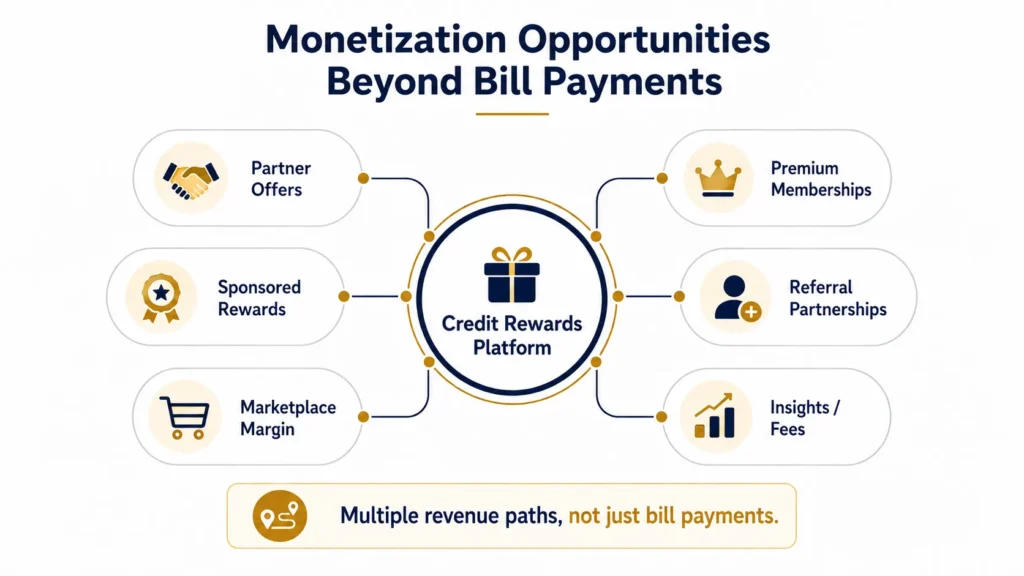
A traditional credit card app usually monetizes indirectly for the issuer. It supports card usage, reduces service costs, and strengthens customer retention.
A credit rewards platform can create multiple monetization paths.
| Revenue Stream | How It Works | Founder Value |
| Partner offer commissions | Brands pay for conversions, clicks, or purchases through offers | Builds revenue from merchant partnerships |
| Sponsored rewards | Featured offers or premium placements inside the rewards catalogue | Helps monetize attention without charging users directly |
| Premium memberships | Users pay for better offers, faster rewards, exclusive benefits, or advanced insights | Creates recurring revenue |
| Referral partnerships | Financial products, cards, loans, insurance, or wallets can be promoted through partner flows | Expands fintech distribution revenue |
| Redemption marketplace margin | The platform earns margin on vouchers, gift cards, or reward inventory | Connects engagement with commerce |
| Data-backed insights for partners | Aggregated, privacy-conscious campaign performance insights help partners improve offers | Creates B2B value without exposing personal user data |
| Convenience or service fees | Applied carefully where permitted and transparent | Adds revenue only when users see clear value |
For deeper monetization planning, founders can review this guide on reward-led credit app monetization models.
The best model usually combines several revenue streams. A platform that depends only on bill payment rewards may struggle if reward costs rise or user engagement drops.
Security, Trust, and Compliance Workflows Founders Should Plan Early
Fintech users are cautious because the product handles financial data, card details, payment activity, identity checks, and rewards value.
Security should be part of the product foundation, not a final development step.
Important workflows include:
- Encrypted data transfer
- Encrypted data storage
- Secure payment gateway integration
- Tokenized payment handling where applicable
- KYC workflow support
- Role-based access control
- Admin activity logs
- Audit trails
- Fraud monitoring
- Suspicious activity flags
- Dispute management
- Secure API integrations
- Permission-based dashboards
- Privacy-conscious data handling
Founders should also be realistic about compliance. A platform can be built with compliance-ready workflows, but final compliance depends on jurisdiction, legal review, integrations, operating model, and financial partners.
This matters because trust is a growth asset. A user may try a rewards platform because of cashback or offers, but they stay only if payments, reminders, data handling, and redemption records feel reliable.
Common Mistakes Founders Should Avoid
Building only a bill payment utility
A payment screen alone does not create enough differentiation. The stronger opportunity is in rewards, credit insights, gamification, partner offers, and admin-controlled campaigns.
Treating rewards as simple coupons
Rewards need proper inventory, expiry rules, eligibility, redemption history, and reconciliation. Without this, the platform can become difficult to operate at scale.
Ignoring admin operations
Partner offers, reward campaigns, disputes, users, and fraud signals need backend control. A weak admin dashboard creates operational dependency and slows growth.
Adding gamification without responsibility
Gamification should encourage timely payments, financial awareness, and responsible credit behavior. It should not push users toward unnecessary spending.
Delaying security and compliance planning
Financial products need secure architecture from the start. Retrofitting KYC, audit logs, encryption, access control, and fraud workflows later can delay launch and increase risk.
So, Which Offers More Value Beyond Bill Payments?
The answer depends on what value means.
If value means direct issuer servicing, statement access, card controls, and official bank support, the traditional credit card app is stronger.
If value means multi-card visibility, reward optimization, gamified engagement, partner offers, credit insights, and monetization flexibility, the credit rewards platform offers more.
For users, the rewards platform becomes valuable when it reduces fragmentation and helps them make smarter credit decisions.
For founders, it becomes valuable when it creates repeat engagement, partner revenue, premium monetization, and a scalable product ecosystem.
The better business opportunity is usually not bill payment alone. It is the ecosystem around bill payment.
How Miracuves Helps Founders Launch Faster
Building a credit rewards platform from zero requires many connected modules: authentication, card vault, bill reminders, rewards, referrals, credit insights, admin dashboards, payments, fraud workflows, and campaign management.
Miracuves helps founders start with a ready-made, white-label, source-code-owned fintech app solutions that can be customized for branding, features, integrations, and launch scope.
This approach is useful when founders want to validate demand faster without spending months rebuilding the same core product flows. The foundation can support a faster launch while still allowing business-specific customization around rewards, partner offers, user journeys, and monetization.
Final Thoughts: The Real Value Is the Ecosystem, Not the Payment Button
A traditional credit card app is useful because it helps users manage one issuer relationship. It is direct, trusted, and practical.
A credit rewards platform becomes more valuable when users need a broader experience: multiple cards, due dates, reward discovery, credit insights, referrals, gamification, and partner benefits.
For founders, the strongest opportunity is not to build another basic bill payment app. It is to build a credit engagement ecosystem where bill payment starts the habit, rewards deepen retention, and admin-controlled monetization keeps the business scalable.
Miracuves can help founders move from idea to launch faster with a white-label, source-code-owned fintech app foundation designed for credit rewards, admin control, and market validation.
FAQs
What is the main difference between a credit rewards platform and a traditional credit card app?
A traditional credit card app usually helps users manage one issuer’s card, including statements, payments, limits, and issuer-specific rewards. A credit rewards platform can support multi-card tracking, bill reminders, reward points, partner offers, credit insights, gamification, and redemption experiences across a broader ecosystem.
Is a credit rewards platform only useful for bill payments?
No. Bill payment is only the recurring habit loop. A strong credit rewards platform also provides rewards, credit score insights, spending visibility, partner offers, referral programs, loyalty tiers, and premium experiences.
Why do users prefer a multi-card credit management experience?
Users with multiple credit cards often deal with different due dates, limits, reward rules, and issuer apps. A multi-card experience brings this information into one place, making it easier to manage payments, track utilization, and discover reward value.
How can a credit rewards platform make money?
A credit rewards platform can earn through partner commissions, sponsored rewards, premium memberships, referral partnerships, redemption marketplace margins, financial product distribution, and carefully structured service fees where permitted.
What features are essential for a credit rewards app?
Essential features include user onboarding, card vault, bill reminders, payment tracking, reward points, redemption catalogue, credit insights, referrals, gamification, notifications, admin dashboard, fraud monitoring, dispute workflows, and secure payment integrations.
Is security important for a credit rewards platform?
Yes. Security is critical because the platform may handle financial data, payment activity, card-related information, user identity workflows, and rewards value. Founders should plan encrypted data handling, secure APIs, role-based access, audit logs, fraud monitoring, and compliance-ready workflows from the beginning.
Should founders build a credit rewards platform from scratch or use a ready-made foundation?
A custom build may be useful when the idea requires completely unique workflows. A ready-made foundation is better when the founder wants to validate faster using proven modules such as bill tracking, rewards, referrals, admin control, and user dashboards. Final choice depends on scope, customization needs, budget, and launch strategy.
Can Miracuves help launch a white-label credit rewards app?
Yes. Miracuves helps founders build ready-made and white-label fintech app solutions with source-code ownership, branded design, admin dashboards, and launch-focused customization.
Miracuves is an independent software development company. We are not affiliated with, connected to, sponsored by, or endorsed by any company or product named in this article.
Terms such as “X Clone” are used descriptively. It is how the software industry refers to building a platform with functionality comparable to a known service, and how clients search for it.
The entire design and codebase of our products is built by our own team. Our products contain no code, design, graphics, or content originating from any third-party website or applications.
All third-party names and marks referenced in this article are the property of their respective owners, referenced solely to identify the services discussed.