




















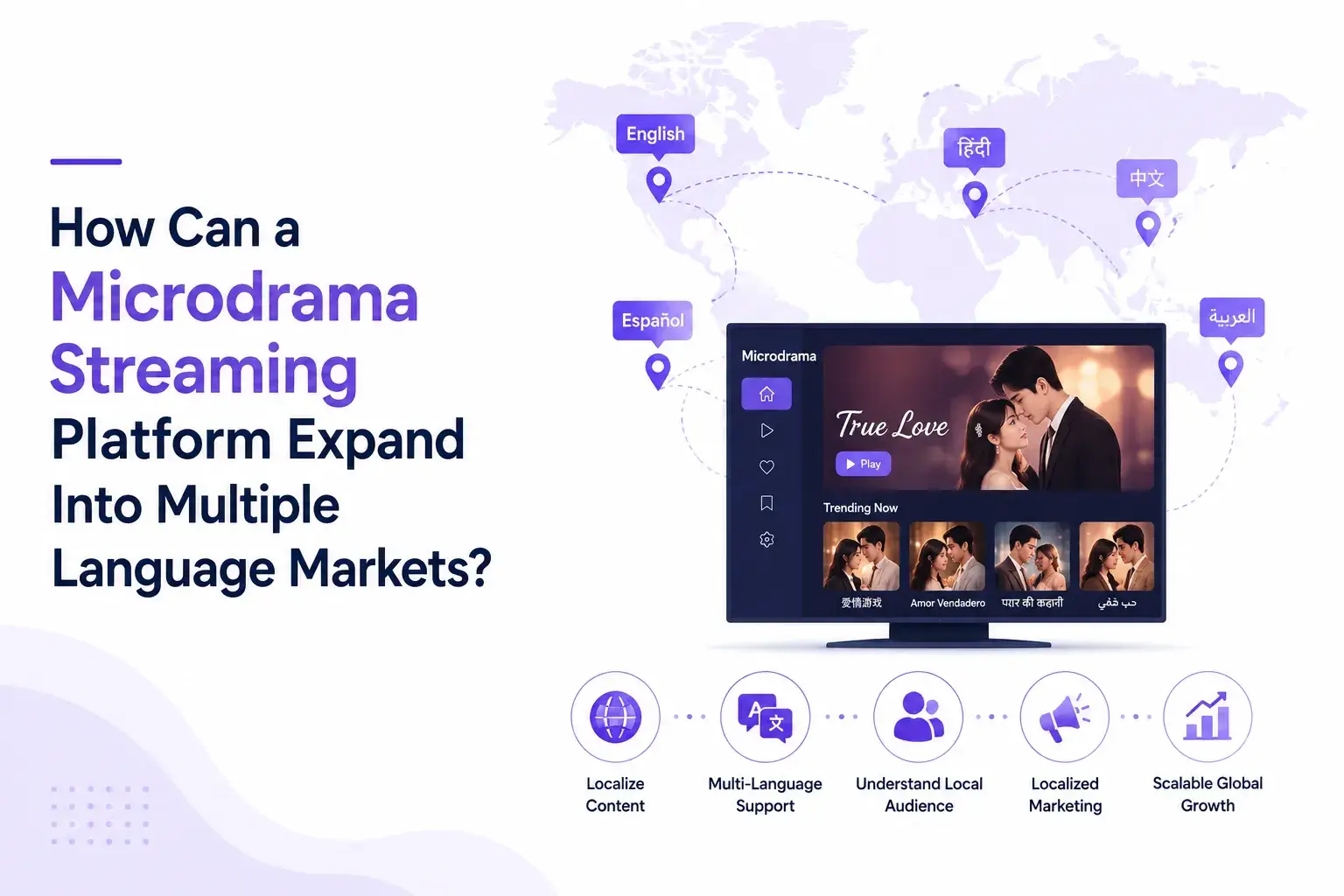
Microdrama streaming is no longer only about short episodes and vertical viewing. The next serious growth layer is language expansion.
For founders, media startups, production houses, and regional entertainment brands, this raises an important question: how do you take one microdrama platform into multiple language markets without rebuilding the product every time?
The answer is not “just add subtitles.” A multilingual DramaBox-like streaming platform needs a clear system for interface localization, regional content strategy, dubbing, subtitles, payment preferences, coin pricing, user acquisition, content rights, moderation, and admin control.
A short-drama platform can scale across languages only when the product foundation and the content operation are built for market variation from day one. The same story may travel across regions, but the way users discover it, pay for it, understand it, and emotionally connect with it will change from market to market.
That is where platform planning becomes a business decision, not just a translation task.
Key Takeaways
- A multilingual microdrama streaming platform needs more than translated app screens. It needs regional content, payments, pricing, discovery, moderation, and monetization workflows.
- Language expansion works best when interface language, content language, subtitles, dubbing, and regional catalogs are managed separately.
- Founders should validate language markets based on audience appetite, content supply, payment readiness, customer acquisition cost, and retention signals.
- Microdrama platforms should avoid copying one market’s pricing, unlock model, or creative tone into every new region.
- Miracuves helps founders launch faster with ready-made, white-label video platform foundations that can support multi-market short-drama growth.
Why Language Expansion Matters for Microdrama Platforms
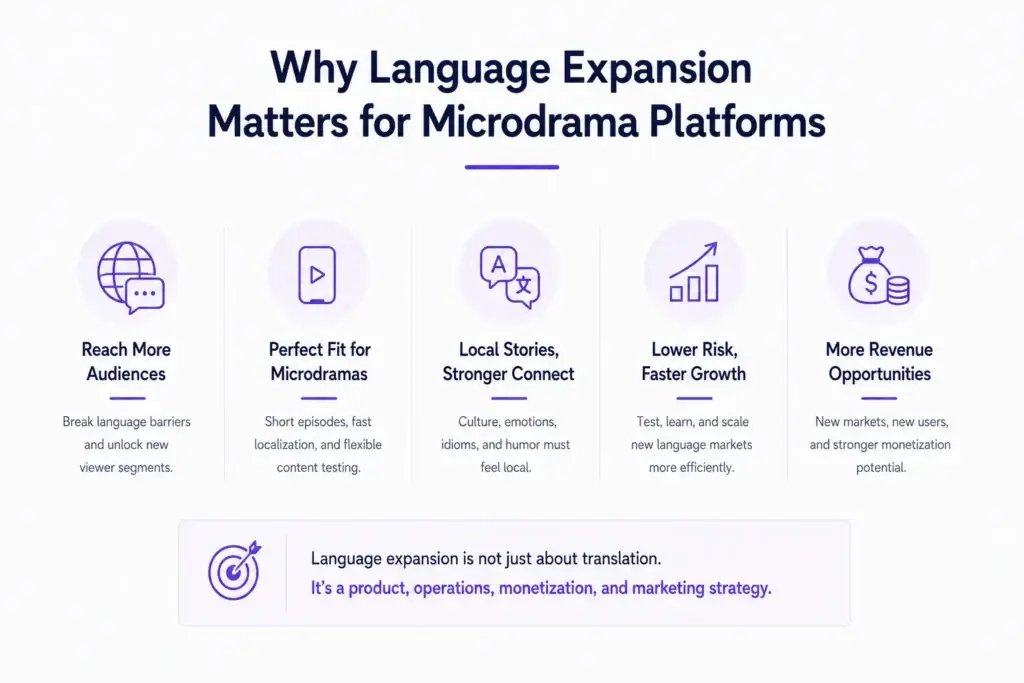
Microdramas are built for speed, emotion, and repeat viewing. Episodes are short, cliffhangers are frequent, and users often consume stories on mobile during small pockets of free time.
This format gives language expansion a strong advantage. A full-length OTT series may require heavy dubbing, expensive marketing, and long viewing commitment. A microdrama, by contrast, can test new language markets with shorter episodes, faster localization cycles, and more flexible monetization.
But the opportunity comes with a risk.
A founder may assume that a successful Hindi, English, Spanish, Arabic, or Indonesian content library can simply be translated and pushed into another region. In reality, short drama depends heavily on cultural timing, emotional cues, family dynamics, humor, romance expectations, social class signals, local idioms, and even how quickly a cliffhanger should land.
That means multilingual expansion is not just a content task. It is a product, operations, monetization, and marketing task.
Start With Market Selection, Not Translation
The first mistake many streaming founders make is choosing languages before choosing markets.
A language is not always a market. Spanish-speaking users in Mexico, Spain, Colombia, and the United States may share a language, but they may not share the same pricing expectations, payment methods, creative references, actor preferences, or content discovery behavior.
Before expanding, founders should evaluate each market through five filters:
- Audience demand: Are users already consuming vertical drama, short video, serialized romance, family drama, or mobile-first entertainment?
- Content fit: Does your existing catalog emotionally match the target region, or does it need adaptation?
- Payment readiness: Can users easily buy coin packs, subscriptions, or pay-per-episode access in their preferred currency and payment method?
- Acquisition channels: Are audiences discoverable through social feeds, influencer pages, paid ads, app stores, or creator partnerships?
- Operational complexity: Can your team handle localization, moderation, support, refunds, content updates, and campaign tracking for that language?
A strong multilingual strategy usually begins with one or two high-probability markets, not ten markets at once.
Separate Interface Language From Content Language
A scalable short-drama streaming app should treat app interface language and content language as two different systems.
Interface language controls the app experience: buttons, menus, login flows, payment screens, wallet labels, notifications, error messages, and onboarding copy.
Content language controls the media experience: show titles, episode names, subtitles, audio tracks, descriptions, thumbnails, dubbing assets, and category labels.
When these two layers are mixed, expansion becomes painful. A viewer may want the app interface in English but still prefer Tamil shows. Another user may want an Arabic interface with Korean dramas dubbed into Arabic. A bilingual user may browse in Hindi but watch Spanish content with subtitles.
For founders, this separation matters because it creates flexibility. You can launch a new language interface without instantly localizing the full catalog. You can also test localized content demand before investing in deeper dubbing or original production.
A platform that handles this properly gives the operator more control and reduces dependency on developers for every language update.
Language Expansion Layers Founders Should Plan
| Expansion Layer | What It Controls | Why It Matters for Growth |
|---|---|---|
| Interface Localization | Menus, buttons, wallet labels, onboarding, notifications, checkout screens | Improves usability and reduces friction for first-time users in each language market. |
| Content Localization | Subtitles, dubbing, title translation, episode descriptions, thumbnails | Helps the same catalog reach more viewers without producing every show from zero. |
| Cultural Adaptation | Dialogue tone, names, idioms, emotional pacing, family and romance context | Makes the story feel native rather than mechanically translated. |
| Payment Localization | Currency, payment gateway, coin pack pricing, tax display, refund flow | Protects conversion because users trust familiar payment methods and local pricing. |
| Discovery Localization | App store metadata, social creatives, influencer campaigns, push notifications | Improves acquisition by matching the channels and language users already engage with. |
| Admin Control | Catalog settings, unlock rules, pricing, user segments, moderation, reports | Allows the operator to manage each market without waiting for code changes. |
Decide Whether to Translate, Dub, Adapt, or Produce Locally
Not every language market needs the same content approach.
A founder can use four levels of localization depending on the market opportunity and budget.
1. Subtitles for Fast Testing
Subtitles are useful for early market validation. They allow the platform to test whether users respond to a story before investing in dubbing or regional production.
This works best when the source content already has strong visual storytelling, simple emotional arcs, and universal themes such as betrayal, revenge, romance, wealth gaps, family conflict, or comeback stories.
2. Dubbing for Better Emotional Access
Dubbing can improve accessibility when audiences prefer listening in their native language. For microdramas, voice tone matters because episodes are short and emotional shifts happen quickly.
Poor dubbing can damage the story. Good dubbing should preserve pacing, emotional intensity, character hierarchy, and regional speech patterns.
3. Cultural Adaptation for Deeper Market Fit
Some markets need more than subtitles or dubbing. Names, slang, family references, social status cues, and humor may need adaptation.
For example, a line that feels dramatic in one culture may feel exaggerated or unnatural in another. A romantic conflict that works in one region may need a different emotional setup elsewhere.
Cultural adaptation is especially important when the platform wants repeat viewing and paid unlocking, because users pay when the story feels emotionally immediate.
4. Local Original Production for Long-Term Growth
Once a language market proves demand, the next step may be original regional production.
This is where a platform moves from translation-led expansion to market ownership. Local writers, actors, directors, and production teams can create content that feels native from the first frame.
For founders, the smarter path is often staged: subtitles first, dubbing second, selective adaptation third, and local originals once retention and monetization justify the investment.
Build a Regional Catalog Strategy
A multilingual microdrama platform should not show the same homepage to every user.
Each market needs a catalog strategy based on local taste. The admin dashboard should allow the operator to organize content by language, genre, region, popularity, unlock behavior, and campaign source.
Useful catalog controls include:
- Language-based home rails
- Region-specific trending sections
- Genre segmentation by market
- Localized thumbnails
- Translated show descriptions
- Separate free episode windows by market
- Different coin unlock rules for selected titles
- Regional watchlists and continue-watching flows
- Market-specific push notifications
This is where short-drama expansion becomes operational. The platform is not only hosting videos. It is deciding which story should be promoted, where, when, in what language, and with what monetization logic.
For a founder comparing build options, this is a key reason to look beyond a basic streaming script. A simple video app may play content, but a growth-ready microdrama platform should help the operator manage catalog economics across languages.
Localize Monetization Instead of Copying One Price Everywhere
Microdrama monetization often depends on small purchases, coin packs, rewarded ads, VIP access, or pay-per-episode unlocks.
The problem is that payment behavior changes by market.
A coin pack that converts well in one country may feel expensive in another. A subscription may work in a market with strong card penetration but underperform where wallets, UPI-style payments, carrier billing, or local payment methods dominate. Rewarded ads may work better in lower ARPU markets where users are willing to watch ads to unlock episodes.
A strong platform should allow market-level monetization control.
| Monetization Lever | Why It Should Vary by Market |
|---|---|
| Coin pack price | Purchasing power and currency expectations differ across regions. |
| Free episode window | Some markets need more free viewing before users trust the platform. |
| VIP access | Subscription appetite depends on content depth and payment maturity. |
| Rewarded ads | Ad-based unlocks may work better in price-sensitive markets. |
| Promotional coins | Launch campaigns often need market-specific incentives. |
| Payment gateway | Checkout trust depends on familiar local payment options. |
The goal is not to force every market into one revenue model. The goal is to give each market enough flexibility while keeping the platform’s wallet, ledger, and entitlement logic consistent.
This is where a ready-made short-drama streaming foundation from Miracuves can become useful for founders who want to test language markets faster without building every wallet, unlock, and admin module from scratch. Learn more about the platform direction here: short-drama streaming app solution.
Make Right-to-Left Readiness a Product Requirement, Not a Later Fix
If your expansion roadmap includes Arabic, Hebrew, Urdu, Persian, or other right-to-left language markets, RTL support should be planned early.
Right-to-left localization is not only text alignment. It affects navigation, icons, content cards, player controls, forms, checkout screens, menus, dashboards, and error messages.
Retrofitting RTL after launch can create design, QA, and usability problems because every screen needs review. For microdrama platforms, this matters even more because the user journey is fast. A viewer may arrive from a social ad, open a show, watch free episodes, hit a lock screen, and decide whether to pay within minutes.
If the RTL checkout flow feels broken or confusing, the platform loses the user at the most valuable moment.
Founders should ask their development team or platform provider:
- Does the viewer app support RTL across all screens?
- Does the admin dashboard support RTL content management?
- Can thumbnails and titles be localized by language?
- Does the wallet screen display currency and coin values clearly?
- Are push notifications tested in RTL formats?
- Can interface copy be updated without a full app release?
A multilingual strategy becomes much stronger when language support is treated as product infrastructure, not cosmetic translation.
Build a Localization Workflow Inside the Content Operation
Language expansion creates content operations pressure.
Every show may require translated metadata, subtitles, dubbing files, thumbnail variants, trailer edits, episode descriptions, content ratings, and campaign copy. Without a workflow, teams lose track of what is ready, what is pending, and what is live.
A practical microdrama localization workflow may include:
- Market shortlist: Choose priority languages based on demand and monetization potential.
- Catalog selection: Identify which shows have the strongest chance to travel.
- Rights check: Confirm whether each title can be distributed in the target territory.
- Localization brief: Define tone, character names, cultural notes, subtitle style, and dubbing direction.
- Asset production: Create subtitles, voice files, thumbnails, descriptions, and trailers.
- Quality review: Check timing, emotional tone, sync, spelling, cultural accuracy, and playback.
- Platform publishing: Upload localized assets, configure pricing, and schedule release.
- Performance review: Track completion rate, unlock rate, paid conversion, refunds, and retention.
This process helps founders avoid a common problem: launching many languages but managing them manually through scattered spreadsheets, developer requests, and disconnected file folders.
A scalable streaming business needs a content workflow that can handle volume.
Use Market-Specific Discovery Channels
Microdrama growth is often driven by discovery outside the app. Users may first encounter a story through social feeds, short video ads, creator clips, influencer reactions, or regional entertainment pages.
That means each language market needs its own acquisition strategy.
For example, one region may respond strongly to dramatic romance hooks. Another may prefer family conflict, revenge arcs, aspirational wealth stories, or comedy. A direct translation of an ad creative may not work because emotional triggers differ.
Founders should localize:
- App store title and description
- Preview videos
- Social ad hooks
- Thumbnail copy
- Influencer scripts
- Push notification tone
- Referral campaigns
- Landing pages
- Email or WhatsApp reactivation flows
The platform should also help the operator understand which language cohorts are converting. Without analytics by language, market, content title, and acquisition source, the founder cannot tell whether growth is driven by strong content, cheap traffic, or temporary launch discounts.
Founder Decision Signals
Speed
If the goal is to test multiple language markets quickly, avoid a build path where every new locale requires a developer release.
Cost
Budget not only for software, but also for dubbing, subtitles, payment setup, content rights, creative testing, and market-specific campaigns.
Scalability
The platform should separate catalog, language, wallet, payments, and admin controls so each new market does not become a messy duplicate build.
Market Fit
Language expansion should be guided by retention, completion rate, unlock rate, and repeat viewing instead of translation volume alone.
Prepare Customer Support and Moderation for Each Language
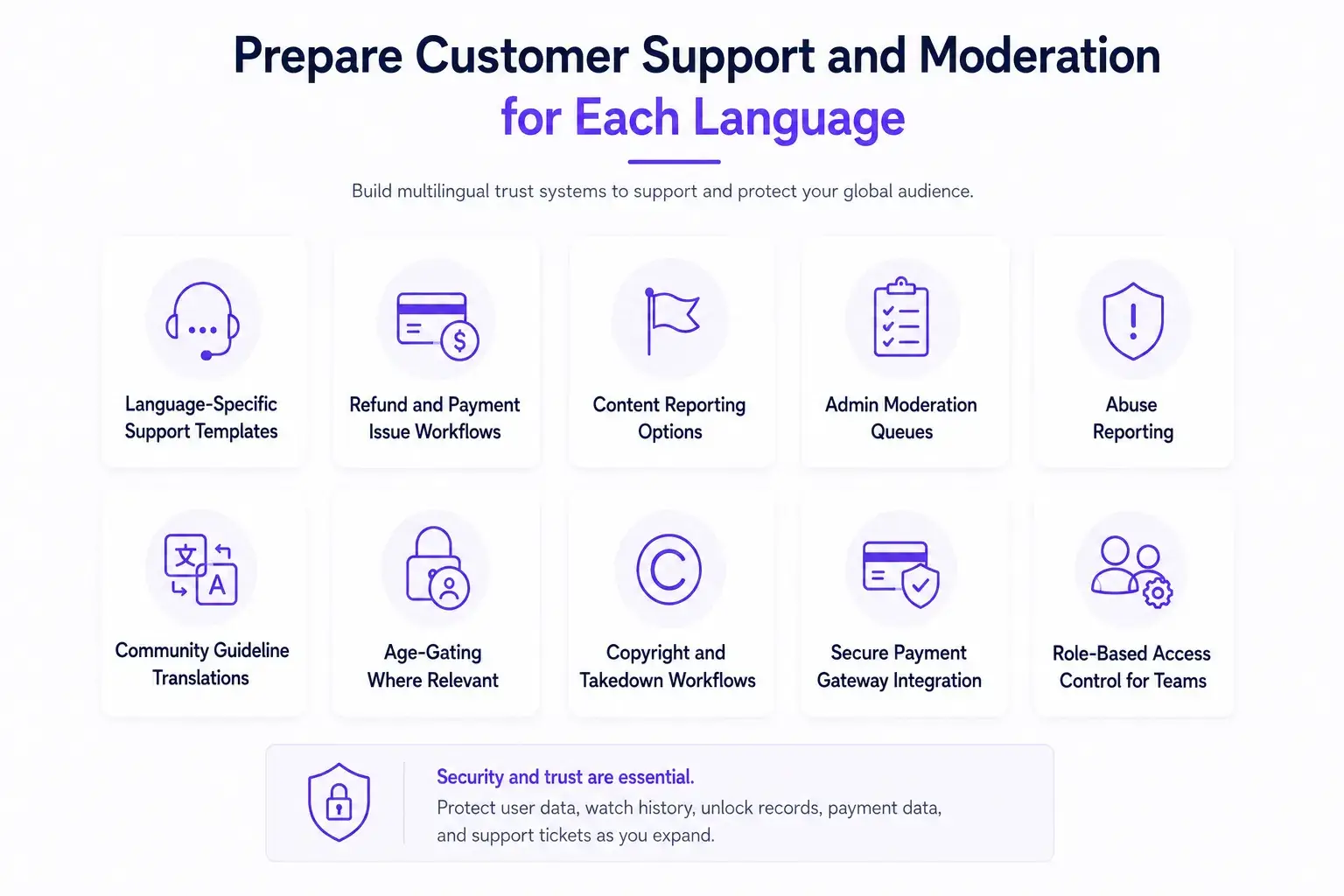
A multilingual streaming platform also needs multilingual trust systems.
Users may ask questions about payment failure, missing coins, episode unlocks, refunds, subscription status, app issues, or content availability. If support is available only in one language, paid users in new markets may lose confidence quickly.
The same applies to moderation. Microdrama platforms may deal with comments, reviews, reports, community reactions, creator uploads, or promotional content. Each language market can have different sensitivities around adult themes, religious references, political content, violence, romance, and age-appropriate viewing.
Founders should prepare:
- Language-specific support templates
- Refund and payment issue workflows
- Content reporting options
- Admin moderation queues
- Abuse reporting
- Community guideline translations
- Age-gating where relevant
- Copyright and takedown workflows
- Secure payment gateway integration
- Role-based access control for support teams
Security and trust should not be treated as afterthoughts. Payment data, user profiles, watch history, unlock records, and support tickets all need privacy-conscious handling as the platform expands.
Track the Right Metrics by Language Market
A founder cannot scale what they cannot measure.
Multilingual expansion should be tracked by market-level performance, not only total app growth. Otherwise, a strong market may hide a weak one, or a high-download region may consume content without converting.
Useful metrics include:
| Metric | What It Reveals |
|---|---|
| Language activation rate | Whether users select or stay in a language experience after onboarding. |
| First episode completion | Whether the localized content hook is strong enough. |
| Free-to-paid unlock rate | Whether viewers value the story enough to pay or watch ads. |
| Coin pack conversion | Whether pricing and checkout are working in that market. |
| Refund or payment failure rate | Whether gateway setup or pricing display is creating friction. |
| Day 1 and Day 7 retention | Whether the market has repeat-viewing potential. |
| Content-level revenue | Which titles should receive more localization investment. |
| CAC by language | Whether acquisition costs justify deeper expansion. |
The strongest expansion decisions come from comparing creative performance, payment behavior, and retention by language market.
Choose the Right Platform Foundation for Multi-Market Growth
Founders usually have three options when building a multilingual microdrama streaming platform.
| Build Route | Strength | Risk |
|---|---|---|
| Generic video streaming script | Faster than building from zero | May lack microdrama-specific wallet, coin unlock, regional catalog, and language controls. |
| Custom development from scratch | Full flexibility | Higher cost, longer development, and more risk if the team has not built short-drama monetization before. |
| Ready-made short-drama platform foundation | Faster launch with core modules already available | Still requires smart customization, content strategy, localization, and rights planning. |
The right choice depends on the founder’s stage.
If you are still validating whether a language market will pay for short dramas, speed and operational control matter. If you already have a large catalog, studio partnerships, and regional marketing budgets, deeper customization may matter more.
Miracuves helps founders bridge this decision with ready-made and white-label video platform solutions designed for faster launch, branding control, admin management, monetization, and source-code ownership. Founders exploring wider entertainment app options can also review Miracuves’ video content platform solutions or the broader OTT app development service.
Common Mistakes Founders Should Avoid
Mistakes Founders Should Avoid
Treating Translation as Localization
Translation changes words. Localization changes the viewing experience, emotional tone, payment flow, discovery strategy, and market fit.
Using One Coin Price Across Every Market
Micro-purchase behavior differs by region. A pricing model that works in one market can block conversion in another.
Ignoring Content Rights by Territory
Founders must confirm where each title can legally be distributed before promoting it in a new region.
Launching Too Many Languages Without Support
Every new language creates support, moderation, QA, content, and marketing work. Expansion should be staged and measurable.
A Practical Expansion Roadmap for Microdrama Founders
A smart multilingual rollout does not need to begin with a huge catalog in every language. It can start with disciplined testing.
Phase 1: Validate the First New Language
Choose one language market where your existing catalog has emotional fit. Localize a small batch of titles, create local app store metadata, run social campaigns, and track completion and unlock behavior.
Phase 2: Improve the Monetization Layer
Adjust coin pack sizes, free episode windows, rewarded ad placement, subscription offers, and payment options based on real market behavior.
Phase 3: Expand the Catalog
Once the first titles show retention, localize more shows in the same genre or emotional category. Use the strongest-performing titles to shape your regional content strategy.
Phase 4: Add Local Originals
If the market shows strong repeat viewing and paid conversion, invest in original language-first productions with local writers, actors, and creators.
Phase 5: Build a Repeatable Market Playbook
Document what worked: acquisition channels, genres, pricing, dubbing style, creative hooks, support issues, refund patterns, and retention signals. Then use that playbook to enter the next market more intelligently.
This staged approach reduces risk. Instead of betting everything on a large multilingual launch, founders can use data to decide where deeper investment makes sense.
Market Expansion Checklist for a Multilingual Microdrama Streaming Platform
Before launching a microdrama app in a new language market, founders should verify more than translated content. The platform must support local viewing preferences, payment behavior, language-specific interfaces, and operational workflows.
Use this checklist before approving each regional launch.
Language and Content Readiness
- Confirm the target country’s primary languages and audience preferences.
- Translate onboarding screens, navigation, wallet labels, checkout messages, and notifications.
- Prepare subtitles with accurate timing, readable formatting, and cultural adaptation.
- Evaluate whether priority titles require dubbed audio.
- Localize series titles, episode descriptions, thumbnails, and app store listings.
- Verify content distribution rights for the target territory.
Right-to-Left (RTL) Compatibility
- Test RTL layouts for Arabic, Urdu, Hebrew, or other applicable languages.
- Check navigation direction, text alignment, icons, and mixed-language content.
- Verify subtitle placement and readability on vertical mobile screens.
- Test checkout forms, currency displays, wallet screens, and error messages.
- Check notifications and admin content-entry workflows for RTL compatibility.
Regional Payments and Monetization
- Identify payment gateways and methods available to the target market.
- Confirm supported currencies, settlement arrangements, and transaction fees.
- Configure region-specific coin packs, VIP plans, and episode unlock prices.
- Test successful payments, failed transactions, refunds, and wallet balance updates.
- Verify subscription renewal and cancellation requirements where applicable.
- Review local tax, privacy, and consumer-protection requirements.
Regional Rollout and Performance Tracking
- Launch with a limited set of localized titles before expanding the full catalog.
- Test localized advertising, app store descriptions, and promotional creatives.
- Prepare regional customer support and content moderation workflows.
- Confirm that operators can update language assets and market settings without unnecessary developer releases.
- Track first-episode completion, retention, coin purchases, VIP conversion, and payment failures by market.
- Expand dubbing, content investment, and marketing budgets only after validating audience demand.
Choosing a Platform Foundation for Regional Expansion
Founders planning multiple language launches should evaluate whether their platform can manage localized catalogs, subtitles, audio tracks, coin wallets, payment integrations, and regional settings from a centralized admin system.
A DramaBox-style streaming platform can serve as a starting point for evaluating a short-drama business model with episodic content and monetization workflows. Before committing to a launch, founders should confirm which multilingual, RTL, and regional payment capabilities are included and which require customization.
Launch decision: A market should move beyond its initial pilot only when language usability, payment reliability, content performance, and operational readiness meet the business’s agreed targets.
Final Thoughts: Language Expansion Is a Platform Strategy
Expanding a microdrama streaming platform into multiple language markets is not about adding a language dropdown.
It is about building a platform that can handle different cultures, catalogs, currencies, payment methods, user behaviors, moderation needs, and monetization patterns without breaking operational control.
The founders who win in multilingual short drama will not simply translate faster. They will localize smarter, price more carefully, measure each market separately, and build a platform foundation that keeps expansion manageable.
Miracuves helps founders move faster with ready-made, white-label app solutions built for branding, admin control, monetization, and source-code ownership. If your goal is to test or scale a short-drama streaming business across multiple language markets, starting with a launch-ready foundation can reduce avoidable build risk and help you focus on content, growth, and market validation.
FAQs
How can a microdrama streaming platform expand into multiple languages?
A microdrama streaming platform can expand into multiple languages by separating interface localization, content localization, payment setup, catalog control, and regional marketing. The platform should support translated app screens, subtitles, dubbing, localized metadata, regional pricing, and admin controls for each market.
Is translation enough for a regional language streaming app?
No. Translation is only one part of localization. A regional language streaming app also needs cultural adaptation, local payment methods, market-specific pricing, localized thumbnails, app store metadata, support workflows, and content discovery campaigns.
What is the best way to test a new language market for microdramas?
The best way is to start with a small set of localized titles, run targeted acquisition campaigns, and measure completion rate, watch time, unlock rate, payment conversion, and retention. If the signals are strong, the platform can invest in dubbing, more titles, and local originals.
Should microdrama platforms use subtitles or dubbing?
Subtitles are useful for fast testing and lower-cost localization. Dubbing is better when the market strongly prefers native-language audio or when emotional storytelling depends on voice performance. Many platforms start with subtitles and move to dubbing once demand is validated.
Why do microdrama platforms need different pricing by market?
Different markets have different purchasing power, payment habits, and willingness to pay. A coin pack, VIP plan, or episode unlock price that works in one region may underperform in another. Market-specific pricing helps improve conversion and user trust.
What features matter most in a multilingual microdrama app?
Important features include multi-language interface support, separate content language management, subtitles, dubbing assets, localized catalog rails, coin wallet, pay-per-episode unlocks, payment gateway integration, push notifications, content moderation, analytics, and admin control.
Can one short-drama catalog work across multiple countries?
Yes, but not automatically. Some stories travel well across regions, especially if they use universal emotional hooks. However, titles, dialogue, pacing, thumbnails, and marketing angles may need localization so the catalog feels relevant to each market.
How does Miracuves help with short-drama platform expansion?
Miracuves helps founders launch ready-made and white-label video platform solutions with source code, branded design, admin dashboards, monetization workflows, and faster deployment. This gives founders a stronger foundation for testing and expanding into language markets without starting every module from zero.
Miracuves is an independent software development company. We are not affiliated with, connected to, sponsored by, or endorsed by any company or product named in this article.
Terms such as “X Clone” are used descriptively. It is how the software industry refers to building a platform with functionality comparable to a known service, and how clients search for it.
The entire design and codebase of our products is built by our own team. Our products contain no code, design, graphics, or content originating from any third-party website or applications.
All third-party names and marks referenced in this article are the property of their respective owners, referenced solely to identify the services discussed.