Key Takeaways
What You’ll Learn
- Practo clone scripts help launch an online healthcare platform faster than building from scratch.
- Strong feature sets should cover patients, doctors, and admin workflows in one system.
- Teleconsultation support is important for virtual care, scheduling, and follow-up experiences.
- White-label readiness matters when branding, deployment, and ownership are launch priorities.
- The right script choice depends on healthcare scope, usability, and long-term flexibility.
Stats That Matter
- Practo works with over 1 lakh doctor partners across the country.
- It also supports appointment booking at over 9,000 hospitals and clinics.
Real Insights
- Prebuilt healthcare scripts work best when launch speed matters more than ground-up development.
- Strong platforms combine patient access, doctor workflows, and admin control together.
- A script is useful only if it supports real customization and practical scaling.
- Teleconsultation, records, and booking flow matter as much as visual design.
- The smart choice comes from usable value, not feature overload.
The days of flipping through directories or sitting on hold to book a doctor’s appointment are long gone. In 2026, online healthcare platforms are no longer a luxury — they’re an expectation. Whether it’s for a quick video consult or managing a full hospital network, digital health tools are quietly revolutionizing how people access care. And at the heart of this evolution sits the mighty doctor consultation app — with Practo being the poster child of that success story.
But you don’t need a billion-dollar budget or a decade of R&D to build a Practo clone script . Thanks to clone script, entrepreneurs and startups can now launch white-labeled healthcare apps in weeks, not months. The real magic lies in picking a solid script, customizing it for your niche (dental, dermatology, mental health, etc.), and launching with confidence.
In this guide, we’ll break down the best Practo clone script of 2026, what features to look for, how they stack up on pricing, and how to avoid rookie mistakes when entering the world of online healthcare.
What Is a Practo Clone Script?
A Practo clone script is ready-made software that helps entrepreneurs launch an online healthcare platform similar to Practo. It connects patients with doctors, clinics, hospitals, diagnostic centers, and healthcare providers through a single digital ecosystem.
Instead of building appointment scheduling, doctor discovery, telemedicine consultations, prescription management, and patient record systems from scratch, founders can use a Practo clone script as a pre-built foundation for launching their healthcare marketplace faster.
For patients, the platform makes it easy to search for doctors, compare profiles, view availability, book appointments, attend video consultations, access prescriptions, and manage healthcare records from one place.
For doctors and healthcare providers, the platform offers tools to manage appointments, conduct online consultations, update availability, communicate with patients, issue digital prescriptions, and grow their practice through increased online visibility.
For healthcare businesses, the script includes an administrative dashboard that helps manage patients, doctors, appointments, payments, consultations, reviews, medical records, platform settings, and overall marketplace operations.
Modern Practo clone solutions often include features such as:
- Doctor discovery and search
- Appointment booking
- Video consultations
- E-prescriptions
- Patient medical records
- Secure payments
- Reviews and ratings
- Clinic management
- Diagnostic and lab integrations
- Admin analytics and reporting
In simple terms, a Practo clone script provides the technology infrastructure needed to launch a doctor appointment booking and telemedicine platform without spending months or years building every feature from the ground up.
For startups entering digital healthcare, it offers a faster and more cost-effective path to launching a scalable healthcare marketplace while focusing resources on user acquisition, partnerships, and business growth.
How a Practo Clone App Works: Patient, Doctor, Clinic, and Admin Flow
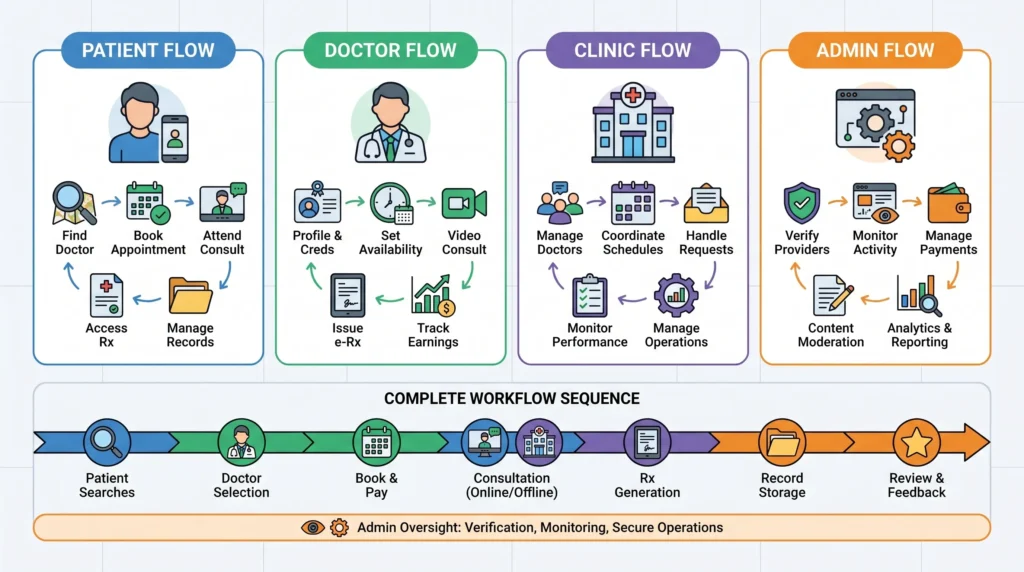
A successful healthcare marketplace depends on seamless interaction between patients, doctors, clinics, and platform administrators. A Practo clone app brings all these stakeholders together within a single ecosystem, allowing healthcare services to be delivered efficiently through digital channels.
Understanding how each user group interacts with the platform helps founders evaluate whether a healthcare marketplace model fits their business goals.
Patient Flow
The patient journey typically begins with finding the right healthcare provider.
A patient can:
- Create an account
- Search for doctors by specialty, location, experience, or availability
- View doctor profiles and ratings
- Check consultation fees
- Book appointments
- Attend video consultations
- Access digital prescriptions
- View appointment history
- Manage medical records
This creates a convenient healthcare experience without requiring patients to visit multiple platforms or clinics.
Doctor Flow
Doctors use the platform to manage consultations and grow their practice.
A doctor can:
- Register and verify credentials
- Create a professional profile
- Define specialties and consultation fees
- Set appointment availability
- Accept or reject bookings
- Conduct video consultations
- Issue e-prescriptions
- Access patient records
- Manage consultation history
- Track earnings and payouts
The platform helps doctors streamline patient management while increasing online visibility.
Clinic and Healthcare Provider Flow
Clinics, hospitals, and healthcare organizations can use the platform to manage multiple practitioners from a centralized dashboard.
Healthcare providers can:
- Manage doctor profiles
- Coordinate appointment schedules
- Handle patient requests
- Manage consultation records
- Monitor doctor performance
- Track revenue and bookings
- Manage operational workflows
This allows larger healthcare organizations to digitize appointment and consultation management across multiple practitioners.
Admin Flow
The administrator oversees the entire marketplace and ensures smooth platform operations.
Administrative capabilities typically include:
- User management
- Doctor verification
- Clinic onboarding
- Appointment monitoring
- Payment management
- Commission configuration
- Consultation tracking
- Content moderation
- Review management
- Analytics and reporting
The admin dashboard serves as the control center for platform growth, compliance, and operational efficiency.
How the Complete Workflow Operates
A typical Practo clone workflow follows this sequence:
Patient Searches for Doctor
            ↓
Doctor Profile Selection
            ↓
Appointment Booking
            ↓
Payment Confirmation
            ↓
Online or Offline Consultation
            ↓
Prescription Generation
            ↓
Medical Record Storage
            ↓
Review and Feedback
Behind the scenes, administrators monitor transactions, verify healthcare providers, manage appointments, and ensure the platform operates securely and efficiently.
By connecting patients, doctors, clinics, and administrators through a unified ecosystem, a Practo clone app creates a scalable healthcare marketplace capable of supporting appointment booking, telemedicine consultations, prescription management, and long-term patient engagement.
Why Build a Practo Clone in 2026?
Demand for Virtual Healthcare Keeps Growing
According to McKinsey, the use of telehealth services has stabilized at 38 times higher than pre-pandemic levels. People are now comfortable talking to their doctors over video, managing prescriptions online, and getting lab tests scheduled without ever visiting a clinic.
Fragmented Market = Huge Opportunity
Despite the growth, the market is far from saturated. There’s a massive opportunity to localize, specialize, or simplify the experience for specific geographies or healthcare needs. A focused platform — say for pediatric care or homeopathic consultations — can stand out faster than a one-size-fits-all solution.
Healthcare Providers Want Digital Tools
It’s not just patients who crave convenience. Clinics, hospitals, and solo practitioners are also looking for robust platforms that handle scheduling, billing, e-prescriptions, and patient engagement — without requiring tech expertise.
Read More : Reasons startup choose our practo clone over custom development
What Makes a Great Practo Clone Script?
Not all clone scripts are created equal. Some only offer basic booking forms and video calls, while others deliver a full-stack patient-care experience. Here are the must-have features you should look for:
For Patients
- Doctor search by specialty, location, or availability
- Appointment booking and calendar sync
- Video/audio consultation module
- Prescription history and downloads
- Online payment gateway integration
- In-app chat or follow-up messaging
- User reviews and doctor ratings
For Doctors
- Profile management and license uploads
- Calendar management and availability settings
- Dashboard to track appointments, earnings, and consultations
- E-prescription generation
- Consultation history and patient records
- Revenue management tools
For Admins
- User management (patients, doctors, support staff)
- Commission settings and subscription plans
- Real-time analytics and dashboards
- CMS for managing content like FAQs and privacy policies
- Notification management (email, SMS, push)
- Support ticket system
Scalability, HIPAA compliance (or regional data regulations), and responsiveness on both web and mobile are also critical factors when choosing your base script.
Must-Have Integrations for a Practo-Like Healthcare Platform
A modern healthcare platform is much more than an appointment booking application. Patients expect seamless healthcare experiences, while doctors and clinics require tools that simplify daily operations. To support these expectations, a Practo-like platform must integrate with various third-party services that enhance functionality, improve efficiency, and create a connected healthcare ecosystem.
The right integrations can significantly improve patient satisfaction, streamline provider workflows, and unlock additional revenue opportunities.
Payment Gateway Integrations
Secure payment processing is essential for appointment bookings, telemedicine consultations, subscription plans, and healthcare services.
Common payment integrations include:
- Stripe
- Razorpay
- PayPal
- PayU
- Authorize.Net
These integrations allow healthcare providers to accept payments securely while simplifying billing and transaction management.
Video Consultation Integrations
Telemedicine has become one of the most valuable features of healthcare platforms.
Popular video communication integrations include:
- WebRTC
- Zoom
- Twilio Video
- Agora
- Vonage
These solutions enable secure virtual consultations, reducing the need for in-person visits while expanding healthcare accessibility.
Calendar and Scheduling Integrations
Efficient appointment management depends on accurate scheduling.
Calendar integrations help synchronize:
- Doctor availability
- Clinic schedules
- Appointment reminders
- Follow-up consultations
- Team calendars
Popular options include:
- Google Calendar
- Microsoft Outlook Calendar
- Apple Calendar
These integrations reduce scheduling conflicts and improve operational efficiency.
SMS, Email, and Notification Services
Communication plays a critical role throughout the patient journey.
Notification integrations can support:
- Appointment confirmations
- Consultation reminders
- Prescription updates
- Payment confirmations
- Follow-up notifications
Common providers include:
- Twilio
- SendGrid
- AWS SES
- Mailchimp
- Firebase Cloud Messaging
Automated communication helps reduce missed appointments and improve patient engagement.
E-Prescription Integrations
Digital prescription management simplifies healthcare delivery and improves record accuracy.
Key benefits include:
- Prescription generation
- Digital record storage
- Medication tracking
- Prescription history management
- Pharmacy coordination
These integrations help create a more efficient consultation workflow.
Pharmacy and Medicine Delivery Integrations
Many healthcare platforms expand beyond consultations by integrating pharmacy services.
Common capabilities include:
- Medicine ordering
- Prescription fulfillment
- Home delivery tracking
- Pharmacy partner management
- Healthcare product sales
This creates additional convenience for patients while generating new revenue opportunities.
Diagnostic Lab and Test Booking Integrations
Patients often require laboratory testing after consultations.
Diagnostic integrations may support:
- Lab test scheduling
- Home sample collection
- Diagnostic reports
- Test result delivery
- Partner laboratory management
These features help healthcare platforms evolve into comprehensive healthcare ecosystems.
Electronic Health Record (EHR) Integrations
Healthcare providers frequently rely on electronic medical records to manage patient information.
EHR integrations can support:
- Medical history access
- Consultation records
- Treatment tracking
- Clinical documentation
- Patient data synchronization
These capabilities improve continuity of care while reducing administrative overhead.
Analytics and Reporting Integrations
Data-driven healthcare businesses depend on analytics to optimize operations and improve user experiences.
Analytics integrations help track:
- Appointment performance
- Consultation trends
- Revenue metrics
- User engagement
- Provider performance
Popular solutions include:
- Google Analytics
- Mixpanel
- Amplitude
- Power BI
These insights support better business and operational decisions.
Cloud Storage and Infrastructure Integrations
Healthcare platforms manage large volumes of documents, prescriptions, consultation records, and media files.
Common infrastructure integrations include:
- AWS
- Google Cloud
- Microsoft Azure
- Cloudflare
- DigitalOcean
These services provide scalability, security, and reliability as the platform grows.
Building a Connected Healthcare Ecosystem
The most successful Practo-like platforms are not standalone applications. They function as integrated healthcare ecosystems that connect appointments, consultations, payments, prescriptions, diagnostics, pharmacies, and patient records through a unified experience.
By selecting the right integrations early, healthcare startups can improve operational efficiency, enhance patient experiences, support healthcare providers, and create a scalable foundation for long-term growth.
Healthcare Compliance, Privacy, and Patient Data Security
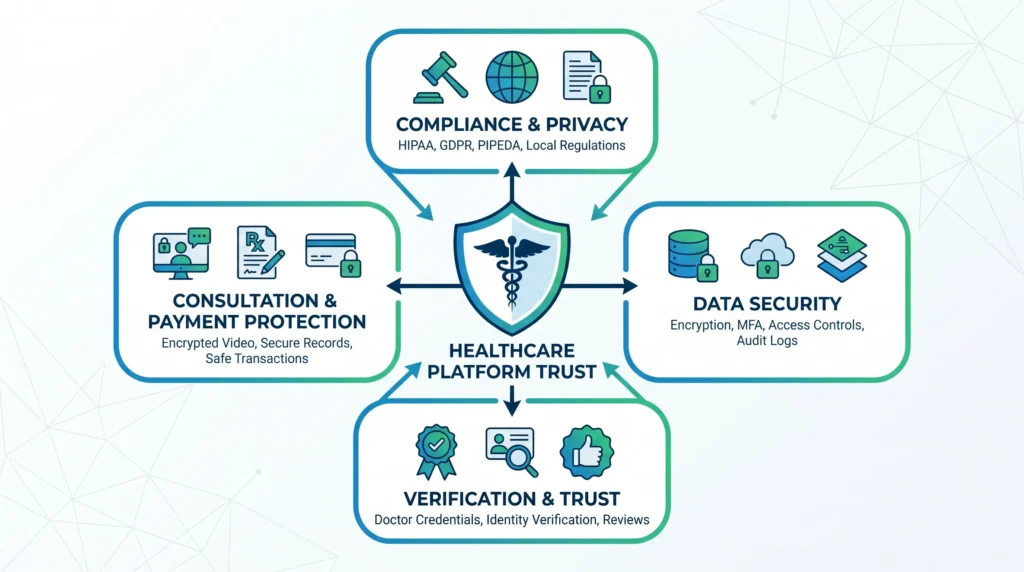
Healthcare platforms handle some of the most sensitive personal information users can share online. Unlike traditional marketplaces, a Practo-like platform manages medical histories, prescriptions, consultation records, diagnostic reports, payment information, and personally identifiable data. As a result, privacy, security, and regulatory compliance are critical factors when evaluating a healthcare app solution.
A feature-rich healthcare platform means little if patient information is not properly protected.
Why Compliance Matters in Digital Healthcare
Patients trust healthcare platforms with confidential medical information. Any breach, unauthorized access, or misuse of that data can damage user trust, create legal liabilities, and impact long-term business growth.
A modern healthcare platform should be designed with compliance and data protection in mind from the very beginning rather than treating security as an afterthought.
Depending on the target market, healthcare businesses may need to consider regulations such as:
- HIPAA (United States)
- GDPR (European Union)
- PIPEDA (Canada)
- Regional healthcare privacy regulations
- Local telemedicine compliance requirements
The specific requirements vary by jurisdiction, but the goal remains the same: protecting patient information and ensuring responsible data handling.
Secure Patient Data Management
A Practo clone platform should implement multiple layers of protection to safeguard sensitive information.
Key security measures include:
- Encrypted data storage
- Secure data transmission
- Role-based access controls
- Multi-factor authentication
- Audit logs and activity tracking
- Automated backup systems
- Session management controls
These safeguards help reduce the risk of unauthorized access while maintaining platform reliability.
Protecting Online Consultations
Video consultations have become a core component of modern healthcare platforms. Because these interactions often involve sensitive medical discussions, consultation security must be prioritized.
Important protections include:
- Encrypted video communication
- Secure consultation sessions
- Protected patient records
- Controlled access permissions
- Secure file sharing
- Consultation history management
These measures help ensure that virtual healthcare interactions remain private and secure.
Prescription and Medical Record Security
Digital prescriptions and patient records contain highly sensitive information that must be protected throughout the platform.
A secure healthcare solution should support:
- Controlled prescription access
- Secure medical document storage
- Record access permissions
- Document version tracking
- Activity monitoring
- Secure download and sharing controls
This helps healthcare providers maintain accurate records while protecting patient privacy.
Doctor Verification and Platform Trust
Trust is one of the most important factors in healthcare marketplaces. Patients need confidence that they are consulting legitimate healthcare professionals.
Healthcare platforms should support:
- Professional license verification
- Credential validation
- Identity verification
- Clinic verification workflows
- Review moderation systems
- Provider profile management
These processes help build credibility while reducing fraudulent activity.
Payment and Transaction Security
Healthcare platforms often process appointment fees, consultation payments, subscription plans, and other financial transactions.
Important payment security practices include:
- Secure payment gateways
- Encrypted transactions
- Fraud monitoring
- Payment audit trails
- Refund management systems
- Transaction reporting
Protecting financial information is just as important as protecting medical data.
Building Long-Term Patient Trust
Compliance is not only about regulations. It is also about creating a healthcare experience that patients feel comfortable using.
When users know their information is protected, consultations are secure, and healthcare providers are properly verified, they are more likely to trust the platform, return for future consultations, and recommend the service to others.
For any Practo-like healthcare marketplace, compliance, privacy, and security should be viewed as core platform requirements rather than optional features. They form the foundation of patient trust, regulatory readiness, and sustainable long-term growth.
Doctor Verification and Patient Trust Features
Trust is the foundation of every successful healthcare marketplace. Unlike traditional service platforms, patients make healthcare decisions that can directly impact their well-being. As a result, a Practo-like platform must provide mechanisms that help users verify healthcare providers and feel confident when booking consultations.
Without strong trust-building features, patients may hesitate to book appointments, attend virtual consultations, or share sensitive medical information through the platform.
Why Doctor Verification Matters
One of the biggest concerns for patients using online healthcare platforms is determining whether a healthcare provider is legitimate, qualified, and authorized to practice.
A robust Practo clone should support verification workflows that help validate:
- Medical licenses
- Professional certifications
- Specializations
- Educational credentials
- Clinic affiliations
- Practice locations
- Identity documents
These verification processes help prevent fraudulent accounts while improving patient confidence.
Verified Doctor Profiles
Doctor profiles serve as the primary decision-making resource for patients.
A complete healthcare provider profile should include:
- Professional photo
- Qualifications
- Specializations
- Years of experience
- Consultation fees
- Languages spoken
- Clinic information
- Availability schedules
- Patient reviews
- Verification status
Well-structured profiles make it easier for patients to compare providers and choose the right healthcare professional.
Ratings and Patient Reviews
Reviews play a major role in healthcare decision-making.
Patients often evaluate providers based on:
- Consultation quality
- Communication skills
- Appointment experience
- Treatment effectiveness
- Wait times
- Overall satisfaction
A transparent review system helps patients make informed choices while encouraging healthcare providers to maintain high service standards.
Verified Clinics and Healthcare Facilities
Trust should extend beyond individual doctors.
Healthcare platforms can strengthen credibility by verifying:
- Clinics
- Hospitals
- Diagnostic centers
- Healthcare organizations
- Telemedicine providers
Verified facility badges provide additional assurance to patients when booking appointments.
Appointment Transparency
Patients are more likely to trust a healthcare platform when booking processes are clear and predictable.
Important trust-enhancing features include:
- Real-time availability
- Transparent consultation fees
- Appointment confirmations
- Cancellation policies
- Consultation reminders
- Follow-up scheduling
These features reduce uncertainty and improve the overall patient experience.
Secure Communication and Consultation History
Healthcare interactions often involve sensitive medical discussions.
Trust can be strengthened through:
- Secure messaging
- Protected video consultations
- Consultation history access
- Prescription records
- Medical document storage
- Appointment tracking
These capabilities help patients maintain continuity of care while protecting their information.
Building Long-Term Platform Credibility
Patient trust is not created through a single feature. It is built through a combination of verification, transparency, security, and consistent healthcare experiences.
When patients can verify providers, review credentials, compare ratings, access secure consultations, and manage their healthcare records confidently, they are more likely to continue using the platform and recommend it to others.
For a Practo-like healthcare marketplace, doctor verification and trust-building features are not optional additions. They are essential components that influence user adoption, patient retention, platform reputation, and long-term business success.
Read More : Business Model of Practo: Revenue, Features & Growth Strategy
Practo Clone Script vs Custom Healthcare App Development
One of the biggest decisions healthcare entrepreneurs face is whether to launch using a ready-made Practo clone script or build a healthcare platform entirely from scratch. Both approaches can create a successful doctor appointment and telemedicine platform, but they differ significantly in terms of cost, development timelines, risk, flexibility, and speed to market.
The right choice depends on your budget, business model, customization requirements, and growth strategy.
| Factor | Practo Clone Script | Custom Healthcare App Development |
|---|---|---|
| Launch Timeline | Days to Weeks | Several Months |
| Initial Investment | Lower | Higher |
| Core Features | Pre-Built | Built From Scratch |
| Customization | Moderate to High | Unlimited |
| Development Risk | Lower | Higher |
| Testing Requirements | Reduced | Extensive |
| Time to Revenue | Faster | Slower |
| Scalability | Depends on Architecture | Fully Controlled |
| Maintenance Effort | Lower Initially | Higher |
| Technical Complexity | Lower | Higher |
When a Practo Clone Script Makes Sense
A ready-made Practo clone is often the best choice for startups that want to validate their healthcare marketplace idea quickly.
It is particularly suitable when:
- Speed to market is a priority
- Budget constraints exist
- Core healthcare workflows are already proven
- Faster customer acquisition is important
- The business wants to start generating revenue sooner
- Custom development resources are limited
Instead of spending months building appointment scheduling, doctor onboarding, video consultations, prescription management, payment systems, and admin dashboards, founders can launch with a pre-built framework and focus on business growth.
When Custom Healthcare Development Makes Sense
Custom development may be a better option when the healthcare platform requires highly specialized workflows that differ significantly from traditional telemedicine models.
Examples include:
- Enterprise healthcare systems
- Hospital management ecosystems
- Insurance-driven healthcare platforms
- Proprietary healthcare workflows
- Highly regulated healthcare environments
- Large-scale healthcare networks
Custom development offers complete control over architecture, features, integrations, and user experience but typically requires larger budgets and longer development cycles.
The Hidden Cost of Delayed Launches
Many founders focus exclusively on development costs while overlooking opportunity costs.
A healthcare startup that spends eight to twelve months building from scratch may lose valuable time that could have been spent:
- Acquiring users
- Building provider partnerships
- Validating market demand
- Generating recurring revenue
- Improving the platform based on real user feedback
In many cases, launching earlier with a proven healthcare marketplace foundation provides more business value than waiting for a fully custom solution.
Choosing the Right Path
For most startups, clinics, healthcare entrepreneurs, and telemedicine businesses, a Practo clone script offers the fastest route to market while significantly reducing development complexity and upfront investment.
Custom healthcare development becomes more attractive when unique business requirements, specialized workflows, or enterprise-scale healthcare operations justify the additional cost and development time.
The most successful healthcare platforms are not necessarily the ones with the most custom code. They are the ones that reach users quickly, solve real healthcare problems efficiently, and continuously improve based on market feedback.
Read More :Practo Feature Breakdown: What Startups Can Learn
Miracuves Practo-Like App Solution Cost and Tech Stack
Miracuves Pricing for a Practo-Like App developed in PHP/Laravel with Flutter Apps for $4,299 USD (One-Time Price) in just 6 days
Get a fully developed, deployment-ready platform modeled after Practo. Built on a rock-solid PHP/Laravel foundation, this complete package includes everything you need to launch and scale:
- Core Workflows: Doctor discovery, appointment booking, online consultations, patient management, and healthcare service categories.
- Built-in Finance: In-app wallet logic, consultation pricing operations, and payout setups.
- Management Hub: Comprehensive doctor management and a centralized admin backend.
- Launch-Ready: Fully prepped for your custom branding, configuration, and immediate market entry.
Why Miracuves’s Practo Like App is so affordable?
Most complex healthcare platforms force you into expensive architectures like Node.js or Go. Building from scratch with those frameworks requires highly specialized, expensive engineering teams, which drives the cost into the tens or hundreds of thousands of dollars.
We took a smarter, more practical approach:
- You Aren’t Paying for Ground-Up Development: Our healthcare platform engine is already developed, battle-tested, and ready to deploy. You skip the inflated costs and months of waiting associated with building from scratch.
- The Power of PHP / Laravel: We built this on one of the most reliable, globally adopted frameworks in the world. Not only does this keep our upfront costs down, but it also protects your future budget. PHP has a massive global talent pool, making it incredibly easy and cost-effective for you to find developers for future scaling or customizations.
You get an enterprise-capable, heavy-duty foundation without the inflated Silicon Valley price tag.
Note: This cost is for the solution, re-branding, deployment and source code only.
Mistakes to Avoid Before Launching a Practo Clone App
Many healthcare startups focus heavily on features and development while overlooking critical business, operational, and compliance factors that determine long-term success. Launching a healthcare marketplace involves much more than building an appointment booking system. Patient trust, provider onboarding, compliance, user experience, and operational efficiency all play a major role in platform adoption.
Avoiding common mistakes early can save significant time, money, and resources while improving the chances of building a sustainable healthcare business.
Prioritizing Features Over User Experience
A common mistake is trying to include every possible healthcare feature before launch.
Many founders attempt to build:
- Appointment booking
- Telemedicine
- Pharmacy delivery
- Diagnostics
- Insurance services
- Wellness programs
- Healthcare communities
all at once.
While these features may eventually be valuable, launching with an overly complex platform can delay market entry and create a confusing user experience.
A better approach is to launch with core healthcare workflows and expand based on real user demand.
Ignoring Doctor Verification
Patients trust healthcare platforms only when they believe the providers are legitimate and qualified.
Failing to verify:
- Medical licenses
- Certifications
- Specializations
- Professional credentials
can damage platform credibility and expose the business to significant risks.
Strong verification workflows should be established before onboarding healthcare providers.
Overlooking Compliance and Data Privacy
Healthcare platforms handle highly sensitive information, including medical records, prescriptions, consultation history, and personal data.
Many startups underestimate the importance of:
- Data protection
- Regulatory compliance
- Access controls
- Secure storage
- Audit tracking
Compliance should be considered during planning and development rather than after launch.
Neglecting Telemedicine Infrastructure
Video consultations have become a major healthcare service channel.
Some founders focus on appointment scheduling while treating telemedicine as a secondary feature.
Poor video quality, unstable connections, or unreliable consultation experiences can negatively affect both patients and providers.
A scalable telemedicine infrastructure should be tested thoroughly before launch.
Weak Doctor and Clinic Onboarding
A healthcare marketplace cannot succeed without healthcare providers.
Many startups spend heavily on patient acquisition while failing to create a smooth onboarding experience for doctors and clinics.
Complicated registration processes, poor profile management tools, and limited provider support can slow platform growth.
Healthcare provider acquisition should be treated as a core business priority.
Failing to Build Patient Trust
Trust is one of the most important assets in healthcare.
Patients often evaluate platforms based on:
- Verified doctors
- Ratings and reviews
- Transparent pricing
- Secure consultations
- Professional profiles
- Reliable appointment management
Trust-building features should be incorporated throughout the platform experience.
Choosing the Wrong Monetization Strategy
Some healthcare startups introduce aggressive monetization too early.
Examples include:
- Excessive consultation fees
- High provider commissions
- Mandatory subscriptions
- Premium-only access models
A sustainable monetization strategy should balance revenue generation with user adoption and provider participation.
Ignoring Scalability Requirements
Healthcare platforms often experience growth in consultations, records, users, and transactions over time.
Building solely for current demand can create performance challenges later.
Founders should consider:
- Cloud infrastructure
- Database scalability
- Video consultation capacity
- Security requirements
- Future integrations
from the beginning.
Launching Without Analytics
Without analytics, platform owners cannot effectively measure:
- Appointment performance
- User retention
- Doctor engagement
- Consultation trends
- Revenue growth
Analytics should be implemented before launch so that business decisions can be based on real usage data.
Focusing on Technology Instead of Healthcare Outcomes
One of the biggest mistakes is treating the platform as a software project rather than a healthcare business.
Patients do not care about the underlying technology stack. They care about finding the right doctor, receiving quality care, booking appointments easily, and managing their healthcare efficiently.
The most successful Practo-like platforms combine strong technology with a patient-centered healthcare experience.
Final Thought
The biggest challenges in healthcare marketplaces rarely come from missing features. They come from weak trust systems, poor provider onboarding, inadequate compliance planning, and limited understanding of patient needs. By avoiding these common mistakes, founders can launch a more reliable, scalable, and trustworthy healthcare platform that is better positioned for long-term growth.
Launch Your Practo-Style Healthcare Platform — Contact Us Today
Revenue Models That Work for Online Healthcare Platforms
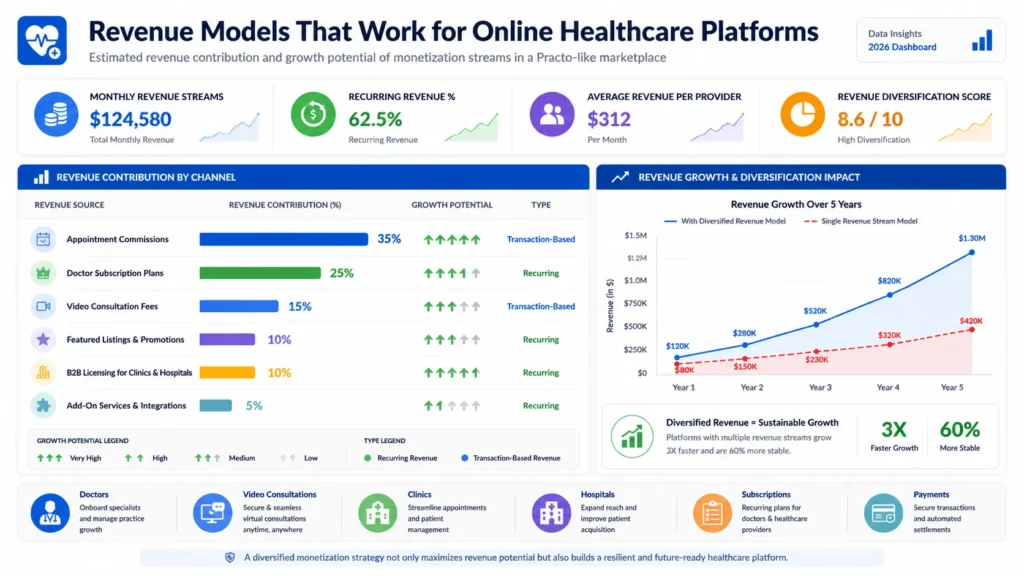
It’s not just about building the platform — you’ll need a viable way to make money from it. Here are popular and effective monetization strategies:
1. Commission per Consultation
Charge a percentage on each paid session booked through your platform. Works best when you have volume and active users.
2. Subscription Plans
Offer doctors monthly or annual subscriptions for premium listings, better visibility, or full access to the patient dashboard.
3. Featured Listings
Allow doctors or clinics to pay for top placement in search results, or for being “verified professionals.”
4. B2B Licensing
Offer your platform to hospitals or clinics as a white-labeled SaaS solution with recurring income.
5. Add-on Services
Sell value-added features like custom domain setup, appointment reminders via SMS, or integration with pharmacy networks.
Practo Clone Revenue Model: Which Monetization Strategy Fits Best?
Launching a healthcare platform is not only about connecting patients and doctors. Long-term success depends on building a sustainable revenue model that balances user experience, provider adoption, and business profitability. While many healthcare startups focus primarily on appointment bookings, modern healthcare marketplaces often generate revenue through multiple monetization channels simultaneously.
The most effective strategy depends on your target audience, healthcare services offered, market maturity, and growth objectives.
Appointment Booking Commissions
One of the most common monetization models is charging a commission for every appointment booked through the platform.
Under this approach:
- Patients book appointments through the platform
- Doctors receive appointment requests
- The platform earns a percentage or fixed fee per booking
This model works particularly well for:
- Doctor discovery platforms
- Specialist consultation marketplaces
- Multi-clinic healthcare ecosystems
- Appointment-focused healthcare businesses
The advantage is that revenue grows alongside platform activity.
Subscription Plans for Doctors
Many healthcare platforms offer premium subscription packages for doctors and clinics.
Subscription plans may include:
- Featured profile placement
- Priority search visibility
- Advanced analytics
- Increased appointment exposure
- Additional marketing tools
- Multi-location practice management
This model generates predictable recurring revenue while helping healthcare providers attract more patients.
Video Consultation Fees
Telemedicine has become one of the fastest-growing healthcare segments.
Platforms can monetize virtual consultations by:
- Charging a consultation commission
- Collecting a platform service fee
- Offering premium telemedicine plans
- Providing subscription-based virtual care services
This approach works especially well for platforms targeting remote healthcare access.
Sponsored Listings and Featured Doctors
As the platform grows, healthcare providers may pay for increased visibility.
Examples include:
- Featured doctor profiles
- Sponsored search placements
- Premium category listings
- Promotional healthcare campaigns
This model creates additional revenue opportunities without affecting core appointment workflows.
Diagnostic and Lab Test Commissions
Healthcare marketplaces often expand beyond doctor consultations.
Additional revenue can be generated through:
- Diagnostic center partnerships
- Lab test bookings
- Health screening packages
- Home sample collection services
The platform earns commissions whenever users book healthcare services through partner providers.
Pharmacy and Prescription Fulfillment Revenue
Many healthcare platforms integrate online pharmacy services.
Revenue opportunities include:
- Medicine delivery commissions
- Prescription fulfillment fees
- Pharmacy partnerships
- Healthcare product sales
This creates a healthcare ecosystem that extends beyond consultations.
Healthcare Subscription Memberships
Some platforms introduce patient membership programs that provide additional benefits.
Membership plans may include:
- Discounted consultations
- Priority appointments
- Unlimited teleconsultations
- Health monitoring services
- Wellness programs
This model helps increase customer retention while creating recurring revenue.
Choosing the Right Monetization Strategy
Different healthcare businesses benefit from different monetization approaches.
| Business Type | Recommended Revenue Model |
|---|---|
| Doctor Appointment Platform | Appointment Commissions |
| Telemedicine Platform | Consultation Fees + Subscriptions |
| Healthcare Marketplace | Commissions + Featured Listings |
| Multi-Clinic Network | Doctor Subscriptions + Booking Fees |
| Integrated Healthcare Ecosystem | Commissions + Pharmacy + Diagnostics |
| Subscription-Based Healthcare Service | Membership Plans |
Most successful healthcare platforms do not rely on a single revenue stream. Instead, they combine multiple monetization models to create diversified and sustainable revenue growth.
Building a Scalable Healthcare Business
The ideal monetization strategy should align with user value rather than create friction in the healthcare experience. Patients should feel they are receiving convenient access to healthcare services, while providers should see measurable benefits from participating in the platform.
For most Practo-like healthcare marketplaces, a combination of appointment commissions, doctor subscriptions, telemedicine fees, pharmacy partnerships, and diagnostic service commissions creates the strongest long-term revenue foundation. By diversifying revenue streams early, healthcare businesses can improve profitability while supporting sustainable platform growth.
Conclusion
The future of healthcare is increasingly digital, and platforms like Practo have shown how technology can simplify access to doctors, appointments, consultations, prescriptions, diagnostics, and ongoing patient care. As demand for convenient healthcare services continues to grow, entrepreneurs have a significant opportunity to build specialized healthcare marketplaces that serve local communities, niche medical segments, or large healthcare networks.
A successful Practo-like platform requires more than appointment booking alone. Features such as teleconsultations, doctor verification, secure patient records, healthcare integrations, compliance readiness, and sustainable monetization strategies all contribute to long-term growth and user trust.
For many startups, launching with a proven Practo clone script is often the fastest route to market. Instead of spending months building core healthcare functionality from scratch, founders can focus on onboarding providers, acquiring patients, building partnerships, and expanding their healthcare ecosystem.
Whether you’re planning a telemedicine startup, a doctor appointment marketplace, a specialist consultation platform, or a full-scale healthcare network, choosing the right technology foundation can significantly reduce development time and business risk.
At Miracuves, we help healthcare entrepreneurs launch scalable, white-label healthcare platforms with source code, telemedicine capabilities, patient management tools, doctor onboarding systems, and monetization-ready infrastructure designed for rapid deployment and long-term growth.
Ready to launch your own Practo-style healthcare platform? Let’s build together.
FAQs
Still have questions about launching a Practo clone? Let’s clear them up.
What is a Practo clone script?
A Practo clone script is a ready-made healthcare platform that allows entrepreneurs to launch doctor appointment booking, telemedicine, patient management, and healthcare marketplace services without developing everything from scratch.
How much does it cost to launch a Practo clone app?
The cost depends on the technology stack, features, integrations, and customization requirements. Ready-made solutions typically cost significantly less than building a healthcare platform from scratch.
How long does it take to launch a Practo-like healthcare platform?
A white-label Practo clone can often be launched within days or weeks, while custom healthcare app development may take several months depending on complexity.
Can a Practo clone support video consultations and telemedicine?
Yes. Most modern Practo clone solutions include video consultations, appointment scheduling, secure messaging, e-prescriptions, and virtual healthcare management features.
What integrations should a Practo-like healthcare platform include?
Common integrations include payment gateways, video conferencing solutions, calendar synchronization, SMS notifications, e-prescriptions, pharmacy services, diagnostic labs, and electronic health records (EHR) systems.
Is a Practo clone suitable for hospitals and multi-clinic healthcare networks?
Yes. Advanced Practo clone platforms can support multiple clinics, hospitals, healthcare providers, doctor onboarding, appointment management, and centralized administration through a unified dashboard.
How do healthcare platforms verify doctors and build patient trust?
Healthcare platforms typically use medical license verification, identity checks, credential validation, verified profiles, patient reviews, clinic verification, and secure consultation systems to build trust.
What security and compliance features should a Practo clone include?
Important features include encrypted data storage, secure communications, role-based access controls, audit logs, secure payments, patient privacy protections, and support for healthcare compliance requirements such as HIPAA or regional regulations.
What is the best monetization strategy for a Practo clone app?
Most healthcare marketplaces combine appointment commissions, doctor subscriptions, telemedicine fees, featured listings, pharmacy partnerships, and diagnostic service commissions to create multiple revenue streams.
Related Articles
Miracuves is an independent software development company. We are not affiliated with, connected to, sponsored by, or endorsed by any company or product named in this article.
Terms such as “X Clone” are used descriptively. It is how the software industry refers to building a platform with functionality comparable to a known service, and how clients search for it.
The entire design and codebase of our products is built by our own team. Our products contain no code, design, graphics, or content originating from any third-party website or applications.
All third-party names and marks referenced in this article are the property of their respective owners, referenced solely to identify the services discussed.