Key Takeaways
- Sports Betting Platform Planning should begin with the complete betting lifecycle, including odds, bet validation, wallet movements, risk control, cash-out, settlement, and compliance workflows.
- Real-time odds, market suspension, repricing, and live event updates are essential for reliable in-play betting.
- Bet slips and bet builders need strong validation rules for odds changes, stake limits, correlated selections, user restrictions, and market availability.
- Wallet and settlement systems should create a clear audit trail for stakes, payouts, refunds, reversals, cash-outs, and manual adjustments.
- Compliance-ready workflows should include KYC, AML support, responsible gambling controls, geofencing where required, and secure admin permissions.
Planning Signals
- Founders supporting live betting should confirm that the backend can process fast odds changes, event status updates, market suspensions, and bet repricing.
- Cash-out should use current market conditions, quote expiry, margin rules, wallet updates, and reliable audit records rather than a static value.
- Operators need back-office tools to settle, void, reverse, review, and reconcile bets without relying on manual database changes.
- Risk dashboards should show liability by event, market, user, sport, league, and bet type so operators can act before exposure becomes excessive.
- Founders evaluating software should inspect admin controls, wallet records, risk tools, settlement screens, responsible gambling features, and source-code access before choosing a platform.
Real Insights
- The betting interface may look simple, but the real product is the backend engine that validates wagers, reserves funds, manages exposure, and settles financial outcomes.
- Odds should be treated as live financial signals rather than static content because delays or stale prices can create direct operator risk.
- Cash-out, bet builders, and live betting should never be added as surface-level features because each depends on pricing, risk, ledger, and settlement logic.
- A betting wallet should behave like an auditable financial ledger, not simply a balance field that changes after every transaction.
- The strongest planning path is: define sports and markets → connect reliable odds feeds → design bet validation → secure wallet logic → plan risk controls → define settlement → add compliance workflows → test the complete bet lifecycle.
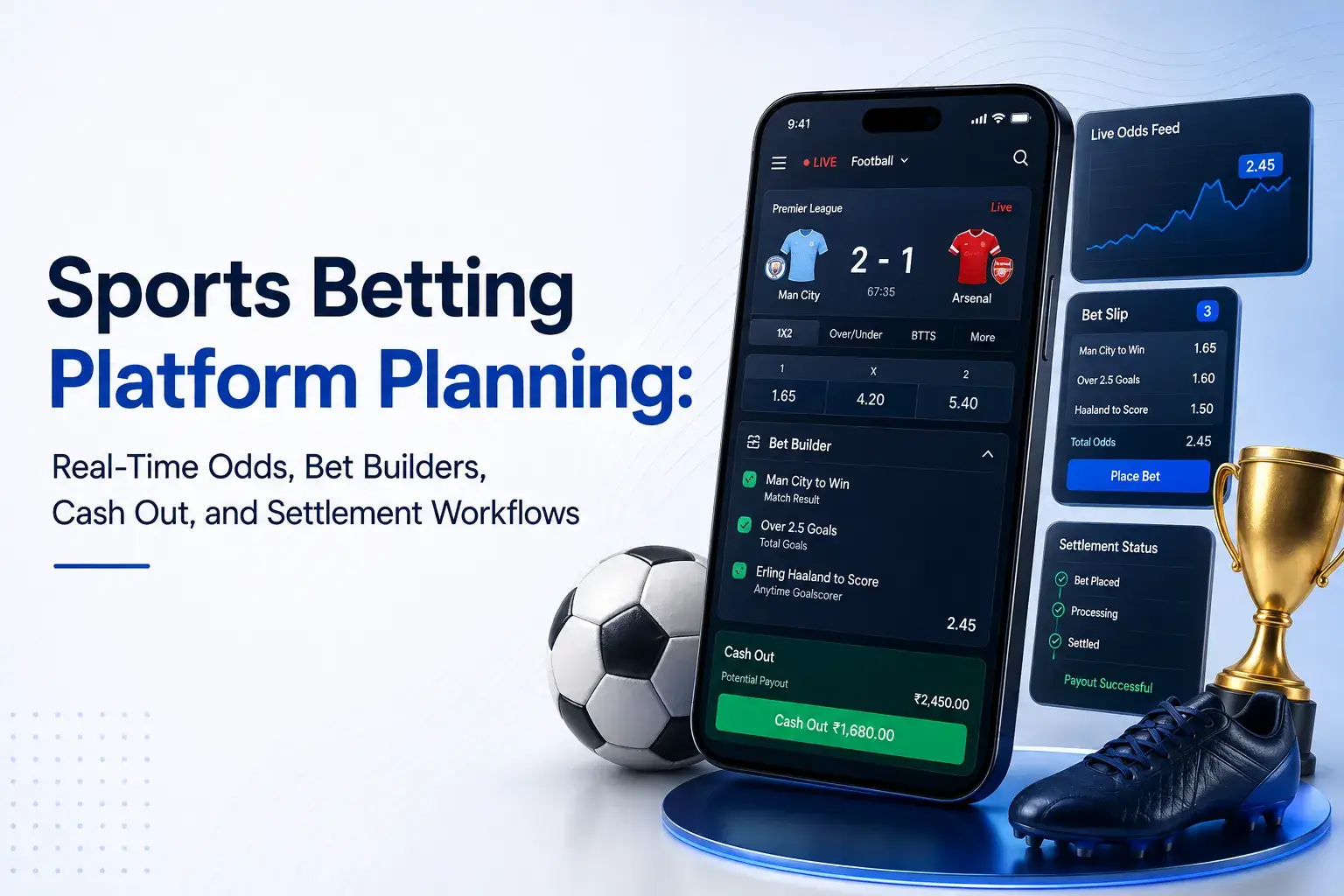
A Sports Betting Platform is not just a betting screen with odds and a payment gateway. The real product sits behind the interface: odds ingestion, live market updates, bet slip validation, bet builder rules, cash-out pricing, wallet movements, market suspension, result settlement, reversals, risk controls, and compliance workflows.
That is why many betting startups underestimate the build.
The front end may look simple to users. They choose a match, select a market, add a stake, and place a bet. But behind that action, the platform must confirm that the odds are still valid, check the user’s balance, apply rules, reserve funds, update exposure, record the transaction, and prepare the bet for settlement once results arrive.
For founders, operators, and product teams, planning these workflows before development matters. A weak betting platform can fail even if the UI looks polished. A strong platform is built around real-time accuracy, financial reliability, operator control, responsible gambling, and a clean settlement trail.
Miracuves helps founders launch ready-made and white-label betting platforms with source-code ownership, admin control, real-time architecture, and launch-ready workflows. This guide explains the planning layers that matter before building or buying a Sports Betting Platform.
Why Sports Betting Platform Planning Is Different From Normal App Development
A normal marketplace app handles listings, users, payments, notifications, and admin controls. A Sports Betting Platform does all of that while also handling changing prices, live events, risk exposure, wager validation, financial ledgers, and legally sensitive user activity.
That makes the backend more important than the interface.
When a bettor places a wager, the platform must answer several questions instantly:
- Is the market still open?
- Are the displayed odds still valid?
- Has the event changed?
- Is the user allowed to bet?
- Does the user have enough balance?
- Does the bet exceed platform, market, or user limits?
- Should the operator accept, reject, or reprice the bet?
- How should the stake be reserved?
- How will the bet be settled later?
- What audit record should be stored?
These questions become more complex during in-play betting, where odds move quickly and markets may need temporary suspension after goals, injuries, red cards, retirements, weather events, or feed delays.
This is why founders should plan the betting lifecycle before choosing a software provider.
The Core Workflow of a Sports Betting Platform
A Sports Betting Platform usually works across several connected systems. Each system must pass clean data to the next.
Founders who want a deeper module-level view can explore these sports betting platform features to compare odds, bet slip, cash-out, wallet, admin, and settlement capabilities before planning the launch scope.
Core Sports Betting Platform Workflow
| Workflow Layer | What It Does | Founder Planning Question |
|---|---|---|
| Odds Feed | Receives sports, events, markets, prices, scores, and status updates. | Which data provider, sports, leagues, and market types will you support? |
| Market Management | Opens, suspends, closes, voids, or reprices betting markets. | Can operators pause risky markets quickly when live events change? |
| Bet Slip | Lets users build singles, accumulators, systems, or same-event combinations. | How will the platform validate odds, stake limits, and accepted bet types? |
| Bet Builder | Combines multiple selections from the same event under controlled rules. | Which selections can be combined, rejected, repriced, or restricted? |
| Cash-Out Engine | Offers users a calculated value to exit an unsettled bet before the result. | How long is the quote valid, and how does the platform protect margin? |
| Wallet and Ledger | Tracks deposits, stakes, reserved funds, winnings, refunds, and adjustments. | Can every wallet movement be reconciled and audited? |
| Settlement Engine | Grades outcomes and pays, refunds, voids, or reverses bets. | Can the platform handle disputes, corrections, partial results, and manual review? |
| Risk Desk | Monitors liability, exposure, suspicious patterns, and market-level risk. | Can your team see and control exposure before it becomes a loss? |
Real-Time Odds: The Foundation of Live Betting
Real-time odds are the foundation of modern sportsbook software. Without reliable odds handling, the platform cannot support serious in-play betting, market suspension, bet validation, or cash-out.
A strong real-time odds workflow should include:
- Sports data feed integration
- Pre-match odds
- In-play odds
- Market status updates
- Score and clock updates
- Odds format support
- Market suspension rules
- Reprice logic
- Admin/trader overrides
- Real-time publishing to web and mobile apps
- Audit trail for price changes
The challenge is not only receiving odds. The challenge is deciding when an odd is valid enough to accept a bet.
For example, if a goal is scored while a user is placing an in-play football bet, the platform should not blindly accept the old price. It may need to suspend the market, wait for updated odds, refresh the bet slip, and ask the user to accept the new price.
For a deeper commercial product view, founders can review Miracuves’ launch-ready sports betting platform</a> as a next step after understanding the planning logic.
Bet Slip Planning: Where User Experience Meets Risk Control
The bet slip looks like a simple conversion tool, but it is also a risk checkpoint.
A Sports Betting Platform should validate every bet before acceptance. This includes stake amount, odds changes, user balance, market status, selection availability, minimum and maximum bet rules, jurisdiction limits, user restrictions, bonus restrictions, and responsible gambling limits.
A strong bet slip should support:
- Single bets
- Accumulators
- System bets
- In-play selections
- Odds change alerts
- Stake and payout preview
- Balance validation
- Bet confirmation
- Error messaging
- Accepted, rejected, or repriced bet status
- Bet history
Founders should pay close attention to error handling. If the platform simply says “bet failed,” users lose trust. Better UX explains whether the odds changed, the market closed, the stake exceeded a limit, or the selection became unavailable.
In betting software, clarity is a retention feature.
Bet Builder Workflows: Why Same-Event Logic Needs Careful Rules
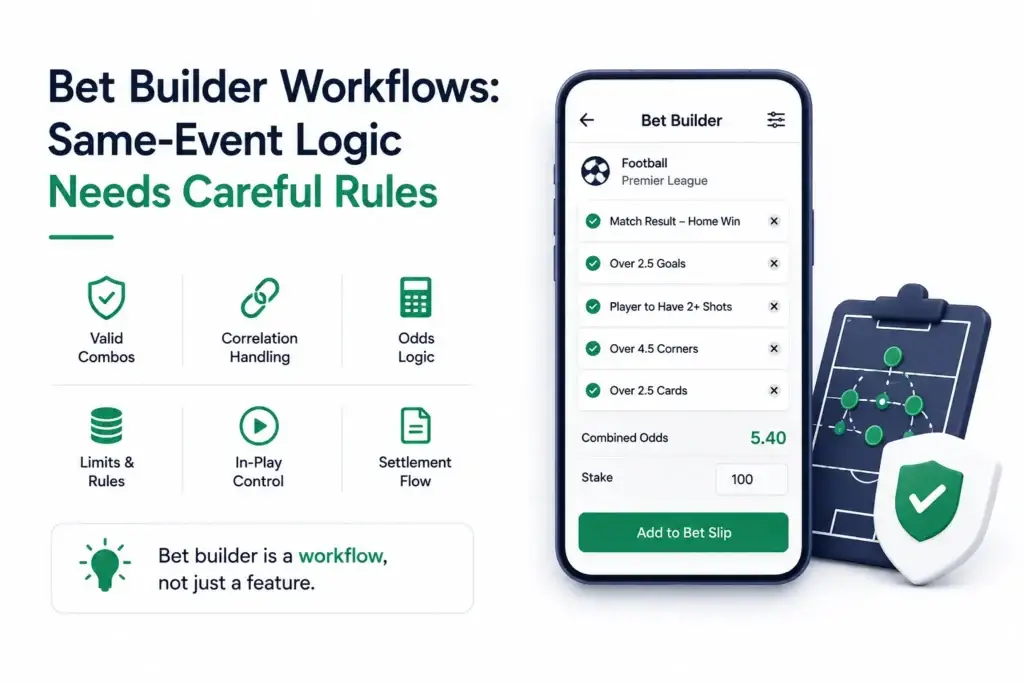
Bet builders allow users to combine multiple selections from the same event. For example, a football bettor may combine match winner, total goals, player shots, corners, and cards into one custom wager.
This can increase engagement, but it also increases complexity.
The platform must understand correlation. Some combinations are logically connected, which means the odds cannot be multiplied like independent events. A same-event combination needs rules that determine which selections can be combined and how pricing should be calculated.
A bet builder workflow should define:
- Supported sports and leagues
- Eligible markets
- Restricted combinations
- Correlated selection handling
- Odds recalculation
- Maximum selection count
- Stake limits
- Suspension rules
- In-play availability
- Settlement dependencies
- Void-leg behavior
- Admin controls
Without these rules, bet builders can create pricing errors, disputed outcomes, or settlement confusion.
For founders, the practical lesson is simple: do not treat bet builder as a front-end feature. It is a pricing, validation, risk, and settlement workflow.
Cash-Out Engine: Planning Quotes, Margins, and Execution
Cash-out lets users settle part or all of an open position before the event ends. It can improve user experience, but it also introduces trading risk.
The platform must calculate a cash-out quote based on current market conditions, remaining outcomes, stake, potential return, live odds, platform margin, and event status.
A cash-out workflow should answer:
- Is cash-out available for this market?
- Is full or partial cash-out supported?
- How long is the quote valid?
- What happens if odds change before confirmation?
- Is the market suspended?
- Does the platform apply a margin?
- How is the wallet updated?
- Is the original bet closed, partially closed, or adjusted?
- What audit record is created?
Cash-out should not be a static number. It should refresh as markets move and should expire quickly when the price is no longer safe.
For operators, the risk is not offering cash-out. The risk is offering it without accurate pricing, expiry, and ledger control.
Settlement Workflows: The Part Founders Should Never Leave Vague
Settlement is where a betting platform proves whether its financial logic is reliable.
Once an event ends, the platform must grade each bet. The result may be win, loss, void, push, half-win, half-loss, dead heat, refund, partial settlement, manual review, or reversal depending on sport, market type, and rules.
A settlement engine should support:
- Result feed integration
- Manual settlement
- Automatic grading
- Market closure
- Bet outcome calculation
- Wallet payout
- Refunds
- Void bets
- Reversals
- Audit logs
- Dispute review
- Admin approval flows
- Reconciliation reports
Settlement is especially sensitive because mistakes directly affect money. A wrong result, delayed score correction, cancelled event, postponed match, abandoned game, or voided market can create user complaints and regulatory risk.
The back office should allow authorized operators to review, settle, void, reverse, and document decisions without editing the database manually.
Wallet and Ledger: Why Betting Platforms Need Financial Discipline
A betting wallet is not just a balance field. It is a financial record.
Every transaction should be traceable: deposit, bonus credit, stake reservation, bet acceptance, bet cancellation, win payout, cash-out, refund, withdrawal, manual adjustment, and reversal.
A strong sports betting platform business model should connect revenue logic with wallet accuracy, margins, payouts, bonuses, and operator controls.
A reliable wallet workflow should include:
- Available balance
- Reserved balance
- Bonus balance where relevant
- Transaction history
- Immutable ledger records
- Payment gateway integration
- Withdrawal review
- Admin adjustment rules
- Fraud monitoring signals
- Reconciliation reporting
Founders should avoid platforms where wallet logic is unclear. If the platform cannot explain exactly how stake reservation, settlement payout, refunds, and reversals affect the ledger, it is not ready for real-money operations.
Risk Management: What Operators Need Behind the Scenes
Risk management is where platform operators protect the business.
A sportsbook operator needs visibility into exposure by event, market, user, sport, league, and bet type. Without that view, the platform may accept too much liability before anyone notices.
A risk desk should help operators:
- Monitor liability
- Set max stake limits
- Adjust margins
- Suspend markets
- Restrict risky bet types
- Review high-value bets
- Identify unusual betting patterns
- Detect multi-account behavior
- Control user-level limits
- Track bonus abuse
- Review settlement exceptions
For operators planning automated risk flags, suspicious activity monitoring, personalization, or smarter back-office workflows, AI-powered betting platform automation can support stronger operational visibility.
Risk controls should be integrated into the betting lifecycle, not added after launch. The operator should be able to act while markets are live.
Compliance-Ready Workflows: Licensing, KYC, AML, and Responsible Gambling
A Sports Betting Platform operates in a regulated category. Software alone does not provide a gambling licence. Licensing, legal approval, payment availability, tax obligations, advertising rules, and compliance requirements depend on jurisdiction.
That means the platform should be built with compliance-ready workflows, including:
- Age and identity verification
- KYC review
- AML workflow support
- Geofencing where required
- Self-exclusion
- Deposit limits
- Loss limits
- Wager limits
- Cooling-off periods
- Reality checks
- Responsible gambling messaging
- Audit logs
- Admin permission controls
- Suspicious activity monitoring
- Secure payment gateway integration
Founders should speak with legal and licensing advisors before launching in any regulated market. The software should support compliance operations, but final compliance depends on jurisdiction, licence type, integrations, operating model, and legal review.
Founder Decision Signals for Sports Betting Platform Planning
Real-Time Readiness
If your platform will support in-play betting, odds updates, market suspension, and cash-out, the backend must handle live event pressure before launch.
Settlement Control
If operators cannot settle, void, reverse, and audit markets through the back office, the platform creates financial and compliance risk.
Wallet Reliability
If every stake, refund, payout, and cash-out cannot be reconciled, the platform is not ready for real-money operations.
Licensing Fit
If the target market has strict gambling regulations, legal review, KYC, AML, self-exclusion, and responsible gambling workflows must be planned early.
Build, Buy, or Customize: Which Route Makes Sense?
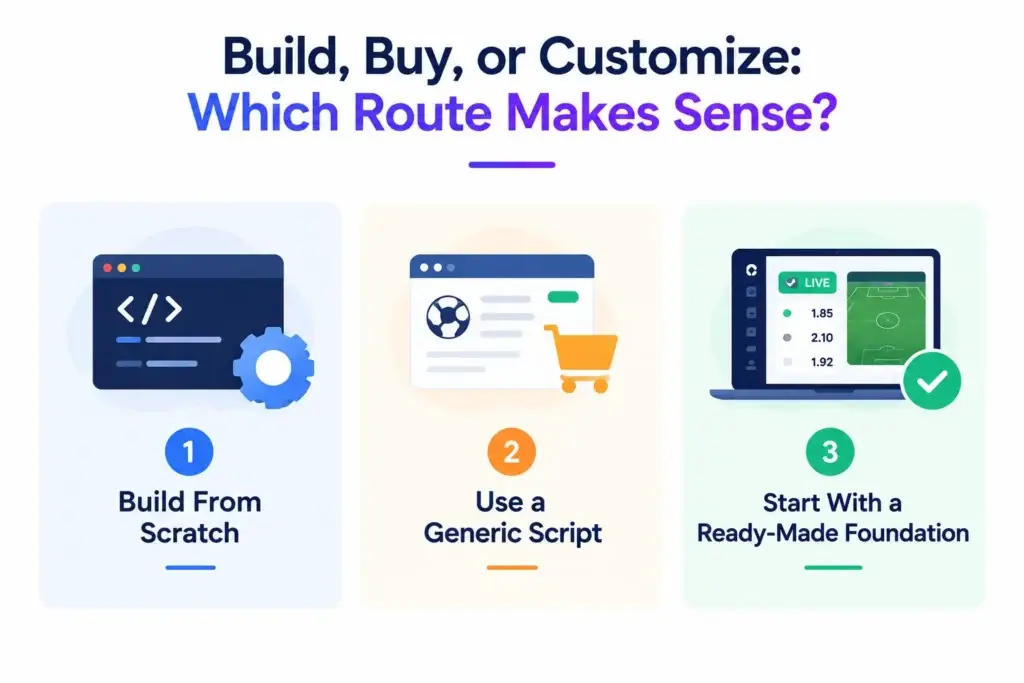
Founders usually have three options when planning a Sports Betting Platform.
Before choosing between a ready-made foundation and a custom build, founders should review the sports betting platform development cost factors that affect odds feeds, wallet logic, payment integrations, compliance workflows, and launch scope.
1. Build From Scratch
Custom development gives maximum flexibility. It may be suitable for operators with large budgets, deep technical teams, proprietary trading models, and strict jurisdiction-specific requirements.
If your product requires native bettor apps, operator dashboards, custom live-betting screens, or mobile-first sportsbook workflows, a custom sportsbook mobile app development team can help scope the experience from the ground up.
The downside is time and risk. Matching engines, live odds, cash-out, settlement, ledger logic, and compliance tooling can take significant planning and testing.
2. Use a Generic Script
A generic script may look affordable, but founders should check whether it has real bet lifecycle logic or only a betting-themed interface.
Important questions include:
- Does it support live odds?
- Is there a real wallet ledger?
- Can operators suspend markets?
- Does it support cash-out?
- Can settlement be reversed safely?
- Are KYC and responsible gambling workflows included?
- Is the source code fully accessible?
- Can it scale under live betting load?
3. Start With a Ready-Made Foundation
A ready-made platform can reduce launch time if it already includes core betting workflows, admin control, wallet logic, real-time updates, and source-code ownership.
Miracuves’ ready-made approach is designed for founders who want to launch faster without building every betting module from zero. The stronger approach is not to copy a brand. It is to use a proven platform pattern, apply original branding, configure the market scope, and prepare operational controls before launch.
Mistakes Founders Should Avoid
Treating Odds as Static Content
Odds are live financial signals, not normal content. The platform must handle feed updates, price changes, market suspension, and rejected bets with clarity.
Adding Cash-Out Without Risk Logic
Cash-out needs quote expiry, margin rules, position valuation, wallet updates, and audit records. A simple button is not enough.
Leaving Settlement to Manual Database Fixes
Operators need proper back-office settlement, void, reversal, and dispute workflows. Manual database changes create audit and reconciliation risk.
Ignoring Responsible Gambling Features
Age checks, self-exclusion, limits, cool-off controls, and activity monitoring should be planned early because they affect licensing readiness and user safety.
Choosing a Vendor Without Seeing the Back Office
The bettor-facing app is only one part of the system. Founders should inspect admin controls, risk dashboards, wallet records, settlement screens, and audit logs before buying.
How Miracuves Supports Sports Betting Platform Launches
Miracuves helps founders and operators plan betting products around the workflows that matter: real-time odds, bet slip validation, bet builders, cash-out, wallet ledger, settlement, risk control, source-code ownership, and compliance-ready operations.
If you want help comparing sportsbook architecture, wallet workflows, settlement logic, operator dashboards, and source-code ownership, Miracuves can act as your sports betting platform development partner.
A ready-made solution from Miracuves can help reduce development time because the platform foundation already includes critical product layers. Founders can then focus on licensing, market selection, payment partners, sports data feeds, brand positioning, and launch operations.
For broader category alignment, you can also explore Miracuves’ betting and gaming app solutions and betting and gaming platform development pages.
Final Thoughts: Plan the Engine Before the Interface
A Sports Betting Platform succeeds when the operational engine is reliable.
The visible app matters, but the deeper value comes from real-time odds, bet validation, cash-out logic, wallet accuracy, settlement control, risk visibility, responsible gambling workflows, and audit-ready back-office operations.
Founders should not start with screens alone. Start with the lifecycle of a bet.
How is the market opened? How are odds updated? How is a bet accepted? How is stake reserved? How is risk measured? How is cash-out priced? How is the result settled? How are corrections handled? How does the operator prove what happened?
Once those answers are clear, the platform becomes easier to scope, build, customize, and launch.
FAQs
What is a Sports Betting Platform?
A Sports Betting Platform is software that allows users to place wagers on sports events while operators manage odds, markets, payments, wallets, risk, settlement, compliance controls, and back-office operations.
What are real-time odds in a betting platform?
Real-time odds are prices that update as sports events, trading decisions, and data feeds change. They are especially important for in-play betting, where odds may change quickly after goals, injuries, substitutions, penalties, or match status changes.
What is a bet builder?
A bet builder lets users combine multiple selections from the same event into one custom wager. It requires careful rules because selections may be correlated and cannot always be priced like independent bets.
How does cash-out work in sports betting software?
Cash-out gives users a calculated offer to close an unsettled bet before the event ends. The platform calculates the value using current odds, stake, potential return, platform margin, and market status.
Why is settlement important in a betting platform?
Settlement determines whether bets win, lose, void, refund, or require manual review. It directly affects wallet balances, user trust, financial reconciliation, and compliance records.
What should founders check before buying sportsbook software?
Cash-out gives users a calculated offer to close an unsettled bet before the event ends. The platform calculates the value using current odds, stake, potential return, platform margin, and market status.
Why is settlement important in a betting platform?
Settlement determines whether bets win, lose, void, refund, or require manual review. It directly affects wallet balances, user trust, financial reconciliation, and compliance records.
What should founders check before buying sportsbook software?
Founders should review live odds handling, bet slip validation, bet builder rules, cash-out logic, wallet ledger, settlement workflows, KYC, responsible gambling controls, source-code ownership, admin dashboards, and licensing readiness.
Does software include a gambling licence?
No. Betting software does not include a gambling licence. Operators must confirm licensing, legal, tax, payment, and compliance requirements for their target jurisdiction with qualified advisors.
Is a ready-made betting platform better than custom development?
A ready-made betting platform is useful when founders want faster launch and proven workflows. Custom development is better when the operator needs proprietary trading logic, unique compliance requirements, or highly specific architecture.
Miracuves is an independent software development company. We are not affiliated with, connected to, sponsored by, or endorsed by any company or product named in this article.
Terms such as “X Clone” are used descriptively. It is how the software industry refers to building a platform with functionality comparable to a known service, and how clients search for it.
The entire design and codebase of our products is built by our own team. Our products contain no code, design, graphics, or content originating from any third-party website or applications.
All third-party names and marks referenced in this article are the property of their respective owners, referenced solely to identify the services discussed.