Key Takeaways
- A ready-made handmade marketplace gives startups an established foundation for testing sellers, buyers, operations, and market demand.
- Custom development offers deeper technical freedom but requires more planning, engineering, testing, budget, and maintenance.
- Standard marketplace workflows—onboarding, listings, checkout, orders, commissions, payouts, and administration—do not always need to be rebuilt.
- Source-code ownership and customization rights allow founders to extend a ready-made platform as their business evolves.
- The right approach depends on product differentiation, launch urgency, budget, internal expertise, and long-term operational needs.
Platform Decision Signals
- Choose a ready-made foundation when fast validation and preserving capital for seller and buyer acquisition are priorities.
- Consider custom development when proprietary technology or highly unusual marketplace workflows create the main competitive advantage.
- Evaluate seller onboarding, product management, multi-seller orders, payments, commissions, payouts, disputes, and admin controls.
- Review branding freedom, integration flexibility, hosting control, documentation, security, scalability, and post-launch support.
- Compare total ownership costs—including customization, infrastructure, third-party services, maintenance, upgrades, and future development.
Real Insights
- Building every standard module from zero can delay the more important test of whether makers and buyers will use the marketplace.
- A ready-made platform becomes restrictive when branding, workflows, integrations, hosting, or source-code access are limited.
- Custom development becomes risky when founders underestimate financial workflows, moderation, seller operations, and administrative control.
- Technology can accelerate launch, but it cannot replace seller recruitment, buyer demand, category positioning, or marketplace trust.
- Miracuves develops white-label handmade marketplaces with seller and buyer workflows, admin controls, customization flexibility, and source-code ownership.
Launching a handmade marketplace sounds straightforward until the product roadmap starts expanding.
You need more than attractive product pages. Independent sellers need onboarding, storefronts, listing management, inventory controls, order visibility and payout workflows. Buyers need search, discovery, checkout, reviews and order tracking. The platform operator needs moderation, commission controls, dispute handling, reporting and visibility across the marketplace.
None of these workflows necessarily makes a startup unique. Yet building all of them from scratch can consume a significant part of the development effort before founders have learned whether sellers will join, buyers will purchase, or the marketplace model works in the target niche.
That is why startups increasingly evaluate a ready-made handmade marketplace platform alongside custom development.
The decision is not simply about which option involves less coding. It is about deciding where custom engineering creates meaningful differentiation and where an existing product foundation can remove unnecessary work.
For a startup entering a maker, artisan, craft, vintage, creator-product or niche commerce market, that distinction can influence launch speed, capital allocation and the amount of attention the team can dedicate to the actual marketplace.
Why Handmade Marketplaces Are More Operationally Complex Than They Look
A normal online store primarily manages the relationship between one business and its customers.
A marketplace adds another side.
Now the platform has to coordinate buyers and independent sellers while maintaining rules that keep transactions, listings and marketplace operations manageable.
For a handmade marketplace, the seller side deserves particular attention. Many merchants may be small businesses, individual makers or independent creators rather than large professional retailers.
That changes the operating model.
The platform may need to make seller registration simple enough to complete without manual assistance, while still giving the operator enough control to review sellers, moderate listings and manage marketplace quality.
The business also has to coordinate activities such as:
- seller onboarding and verification;
- product and variant management;
- marketplace search and discovery;
- multi-seller order handling;
- commission calculations;
- seller balances and payouts;
- reviews and customer communication;
- refunds and disputes;
- listing moderation;
- operator reporting and controls.
The question for an early-stage startup is therefore not just, “Can we build these features?”
It is:
“Which parts of this infrastructure actually differentiate our marketplace enough to justify building them from zero?”
That question is where ready-made development becomes strategically interesting.
Read More: What Is a Handmade Marketplace Platform and How Do Makers, Listings, Orders, and Payouts Work?
Ready-Made vs Custom Development Is Really a Capital-Allocation Decision
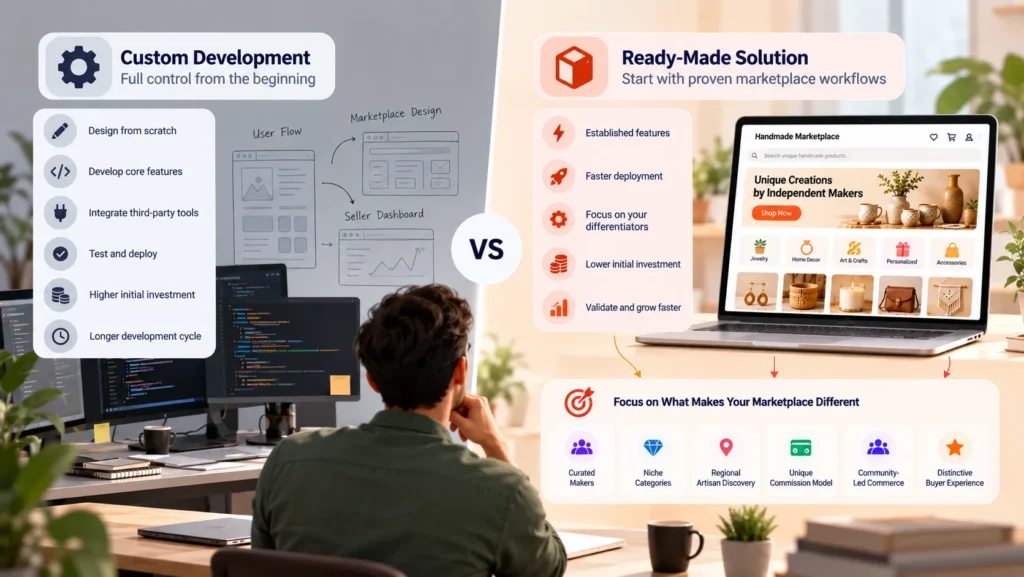
Custom development gives founders control over the product specification from the beginning.
That can be valuable. But complete control also means paying to design, develop, integrate and test standard marketplace functionality before the business has generated much real-world evidence.
A ready-made foundation changes the sequence.
Instead of spending the earliest development cycle recreating standard commerce infrastructure, the startup can begin with established marketplace workflows and direct more attention toward its actual differentiators.
Those differentiators could be:
- a carefully selected maker community;
- specialization around a particular craft or product category;
- regional artisan discovery;
- stronger seller curation;
- a distinctive commission or membership model;
- community-led commerce;
- specialized fulfilment;
- unique discovery or merchandising;
- a differentiated buyer experience.
That distinction matters because software infrastructure and business differentiation are not the same thing.
A startup does not automatically become more differentiated because its cart, seller registration system or admin dashboard was written from an empty repository.
The founder question to ask
Before approving a custom build, separate the roadmap into two groups:
- Standard infrastructure: What must exist simply because this is a marketplace?
- Strategic differentiation: What must exist because this is your marketplace?
The more of the first group that can be handled by a suitable existing foundation, the more development attention can potentially move toward the second.
Faster Launch Means Faster Learning, Not Just an Earlier Release Date
Speed-to-market is often discussed as if launching first were the entire objective.
For startups, the more useful advantage is speed-to-learning.
Before launch, many important assumptions are still assumptions.
Will enough makers complete onboarding?
Which categories attract the most supply?
Will sellers accept the commission structure?
What information do buyers need before trusting an unfamiliar maker?
Where do users abandon checkout?
Which products generate repeat purchases?
How much moderation will the marketplace actually require?
Software specifications cannot fully answer those questions. Real marketplace activity can.
A ready-made platform can shorten the distance between planning and observing actual behavior when its existing workflows already fit the business model.
That creates an important change in how a startup invests.
Instead of making every major product decision before launch, founders can preserve some decisions until they have better evidence.
Start With the Marketplace Foundation, Then Customize What Users Actually Value
One common concern about ready-made software is that the startup will end up looking identical to every other marketplace.
That is a valid concern if the software cannot be meaningfully customized.
But “ready-made” should describe the starting foundation, not the final brand or product strategy.
A startup should still be able to evaluate customization across areas such as branding, navigation, category structure, seller policies, commission logic, integrations, merchandising, regional workflows and other requirements specific to the business.
The strategic difference is the order in which customization happens.
With a ground-up build, founders often have to predict almost everything before users arrive.
With an extensible ready-made foundation, the team can potentially launch standard workflows first and invest more heavily in the areas where actual seller and buyer behavior shows that differentiation matters.
That can make customization more evidence-driven.
The Marketplace Operations Layer Matters More Than Founders Often Expect
The visible storefront receives most of the attention during product planning because it is what buyers see.
But the long-term workload often sits behind it.
Imagine onboarding hundreds of independent sellers. Each may create listings, update stock, receive orders, communicate with buyers, request payouts or need support.
At the same time, the operator may need to review marketplace activity, handle problematic listings, manage commission rules, resolve disputes and understand what is happening across the seller network.
That is why a marketplace should be evaluated as an operating system for the business, not simply a shopping interface.
For founders comparing development approaches, the important question is whether the platform already provides a workable operational foundation that can be adapted to the planned model.
A beautiful storefront without strong operator controls simply moves complexity behind the scenes.
Ready-Made Development Can Reduce the Cost of Testing the Wrong Assumptions
Startups rarely know their final product requirements on day one.
A team might initially believe that sophisticated product personalization is essential, only to discover that sellers struggle with onboarding.
Another may prioritize advanced discovery while discovering that its real bottleneck is attracting enough high-quality makers.
A third may build complicated seller functionality when buyers mainly care about trust, transparent delivery and product authenticity.
The danger of extensive pre-launch custom development is not only development expense. It is committing engineering resources to assumptions before the market has tested them.
A ready-made marketplace foundation can reduce that exposure when it covers the standard workflows well enough to begin validation.
The startup can then direct subsequent investment toward problems supported by evidence rather than predictions.
What a Ready-Made Handmade Marketplace Should Already Solve
A ready-made platform only creates an advantage if its foundation actually matches the operating model.
Founders do not need to compare solutions by counting the largest number of features. They need to determine whether the essential marketplace relationships are already connected.
A useful evaluation starts with four areas.
| Area | What the Foundation Should Enable | Why It Matters |
|---|---|---|
| Seller operations | Onboarding, listings, stock, orders and seller account management | Reduces manual work as the seller base expands |
| Buyer journey | Discovery, product evaluation, checkout, order visibility and communication | Creates a complete purchasing path |
| Marketplace operations | Seller oversight, moderation, commissions, disputes and reporting | Gives the operator control over marketplace quality |
| Financial workflows | Payments, platform fees, balances, refunds and seller settlement logic | Connects marketplace activity to the business model |
The detailed implementation can vary by market.
What matters is whether the platform provides a coherent starting system rather than a collection of disconnected screens.
For a deeper look at the technical relationships between sellers, listings, orders, payments and payouts, read our guide to handmade marketplace platform architecture.
Where Startups Can Redirect the Time They Do Not Spend Rebuilding Standard Features
Choosing an existing foundation does not eliminate work.
It changes the work.
A startup still needs to build the business surrounding the software.
That includes recruiting the initial seller community, defining marketplace policies, choosing categories, creating a positioning strategy, establishing customer support processes, planning acquisition, deciding how quality will be controlled and determining why buyers should return.
For a handmade marketplace, this non-code work can become especially important because supply quality influences demand.
A technically complete marketplace with weak sellers has a marketplace problem.
A marketplace with excellent sellers but no discovery strategy has a distribution problem.
A marketplace with transactions but unclear economics has a business-model problem.
None of those issues is solved simply by writing more code.
The development approach should therefore leave enough founder attention and capital for the rest of the marketplace.
Source-Code Ownership Changes the Long-Term Ready-Made vs Custom Equation
Founders sometimes evaluate ready-made software as if it automatically means permanent dependence on the original development provider.
That does not have to be the case.
Source-code ownership is an important evaluation criterion because a startup’s requirements can become more specialized as the marketplace grows.
If the business eventually needs proprietary recommendation logic, specialized seller tools, new fulfilment workflows, unusual integrations or market-specific functionality, the ability to extend the underlying platform becomes important.
This creates a useful middle path:
start with an existing marketplace foundation, validate the operating model, then customize strategically as evidence accumulates.
For many startups, that is a more useful comparison than treating “ready-made” and “custom” as permanent opposites.
When Custom Development Is the Better Starting Point
When comparing a ready-made handmade marketplace vs custom development, speed should not be the only deciding factor. The right approach depends on how much of the marketplace requires standard functionality versus genuinely unique technology.
Custom marketplace development becomes a stronger choice when the business depends on specialized workflows that cannot be efficiently adapted from an existing marketplace foundation. This may include proprietary pricing logic, complex product customization, unusual buyer-seller interactions, specialized fulfillment, or a transaction model that fundamentally changes how the marketplace operates.
By contrast, if the platform mainly requires familiar functions such as seller onboarding, product listings, search, checkout, commissions, payments, reviews, and order management, rebuilding those modules from scratch may add development time without creating meaningful differentiation.
| Ready-Made Marketplace Is Better Suited When | Custom Development Is Better Suited When |
|---|---|
| Most marketplace workflows are standard | Core workflows require unique architecture |
| Faster launch and market validation matter | Proprietary technology drives the business model |
| Differentiation comes from niche, branding, sellers, or community | Differentiation depends on custom transaction logic |
| Existing modules require selective customization | Existing platforms would need major restructuring |
| Resources need to support seller and buyer acquisition | Specialized requirements are already validated |
How Should Founders Decide?
A practical question is:
Are you customizing an established marketplace model, or creating a fundamentally different marketplace experience?
If most workflows are standard and only selected areas require customization, an extensible ready-made marketplace platform can provide a more efficient starting point.
If unique technology determines how products are configured, transactions are processed, sellers operate, or orders are fulfilled, custom development may be the better foundation.
The goal is not to choose ready-made or custom development by default. It is to invest custom engineering where it creates genuine business differentiation rather than rebuilding standard marketplace infrastructure unnecessarily.
How Founders Should Compare Ready-Made and Custom Marketplace Development
Do not make the decision using development time alone.
Evaluate the two approaches against the same business questions.
1. How much of the roadmap is genuinely unique?
If most requirements are common marketplace functions, rebuilding everything may provide limited strategic value.
2. How quickly does the business need real market evidence?
A startup that still needs to validate seller acquisition, buyer demand or marketplace economics may value an earlier path to real transactions.
3. How much customization is actually required before launch?
Separate essential differentiation from features that can reasonably wait until actual user behavior justifies them.
4. Who controls the product after deployment?
Understand source-code access, infrastructure control and the ability to extend the platform.
5. Does the foundation match the marketplace’s seller model?
A marketplace for many independent makers creates different operational pressures from a conventional single-store ecommerce site.
6. What work remains after the software is ready?
Seller acquisition, content, policies, payment configuration, branding, marketplace moderation, support and demand generation still require execution.
A fast software deployment should never be confused with an instantly established marketplace business.
Read More: What Features Should a Handmade Marketplace Platform Include for Independent Makers and Buyers?
How Miracuves Helps Founders Launch a Handmade Marketplace Without Building From Scratch
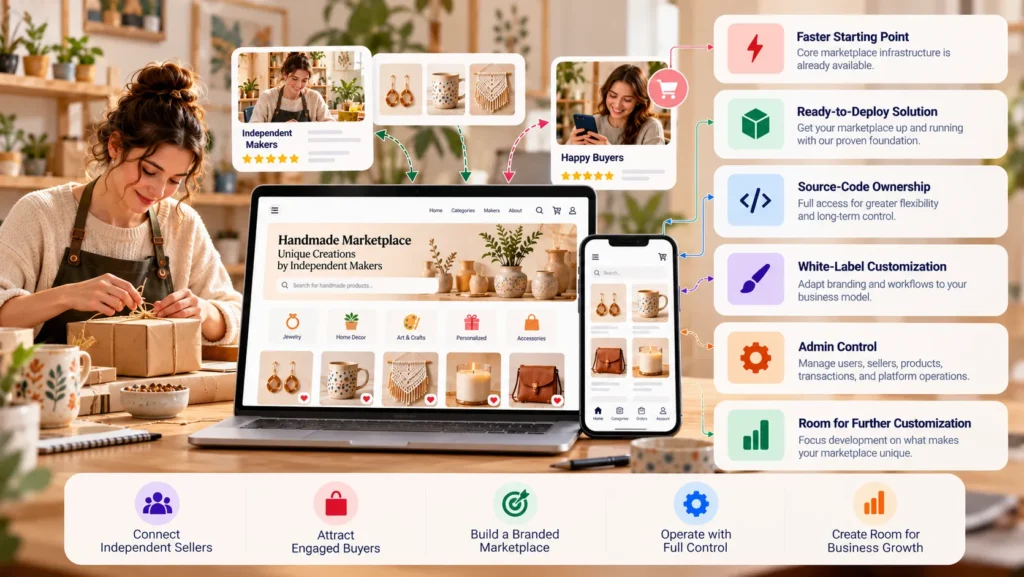
Miracuves provides a ready-made marketplace foundation for businesses planning to connect independent sellers with buyers. Instead of developing every standard marketplace workflow from scratch, founders can start with an established base and focus development resources on branding, business rules, integrations, and the functionality that makes their marketplace different.
For founders whose requirements align with the existing foundation, the Miracuves Etsy clone provides the commercial next step. The solution page contains the live product details, marketplace workflows, demos, features, technical information, and deployment scope.
What Founders Gain From the Ready-Made Approach
- Faster starting point: Core marketplace infrastructure is already available instead of being developed from zero.
- 6-day deployment: The ready-made base can be deployed in 6 days where the standard solution fits the agreed scope.
- Source-code ownership: Founders have greater flexibility to modify and extend the platform as requirements evolve.
- White-label customization: Branding and selected marketplace workflows can be adapted around the intended business model.
- Admin control: The marketplace operator has a central foundation for managing users, sellers, products, transactions, and platform operations.
- Room for further customization: Additional engineering can be focused on functionality that genuinely differentiates the business.
The 6-day deployment refers specifically to the software foundation-not the time required to recruit sellers, establish buyer demand, build marketplace liquidity, or create a successful marketplace business.
This distinction matters.
The purpose of starting with a ready-made product is not to suggest that the entire business can be built in six days. It is to avoid spending unnecessary time rebuilding standard marketplace software before the harder work of creating supply, demand, trust, and differentiation begins.
During product evaluation, founders should therefore verify platform fit, identify required customization, review ownership and scalability requirements, and determine which functionality genuinely needs additional engineering. This helps ensure that development investment goes toward business differentiation rather than rebuilding marketplace infrastructure that already exists.
Common Mistakes Startups Make When Choosing a Development Approach
Choosing purely on the lowest initial price
A lower upfront figure is not useful if the platform cannot support the operating model or requires extensive reconstruction immediately afterward.
Evaluate fit before price.
Building every planned feature before testing demand
A long roadmap can create the illusion of product certainty.
Separate launch-critical functionality from assumptions that can be tested later.
Ignoring seller operations
Handmade marketplaces depend on their supply side. Seller onboarding, listing management, moderation and settlement deserve as much attention as the buyer storefront.
Treating ready-made software as automatically inflexible
The real question is not whether the foundation already exists. It is whether it can be branded, configured and extended appropriately.
Treating custom development as automatically differentiated
Custom code does not create a unique business by itself.
Differentiation comes from what the marketplace does differently for its buyers and sellers.
What Should Startups Validate After Launch?
Once the marketplace is operating, founders can begin replacing assumptions with evidence.
Useful early questions include:
- How many invited sellers complete onboarding?
- How quickly can a new seller publish the first acceptable listing?
- Which product categories generate meaningful buyer interest?
- Where do shoppers abandon the purchase journey?
- How frequently do disputes or moderation issues appear?
- Which sellers generate repeat orders?
- Which monetization model fits seller behavior without discouraging supply?
- Which manual operational tasks are consuming the team’s time?
These observations can shape the next customization cycle.
For founders working through marketplace economics, our guide to handmade marketplace monetization explores seller plans, commissions and other revenue mechanisms in more detail.
The objective is to let market evidence influence the roadmap rather than assuming the first specification should also be the final one.
Final Thoughts: Build What Differentiates the Marketplace
The strongest argument for a ready-made handmade marketplace platform is not that custom development is unnecessary.
It is that custom development should be spent where customization creates business value.
Seller registration, order management, payments, marketplace administration and other foundational workflows are necessary. But necessity does not automatically make them differentiators.
For a startup still proving its market, beginning with a suitable existing foundation can create room to focus on the questions that software alone cannot answer: Which makers should join? Why should buyers care? How will the marketplace earn? What creates trust? What creates repeat activity? And which product capabilities genuinely deserve custom engineering?
Miracuves helps founders start with a source-code-owned, white-label marketplace foundation and then adapt it around the business model. Where the ready-made scope is suitable, the software can be deployed in 6 days, giving the team an earlier starting point for the much larger work of building the marketplace itself.
FAQs
What is a ready-made handmade marketplace platform?
It is an existing software foundation designed around common marketplace workflows such as seller onboarding, product listings, buyer discovery, orders, payments and platform administration. The business can then configure and customize that foundation around its niche, brand and operating model.
Is a ready-made marketplace the same as copying another business?
No. Starting with established marketplace functionality does not mean copying another company’s branding, content or business strategy. The purpose is to avoid rebuilding common software infrastructure while creating your own marketplace positioning, seller network, policies and customer experience.
Why might a startup choose ready-made marketplace software over custom development?
The approach can reduce the amount of standard marketplace infrastructure that must be engineered before the startup begins testing seller participation, buyer demand and operational assumptions. It can therefore be useful when speed of validation matters.
Can a ready-made marketplace still be customized?
That depends on the platform and ownership model. Founders should evaluate branding flexibility, source-code access, integrations and the ability to extend important workflows before selecting a solution.
When is custom marketplace development a better option?
Custom-first development can make more sense when unusual technology or workflows form the core of the business and cannot reasonably be supported by an existing marketplace architecture.
What should founders evaluate before choosing a ready-made platform?
Look beyond the feature count. Evaluate seller workflows, buyer journeys, operator controls, payment and settlement logic, customization flexibility, source-code ownership, scalability, security, integrations and the ability to extend the product later.
Does a 6-day software deployment mean the marketplace business launches completely in six days?
No. Miracuves’ 6-day timeline applies to deployment of an applicable ready-made software foundation. Seller recruitment, branding inputs, business setup, marketplace policies, acquisition, operational preparation and other go-to-market work remain separate business activities.
Should startups customize heavily before launching?
Only when those customizations are necessary for the core business proposition or initial operating model. Other improvements can often be prioritized after the startup has observed how real sellers and buyers use the marketplace.
Miracuves is an independent software development company. We are not affiliated with, connected to, sponsored by, or endorsed by any company or product named in this article.
Terms such as “X Clone” are used descriptively. It is how the software industry refers to building a platform with functionality comparable to a known service, and how clients search for it.
The entire design and codebase of our products is built by our own team. Our products contain no code, design, graphics, or content originating from any third-party website or applications.
All third-party names and marks referenced in this article are the property of their respective owners, referenced solely to identify the services discussed.