Key Takeaways
What You’ll Learn
- Swiggy clone scripts help launch a food delivery platform faster without building logistics and ordering systems from scratch.
- Core food delivery features include restaurant listings, real-time order tracking, delivery partner management, and seamless checkout.
- White-label solutions reduce development time, simplify technical setup, and allow quicker go-to-market execution.
- Revenue models such as commissions, delivery fees, surge pricing, ads, and subscriptions create multiple income streams.
- Pricing depends on platform scale, delivery network, payment integrations, and backend management capabilities.
Stats That Matter
- Food delivery platforms are driven by high-frequency daily orders, increasing repeat usage.
- A Swiggy-style platform connects restaurants, delivery partners, and customers within one ecosystem.
- Order frequency and retention improve when users rely on a single app for everyday meals.
- Integrated payments and fast checkout improve conversion rates and user experience.
- A successful platform requires strong restaurant partnerships, reliable delivery, and operational efficiency to scale.
Real Insights
- Start with high-demand areas where restaurant density and order volume are already strong.
- Delivery efficiency is critical because speed and reliability directly impact customer satisfaction.
- Restaurant onboarding and quality control play a major role in long-term retention.
- Pricing strategies and offers influence order frequency and competitive positioning.
- Long-term growth depends on logistics optimization, user experience, and consistent service quality.
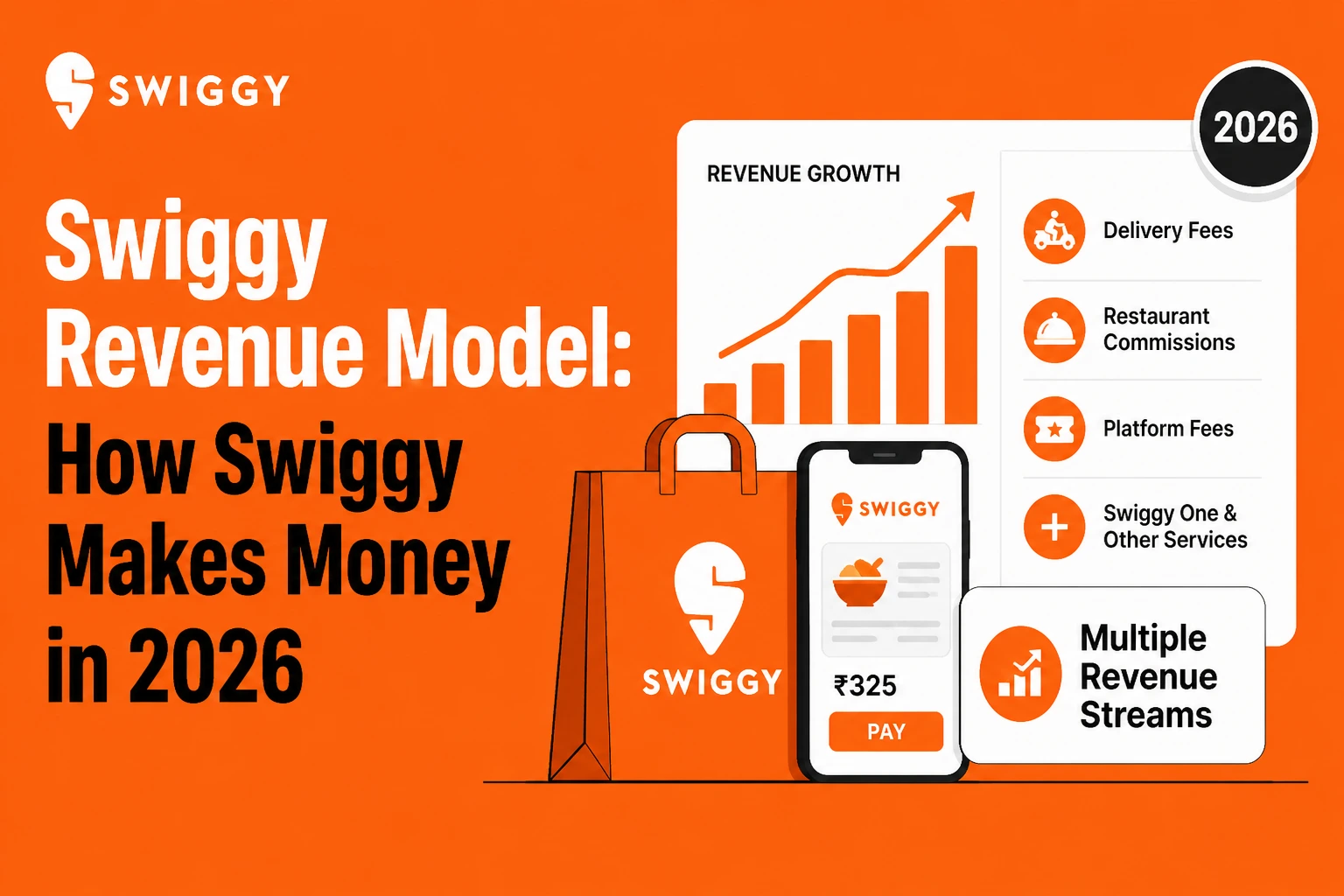
Swiggy generated over ₹11,700 crore in operating revenue in FY25, a sharp rise of nearly 24% from the previous year. The company’s path to profitability — once distant — is now within reach, thanks to diversified revenue streams across food delivery, grocery, and quick commerce.
For entrepreneurs, Swiggy’s success story offers a playbook on how to build a multi-stream platform like swiggy combining food, grocery, and logistics. Understanding its revenue model is key if you’re planning to launch a Swiggy Clone using Miracuves’ ready-to-deploy app solutions with built-in monetization modules.
Planning to build in this space? Miracuves offers a ready-made food delivery marketplace platform that you can launch under your own brand.
Swiggy Revenue Overview — The Big Picture
Current Valuation and Revenue
In FY25, Swiggy’s operating revenue reached approximately ₹11,700 crore, compared to ₹9,600 crore in FY24 — a solid 23–24% year-over-year jump. Valuation estimates place Swiggy around $7–8 billion, reaffirming its dominance in India’s quick-commerce and food delivery sector.
Year-over-Year Growth
Swiggy’s top line continues to rise on the back of increased order volumes and the expansion of Instamart (grocery arm). Its quick commerce division alone contributed over 30% of total order volume in FY25.
Revenue Breakdown by Business Unit
- Food delivery: ~60%
- Instamart (grocery): ~25%
- Dineout and Genie (others): ~15%
Profit Margins Analysis
Swiggy reduced its losses significantly to around ₹1,600 crore in FY25, down from ₹3,000 crore in FY24. Optimized delivery logistics, increased advertising revenue, and efficiency improvements contributed to margin expansion.
Market Position vs Competitors
Swiggy remains one of India’s top two food delivery players, neck-and-neck with Zomato. Together, they dominate nearly 95% of India’s online food delivery market, with Swiggy’s strength lying in Tier-2 cities and instant grocery delivery.
Read More: What is Swiggy App and How Does It Work?
Primary Revenue Streams Deep Dive
Revenue Stream #1: Commission from Restaurants
How It Works
Swiggy earns a commission on every order placed through its app. Restaurants pay Swiggy a cut for exposure, logistics, and customer access.
Percentage of Total Revenue
This remains the core stream — roughly 45–50% of Swiggy’s overall revenue.
Pricing Structure / Rates
Commission rates range between 15% and 30%, depending on the restaurant category and exclusivity.
Growth Trends
Higher order frequency, improved delivery density, and premium placements have helped Swiggy maintain growth in this category.
Example
If Swiggy processes ₹10,000 crore in gross order value, commissions contribute about ₹1,500–₹2,000 crore.
Revenue Stream #2: Delivery Charges from Customers
How It Works
Users pay a delivery fee per order, varying by distance, order value, and demand time.
Percentage of Total Revenue
Delivery fees contribute around 20%–25% of Swiggy’s total earnings.
Pricing & Rates
Typical range: ₹25–₹70 per order. Surge pricing applies during peak hours.
Growth Trends
Customer tolerance for delivery fees has increased due to reliability and convenience.
Revenue Stream #3: Swiggy One (Subscription Program)
How It Works
Swiggy offers “Swiggy One” — a paid subscription for free deliveries, extra discounts, and priority customer support.
Percentage of Total Revenue
Contributes 5%–8%, but growing rapidly.
Pricing Structure
₹199 per month or ₹999 annually (approximate).
Growth Trends
Recurring revenue from memberships stabilizes cash flow and increases user retention.
Revenue Stream #4: Advertising and Sponsored Listings
How It Works
Restaurants and FMCG brands pay Swiggy to appear in featured listings, banner ads, or sponsored search results.
Percentage of Total Revenue
Accounts for around 10%–12%.
Pricing & Rates
Brands pay per click, per view, or via fixed monthly packages.
Growth Trends
Advertising is Swiggy’s highest-margin stream, expanding rapidly as brand budgets shift to digital platforms.
Revenue Stream #5: Instamart & Dineout Integrations
How It Works
Instamart handles grocery and instant delivery services, while Dineout (acquired) adds dine-in and event-based monetization.
Percentage of Total Revenue
Combined, they contribute 15%–20%.
Growth Trends
Instamart alone grew 40% YoY, solidifying Swiggy’s diversification beyond food delivery.
Detailed Breakdown of Revenue Streams by Percentage
| Revenue Stream | % of Total Revenue |
|---|---|
| Commissions from Restaurants | 45–50% |
| Delivery Fees | 20–25% |
| Swiggy One Subscriptions | 5–8% |
| Advertising & Sponsored Listings | 10–12% |
| Instamart & Dineout | 15–20% |
Read More: Business Model of Swiggy: Complete Strategy Breakdown
The Fee Structure Explained
User-Side Fees
- Delivery charge (distance/surge-based)
- Platform fees (₹2–₹5 per order)
- Subscription fee (Swiggy One)
Provider-Side Fees
- Commissions per order (15–30%)
- Listing and promotional fees
- Sponsored ad slots
- Dineout booking or event fees
Hidden Revenue Tactics
- Peak-hour surge pricing
- Preferred restaurant partnerships
- Customer data insights (non-personalized)
Regional Pricing Variations
Urban cities carry higher delivery fees and commissions, while smaller cities operate at lower margins but higher order density.
Detailed Fee Structure Breakdown by User Type
| Stakeholder | Fee Type | Range / Model |
|---|---|---|
| Customer | Delivery Fee | ₹25–₹70 per order |
| Customer | Platform Fee | ₹2–₹5 |
| Customer | Subscription | ₹199/month |
| Restaurant | Commission | 15–30% |
| Restaurant | Ads & Promotions | CPC/CPM |
| Partner | Logistics / Fulfillment | Volume-based |
How Swiggy Maximizes Revenue per User
Swiggy’s algorithms dynamically adjust pricing, delivery allocation, and upselling recommendations.
Core Techniques:
- Upselling: Encouraging customers to add items with higher margins (desserts, add-ons).
- Cross-Selling: Promoting Instamart during off-meal hours.
- Dynamic Pricing: Surge-based delivery and distance-linked charges.
- Retention Monetization: Reward programs, push notifications, and in-app coins.
- Lifetime Value Optimization: Subscription bundling (Swiggy One + Instamart offers).
- AI-Driven Recommendations: Personalizing restaurant visibility to maximize cart size.
Cost Structure & Profit Margins
Major Cost Categories:
- Delivery partner payouts (~45% of total costs)
- Marketing and customer acquisition (~15%)
- Technology and infrastructure (~10%)
- Discounts and cashback (~10%)
- Admin, staff, and logistics (~20%)
Unit Economics:
Swiggy earns about ₹1.20 for every ₹1 spent, approaching breakeven.
Margin Improvement Strategies:
- Route optimization for delivery partners
- Reduced incentive-based marketing
- Leveraging ad and subscription revenues

Future Revenue Opportunities & Innovations
Emerging Streams:
- Grocery and medicine delivery expansion
- AI-based order prediction for better resource allocation
- Integration with electric vehicle delivery fleets
- Monetization via loyalty programs and co-branded credit cards
AI/ML Monetization:
Demand forecasting, route optimization, and personalized discounts improve conversion rates.
Expansion Markets:
Tier-2 and Tier-3 cities are showing explosive demand in 2026, providing low-cost acquisition potential.
Predictions for 2025–2027:
- Swiggy’s grocery and dine-in services will surpass 35% of total revenue
- Improved ad monetization via brand collaborations
- Profitability expected by late FY26
Opportunities for Entrepreneurs:
The Swiggy model proves the scalability of multi-service delivery. Entrepreneurs can launch Swiggy Clone Apps using Miracuves’ pre-built frameworks to enter food, grocery, or logistics markets quickly with lean MVPs.
Lessons for Entrepreneurs & Your Opportunity
Key Takeaways:
- Diversified revenue ensures long-term stability
- Ads and subscriptions create high-margin income
- AI-driven pricing and logistics boost profitability
- Quick-commerce integration is the next big wave
Global Cost Factors & Pricing Breakdown
The technology stack behind your platform plays a major role in how much it costs, how fast it can launch, and how efficiently it can handle food delivery operations as it grows. Some businesses need a faster and more affordable launch, while others require a more advanced setup to manage high order volumes, real-time delivery tracking, and multi-city expansion.
Here is a simple comparison of common global development approaches for a Swiggy-like food delivery platform:
PHP/Laravel is often the most practical choice for launching a Swiggy-like food delivery platform quickly and affordably. Node.js/Python fits better when real-time order tracking and heavier data movement become more important, while Go microservices are better suited for enterprise-scale Swiggy-like platforms with higher concurrency and more complex infrastructure needs.
Miracuves Swiggy-Like App Solution Cost and Tech Stack
Miracuves Pricing for a Swiggy-Like Food Delivery App developed in PHP/Laravel with Flutter Apps for $3,399 USD (One-Time Price) in just 6 days
Get a fully developed, deployment-ready platform modeled after Swiggy. Built on a rock-solid PHP/Laravel foundation, this complete package includes everything you need to launch and scale:
- Core Workflows: Food delivery operations, restaurant listings, order management, and real-time delivery tracking.
- Built-in Finance: In-app wallet logic, dynamic pricing, delivery charges, and seamless payment integrations.
- Management Hub: Comprehensive restaurant, delivery partner management, and a centralized admin backend.
- Launch-Ready: Fully prepped for your custom branding, configuration, and immediate market entry.
Why Is Swiggy-Like App Development More Affordable?
Most advanced food delivery platforms push businesses toward expensive architectures like Node.js or Go. Building from scratch with those frameworks requires highly specialized, expensive engineering teams, which drives the cost into the tens or hundreds of thousands of dollars.
We took a smarter, more practical approach:
- You Aren’t Paying for Ground-Up Development: Our food delivery engine is already developed, battle-tested, and ready to deploy. You skip the inflated costs and months of waiting associated with building from scratch.
- The Power of PHP / Laravel: We built this on one of the most reliable, globally adopted frameworks in the world. Not only does this keep our upfront costs down, but it also protects your future budget. PHP has a massive global talent pool, making it incredibly easy and cost-effective for you to find developers for future scaling or customizations.
You get an enterprise-capable, heavy-duty foundation without the inflated development cost.
Note: This cost is for the solution, re-branding, deployment, and source code only.
Conclusion
Swiggy’s transformation from a food delivery startup to a multi-vertical commerce platform demonstrates the power of monetization through diversification. For new entrepreneurs, replicating this model through Miracuves’ Swiggy Clone offers the fastest path to build, launch, and scale a profitable on-demand business.
FAQs
How much does Swiggy make per order?
Swiggy earns roughly ₹25–₹70 from delivery fees and 15–30% commission from restaurants.
What’s Swiggy’s most profitable segment?
Advertising and Instamart (grocery) contribute the highest margins.
How has Swiggy reduced its losses?
By improving delivery density, cutting marketing costs, and boosting ad revenue.
Can small businesses replicate Swiggy’s model?
Yes — using Miracuves’ Swiggy Clone with built-in monetization.
How quickly can a Swiggy Clone monetize?
With Miracuves’ ready framework, you can start earning in just 6 Days with guaranteed delivery, ensuring a fast and seamless monetization process post-launch.
What are alternatives to Swiggy’s model?
Hyperlocal delivery, dark stores, or multi-vendor platforms.
What’s Swiggy’s commission rate?
Restaurants typically pay 15–30% per order.
How much revenue does Swiggy earn annually?
Around ₹11,700 crore in FY25
Which is more profitable — Swiggy or Zomato?
Both are close; Swiggy’s Instamart gives it a stronger long-term growth edge.
What’s next for Swiggy?
Profitability by FY26 and expanded offerings beyond food delivery.
Related Articles:
Miracuves is an independent software development company. We are not affiliated with, connected to, sponsored by, or endorsed by any company or product named in this article.
Terms such as “X Clone” are used descriptively. It is how the software industry refers to building a platform with functionality comparable to a known service, and how clients search for it.
The entire design and codebase of our products is built by our own team. Our products contain no code, design, graphics, or content originating from any third-party website or applications.
All third-party names and marks referenced in this article are the property of their respective owners, referenced solely to identify the services discussed.