Key Takeaways
- A complete astrology platform should connect free tools, paid reports, expert consultations, payments, and admin operations.
- Important user features include kundali generation, horoscopes, panchang, compatibility matching, personalized reports, and astrologer discovery.
- Chat, audio calls, video sessions, appointments, wallets, and per-minute billing support consultation-based revenue.
- Astrologers need verification, availability, pricing, session management, earnings, and payout tools.
- Founders should prioritize connected user journeys instead of selecting features only by quantity.
Platform Evaluation Signals
- Test whether free kundali, horoscope, matching, and panchang tools naturally guide users toward paid services.
- Review report generation, payment confirmation, PDF delivery, purchase history, and refund workflows.
- Check astrologer onboarding, verification, availability, consultation pricing, reviews, commissions, and payouts.
- Inspect wallet recharges, balance deductions, per-minute billing, promotional credits, and transaction records.
- Confirm that administrators can manage users, experts, content, pricing, payments, disputes, permissions, and analytics.
Real Insights
- Free astrology tools can attract search traffic and build trust before users are ready to make a purchase.
- Paid reports create a lower-friction first transaction than requiring every user to book a live consultation.
- Weak wallet and payout logic can create billing disputes between users, astrologers, and platform operators.
- Advanced AI, live events, and commerce features should follow reliable onboarding, reports, consultations, and admin workflows.
- Miracuves develops white-label astrology platforms with user tools, expert workflows, wallet billing, admin control, source-code ownership, and six-day delivery where the standard scope applies.
Astrology has moved from physical consultations, printed calendars, and one-to-one appointment-based guidance into digital platforms where users can generate kundali charts, read horoscopes, download reports, check compatibility, find auspicious timings, and connect with astrologers from one place.
That is where an astrology portal platform becomes important.
An astrology portal is not just a website with zodiac articles. It is a structured digital ecosystem where self-service astrology tools, personalized reports, expert consultations, payments, content, user profiles, and admin control work together. For users, it feels simple: enter birth details, receive insights, explore reports, and consult an expert when needed. For founders, the real value is in how these modules connect behind the scenes.
This guide explains how astrology portal platforms work, why kundali and horoscope tools attract users, how paid reports and consultations create revenue opportunities, and what founders should understand before launching a digital astrology business.
What Is an Astrology Portal Platform?
An astrology portal platform is a digital product that allows users to access astrology-related tools, content, reports, and expert guidance through a website or mobile app.
Unlike a simple astrology blog, a portal includes interactive features. Users do not only read information. They enter birth details, generate charts, compare compatibility, view daily predictions, order detailed reports, and connect with astrologers through chat, audio, or video.
A complete astrology portal usually includes:
- Kundali or birth chart generation
- Daily, weekly, monthly, and yearly horoscopes
- Kundali matching for compatibility
- Panchang and muhurta tools
- Personalized astrology reports
- Astrologer profiles and consultation booking
- Wallet or payment system
- User dashboard
- Astrologer dashboard
- Admin panel
- Content management system
- Review, rating, and moderation workflows
For users, the platform provides convenience. For founders, it creates a business model where free tools can attract traffic and paid services can generate revenue.
Why Astrology Portals Are Different From Normal Astrology Websites
A normal astrology website usually depends on static content. It may publish articles about zodiac signs, planets, festivals, remedies, and spiritual guidance. That content can attract search traffic, but it does not always create a strong conversion path.
An astrology portal works differently because it combines content with action.
A visitor may arrive to check today’s horoscope. From there, the platform can invite the user to create a free kundali, explore a detailed report, match a partner’s chart, or consult an astrologer. This journey turns astrology content into a product experience.
The difference is important for founders. A blog can educate users, but a portal can collect intent, personalize guidance, and create paid actions.
How Kundali Generation Works Inside an Astrology Portal
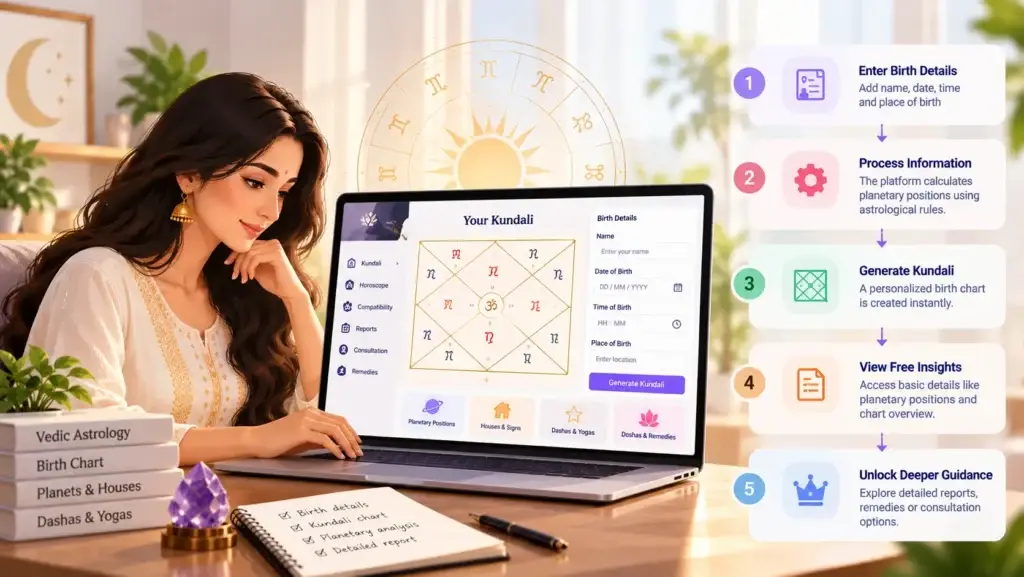
Kundali generation is often one of the strongest entry points for an astrology platform. A kundali, also called a birth chart, is created using the user’s date of birth, time of birth, and place of birth.
The platform takes this information and calculates planetary positions based on astrological rules. The output may include houses, planets, signs, dashas, yogas, doshas, and chart styles depending on the system used.
A user-facing kundali flow usually looks like this:
- The user enters name, birth date, birth time, and birth location.
- The platform processes the birth details through the astrology calculation engine.
- A basic kundali is generated instantly.
- The user can view free sections such as planetary positions or chart overview.
- The platform may offer deeper paid reports, remedies, or consultation options.
For founders, kundali generation matters because it captures strong intent. A user who enters birth details is not casually browsing. They are looking for personalized insight. That makes kundali tools a useful bridge between free traffic and paid astrology services.
How Horoscopes Keep Users Coming Back
Horoscopes are one of the most powerful retention tools in an astrology portal. Unlike a one-time kundali report, horoscopes create recurring engagement.
Users may return daily to read zodiac predictions, weekly career guidance, monthly love forecasts, or yearly life themes. This gives the platform repeated opportunities to build habit, recommend reports, send notifications, and promote consultations.
A horoscope module may include:
- Daily horoscope
- Weekly horoscope
- Monthly horoscope
- Yearly horoscope
- Zodiac sign pages
- Love horoscope
- Career horoscope
- Finance horoscope
- Health horoscope
- Personalized horoscope alerts
The business value is simple. Kundali tools may bring users in, but horoscope content can bring them back.
For an astrology portal, this repeat behavior matters because retention is often more valuable than a single visit. A founder should think of horoscopes not only as content, but as a habit-building layer.
Read More: From Free Kundli to Paid Consultation: Designing the User Journey in a Digital Astrology Platform
How Astrology Reports Turn Free Users Into Paying Customers
Reports are where many astrology portals begin monetizing user intent.
A user may generate a free kundali first. After seeing basic information, they may want a more detailed explanation. That is where paid astrology reports fit naturally.
Common report categories include:
| Report Type | User Intent | Business Value |
|---|---|---|
| Detailed Kundali Report | Understand birth chart in depth | Converts free chart users into paid users |
| Marriage Compatibility Report | Evaluate partner compatibility | High emotional and family-driven intent |
| Career Report | Understand profession and growth direction | Useful for young professionals and students |
| Finance Report | Explore wealth and money-related guidance | Strong commercial intent |
| Health Report | Understand wellness-related astrological patterns | Sensitive but high-interest category |
| Remedy Report | Find suggested remedies for doshas or concerns | Can connect to consultation or product sales |
| Yearly Prediction Report | Plan the coming year | Seasonal monetization opportunity |
A good report system should not feel like a forced upsell. The free layer should provide useful value, while the paid layer should offer deeper interpretation, better formatting, downloadable access, and clearer recommendations.
For founders, the key question is not “How many reports can we sell?” It is “Where does the user naturally need more depth?”
How Live Astrology Consultations Work
Live consultation is the human trust layer of an astrology portal. Some users are satisfied with automated tools. Others want a real expert to interpret the chart, answer personal questions, and provide guidance.
A consultation system usually includes:
- Astrologer onboarding
- Profile creation
- Specialization and language selection
- Availability management
- Per-minute or session-based pricing
- Chat, audio, or video consultation
- Wallet deduction or direct payment
- Ratings and reviews
- Dispute or refund handling
- Admin moderation
The platform has to support both sides. Users need a simple way to discover astrologers, check expertise, compare pricing, and start a session. Astrologers need tools to manage availability, earnings, consultation history, and user communication.
This is why consultation platforms are more complex than basic astrology websites. They are marketplaces, not just content portals.
The User Journey: From Free Tool to Paid Guidance
The strongest astrology portals do not push users directly into payment. They guide users step by step.
A typical journey may look like this:
- The user searches for a kundali, horoscope, compatibility check, or muhurta.
- The user lands on a free astrology tool or content page.
- The platform asks for only the details needed to generate a result.
- The user receives a useful free output.
- The platform recommends a deeper report or expert consultation.
- The user pays for a report, books a consultation, or saves the profile for later.
- The platform brings the user back through horoscope alerts, festival content, or personalized reminders.
This journey works because it respects user intent. The first step solves a real need. The paid step appears only after the user understands the value.
For founders, this is the core product logic: free tools create trust, personalization creates relevance, and paid services create revenue.
Core Modules Every Astrology Portal Platform Needs
A scalable astrology portal needs more than attractive screens. It needs connected modules that support users, astrologers, content, payments, and operations.
| Module | What It Does | Why It Matters |
|---|---|---|
| User App or Web Portal | Lets users access tools, reports, horoscopes, and consultations | Creates the main customer experience |
| Kundali Engine | Generates birth charts based on user birth details | Drives personalized astrology journeys |
| Horoscope System | Publishes recurring zodiac-based predictions | Builds repeat engagement |
| Report Module | Offers free and paid report options | Converts intent into revenue |
| Astrologer Panel | Helps experts manage profiles, availability, and consultations | Supports service delivery |
| Admin Dashboard | Controls users, astrologers, pricing, content, payouts, and settings | Gives the operator business control |
| Wallet and Payments | Manages paid reports, consultation fees, and transactions | Enables monetization |
| Content CMS | Publishes blogs, guides, festival pages, and educational content | Supports SEO and trust |
| Review and Rating System | Lets users evaluate astrologers and services | Builds marketplace credibility |
| Moderation Tools | Helps manage abuse, disputes, and content quality | Protects platform trust |
The admin dashboard is especially important. Without strong admin control, founders become dependent on developers for small operational changes such as pricing, featured astrologers, report visibility, refunds, banners, or content updates.
Astrology Portal Monetization Models
A strong astrology portal can use multiple revenue streams. The right mix depends on the audience, region, cultural use case, and service depth.
Common monetization models include:
- Paid kundali or detailed birth chart reports
- Per-minute chat, audio, or video consultations
- Fixed-price astrology sessions
- Subscription plans for premium horoscope access
- Compatibility and marriage report sales
- Panchang, muhurta, or festival-specific premium tools
- Featured astrologer listings
- Astrology courses or workshops
- Remedies, products, or spiritual service bookings
- Ads or sponsored placements
- B2B astrology tools for consultants or publishers
The safest founder approach is to start with the clearest user intent. For example, if users arrive for kundali and matching, reports and consultations may convert better than unrelated product sales. If the platform has strong daily horoscope traffic, subscriptions or personalized alerts may become more relevant.
Founder Decision Signals Before Building an Astrology Portal
Before launching an astrology portal, founders should evaluate four areas: traffic, trust, monetization, and operations.
1. Traffic: What Will Bring Users In?
Astrology portals often depend on search-driven and recurring content. Kundali, horoscope, panchang, muhurta, and compatibility queries can all attract intent-rich users. The question is whether the platform has enough useful entry points to bring people in consistently.
2. Trust: Why Should Users Believe the Platform?
Trust comes from accurate tools, clear explanations, credible astrologer profiles, transparent pricing, and secure handling of user data. Astrology is personal. Users may share birth details, relationship concerns, family questions, and financial worries. The platform experience must feel respectful and secure.
3. Monetization: Where Does Payment Feel Natural?
Payment should not interrupt the journey too early. It should appear when the user wants more depth, human interpretation, downloadable access, or private guidance.
4. Operations: Can the Founder Control the Platform?
A founder needs control over pricing, astrologer approvals, content, reports, refunds, wallet transactions, promotions, and user support. Without this, growth becomes operationally difficult.
White-Label vs Custom Astrology Portal Development
Founders usually have two development paths: build everything from scratch or start with a ready-made white-label foundation.
| Option | Best For | Strength | Tradeoff |
|---|---|---|---|
| Custom Development | Businesses with very specific workflows and longer timelines | Full flexibility from the first line of code | Higher cost, longer build cycle, more technical risk |
| White-Label Astrology Platform | Founders who want faster launch and proven workflows | Faster deployment with existing modules | Customization must be planned around available foundation |
| Hybrid Approach | Teams that want speed plus targeted customization | Launch faster, then improve based on market feedback | Requires clear roadmap discipline |
For many founders, the practical decision is not whether custom development is “better.” It is whether the business needs a long build before validation, or whether it can start with a launch-ready foundation and refine after real user feedback.
Miracuves helps founders launch a white-label astrology portal solution with source-code ownership, admin control, and faster deployment. For ready-made astrology platforms, Miracuves can support a 6-day solution delivery path depending on the selected scope and customization requirements.
Common Mistakes Founders Should Avoid
Building Only a Content Website
Content is important, but an astrology business needs interactive tools and conversion paths. A blog without kundali, reports, consultations, or user journeys may struggle to monetize intent.
Hiding All Value Behind Payment
If users cannot experience useful free value, they may leave before trusting the platform. Free kundali, horoscope previews, or basic compatibility checks can help create confidence.
Treating Consultations as a Simple Chat Feature
Astrology consultations need expert profiles, availability, pricing, wallet logic, ratings, support, and moderation. Without these systems, service quality becomes difficult to manage.
Ignoring Admin Control
Founders should not need a developer for every price change, banner update, astrologer approval, or report setting. Admin control is essential for daily operations.
Launching Without a Clear Monetization Ladder
A platform should define the path from free tool to paid report to consultation to repeat engagement. Without that ladder, traffic may not turn into revenue.
What Makes a Good Astrology Portal Experience?
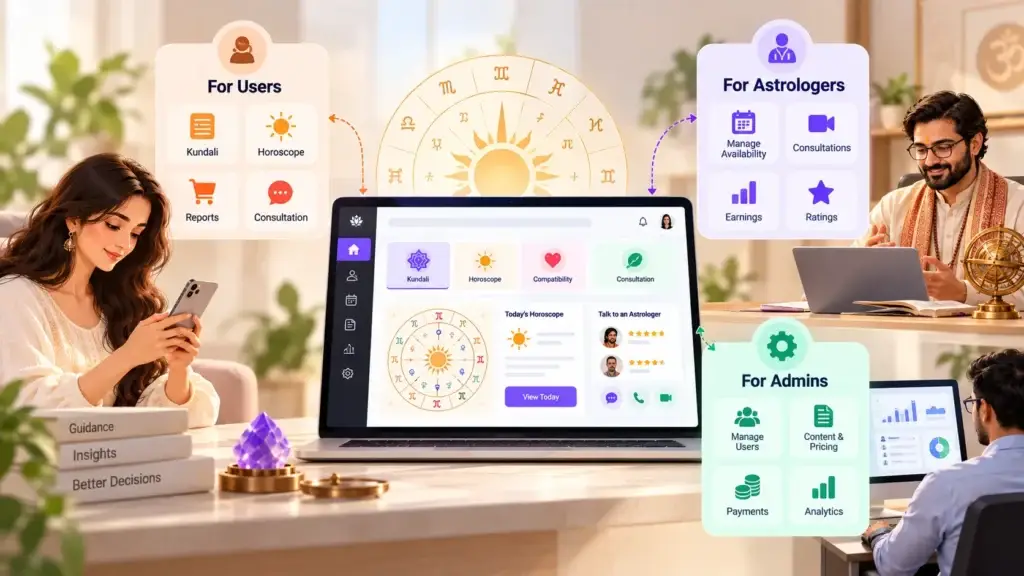
A good astrology portal feels easy for users and manageable for operators.
For users, it should provide:
- Fast kundali generation
- Clear explanations
- Simple horoscope navigation
- Easy report purchase
- Reliable consultation access
- Transparent pricing
- Secure payments
- Helpful notifications
- Multilingual or regional support where needed
For astrologers, it should provide:
- Profile management
- Availability control
- Consultation tools
- Earnings visibility
- Rating and review management
- Communication workflows
For admins, it should provide:
- User management
- Astrologer verification
- Report and feature pricing
- Content publishing
- Payment and wallet control
- Refund and dispute handling
- Analytics and moderation
When these three sides work together, the platform becomes more than an astrology app. It becomes a managed digital astrology business.
Read More: The Hallucinated Planet Trap: Why Basic ChatGPT Scripts Destroy Astrology Apps
How Miracuves Supports Astrology Portal Founders
Miracuves helps founders move from idea to launch faster with ready-made and white-label app solutions designed around business workflows, admin control, monetization, and source-code ownership.
For an astrology portal, that means founders do not need to start from a blank screen. They can begin with a structured platform foundation that supports free astrology tools, user journeys, consultation flows, paid reports, and operator control. From there, branding, content strategy, pricing, and feature priorities can be aligned with the target market.
If your goal is to test a digital astrology business faster, a ready-made foundation can reduce avoidable development effort and help you focus on positioning, user acquisition, astrologer onboarding, and monetization.
Explore Miracuves’ white-label astrology portal solution to understand how a launch-ready platform can support kundali tools, reports, consultations, and admin-led operations.
Related reading: astrology platform features guide.
Final Thoughts
An astrology portal platform works because it connects three layers: self-service tools, personalized paid guidance, and expert consultation. Kundali and horoscope tools bring users in. Reports create deeper value. Consultations add human trust. Admin control turns the whole experience into a manageable business.
For founders, the goal is not to copy another platform feature by feature. The stronger move is to understand the user journey, identify where trust is built, decide where monetization should happen, and launch with the right operational foundation.
A well-planned astrology portal can become a content engine, consultation marketplace, report business, and personalized guidance platform in one ecosystem. The opportunity lies in building it with clarity from the beginning.
FAQs
What is an astrology portal platform?
An astrology portal platform is a website or app where users can access kundali generation, horoscopes, panchang, muhurta, reports, compatibility matching, and live astrologer consultations from one place.
How does kundali generation work in an astrology platform?
The user enters birth date, birth time, and birth location. The platform processes these details through an astrology calculation system and generates a birth chart with planetary positions, houses, signs, and related interpretations.
Why do astrology portals offer free kundali or horoscope tools?
Free tools attract users with immediate value. Once users trust the output, they may choose paid reports, detailed interpretations, remedies, or expert consultations.
How do astrology portals make money?
Astrology portals can earn through paid reports, live consultations, subscriptions, featured astrologer listings, spiritual products, remedies, courses, ads, and premium tools.
What features should an astrology consultation platform include?
It should include astrologer profiles, availability management, chat/audio/video consultation, wallet or payment flow, user reviews, consultation history, admin controls, and dispute handling.
Is a mobile app necessary for an astrology portal?
A mobile app is useful for notifications, repeat horoscope visits, consultation access, and personalized engagement. However, a web portal is also important for SEO-driven traffic and content discovery.
What should founders check before launching an astrology portal?
Founders should check the user journey, monetization model, kundali and report flow, astrologer onboarding process, admin control, payment setup, content strategy, and launch timeline.
Can Miracuves help launch an astrology portal faster?
Yes. Miracuves supports founders with ready-made and white-label astrology portal solutions that can include source code, branding, admin control, and faster deployment based on the selected scope.
Miracuves is an independent software development company. We are not affiliated with, connected to, sponsored by, or endorsed by any company or product named in this article.
Terms such as “X Clone” are used descriptively. It is how the software industry refers to building a platform with functionality comparable to a known service, and how clients search for it.
The entire design and codebase of our products is built by our own team. Our products contain no code, design, graphics, or content originating from any third-party website or applications.
All third-party names and marks referenced in this article are the property of their respective owners, referenced solely to identify the services discussed.