Key Takeaways
- Online travel agency platform security should protect traveler accounts, payments, supplier connections, booking data, staff access, and post-booking operations throughout the reservation journey.
- Account security should cover authentication, password recovery, session management, suspicious-login monitoring, and appropriate access to traveler information.
- Payment security requires server-side transaction validation, trusted payment-state verification, duplicate-payment prevention, and controlled refund workflows.
- Supplier API credentials, availability responses, booking requests, and external data should be protected and validated because supplier connections create additional trust boundaries.
- Booking and payment states should remain traceable so the platform can distinguish successful payments from confirmed, failed, cancelled, or unresolved reservations.
Security Signals
- Traveler accounts should use secure password handling, rate limiting, session expiration, token controls, and appropriate multi-factor authentication options.
- Critical payment amounts should be calculated and validated on trusted backend systems rather than relying on browser or mobile-app values.
- Supplier credentials should remain restricted to authorized systems and personnel and should be rotatable when keys are exposed or access changes.
- Staff permissions should follow the principle of least privilege, separating customer support, finance, supplier operations, and administration access.
- Monitoring should cover unusual authentication activity, payment failures, refund patterns, supplier API errors, webhook failures, credential changes, and suspicious administrative actions.
Real Insights
- OTA security is not limited to HTTPS or the checkout page; weak recovery, excessive permissions, exposed supplier credentials, and poor booking-state logic can also create serious risks.
- Payment confirmation and supplier booking confirmation should be tracked independently because a successful payment does not guarantee a successful reservation.
- Traveler information should be exposed according to operational need, with sensitive fields appropriately restricted or masked.
- Security controls need to continue after launch through access reviews, monitoring, updates, credential rotation, testing, backups, and incident-response processes.
- The strongest security flow is: authenticate traveler → protect sessions and data → validate payment server-side → secure supplier connections → separate payment and booking states → restrict staff access → monitor critical events → maintain audit trails → continuously review security controls.
Trust in an online Travel Agency Platform is created long before a traveler clicks “Book Now.”
A single reservation can pass through several systems: the traveler account, search and availability engine, supplier connection, checkout, payment gateway, booking database, notification service, and administrative dashboard.
Each connection creates a trust decision.
Is the person accessing the account really the traveler? Is the price shown at checkout still valid? Did the payment actually succeed? Did the supplier confirm the reservation? Can a support employee change the booking? If a refund is requested, who can authorize it?
For founders building a travel marketplace, these questions matter because security failures are rarely isolated technical problems. They can become failed bookings, payment disputes, exposed traveler information, supplier issues, support costs, and loss of customer confidence.
This guide explains the four security layers that deserve particular attention in an online travel agency platform: accounts, payments, supplier connections, and booking data.
Why OTA Security Is a Chain, Not a Single Feature
A normal content website primarily manages visitors and information. An online travel agency coordinates users, money, external inventory, personal information, suppliers, and post-booking operations.
Before evaluating individual security controls, founders should understand how an online travel platform works across search, availability, booking, payment, supplier confirmation, and post-booking management. Each stage introduces a different trust boundary, which is why OTA security needs to be evaluated across the complete reservation journey.
Consider a hotel reservation.
The platform may need to authenticate the traveler, request current availability from a supplier, display a rate, collect traveler details, process payment, send the reservation request, receive confirmation, create the booking record, and later support cancellation or modification.
A security control at checkout cannot protect that entire process.
Founders should therefore think about OTA security as a chain. The platform is only as dependable as the connections between its major systems.
Where Trust Has to Be Protected in an OTA
| Trust Layer | What Needs Protection | What Can Go Wrong |
|---|---|---|
| Traveler Accounts | Identity, login sessions, profiles and booking access | Account takeover or unauthorized reservation access |
| Payments | Amounts, payment states, gateway responses and refunds | Duplicate charges, manipulated transactions or refund abuse |
| Supplier Connections | API credentials, rates, availability and booking requests | Unauthorized access, incorrect inventory or failed bookings |
| Booking Data | Traveler details, reservation state and change history | Data exposure, unauthorized changes or inconsistent records |
| Staff Access | Refunds, supplier settings and administrative functions | Excessive permissions or untraceable actions |
Traveler Account Security Starts With Identity and Access
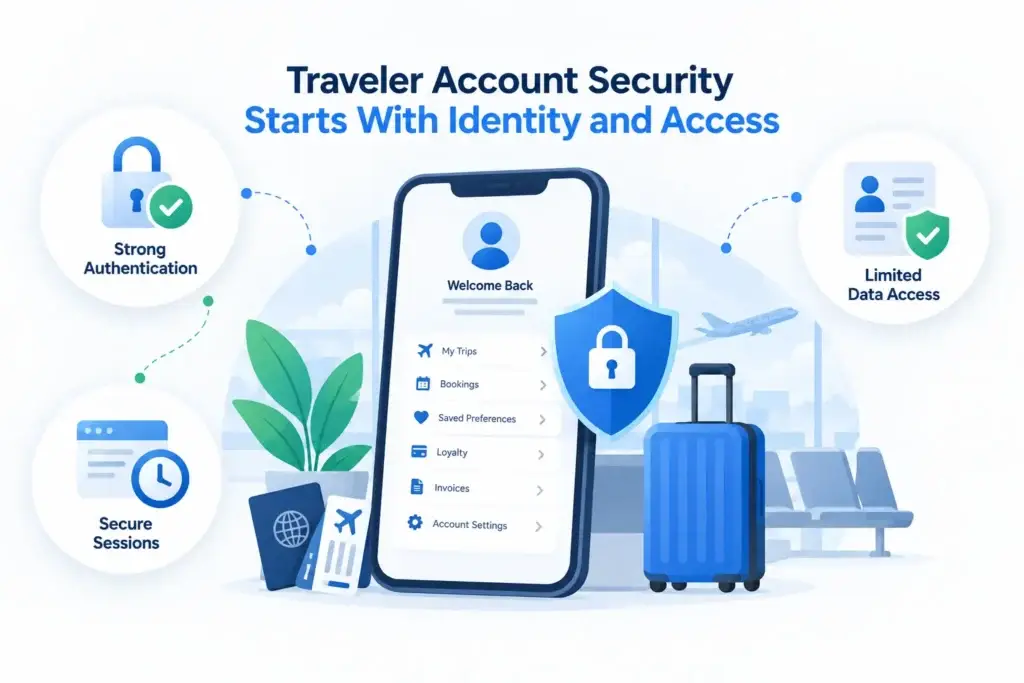
The traveler account can contain far more than an email address.
Depending on the business model, it may provide access to upcoming trips, previous reservations, traveler information, saved preferences, loyalty details, invoices, cancellation options, and booking-management functions.
That makes account takeover an operational risk as well as a privacy problem.
Authentication Should Protect More Than the Login Screen
Strong password handling is the starting point, not the complete solution.
An OTA should consider controls such as secure password hashing, rate limiting, optional multi-factor authentication, suspicious-login monitoring, session expiration, token management, and appropriate controls around repeated failed attempts.
Password recovery deserves equal attention. A sophisticated login process provides limited protection if the recovery workflow gives an attacker an easier route into the account.
Sessions Need Their Own Security Controls
Once a traveler signs in, the platform has to decide how long that authorization remains valid.
Session expiration, logout invalidation, password-change behavior, device changes, revoked accounts, and token rotation all influence how long unauthorized access could persist.
A suspended or compromised account should not remain accessible indefinitely because an old session token is still valid.
Minimize Exposure of Traveler Information
Travel bookings can require names, phone numbers, dates of birth, addresses, identification details, or other information required by a particular supplier.
The important principle is not simply collecting data securely. It is controlling where that information goes afterwards.
A customer-support employee, analytics service, supplier, administrator, and marketing system do not automatically need access to the same fields.
Collecting and exposing only what is operationally necessary reduces the amount of information that can be affected by an account or system compromise.
Secure Payments Depend on Transaction Logic
Founders often associate payment security with selecting a reputable gateway.
That is important, but the gateway protects only part of the transaction.
The OTA still decides what amount should be charged, how payment status is recorded, what happens when a request is repeated, how supplier confirmation affects the booking, and who can initiate a refund.
Avoid Unnecessary Storage of Payment Credentials
Where practical, tokenized or gateway-hosted payment flows can reduce direct exposure to raw card information.
Instead of keeping sensitive payment credentials inside the travel platform, the OTA can work with payment references or tokens provided by the payment service.
The exact implementation depends on the selected provider and payment architecture.
Calculate Critical Transaction Values on Trusted Systems
A traveler-facing browser or mobile application should not be treated as the authoritative source for the final payable amount.
Travel pricing can include supplier rates, markups, taxes, discounts, service charges, wallet balances, or currency conversions.
Those values should be validated through trusted server-side logic before the transaction is finalized.
Verify Payment Status Instead of Trusting the Success Screen
A user reaching a “Payment Successful” page does not necessarily prove that the transaction settled correctly.
The platform should validate the payment state through the payment provider’s trusted server-side mechanisms.
This becomes especially important when network interruptions, delayed responses, retries, or asynchronous callbacks are involved.
Prevent Duplicate Transactions
Travelers retry actions.
A slow connection may cause someone to tap the payment button twice. A provider may resend a notification. A request may time out even though the transaction completed.
Payment and booking workflows should therefore be designed so repeated requests do not accidentally create duplicate charges, bookings, or refunds.
Supplier Connections Create a Critical External Trust Boundary
An OTA becomes useful because it connects travelers with inventory.
That inventory may come from accommodation providers, airlines, activity operators, transfer services, aggregators, or other travel suppliers.
Every supplier connection expands the platform’s trust boundary.
A founder should understand not only which suppliers can be connected, but also how those connections are controlled.
Supplier security is closely connected to the underlying platform architecture. Founders who want to understand the technical flow in greater detail can explore this travel booking app development guide, including how different components of a travel marketplace work together during development and integration.
Protect Supplier Credentials as Sensitive Secrets
API keys and supplier credentials can provide valuable access to external systems.
They should not be casually exposed through mobile applications, frontend code, public repositories, support screenshots, unrestricted dashboards, or application logs.
Access should be limited to authorized systems and personnel.
There should also be a practical method for rotating credentials when an employee leaves, a key is exposed, or the supplier requires a change.
Validate External Responses
An external API should never be assumed to behave perfectly.
Supplier systems can time out, return unexpected values, change response formats, experience outages, or temporarily provide inconsistent inventory.
The OTA therefore needs input validation, controlled error handling, timeout logic, appropriate retry behavior, and clear booking-state management.
Security here overlaps with reliability.
For a traveler, a compromised supplier connection and a badly handled supplier failure can produce a similar outcome: a booking they cannot trust.
Payment Confirmation and Booking Confirmation Are Not the Same Thing
This distinction is particularly important in travel.
Suppose a traveler selects a room and submits payment.
The payment provider confirms the charge, but before the supplier finishes processing the reservation, the room becomes unavailable or the supplier request fails.
The platform now has two different facts:
Payment status: successful.
Supplier booking status: unsuccessful or unresolved.
Combining these into a single “successful” state creates operational problems.
A better architecture maintains clear booking states so the system can distinguish situations such as payment pending, payment confirmed, supplier pending, booking confirmed, booking failed, cancelled, and refunded.
The exact states depend on the business model, but the principle remains the same.
Money movement and reservation confirmation should be tracked independently.
That separation makes it easier to handle supplier failures, retries, support requests, and refunds without creating ambiguous reservations.
Booking Data Needs Integrity as Well as Privacy
Protecting traveler information from unauthorized disclosure is important.
But an OTA has another requirement: the booking record must also remain accurate.
A reservation may contain traveler information, dates, destination, supplier reference, booking status, fare or room conditions, cancellation terms, payment references, itinerary details, and subsequent changes.
If an important field changes, the business should be able to determine whether the change was legitimate.
Keep a Dependable Internal Booking Record
The OTA should maintain a reliable representation of each booking rather than depending entirely on whatever an external supplier happens to return at a particular moment.
Supplier references, payment references, booking states, timestamps, refund information, and important operational changes help create a traceable history.
That becomes valuable when a traveler raises a dispute or a support team needs to reconstruct what happened.
These controls become easier to evaluate when they are considered as part of the complete travel booking platform, where traveler accounts, inventory, supplier connections, payments, booking management, and administrative operations need to work as a coordinated system.
Limit Who Can See Sensitive Booking Information
Access should follow job responsibility.
An employee resolving a basic booking query may need the travel dates and supplier confirmation but may not need unrestricted access to identity documents or payment-related information.
Role-based permissions and appropriately masked views can reduce unnecessary exposure.
Staff Permissions Are Part of Customer Security
The customer-facing app receives most of the visual attention during product development.
The administrative dashboard can hold considerably more power.
Depending on the OTA, internal users may be able to inspect bookings, view traveler details, process cancellations, initiate refunds, manage suppliers, change commissions, alter platform settings, or control other staff accounts.
Giving every employee unrestricted administrator access creates unnecessary risk.
Role-based access is one part of a broader operational control structure. Founders evaluating travel platform features should look beyond customer-facing functionality and examine how administrative permissions, booking management, payment operations, and supplier controls are handled behind the scenes.
A better model separates permissions according to operational responsibility.
Example of Role-Based Access in a Travel Platform
| Team | Access They May Need | Access That May Need Restriction |
|---|---|---|
| Customer Support | Booking lookup, customer communication and support notes | Supplier credentials and unrestricted refund authority |
| Finance | Transactions, reconciliation and approved refund workflows | Supplier API configuration |
| Supplier Operations | Supplier status, booking issues and integration operations | Unnecessary traveler financial information |
| Platform Administration | Authorized configuration and permission management | Actions outside defined organizational controls |
This is the principle of least privilege: provide enough access for someone to perform their role without turning every employee account into a master key.
Cancellations and Refunds Need Security Controls Too
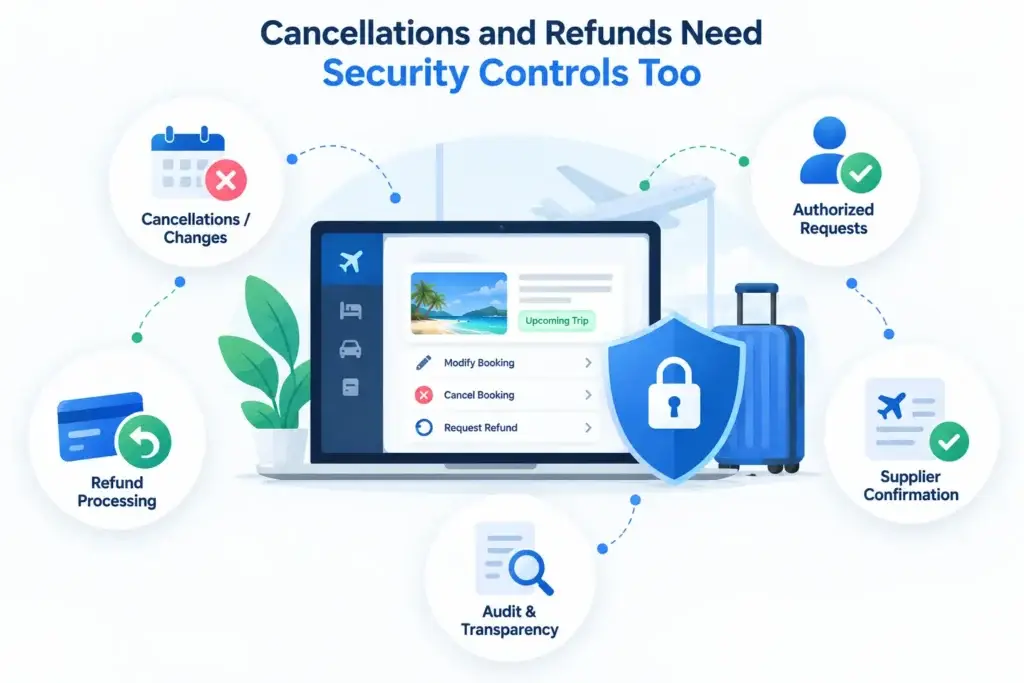
The security model cannot stop once the reservation is confirmed.
Travel plans change. Suppliers cancel services. Customers request amendments. Refunds are issued. Support employees intervene.
Post-booking operations combine identity, money, supplier communication, and staff authority.
These controls should also reflect the online travel business model being operated. Revenue structures based on commissions, markups, service fees, or supplier relationships can create different payment, reconciliation, cancellation, refund, and administrative workflows that need appropriate controls.
Before processing a sensitive change, the platform should be able to establish who requested it, whether that person is authorized, what supplier rules apply, whether the supplier accepted the cancellation, what amount is eligible for refund, and whether a refund has already been processed.
Exceptional actions may also need additional approval depending on the organization’s operating model.
Good refund controls protect both sides.
They reduce opportunities for abuse while also giving legitimate customers a clearer and more traceable resolution process.
Audit Logs Help Explain What Happened
When something goes wrong, operators need more than the current state of a booking.
They need history.
Important actions such as refund processing, booking modifications, supplier credential changes, administrative permission changes, and security-sensitive configuration changes should generate appropriate activity records.
A useful audit trail can help answer:
Who performed the action?
What changed?
When did it happen?
What booking, transaction, or account was affected?
This becomes particularly valuable during disputes, fraud investigations, supplier incidents, and internal security reviews.
Logs themselves should also be handled carefully. Passwords, payment credentials, supplier secrets, and unnecessary personal information should not be copied indiscriminately into diagnostic records.
Monitoring Helps Detect Problems Before They Become Larger Incidents
Security controls are more useful when operators know when they are being triggered or failing.
An OTA may need visibility into unusual authentication activity, repeated payment failures, abnormal refund patterns, supplier API errors, webhook failures, credential changes, administrative actions, or unexpected spikes in failed bookings.
What should be monitored depends on the platform architecture and risk model.
The important point for founders is that monitoring should connect technical events to operational consequences.
A supplier timeout is not merely an API error if hundreds of travelers are simultaneously trying to book that inventory.
Compliance Depends on the Actual OTA Business
Founders should be cautious with statements that a travel platform is simply “fully compliant.”
The requirements affecting an OTA can depend on where the company operates, where its travelers are located, what information is collected, how payments are processed, where information is stored, which suppliers receive it, and what services the business provides.
Technology can provide controls that support compliance workflows, but technical features alone do not guarantee legal compliance across jurisdictions.
A more practical approach is to establish a compliance-ready foundation and then map the business’s technology, policies, supplier contracts, payment architecture, data handling, and operating procedures against the requirements of its intended markets.
Appropriate legal, privacy, payment-security, and cybersecurity review may be necessary depending on the business.
What Founders Should Ask Before Launching an OTA
A feature checklist tells you what the platform claims to contain.
Planning these controls can also influence travel platform development costs, particularly when the project requires additional supplier integrations, payment workflows, authentication controls, monitoring, infrastructure changes, or market-specific customization. Founders should therefore define security and integration requirements before finalizing the implementation scope.
The implementation partner matters as well. When selecting a travel platform development partner, founders should ask how authentication, supplier credentials, payment states, administrative permissions, booking records, security updates, and post-launch responsibilities will be handled—not simply which customer-facing features can be delivered.
Failure scenarios tell you how the platform actually behaves.
Before launch, founders should test questions such as:
- What happens if payment succeeds but supplier confirmation fails?
- What happens if the traveler submits the same payment twice?
- Can supplier credentials be viewed from ordinary staff accounts?
- Who can issue a refund?
- Can a refund accidentally be processed twice?
- What happens to active sessions after an account is suspended?
- Which employees can access sensitive traveler information?
- Are important booking changes recorded?
- What happens when a supplier API times out?
- Can compromised supplier credentials be rotated quickly?
- What sensitive information appears in application logs?
- What happens when a booking is cancelled by the supplier rather than the traveler?
- How are backups protected?
- Who responds when suspicious activity is detected?
These questions shift the evaluation from “Does it have security?” to “How does it behave when a real operational problem occurs?”
Security is only one part of platform evaluation. Founders comparing ready-made options may also want to examine travel platform scripts, features, and pricing separately so that technical security requirements can be considered alongside functionality and commercial scope.
Mistakes That Weaken Trust in a Travel Platform
Security problems are not always caused by sophisticated attacks. Many begin with architectural shortcuts or operational decisions that become harder to control as booking volume grows.
Treating HTTPS as the Entire Security Strategy
Encrypted connections matter, but they do not fix weak account recovery, excessive permissions, exposed credentials, refund abuse, or poor booking-state logic.
Giving Everyone Administrator Access
Broad permissions may feel convenient early on, but they increase exposure as the team and booking operation grow.
Combining Payment and Booking Status
A successful payment does not guarantee successful supplier confirmation. Tracking them separately makes failures and refunds easier to control.
Exposing Supplier Credentials for Convenience
API keys and payment secrets should not appear in client-side code, unrestricted dashboards, screenshots, repositories, or diagnostic logs.
Thinking Security Ends at Launch
Integrations, dependencies, employees, suppliers, and threats change. Access reviews, updates, monitoring, credential rotation, testing, and incident response must continue after launch.
Where Miracuves Fits Into the Decision
For founders, evaluating an OTA should eventually move from security principles to implementation.
The question becomes whether the chosen product foundation gives the business enough control over travelers, supplier integrations, booking states, payments, administrative permissions, and future customization.
Miracuves provides a ready-made, white-label travel platform foundation for businesses that want to launch without building every booking workflow from zero. Founders can explore the travel marketplace solution when they are ready to move from security research into platform capabilities and implementation.
For suitable ready-made projects, Miracuves also offers a 6-day solution delivery path. The final security architecture, integrations, infrastructure, and compliance requirements should still be determined by the selected suppliers, payment services, target markets, business model, and customization scope.
This distinction matters: faster deployment should reduce repetitive development work, not remove security due diligence.
Final Thoughts: Trust Has to Survive the Entire Booking Journey
The strongest OTA security strategy is not the one with the longest list of security terminology.
It is the one that protects the complete journey.
A traveler signs in. The platform requests inventory. A supplier returns availability. The customer pays. The supplier confirms the reservation. The booking is stored. Staff may later modify it. A cancellation or refund may follow.
Every transition involves identity, authority, data, or money.
Founders should therefore evaluate travel platforms by asking how those transitions are controlled, what happens when one of them fails, and whether the business can reconstruct events afterwards.
Accounts, payments, supplier connections, booking records, administrative permissions, monitoring, and post-booking controls should operate as one trust system.
Businesses exploring opportunities beyond a single OTA model can also review Miracuves’ travel solutions for different business models to understand how different travel marketplace concepts can be structured around their intended customers, services, and operating requirements.
That foundation becomes more important—not less—as booking volume, supplier relationships, staff access, and market reach grow.
FAQs
What makes an online travel agency platform secure?
OTA security combines account protection, controlled staff access, secure payment integration, supplier credential protection, validated API communication, booking-data integrity, monitoring, audit records, and incident-response processes. Security should be evaluated across the complete booking lifecycle rather than through one feature.
Why are supplier APIs important to OTA security?
Supplier APIs exchange availability, prices, booking requests, confirmation information, and other operational data. Their credentials and responses therefore need appropriate protection, validation, monitoring, and error handling.
Should an OTA store customers’ card information?
Where practical, tokenized or gateway-hosted payment flows can reduce direct exposure to raw card information. The appropriate architecture depends on the selected payment provider and the requirements applying to the business.
What is booking-data integrity?
Booking-data integrity means keeping reservation information accurate and protected against unauthorized or unintended modification. Important changes to booking status, supplier references, payments, cancellations, and refunds should be controlled and traceable.
Why is role-based access important in travel platforms?
Different employees require different capabilities. Support teams may need booking information, while finance teams may require payment and refund access. Role-based controls reduce unnecessary access to sensitive traveler, supplier, and financial information.
What happens if payment succeeds but the supplier booking fails?
The platform should treat payment status and supplier confirmation as separate states. Depending on the workflow, the failed booking may require a retry, manual review, alternative inventory, or an appropriate refund process.
Does a ready-made travel platform automatically meet every compliance requirement?
No. A platform can provide controls that support compliance workflows, but actual requirements depend on jurisdiction, integrations, data handling, infrastructure, contracts, and the operating model.
What should founders test before launching an OTA?
Test normal bookings as well as failed payments, repeated requests, supplier timeouts, unsuccessful confirmations, cancellations, refunds, account recovery, session revocation, staff permissions, audit records, credential changes, backups, and incident-response procedures.
Miracuves is an independent software development company. We are not affiliated with, connected to, sponsored by, or endorsed by any company or product named in this article.
Terms such as “X Clone” are used descriptively. It is how the software industry refers to building a platform with functionality comparable to a known service, and how clients search for it.
The entire design and codebase of our products is built by our own team. Our products contain no code, design, graphics, or content originating from any third-party website or applications.
All third-party names and marks referenced in this article are the property of their respective owners, referenced solely to identify the services discussed.