

Key Takeaways
- The online travel booking workflow coordinates search, supplier routing, live inventory, normalization, pricing, ranking, revalidation, checkout, payment, booking, confirmation, and reconciliation.
- Supplier routing determines which inventory sources should receive a search request, helping control response time, API usage, and failure risk.
- Supplier responses need normalization and deduplication so travelers see consistent inventory even when multiple providers use different formats or sell the same property.
- Search results should be revalidated before booking because prices, availability, rate tokens, and cancellation conditions can change between search and checkout.
- Payment and booking should use separate state tracking, with idempotency, timeout handling, webhooks, queues, and reconciliation supporting reliable reservation operations.
Workflow Signals
- Search requests should be validated before expensive supplier APIs are called, including dates, travelers, occupancy, currency, destination, and category rules.
- Parallel supplier requests can improve search speed, but controlled timeouts and partial-result strategies are needed when providers respond at different speeds.
- Pricing should maintain a traceable breakdown of supplier rates, taxes, fees, markups, commissions, currency conversion, discounts, and the final traveler price.
- Booking states such as initiated, revalidating, pending, confirmed, failed, unknown, canceled, and refund pending help teams manage real-world exceptions.
- Queues and webhooks allow confirmations, vouchers, notifications, refunds, supplier updates, and other asynchronous tasks to run without unnecessarily blocking the core booking flow.
Real Insights
- A successful search is not the same as a successful booking; inventory can change, supplier calls can fail, and payment can succeed while reservation creation does not.
- Blindly retrying a timed-out booking can create duplicate reservations, so supplier status should be reconciled before retrying uncertain requests.
- Caching can improve search performance and reduce supplier load, but volatile information such as current prices and availability requires shorter cache periods or fresh validation.
- Reconciliation is essential because internal payment, booking, supplier, and refund records can temporarily disagree even when individual systems are functioning correctly.
- The strongest workflow is: validate search → route suppliers → query inventory → normalize and deduplicate → calculate price → rank results → revalidate → create booking intent → process payment → submit supplier booking → confirm → generate itinerary → reconcile and manage post-booking events.
A traveler opens a booking app, enters a destination and dates, taps Search, chooses a hotel or flight, pays, and receives a confirmation.
From the user’s perspective, that may take only a few minutes.
Behind the scenes, dozens of systems may participate in the same journey.
The platform may need to decide which suppliers to query, call several APIs in parallel, normalize incompatible response formats, apply pricing rules, remove duplicates, rank results, recheck inventory, authorize payment, create the supplier reservation, handle timeouts, wait for confirmation, generate an itinerary, and reconcile the final transaction.
This is what makes online travel agency platform more complex than a normal marketplace.
The platform is not simply storing products and accepting orders.
It is coordinating fast-changing inventory across systems it does not fully control.
A practical travel booking workflow looks more like this:
Search request → supplier routing → inventory responses → normalization → pricing → ranking → revalidation → checkout → payment authorization → supplier booking → confirmation → itinerary → reconciliation
For readers who want a simpler overview before going deeper into architecture, this guide explains how an online travel agency platform works from search and live inventory to checkout, confirmation, and post-booking management.
Understanding these stages helps founders make better decisions about supplier integrations, booking reliability, payment architecture, admin tools, and launch scope.
The Architecture Starts Before the Search Request
A travel search looks like a simple form, but the platform needs several supporting layers before it can respond reliably.
These may include:
- Destination and airport reference data
- Supplier configuration
- API credentials
- Currency rules
- Markup rules
- Search-routing rules
- Supplier priority
- Availability cache
- Hotel or property mapping
- Location mapping
- Traveler authentication
- Feature configuration
- Rate limits
- Logging and monitoring
If these layers are poorly designed, adding more suppliers does not automatically improve the user experience.
It can make search slower and operations harder.
Step 1: The Platform Interprets the Search Request
The booking journey begins when the traveler enters criteria such as:
- Origin
- Destination
- Departure date
- Return date
- Check-in
- Check-out
- Number of travelers
- Room occupancy
- Cabin class
- Preferred currency
- Travel category
The frontend sends a structured request to the search service.
Before calling suppliers, the platform may validate:
- Date formats
- Passenger counts
- Child ages
- Supported destinations
- Room occupancy
- Currency
- Category availability
- Supplier coverage
The goal is to stop invalid requests before they reach expensive external APIs.
Step 2: Supplier Routing Decides Where the Search Goes
Not every search needs to query every supplier.
The routing layer can decide which inventory sources are relevant.
For example, routing may depend on:
- Travel category
- Origin and destination
- Country
- Supplier coverage
- Contract status
- API health
- Currency
- Request type
- Historical response speed
- Business priority
A domestic hotel search may use a different supplier set from an international flight search.
This matters because unnecessary supplier calls increase latency, cost, and failure risk.
A smarter routing layer asks:
Which suppliers are most likely to return useful inventory for this request?
Step 3: Supplier Requests Run in Parallel
Once the supplier set is selected, the platform may call several providers simultaneously.
A simplified flow could look like:
Traveler Search
      |
      v
Search Orchestrator
  |       |       |
  v       v       v
Supplier A Supplier B Supplier C
  |       |       |
  +-------+-------+
          |
          v
Normalized Results
Parallel requests improve response time, but they introduce new questions.
What happens if:
- Supplier A answers in 700 ms?
- Supplier B answers in 2 seconds?
- Supplier C times out completely?
The platform needs a response strategy.
Possible approaches include:
- Wait for all suppliers.
- Stop waiting after a defined timeout.
- Display fast results first.
- Append slower results later.
- Exclude temporarily unhealthy suppliers.
There is no universal answer.
The correct strategy depends on user expectations, supplier quality, and platform scale.
Step 4: Supplier Responses Must Be Normalized
Every supplier can return different field names, structures, currencies, policies, and identifiers.
One provider might return:
hotel_name
room_name
net_price
Another might use:
propertyName
unitType
totalAmount
The user should never see that complexity.
The platform converts external responses into an internal schema.
For hotel inventory, that might look like:
property_id
supplier_id
supplier_property_id
room_id
room_type
meal_plan
currency
base_rate
taxes
platform_price
cancellation_policy
availability_token
rate_token
The same principle applies to:
- Flights
- Cars
- Transfers
- Tours
- Activities
- Packages
This normalized layer is one of the most important parts of multi-supplier travel architecture.
Why Mapping and Deduplication Matter
Two suppliers may sell inventory for the same hotel.
Without mapping, the traveler could see the same property several times.
For example:
Supplier A: Grand Central Hotel
Supplier B: Grand Central Hotel & Suites
Supplier C: Grand Central
They may all refer to the same property.
The platform needs property mapping or deduplication logic so it can group similar inventory while preserving supplier-level rates.
A mapped result may contain:
One property
→ Supplier A rate
→ Supplier B rate
→ Direct contract rate
The booking engine can then decide which rate is available, profitable, or suitable.
Step 5: The Pricing Layer Builds the Traveler Price
Supplier price is only one part of the final amount.
The platform may apply:
- Taxes
- Supplier fees
- Platform markup
- Agent markup
- Commission rules
- Currency conversion
- Service fee
- Coupon
- Membership discount
- Corporate pricing
- Package discount
A simplified flow can be:
Supplier Net Rate
+ Supplier Fees
+ Taxes
+ Platform Margin
- Eligible Discount
= Traveler Price
The platform should keep a breakdown of how that final price was created.
Founders planning supplier margins, commissions, service fees, agent earnings, and booking-level revenue can review the travel booking platform business model to understand how monetization connects with pricing and booking operations.
That matters later for:
- Refunds
- Supplier settlement
- Agent commission
- Revenue reports
- Tax reporting
- Customer support
- Reconciliation
Step 6: Results Are Ranked and Returned
Once inventory has been normalized and priced, the platform can rank the options.
Potential ranking signals include:
- Traveler-selected sort
- Price
- Rating
- Distance
- Duration
- Departure time
- Cancellation flexibility
- Inventory quality
- Conversion history
- Supplier reliability
- Availability confidence
The business may also have commercial priorities.
But ranking should not become purely margin-driven.
If irrelevant results repeatedly appear above useful ones, search quality suffers even if short-term margin improves.
Search Architecture at a Glance
What Happens Behind an OTA Search?
| Stage | Behind-the-Scenes Action | Main Risk |
|---|---|---|
| Validation | Check destination, dates, occupancy, passenger data, currency, and category rules. | Invalid requests reaching external APIs. |
| Supplier Routing | Select relevant inventory providers for the specific request. | Calling unnecessary or unhealthy suppliers. |
| Parallel Search | Query multiple suppliers within controlled timeout windows. | Slow suppliers delaying the entire result set. |
| Normalization | Convert supplier-specific responses into one internal format. | Inconsistent inventory and pricing data. |
| Deduplication | Map equivalent properties, routes, or products from multiple sources. | Duplicate listings confusing users. |
| Pricing | Apply taxes, margins, commissions, currency rules, and discounts. | Incorrect final price or revenue calculation. |
| Ranking | Sort results using traveler preferences and business rules. | Poor relevance reducing conversion. |
Step 7: The Selected Result Must Be Revalidated
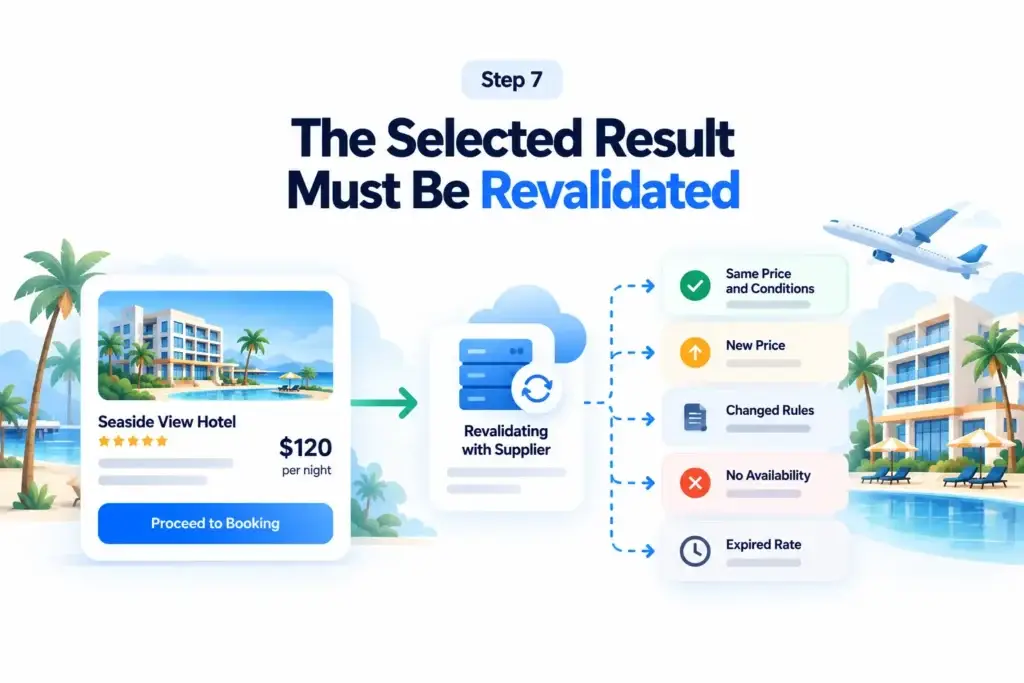
Search results are temporary representations of inventory.
They are not always guaranteed bookings.
Between search and checkout:
- A hotel room may sell out.
- A flight fare class may close.
- A supplier may change its rate.
- A cancellation policy may change.
- A rate token may expire.
That is why the selected result should usually go through a revalidation step.
The booking service asks the supplier:
Is this exact inventory still bookable at these conditions?
Possible responses include:
- Same price and conditions
- New price
- Changed rules
- No availability
- Expired rate
- Timeout
- Supplier error
If the price changes, the traveler should see the updated amount before payment.
Why Search Tokens and Rate Keys Matter
Many travel suppliers return temporary identifiers with search results.
These identifiers may represent:
- A fare
- A room rate
- A package combination
- An availability session
- A booking option
They can expire.
The platform should therefore retain the supplier reference or rate token required to revalidate or book the same option.
This prevents the booking system from trying to reconstruct a supplier selection from incomplete frontend data.
Step 8: Checkout Creates a Booking Intent
Before the supplier reservation exists, the platform may create an internal booking intent.
This can contain:
- Internal booking ID
- User ID
- Selected inventory
- Supplier ID
- Supplier rate token
- Pricing breakdown
- Traveler details
- Currency
- Payment status
- Booking status
- Expiration time
At this stage, the reservation may still be:
INITIATED
rather than:
CONFIRMED
That distinction is important.
The platform should know the difference between:
- User selected something
- User began checkout
- User paid
- Supplier accepted booking
- Final itinerary was generated
Step 9: Payment and Booking Should Be Separate State Machines
A common architecture mistake is treating payment success as booking success.
They are related but independent.
Possible payment states include:
- Not started
- Authorized
- Captured
- Failed
- Voided
- Refund pending
- Refunded
Possible booking states include:
- Initiated
- Revalidating
- Booking pending
- Confirmed
- Failed
- Canceled
- Supplier pending
These states can combine in uncomfortable ways.
For example:
Payment: Captured
Booking: Failed
or:
Payment: Authorized
Booking: Confirmed
Capture: Pending
or:
Payment: Successful
Supplier: Timed Out
Booking: Unknown
The architecture needs recovery rules for each case.
Because payment state, traveler data, supplier APIs, booking records, refunds, and admin access are closely connected, founders should also plan travel booking platform security across the complete transaction lifecycle.
Idempotency Prevents Duplicate Bookings
Imagine a traveler taps Pay twice because the screen appears frozen.
Or the booking request times out, so the backend retries.
Without idempotency, the supplier could receive two valid reservation requests.
That could create:
- Duplicate hotel reservations
- Duplicate tickets
- Double payment
- Customer support problems
An idempotency key allows the system to recognize that a retry belongs to an existing booking attempt.
Instead of creating another reservation, it can return or recover the existing state.
This is especially important around:
- Payment capture
- Booking creation
- Cancellation
- Refund processing
Step 10: The Supplier Booking Request Is Created
Once checkout requirements are satisfied, the booking service sends the final reservation request.
Depending on the supplier, that may contain:
- Inventory ID
- Rate token
- Traveler details
- Passenger details
- Room occupancy
- Contact information
- Payment reference
- Currency
- Special requests
- Agency credentials
The supplier may answer immediately.
Or it may not.
Possible responses include:
- Confirmed
- Pending
- Failed
- On request
- Timed out
- Unknown
That last category matters.
A timeout does not automatically mean the supplier did not create the reservation.
It only means the platform did not receive a successful response in time.
Why Blind Retries Are Dangerous
If a booking request times out and the platform immediately submits the same reservation again, it may create duplicates.
A safer flow can be:
- Booking request times out.
- Mark internal status as
UNKNOWNorPENDING_REVIEW. - Query supplier booking status.
- Search using supplier reference or correlation ID.
- Retry only when the system can determine the first attempt did not succeed.
This is one reason OTA reliability depends on more than simply calling an API.
Step 11: Supplier Confirmation Becomes the Source of Booking Truth
When a supplier confirms the reservation, it may return:
- Supplier reservation ID
- PNR
- Ticket number
- Voucher number
- Hotel confirmation code
- Confirmed price
- Cancellation policy
- Traveler details
- Service details
The platform stores these against its own internal booking record.
A useful data model keeps both:
Internal booking ID
and
Supplier booking reference
The internal ID belongs to the OTA.
The supplier reference is needed for later communication with the inventory provider.
OTA Booking State Model
Behind-the-Scenes Booking States
| Status | What It Means | Operational Action |
|---|---|---|
| Initiated | The traveler started checkout but no supplier reservation exists yet. | Retain pricing and booking intent temporarily. |
| Revalidating | The platform is confirming current price and availability. | Wait for supplier validation before payment or booking. |
| Booking Pending | The supplier request has been sent but final status is not yet known. | Poll, receive callback, or reconcile supplier status. |
| Confirmed | The supplier has returned valid booking confirmation. | Generate itinerary, voucher, or ticket details. |
| Failed | The reservation was rejected or could not be completed. | Release payment authorization, refund, or offer another option. |
| Unknown | The request timed out and the platform cannot yet confirm whether booking succeeded. | Reconcile before retrying. |
| Canceled | The supplier has accepted the cancellation request. | Calculate and process applicable refund. |
| Refund Pending | The financial reversal has started but is not finished. | Track gateway and supplier settlement. |
Step 12: Confirmation Triggers Post-Booking Workflows
A successful booking can trigger several background processes.
These may include:
- Itinerary generation
- Voucher generation
- E-ticket generation
- Confirmation email
- SMS
- Push notification
- Invoice generation
- Loyalty credit
- Analytics event
- Agent commission calculation
- Supplier settlement record
- CRM update
These tasks do not all need to happen inside the main booking request.
Many can run through background queues.
Why Queues Matter
If sending a confirmation email takes three seconds, there is little reason for the traveler to wait three extra seconds before seeing the booking result.
A queue can process secondary tasks after confirmation.
Typical queued jobs include:
- SMS
- Push notifications
- Voucher generation
- Reporting
- Webhook delivery
- Analytics
- Refund jobs
- Supplier synchronization
- Retry jobs
This isolates the critical booking path from less critical work.
Why Webhooks Matter
Some suppliers or payment providers do not complete every process synchronously.
They may send a callback later.
For example:
Booking request
      |
      v
Supplier says: PENDING
      |
      v
Several seconds later
      |
      v
Webhook: CONFIRMED
The platform needs webhook processing that can:
- Verify authenticity
- Find the correct booking
- Handle duplicate callbacks
- Update state safely
- Trigger downstream events
- Log the change
Webhook handlers should be idempotent too.
The same callback arriving twice should not generate two tickets or two refunds.
Caching Improves Search but Can Damage Booking Accuracy
Caching is useful because travel search can involve expensive external API calls.
It can improve:
- Search speed
- API usage
- Supplier rate-limit management
- Infrastructure cost
- High-volume destination searches
But different data needs different cache rules.
For example:
Reasonable to cache briefly:
- Destination metadata
- Hotel descriptions
- Images
- Amenities
- Static property information
Needs shorter cache or revalidation:
- Room availability
- Flight seats
- Current prices
- Fare rules
- Cancellation conditions
The final booking should depend on fresh validation, not a stale search cache.
Reconciliation Catches What Real-Time Systems Miss
Even well-designed real-time systems can disagree.
Examples:
- Payment provider says paid, internal system says pending.
- Supplier confirms booking, but OTA still shows unknown.
- Refund was processed, but customer ledger was not updated.
- Cancellation succeeded at the supplier but failed internally.
A reconciliation process compares internal records with external sources.
It may run:
- Every few minutes
- Hourly
- Daily
- On demand
Reconciliation can identify:
- Missing bookings
- Duplicate bookings
- Payment mismatches
- Refund mismatches
- Supplier settlement differences
- Stuck pending records
This is one of the less visible but most important OTA operational layers.
Observability: Founders Need to Know Where a Booking Failed
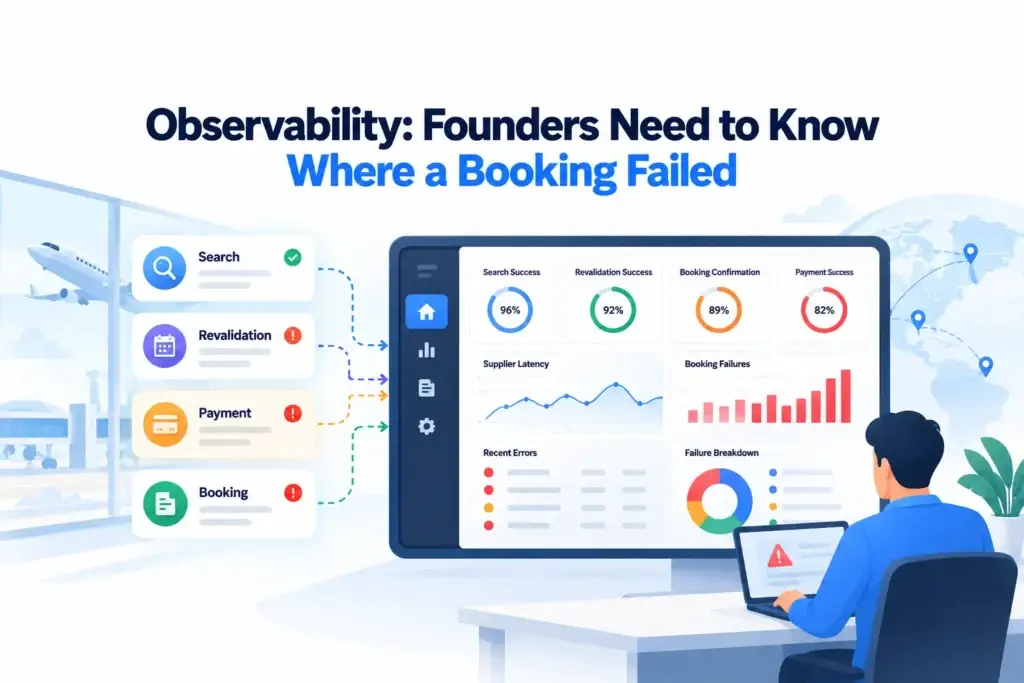
When something goes wrong, support teams need more than:
“Booking failed.”
They need context.
Useful logs may include:
- Search ID
- Booking ID
- Supplier
- API operation
- Request time
- Response time
- Status code
- Error category
- Payment state
- Booking state
- Retry count
- Correlation ID
Dashboards can track:
- Supplier latency
- Search success rate
- Revalidation failure rate
- Booking confirmation rate
- Payment failure rate
- Pending booking volume
- Refund backlog
- API timeout rate
Without observability, scaling supplier integrations becomes guesswork.
The Admin Dashboard Is an Operations Console
For travelers, the product is an app.
For the business team, it is an operations system.
Admin users may need to:
- Search bookings
- View supplier references
- Inspect payment status
- View API errors
- Retry safe operations
- Process cancellations
- Track refunds
- Adjust commissions
- Manage markup rules
- Disable unhealthy suppliers
- Review pending reservations
- View agent bookings
- Reconcile transactions
- Export reports
Founders planning search, supplier connectivity, booking management, payments, agent access, refunds, and operator workflows can also review the travel booking platform features needed to support day-to-day OTA operations.
The admin dashboard should expose enough information to resolve real booking problems without requiring developers for every incident.
Founder Decision Signals
Supplier Count
If you plan to connect several suppliers, invest early in normalization, mapping, routing, timeout handling, and reconciliation rather than writing supplier-specific logic directly into the booking flow.
Inventory Volatility
If prices or availability change quickly, revalidation and clear price-change handling should be core booking requirements rather than optional enhancements.
Payment Risk
If payment can complete before final supplier confirmation, design void, refund, unknown-state, and support workflows before launch.
Operational Scale
If support teams will manage hundreds or thousands of bookings, invest in admin visibility, audit trails, supplier status tracking, and reconciliation from the start.
Startup Architecture Checklist
Before launching an OTA platform, founders should confirm:
- Which travel categories launch first?
- Which suppliers are required?
- How are supplier APIs isolated?
- What is the normalized inventory schema?
- How are duplicate hotels or products mapped?
- Which suppliers are queried for each search?
- What timeout applies to search?
- What data can be cached?
- When is inventory revalidated?
- How are price changes shown?
- How are rate tokens stored?
- When is payment authorized?
- When is payment captured?
- What happens if booking fails after payment?
- Is booking creation idempotent?
- How are supplier timeouts handled?
- Does the platform support unknown booking states?
- How are webhooks verified?
- How are cancellations processed?
- How are refunds tracked?
- What jobs use queues?
- How are supplier bookings reconciled?
- Which metrics are monitored?
- What information does support see?
- What can administrators recover manually?
The successful booking path is only part of the system.
A production-ready platform also needs to handle retries, failures, delays, duplicates, cancellations, refunds, and external-system disagreements safely.
Mistakes Founders Should Avoid
Connecting Suppliers Directly to Frontend Logic
Supplier-specific formats should be isolated behind adapters or normalization services. Otherwise, every new integration increases frontend and booking complexity.
Using Search Availability as Booking Truth
Search results can become stale. Revalidate important pricing, policies, and availability before creating a final reservation.
Retrying Timed-Out Bookings Blindly
A timeout does not prove that the first reservation failed. Reconcile or query supplier status before resubmitting a booking request.
Combining Payment and Booking Status
Payment and supplier confirmation can succeed or fail independently. Keep separate state machines and define recovery workflows for every important combination.
Ignoring Reconciliation
Real-time flows eventually produce mismatches. Automated reconciliation helps identify stuck bookings, payment discrepancies, duplicate reservations, and incomplete refunds.
How Miracuves Helps Founders Launch Online Travel Platforms
Miracuves helps founders and travel businesses launch ready-made and white-label OTA platforms with multi-category booking engines, supplier connectivity, traveler workflows, agent access, payment integrations, booking management, admin controls, and source-code ownership.
For founders who want a launch-ready product rather than building every search, supplier, payment, booking, and administration layer from the beginning, Miracuves’ online travel booking platform provides a commercial foundation for flights, hotels, cars, tours, supplier connections, checkout, and booking operations.
Businesses evaluating multiple travel business models can also explore Miracuves’ travel booking solutions.
For products that need AI-assisted travel discovery, itinerary planning, and intelligent booking experiences, Miracuves’ travel booking platform software provides another relevant route.
When the standard ready-made scope fits the rollout requirement, Miracuves can support 6-day deployment, helping founders launch without rebuilding the complete OTA foundation from zero.
Final Thoughts
The most important part of an online travel platform is not the search form travelers see.
It is the orchestration underneath it.
The platform needs to know which suppliers to query, how long to wait, how to normalize responses, how to prevent duplicates, how to construct prices, when to revalidate, how to coordinate payment and booking states, how to recover after timeouts, and how to reconcile systems when they disagree.
That is the real journey from travel search to confirmed booking.
For founders, this changes the architecture conversation.
The question is not only:
“Which features do we need?”
It is also:
“What happens when an external supplier is slow, a fare changes, payment succeeds but booking fails, or a booking request times out?”
Platforms that answer those questions early are easier to operate, debug, support, and scale.
Start with reliable booking orchestration.
If you are comparing budget and rollout scope, review Miracuves’ guide on travel booking platform development cost. For vendor evaluation, this page on choosing a travel platform development partner can help you understand what to review before selecting a development team.
Then expand supplier count, travel categories, packages, loyalty, agents, personalization, and AI planning once the core transaction flow is dependable.
FAQs
What is online travel agency platform architecture?
Online travel agency platform architecture is the set of services and workflows that connect traveler search, supplier inventory, pricing, revalidation, payments, booking creation, confirmation, and post-booking operations.
Why do OTA platforms use multiple supplier APIs?
Multiple suppliers can provide broader inventory, better coverage, alternative rates, and different travel categories. However, each integration adds mapping, timeout, reconciliation, and operational complexity.
What is supplier normalization?
Supplier normalization converts different external API formats into one internal structure so the platform can process and display inventory consistently.
Why must travel inventory be revalidated?
Travel prices and availability can change between search and checkout. Revalidation confirms that the selected option is still bookable under the expected conditions.
What is an idempotent booking request?
An idempotent request prevents the same logical booking operation from creating multiple reservations if the user retries or a network timeout causes the request to be sent again.
Why should payment and booking states remain separate?
Because payment processing and supplier reservation creation are independent systems. Payment may succeed while booking fails, or a booking may be confirmed while final payment processing is still incomplete.
What happens when a supplier booking request times out?
The platform should avoid automatically assuming failure. It can mark the reservation as unknown or pending, query supplier status, reconcile the request, and retry only when it is safe.
Why are queues used in travel booking platforms?
Queues handle work such as confirmation emails, vouchers, notifications, supplier synchronization, refunds, analytics, and retries outside the critical booking request.
What is OTA reconciliation?
Reconciliation compares internal booking and payment records with external supplier and payment-provider records to identify mismatches, missing updates, duplicate transactions, and stuck states.
What should an OTA admin dashboard show?
Operators should be able to view booking states, supplier references, payments, refunds, cancellations, API errors, commissions, pending reservations, reconciliation issues, and transaction history.
Miracuves is an independent software development company. We are not affiliated with, connected to, sponsored by, or endorsed by any company or product named in this article.
Terms such as “X Clone” are used descriptively. It is how the software industry refers to building a platform with functionality comparable to a known service, and how clients search for it.
The entire design and codebase of our products is built by our own team. Our products contain no code, design, graphics, or content originating from any third-party website or applications.
All third-party names and marks referenced in this article are the property of their respective owners, referenced solely to identify the services discussed.