Key Takeaways
- B2B Travel Booking Platform Features should be planned around the roles and workflows of travel agents, corporate clients, suppliers, finance teams, and platform administrators.
- Agent portals should support client records, booking on behalf of customers, prepaid balances, credit controls, commissions, statements, and booking history.
- Corporate features should cover employee profiles, travel policies, approval workflows, company bookings, invoices, expenses, and reporting.
- Supplier and financial workflows need inventory management, rates, booking visibility, payout records, refunds, adjustments, commissions, settlements, and reconciliation.
- A complete B2B platform also needs CRM, role-based permissions, audit records, support tools, reporting, and centralized back-office controls to reduce dependence on spreadsheets and disconnected systems.
Feature Signals
- Partner management should handle agent, supplier, and corporate onboarding, approval, account organization, and relationship management.
- Booking operations should allow agents and corporate users to search inventory, manage travelers, create bookings, and handle changes throughout the booking lifecycle.
- Financial controls should provide prepaid balances, credit limits, commission tracking, refunds, adjustments, statements, payouts, and settlement status.
- Supplier portals should allow approved partners to manage inventory, availability, rates, documents, bookings, and payout information while maintaining appropriate access boundaries.
- Admin controls should cover partner approvals, bookings, CRM, permissions, reports, support, refunds, settlements, commission settings, credit controls, and audit history.
Real Insights
- A B2B travel platform should not simply copy consumer booking features because multiple business roles may participate in the same transaction.
- Financial controls should not depend on spreadsheets as booking volume grows; balances, credit, commissions, refunds, adjustments, and supplier payouts need connected records.
- Not every advanced feature needs to launch on day one. Sub-agent hierarchies, distributor tiers, advanced accounting exports, additional integrations, and complex approval models can be added when commercially necessary.
- Role-based permissions are essential because support, operations, sales, and finance teams should not automatically receive access to sensitive credit, refund, payout, or commission functions.
- The strongest feature planning path is: identify user roles → map responsibilities → build core partner workflows → connect booking and financial controls → add corporate and supplier operations → establish CRM and admin visibility → apply permissions and audit controls → expand advanced features as the business grows.
A B2B travel booking platform has to do more than help someone search for a flight or hotel.
It has to coordinate multiple businesses.
Travel agents may need to book on behalf of customers and work against a prepaid balance or approved credit. Corporate travel managers may need employee policies, approval chains, invoices, and reporting. Suppliers need inventory, rates, documents, booking visibility, and payout records. Finance teams need commissions, refunds, adjustments, statements, and settlement controls.
Then the platform owner has to see all of those activities from one back office.
That is why feature planning should start with roles and business workflows, not with the longest possible feature list.
A feature is valuable when it reduces manual work, improves transaction control, helps partners book more efficiently, or gives the operator better visibility.
Why B2B Travel Platforms Need Different Features From Consumer Booking Apps
A consumer travel app can center most of its experience around one person:
search, compare, pay, receive confirmation, manage the trip.
A B2B travel platform has more relationships to manage.
An agent may be booking for a customer. A company employee may be booking under a corporate policy. A supplier may be maintaining the inventory being sold. An account manager may be managing the commercial relationship. A finance employee may be controlling credit or releasing a payout.
The same booking may therefore involve several roles.
That creates requirements around:
- Role-based access
- Partner accounts
- Client records
- Agent balances
- Credit controls
- Commissions
- Corporate policies
- Approval chains
- Supplier inventory
- Refunds
- Payouts
- Statements
- CRM
- Audit records
- Admin permissions
The best B2B platform is not necessarily the one with the most features. It is the one where these roles can complete real travel operations without repeatedly moving back to spreadsheets, emails, calls, or disconnected systems.
Core Feature Groups a B2B Travel Platform Should Cover
Before looking at each stakeholder separately, founders can divide the product into six major capability groups.
Core Feature Groups for a B2B Travel Booking Platform
| Feature Group | Who Uses It | Business Purpose |
|---|---|---|
| Partner Management | Agents, suppliers, corporate clients, admin teams | Onboard, approve, organize, and manage business relationships. |
| Booking Operations | Agents, corporate users, operations teams | Search inventory, create bookings, manage travelers, and handle changes. |
| Financial Controls | Agents, finance teams, administrators | Control balances, credit, commissions, refunds, adjustments, and settlements. |
| Corporate Travel Controls | Employees, travel managers, approvers, finance departments | Apply company policies, approval chains, employee roles, and reporting. |
| Supplier Operations | Hotels, operators, inventory partners, admin teams | Manage inventory, rates, documents, bookings, and payouts. |
| Back-Office Control | Platform owner, support, operations, finance | Control the network through CRM, permissions, reports, support, and audit history. |
Travel Agent Portal Features: Help Agents Book Without Calling Your Team

The agent portal is one of the most important layers in a B2B travel operation.
Agents should be able to manage their own customers and bookings without depending on the operator for every routine task.
Agent Registration and Approval
The platform should allow agencies to create a business account and submit the information needed for review.
The admin team can then approve, reject, or request more information before allowing bookings.
This gives the platform operator a controlled partner-onboarding process instead of creating agent accounts manually.
Client Records
An agent usually books on behalf of someone else.
The portal should therefore let the agent:
- Create client profiles
- Save traveler details
- Access previous bookings
- Reuse passenger information
- Track booking history by client
This becomes more valuable as the agent’s booking volume grows.
Book on Behalf of Customers
The agent should be able to search available inventory, choose an existing client, confirm traveler information, and complete the booking from one workflow.
Depending on the business scope, inventory may include:
- Flights
- Hotels
- Buses
- Cabs
- Holiday packages
- Activities
- Transfers
- Other ancillary travel services
The important point is not how many categories exist. It is whether the categories match actual partner demand.
Agent Balance and Credit Features: Reduce Payment Friction Without Losing Control
B2B agents often need different payment logic from direct consumers.
A traveler may pay for one booking using a card or another payment method.
A travel agency may issue many bookings throughout the day.
That is why B2B platforms often need prepaid balances or controlled credit.
Prepaid Agent Balance
An agent can maintain funds inside the platform and use that balance when completing bookings.
This can simplify repeat transactions because the agent does not need to complete the same external payment process for every booking.
Credit Limits
Approved agents may also need controlled credit.
The platform should let authorized staff:
- Assign a credit ceiling
- View current utilization
- Adjust the limit when appropriate
- Prevent bookings beyond approved exposure
- Record account adjustments
- Review credit history
Credit should be treated as a financial-control feature rather than simply a growth incentive.
Wallet and Balance History
Agents should be able to see:
- Opening balance
- Credits
- Booking debits
- Refunds
- Adjustments
- Current available balance
Transparent financial records reduce unnecessary reconciliation conversations.
Commission Features: Make Agent Earnings Easy to Understand
A B2B travel platform needs clear commission logic.
If agents cannot understand what they earned and why, settlement disputes become more likely.
The system should be able to associate commission with each relevant booking.
Important commission features may include:
- Commission percentage
- Category-based commission
- Booking-level commission
- Commission adjustments after refund
- Commission history
- Monthly statements
- Admin commission configuration
The objective is consistency.
Founders planning how commissions, supplier margins, corporate plans, booking revenue, and settlements connect can also review the B2B travel platform business model.
The agent, finance team, and platform operator should all be looking at the same transaction record.
Corporate Travel Features: Give Companies More Than a Booking Login
Corporate travel is not simply consumer booking with a company email address.
Businesses need control over who travels, what can be booked, who approves it, and how finance sees the expense.
Company Accounts
Each organization should have its own controlled account structure.
That may include:
- Corporate administrator
- Employees
- Travel coordinators
- Managers
- Approvers
- Finance users
Each role should only see the data and actions appropriate to its responsibility.
Employee Profiles
Companies should be able to create or manage employee traveler profiles.
This reduces repetitive data entry and gives travel managers better control over company travel activity.
Travel Policies
A company may have rules around:
- Hotel budget
- Fare class
- Advance booking window
- Destination
- Employee level
- Department
- Travel category
The platform should be capable of checking bookings against relevant business rules.
Approval Workflows
Some employee bookings should require manager approval before they become final.
A good workflow lets the organization define who approves what rather than handling approvals through email threads.
Corporate Reports
Corporate administrators and finance teams may need visibility into:
- Employee travel
- Department spend
- Trip history
- Booking value
- Cancellations
- Approval activity
- Expenses
- Account usage
Reporting is one of the main reasons a corporate platform is more useful than a consumer booking account.
Supplier Portal Features: Let Supply Partners Manage Their Side of the Marketplace
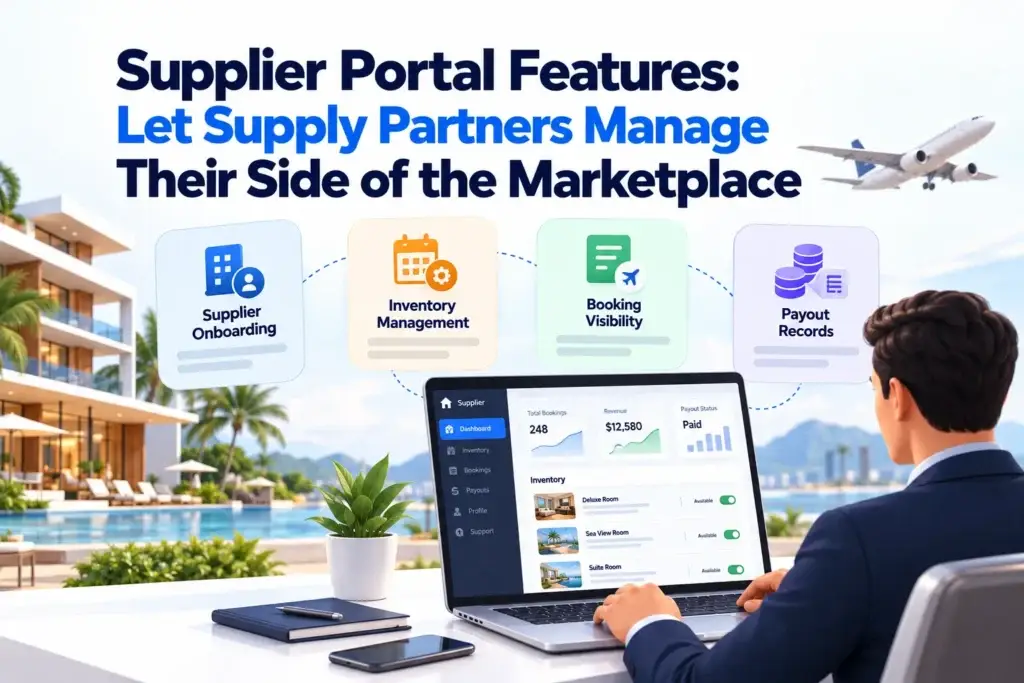
The supplier portal should reduce how much routine inventory management the operator has to perform manually.
Depending on the platform, suppliers may include hotels, homestays, activity operators, transportation providers, or other travel businesses.
Supplier Onboarding
The platform should support supplier application and review.
Relevant workflows may include:
- Business information
- Contact details
- Bank information
- Required documents
- Approval status
- Admin notes
Document requirements will vary depending on the business and target market.
Inventory Management
Approved suppliers should be able to manage the inventory they control.
That may include:
- Availability
- Rates
- Blocked dates
- Room or product information
- Booking status
- Inventory updates
The platform operator should retain enough control to review, suspend, or modify partner access when required.
Supplier Booking Visibility
A supplier should be able to see the bookings relevant to its inventory without gaining access to unrelated platform data.
This is where role-based permissions matter.
Supplier Payout Records
Suppliers also need financial visibility.
Useful records include:
- Booking value
- Supplier share
- Refund adjustments
- Payout status
- Statement history
- Relevant tax or billing documents where applicable
Clear payout information improves the commercial relationship between the platform and its supply network.
Shared Inventory: Let Different Channels Sell From the Same Supply Layer
One useful design principle is shared inventory.
An operator may sell the same hotel or travel product through:
- Travel agents
- Corporate accounts
- Direct travelers
- Internal booking teams
That does not mean every channel needs the same price or rules.
It means the operator can avoid maintaining completely separate inventory systems for every sales channel.
The business can then apply channel-specific logic such as:
- Agent commission
- Corporate policies
- Retail margin
- Promotional pricing
- Supplier share
- Booking restrictions
For businesses that need multi-category inventory, supplier connectivity, booking operations, and broader travel workflows, Miracuves’ travel booking platform software provides a useful next step for evaluating the technology layer.
Shared inventory with channel-specific commercial rules can simplify operations considerably.
Booking Management Features: One Record Should Follow the Entire Transaction
A booking should not disappear into separate systems once payment is completed.
Operations teams need to manage the booking throughout its lifecycle.
Useful booking states may include:
- Pending
- Awaiting approval
- Awaiting payment
- Confirmed
- Failed
- Cancelled
- Partially refunded
- Refunded
- Completed
The platform should keep the agent, traveler or employee, supplier, payment, commission, and relevant account relationship attached to the same booking record.
That makes support and reconciliation much easier.
Refund and Cancellation Workflows
Travel bookings frequently change.
Therefore, cancellation and refund management should not be treated as an afterthought.
The platform may need to record:
- Who requested the cancellation
- Supplier cancellation status
- Refund amount
- Refund destination
- Agent commission adjustment
- Supplier payout adjustment
- Administrative action
- Support history
A structured refund workflow prevents finance and support teams from relying on separate manual records.
Settlement Features: Turn Transaction Records Into Clear Partner Statements
Settlement is where weak B2B systems often create manual work.
The finance team should be able to determine:
- What each agent booked
- What commission was earned
- Which bookings were cancelled
- Which adjustments were applied
- What each supplier is owed
- Which payouts have been completed
- Which accounts need review
Useful settlement capabilities include:
- Agent statements
- Supplier payout records
- Refund adjustments
- Commission reconciliation
- Exportable reports
- Administrative notes
- Settlement status
The larger the partner network becomes, the more important this layer becomes.
Partner CRM Features: Keep Commercial Relationships Connected to Transactions
A B2B travel business is relationship-driven.
A platform should therefore keep more than transaction data.
A partner CRM may store:
- Agent contact details
- Corporate contacts
- Supplier contacts
- Account owner
- Internal notes
- Open support tickets
- Booking history
- Credit position
- Commission terms
- Recent communication
- Account status
This gives sales, support, operations, and finance teams a shared picture of each business relationship.
Without it, partner information often becomes scattered across spreadsheets, inboxes, phones, and individual employees.
Admin Dashboard Features: Give the Operator Real Control
The admin layer is where the platform becomes manageable as a business.
Founders should be able to change routine commercial and operational settings without requesting a code change every time.
Important admin capabilities may include:
- Agent approvals
- Corporate account management
- Supplier approvals
- Credit-limit controls
- Commission settings
- Booking search
- Refund processing
- Settlement management
- CRM
- Reports
- Staff roles
- Permissions
- Support tickets
- Audit history
The exact scope depends on the operating model.
The principle is simple: if something happens frequently in day-to-day operations, the business should not depend on developers to manage it.
Roles and Permissions: Separate Sales, Operations, Support, and Finance Access
Not every internal employee should have the same permissions.
A support employee may need booking and ticket access but not the ability to change balances.
A finance employee may need payout and adjustment access but not supplier inventory controls.
An operations employee may approve partners without seeing sensitive finance functions.
Role-based access can help separate responsibilities such as:
- Partner approval
- Credit management
- Refund authorization
- Payout release
- Commission configuration
- Support actions
- Reporting
- Account management
This becomes increasingly important as the internal team grows.
Security and Audit Features Should Protect High-Risk Actions
B2B travel platforms can contain partner balances, supplier documents, corporate travel data, refunds, and payout records.
Security should therefore be part of the operating model.
Useful controls may include:
- Encrypted data transfer
- Secure payment gateway integration
- Role-based access control
- Activity logs
- Administrative audit records
- Permission-controlled financial actions
- Partner verification workflows
- Secure document handling
- Fraud-monitoring signals
- Booking and payment history
Security controls should be configured according to the actual operating model, integrations, and jurisdiction.
Which Features Matter to Each B2B Travel User?
B2B Travel Features by User Role
| User Role | Core Features | Business Value |
|---|---|---|
| Travel Agent | Client records, booking tools, prepaid balance, credit visibility, commission, statements, booking history. | Helps agents serve customers and complete repeat bookings with less manual coordination. |
| Corporate Client | Employee accounts, policies, approvals, company bookings, expenses, invoices, reports. | Gives companies control and visibility over business travel. |
| Supplier | Onboarding, documents, inventory, rates, booking visibility, payout records. | Lets supply partners maintain their operations without relying on the platform team for every update. |
| Finance Team | Balances, credit, refunds, commissions, statements, adjustments, payouts, reconciliation. | Creates clearer financial records across a growing partner network. |
| Platform Admin | Partner approvals, CRM, bookings, permissions, reports, support, settings, audit history. | Gives the operator centralized control over the business. |
Founder Decision Signals
Agent-Led Business
If travel agencies will generate most bookings, prioritize client records, agent balances, credit controls, commission visibility, statements, and partner CRM.
Corporate-Led Business
If companies are the primary customers, prioritize employee roles, policy rules, approvals, reporting, billing records, and account management.
Supplier-Led Marketplace
If direct supplier relationships are central to the model, prioritize partner verification, inventory, rates, availability, booking visibility, payout records, and supplier support.
Multi-Channel Model
If agents, companies, suppliers, and direct travelers will operate together, prioritize shared inventory, channel-specific commercial rules, centralized bookings, and strong back-office controls.
Features Founders Can Add Later Instead of Overloading the First Release
Not every travel business needs every advanced B2B feature on day one.
Potential later-stage capabilities may include:
- Sub-agent hierarchy
- Distributor tiers
- Agent-controlled markup
- Agent-branded booking sites
- Corporate single sign-on
- Advanced accounting exports
- Complex regional sales hierarchies
- Additional supplier integrations
- Advanced analytics
- Custom approval models
The important question is whether a capability is essential to the launch business model.
If agents cannot operate without a balance and commission system, those features belong in the initial product.
If a sub-agent hierarchy is only needed after a distributor network grows, it may belong in a later phase.
Feature prioritization should follow commercial necessity.
Mistakes Founders Should Avoid
Building Only Traveler-Facing Features
A polished booking interface does not solve agent credit, corporate approvals, supplier inventory, commissions, settlements, or partner support. B2B operations need their own workflows.
Treating Corporate Accounts Like Normal User Accounts
Corporate travel usually requires employees, managers, policies, approval chains, reporting, and finance visibility. A simple shared company login is rarely enough.
Keeping Financial Controls in Spreadsheets
Agent balances, credit limits, commission, refunds, adjustments, and supplier payouts become difficult to reconcile as booking volume increases.
Giving Every Admin User Full Access
Support, operations, sales, and finance teams have different responsibilities. Sensitive balance, credit, refund, and payout actions should be permission-controlled.
Founders can also review these B2B travel platform mistakes before finalizing agent credit, corporate approvals, supplier workflows, settlement logic, and administrative controls.
Once the feature scope is defined, this guide on B2B travel platform launch marketing explains how founders can approach partner acquisition and post-launch growth.
Startup Feature Checklist for a B2B Travel Platform
Before finalizing scope, founders should ask:
- Can an agent register and be approved?
- Can the agent maintain client records?
- Can an agent book on behalf of a customer?
- Can prepaid balances be maintained?
- Are credit limits visible and controlled?
- Can commission be associated with bookings?
- Can agents access statements?
- Can companies create employee accounts?
- Can travel policies be configured?
- Can bookings move through approvals?
- Can corporate administrators view travel reports?
- Can suppliers maintain inventory and rates?
- Can suppliers see relevant bookings?
- Are supplier payout records available?
- Can refunds update relevant partner records?
- Can finance reconcile commissions and settlements?
- Can the operator manage partners through CRM?
- Are sensitive actions permission-controlled?
- Is there an audit trail for important administrative changes?
- Can the platform grow into additional B2B workflows later?
If you are comparing the budget required for these modules, integrations, branding, and customization, review Miracuves’ guide to B2B travel platform development cost.
A founder who can answer these questions clearly is much closer to a realistic product scope than one who simply starts with a long generic travel-app feature list.
How Miracuves Helps Founders Launch B2B Travel Platforms
Miracuves helps travel businesses launch ready-made, white-label platforms designed around agent, corporate, supplier, finance, booking, and administrative workflows.
Businesses that want to examine the commercial feature set in greater detail can review Miracuves’ B2B travel platform features, including partner, corporate, supplier, settlement, and back-office workflows.
Businesses exploring related travel marketplace models can also review Miracuves’ travel booking solutions for broader platform options. For founders comparing vendors, this guide on choosing a B2B travel development partner explains what to evaluate when selecting a team for implementation and customization.
When the ready-made scope fits the launch requirement, Miracuves can support 6-day solution delivery, helping founders avoid rebuilding every core partner, booking, financial, and administrative workflow from zero.
Businesses that want to evaluate the commercial feature set in greater detail can also review Miracuves’ B2B travel platform features, including partner, corporate, supplier, settlement, and back-office workflows.
When the ready-made scope fits the launch requirement, Miracuves can support 6-day solution delivery, helping founders avoid rebuilding every core partner, booking, financial, and administrative workflow from zero.
Final Thoughts: Build Around Roles, Not a Generic Feature Checklist
The most useful B2B travel platform feature list begins with a simple question:
Who needs to do what?
Agents need to serve customers and understand balances, credit, and commission.
Corporate clients need control over employees, policies, approvals, and reporting.
Suppliers need to maintain inventory and understand bookings and payouts.
Finance teams need consistent transaction records.
Platform operators need one back office that connects the entire network.
Once these responsibilities are clear, feature prioritization becomes much easier.
The strongest product scope is not the longest list. It is the set of workflows that allows real agents, companies, suppliers, and internal teams to operate the travel business with less manual coordination and better control.
FAQs
What features should a B2B travel booking platform include?
A B2B travel platform should typically include agent accounts, customer records, booking tools, prepaid balances or credit controls, commissions, corporate accounts, travel policies, approval workflows, supplier inventory, payouts, settlements, CRM, reports, permissions, and admin controls.
What features do travel agents need?
Agents commonly need client records, search and booking tools, booking history, prepaid balances, credit visibility, commission tracking, statements, refunds, and account support.
What features do corporate travel clients need?
Corporate accounts may require employee profiles, administrator roles, travel policies, approval chains, booking history, expense visibility, invoices, and company-level reports.
What features should a supplier portal include?
A supplier portal may include onboarding, document submission, inventory management, rates, blocked dates, booking visibility, payout records, and account support.
Why are agent credit limits important?
Credit limits allow approved partners to book within defined commercial boundaries. They should be controlled by authorized staff and tracked alongside balances and payment history.
Why does a B2B travel platform need a settlement system?
A settlement system helps finance teams reconcile bookings, agent commission, supplier payouts, refunds, adjustments, and partner statements without rebuilding the record manually at month end.
What should the B2B travel admin dashboard control?
The admin layer should typically manage partners, bookings, credit, commission, corporate accounts, suppliers, refunds, settlements, CRM, reports, permissions, support, and audit records.
Can Miracuves help launch a B2B travel booking platform?
Yes. Miracuves offers ready-made and white-label travel platform foundations for agent, corporate, supplier, booking, finance, and admin workflows. A 6-day solution delivery may apply when the ready-made scope matches the project requirements.
Miracuves is an independent software development company. We are not affiliated with, connected to, sponsored by, or endorsed by any company or product named in this article.
Terms such as “X Clone” are used descriptively. It is how the software industry refers to building a platform with functionality comparable to a known service, and how clients search for it.
The entire design and codebase of our products is built by our own team. Our products contain no code, design, graphics, or content originating from any third-party website or applications.
All third-party names and marks referenced in this article are the property of their respective owners, referenced solely to identify the services discussed.