



























Key Takeaways
- B2B travel booking platform mistakes often come from underestimating the financial and operational relationships behind agent, supplier, corporate, and finance workflows.
- Agent credit should have defined ceilings, approval rules, repayment policies, and audit trails instead of being treated as a simple account setting.
- Commission should be calculated with the booking and evaluated against supplier costs, processing fees, discounts, refunds, support costs, and platform margin.
- Supplier inventory needs verification, while availability, booking confirmation, refunds, and payment failures require clear handling and recovery workflows.
- Settlement should be designed before launch so bookings, balances, commissions, refunds, supplier payouts, adjustments, and statements remain traceable as transaction volume grows.
Mistake Signals
- Giving agents uncontrolled credit can create financial exposure when settlement is delayed or booking volume exceeds expectations.
- Allowing too many staff members to change balances, credit limits, refunds, or payments makes accountability and dispute investigation difficult.
- Treating agent balances as simple wallets can hide deposits, booking deductions, credit usage, refunds, commission credits, and manual corrections.
- Trusting supplier availability without failure handling can create problems when prices change, inventory sells out, APIs time out, or payment succeeds while supplier confirmation fails.
- Using one administrator role for every function can expose sensitive financial and operational controls to staff who do not require them.
Real Insights
- A B2B platform should treat credit, commission, refunds, and settlement as connected financial workflows rather than separate features.
- Supplier verification should happen before inventory becomes commercially bookable, with ongoing monitoring appropriate to the operating model.
- Refunds should update all affected financial records while preserving the original booking history rather than overwriting the transaction.
- Launching agents, corporates, suppliers, resellers, consumer bookings, and additional services simultaneously can make the initial operating model unnecessarily complex.
- The strongest launch path is: define credit rules → control permissions → model booking economics → verify suppliers → handle booking failures → connect refunds to ledgers → build settlement records → separate admin roles → validate one repeatable revenue workflow before expanding.
Launching a B2B travel booking platform is very different from launching a simple consumer travel app.
A consumer booking flow may end when a traveler searches, pays, and receives a confirmation. A trade platform has to continue far beyond that point.
Travel agents may book for clients using prepaid balances or approved credit. Suppliers may receive payouts after commission and margin calculations. Corporate accounts may require policies and manager approvals. Finance teams may need to reconcile refunds, credit adjustments, commissions, supplier payments, and monthly statements.
That creates a different category of startup risk.
The biggest mistakes are rarely about missing a search filter or changing the color of a booking button. They happen when founders underestimate the financial and operational relationships behind every booking.
A B2B travel platform therefore needs to answer questions such as:
- How much credit can each agent use?
- Who can increase that credit?
- When is commission earned?
- What happens to commission after cancellation?
- How is supplier cost recorded?
- How are refunds reflected in agent balances?
- How does finance close the month?
- Who can release payouts?
- How are disputes investigated?
- How does direct pricing affect trade partners?
If you want to understand the complete trade workflow first, this guide explains how a B2B travel booking platform works, from agent bookings and credit balances to commissions and settlement records.
Getting these answers right before launch reduces problems that become much harder to fix once agents, suppliers, and companies are already transacting.
Mistake #1: Giving Agent Credit Before Defining the Risk Rules
Credit can help a travel platform attract and retain trade partners.
It can also create one of the largest financial risks in the business.
A founder may think:
“Give good agents more credit so they can book more.”
The principle makes sense. The problem is implementing it without controls.
An agent with an approved credit facility can create financial exposure before the platform has actually received those funds. If the partner delays settlement, disputes transactions, suffers a cash-flow issue, or simply exceeds expected volume, the platform can become responsible for supplier payments without having collected enough money.
Founders planning prepaid balances, credit ceilings, booking-level commissions, monthly statements, supplier workflows, and finance permissions can review these B2B travel platform features to understand how the operational modules connect.
Credit should therefore be treated as a financial control, not just another account field.
What the platform should define
For each agent, consider:
- Prepaid balance
- Approved credit ceiling
- Credit currently used
- Remaining available amount
- Settlement history
- Overdue amount
- Credit-review date
- Adjustment history
- Authorized approver
- Reason for credit changes
New partners may start with prepaid-only booking.
Reliable partners can later receive controlled credit based on the commercial relationship and settlement history.
The important principle is simple:
Credit should be earned and controlled, not granted casually to increase sign-ups.
Mistake #2: Letting Too Many Staff Members Change Agent Balances
Even if a platform has credit limits, another risk appears when too many staff members can change them.
Consider what could happen if customer support, partner operations, sales, and finance all have permission to:
- Increase balances
- Increase credit limits
- Reverse deductions
- Issue refunds
- Apply adjustments
- Release payments
It becomes difficult to understand who changed what and why.
A B2B travel booking platform should use role-based access.
A support user might be allowed to view a booking.
A partner-operations user might approve an agent.
A finance user might adjust a balance.
A senior finance role might increase a credit ceiling.
An owner might configure commission rules.
These should not automatically be the same permission.
Sensitive financial actions should record
- User who performed the action
- Previous amount
- New amount
- Date and time
- Reason
- Related booking or settlement
- Approval where required
An audit trail is not administrative clutter. It is what helps the operator investigate disputes and protect partner money.
Mistake #3: Setting Agent Commission Before Understanding the Margin
Commission is often one of the first commercial questions an agent asks.
Founders may therefore set an attractive commission percentage early to recruit partners.
That can become expensive if the complete booking economics have not been modeled.
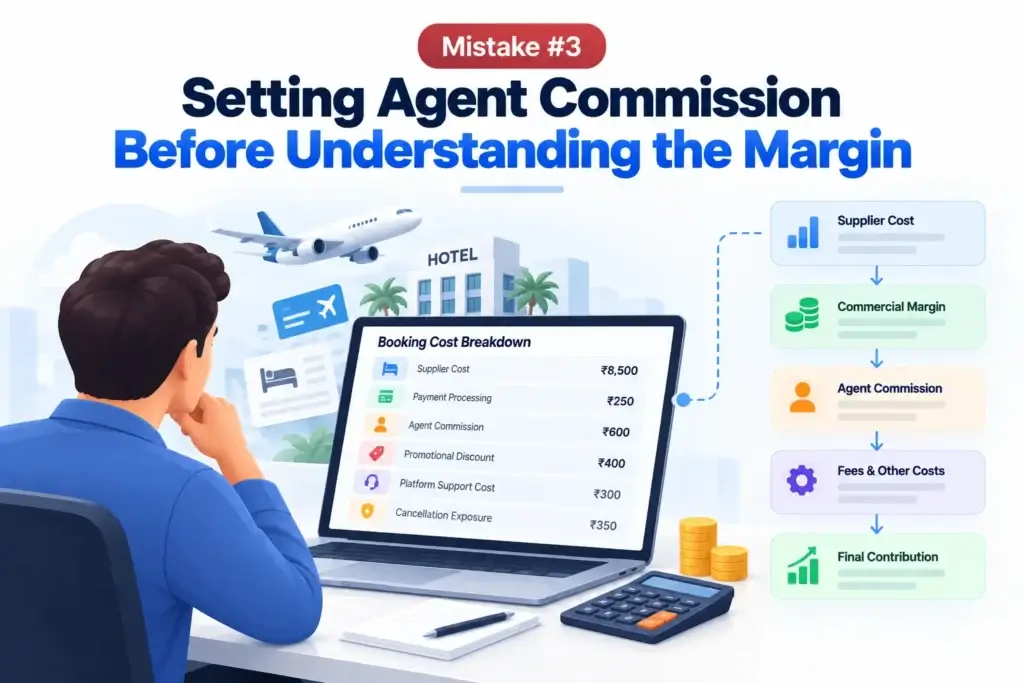
Suppose a booking involves:
- Supplier cost
- Payment-processing cost
- Agent commission
- Promotional discount
- Platform support cost
- Cancellation exposure
- Platform margin
If the commission is decided in isolation, the business may increase booking volume while losing money on each transaction.
For a deeper look at trade margins, supplier commissions, partner revenue, and platform monetization, review this B2B travel platform business model guide.
The platform should model:
Supplier cost → commercial margin → agent commission → fees → final contribution
before announcing partner terms.
Commission rules may vary by
- Travel category
- Supplier
- Agent agreement
- Booking value
- Route
- Season
- Partner tier
- Campaign
- Cancellation status
Not every startup needs all these variables at launch.
But founders should know which variables affect profitability.
Mistake #4: Calculating Commission Later Instead of Recording It With the Booking
Another common mistake is generating commission from a spreadsheet at the end of the month.
This sounds manageable when there are ten bookings.
It becomes much less manageable when there are thousands of bookings, refunds, partial cancellations, supplier adjustments, and account corrections.
A better approach is to attach the commercial values to the booking when the transaction occurs.
A booking record can preserve:
- Agent
- Client
- Supplier
- Supplier cost
- Agent commission
- Platform margin
- Funding source
- Applicable taxes
- Refund adjustment
- Settlement status
Then both the agent and finance team can work from the same number.
When the booking changes, the financial records can be adjusted systematically rather than recreated from separate spreadsheets.
Mistake #5: Treating the Agent Balance Like a Simple Consumer Wallet
An agent balance may look like a wallet on screen, but operationally it can behave very differently.
It may contain:
- Deposited funds
- Booking deductions
- Credit utilization
- Refund credits
- Commission credits
- Manual corrections
- Settlement adjustments
- Repayments
That means the platform needs a ledger, not only a balance number.
A simple field saying:
Balance = ₹80,000
does not explain how the system reached ₹80,000.
A useful ledger should explain every movement.
What an Agent Balance Ledger Should Record
| Transaction | What Changes | Why It Matters |
|---|---|---|
| Deposit | Available prepaid balance increases. | Shows the actual funds added by the agent. |
| Confirmed booking | Available funds or credit reduce. | Connects the financial deduction to a booking. |
| Refund | Eligible amount returns to the balance. | Prevents cancellation records from being separated from finance records. |
| Credit utilization | Outstanding credit increases. | Shows the operator’s financial exposure. |
| Credit repayment | Outstanding credit decreases. | Supports partner settlement history. |
| Manual adjustment | Balance changes with a recorded reason. | Creates accountability for corrections and disputes. |
Mistake #6: Onboarding Suppliers Before Proper Verification
B2B travel platforms depend on inventory.
That creates pressure to onboard as many hotels, activity providers, transport operators, and other suppliers as possible.
But inventory quantity should not come before supplier trust.
A poorly verified supplier can create:
- Invalid inventory
- Customer complaints
- Payment disputes
- Refund exposure
- Fake listings
- Service-quality problems
- Partner distrust
Supplier onboarding should include verification appropriate to the business and target jurisdiction.
A practical supplier workflow may include:
- Supplier registration
- Business-information submission
- Document upload
- Bank information
- Operator review
- Approval or rejection
- Inventory activation
- Ongoing monitoring
The supplier should not automatically become bookable simply because a registration form was completed.
Mistake #7: Trusting Supplier Availability Without Failure Handling
Travel inventory changes constantly.
Rooms sell out.
Fares change.
Supplier APIs time out.
A price seen during search may no longer be valid during confirmation.
The platform therefore needs a clear distinction between:
Search result → availability check → booking request → supplier confirmation → final deduction
A risky implementation deducts money permanently before supplier confirmation is known.
A safer workflow can reserve or authorize the amount, attempt confirmation, and finalize the financial transaction only after the booking succeeds.
If confirmation fails, the platform needs a reliable rollback path.
Founders should test:
- Supplier timeouts
- Price changes
- Sold-out inventory
- Partial API failures
- Payment success + supplier failure
- Supplier success + payment failure
- Duplicate booking requests
- Retry behavior
The happy path is only one part of travel booking.
Mistake #8: Treating Refunds as a Customer-Support Task
A refund is not simply a support ticket.
It is a financial event.
One canceled booking can affect:
- Traveler refund
- Agent balance
- Agent commission
- Supplier payable amount
- Platform margin
- Payment gateway record
- Tax record
- Monthly statement
- Settlement report
If customer support processes the cancellation but finance systems do not receive the same adjustment, reconciliation problems appear later.
A good refund workflow should keep the original booking and add financial adjustments around it.
Do not simply overwrite the booking record and lose the history.
Mistake #9: Waiting Until Month-End to Think About Settlement
Settlement should be designed before the first booking, not after the first month.
If the system cannot explain every financial movement during the month, creating an accurate closing statement becomes difficult.
A monthly agent statement might need:
- Opening balance
- Deposits
- Bookings
- Commission
- Refunds
- Credit usage
- Credit repayment
- Manual adjustments
- Closing balance
Supplier settlement may require:
- Confirmed bookings
- Supplier share
- Platform commission
- Refund adjustments
- Taxes
- Payout amount
- Payout status
The system should accumulate this information during everyday transactions.
Month-end reporting should summarize reliable records, not reconstruct them.
Mistake #10: Using One Admin Role for Everything
A small startup may initially have only a few team members.
That does not mean every staff account should have full platform access.
Consider the difference between:
- Customer support
- Partner operations
- Supplier verification
- Finance
- Settlements
- Content management
- Platform administration
- Owner access
Finance may need to issue adjustments but should not necessarily change supplier inventory.
Support may need to inspect bookings but should not increase agent credit.
Partner operations may approve an agent but should not release supplier payments.
Role-based access becomes more important as the business grows.
Designing it early is easier than removing excessive permissions later.
Mistake #11: Undercutting the Agent Channel With Direct Pricing
Some B2B travel platforms also sell directly to travelers.
That creates an important commercial decision.
If the platform repeatedly offers direct travelers a price that the trade partner cannot reasonably compete with, agents may feel that the platform is using them to build volume while competing against them.
That can weaken partner loyalty.
Founders should define:
- Trade price
- Retail price
- Agent commission
- Promotional pricing
- Direct-channel discount rules
- Supplier-funded offers
- Category margin
B2B and B2C can coexist.
But the pricing strategy should make sense for both channels.
Mistake #12: Launching Too Many Business Models at Once
Travel platforms can become complicated quickly.
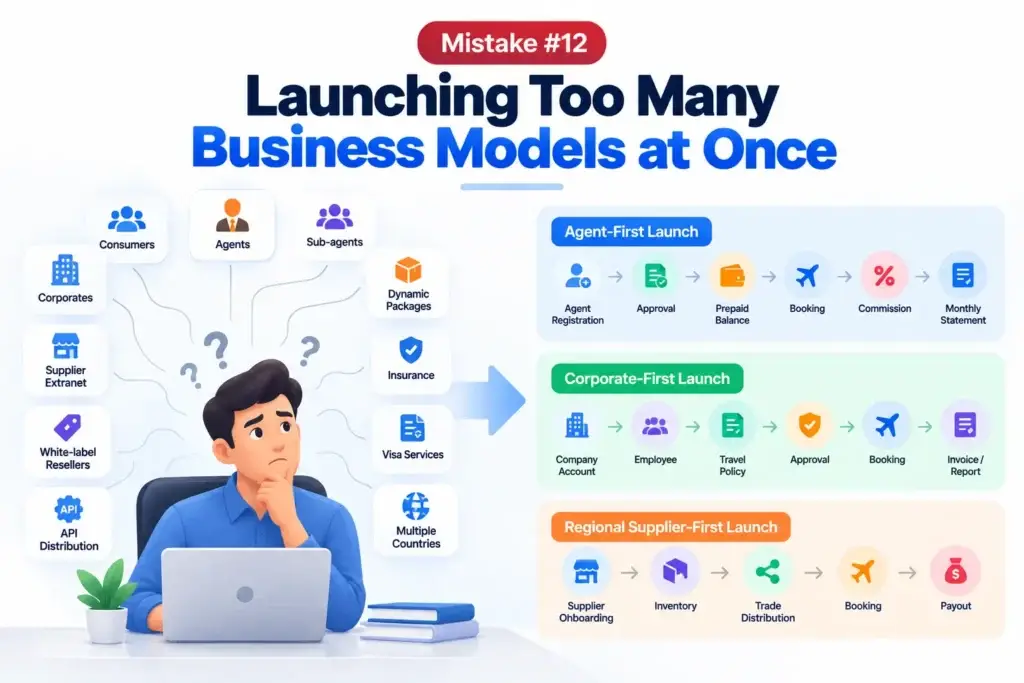
Founders may want to launch:
- Consumer bookings
- Agents
- Sub-agents
- Corporates
- Supplier extranet
- White-label resellers
- API distribution
- Loyalty
- Corporate expense management
- Dynamic packages
- Insurance
- Visa services
- Multiple countries
Trying to validate all of these at once increases operational complexity.
A better approach is to identify the first revenue engine.
For example:
Agent-first launch
Agent registration → approval → prepaid balance → booking → commission → monthly statement.
Or:
Corporate-first launch
Company account → employee → travel policy → approval → booking → invoice/report.
Or:
Regional supplier-first launch
Supplier onboarding → inventory → trade distribution → booking → payout.
The initial product should prove one repeatable commercial workflow before the startup adds every possible travel model.
Once the core booking and partner model is defined, founders should also plan how they will attract and retain agents, suppliers, companies, and travelers. This guide to B2B travel platform launch marketing explains what to prioritize before and after going live.
Mistake #13: Ignoring the Finance Team During Product Design
Founders often design around travelers, agents, and suppliers.
Finance gets added later.
That is a mistake because the finance team may eventually need to answer questions such as:
- Why did this balance change?
- Who approved this credit increase?
- Why was this commission reversed?
- Which supplier is still owed money?
- Which agents have outstanding credit?
- Which refunds have not been settled?
- What is the platform margin for this category?
- What changed after the monthly statement was generated?
If the product cannot answer those questions, finance falls back to spreadsheets.
That defeats much of the value of a B2B platform.
Founder Decision Signals
Credit Readiness
If agents need credit from day one, define limits, authorization, repayment, audit logs, and review rules before onboarding high-volume partners.
Margin Clarity
If commission is being used to attract partners, model supplier cost, processing fees, refunds, discounts, and platform margin before publishing trade terms.
Settlement Readiness
If agents and suppliers transact frequently, make every financial adjustment traceable during the month instead of rebuilding records at month-end.
Launch Focus
If the platform has agents, corporates, suppliers, and consumer users, decide which workflow creates the first repeatable revenue before expanding the operating model.
The Four Mistakes That Should Stop a Launch
Some issues can be improved after launch.
Others should stop the rollout until they are fixed.
Uncontrolled Agent Credit
Do not launch credit-based booking if limits, authorization, transaction history, and outstanding exposure cannot be reviewed clearly.
Unclear Booking Economics
Do not promise agent commission until supplier cost, fees, discount rules, refund exposure, and platform margin are understood.
Unverified Supplier Inventory
Do not make supplier inventory publicly or commercially bookable before the required business and payment details have been reviewed.
No Settlement Audit Trail
Do not launch high-volume trade booking if refunds, balance changes, commissions, adjustments, and payouts cannot be traced back to their source transactions.
Pre-Launch Checklist for a B2B Travel Booking Platform
Before going live, founders should verify:
Agent Operations
- Agent registration works
- Approval workflow is defined
- Client records are isolated by agent
- Prepaid balance works
- Credit ceiling is enforced
- Credit changes are logged
- Commission is attached to bookings
- Agent statement can be generated
Supplier Operations
- Supplier verification exists
- Inventory publishing requires approval
- Supplier cost is stored
- Cancellation rules are available
- Payout records are generated
- Refund adjustments flow into settlement
Booking Operations
- Search and confirmation are separate states
- Failed supplier confirmation rolls back correctly
- Duplicate bookings are controlled
- Payment retries are handled
- Cancellations retain history
- Refunds update all related ledgers
Finance Operations
- Balance ledger is traceable
- Agent credit exposure is visible
- Commission reports are available
- Platform margin can be reviewed
- Supplier payable amounts can be reconciled
- Adjustment reasons are required
- Settlement statements can be exported
Access Control
- Support cannot freely change balances
- Finance permissions are separated
- Supplier approval has a dedicated role
- Sensitive actions create audit records
- Payout access is restricted
Business Model
- Agent commission is financially sustainable
- Direct pricing does not unnecessarily damage the trade channel
- The first revenue engine is clear
- Launch scope is realistic
- Partner acquisition strategy is defined
For a broader module-by-module review, this travel booking platform feature checklist can help founders compare booking, partner, finance, and admin requirements.
A founder who can answer these points clearly is much closer to operating a travel trade business rather than merely publishing a booking interface.
How Miracuves Helps Founders Launch B2B Travel Platforms
Miracuves helps founders and travel businesses launch ready-made and white-label B2B travel platforms with agent workflows, prepaid balances, credit controls, commission tracking, supplier operations, corporate travel, settlement tools, and admin permissions.
Businesses evaluating additional travel marketplace models can also explore Miracuves’ travel booking solutions for broader white-label platform options.
For teams that want to avoid rebuilding the core trade workflow from zero, Miracuves’ B2B travel booking platform foundation provides a commercial starting point for agent, supplier, corporate, finance, and booking operations.
Founders can then customize branding, integrations, commercial rules, and additional workflows around their target market.
For founders comparing budget, integrations, branding, supplier connections, and rollout scope, this guide to B2B travel platform development cost explains the main factors that can affect pricing.
If you are also evaluating implementation teams, this guide on choosing a B2B travel platform development partner explains what founders should review before selecting a development company.
When the ready-made scope matches the rollout requirement, Miracuves can support 6-day solution delivery, giving founders a faster route to testing real agent and supplier operations without waiting for every foundational module to be built from scratch.
Final Thoughts: B2B Travel Failures Usually Begin Behind the Booking Screen
The booking interface is only the visible part of a B2B travel business.
The harder problems sit behind it:
Who gets credit?
Who approves it?
How is commission calculated?
What happens after a refund?
How does supplier cost affect margin?
Who can adjust a partner balance?
How does finance explain every transaction at month-end?
Startups that answer these questions early have a much stronger operational foundation.
The goal should not be to launch the largest possible travel platform on day one. The goal should be to launch a controlled commercial workflow where bookings, money, partners, and settlements remain understandable as transaction volume grows.
Founders planning a wider travel ecosystem can also explore Miracuves’ travel booking platform software to understand how booking, operations, partner management, and travel-commerce workflows can connect.
For B2B travel founders, operational clarity is not back-office housekeeping.
It is part of the product.
FAQs
What is the biggest mistake when launching a B2B travel booking platform?
One of the biggest mistakes is offering agent credit without clear ceilings, authorization rules, transaction records, and settlement controls. Credit can increase booking volume, but it also creates financial exposure.
Should travel agents receive unlimited credit?
No. Credit should normally depend on the commercial relationship, settlement history, risk assessment, and internal policy. The platform should enforce a defined credit ceiling.
Why should commission be recorded with each booking?
Recording commission with the booking gives the agent and finance team a consistent value. It also makes cancellations, refunds, adjustments, and monthly settlement easier to reconcile.
Why is supplier verification important?
Supplier verification reduces the risk of fraudulent listings, incorrect payment information, poor-quality inventory, and operational disputes. The required verification process depends on the target market and operating model.
What should happen when a travel booking is refunded?
The refund process may need to update the traveler or agent balance, commission, supplier payable amount, platform margin, payment records, and settlement statement. The original transaction history should remain traceable.
What is a monthly agent settlement statement?
It is a period-based record showing the agent’s deposits, bookings, commission, refunds, credit use, adjustments, and closing balanc
Should a B2B travel startup launch agents, corporates, suppliers, and consumer bookings together?
Not necessarily. Many founders benefit from validating one primary revenue workflow first, then expanding additional business models once the core operations are reliable.
How can Miracuves help launch a B2B travel booking platform?
Miracuves provides a ready-made and white-label platform foundation supporting agent bookings, prepaid balances, credit controls, commissions, supplier operations, corporate travel, settlements, and admin control. A 6-day delivery may apply when the ready-made scope matches the launch requirement.
Miracuves is an independent software development company. We are not affiliated with, connected to, sponsored by, or endorsed by any company or product named in this article.
Terms such as “X Clone” are used descriptively. It is how the software industry refers to building a platform with functionality comparable to a known service, and how clients search for it.
The entire design and codebase of our products is built by our own team. Our products contain no code, design, graphics, or content originating from any third-party website or applications.
All third-party names and marks referenced in this article are the property of their respective owners, referenced solely to identify the services discussed.