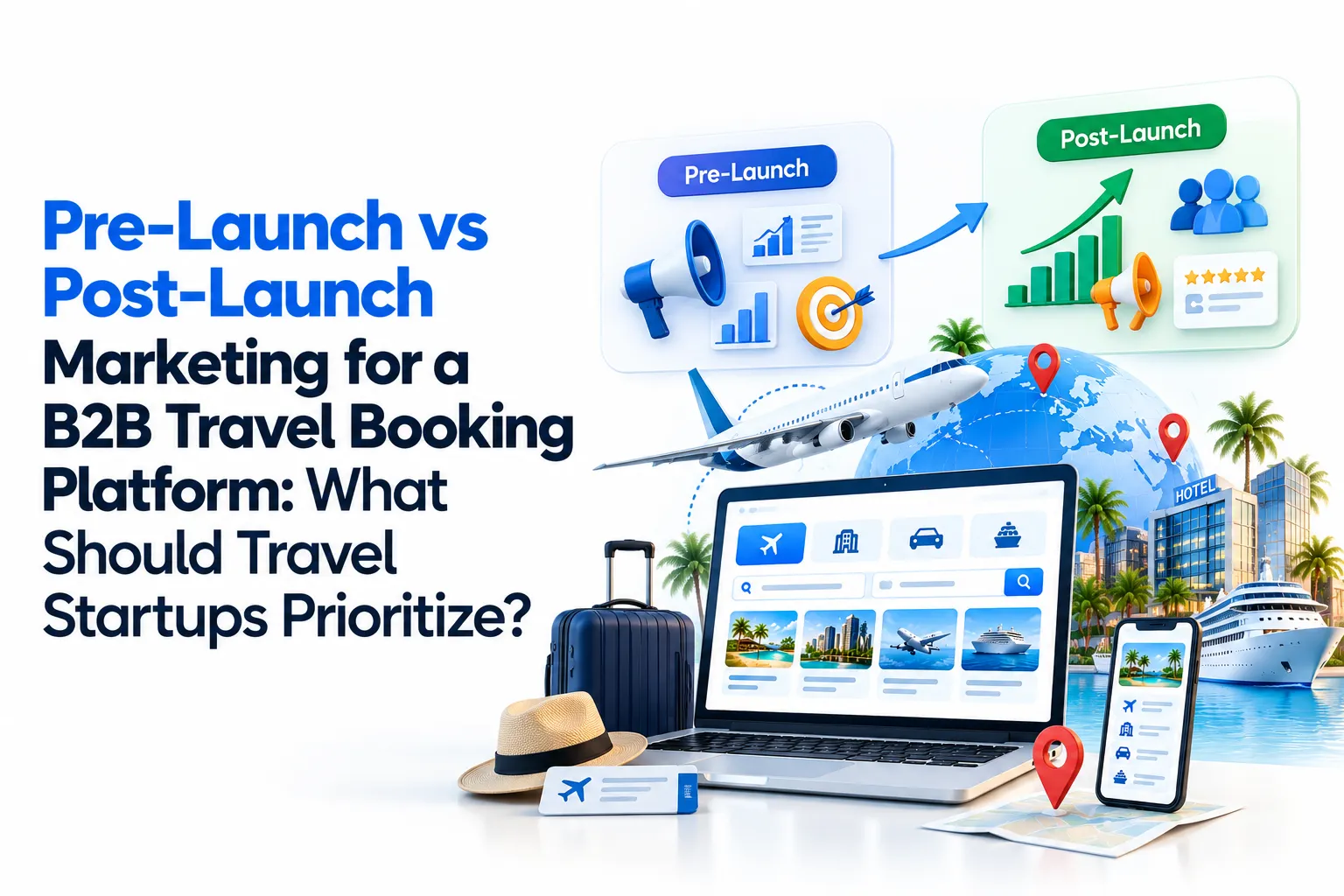
Key Takeaways
- B2B Travel Booking Platform Marketing should focus on building business relationships with travel agents, corporate accounts, suppliers, distributors, and other travel partners rather than relying only on broad consumer-style awareness.
- Pre-launch marketing should validate demand, identify the right partner segments, build qualified leads, start supplier conversations, and create a pipeline of agents and corporate prospects before launch.
- Post-launch marketing should focus on partner activation, first bookings, repeat transactions, account expansion, referrals, dormant-account reactivation, and retention.
- Different partner groups require different messaging based on their needs, such as commissions and inventory for agents, approvals and reporting for corporate clients, and distribution and settlement for suppliers.
- Marketing performance should be connected to business outcomes such as active accounts, first-booking conversion, bookings per partner, repeat-booking rate, account expansion, supplier performance, and partner retention.
Marketing Signals
- Direct email, LinkedIn outreach, travel communities, industry associations, webinars, demonstrations, referrals, corporate prospecting, and founder-led networking can support B2B partner acquisition.
- Partner landing pages should communicate business value, relevant travel categories, commercial benefits, workflows, early access, and demo opportunities.
- Demos can show real workflows such as agent booking, balances, commissions, employee management, approvals, invoices, and reporting.
- Post-launch campaigns should segment partners by status, including approved but inactive, first-booking accounts, repeat bookers, high-volume accounts, dormant partners, and low-adoption corporate accounts.
- Supplier marketing should run alongside demand generation because inventory coverage, pricing, availability, and confirmation performance directly affect partner activity.
Real Insights
- A large registration count does not necessarily indicate successful B2B marketing if partners are not completing bookings or returning to transact.
- If signup is strong but booking activity is weak, investigate onboarding, inventory, pricing, credit, product understanding, and first-booking support before simply increasing acquisition spend.
- Existing partners can become a major growth source through additional travel categories, destinations, departments, employees, and higher booking frequency.
- Pre-launch and post-launch marketing should form a continuous loop: pre-launch conversations generate initial accounts, while post-launch booking data improves future acquisition and messaging.
- The strongest marketing path is: define the first partner segment → build qualified demand → establish supplier readiness → conduct targeted outreach → convert partners → support first bookings → increase booking frequency → expand accounts → reactivate dormant partners → improve retention.
Marketing a B2B travel booking platform is very different from marketing a consumer travel app.
A consumer travel business may focus heavily on downloads, destination campaigns, discounts, social media reach, and individual traveler acquisition.
A B2B travel platform grows through business relationships.
Before launch, the priority is identifying travel agencies, corporate accounts, distributors, suppliers, and other partners that have a real reason to use the platform.
After launch, the priority changes.
Now the business has to convert approved partners into active bookers, increase booking frequency, strengthen supplier coverage, retain valuable accounts, and expand revenue from relationships that already exist.
That distinction matters because many travel startups spend too much before launch trying to create general awareness—or launch with no partner pipeline at all.
The stronger strategy is to give pre-launch and post-launch marketing different jobs.
Why Marketing a B2B Travel Platform Requires a Different Strategy
A B2B travel platform usually connects several business groups.
These may include:
- Independent travel agents
- Travel agencies
- Corporate travel departments
- Tour operators
- Regional distributors
- Hotels
- Transport providers
- Activity suppliers
- Other travel inventory partners
Each group has a different reason to join.
An agent may care about inventory, commission, credit, booking speed, and statements.
A corporate travel manager may care about approvals, policies, traveler records, invoices, and spend reporting.
A supplier may care about distribution, booking visibility, rates, availability, and settlement.
Marketing therefore cannot rely on one generic message.
For founders who want to understand the operational workflow before planning campaigns, this guide explains how a B2B travel booking platform works across agents, suppliers, corporate accounts, bookings, payments, and admin operations.
The startup first needs to determine which partner group creates the most important initial demand.
That decision should shape both pre-launch and post-launch marketing.
What Pre-Launch Marketing Should Actually Achieve
Pre-launch marketing is not mainly about creating noise.
Its job is to reduce uncertainty before the platform goes live.
A founder should use the pre-launch period to answer questions such as:
- Which agent segments are most interested?
- Which travel categories matter first?
- Do agencies care more about price, inventory, credit, or commission?
- Which corporate travel problems are worth solving?
- Which destinations need better supplier coverage?
- What objections prevent partners from signing up?
- Which acquisition channels generate serious business leads?
- What information does the sales team need before demonstrations?
The goal is to enter launch with evidence.
A startup that already has interested agents, corporate prospects, and supplier conversations is in a much stronger position than one launching into an unknown market.
Pre-Launch Priority 1: Define the First Partner Segment
Do not market to every travel business at once.
Choose an initial segment.
Examples include:
- Independent travel agencies
- Corporate-focused agencies
- Holiday package sellers
- Regional travel operators
- Business travel companies
- Hotel-focused agents
- Group travel specialists
- Tour operators
The more specific the segment, the more specific the message can become.
For example, an agency focused on business travel may respond to:
- Faster corporate booking
- Account reporting
- Employee profiles
- Approval controls
- Invoice visibility
A leisure package seller may care more about:
- Hotel inventory
- Transfers
- Activities
- Package customization
- Commission
A strong pre-launch campaign speaks directly to the partner’s business model.
Pre-Launch Priority 2: Build a Partner Landing Page
The pre-launch landing page should not simply say:
“New travel platform coming soon.”
It should explain the business value.
A B2B partner page may include:
- Who the platform is for
- Travel categories available
- Agent benefits
- Corporate use cases
- Supplier opportunities
- Booking workflow
- Commercial model
- Early access form
- Demo request
- Contact details
The primary CTA should reflect business intent.
Useful CTAs might include:
- Request Early Access
- Join the Agent Waitlist
- Book a Platform Demo
- Register Corporate Interest
- Become a Supply Partner
This produces higher-quality leads than a generic newsletter signup.
Pre-Launch Priority 3: Start Direct Agent Outreach Early
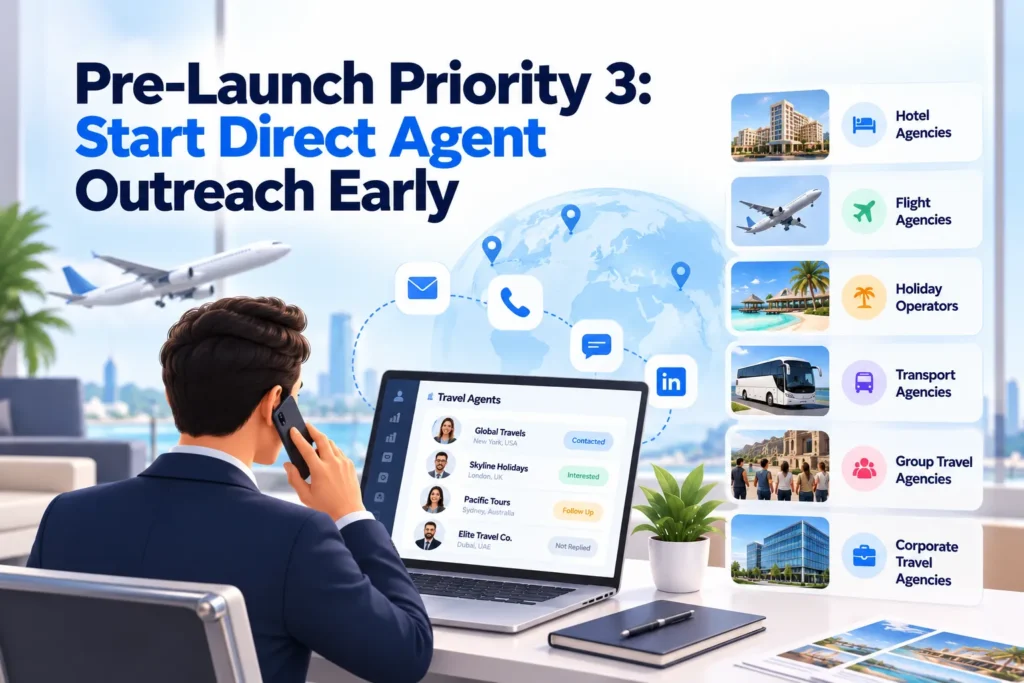
B2B travel growth often depends on direct sales.
Founders should not wait until launch day to begin agency outreach.
Start building a list of relevant agencies and operators.
Segment them by:
- Location
- Travel category
- Estimated booking activity
- Customer type
- Regional specialization
- Corporate focus
- International or domestic travel
- Group travel capability
Then reach out with a specific value proposition.
Avoid sending the same message to every agency.
The aim of early outreach is not always immediate signup.
It is to learn:
- What they currently use
- What frustrates them
- Which inventory is missing
- How they handle payments
- Whether they need credit
- What reports matter
- What would motivate switching or adding another platform
Those conversations can improve both the marketing message and the product rollout.
Pre-Launch Priority 4: Build a Corporate Prospect Pipeline
Corporate travel requires a different sales motion.
Potential stakeholders may include:
- Travel managers
- Finance teams
- Procurement
- HR
- Administration teams
- Operations managers
- Office managers
The message should focus less on consumer-style travel deals and more on:
- Travel-policy control
- Employee management
- Approval workflows
- Booking visibility
- Department reporting
- Invoices
- Account support
Founders can begin prospecting before launch by inviting companies to:
- Schedule a workflow demonstration
- Join a pilot group
- Review corporate travel requirements
- Share current approval pain points
- Discuss employee booking needs
The purpose is to build a qualified pipeline before the platform is opened broadly.
Pre-Launch Priority 5: Start Supplier Conversations Before Demand Arrives
Marketing a B2B travel platform is not only demand-side marketing.
Supply matters too.
Agents and corporate customers will not remain active if the platform cannot provide relevant inventory.
Pre-launch supplier outreach can help founders identify:
- High-demand destinations
- Hotel availability gaps
- Local transport needs
- Activity inventory
- Package opportunities
- Commercial terms
- Settlement expectations
Do not wait until agents complain about inventory after launch.
If supplier connectivity, multi-category inventory, booking workflows, and travel operations are central to your launch plan, Miracuves’ travel booking platform software can help founders evaluate the broader technology layer behind those workflows.
Supplier readiness should develop alongside partner acquisition.
Pre-Launch Priority 6: Use Demos as a Sales Tool
B2B buyers often need to see workflows.
A written feature list may not be enough.
Demonstrations can show how an agent:
- Logs in.
- Searches inventory.
- Creates a customer booking.
- Uses available balance or approved payment logic.
- Checks commission.
- Views booking history.
A corporate demonstration can show:
- Employee account creation.
- Travel-policy configuration.
- Booking request.
- Manager approval.
- Invoice or reporting workflow.
Demos turn abstract promises into operational understanding.
Before building your demonstration flow, review the B2B travel platform features that agents, corporate users, suppliers, finance teams, and administrators may need during day-to-day operations.
They also create valuable objections.
For a more educational breakdown of role-specific requirements, this B2B travel platform feature checklist explains which workflows matter most for agents, corporate clients, suppliers, and platform operators.
If ten potential partners repeatedly ask the same question, that question belongs in your marketing, onboarding, or product roadmap.
What Should Travel Startups Measure Before Launch?
Pre-launch metrics should focus on qualified demand.
Useful metrics include:
- Qualified agent leads
- Corporate prospects
- Supplier conversations
- Demo requests
- Demo attendance
- Early-access applications
- Partner-segment conversion
- Pilot participants
- Sales objections
- Requested travel categories
- High-demand destinations
- Supplier coverage gaps
These are more useful for a B2B startup than measuring broad social reach alone.
Post-Launch Marketing Has a Different Job
Once the platform is live, awareness is no longer enough.
Now marketing must create transaction activity.
The core post-launch question becomes:
Are partners actually booking?
A registered agent who never transacts has limited commercial value.
A corporate account that creates employee profiles but never completes a booking has not activated.
A supplier that registers but never maintains inventory may not improve the marketplace.
Post-launch marketing should therefore move through four stages:
- Activation
- Retention
- Expansion
- Advocacy
Post-Launch Priority 1: Get Partners to Their First Booking
The first booking is one of the most important events in the partner journey.
A travel agent may need help understanding:
- Search
- Inventory
- Booking workflow
- Balance or payment process
- Commission
- Cancellation rules
- Support
Corporate accounts may need assistance with:
- Adding employees
- Setting roles
- Configuring approvals
- Making the first booking
- Accessing reports
This is why onboarding is part of marketing.
A welcome email alone is not enough.
High-value accounts may benefit from:
- Guided onboarding
- Short product walkthroughs
- First-booking support
- Account-manager calls
- Training videos
- Category-specific tutorials
The goal is reducing the time between registration and first transaction.
Post-Launch Priority 2: Segment Active and Inactive Partners
Do not send the same campaigns to everyone.
Partners behave differently after launch.
Useful segments may include:
- Registered but not approved
- Approved but not activated
- Activated but no booking
- First booking completed
- Repeat booking partner
- High-volume account
- Dormant account
- Corporate account with low adoption
- Supplier with low inventory activity
Each segment needs a different message.
For example:
An inactive agent may need onboarding help.
A high-volume agent may respond to new categories or commercial incentives.
A dormant account may need better inventory or account support.
A corporate client with one active department may be ready for account expansion.
Segmentation makes post-launch marketing more relevant.
Post-Launch Priority 3: Increase Booking Frequency
Partner acquisition is only the beginning.
A stronger growth metric is booking frequency.
Marketing can support repeat bookings through:
- Relevant inventory updates
- New destination alerts
- Partner-specific promotions
- Product education
- Corporate account support
- Booking reminders
- Seasonal inventory campaigns
- Commission incentives
- Faster repeat-booking workflows
The aim is not to send more marketing messages.
Founders planning how commission, supplier margins, corporate plans, settlements, and booking revenue connect can also review the B2B travel platform business model.
The aim is to create more reasons to transact.
Post-Launch Priority 4: Expand Existing Accounts
Existing accounts can become a major source of growth.
An agent who books flights may also need:
- Hotels
- Transfers
- Cabs
- Packages
- Activities
A corporate account using the platform for one department may expand to:
- Additional departments
- More employee accounts
- New offices
- More travel categories
- Additional destinations
This is account expansion.
It can be more efficient than repeatedly acquiring completely new partners because the business relationship already exists.
Post-Launch Priority 5: Use Partner Referrals Carefully
Referrals can work well in B2B travel because agencies, suppliers, and business networks are relationship-driven.
A partner referral program may reward:
- Qualified agency introductions
- Activated agent accounts
- New corporate accounts
- Supplier introductions
The incentive should be tied to a meaningful business event rather than only a signup.
For example, rewarding an activated account or first transaction can be more valuable than rewarding an unqualified registration.
Post-Launch Priority 6: Reactivate Dormant Partners
Dormant partners should be treated as a separate marketing audience.
An agent may stop booking because:
- Relevant inventory is unavailable.
- Rates are less competitive.
- Credit is insufficient.
- Support was slow.
- The interface was difficult.
- Another category became more important.
- Demand became seasonal.
Before launching a reactivation campaign, identify the likely reason for inactivity.
Then respond to the actual problem.
A generic discount may not fix an inventory or support issue.
Pre-Launch vs Post-Launch Marketing Priorities
Pre-Launch vs Post-Launch Marketing for B2B Travel Platforms
| Marketing Area | Pre-Launch Priority | Post-Launch Priority |
|---|---|---|
| Main Goal | Validate demand and build a qualified partner pipeline. | Activate partners and increase recurring booking volume. |
| Travel Agents | Identify segments, collect interest, conduct interviews, and book demos. | Drive first bookings, repeat transactions, referrals, and account expansion. |
| Corporate Accounts | Build a prospect list and validate policy, approval, billing, and reporting needs. | Onboard employees, increase department adoption, and grow booking activity. |
| Suppliers | Identify inventory gaps and begin supplier conversations. | Improve availability, destination coverage, pricing, and confirmation performance. |
| Primary KPI | Qualified leads, demos, pilot interest, and partner readiness. | Active accounts, bookings per partner, retention, and account growth. |
Which Marketing Channels Matter Before Launch?
B2B travel startups should choose channels based on partner quality rather than raw reach.
Useful pre-launch channels can include:
- Direct email outreach
- LinkedIn outreach
- Travel trade communities
- Industry associations
- Regional sales representatives
- Referral introductions
- Partner landing pages
- Webinars
- Product demonstrations
- Existing agency networks
- Corporate prospecting
- Supplier outreach
- Founder-led networking
SEO can also begin before launch.
Educational content around travel operations, agent management, corporate travel, booking workflows, and supplier relationships can build topical authority while the commercial platform is being prepared.
Which Marketing Channels Matter After Launch?
Post-launch channels should support activation and retention.
Useful channels include:
- CRM-based email
- Account-manager outreach
- Partner WhatsApp or communication channels
- Educational webinars
- Training sessions
- Product-update emails
- Referral programs
- Re-engagement campaigns
- SEO content
- Sales follow-up
- Corporate account reviews
- Supplier performance communication
The strongest channel depends on the account.
A strategic corporate account may require direct account management.
A long tail of smaller agencies may be supported through automated campaigns, webinars, and self-service education.
Founder Decision Signals
Weak Pre-Launch Pipeline
If launch is approaching but you have few agent conversations, corporate prospects, or demos booked, shift resources from broad awareness toward targeted B2B outreach.
High Signup, Low Booking
If partners register after launch but do not transact, the issue may be onboarding, inventory, pricing, credit, product understanding, or first-booking support rather than acquisition.
Strong Active Accounts
If existing partners book consistently, prioritize account expansion, additional travel categories, referrals, and higher booking frequency before aggressively adding new segments.
Weak Inventory Conversion
If searches are high but bookings remain low, investigate supplier availability, confirmation rates, pricing, and destination coverage before increasing marketing spend.
What Metrics Should Change After Launch?
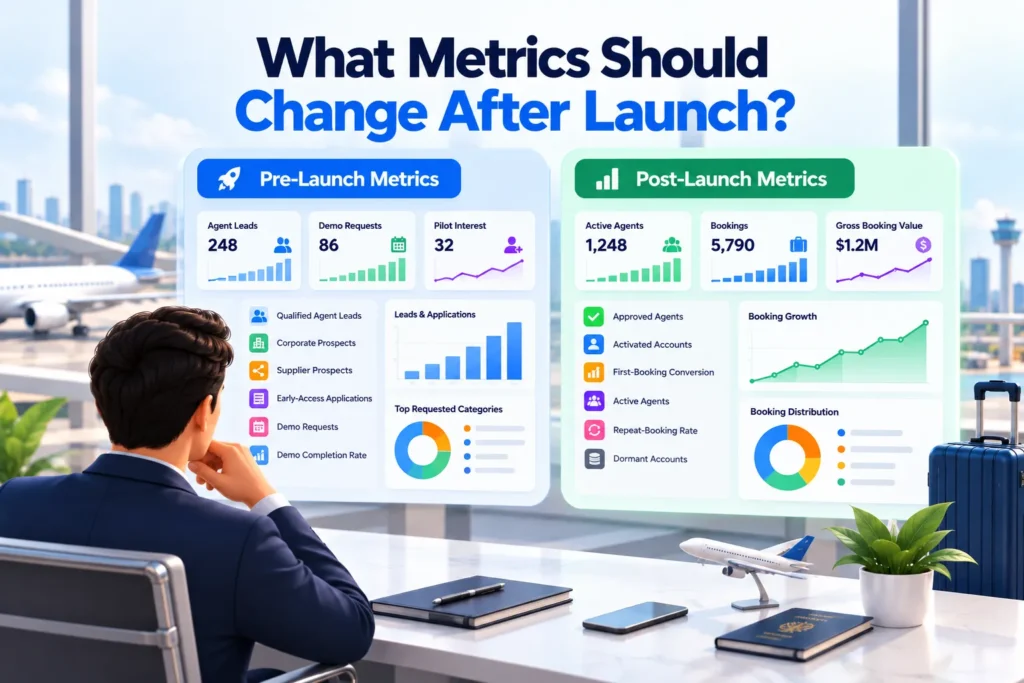
Pre-launch and post-launch dashboards should not look identical.
Pre-launch metrics
Track:
- Qualified agent leads
- Corporate prospects
- Supplier prospects
- Early-access applications
- Demo requests
- Demo completion rate
- Pilot interest
- Partner interview count
- Common objections
- Requested categories
- Target destinations
Post-launch metrics
Track:
- Approved agents
- Activated accounts
- First-booking conversion
- Time to first booking
- Active agents
- Active corporate accounts
- Bookings per account
- Repeat-booking rate
- Gross booking value
- Dormant accounts
- Reactivated accounts
- Account expansion
- Referral activation
- Supplier confirmation rate
- Cancellation rate
- Partner retention
Marketing becomes much easier to improve when acquisition activity can be connected to actual booking behavior.
How Much Marketing Should Happen Before Launch?
There is no universal percentage of budget that every B2B travel startup should spend before launch.
The right allocation depends on:
- Existing agent network
- Corporate relationships
- Supplier access
- Geographic market
- Sales cycle
- Platform readiness
- Team size
- Travel categories
- Budget
However, founders should avoid treating launch day as the starting point for marketing.
Basic market validation, lead generation, agent conversations, supplier discussions, and corporate prospecting should begin before the product goes live.
The startup should ideally enter launch with a clear answer to:
Who are the first accounts we expect to activate?
How Miracuves Can Support a Faster B2B Travel Launch
Marketing works better when the product foundation is ready to support the accounts being acquired.
If the strategy involves agents, corporate clients, suppliers, commissions, booking workflows, balances, reporting, and administrative control, those workflows need to function before growth campaigns create operational pressure.
Businesses exploring broader travel marketplace models can also review Miracuves’ travel booking solutions for related platform options.
If you are comparing budget and rollout scope, review Miracuves’ guide to B2B travel platform development cost.
For vendor evaluation, this page on choosing a B2B travel development partner can help you understand what to evaluate before selecting a team. When the ready-made scope fits the rollout requirement, Miracuves can support 6-day solution delivery, helping founders move from planning toward partner validation without building every core travel workflow from zero.
For founders evaluating a launch-ready foundation, Miracuves’ B2B travel booking platform provides a commercial next step for reviewing agent, supplier, corporate, booking, and administrative workflows.
A ready-made foundation can also allow founders to begin partner conversations earlier because they have something more concrete to demonstrate than a concept alone.
When the ready-made scope fits the rollout requirement, Miracuves can support 6-day solution delivery, helping founders move from planning toward market validation without building every core travel workflow from zero.
Mistakes Founders Should Avoid
Waiting Until Launch Day to Find Agents
A platform can be technically ready and still launch without demand. Agent interviews, partner outreach, demos, and early-access conversations should begin before launch.
Using Consumer Marketing as the Main B2B Strategy
Downloads, broad social reach, and destination content can support a consumer business, but B2B platforms also need direct sales, partner onboarding, account management, and relationship-driven acquisition.
Measuring Registrations Instead of Activation
A large number of registered partners means little if few complete bookings. Track first-booking conversion, repeat activity, account expansion, and retention.
Increasing Marketing Spend Before Fixing Supply Problems
If partners cannot find suitable inventory, pricing, or reliable confirmations, more acquisition can increase disappointment rather than revenue.
Founders can also review these B2B travel platform mistakes before increasing acquisition spend, expanding supplier coverage, or scaling partner onboarding.
Pre-Launch Checklist for B2B Travel Startups
Before launch, confirm:
- Primary agent segment is defined.
- Corporate prospect profile is clear.
- Supplier gaps have been identified.
- Partner landing page is live.
- Early-access CTA is available.
- Agent outreach list exists.
- Corporate prospecting has started.
- Supplier conversations have started.
- Demonstration workflow is ready.
- Sales objections are being documented.
- Initial onboarding material exists.
- Launch KPIs are defined.
- Analytics and CRM tracking are ready.
- First accounts have been identified.
Post-Launch Checklist for B2B Travel Startups
After launch, prioritize:
- First-booking activation
- Agent onboarding
- Corporate account setup
- Partner segmentation
- Dormant-account identification
- Supplier-performance monitoring
- Repeat-booking campaigns
- Referral programs
- Account expansion
- Product education
- Partner feedback
- Support quality
- Booking-volume reporting
- Retention analysis
Related reading: B2B travel booking platform growth strategy.
Final Thoughts: Pre-Launch Builds the Pipeline, Post-Launch Builds the Business
Pre-launch marketing and post-launch marketing should not compete for importance.
They solve different problems.
Before launch, the startup needs evidence that the market cares. That means finding the right agents, corporate prospects, suppliers, and early partners.
After launch, the business needs evidence that those relationships can produce transactions. That means activation, repeat bookings, account growth, retention, referrals, and supplier performance.
For B2B travel startups, the strongest marketing strategy connects the two stages.
Pre-launch activity should create the first post-launch accounts.
Post-launch data should improve the next acquisition campaign.
When those loops work together, marketing stops being a collection of promotions and becomes a repeatable partner-growth system.
FAQs
Why is pre-launch marketing important for a B2B travel platform?
Pre-launch marketing helps founders identify target agents, corporate accounts, supplier requirements, market objections, and early demand before the platform goes live.
What should a travel startup market before launch?
Focus on partner value, agent benefits, corporate workflows, inventory coverage, demonstrations, early access, and business-specific use cases rather than broad consumer awareness alone.
What should change after the platform launches?
Post-launch marketing should move from lead generation toward partner activation, first bookings, repeat transactions, account expansion, referrals, and retention.
How can a B2B travel platform acquire travel agents?
Travel startups can use direct outreach, regional sales, travel associations, referrals, demos, partner landing pages, webinars, existing industry networks, and account-manager follow-up.
How should corporate travel accounts be marketed?
Corporate messaging should focus on employee travel management, approvals, policies, booking visibility, reporting, invoices, and account support.
What is the most important post-launch metric?
There is no single metric for every business, but first-booking conversion, active partners, repeat-booking rate, bookings per account, and retention are generally more useful than registration totals alone.
Should supplier acquisition begin before launch?
Yes. Supplier discussions can begin before launch so the platform can identify inventory gaps, target destinations, availability needs, and commercial expectations before agent demand increases.
Can Miracuves help launch a B2B travel booking platform?
Yes. Miracuves helps founders launch ready-made and white-label travel platforms with agent, corporate, supplier, booking, and administrative workflows. A 6-day solution delivery may apply when the ready-made scope matches the project requirements.
Miracuves is an independent software development company. We are not affiliated with, connected to, sponsored by, or endorsed by any company or product named in this article.
Terms such as “X Clone” are used descriptively. It is how the software industry refers to building a platform with functionality comparable to a known service, and how clients search for it.
The entire design and codebase of our products is built by our own team. Our products contain no code, design, graphics, or content originating from any third-party website or applications.
All third-party names and marks referenced in this article are the property of their respective owners, referenced solely to identify the services discussed.