Key Takeaways
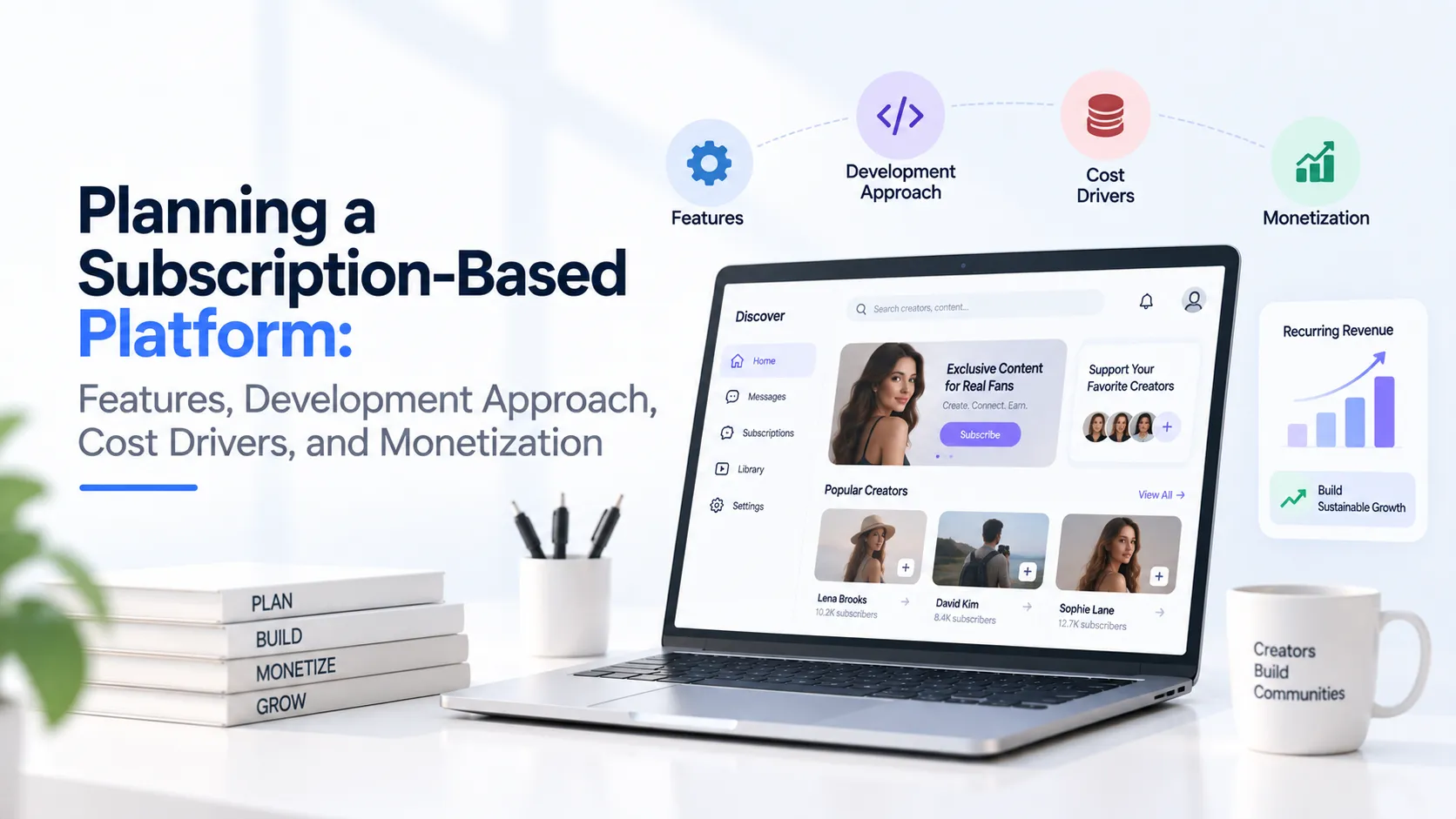
- A subscription-based platform is a complete ecosystem connecting creators, subscribers, premium content, payments, and administration.
- Core features include creator profiles, subscription tiers, gated content, pay-per-view access, messaging, wallets, payouts, and analytics.
- The right development approach depends on launch speed, customization requirements, technical control, budget, and business-model complexity.
- Development cost is influenced by user panels, feature depth, payment logic, content infrastructure, integrations, security, and customization.
- Founders should define the platform niche, monetization structure, user roles, and operational workflows before development begins.
Platform Planning Signals
- Decide whether the product will focus on creators, premium content libraries, expert memberships, fan engagement, or niche communities.
- Map subscriber, creator, administrator, moderator, finance, support, and agency roles where required.
- Define subscriptions, premium unlocks, tips, paid messages, live sessions, commissions, refunds, and creator payouts.
- Plan content protection, creator verification, reporting, moderation, dispute handling, activity logs, and permission-based access.
- Separate essential launch workflows from future features so the platform can validate demand without unnecessary development complexity.
Real Insights
- Recurring billing alone does not create a sustainable product when content access, creator tools, and subscriber value remain unclear.
- Supporting more user roles and payment scenarios increases permission logic, financial tracking, testing, and administrative complexity.
- Custom development suits highly differentiated workflows, while a ready-made foundation can accelerate validation of common platform operations.
- After launch, founders should track creator activation, subscription conversion, payment success, engagement, churn, and revenue per creator.
- Miracuves offers a white-label, source-code-owned subscription platform starting at $3,699, with eligible ready-made scopes delivered in 6 days and final pricing based on features, integrations, branding, and customization.
A subscription-based platform is a digital product where users pay recurring fees to access exclusive content, private communities, premium creator posts, digital services, live experiences,
A subscription-based platform gives creators, experts, and digital entrepreneurs a way to earn recurring revenue by offering exclusive access to premium content, private communities, paid interactions, coaching material, or member-only benefits. Instead of depending only on ads, one-time purchases, or unpredictable sponsorship income, this model helps platform owners build a more stable monetization system around loyal paying users.
For founders, the opportunity is not just about adding monthly billing. A successful subscription platform needs the right mix of creator profiles, gated content, secure payments, wallet flows, subscriber engagement, moderation, analytics, and admin control. Each feature must support the business model, protect paid access, and create a smooth experience for both creators and subscribers.
A subscription platform can support several creator-focused models, including premium creator communities, fan membership platforms, paid photo and video access, lifestyle or coaching memberships, exclusive content subscriptions, pay-per-view content, paid messaging, niche entertainment communities, and premium digital resource libraries.
The biggest planning mistake founders make is treating the product as a simple payment app. In reality, long-term success depends on how content access, creator tools, subscriber experience, payments, trust, and platform governance work together.
Why Founders Are Planning Subscription Platforms Now
Creators, coaches, entertainers, lifestyle experts, and digital communities are looking for better ways to build direct relationships with paying audiences. Public social platforms are useful for visibility, but they do not always give creators full control over monetization, member experience, content access, or long-term audience value.
That is why subscription-based platforms are becoming attractive for founders. They allow businesses to create a branded ecosystem where creators can publish premium content, subscribers can pay for exclusive access, and platform owners can manage payments, communication, moderation, analytics, and growth from one place.
For founders, this is not just a technology decision. It is a business control decision.
Before development begins, you need to answer:
- Who owns the customer relationship?
- How will creators earn from subscriptions, tips, paid messages, or pay-per-view content?
- How will subscribers access locked or premium content?
- How will payments, refunds, disputes, commissions, and payouts be managed?
- What moderation, reporting, and verification workflows are needed?
- How will the platform expand after launch?
When these decisions are made early, the product scope becomes clearer, cost planning becomes more realistic, and the platform is easier to launch, monetize, and scale.
Subscription-Based Platform Models Founders Can Build
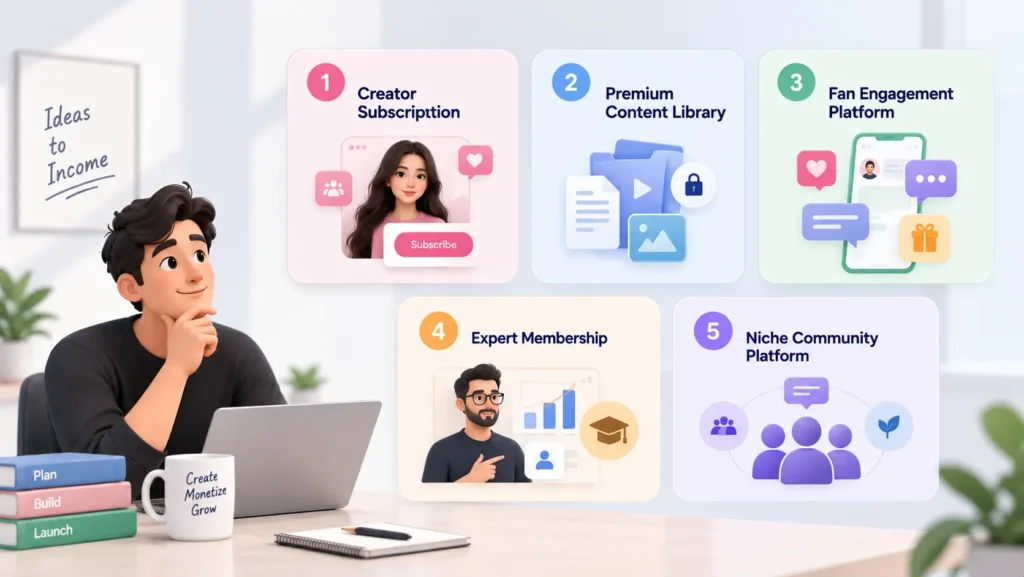
Image Source: AI-generated visual by Miracuves
Not every subscription platform should follow the same structure. A strong product starts with the business model, not the feature list.
1. Creator Subscription Platform
This model allows creators to publish content behind recurring access plans. Subscribers pay monthly or yearly to view exclusive posts, videos, photos, files, updates, or private community content.
Best for:
- Influencers
- Digital creators
- Coaches
- Premium media brands
- Entertainment communities
- Creator agencies
Business value: predictable recurring revenue and stronger creator-audience relationships.
2. Premium Content Library
This model focuses on gated content collections rather than creator personalities. Users pay to access premium videos, tutorials, research, files, templates, or resource bundles.
Best for:
- Education businesses
- Fitness programs
- Professional communities
- Digital product sellers
- Training platforms
Business value: scalable content monetization without needing every interaction to be creator-led.
3. Fan Engagement Platform
This model combines subscriptions with interaction tools such as private messages, live sessions, paid requests, shoutouts, tips, gifts, and exclusive fan experiences.
Best for:
- Influencer communities
- Celebrity engagement products
- Music and entertainment communities
- Sports personalities
- Personal brand businesses
Business value: higher revenue per subscriber through direct engagement and premium experiences.
4. Expert Membership Platform
This model works when subscribers pay for specialized knowledge, mentoring, coaching, or advisory access.
Best for:
- Business coaches
- Fitness trainers
- Finance educators
- Career mentors
- Skill-based experts
- Consultants
Business value: premium pricing potential through perceived expertise and direct access.
5. Niche Community Platform
This model focuses on community access, discussions, member groups, premium updates, and creator-led interaction.
Best for:
- Private clubs
- Professional networks
- Hobby communities
- Paid interest groups
- Local or regional creator communities
Business value: retention improves when users pay for belonging, not just content.
What Makes a Direct-to-Fan Creator Platform Different?
A direct-to-fan platform allows creators to build paid relationships with their audiences without depending entirely on advertising, sponsorships, or public social networks. Platforms such as OnlyFans helped popularize this model by bringing creator profiles, exclusive content, recurring subscriptions, tips, pay-per-view access, private messaging, and creator earnings into one ecosystem.
Unlike a general membership website, a direct-to-fan platform is built around regular content publishing and personalized fan interaction. Creators control what they publish, how much they charge, and whether their content is available through a recurring subscription or a separate purchase.
The commercial model usually connects four important activities:
- Creators publish free, subscriber-only, or individually locked content.
- Fans follow creators and pay for recurring or one-time access.
- Creators earn through subscriptions, PPV content, tips, and paid interactions.
- The platform manages commissions, payment records, moderation, and payouts.
OnlyFans is not the only possible version of this model. The same platform structure can support influencers, artists, musicians, fitness professionals, educators, entertainers, personal brands, or verified adult creators. Founders can adapt the model through different branding, creator categories, pricing rules, content policies, and engagement features.
The main difference is that revenue does not come from subscriptions alone. The product must connect content discovery, premium access, fan communication, payment processing, and creator payouts without creating confusion for users.
How Subscriptions, Feeds, Messaging, and PPV Connect
The creator feed should clearly distinguish between free posts, subscriber-only content, and media that requires a separate payment. Fans must always understand what their subscription includes and what must be purchased individually.
A complete direct-to-fan experience may include:
- Free and paid creator profiles
- Follow and subscription options
- Recurring monthly memberships
- Multi-month subscription bundles
- Promotional subscription offers
- Subscriber-only photos, videos, audio, and posts
- Locked pay-per-view posts
- Paid media inside private messages
- Direct creator-to-fan messaging
- Tips through profiles, posts, or messages
- Subscription renewal and expiry notifications
- Accurate purchase and content-unlock records
Access rules must remain accurate after subscription renewals, cancellations, refunds, disputes, deleted content, or account suspension. These workflows determine whether fans trust the purchasing experience and whether creators can monetize consistently.
Core Features Every Subscription-Based Platform Should Include
A subscription platform must serve three sides of the business: subscribers, creators, and platform operators. If one side is weak, the entire product becomes harder to scale.
| Feature Area | Business Value | Founder Impact |
|---|---|---|
| Creator Profiles | Gives creators a branded space to showcase content, pricing, bio, media, and offers. | Helps attract creators and improves subscriber trust before payment. |
| Subscription Plans | Supports recurring revenue through free, paid, VIP, or custom membership tiers. | Allows the platform to monetize different audience segments. |
| Gated Content Access | Controls who can view premium posts, media, files, videos, or private updates. | Protects paid content and makes subscription value clear. |
| Pay-Per-View Access | Lets users unlock individual content without subscribing to everything. | Adds flexible revenue beyond recurring plans. |
| Wallet and Payments | Enables subscriptions, tips, top-ups, paid messages, and one-time purchases. | Reduces checkout friction and improves transaction visibility. |
| Messaging and Engagement | Supports private communication, paid replies, media messages, and fan interaction. | Improves retention by making the platform interactive, not just transactional. |
| Live Sessions and Calls | Adds real-time engagement through paid live access, private sessions, or one-to-one calls. | Creates premium revenue opportunities for high-value creators. |
| Creator Dashboard | Allows creators to manage content, subscribers, earnings, messages, and offers. | Improves creator satisfaction and reduces support dependency. |
| Admin Dashboard | Centralizes control over users, creators, payments, content, reports, and disputes. | Gives founders operational control as the platform grows. |
| Moderation and Verification | Supports content review, user reporting, identity checks, creator verification, and policy enforcement. | Protects platform trust, user safety, and payment provider relationships. |
| Analytics and Reporting | Tracks revenue, engagement, subscriptions, churn, creator performance, and transaction activity. | Helps founders make better pricing, retention, and growth decisions. |
Subscriber-Side Features That Improve Paid User Experience
Subscribers need a smooth experience from discovery to payment to content access. If the subscriber journey is confusing, creators earn less and the platform struggles with retention.
Important subscriber-side features include:
- Account registration and profile setup
- Creator discovery and search
- Subscription plan comparison
- Secure checkout
- Wallet balance and payment history
- Premium content feed
- Locked and unlocked content states
- Private messaging
- Saved posts and bookmarks
- Notifications for new content
- Refund and dispute support where applicable
- Account privacy and security settings
The most important principle is clarity. Subscribers should always know what is free, what is paid, what is included in a subscription, and what requires a separate purchase.
Creator-Side Features That Help Creators Earn More
Creators are the supply side of the platform. If creator tools are weak, the platform may attract users but fail to retain the people who produce value.
A strong creator dashboard should help creators:
- Set up profiles and pricing
- Create subscription tiers
- Upload premium content
- Schedule content drops
- Manage paid messages
- Send updates to subscriber groups
- Track earnings
- View subscriber growth
- Manage media libraries
- Offer tips, bundles, or one-time unlocks
- Run live sessions or private paid interactions
- Respond to subscriber requests
- Understand which content performs best
For founders, this is where product planning becomes strategic. The platform should not only help creators publish. It should help them monetize consistently.
A creator who understands earnings, engagement, subscriber behavior, and content performance is more likely to stay active. Active creators keep subscribers engaged. Engaged subscribers increase platform revenue.
Admin Features That Give Founders Operational Control
The admin dashboard is the control center of the business. It is where the platform operator manages users, creators, subscriptions, transactions, content, reports, disputes, and platform rules.
A subscription platform without strong admin control becomes difficult to operate as soon as real users, real payments, and real moderation needs appear.
Important admin controls include:
- User and creator management
- Creator approval and verification workflows
- Subscription plan visibility
- Payment and transaction monitoring
- Payout management
- Commission settings
- Content moderation queues
- Abuse reporting
- Dispute management
- Refund visibility
- Role-based access control
- Platform analytics
- Revenue reporting
- Notification management
- Category and content policy settings
This is especially important for founders planning a paid content platform because platform risk increases when money, private content, creator earnings, and user trust are involved.
Payment, Wallet, and Payout Planning
Payments are one of the most important parts of a subscription platform. The platform must handle recurring billing, one-time purchases, wallet top-ups, creator earnings, commissions, refunds, and payout records.
Founders should think about payment planning in layers:
Subscription Billing
Recurring billing allows subscribers to pay for ongoing access. This can include monthly, yearly, free trial, discounted, or custom membership plans depending on the business model.
One-Time Unlocks
Pay-per-view content allows users to buy individual posts, messages, media files, bundles, or premium experiences without subscribing to a full plan.
Wallet-Based Spending
A wallet system can support faster repeat purchases. Users can add balance and spend it on tips, gifts, paid messages, live access, or premium content.
Creator Payouts
Creators need transparent earnings records. The platform should show how much they earned, what commission was deducted, what is pending, and what has been paid.
Admin Revenue Control
The platform operator should be able to configure commissions, payment rules, payout thresholds, and transaction visibility from the admin dashboard.
Payment gateway selection also depends on geography, business category, provider approval, risk policy, currency support, payout flows, and compliance expectations. Founders should confirm these requirements before finalizing the build.
Payment Considerations for Platforms That Permit Adult Content
Payment processing becomes more complicated when a creator platform permits adult or restricted content. Many standard payment gateways limit or prohibit adult-oriented businesses, while specialist or high-risk payment providers may require stricter identity checks, transaction monitoring, reserve balances, chargeback controls, or delayed payouts.
A payment gateway that supports normal ecommerce subscriptions may not automatically approve a platform similar to OnlyFans. Founders should therefore confirm business-category approval before finalizing development or promising specific payment methods to creators.
The selected payment infrastructure should support:
- Recurring subscription billing
- Automatic renewals and cancellations
- Failed
Security, Trust, and Compliance-Ready Workflows
Security should not be treated as a final add-on. It should be part of the product foundation from the beginning.
A subscription-based platform may involve personal profiles, private content, paid access, user messages, creator earnings, and payment records. That makes privacy-conscious data handling and platform governance essential.
Important trust and safety layers include:
- Encrypted data transfer
- Secure payment gateway integration
- Role-based access control
- Admin activity logs
- Creator verification
- User reporting
- Content moderation
- Takedown workflows
- Age-gating where relevant
- Transaction monitoring
- Dispute management
- Permission-based dashboards
- Secure API integration
- Privacy-conscious data handling
Founders should also understand that compliance requirements depend on the target market, content category, payment providers, legal structure, and operating model. A platform can support compliance-ready workflows, but final legal and regulatory review should be handled based on jurisdiction and business scope.
Stronger 18+ Verification and Consent Workflows
If a platform permits adult or restricted content, basic age gating is not enough. Identity, age, and consent checks should be built into creator onboarding, content submission, user access, moderation, and payout workflows.
Creators should complete identity and age verification before publishing restricted content or receiving earnings. Depending on the target jurisdiction, users attempting to access adult content may also need to complete an approved age-assurance process.
The platform should also verify every person appearing in uploaded restricted content. A creator’s verification alone does not establish the identity, age, or consent of other participants.
Important verification and consent controls include:
- Creator identity and age verification
- User age assurance before restricted content access
- Verification of every person appearing in uploaded media
- Consent declarations and model-release documentation
- Tagged collaborator or co-performer records
- Secure storage of verification and consent evidence
- Expiration and reverification workflows
- Geographic content restrictions
- Non-consensual content reporting
- Rapid review and takedown procedures
- Repeat-violation detection
- Moderator escalation and audit records
Content records should connect each uploaded media item with the relevant creator, participants, verification status, and consent documentation. If required evidence is missing, expired, or disputed, the content should be held for review rather than published automatically.
The platform should also provide clear reporting options for impersonation, underage content, stolen media, non-consensual intimate content, and other policy violations. High-risk reports should enter a priority moderation queue with recorded decisions and escalation procedures.
Requirements differ across countries and business models. Technology can support compliance-ready workflows, but founders should obtain legal guidance for the jurisdictions and content categories in which the platform will operate.
Development Approaches: Custom Build vs Ready-Made Platform Foundation
Founders usually compare two routes when planning a subscription-based platform: building from scratch or starting with a ready-made platform foundation.
Both approaches can work, but they serve different business situations.
| Development Approach | What It Means | Best For | Founder Tradeoff |
|---|---|---|---|
| Custom Development | Building the product from the ground up based on unique requirements. | Highly differentiated platforms with uncommon workflows. | More flexibility, but usually higher time, cost, and planning complexity. |
| Ready-Made Platform Foundation | Starting with prebuilt core modules such as profiles, subscriptions, payments, content access, messaging, and admin control. | Founders who want faster market entry and a proven starting point. | Faster launch, but customization scope should be planned clearly. |
| Hybrid Approach | Launching with a ready-made foundation and customizing priority workflows. | Founders who need speed plus brand-specific differentiation. | Balanced approach when validation speed matters. |
For many founders, the hybrid approach is practical. It avoids building every module from zero while still allowing customization around branding, monetization, content policies, creator categories, payment gateways, and growth strategy.
Miracuves supports this approach by helping founders launch a branded creator monetization platform with a ready-made foundation, source-code ownership, admin control, and eligible 6-day delivery for ready-made scopes. Founders who want a product-specific route can explore the ready-made creator subscription solution to understand how a launch-ready platform can be configured for their business model.
Founder Decision Signals
Speed
If the goal is market validation, a ready-made foundation can reduce the time spent rebuilding common modules such as profiles, subscriptions, content access, payments, messaging, and admin operations.
Cost
Cost rises when the platform needs advanced custom design, complex payment flows, live engagement, moderation, analytics, AI workflows, or regional compliance configuration.
Scalability
Scalability depends on media storage, content delivery, backend architecture, database structure, payment reliability, and admin visibility into platform activity.
Market Fit
The platform should be planned around a clear creator niche, audience willingness to pay, content frequency, pricing logic, and retention strategy before heavy customization begins.
Cost Drivers in Subscription-Based Platform Development
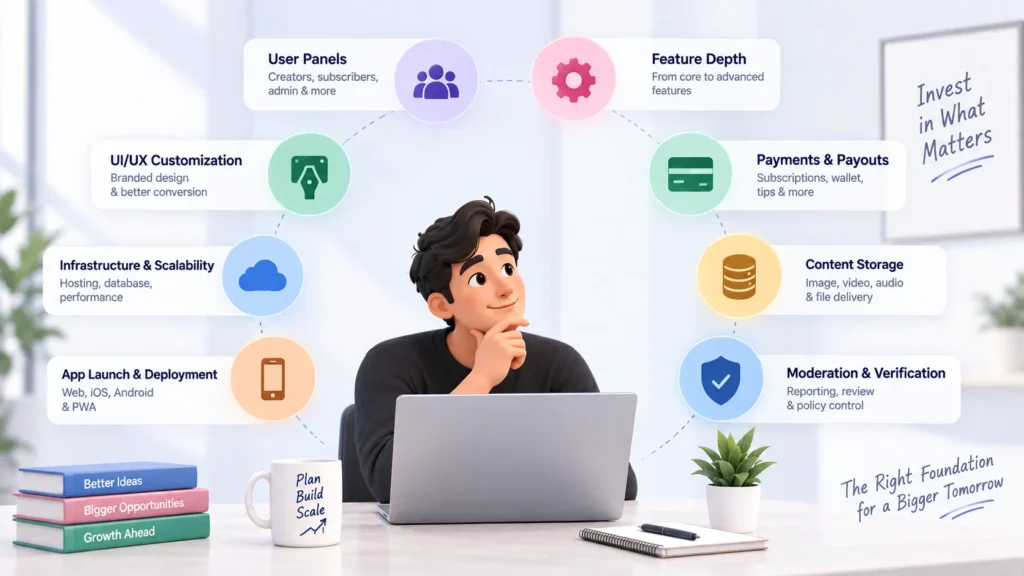
Image Source: AI-generated visual by Miracuves
The cost of developing a subscription-based platform depends on scope. Instead of asking for a single flat estimate, founders should break the cost into product layers.
1. Number of User Panels
A basic platform may need subscriber, creator, and admin panels. More advanced models may need agency dashboards, moderator roles, finance roles, support teams, or partner accounts.
More roles mean more permissions, workflows, testing, and dashboard logic.
2. Feature Depth
A simple subscription product may include profiles, content upload, payments, and admin control. A more advanced platform may include paid messaging, live streaming, wallet flows, creator shops, custom requests, media vaults, AI engagement, and advanced analytics.
Feature depth directly affects planning, development, QA, and infrastructure.
3. Payment Gateway and Payout Logic
Subscription billing, wallet top-ups, pay-per-view access, tips, platform commission, creator payouts, refunds, and tax-related records can add complexity.
The more payment scenarios you support, the more carefully the system needs to track transactions and access rights.
4. Content Storage and Delivery
Premium content platforms often need image, video, audio, and file handling. Media-heavy platforms require careful planning for storage, streaming, compression, access control, and delivery performance.
Poor media architecture can hurt user experience and increase operating costs later.
5. Moderation and Verification
Platforms with user-generated content need reporting tools, moderation queues, admin review workflows, creator verification, and policy enforcement.
If trust and safety are not planned early, platform operators may struggle with abuse, payment provider concerns, user complaints, and brand risk.
6. UI/UX Customization
A branded subscription platform should not feel generic. Custom design, onboarding flows, creator discovery, pricing pages, checkout experience, and mobile responsiveness all influence conversion and retention.
The more unique the design experience, the more time is needed for design, development, and testing.
7. Infrastructure and Scalability
Backend architecture, database design, cloud hosting, caching, media storage, notification systems, analytics, and API performance all affect cost.
A founder does not need enterprise-scale infrastructure on day one, but the foundation should not block growth.
8. App Publishing and Deployment
Launching mobile apps may involve app store preparation, compliance checks, build generation, testing, deployment support, and release management.
A web platform, mobile app, and PWA may each require different QA and deployment steps.
Cost Planning Table for Founders
| Cost Area | What Affects It | Planning Advice |
|---|---|---|
| Product Scope | Number of panels, modules, content types, and monetization flows | Define must-have features before adding advanced ideas. |
| Design | Branding, onboarding, dashboards, mobile UI, creator pages, and checkout flow | Prioritize trust-building screens and revenue-critical flows. |
| Payments | Subscriptions, wallets, PPV, tips, payouts, refunds, and commission rules | Confirm payment provider compatibility early. |
| Media Infrastructure | Video, audio, image, file storage, streaming, and access control | Plan for secure access and performance from the start. |
| Moderation | Reporting, review queues, verification, admin decisions, and policy workflows | Build trust tools before user activity scales. |
| Customization | Unique workflows, niche requirements, regional settings, and advanced modules | Separate launch essentials from later roadmap items. |
| Maintenance | Updates, bug fixes, security improvements, hosting, and feature iteration | Treat post-launch support as part of the business plan. |
Miracuves can help founders reduce planning uncertainty by starting with a ready-made platform base that already includes essential creator monetization workflows. Final pricing depends on selected modules, integrations, branding, infrastructure, and customization requirements.
Read More: How Can a Subscription-Based Platform Keep Creators Active and Subscribers Engaged?
Monetization Models for a Subscription-Based Platform
A strong subscription platform rarely depends on one revenue stream. Founders should design revenue layers that serve creators, subscribers, and platform operators.
1. Platform Commission
The platform earns a percentage from creator revenue. This can apply to subscriptions, paid content, tips, messages, live sessions, calls, shop purchases, or other monetized actions.
This is one of the most common platform revenue models because it grows with creator activity.
2. Creator Subscription Plans
Creators charge subscribers for recurring access to premium content. The platform can earn through commission, subscription processing, or creator plan fees.
This model works well when creators publish consistently and provide ongoing value.
3. Pay-Per-View Content
Subscribers pay once to unlock specific content. This is useful for premium posts, special media, exclusive files, limited content drops, and high-value creator updates.
This model helps creators monetize beyond monthly memberships.
4. Paid Messaging
Creators can charge for private replies, premium media messages, custom requests, or priority communication.
This works well when audiences value direct creator access.
5. Tips and Virtual Gifts
Fans can support creators with one-time tips or virtual gifts. This adds flexible monetization without forcing every user into a recurring subscription.
6. Wallet Top-Ups
A wallet system allows users to add balance and spend across the platform. This can improve repeat purchases and reduce checkout friction.
7. Live Sessions and Paid Calls
Creators can monetize real-time interaction through paid live access, private live sessions, audio calls, video calls, or group events.
This is useful for coaching, entertainment, fitness, fan engagement, and expert-led platforms.
8. Creator Commerce
Creators can sell digital products, physical products, bundles, consultations, premium files, or personalized services.
This expands the platform beyond content access into creator-led commerce.
9. Featured Placement and Promotion
The platform can charge creators for boosted visibility, featured listings, category promotions, or campaign placements.
This should be used carefully so discovery remains fair and user experience is not damaged.
How to Plan the First Version Without Overbuilding
Founders often try to include every possible feature in the first release. That can delay launch, increase cost, and make the product harder to test.
A better approach is to plan around the minimum set of workflows needed to validate the business.
For a subscription-based platform, the first version should usually answer these questions:
- Can creators create profiles and publish premium content?
- Can subscribers discover creators and understand pricing?
- Can users pay securely?
- Can paid access be controlled correctly?
- Can creators track earnings?
- Can the platform operator manage users, creators, payments, content, and disputes?
- Can moderation and reporting workflows protect the platform?
- Can the business add more monetization layers later?
Once these flows work, advanced features such as live sessions, AI engagement, creator shops, agency dashboards, loyalty tools, advanced analytics, and complex promotional systems can be added based on real user behavior.
Mistakes Founders Should Avoid
Starting With Features Before Defining the Business Model
A subscription platform for fitness creators, premium media, coaching, entertainment, and private communities may need different pricing, content, moderation, and engagement workflows. Define the model before finalizing features.
Ignoring Payment Provider Requirements
Payment gateways may have category restrictions, verification requirements, payout rules, and regional limitations. Confirm payment compatibility before development decisions become expensive to change.
Underestimating Moderation and Trust
Paid content platforms need user reporting, creator verification, admin review, content policy controls, and dispute handling. Weak trust systems can create operational problems after launch.
Building Without Admin Visibility
Founders need dashboards for users, creators, payments, subscriptions, content, payouts, reports, and platform revenue. Without admin visibility, scaling becomes reactive and inefficient.
Trying to Build Everything From Zero
Many subscription platforms share common foundations: profiles, subscriptions, content access, payments, messaging, analytics, and admin controls. Starting with a ready-made foundation can help founders validate faster and focus customization on market differentiation.
How to Plan and Launch a Subscription-Based Platform Step by Step
A practical roadmap helps founders avoid confusion between launch essentials and future expansion.
Step 1: Define the Platform Niche
Decide whether the platform is for creators, coaches, educators, influencers, communities, entertainers, consultants, or niche content publishers.
The niche affects pricing, content formats, moderation requirements, payment flows, and acquisition strategy.
Step 2: Map User Roles
Identify who will use the platform:
- Subscribers
- Creators
- Platform admins
- Moderators
- Finance or payout managers
- Support teams
- Agencies or brand partners, if relevant
Each role needs different permissions and dashboards.
Step 3: Finalize Core Monetization
Choose the first revenue layers. Avoid launching with too many monetization experiments at once.
A practical first release may include:
- Creator subscriptions
- Pay-per-view access
- Tips
- Platform commission
- Wallet top-ups
- Paid messaging
Step 4: Plan Content Access Rules
Define how content is locked, unlocked, expired, purchased, refunded, reported, or restricted.
This is one of the most important technical layers because paid access must be accurate and reliable.
Step 5: Select Payment and Payout Workflows
Decide how subscribers pay, how creators earn, how the platform takes commission, and how payouts are recorded.
Payment strategy should be planned before development because gateway rules can affect user experience and product scope.
Step 6: Build Trust and Safety Workflows
Plan user reporting, moderation queues, creator verification, admin review, content policy controls, and dispute handling.
Trust systems protect both users and the business.
Step 7: Launch, Measure, and Improve
After launch, track subscription conversion, creator activation, content frequency, payment success rate, churn, revenue per creator, and subscriber engagement.
The strongest platforms improve based on data, not assumptions.
Why a Ready-Made Foundation Can Help Founders Launch Faster
Building a subscription-based platform from scratch can take time because many modules need to work together: profiles, gated content, recurring payments, wallets, creator earnings, private communication, content moderation, analytics, and admin operations.
A ready-made foundation can help founders move faster because the core workflows already exist and can be configured around the business model.
This does not mean every platform should look the same. The real value is using a proven base for common platform logic, then customizing the areas that matter most:
- Brand identity
- Creator niche
- Pricing structure
- Content categories
- Payment gateway strategy
- Moderation rules
- Monetization mix
- Creator onboarding
- Subscriber experience
- Regional requirements
Miracuves helps founders launch white-label creator monetization platforms with source-code ownership, branded design, admin controls, and eligible 6-day delivery for ready-made scopes. For founders evaluating a product-ready path, the white-label creator monetization platform page explains the ready-made solution in more detail.
Final Thoughts: Plan the Platform Before You Build the Product
A subscription-based platform is not just a payment system. It is a complete ecosystem where creators publish value, subscribers pay for access, the platform manages trust, and the business earns through recurring and transaction-based revenue.
The strongest founders plan the model before development begins. They understand which users they serve, which monetization layers matter, which trust workflows are required, and which features should launch now versus later.
For many businesses, the smarter route is not to build every common module from zero. It is to start with a reliable product foundation, customize it around the market, and move faster toward validation.
Miracuves can help founders launch a branded, source-code-owned, subscription-based creator platform with the right balance of speed, control, monetization, and customization.
FAQs
What is a subscription-based platform?
A subscription-based platform is a digital product where users pay recurring fees to access premium content, creator communities, private updates, digital resources, live sessions, or member-only benefits. It usually includes user accounts, subscription plans, gated content, payments, creator tools, and admin controls.
What features are needed for a subscription-based creator platform?
A subscription-based creator platform usually needs creator profiles, subscriber accounts, subscription tiers, gated content, pay-per-view access, secure payments, wallet flows, messaging, notifications, creator dashboards, admin controls, moderation tools, and analytics.
How much does it cost to build a subscription-based platform?
Miracuves offers a ready-made subscription-based platform starting at $3,699 , with eligible delivery in 6 days. Final pricing depends on branding, integrations, features, and customization needs.
What monetization models can a subscription platform use?
A subscription platform can monetize through platform commission, creator subscriptions, pay-per-view content, paid messaging, tips, wallet top-ups, live sessions, paid calls, creator shops, promotional placements, and premium creator tools.
Should I build a subscription platform from scratch or use a ready-made foundation?
Custom development is useful when the product requires highly unique workflows. A ready-made foundation is better when founders want faster launch, lower initial complexity, and proven modules such as profiles, subscriptions, payments, gated content, messaging, and admin dashboards. Many founders use a hybrid route by starting with a ready-made base and customizing priority features.
Why is admin control important in a subscription-based platform?
Admin control helps the platform operator manage users, creators, content, payments, subscriptions, payouts, reports, disputes, moderation, and platform rules. Without strong admin visibility, scaling a paid content platform becomes difficult and risky.
How can creators earn from a subscription-based platform?
Creators can earn through recurring subscriptions, one-time content unlocks, tips, paid messages, live sessions, paid calls, digital products, custom requests, and premium content bundles. The platform can define which earning options are available based on its business model.
How fast can Miracuves help launch a subscription-based creator platform?
For eligible ready-made scopes, Miracuves can help launch a white-label creator monetization platform in 6 days. The final timeline depends on customization, payment gateways, design requirements, infrastructure, app publishing, and any advanced feature needs.
Miracuves is an independent software development company. We are not affiliated with, connected to, sponsored by, or endorsed by any company or product named in this article.
Terms such as “X Clone” are used descriptively. It is how the software industry refers to building a platform with functionality comparable to a known service, and how clients search for it.
The entire design and codebase of our products is built by our own team. Our products contain no code, design, graphics, or content originating from any third-party website or applications.
All third-party names and marks referenced in this article are the property of their respective owners, referenced solely to identify the services discussed.