


Key Takeaways
- On a speciality food marketplace the roster is both the inventory and the reason to visit, which makes supply the binding constraint rather than demand.
- Rank a prospective maker on capacity to fulfil first, a distinctive product second and an honest story third; the existing following is the attribute you can most afford to trade away.
- Every maker who joins tells their own customers, and those pre-sold arrivals are the cheapest acquisition on the platform and a direct consequence of supply work.
- Discovery has to handle proper nouns as well as categories, because a name query has exactly one correct result and every near miss reads as a broken product.
- Standing orders beat loyalty points here because they give the buyer a habit and the maker a floor under next week’s batch.
Roster Before Spend
- Score every prospective maker on capacity to fulfil before you score their following.
- Send a maker’s announcement traffic to their own storefront, with live stock and an honest delivery zone.
- Capture origin, maker, method, batch size and lead time as fields, never as a paragraph.
- Offer standing orders to the makers whose production runs on a weekly rhythm.
- Report roster-attributed demand next to paid demand in the same weekly review.
Real Insights
- Advertising against a thin roster costs twice: the wasted click and the opinion formed by a buyer who will be harder to win back later.
- A maker who cannot fulfil converts your demand into refunds, and the damage spreads to the makers either side of them on the results page.
- Supply-side churn is more expensive than buyer churn, because a departing maker takes their following with them and hands it to whoever signs them next.
- Signing stops helping once browse depth flattens and new vendors take longer to reach a first order; that is when discovery and zones matter more than the next forty signatures.
- Miracuves builds the vendor spine that makes supply-led growth possible, with eligible ready-made scopes deployed in 6 days of build time on your own hosting and developer accounts.
Two marketplaces launched in the same quarter with roughly the same money to spend on growth. Both had a year of runway and a catalogue to fill.
The first spent it on demand. Paid search, social ads, a launch discount, an agency on retainer. The catalogue filled with whoever answered the outreach email: forty suppliers, competent enough, none of them a reason to open the app. The second spent it on supply, mostly on people who drove to bakeries and smokehouses and preserve kitchens and signed makers one at a time. Forty of those too, but each arrived with a mailing list, a queue outside the door on Saturday, and a product customers had already decided they wanted.
A year later the first has an acquisition cost it cannot bring down and a repeat rate nobody can explain. The second has traffic it never bought, a search log full of proper nouns, and makers politely declining rival platforms. Same spend. The whole difference was what the money bought.
A marketplace like Goldbelly grows by adding makers people already want, not by buying demand for the ones it has.
Why Supply Constrains a Speciality Food Marketplace
On a marketplace like Goldbelly the maker is the reason anyone arrives in the first place.
On an ordinary local delivery platform, demand really is the hard part. Within a zone the supply is broadly substitutable: a hungry person at seven in the evening will take one of nine pizza places, and which one is a matter of price, rating and arrival time. Buy the appetite and the catalogue absorbs it. Supply is a cost line.
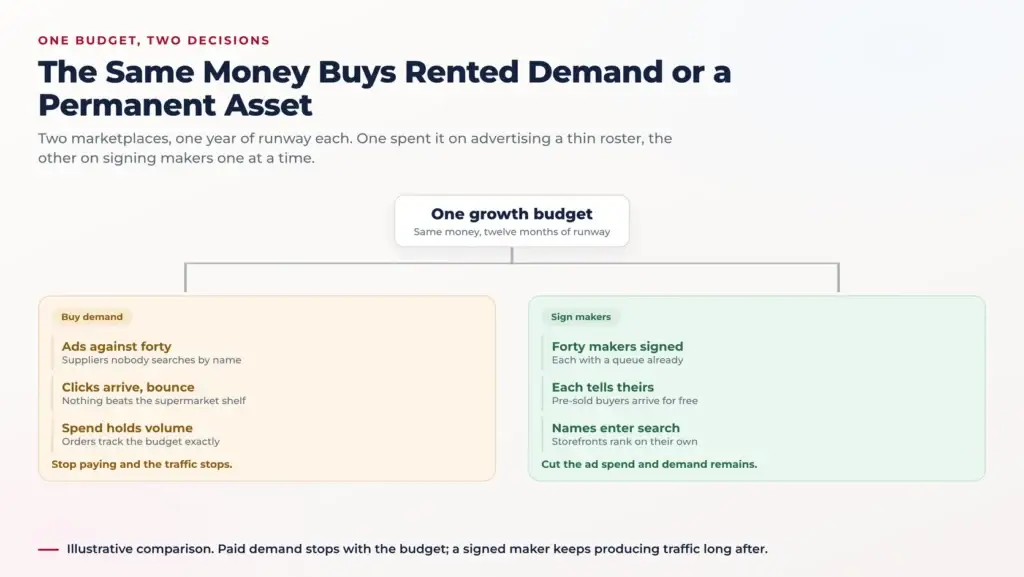
Image Source: AI-generated visual by Miracuves
A speciality food marketplace inverts that. Nothing on it is substitutable, because being non-substitutable is the entire proposition. Nobody wants the generic version of a small-batch hot sauce. They want that one, from that kitchen, and the reason they opened your platform is that it is not on the supermarket shelf.
Nobody Arrives Wanting a Marketplace
People arrive wanting a thing. The marketplace is the route, not the destination. Which means the roster is doing two jobs at once: it is your inventory, and it is your reason to exist.
A thin roster is not a catalogue problem to be solved later once the traffic arrives. It is the absence of a business, dressed up as a marketing plan.
The business model page says it plainly: the roster is the asset. The six revenue lines downstream of it, commission, subscriptions, setup fees, placement, delivery margin and membership, all monetize a roster worth visiting. None of them work upstream of that, which is why how the business model works is worth reading alongside this.
Advertising Against a Thin Roster Buys Bounces
Paid demand against a weak catalogue fails twice. The first cost is the click you paid for and lost. The second is the impression: somebody looked, saw nothing they could not get closer and cheaper, and formed an opinion.
You do not get to re-advertise to that person from a clean slate once the roster is good. You have to overcome the version of you they already met.
Spend on demand when the roster can convert it. Before that, the same money spent on signing is not the slower route to growth. It is the only one that compounds.
What Makes a Maker Worth Signing to a Food Marketplace
Four things make a maker worth the effort of onboarding, and they are not equally weighted. Getting the order wrong is how a roster ends up looking busy and performing like a directory.
The Four Attributes
An existing following: a mailing list, a social account, regulars who know the name. A product worth crossing town for: the thing with a queue, a waiting list, or a reputation that travels further than the shop does. A story that can be told honestly: a real origin, a real person, a real method, all of it checkable. And the capacity to fulfil: enough production, enough hands, enough consistency to take orders from strangers without falling over.
How I Would Rank Them
Capacity first, and it is not close. A maker who cannot fulfil turns every bit of demand you send into a refund, an apology and a review you will be arguing about for a month. It is the only attribute whose absence damages the makers either side of them on the results page.
The distinctive product second, because it creates the search, the recommendation and the screenshot. The honest story third, since a story is largely a function of the first two once somebody competent writes it down. Telling amplifies a real thing. It cannot manufacture one.
The One I Would Trade Away
The existing following, and I would trade it without much hesitation. A distinctive product, with capacity behind it and an honest story in front of it, will build a following on your platform. That is what a marketplace is for.
The reverse does not hold. A following attached to an unremarkable product moves across once, out of loyalty to the person, buys once, and stops. You have rented an audience for a single transaction and inherited a listing nobody searches for again. The following accelerates a good signing. It does not make one.
Why a Maker Brings a Pre-Sold Audience to a Food Marketplace
When a maker joins, they tell their own customers. Not because you asked, though you should ask, but because a new way to buy their product is genuinely news to the people who already buy it.
Those arrivals behave nothing like paid traffic. They are not evaluating whether the category is worth their time. They already trust the maker, and for that first visit they extend part of it to you. Conversion is high, price sensitivity is low, and the acquisition cost was one signing.
A Consequence of Supply Work, Not Marketing Work
Nobody in marketing made that happen. It happened because somebody in business development signed a vendor with a real audience, and because onboarding was quick enough that the maker was still enthusiastic when they announced it.
Say that plainly inside your own company, because budgets follow attribution. Credit the cheapest demand on the platform to a channel rather than to the roster, and you will fund the channel while starving the thing producing the result.
What the Announcement Needs From You
A maker announcing their storefront sends people to one link, and everything you built is judged on what that link does. It must open on the maker’s own storefront, not your homepage. Stock must be live, not “coming soon”. The delivery zone must be honest on the first screen, because part of that following will be outside it and checkout is the worst place to find out. And nothing may sit behind an account wall.
The features page covers what a vendor storefront carries. What matters here is that it is a real destination with its own address, not a filtered view of your catalogue.
Get the link wrong and the maker spends their own credibility sending people somewhere that disappoints them. They will not do it twice.
Discovery by Maker in a Speciality Food Marketplace
On a food delivery app the dominant query is a cuisine or a dish. On a maker marketplace, a large share of your search traffic is proper nouns: the name of a bakery somebody heard about, spelled three different ways.
A Name Is a Different Query Than a Cuisine
A category query is forgiving. Show the searcher a decent set of options and they will pick one. A name query is not. There is exactly one correct result, the searcher knows what it is, and every near miss reads as a broken product.
So search has to tolerate how people actually type a name: dropped apostrophes, missing accents, the shop without the town, the town without the shop, the product name used in place of the maker. Vendor and product names belong in one index with the vendor weighted hard, or a search for a bakery returns four listings that merely mention bread. It is the query to load-test first, in the spirit of Sub-2 Second Tracking: Load-Testing GPS Delivery Updates on Flutter and Laravel.
Surfacing Makers Nobody Has Heard Of Yet
The harder half is the buyer with no name in mind. They came to find someone new, so your job is to introduce rather than to filter.
That changes what a card contains. A price and a photograph identify a product. A maker card needs the person, the place, the thing they are known for and how long they have been doing it, because those four facts turn an unknown name into a plausible purchase.
The unit of browsing is the maker. The product is what they are eventually sold.
The Storefront Is the Landing Page
Every maker is a page that can be found, linked, shared and remembered. Treat each as a landing page with its own reason to exist, not a folder inside your catalogue.
That settles the argument you will have internally about whether vendors may look different from one another. Within limits, yes. A roster where every storefront looks identical has thrown away the one thing it was selling.
The Story Is Product Data, Not Decoration
Every speciality marketplace writes maker stories. Most write them as a paragraph of prose under a photograph, then wonder why the story does nothing for search and nothing for conversion.
Fields, Not Paragraphs
Where it is made. Who makes it. Since when. What is in it. How big the batch is. How long between order and readiness. Each of those is a field, not a sentence, and the difference matters enormously.
A field can be filtered on, sorted by, aggregated into a regional page, shown on a card, compared across makers and rendered into structured markup. A paragraph can be read by one person at a time. Capture the story as data and you can still print it as prose. Capture it as prose and the structure is gone permanently. The development cost page sets out what a build of this shape covers.
Who Writes It, and Who Checks It
Makers are usually poor at writing about themselves and excellent at answering questions. Ask the questions during onboarding, fill the fields yourself, send it back for approval. Better copy, faster.
You also inherit a responsibility. Anything describing how a food was made, where it came from or what it contains is a claim, and claims get tested by buyers and by regulators. Record who supplied each claim and when, keep the vendor’s own documents attached to their record, and route the question of which claims are permitted in your market to the operator’s own counsel and local food authority. The platform captures and versions the claim. It does not decide the labelling rule.
Regional and Seasonal Browsing for the Buyer With No Name in Mind
Name search serves people who already know something. Browsing has to serve everyone else, and on a speciality marketplace the two browse modes that actually work are place and season.
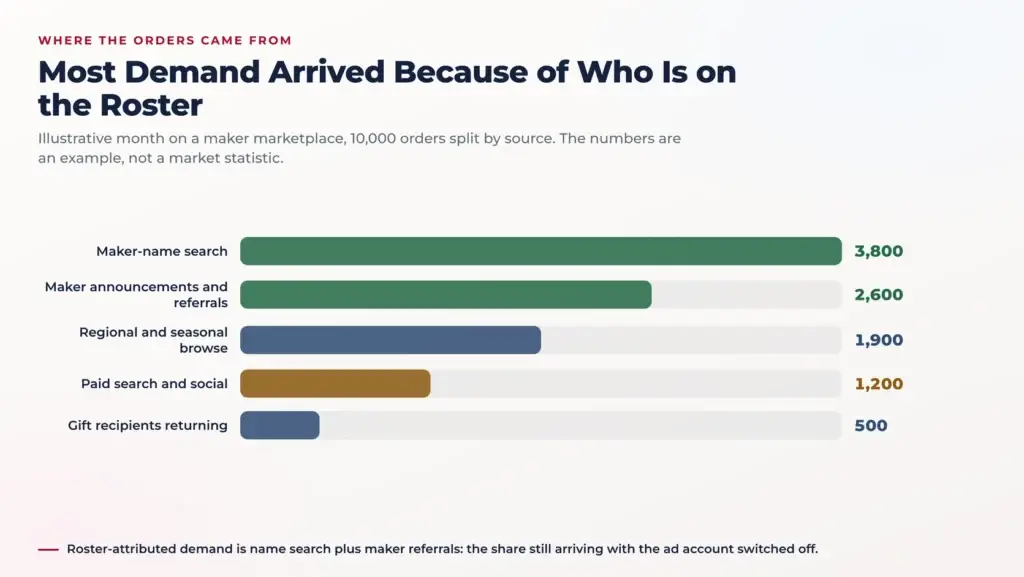
Image Source: AI-generated visual by Miracuves
Place Is a Browse Mode, Not a Filter
“What is made near here that I do not know about” is a common intent, and it is not the same as “deliver to my postcode”. One is curiosity about a region. The other is a logistics constraint. Conflating them produces a page showing a buyer only what can reach them, which quietly deletes the discovery.
Build the regional page around origin and be honest about reach on the card. A maker two zones away is still worth showing, because next quarter’s zone expansion is easier to justify when you can see who wanted what and could not have it.
Seasonality Is a Calendar You Operate
Speciality food is seasonal in a way restaurant delivery is not. Preserves have a fruit season. Bakeries have festivals. Some products exist for six weeks a year and are the single best reason anybody will visit your platform during those six weeks.
Treat that as an operating calendar, not a merchandising afterthought. Know which makers have a peak, know when it starts, and have the listing, the stock and the pre-order window ready in advance. A peak you prepared for is the cheapest traffic of the year. A peak you notice afterwards is a missed quarter.
Repeat Purchase Behaves Differently on a Speciality Marketplace
Almost every retention playbook available to you was written for a business where the same customer buys the same thing repeatedly. That is not the dominant shape here, and copying the playbook produces campaigns that miss.
The Reorder Is Not the Main Event
Some buyers do reorder the same jar. Most do not, at least not on the cadence a delivery app expects. Speciality purchases are occasional by nature, and months between two purchases of the same item indicates nothing is wrong. A churn model tuned to weekly ordering will declare most of your healthy customers lost. Measure the second purchase of anything, from anyone on the roster, before you measure the second purchase of the same thing.
The Gift Is a Different Buyer Every Time
A large share of speciality food is bought for somebody else, and the growth consequence of that is easy to miss. Every gift introduces the roster to someone who did not choose it.
A recipient who liked what arrived is the warmest cold audience you will ever have. Most platforms never speak to them, because they were never a customer record.
Membership and Loyalty Do Not Transfer
On a delivery app, a membership that removes the delivery fee is compelling because the member orders four times a week and the arithmetic is obvious. A buyer purchasing once every two months cannot make that sum work and will not subscribe to a fee waiver.
Membership here has to sell access and discovery rather than delivery economics: first refusal on limited batches, the seasonal window before it opens publicly, a curated arrival each month. Loyalty points behave the same way. Points toward a discount are weak. Points toward something that cannot otherwise be bought are not.
Standing Orders Are the Strongest Retention Instrument You Have
If you take one operational idea from this article, take this one. The standing order, a repeating purchase on a schedule the buyer sets, outperforms every loyalty mechanic available to a marketplace of this shape, because it is the only one that helps both sides at once.
They Suit the Maker’s Production Rhythm
A maker producing in batches has one persistent problem: deciding how much to make before knowing how much will sell. Every standing order converts a guess into a commitment. Fifty weekly subscriptions is a floor under Thursday’s bake, and a floor is worth more to a small producer than a good week.
This is also the argument that signs makers who are lukewarm about marketplaces in general. You are not offering exposure. You are offering predictable volume against which they can plan flour, hours and staff.
What Must Be True Before You Offer One
A standing order is a promise made repeatedly, so everything underneath it has to be dull and correct. The schedule, the substitution rule when a batch is short, the pause, the skip and the maker’s own closure calendar all have to agree with each other.
When they disagree, the maker takes the blame in public for a platform defect. It is the same shape as The Out-of-Stock Trap: Why Cheap Delivery Scripts Ruin Restaurant Relationships: stock state and ordering fall out of step, and the vendor absorbs the complaint.
Vendor Retention Is Growth, Not Account Management
On a restaurant marketplace, losing a partner costs you their orders. Here it costs their orders and their following, because the audience that arrived for them leaves with them. That asymmetry is why supply-side churn deserves more attention than buyer churn.
Orders, Correct Payment, and Not Being Buried
Three things keep a maker, and they are unglamorous. Enough orders to be worth the packing. Money that arrives on the day it was promised, for the amount the statement says. And visibility that does not quietly collapse.
The middle one loses good vendors for reasons unrelated to growth. A late payout, or a statement whose arithmetic the maker cannot reproduce, converts a partner into a sceptic in one cycle. Commission frozen at settlement is not an accounting nicety here. It is a retention feature.
Being Buried Is a Silent Exit
Makers rarely resign over placement. They stop restocking, stop answering, and let the listing go stale. By the time you notice, the following has already been told to order direct.
Watch the leading indicators instead: a drop in listing views the maker did not cause, a vendor who stops updating stock, a storefront whose newest product is four months old. Those are resignation letters written in telemetry.
Featured placement is a legitimate revenue line and also the fastest way to bury the makers who earned their position. Sell it visibly bounded, and keep organic results genuinely organic.
Founder Decision Signals
Speed
Signing compounds where advertising does not. A maker signed this month is still producing traffic next year; a paid channel stops the day the budget does.
Cost
The cheapest demand on the platform arrives because of who is on the roster. Attribute it to supply work or you will fund the wrong team.
Scalability
Adding makers stops helping once browse depth flattens. Watch how far down the results buyers get before you sign the next forty.
Market Fit
If buyers search for names you carry, the roster is working. If they search only for categories, you have built a directory.
The Honest Limits of Supply-Led Growth
Supply-led growth is not unlimited, and pretending otherwise produces the second failure mode: a roster that keeps growing while the business stops improving.
When a Maker Cannot Scale
Some of your best makers will be two people and an oven, and will stay that way because it is the business they want. Not a problem to fix. A constraint to respect in the product.
Give them the controls to be small safely: a cap on daily units, a cut-off time, an honest lead time, closure dates they set themselves. A maker who can express real capacity sells out and looks popular. A maker forced to look always-available oversells and looks unreliable.
When Demand Outruns Production
Sooner or later you will send a maker more demand than they can absorb, usually within days of a feature or a seasonal peak. The temptation is to push them to expand. Resist it for one cycle.
A waiting list preserves the demand instead of wasting it. A pre-order window moves the order to a date the maker can meet. A rationed batch keeps scarcity working for you rather than producing cancellations. And a maker who scales badly because you pushed them blames the platform, correctly.
When Signing More Makers Stops Helping
There is a point where the roster is deep enough that the next signing adds catalogue but no traffic. You can see it coming. Browse depth flattens, the share of demand landing on the top makers stops falling, and new vendors take longer to reach a first order.
That is where supply-led growth hands over: make the existing roster more findable, expand the zones so the same makers reach more people, and only then spend on demand, which now has somewhere good to land. Our food delivery solution overview and the wider solutions catalogue show where a marketplace of this shape sits beside the adjacent models you may end up operating.
Deliberately Local, and What That Does to the Roster
Worth stating early rather than in the small print: this build delivers locally, through delivery zones and riders, or by letting a vendor deliver with their own staff, or by collection in person. Carrier shipping, cold-chain packaging and multi-day transit are a different business with different logistics, and they are not part of it.
Zones Decide Who Is Addressable
That constraint is a signing constraint. A maker with a national following and a local catchment brings you far fewer buyers than their audience size suggests, because most of that audience sits outside the zone. Estimate the in-zone share of a following before you treat the following as an asset and you will rank prospects differently.
It also makes zone expansion a supply decision as much as a logistics one. The right second zone is where your existing roster already has demand it cannot serve, which your search logs can answer if you record the misses.
Fulfilment Is a Choice Made Per Vendor
Some makers want nothing to do with delivery and hand every order to your riders. Others have a van and a driver and would rather keep the last mile. Others do best with collection, because the shop visit is part of what they sell.
Letting each vendor choose removes an objection during signing, which is where most roster growth is actually lost. On how much of this machinery to build versus buy, The 36-Month TCO Comparison: SaaS Delivery Builders vs. Owned White-Label Engines and a white-label engine you own are the places to start.
Where Supply-Led Growth Goes Wrong
The failures are consistent across marketplaces of this shape, and every one of them is committed by people who understood the theory perfectly well.
Signing for count instead of pull
A hundred vendors is a number for a pitch deck. Forty makers people search for by name is a business. Roster size is the vanity metric of this category.
Buying demand before the roster converts it
Paid traffic against a thin catalogue costs twice: the click you wasted and the opinion you formed in a buyer who will be harder to win back later.
Treating the maker story as copywriting
Origin, maker, method and ingredients captured as prose cannot be filtered, compared or aggregated into a regional page. Capture them as fields first.
Copying a delivery app’s loyalty programme
Fee waivers and points toward discounts assume weekly ordering. An occasional buyer wants access and first refusal, not delivery economics.
Letting a payout run go wrong twice
Late money, or a statement a maker cannot reproduce, ends more vendor relationships than commission rates do. The second occurrence is usually the last.
Pushing a small maker to scale
Demand you cannot fulfil is worth less than demand you defer. Use waiting lists, pre-order windows and honest cut-offs before encouraging anyone to expand.
What To Measure
Most marketplace dashboards were designed for a business where supply is a cost line. Yours has to treat the roster as the thing being invested in, which puts a different set of numbers on the first screen.
Roster Health Before Funnel Health
Time from signature to first order, because a slow start is where enthusiasm dies. Share of makers who received an order this month, because a long tail of zero-order vendors is churn waiting to happen. Payout accuracy and punctuality, measured rather than assumed. And supply churn by cohort, which says whether your signing is getting better or just faster.
Then the demand side: share of search that is a maker name rather than a category, depth of browse before the first click, and second-purchase rate measured across the roster rather than against the same item. Those three tell you whether people come for the roster or merely tolerate it.
The One Number That Matters
Roster-attributed demand: the share of orders that arrived because of who is on the platform rather than what you spent to be seen. Count maker-name search, direct traffic to a vendor storefront, referrals from a maker’s own channels, and unpaid arrivals on a maker’s page. Divide by total orders.
That is the fraction of the business still running if you switch the ad account off on Friday afternoon. Rising while spend is flat means supply-led growth is working and you should sign more. Falling while spend rises means you are renting a business rather than building one, and no amount of channel optimization changes the diagnosis. The speciality food marketplace build and food delivery app development pages set out what the platform actually has to produce.
Final Thoughts: The Roster Is the Campaign
Goldbelly’s growth came from who was on it. That is a supply problem wearing a marketing label.
The uncomfortable part of supply-led growth is that it looks slower for about two quarters. Signing forty makers one at a time is unglamorous work done in cars and kitchens, and it produces no chart that goes up and to the right in week three. Advertising produces that chart immediately, then stops the day you stop paying.
What makes the slower path worth it is that everything it builds stays built. A maker with a following is a permanent acquisition channel you own no part of and pay nothing for. A storefront that ranks for its own name keeps ranking. A standing order placed in March is still producing revenue in October, for you and for the person who made the thing. None of that is true of a campaign. The argument in Migrating from SaaS to Owned Infrastructure: A Peak-Hour Performance Comparison applies to demand as much as to servers: rented is cheaper until it is the only thing holding the business up.
The decisions worth getting right early are the ones this article kept returning to: maker storefronts as real destinations, the story captured as fields, standing orders and gifting on one order spine, payouts a vendor can reproduce. Those are build decisions, cheap now and expensive later. See what a ready-made scope covers on our facts page, read about the team that builds these, and walk through your own roster plan with us before you spend anything on demand.
FAQs
What is the Goldbelly marketing strategy for growing a marketplace?
Because nothing on the platform is substitutable. On a general delivery app a hungry buyer will accept one of nine pizza places, so buying appetite works. Here the buyer wants one specific product from one specific kitchen, and the reason they opened your platform at all is that it is not on the supermarket shelf. The roster is simultaneously your inventory and your reason to exist, so a thin roster is not a catalogue gap. It is the absence of a business.
How should a food marketplace decide which makers to sign?
Four attributes, weighted unevenly. Capacity to fulfil comes first, because a maker who cannot deliver turns your demand into refunds and damages the makers around them. A distinctive product comes second, since that is what creates the search and the recommendation. An honest, checkable story comes third. An existing following comes last. Score prospects in that order and your roster will convert traffic instead of merely holding it.
Does a maker following matter most to a food marketplace?
It is the most visible thing and the least important of the four. A distinctive product with real capacity and an honest story will build a following on your platform, which is what a marketplace is for. The reverse does not hold: a following attached to an unremarkable product crosses over once out of loyalty, buys once, and stops. You have rented an audience for a single transaction. Treat the following as an accelerator of a good signing, not as a reason to make one.
How does maker-led discovery work in a food marketplace?
A category query is forgiving, because any decent set of options will satisfy it. A name query is not. There is exactly one correct result, the searcher already knows what it is, and every near miss reads as a broken product. Your index has to carry vendor names and product names together with the vendor weighted hard, and it has to tolerate dropped apostrophes, missing accents, and the shop name typed without its town.
Why should the maker story be stored as structured fields rather than prose?
Because a field can be filtered on, sorted by, aggregated into a regional page, shown on a card, compared across makers and rendered into structured markup. A paragraph can only be read by one person at a time. Capture where it is made, who makes it, since when, what is in it, the batch size and the lead time as separate fields, and you can still print them as prose. Capture them as prose first and the structure is gone permanently.
What actually drives a second purchase on a speciality marketplace?
Rarely the same jar again. Speciality purchases are occasional, and months between two orders of one item signals nothing wrong. Measure the second purchase of anything from anyone on the roster instead. The strongest drivers are the standing order, the gift bought for somebody else, and membership that sells access rather than delivery economics. A churn model copied from a weekly-ordering delivery app will declare most of your healthy customers lost.
Why do standing orders retain better than loyalty points here?
Because they help both sides at once. A buyer gets a habit they set themselves, and a maker producing in batches gets a floor under next week’s production instead of a guess. Fifty weekly subscriptions is a commitment a small producer can plan flour, hours and staff against. Loyalty points toward a discount ask a buyer to want something cheaper; a standing order asks them to want something regular, which is closer to how they already shop.
When does signing more makers stop helping growth?
When the next signature adds catalogue but no traffic. The signs are visible in advance: browse depth flattens, the share of demand landing on your top makers stops falling, and new vendors take longer to reach a first order. At that point the work shifts to making the existing roster more findable, expanding delivery zones so the same makers reach more people, and finally spending on demand, which now has somewhere good to land.
Miracuves is an independent software development company. We are not affiliated with, connected to, sponsored by, or endorsed by any company or product named in this article.
Terms such as “X Clone” are used descriptively. It is how the software industry refers to building a platform with functionality comparable to a known service, and how clients search for it.
The entire design and codebase of our products is built by our own team. Our products contain no code, design, graphics, or content originating from any third-party website or applications.
All third-party names and marks referenced in this article are the property of their respective owners, referenced solely to identify the services discussed.