

Key Takeaways
- Real-time market data architecture powers digital trading platforms by delivering live prices, quotes, order book updates, charts, and market movements with minimal delay.
- A reliable market data system connects exchange feeds, data providers, APIs, WebSockets, processing services, caching layers, databases, and user-facing trading interfaces.
- Low latency, data accuracy, scalability, synchronization, monitoring, and fault tolerance are essential for delivering consistent trading information during changing market conditions.
Market Data Architecture Signals
- Market data feeds collect live price ticks, bid-ask quotes, trading volumes, index movements, and instrument updates before distributing them across the platform.
- WebSockets, streaming APIs, message queues, caching, and event-driven processing help deliver continuous market updates without repeatedly refreshing the trading application.
- Data normalization, validation, timestamping, rate management, redundancy, and failover mechanisms help maintain accurate and reliable market information across multiple data sources.
Platform Performance Insights
- Fast market data delivery improves watchlists, live charts, price alerts, order decisions, portfolio valuation, and overall responsiveness across a digital trading platform.
- Scalable cloud infrastructure, load balancing, monitoring, caching, and recovery workflows help trading systems handle sudden increases in users and market activity.
- Miracuves develops customizable digital trading platforms with real-time market data, streaming APIs, live charts, order management, portfolio dashboards, alerts, analytics, security, and admin controls.
A digital trading platform may look simple from the outside. A user opens the app, checks a price, studies a chart, places an order, and tracks portfolio movement. Behind that experience, however, is a fast-moving data system that must collect, clean, route, cache, display, and monitor market information with very little room for error.
That system is called real-time market data architecture.
For founders, this architecture matters because trading platforms are built on trust. If prices feel delayed, charts freeze, alerts arrive late, or portfolio values look inconsistent, users may lose confidence even if the design looks polished. A trading app is not only a user interface. It is a financial data product where speed, accuracy, reliability, and control must work together.
Miracuves helps founders build finance and investment app solutions where real-time market data, portfolio workflows, secure transactions, charts, analytics, and admin operations are planned as part of the product foundation, not added as an afterthought.
What Real-Time Market Data Means in a Trading Platform
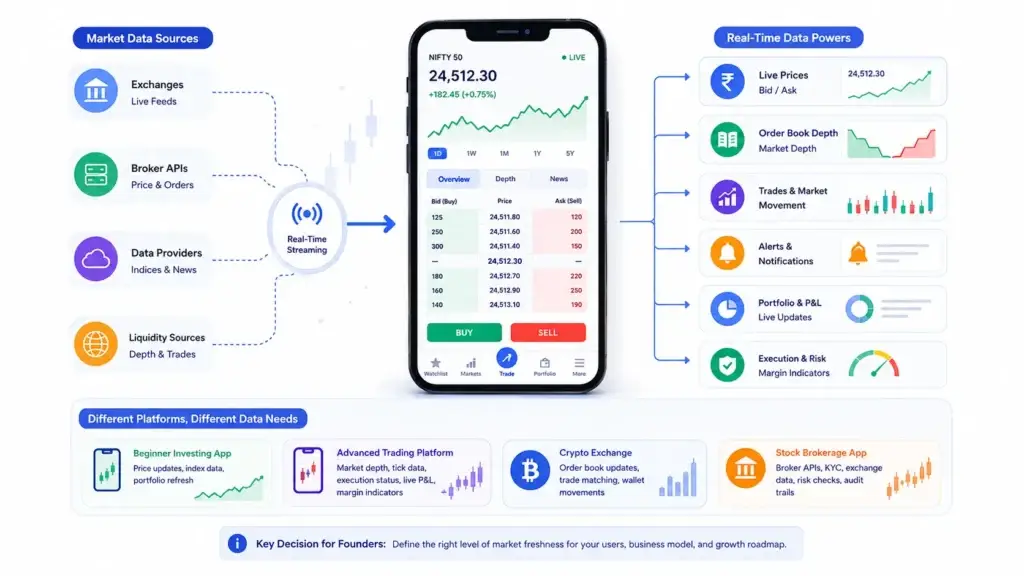
Real-time market data is the live information users rely on before making a trading decision. It may include current prices, bid and ask values, order book depth, executed trades, market movement, chart candles, price alerts, index movement, and instrument details.
In a simple investing app, real-time data may mean frequent price updates and portfolio refreshes. In a more advanced trading platform, it can include market depth, tick-level updates, execution status, live P&L, margin indicators, and broker or exchange connectivity.
This difference matters because not every trading product needs the same architecture. A beginner investing app may not need the same latency target as a professional trading terminal. A crypto exchange may require order book updates, wallet movement, and trade matching visibility. Founders exploring this model can also review how digital asset exchange architecture connects trading engines, liquidity APIs, KYC workflows, admin dashboards, and user-side trading flows. A stock brokerage app may need broker APIs, KYC workflows, exchange data, risk checks, and audit trails.
The founder’s first decision is not “How do we show live prices?” The better question is: “What level of market freshness does our business model actually require?” If you are planning a branded trading product, the right stock trading platform foundation should connect live prices, watchlists, charts, order status, portfolio updates, and admin visibility into one reliable product flow.
Why Market Data Architecture Is a Business Decision
Real-time market data architecture affects product trust before it affects technology.
When users open a trading platform, they expect prices, charts, watchlists, portfolio values, and order statuses to feel connected. If the price on the watchlist differs from the chart, or the portfolio value does not update after an order, the user may assume the platform is unreliable.
That perception can hurt retention, support load, and transaction confidence.
Market data architecture also affects cost. Real-time data providers, exchange licensing, WebSocket infrastructure, caching, historical storage, alert engines, charting tools, and monitoring systems can all influence the final scope. Founders comparing technical scope and budgeting can review this trading platform development cost breakdown before finalizing the build roadmap.
For founders, the practical takeaway is simple: market data is not just a feature. It is one of the core operating layers of a trading business.
The Core Flow of Real-Time Market Data Architecture
A practical trading platform data flow usually has several layers working together.
First, the platform receives data from exchanges, brokers, liquidity providers, or market data vendors. This can include live ticks, trade events, order book updates, reference data, and historical candles.
Second, the data is normalized. Different providers may use different symbols, timestamp formats, price precision, instrument identifiers, and data structures. Without normalization, the platform becomes harder to scale across asset classes.
Third, the data moves through a streaming layer. This may include event streaming, message queues, pub/sub systems, or internal services that distribute updates to the right parts of the platform.
Fourth, the platform stores and caches the latest values. A caching layer helps the application quickly serve watchlists, charts, top movers, and portfolio updates without repeatedly calling the external provider.
Fifth, the platform pushes relevant updates to users. WebSockets are often used because they maintain a persistent connection between the server and client, allowing live data to be sent without waiting for repeated browser or mobile app requests. AWS describes WebSocket APIs as common for real-time market data distribution in cloud-hosted digital asset exchanges, while REST APIs are commonly used for periodic data retrieval such as historical trades, candlesticks, or order book snapshots.
Finally, admin teams need monitoring, logs, alerts, and replay capability. Without visibility into feed health, latency, provider errors, and user-facing delays, operators may not discover issues until users complain.
Market Data Architecture Layers and Business Value
| Architecture Layer | What It Does | Why It Matters for Founders |
|---|---|---|
| Data ingestion | Receives market data from exchanges, brokers, or vendors | Determines data quality, coverage, and provider dependency |
| Normalization | Converts different data formats into one internal structure | Makes the platform easier to scale across assets and regions |
| Streaming layer | Moves live updates across services | Supports fast watchlists, charts, alerts, and portfolio refreshes |
| Cache layer | Stores latest prices and frequently requested values | Reduces delay, API pressure, and repeated external calls |
| Historical storage | Saves candles, trades, and past prices | Powers charts, analytics, reports, and backtesting features |
| WebSocket delivery | Pushes live updates to user apps | Creates the feeling of a live trading experience |
| Monitoring and replay | Tracks feed health, latency, and errors | Helps teams diagnose incidents and protect trust |
| Admin dashboard | Gives operators visibility and control | Reduces dependency on developers for everyday decisions |
This is why founders should map trading platform features around business value, not just user-interface screens. A watchlist, chart, alert, portfolio view, or admin dashboard becomes more valuable when it is connected to a reliable market data flow.
REST APIs, WebSockets, and Streaming Pipelines
A common mistake is assuming one API style can handle everything.
REST APIs are useful for account details, historical data, instrument search, profile updates, reports, and occasional snapshots. They work well when the user requests information and the server responds.
Real-time trading screens behave differently. Prices, order books, alerts, and portfolio changes may update continuously. Repeatedly asking the server for new prices creates unnecessary load and can make the experience feel delayed.
That is why WebSockets are widely used for real-time trading data. They allow the platform to keep a connection open and push updates as they happen. Google Cloud’s market data streaming example also shows how cloud infrastructure can distribute market data into pub/sub topics for real-time visualization and downstream consumption.
The founder-level decision is not REST versus WebSocket. A strong trading platform usually needs both. REST supports structured requests. WebSockets support live user experience. Streaming pipelines support internal movement of events between services. For a deeper explanation of how APIs, dashboards, and platform workflows connect, read Miracuves’ guide on how modern trading platforms use APIs and dashboards.
Why Data Normalization Matters Before Scaling
At early launch, a founder may connect one data provider and support one asset class. That can work for a narrow first version. But if the business later adds equities, crypto, forex, commodities, derivatives, or mutual funds, the platform may face a data model problem.
Each provider may describe instruments differently. One may use a symbol. Another may use an exchange-specific identifier. Timestamps, currency formats, decimal precision, trading sessions, and market status can vary.
Normalization creates a common internal language.
For example, the platform should know that a price update belongs to a specific instrument, exchange, asset class, currency, and timestamp. Once that structure is stable, the application can support cleaner charts, portfolio calculations, price alerts, reporting, and admin monitoring.
Without normalization, every new provider creates custom logic. That slows development and increases the risk of inconsistent data.
Low Latency Does Not Mean the Same Thing for Every Trading Platform
Low latency is important, but founders should define it carefully.
A high-frequency trading environment has very different needs from a mobile-first retail investing app. Some platforms need ultra-fast execution paths. Others need reliable sub-second updates, stable charts, clean alerts, and accurate portfolio movement.
Overengineering for the wrong latency target can increase cost without improving the business. Underengineering can damage trust when market activity rises.
A practical decision framework looks like this:
| Platform Type | Market Data Requirement | Architecture Focus |
| Beginner investing app | Near real-time or delayed data may be enough depending on use case | Clean charts, watchlists, portfolio updates |
| Retail trading app | Fast real-time updates and reliable order status visibility | WebSockets, cache, broker APIs, monitoring |
| Professional trading dashboard | Lower latency, deeper market data, more analytics | Streaming pipeline, market depth, advanced charts |
| Digital asset exchange | Live order book, trade stream, wallet and risk events | Matching engine visibility, WebSocket fan-out, replay |
| Institutional tools | High data quality, auditability, risk, reporting | Data governance, monitoring, compliance workflows |
AWS notes that traditional markets often distribute data through UDP multicast in optimized colocated networks, while cloud-hosted digital asset exchanges commonly use WebSocket APIs for real-time data delivery. This difference shows why architecture should match the business category instead of following a generic pattern.
The Role of Caching in Live Trading Experiences
Caching is one of the most important performance layers in a trading platform.
A user opening a watchlist does not need the system to fetch every price from the provider from scratch. The platform can keep the latest price, percentage change, market status, and related fields in a fast cache. This helps reduce load and improves response time.
Caching is also useful for charts, alerts, leaderboards, top gainers, and portfolio summaries. The platform can separate frequently changing data from slower account data, which keeps the experience smooth during busy market periods.
The challenge is freshness. A poorly designed cache can show stale values. A strong cache strategy should define how long data remains valid, how updates replace old values, and how the system detects missing or delayed feeds.
For founders, caching is not only a developer choice. It affects trust, infrastructure cost, and the user’s perception of speed.
Separating Market Data From Order Execution
One of the most important architecture decisions is separating market data from order execution.
Market data tells users what is happening in the market. Order execution handles the user’s trade request, risk check, broker routing, exchange response, and order status. These two systems are related, but they should not be treated as the same flow.
A user may see a price on the screen, but the final execution price can depend on liquidity, order type, spread, market movement, broker rules, and exchange response. The platform must make this clear through order previews, confirmations, execution status, and transaction history.
This separation also protects system stability. If the market data feed slows down, the order management system should still follow controlled rules. If broker execution faces issues, the live price display should not collapse with it.
A stronger platform connects these layers through clear events, audit logs, and admin visibility.
Historical Data, Replay, and Chart Accuracy
Real-time data powers the live screen. Historical data powers context.
Charts, candlesticks, performance reports, backtesting, portfolio analytics, tax reports, and investor dashboards depend on stored data. This means the architecture should not only stream data to users. It should also decide what to store, how to aggregate it, and how to retrieve it later.
Replay is especially useful. If there is an incident, the team should be able to review what data arrived, when it arrived, how the system processed it, and what users saw. This helps diagnose price delays, missing candles, alert failures, or order-status confusion.
For a trading platform, data history is not just an analytics feature. It is part of trust and operational control.
Admin Visibility Is Where Many Trading Platforms Fail
Founders often focus on the trader-facing app first. That is natural because users judge the product through screens. But the admin layer decides whether the business can operate the platform after launch.
A strong admin dashboard should help teams monitor feed status, provider health, delayed updates, failed subscriptions, alert queues, broker connectivity, suspicious activity, user complaints, order status issues, and reporting.
Miracuves’ modern trading platform guide highlights admin and reporting depth as a cost and scope factor because serious platforms may need KYC workflows, broker health monitoring, order oversight, risk controls, staff roles, audit logs, system alerts, and compliance dashboards.
For founders, this is where source-code ownership and backend control become important. If the team cannot inspect, customize, or extend the operating layer, every new market data requirement can become a vendor dependency.
Security and Compliance Considerations for Market Data Architecture
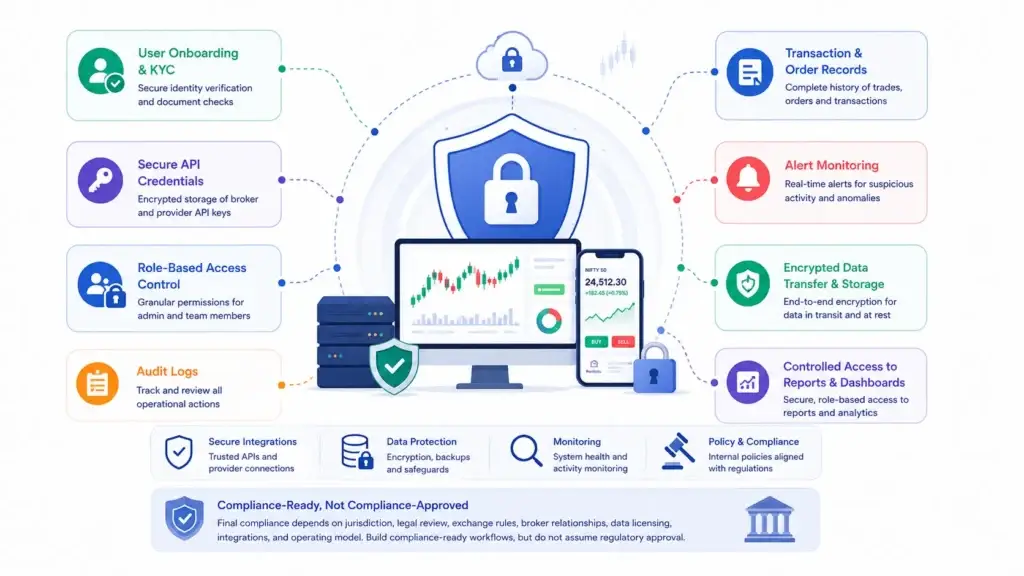
Trading platforms handle sensitive workflows. Even if market prices are not private in the same way as user identity or transaction data, the platform still needs secure API integrations, protected provider credentials, encrypted data transfer, admin access controls, audit logs, and monitoring.
Security should be planned around the full trading journey:
- User onboarding and KYC workflow support
- Secure broker or provider API credentials
- Role-based access control for admin teams
- Audit logs for operational actions
- Transaction and order-status records
- Alert monitoring for suspicious activity
- Encrypted data transfer and storage where relevant
- Controlled access to reporting dashboards
Final compliance depends on jurisdiction, legal review, exchange rules, broker relationships, data licensing, integrations, and operating model. The platform can be built with compliance-ready workflows, but it should not assume regulatory approval by default.
How Real-Time Data Supports Monetization
Market data architecture can also shape revenue.
A platform with basic delayed data may support beginner investing, content-led discovery, and portfolio tracking. A platform with real-time data, advanced charts, deeper analytics, alerts, and APIs can support more commercial models.
Possible monetization layers include premium market data access, advanced charting subscriptions, pro trader dashboards, API access fees, brokerage commissions, spread-based revenue, alerts, analyst tools, and white-label partner access. These revenue streams should connect to a clear trading platform business model so founders know how the platform will earn before investing heavily in advanced data infrastructure.
The architecture should support these models without requiring a full rebuild. For example, if premium users receive faster updates or deeper market depth, the platform needs subscription-aware access rules. If partners access data through APIs, rate limits and permission controls become important.
This is why monetization should influence architecture early.
Founder Decision Signals
Speed
Choose real-time streaming when the user experience depends on live prices, watchlists, charts, and alerts. Use REST for snapshots and historical requests.
Cost
Market data licensing, provider limits, WebSocket infrastructure, charting depth, and historical storage can all influence the build scope.
Scalability
Plan normalization, caching, provider fallback, and monitoring early so the platform can support more users, symbols, and asset classes later.
Trust
Users need consistent prices, accurate charts, clear order status, and reliable portfolio updates before they trust the platform with real activity.
Common Mistakes Founders Should Avoid
Treating Live Prices as a Simple API Feature
A live price feed is not just another API call. Once users subscribe to watchlists, charts, alerts, and portfolio updates, the platform needs a controlled data flow. Without streaming, caching, and monitoring, performance can break under real usage.
Ignoring Data Licensing Early
Market data can involve provider terms, exchange permissions, user limits, redistribution rules, and commercial usage restrictions. Founders should confirm licensing before building the product experience around a specific feed.
Using One Data Model for Every Asset Class
Stocks, crypto, forex, derivatives, commodities, and funds do not always behave the same way. A flexible data model helps the platform expand without forcing every new asset class into a narrow structure.
Mixing Market Data and Order Execution Too Closely
A trading platform should clearly separate what users see, what orders they place, how orders are routed, and how execution status is confirmed. This helps with reliability, support, and auditability.
Forgetting Admin Monitoring
If the team cannot see feed delays, failed subscriptions, provider downtime, or alert queue issues, they cannot manage user trust during active market hours.
Build From Scratch or Start With a Ready-Made Trading Foundation?
A custom market data architecture gives full control, but it can require more time, more technical decisions, and more early investment. A ready-made trading platform foundation can help founders move faster when core workflows such as onboarding, watchlists, market data integration, portfolio dashboards, order management, admin control, and reporting are already planned.
The right choice depends on scope.
Founders who want a broader feature, pricing, and tech-stack view can also read this modern trading platform guide before choosing between a ready-made foundation and a fully custom build.
If the product needs a highly specialized institutional trading engine, a deeply custom architecture may be necessary. If the goal is to launch a branded trading or investment platform faster, a ready-made and customizable foundation can reduce avoidable development work.
If the product needs a highly specialized institutional trading engine, a deeply custom architecture may be necessary. If the goal is to launch a branded trading or investment platform faster, a ready-made and customizable foundation can reduce avoidable development work. A specialized trading app development company can help connect market data, dashboards, admin tools, and platform workflows with the right technical foundation.
Miracuves offers finance and investment app solutions and a stock trading platform foundation that can support trading workflows, real-time market data planning, admin dashboards, source-code ownership, and faster deployment. For businesses building data-heavy fintech products, Miracuves’ data engineering app development services can also support pipeline design, data processing, and scalable product architecture.
Miracuves Perspective: Build Around Trust, Not Just Live Charts
A trading platform should not be planned only around attractive dashboards. The real value is in how data moves.
Live prices must reach users quickly. Charts must stay consistent. Alerts must trigger reliably. Portfolio values must update clearly. Admin teams must understand provider health and system performance. Security controls must protect sensitive workflows. Compliance-ready processes must be planned from the beginning.
Miracuves helps founders build trading and fintech platforms with branded user experiences, admin control, market data workflows, secure integrations, and source-code ownership. That gives businesses a stronger foundation to launch, customize, and scale without depending on a fragile data layer.
Final Thoughts
Real-time market data architecture is what turns a trading app from a static financial dashboard into a responsive trading experience.
For users, it creates confidence. For operators, it creates control. For founders, it affects cost, scalability, monetization, and long-term product flexibility.
The strongest digital trading platforms are not built around live charts alone. They are built around reliable data ingestion, clean normalization, streaming delivery, caching, historical storage, monitoring, security, admin visibility, and clear separation between market data and order execution.
When those layers work together, a trading platform becomes easier to trust, easier to operate, and easier to scale.
FAQs
What is real-time market data architecture?
Real-time market data architecture is the technical system that collects, processes, stores, streams, and displays live financial market information inside a trading platform. It usually includes data providers, ingestion services, normalization, streaming pipelines, caching, WebSockets, historical storage, monitoring, and admin visibility.
Why is real-time market data important for digital trading platforms?
Real-time market data helps users see current prices, charts, watchlists, order book movement, alerts, and portfolio changes. Without reliable data delivery, a trading platform can feel delayed or inaccurate, which may reduce user trust.
Do trading platforms need WebSockets?
Trading platforms commonly use WebSockets for live data because they allow the server to push updates to users continuously. REST APIs are still useful for historical data, account information, snapshots, and reports.
What is the difference between market data and order execution?
Market data shows users what is happening in the market. Order execution handles trade placement, broker or exchange routing, risk checks, execution response, and order status. Both layers should be connected but separated for reliability and operational clarity.
What affects the cost of real-time market data integration?
Cost can depend on data provider licensing, exchange coverage, number of symbols, real-time versus delayed feeds, WebSocket infrastructure, caching, historical storage, charting tools, broker integrations, monitoring, and admin dashboard depth.
Can a trading platform use multiple market data providers?
Yes. A trading platform can use multiple providers, but it needs strong normalization, provider routing, fallback rules, consistent instrument mapping, and admin monitoring to avoid inconsistent data across the user experience.
Is ultra-low latency always required?
No. Ultra-low latency is important for certain professional or exchange-grade systems, but many retail trading and investing platforms need reliable real-time or near real-time updates rather than high-frequency trading infrastructure.
How does market data architecture support monetization?
It can support premium real-time feeds, advanced charts, pro dashboards, API access, price alerts, analytics tools, and partner access. These models work better when the architecture includes permission controls, subscription logic, usage limits, and scalable streaming.
Miracuves is an independent software development company. We are not affiliated with, connected to, sponsored by, or endorsed by any company or product named in this article.
Terms such as “X Clone” are used descriptively. It is how the software industry refers to building a platform with functionality comparable to a known service, and how clients search for it.
The entire design and codebase of our products is built by our own team. Our products contain no code, design, graphics, or content originating from any third-party website or applications.
All third-party names and marks referenced in this article are the property of their respective owners, referenced solely to identify the services discussed.