
Key Takeaways
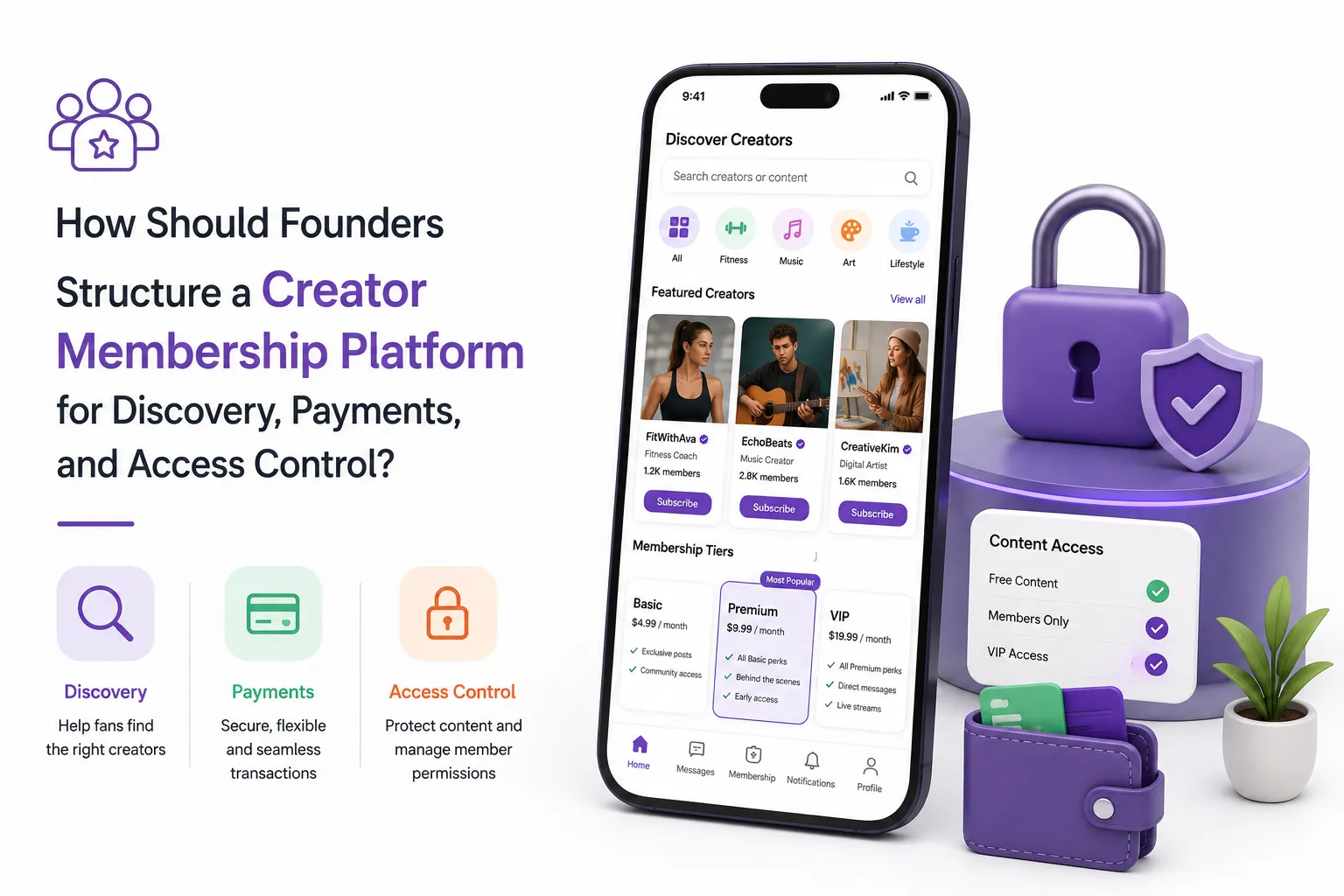
- A creator membership platform should connect creator discovery, membership tiers, payments, premium content, messaging, and access permissions within one structured ecosystem.
- Founders need clear workflows for free users, paid members, creators, and admins so each role sees the right content, features, payment options, and account controls.
- Strong platform architecture links discovery, conversion, recurring billing, content access, creator payouts, security, and retention instead of treating them as separate modules.
Discovery & Payment Signals
- Creator profiles, search, categories, recommendations, trending content, previews, and personalized feeds help users discover creators before deciding to become paid members.
- Payment workflows should support membership tiers, recurring billing, PPV purchases, tips, discounts, renewals, failed-payment handling, refunds, and creator payouts.
- Subscription conversion, renewal rate, PPV purchases, creator earnings, failed transactions, and revenue per member help founders evaluate monetization performance.
Access Control Insights
- Access control should define which membership tiers can view specific posts, videos, live sessions, communities, messages, downloads, and other premium experiences.
- Role-based permissions, content gating, secure media delivery, session management, subscription status checks, and admin overrides help protect paid content and user accounts.
- Miracuves develops customizable creator membership platforms with discovery, memberships, payments, PPV content, access controls, messaging, live sessions, payouts, analytics, and admin management.
A creator membership platform is not just a place where creators upload exclusive content and fans pay to access it. For founders who are still understanding the paid creator membership platform model, it helps to first understand how subscriptions, exclusive access, creator earnings, and fan engagement work together. At a business level, every creator membership platform should be planned as a complete system where discovery, payments, access control, creator trust, and admin operations work together.
The real challenge is not only building creator profiles or subscription buttons. The real challenge is creating a paid creator platform where fans can easily discover the right creators, understand the value of paid access, make secure payments, and receive the correct level of content access without confusion.
This is where structure matters. If discovery is weak, creators must bring all their own traffic. If payments are unclear, creators may not trust the platform. If access control is poorly planned, fans may not understand what they are paying for, and admins may struggle to manage subscriptions, locked content, refunds, and disputes.
For founders entering the creator economy, the smartest approach is to structure the creator subscription platform around three core layers: discovery, payments, and access control. These layers decide how the creator monetization platform grows, how creators earn, and how fans experience value after they subscribe.
Start With the Platform Journey Before Choosing Features
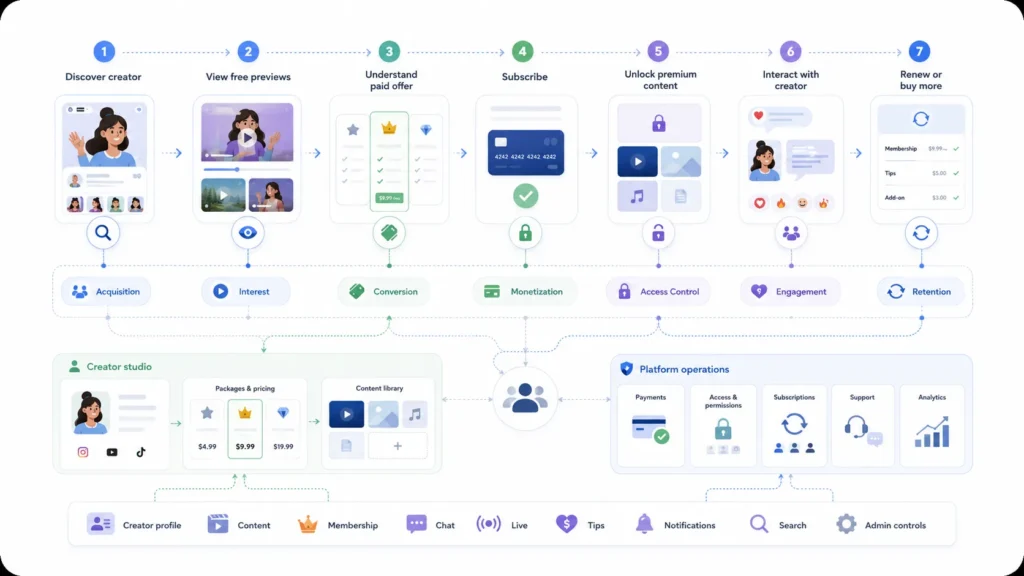
Many founders begin planning a creator membership platform by listing features such as creator profiles, subscriptions, chat, payments, locked content, admin panels, and notifications. While these features are important, they do not explain how the platform will actually convert visitors into paying members.
A better starting point is the user journey. A visitor should be able to discover a creator, view free previews, understand the creator’s paid offering, follow or subscribe, unlock premium content, interact with the creator, and continue renewing or purchasing more access over time.
This journey gives every feature a clear business purpose. Discovery supports acquisition, payments support monetization, access control supports conversion, and admin control supports long-term operations.
If these layers are planned separately, the platform can feel disconnected. Fans may browse creators but fail to understand what they get after subscribing, while creators may upload content without knowing how to price or package it effectively.
A structured platform helps founders avoid this problem. It creates a clearer connection between what fans see, what they pay for, what they can access, and how the operator manages the business behind the scenes.
If you are planning a similar paid creator product from the ground up, this guide on how to build a creator subscription platform can help you understand the broader development path before deciding which modules should be included in the first launch.
Discovery Should Work as the Marketplace Layer
Discovery is one of the biggest differences between a creator membership platform and a simple subscription website. If every creator must bring their own audience from Instagram, TikTok, YouTube, X, or another external channel, the platform becomes only a payment processor for existing demand.
A stronger creator membership platform helps fans discover creators they may not already know. This can happen through search, categories, tags, featured creator sections, trending profiles, creator recommendations, live-now sections, preview content, and curated collections.
Discovery should help fans answer three important questions. They need to know which creator is relevant to their interest, what they can preview before paying, and why they should follow, subscribe, or unlock content now.
For founders, this is not only a user experience decision. It is a marketplace growth decision because discovery affects creator visibility, fan engagement, subscription conversion, and overall platform revenue.
This becomes especially important for niche creator platforms. A founder building for fitness coaches, educators, musicians, regional influencers, premium communities, fan creators, or lifestyle experts needs discovery flows that help users move from curiosity to paid engagement.
Creator Profiles Should Turn Curiosity Into Trust
A creator profile is not just an information page. It is the creator’s conversion page, and it plays a direct role in whether a fan decides to subscribe or leave.
A strong creator profile should clearly explain who the creator is, what type of content they provide, what is available for free, what is locked, and what paid members receive. Fans should not have to guess the difference between a free follower, a basic subscriber, and a premium member.
The profile should include a creator bio, profile image, niche or category, free preview content, membership tiers, premium content previews, subscriber-only benefits, pricing, and interaction options. Founders can also review these paid creator platform features to understand how profiles, paid tiers, gated content, messaging, discovery, and admin workflows connect inside a creator membership product. The profile should also include trust and safety elements such as report buttons, account status, and verification where relevant.
The goal is to reduce uncertainty before payment. When fans understand the value of a membership before subscribing, they are more likely to convert and less likely to cancel because of unclear expectations.
For creators, profile clarity is also important. A well-structured profile helps creators package their value better, explain their offers clearly, and build confidence with fans before asking for payment.
Access Control Should Be Planned Before Content Uploads Begin
Access control is the rule system behind paid content. It decides which users can view specific content based on their membership level, payment status, purchase history, or special access permissions.
Founders should plan access control before creators start uploading content. If this layer is added later, the platform can become difficult to manage because existing content may not be organized properly across free posts, paid posts, VIP content, and pay-per-view unlocks.
A practical access model may include public previews, follower-only content, basic paid membership, premium membership, VIP membership, pay-per-view content, locked message attachments, subscriber-only livestreams, paid audio or video calls, limited-time content, and content bundles.
The important point is that access should work at the content level, not only at the creator profile level. One creator may want to publish free previews, basic subscriber posts, VIP-only videos, and separate pay-per-view files, while another creator may only need one paid tier.
This flexibility helps the platform serve different creator styles without forcing everyone into the same monetization structure. However, founders should avoid making the first version too complicated because too many access levels can confuse creators and fans.
A simple launch structure usually works better. Free previews, one main paid tier, premium unlocks, and optional VIP access can give the platform enough monetization flexibility without overwhelming users.
Payments Should Support Recurring and One-Time Revenue
A creator membership platform should not depend on only one payment flow. Subscriptions are important because they create recurring revenue, but many fans may prefer to buy individual content, send tips, pay for private messages, or unlock special sessions without committing to a full membership.
This is why payment architecture should support both recurring and one-time revenue. A strong platform can include monthly subscriptions, annual subscriptions, pay-per-view unlocks, tips, gifts, wallet top-ups, paid direct messages, paid live sessions, creator payouts, refund handling, and admin-level payment reporting.
For founders, this flexibility matters because different creators monetize differently. Some creators may perform well with subscriptions, while others may earn more from exclusive content drops, paid chats, live interactions, or premium bundles. This is also where the paid creator platform business model becomes important, because subscriptions, pay-per-view content, tips, payouts, and platform commissions must work together instead of operating as separate revenue tools.
The payment system should also make revenue clear for creators. A creator should be able to see subscription earnings, content unlock earnings, tips, paid message income, pending balance, available balance, commission deductions, refund impact, payout status, and payout history.
Payment visibility builds creator trust. If creators cannot understand where their money is, when they will be paid, or how platform commissions are calculated, they may stop publishing actively or move their audience elsewhere.
Access, Payments, and Discovery Should Share Data
The strongest creator membership platforms do not treat discovery, payments, and access control as separate systems. These layers should share data so the founder can understand what is actually driving growth and revenue.
Discovery data should show which categories, tags, creator profiles, and featured placements are generating visits. Access data should show which free previews, membership tiers, locked posts, and premium bundles are converting fans into paying users.
Payment data should show which revenue streams are performing best across subscriptions, pay-per-view unlocks, tips, messages, and live experiences. When these insights are connected, the platform operator can make better decisions about creator onboarding, category expansion, pricing, promotion, and product improvements.
For example, a creator may receive strong profile visits but low subscription conversion. That may mean the creator needs better previews, clearer tier descriptions, stronger pricing, or more visible benefits.
Another creator may have fewer visits but high conversion. That may signal a strong niche, better content packaging, or a creator type the platform should feature more often.
This type of connected data helps founders build the platform as a business, not just as a content application.
The Admin Dashboard Should Control the Business Layer
The admin dashboard is the control center of a creator membership platform. It should help the operator manage creators, fans, payments, access rules, moderation, disputes, platform settings, and growth visibility.
A weak admin panel only shows users and content. A strong admin dashboard helps the founder control the actual business operations behind the platform.
The admin dashboard should include creator approval, creator verification, fan account management, subscription monitoring, payment reports, payout reports, commission settings, refund handling, dispute workflows, access rule management, content moderation, reported content queues, category management, featured creator placement, analytics, role-based permissions, and activity logs.
This matters because manual operations become difficult as the platform grows. A founder may be able to manage 20 creators manually, but the same approach will not work with hundreds of creators, thousands of content items, recurring subscriptions, creator payouts, and support requests.
Admin control also protects the platform. Role-based access, audit logs, moderation workflows, and payment visibility help reduce operational risk and give the team a clearer way to manage platform activity.
Founder Decision Framework for a Creator Membership Platform
| Platform Layer | Founder Question | What to Structure First |
|---|---|---|
| Discovery | How will fans find creators beyond external social traffic? | Search, categories, tags, explore feed, featured creators, and previews |
| Payments | How will creators earn and trust the platform? | Subscriptions, unlocks, tips, wallets, payouts, and transaction records |
| Access Control | Who can see each type of content? | Free previews, paid tiers, VIP access, pay-per-view, and locked messages |
| Admin Control | How will the operator manage the business safely? | Creator approvals, moderation, refunds, reports, roles, and analytics |
| Retention | Why will fans return after paying once? | Creator updates, notifications, renewal value, and paid interactions |
This framework helps founders avoid feature-led development. Instead of asking only what features the app needs, it encourages founders to ask how each platform layer supports growth, monetization, trust, and retention.
Once this structure is clear, founders can use this guide on creator monetization platform features as a deeper reference for deciding which modules belong in the first launch and which features can be added after real creator and fan behavior becomes visible.
Mistakes Founders Should Avoid
Treating Discovery as Only a Search Bar
Discovery should not be reduced to basic search. A creator membership platform needs categories, tags, featured sections, previews, recommendations, trending creators, and curated discovery experiences.
When discovery is weak, the platform becomes too dependent on creators bringing their own audience. That makes the business harder to scale because the platform itself is not creating enough value between creators and fans.
Adding Too Many Payment Options Too Early
Multiple monetization options can increase revenue, but only when creators and fans understand them clearly. If a founder launches with subscriptions, pay-per-view, tips, wallets, paid messages, live access, stores, and calls all at once, the experience may become confusing.
A better approach is to start with the clearest revenue flows and expand based on real usage. Subscriptions, pay-per-view unlocks, and tips are usually easier for users to understand before adding more complex monetization layers.
Making Access Rules Too Complicated
Access control should be flexible, but it should not confuse users. If fans cannot understand what each tier includes, they may avoid subscribing because the value feels unclear.
Creators also need simple publishing controls. If creators struggle to choose the correct access level for every post, they may publish less often or make mistakes that affect paid user experience.
Many early-stage founders also make avoidable product and access-control mistakes when building paid creator platforms. This guide on mistakes founders make when building paid creator platforms can be useful for understanding what usually goes wrong when access rules, monetization, creator onboarding, and admin control are not planned properly.
Ignoring Admin Permissions
As the platform grows, not every team member should have the same level of access. Payment reports, creator approvals, content removals, refunds, and admin settings should be protected through role-based permissions.
This protects the platform from internal mistakes and helps the team scale operations more professionally. It also gives the founder better visibility into who changed what inside the system.
Forgetting Trust and Safety
Creator membership platforms need practical trust and safety workflows. These may include content moderation, abuse reporting, secure payment gateway integration, user verification where relevant, creator verification, payout monitoring, activity logs, and privacy-conscious data handling. Founders who want a deeper risk-focused checklist can also review this creator platform security checklist, especially when the product involves paid media, private access, user verification, moderation queues, and secure payment workflows.
Founders should avoid making broad compliance claims unless they are verified for the target market. Final compliance depends on jurisdiction, legal review, payment providers, content category, platform policies, and operating model.
Ready-Made vs Custom Development for Creator Membership Platforms
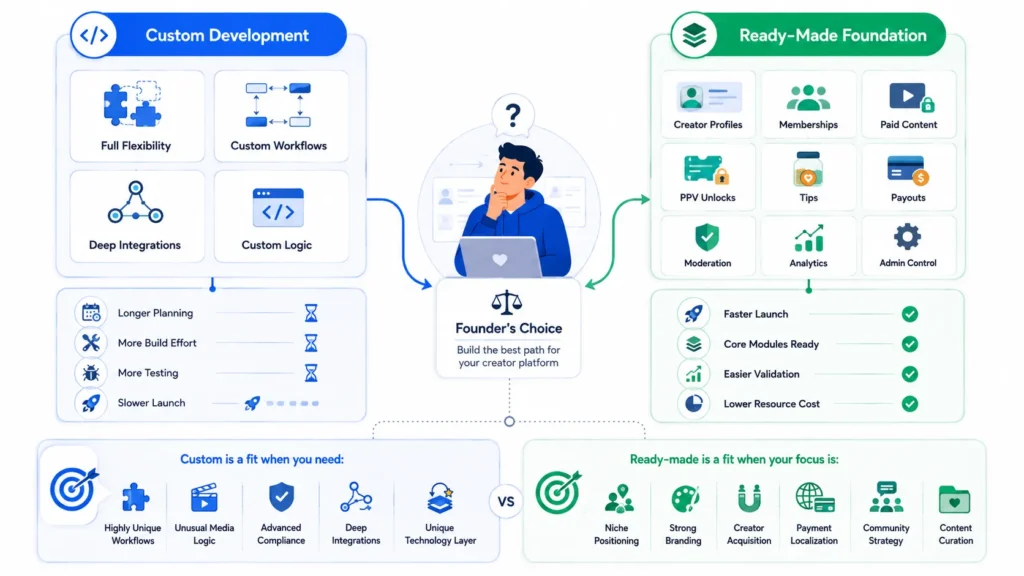
Founders usually compare two development routes when planning a creator membership platform. One option is building everything from scratch, and the other is starting with a ready-made or white-label foundation that can be customized. If you want a deeper comparison, this guide on ready-made vs custom creator platform development explains when founders should prioritize speed, source-code ownership, customization, or a fully custom build.
Custom development can be useful when the platform requires highly unique workflows, unusual media logic, deep integrations, or a completely new interaction model. However, it can also increase planning time, development effort, testing complexity, and launch risk.
A ready-made foundation can help founders move faster when the core model is already clear. If the platform needs creator profiles, memberships, paid content, subscriptions, pay-per-view unlocks, tips, payouts, moderation, and admin control, starting from an existing foundation can reduce unnecessary development effort.
The smarter choice depends on what makes the business unique. If the differentiation is niche positioning, creator acquisition, branding, community strategy, payment localization, or content curation, a ready-made foundation can help the founder validate faster.
If the differentiation depends on completely custom product behavior, advanced compliance workflows, or a unique technology layer, a custom build may be more appropriate. The key is to avoid rebuilding common modules from zero unless they truly create business advantage.
Founders who are comparing budget, scope, and launch planning can also review this creator subscription platform development cost breakdown to understand how features, integrations, customization, access rules, and payment workflows influence the final build decision.
How Miracuves Helps Founders Build Creator Membership Platforms
Miracuves helps founders build white-label creator membership platforms with source-code ownership, branded design, creator dashboards, fan apps, payment workflows, access control, content moderation, analytics, and admin control.
The benefit is not only faster development. The bigger advantage is starting with a structured product foundation where discovery, payments, and access rules can support the creator economy business model from the beginning.
For founders, this can reduce avoidable complexity during the early launch phase. Instead of spending months building basic creator profiles, subscription flows, payout logic, and admin controls from scratch, they can focus more time on creator acquisition, niche positioning, launch campaigns, trust-building, and post-launch growth.
Miracuves can also help founders decide which features should be included in the first launch and which features can be added later. This is important because a creator membership platform should be flexible enough to scale, but simple enough for creators and fans to understand from day one.
Final Thoughts
A creator membership platform should not be planned as a content feed with a payment button attached to it. It should be structured as a complete marketplace system where discovery creates attention, access control turns attention into paid value, payments build creator trust, and admin workflows keep the business manageable.
Fans should be able to discover creators, understand membership value, make payments confidently, and access the right content without confusion. Creators should be able to publish, price, earn, track payouts, and build stronger relationships with their audience.
Founders should also have the control layer needed to manage users, creators, payments, content rules, moderation, disputes, and analytics. Without this structure, the platform may work at a small scale but become difficult to manage as creators, subscribers, and transactions grow.
After the product structure is planned, the next challenge is launch execution. A clear creator platform launch marketing strategy can help founders connect creator acquisition, fan conversion, trust-building, and retention after the platform goes live.
The strongest creator membership platforms are simple on the surface and controlled underneath. That is what helps founders move beyond basic subscriptions and build a creator economy business that can scale with confidence.
FAQs
What is a creator membership platform?
A creator membership platform is a digital product where creators offer paid access to exclusive content, communities, messages, live sessions, digital products, or premium experiences through subscriptions or one-time purchases.
Why is discovery important in a creator membership platform?
Discovery helps fans find creators they did not already know. Without discovery, creators must bring most of their own audience, which limits the platform’s marketplace value.
What payment features should a creator membership platform include?
A creator membership platform should support subscriptions, pay-per-view unlocks, tips, wallet payments, paid messaging, refunds, payout records, transaction history, and admin payment reports.
What does access control mean for paid creator content?
Access control defines who can view specific content based on free access, follower status, subscription tier, VIP membership, pay-per-view purchase, or special permission rules.
Should founders launch with free tiers?
Free tiers can help users follow creators before paying. They work best when they act as a conversion path toward paid tiers, locked content, or premium interactions.
What should the admin dashboard control?
The admin dashboard should control creator approvals, users, subscriptions, payments, payouts, commissions, content moderation, access rules, featured placements, reports, disputes, and staff permissions.
How can founders reduce payment-related creator churn?
Founders can reduce creator churn by offering clear payout records, transparent commissions, reliable payment status updates, earning dashboards, refund visibility, and responsive support.
Can Miracuves help build a creator membership platform?
Yes. Miracuves helps founders build ready-made and white-label creator membership platforms with source-code ownership, admin dashboards, discovery workflows, creator monetization tools, payment systems, access control, and faster deployment.
Miracuves is an independent software development company. We are not affiliated with, connected to, sponsored by, or endorsed by any company or product named in this article.
Terms such as “X Clone” are used descriptively. It is how the software industry refers to building a platform with functionality comparable to a known service, and how clients search for it.
The entire design and codebase of our products is built by our own team. Our products contain no code, design, graphics, or content originating from any third-party website or applications.
All third-party names and marks referenced in this article are the property of their respective owners, referenced solely to identify the services discussed.