























Key Takeaways
- Microdrama Payment Infrastructure should connect checkout, coin wallets, subscriptions, entitlement logic, refunds, fraud controls, regional pricing, and admin reporting.
- A payment gateway alone cannot manage coin balances, episode access, subscription status, refunds, or reward credits.
- Coin wallets need ledger-style tracking for purchased, rewarded, bonus, spent, expired, refunded, and adjusted coins.
- Global expansion requires local payment methods, multiple currencies, regional pricing, gateway routing, and reliable payment confirmation.
- Every successful payment should remain synchronized with the viewer’s wallet balance and exact content entitlement.
Payment Signals
- If checkout conversion is weak, test local payment methods, smaller coin packs, localized pricing, and clearer payment messaging.
- If users report incorrect balances, review wallet deductions, reward credits, expiry rules, refunds, and transaction history.
- If users pay but content remains locked, payment confirmation and entitlement workflows need stronger synchronization.
- Refunds and chargebacks should trigger defined wallet, subscription, and content-access adjustments.
- Operators should monitor revenue, payment failures, refunds, coin packs, gateways, unlocks, and market-level performance from one admin dashboard.
Real Insights
- Microdrama payments are closely tied to content access because viewers frequently make small transactions to continue watching.
- Local payment preferences can directly affect expansion because users are more likely to convert through familiar payment methods and currencies.
- Hardcoded pricing and coin packs make multi-market testing slower and increase dependence on developer releases.
- Fraud monitoring should cover payment abuse, repeated refunds, promotional coin farming, fake referrals, and abnormal unlock activity.
- The strongest infrastructure path is: localize checkout → confirm payment → update wallet → grant entitlement → record access → monitor refunds and fraud → reconcile revenue → optimize each market.
A DramaBox-style streaming platform does not scale globally on content alone. The real expansion challenge begins when viewers in different markets try to unlock episodes, buy coins, start subscriptions, claim rewards, request refunds, or pay through local methods they already trust.
For founders, this is where the business model becomes technical.
A Microdrama Payment Infrastructure may look like a vertical video product on the surface, but behind every paid episode sits a payment system, wallet ledger, entitlement engine, refund workflow, tax logic, fraud control layer, and admin dashboard. If these systems are weak, growth becomes expensive. If they are planned early, global expansion becomes easier to manage.
This guide explains the payment infrastructure a microdrama business needs before entering multiple countries, currencies, platforms, and monetization models.
Why Payments Decide Whether a Microdrama Platform Can Expand Globally
Microdrama platforms monetize differently from traditional OTT apps.
A standard streaming app may depend mainly on monthly subscriptions. A microdrama product usually combines several smaller revenue actions: coin pack purchases, paid episode unlocking, VIP access, rewarded ads, direct unlocks, promotional coins, check-in rewards, referral credits, and sometimes creator or licensor payouts.
That means the payment system is not only a checkout page. It is the engine that decides:
- who has paid
- what they bought
- which episode they can access
- when access expires
- whether coins are purchased, rewarded, or promotional
- how refunds affect unlocked content
- how each market sees pricing
- how the admin team monitors revenue and abuse
For global expansion, this becomes even more important. A viewer in India may prefer UPI-based flows. A viewer in the United States may use card or wallet payments. A viewer in Southeast Asia may expect local wallets or carrier billing. A viewer on iOS may go through app store billing, while a web user may complete payment through hosted checkout.
A scalable Microdrama Streaming Platform needs infrastructure that can support all of these flows without breaking the wallet, content access, or revenue reporting.
This is also why microdrama apps differ from traditional OTT platforms: monetization is often driven by frequent small unlocks, coin packs, VIP access, and regional pricing rather than only monthly subscriptions. For a deeper comparison, read our guide on how microdrama apps differ from traditional OTT platforms.
Regional Payment Gateway Comparison for Microdrama Platforms
Choosing a payment gateway for a global microdrama platform requires more than comparing transaction fees. Founders should evaluate which payment methods audiences prefer, whether their business entity is eligible for the provider, how currencies are settled, and how refunds and recurring subscriptions are handled.
| Target Region | Payment Options to Evaluate | Gateway Examples | Key Consideration |
|---|---|---|---|
| United States and Canada | Credit/debit cards and digital wallets | Stripe, Adyen | Card authorization, fraud prevention, chargebacks, and subscription renewals |
| India | UPI, cards, and supported local payment options | Razorpay, Cashfree | UPI checkout, INR settlement, refunds, and recurring-payment requirements |
| Europe | Cards, digital wallets, and country-specific bank payment methods | Stripe, Adyen, Mollie | Local payment preferences, currency support, tax treatment, and refund processing |
| Southeast Asia | Cards, local wallets, and bank transfers | Xendit, 2C2P, regional providers | Country-specific availability, settlement currency, payment confirmation, and wallet compatibility |
| Latin America | Cards, bank transfers, and local instant-payment methods | dLocal, EBANX, regional providers | Local payment coverage, currency conversion, settlement arrangements, and refund limitations |
These are providers to evaluate, not guarantees of availability. Supported countries, merchant eligibility, payment methods, currencies, and subscription capabilities must be confirmed directly with each provider.
Currency Settlement and Conversion
Founders should distinguish between the currency displayed to viewers, the currency actually charged, and the currency deposited into the business bank account. These may differ.
For example, a viewer might purchase a coin pack in USD while the platform receives its payout in another currency. Currency conversion, gateway fees, and settlement timing can affect the actual revenue received.
A global microdrama platform should record the original transaction amount, charged currency, exchange rate where applicable, gateway fees, settlement currency, and final payout amount. This makes it easier to reconcile revenue from coin purchases and VIP subscriptions across markets.
Refunds and Chargeback Handling
Refunds should update more than the payment record. If a viewer receives a refund for a coin pack, the platform should check the remaining purchased coins, any coins already spent, and the episodes unlocked using that purchase.
Refund workflows should also account for partial refunds, chargebacks, failed transactions, duplicate payments, and subscription reversals. Operators need clear transaction histories and consistent rules for adjusting wallet balances and content entitlements.
Refund eligibility, processing times, and reversal rules can differ by payment provider, app store, and jurisdiction.
Subscription Billing and Renewal Considerations
Recurring VIP subscriptions require additional planning. Not every regional payment method supports automatic recurring charges, and the billing rules for web payments may differ from those for purchases made inside mobile apps.
Before launch, founders should verify support for automatic renewals, failed-payment retries, cancellation, billing notifications, refunds, and subscription status updates.
The platform should synchronize every successful renewal, cancellation, expiration, or refund with the user’s VIP entitlement so that access accurately reflects their billing status.
The practical goal is to build a payment infrastructure that can adapt to each market without requiring separate wallet, billing, and entitlement systems for every region.
The Core Payment Layers Every Microdrama Platform Needs
Payment infrastructure should be planned as a system, not as a single integration. For founders, the safest way to think about it is in layers.
These payment layers should connect with core wallet and admin features so operators can manage unlocks, pricing, refunds, and user access from one control panel.
Payment Infrastructure Layers for Global Microdrama Expansion
| Payment Layer | What It Handles | Why It Matters for Founders |
|---|---|---|
| In-app purchase system | Coins, subscriptions, and digital access sold inside mobile apps | Helps the platform follow app store payment expectations for digital content. |
| Web checkout | Card payments, wallets, and local payment methods outside app stores | Can improve market flexibility and reduce friction for users who prefer browser payments. |
| Coin wallet ledger | Purchased coins, reward coins, bonus coins, deductions, expiry, and balance history | Prevents disputes, double charging, and unclear wallet balances. |
| Entitlement engine | Episode access after payment, VIP access, ad unlocks, and direct unlocks | Makes sure users receive the exact content access they paid for. |
| Refund and reversal logic | Refunds, chargebacks, subscription cancellations, and coin clawbacks | Protects the business from revenue leakage and refund abuse. |
| Regional payment routing | Cards, wallets, UPI, carrier billing, local gateways, and market-specific processors | Allows the platform to match payment preferences by country. |
| Fraud monitoring | Suspicious transactions, abnormal unlock behavior, repeated refunds, and bot activity | Protects revenue, content value, and platform reputation. |
| Admin reporting | Revenue by market, gateway, content title, coin pack, user cohort, and refund type | Helps founders understand which markets are profitable and which need adjustment. |
Coin Wallet Infrastructure: The Center of Microdrama Monetization
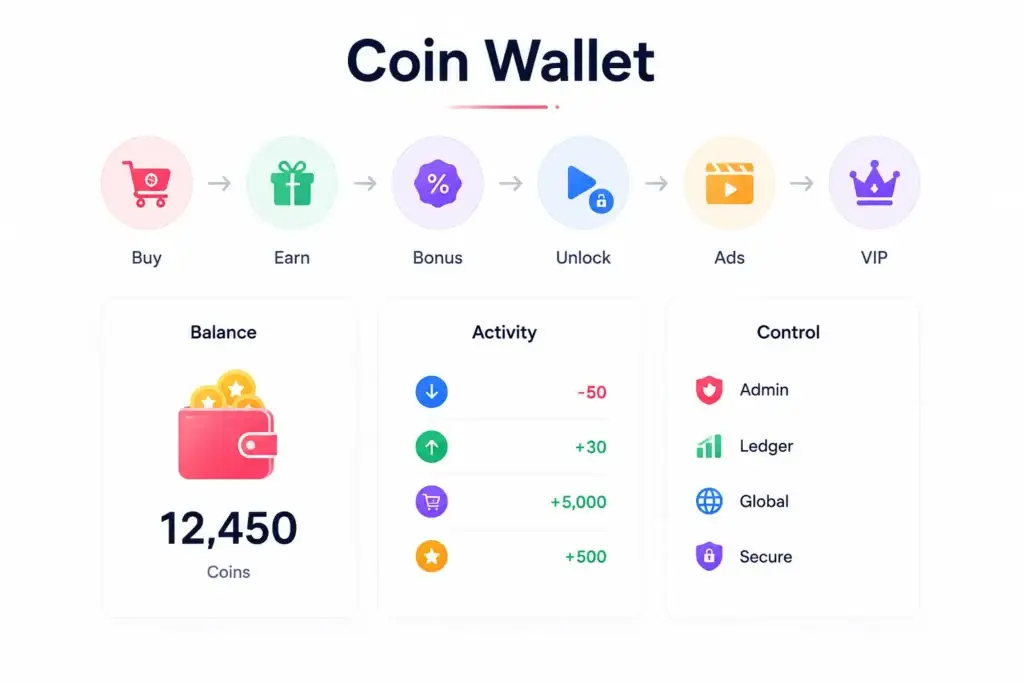
For most microdrama products, the coin wallet is the most important monetization module.
Users may buy coin packs, earn bonus coins, receive promotional coins, unlock episodes, watch ads for rewards, or use coins before they expire. From a viewer’s perspective, this should feel instant and simple. From the platform operator’s perspective, it needs strong accounting logic.
Founders planning coin packs, VIP unlocks, rewarded coins, and paid episodes should also understand the broader short-drama monetization model before finalizing payment flows.
A proper coin wallet should track:
- purchased coin balance
- rewarded coin balance
- bonus coin balance
- promotional expiry dates
- wallet deductions
- episode unlock history
- failed and successful top-ups
- manual admin adjustments
- refund-related reversals
- balance changes with timestamps
This matters because a coin wallet behaves like a financial ledger even when coins are only used for digital entertainment access. When users ask why their balance changed, the support team should not need a developer to inspect the database. The admin dashboard should show the complete wallet story clearly.
For a global Microdrama Streaming Platform, the wallet also needs to understand market differences. A coin pack may cost different amounts in different countries. Bonus coin offers may vary by region. Reward campaigns may need market-specific limits. A strong wallet system gives founders control without requiring a new app release for every pricing change.
In-App Purchases, Subscriptions, and Store Billing
Mobile app stores are a major part of microdrama monetization because paid digital content, virtual currency, and subscriptions often flow through in-app purchase systems.
This creates two important responsibilities.
First, the platform must connect app store transactions with the backend wallet and entitlement engine. When a user buys coins or starts a VIP plan, the backend must confirm payment, update the wallet, unlock access, and store the transaction record.
Second, the product must handle subscription states correctly. A subscription may be active, cancelled, expired, renewed, refunded, or temporarily affected by billing issues. If the platform treats every subscription as permanently active after the first payment, revenue leakage and support disputes can grow quickly.
Founders should plan for:
- consumable coin purchases
- VIP subscription plans
- renewal checks
- payment webhooks
- receipt validation
- entitlement updates
- refund events
- cancelled subscription handling
- grace periods where applicable
- clear paywall and purchase disclosures
The goal is not just to accept payments. The goal is to keep content access, wallet balance, and billing status aligned at all times.
Web Checkout and Local Payment Methods for International Markets
A global microdrama business cannot assume every market pays the same way.
Some regions convert well with cards. Some require digital wallets. Some markets rely heavily on UPI-style flows, carrier billing, bank transfers, vouchers, or local payment apps. If your platform only supports one global card gateway, expansion may look technically complete but commercially weak.
Payment expansion should also align with microdrama platform localization, because language, currency, checkout copy, and regional payment habits influence conversion together.
Web checkout can help founders add more regional flexibility, especially for browser users, promotional campaigns, affiliate traffic, and markets where local payment methods matter. A hosted checkout flow can also reduce the amount of sensitive card data your own infrastructure directly handles.
However, web checkout should not be treated as a shortcut around mobile store rules. A founder should review the target market, platform policies, product flow, and legal requirements before deciding how mobile, web, and alternative billing routes should work.
A strong payment setup should support:
- country-based gateway selection
- local payment methods
- multi-currency display
- localized checkout copy
- gateway fallback logic
- payment retry handling
- failed payment messaging
- secure payment token handling
- webhook-based confirmation
- order reconciliation
This is where payment infrastructure becomes a growth lever. The easier it is for each market to pay in a familiar way, the easier it becomes to test new language markets, new campaigns, and new pricing models.
Entitlement Logic: The Hidden System Behind Every Unlock
Payment is only half the transaction. The other half is entitlement.
An entitlement answers one simple question: what does this user have the right to watch?
In a microdrama product, entitlement can come from different paths:
- a user spends coins to unlock one episode
- a user buys access to a full series
- a VIP user bypasses locked episodes
- a rewarded ad gives temporary access
- a promotional campaign unlocks selected episodes
- an admin manually grants access
- a refunded transaction removes access
Without a strong entitlement engine, users may pay and still see locked content. Or worse, users may receive access without valid payment. Both situations damage trust.
The entitlement system should be idempotent, meaning repeated taps or retries should not create duplicate charges. This is especially important on mobile networks where users may tap the unlock button more than once during a slow response.
For founders, this is not a minor technical detail. It directly affects user trust, payment disputes, app reviews, and retention.
Refunds, Chargebacks, and Coin Clawback Workflows
Refund logic is one of the most ignored parts of microdrama payment infrastructure.
A user may buy coins, unlock episodes, consume content, and then request a refund through the store or payment provider. If the platform does not track what was purchased, spent, and consumed, the wallet will stop matching financial reality.
A global Microdrama Streaming Platform should define refund behavior before launch.
Important questions include:
- Are purchased coins refundable after use?
- What happens if a coin pack is refunded after some episodes are unlocked?
- Should unused coins be removed from the wallet?
- Should bonus coins be reversed first or last?
- How should subscription refunds affect VIP access?
- What should support agents see inside the admin panel?
- How are chargebacks flagged for fraud monitoring?
The answer may vary by market, payment provider, app store rules, and legal advice. The product foundation should be flexible enough to support those differences.
Tax, Currency, and Pricing Infrastructure
Global expansion creates pricing complexity very quickly.
A coin pack that feels affordable in one country may feel expensive in another. A subscription price that converts well in one market may fail in a market with lower purchasing power. Taxes, currency conversion, payment provider fees, and store commissions can also change the real margin behind every unlock.
Founders should avoid hardcoding pricing into the app.
Instead, pricing should be managed from the admin dashboard or payment configuration layer. The platform should support:
- country-specific coin packs
- currency display rules
- localized subscription pricing
- limited-time offers
- bonus coin campaigns
- market-specific free episode windows
- tax-aware reporting where applicable
- margin reporting by country
Founders should also review short-drama app development cost factors, especially when payment rails, merchant accounts, CDN usage, and market expansion are part of the launch scope.
This helps operators test pricing without rebuilding the product. It also helps the business understand whether expansion is creating profitable revenue or only increasing payment volume.
Fraud Monitoring and Abuse Controls
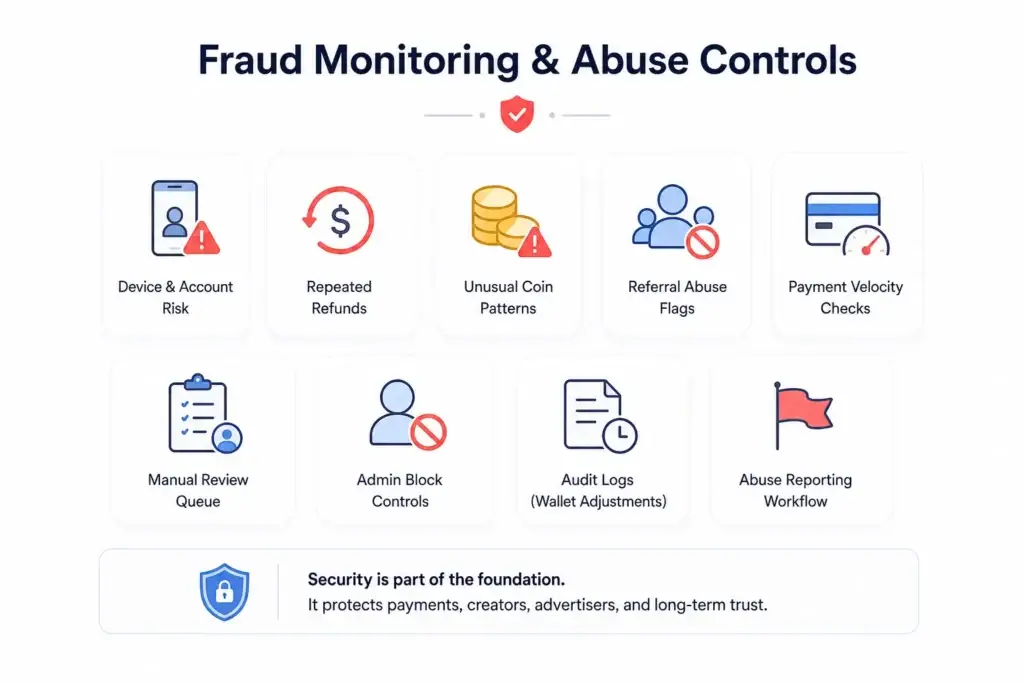
Microdrama platforms are vulnerable to payment and reward abuse because the business model encourages frequent small transactions.
Common risks include repeated refund abuse, promotional coin farming, bot-driven reward claims, fake referrals, suspicious payment retries, account sharing, and abnormal unlock behavior. These issues may look small at the user level but become expensive when repeated across large audiences.
A practical fraud-control layer should include:
- device and account risk signals
- repeated refund tracking
- unusual coin earning patterns
- referral abuse flags
- payment velocity checks
- manual review queues
- admin block controls
- audit logs for wallet adjustments
- abuse reporting workflows
Security should be treated as part of the product foundation, not as a feature added after growth arrives. For entertainment platforms, trust affects payments, creator confidence, advertiser relationships, and long-term retention.
Admin Controls Founders Need Before Scaling Payments
The admin panel is where the founder turns payment infrastructure into business control.
A strong admin dashboard should allow the operator to manage coin packs, VIP plans, gateway switches, currency defaults, refund records, user wallet history, transaction reports, unlock analytics, and market-level pricing.
For microdrama expansion, the admin system should answer questions such as:
- Which countries generate the most paid unlocks?
- Which titles convert viewers after the free window?
- Which coin packs are purchased most often?
- Which gateways have the highest failure rate?
- Which markets show high refunds or failed payments?
- Which VIP plan creates the strongest repeat viewing?
- Which rewarded coin campaigns reduce paid conversion?
Without these answers, a founder may spend more on content and user acquisition without knowing whether the payment model is healthy.
Founder Decision Signals
Speed
If your first market depends on coin unlocks, start with wallet, payment confirmation, and entitlement logic from day one instead of adding them after launch.
Margin
If delivery costs rise faster than paid unlocks, your payment infrastructure should show revenue by episode, title, market, and gateway.
Scalability
If you plan to expand across regions, pricing, payment methods, currencies, and access rules must be configurable without rebuilding the app.
Market Fit
If users hesitate at checkout, test local payment methods, smaller coin packs, bonus offers, and market-specific free episode windows.
Common Payment Infrastructure Mistakes Founders Should Avoid
Adding payment gateways without wallet logic
A payment gateway can confirm that money moved, but it does not automatically manage coin balances, episode access, refunds, reward coins, or subscription entitlements.
Using one pricing model for every country
Different markets have different payment habits and price sensitivity. Global expansion needs localized pricing, currency display, and offer control.
Ignoring refund and chargeback behavior
If refunds are not connected to wallet reversal and access control, users may consume paid content while the platform loses revenue.
Hardcoding paywalls and coin packs
Microdrama monetization depends on testing. Operators should be able to change free windows, episode prices, offers, and gateways from the admin panel.
How Miracuves Helps Founders Build Payment-Ready Microdrama Platforms
Miracuves helps founders launch entertainment and short-drama products with the product foundation needed for monetization, admin control, branding, and faster validation.
If you are comparing technical partners, review what to look for in a short-drama development partner before choosing between a ready-made foundation, freelancer script, or custom agency build.
For founders who want to move from strategy to execution, a launch-ready short-drama streaming solution can provide the product base for vertical playback, paid unlocking, wallet workflows, user management, admin controls, and monetization configuration.
The important point is not to copy another platform blindly. The stronger decision is to understand the payment model your market needs, then build a platform that can support that model across content, pricing, access, and reporting.
You can also explore Miracuves’ short drama app development services and the short drama and micro-content industry page to understand how the platform, content model, and monetization layer work together.
Final Thoughts: Global Expansion Starts With Payment Control
A Microdrama Streaming Platform can attract users with short episodes, emotional hooks, and cliffhanger storytelling. But it expands globally through payment reliability.
Founders need more than a payment gateway. They need a wallet ledger, entitlement engine, localized pricing, subscription handling, refund workflows, fraud monitoring, tax-aware reporting, and admin control.
The platforms that scale best are not always the ones with the largest catalog first. They are often the ones that understand how each market pays, what each viewer unlocks, and whether every transaction contributes to sustainable growth.
For broader platform planning, explore Miracuves’ custom mobile app development services or browse our digital entertainment app solutions.
FAQs
What payment infrastructure does a Microdrama Streaming Platform need?
A Microdrama Streaming Platform needs in-app purchases, coin wallet logic, subscription billing, web checkout, local payment methods, refund handling, entitlement management, fraud monitoring, and admin reporting. These systems help connect payments with actual episode access.
Why is a coin wallet important for microdrama monetization?
A coin wallet allows users to buy or earn virtual currency and spend it on locked episodes. It also helps the platform manage bonus coins, reward campaigns, wallet history, expiry rules, and user support issues.
Should microdrama apps use subscriptions or pay-per-episode payments?
Many platforms use a hybrid model. Pay-per-episode unlocking can work well for impulse viewing, while VIP subscriptions can support repeat users. The right choice depends on market behavior, content depth, pricing, and retention.
Why do global microdrama platforms need local payment methods?
Local payment methods reduce checkout friction. Users are more likely to pay when the platform supports familiar payment options, local currency display, and payment flows trusted in their country.
How should refunds work in a microdrama app?
Refunds should be connected to the wallet and entitlement system. If a coin purchase or subscription is refunded, the platform should know whether coins were used, which episodes were unlocked, and how access should be adjusted.
What role does the admin dashboard play in payment management?
The admin dashboard helps operators manage coin packs, VIP plans, payment gateways, wallet balances, refund records, user access, pricing, revenue reports, and market-level monetization settings without depending on developers for every change.
Can Miracuves help build a payment-ready microdrama platform?
Yes. Miracuves helps founders build white-label and launch-ready short-drama platforms with wallet workflows, monetization modules, admin control, source-code ownership, and customisation support based on the target market.
Miracuves is an independent software development company. We are not affiliated with, connected to, sponsored by, or endorsed by any company or product named in this article.
Terms such as “X Clone” are used descriptively. It is how the software industry refers to building a platform with functionality comparable to a known service, and how clients search for it.
The entire design and codebase of our products is built by our own team. Our products contain no code, design, graphics, or content originating from any third-party website or applications.
All third-party names and marks referenced in this article are the property of their respective owners, referenced solely to identify the services discussed.