Key Takeaways
- Short drama apps and traditional OTT platforms serve different viewing behaviors.
- OTT platforms focus on long-form catalogs, subscriptions, and planned viewing.
- Short drama apps rely on fast hooks, cliffhangers, and mobile-first episode flows.
- Coins, rewarded ads, and episode unlocks support flexible short-drama monetization.
- Founders should choose a platform model based on audience behavior, content format, and payment intent.
Platform Choice Signals
- Choose traditional OTT when users expect long-form content and catalog-based subscriptions.
- Choose short drama when discovery depends on teasers, emotional hooks, and vertical episodes.
- Prioritize Smart TV and multi-device access for OTT, but mobile speed for short drama.
- Track episode completion, continuation, unlocks, and drop-off points before scaling content.
- Confirm the admin panel can manage episodes, pricing, unlocks, promotions, and analytics.
Real Insights
- A short drama app is not simply an OTT platform with shorter videos.
- Story packaging can influence retention as strongly as streaming quality.
- Paywalls perform better after viewers develop emotional interest in a story.
- Install numbers matter less than episode continuation and unlock behavior.
- Miracuves provides white-label foundations for short-drama and traditional video streaming platforms.
Short Drama Apps vs Traditional OTT platforms both deliver video content, but they do not operate with the same product logic.
A traditional OTT platform is usually built around long-form viewing. Users search, browse, select a movie or series, and commit to a longer session. A short drama app works differently. Viewers often discover content through emotional hooks, vertical teasers, cliffhangers, and fast episode sequences designed for mobile-first consumption.
For founders, this difference matters because the product strategy changes completely.
You cannot simply take an OTT model, shorten the videos, and expect the same retention, monetization, or growth behavior. Short drama platforms need faster storytelling, different content packaging, stronger episode progression, flexible unlock models, and sharper mobile engagement loops.
This guide explains how short drama apps differ from traditional OTT platforms and what founders should understand before launching a vertical entertainment product.
Why Short Drama Apps Should Not Be Treated Like Mini OTT Platforms
A common founder mistake is thinking that a short drama platform is simply an OTT app with shorter episodes. That assumption creates product problems.
Traditional OTT platforms are usually built around catalog browsing. Users may already know what they want to watch. They search for a title, explore genres, check thumbnails, and commit to longer viewing sessions. The platform experience supports this behavior with watchlists, profiles, recommendations, continue-watching rows, subscriptions, and multi-device access.
Short drama apps are more impulsive. A user may enter through a teaser, a dramatic scene, a cliffhanger, or a paid social ad. The first few seconds decide whether the user keeps watching. The next episode decides whether the user stays. The first unlock point decides whether the platform can monetize.
That means a short drama app needs to be designed around speed, curiosity, and continuation. The product question is not only whether users can stream video. The stronger question is whether the app can turn one dramatic hook into repeated viewing, unlocks, and returns.
Short Drama Apps vs Traditional OTT Platforms: The Core Difference
Short Drama Apps and Traditional OTT Platforms
| Comparison Area | Traditional OTT Platform | Short Drama App |
|---|---|---|
| Viewing Behavior | Users browse and select long-form content. | Users respond to hooks, teasers, and fast episode progression. |
| Session Intent | Planned viewing or binge-watching. | Impulsive mobile viewing and quick continuation. |
| Content Format | Movies, web series, documentaries, live content, and long episodes. | Short vertical or mobile-first episodes with dramatic cliffhangers. |
| Discovery Logic | Search, categories, recommendations, and watchlists. | Teasers, emotional hooks, trending scenes, push notifications, and feed-style discovery. |
| Monetization | Subscriptions, ads, rentals, and premium plans. | Coins, episode unlocks, rewarded ads, subscriptions, bundles, and premium access. |
| Retention Driver | Catalog depth and long-term content value. | Cliffhangers, episode sequencing, unlock timing, and story addiction loops. |
| Product Priority | Stable streaming, multi-device access, library management, and subscription control. | Instant playback, episode flow, wallet logic, content testing, and mobile engagement. |
1. Viewer Intent Is Different
Traditional OTT users often arrive with stronger viewing intent. They may already plan to watch a movie, continue a series, or explore a familiar category. The platform supports this behavior through search, banners, profile-based recommendations, and watch history.
Short drama viewers often arrive with curiosity, not commitment. They may see a short clip showing betrayal, revenge, romance, humiliation, or a dramatic reveal. At that moment, the user is not thinking about subscribing to a full entertainment platform. The user is thinking about what happens next.
That single question drives the product. For short drama apps, the first product goal is not broad browsing. It is fast emotional entry. The app should reduce friction between the hook and the next episode. Sign-up, loading time, confusing pricing, weak thumbnails, or poor episode sequencing can break that momentum.
2. Content Packaging Matters More in Short Drama Apps
Traditional OTT platforms package content through seasons, genres, cast names, trailers, hero banners, and recommendation rows. Short drama apps need more aggressive packaging.
Each story needs:
- A clear emotional premise
- A strong thumbnail
- A dramatic title
- Short episode descriptions
- Fast opening scenes
- Cliffhanger-led sequencing
- Unlock points that match emotional tension
- Push notification angles
- Teaser-friendly scenes
The same story can perform differently depending on how it is packaged. A romance drama can be positioned as betrayal, revenge, secret identity, family conflict, or second-chance love. Each angle attracts a different audience response.
Founders should treat story packaging as a growth lever, not a cosmetic layer.
Before scaling production or paid acquisition, founders can use short drama story hook testing to compare teaser concepts, thumbnails, opening scenes, emotional premises, and cliffhangers. Testing these elements early can reveal which story angles generate stronger curiosity and continuation before larger resources are committed to production.
3. Episode Structure Changes the Retention Model
In traditional OTT, a viewer may commit to a 30-minute or 60-minute episode. The content can take more time to build character, setting, and conflict. Short drama apps do not have that luxury.
Each episode must move quickly. The viewer needs a reason to continue almost immediately. This does not mean every scene should be loud or exaggerated. It means each episode should create progression.
A strong short drama episode usually answers one question while opening another. For example:
- The character discovers a secret but does not yet reveal it.
- A betrayal happens, but the revenge plan is not shown.
- A romantic tension starts, but the relationship remains blocked.
- A villain gains power, but the hero finds hidden leverage.
This structure keeps the viewer moving through the episode chain. For founders, episode design is directly tied to product performance. Completion rate, next-episode starts, unlocks, rewarded ad usage, and subscriptions all depend on whether the story creates continuation intent.
4. Monetization Timing Is More Sensitive
Traditional OTT platforms often monetize through monthly or annual subscriptions. Users pay for access to a full catalog. Short drama apps can use more flexible monetization models:
- Free starter episodes
- Coin-based episode unlocks
- Rewarded ads
- VIP access
- Pay-per-story bundles
- Subscriptions
- Limited-time offers
- Premium early access
Monetization timing is delicate because viewers often need to become emotionally invested before they are willing to pay. A coin-based drama platform can combine free starter episodes, episode unlocks, rewarded ads, subscriptions, and premium access within the viewing journey. If the app asks for payment too early, users may leave; if the unlock appears too late, the platform may miss revenue opportunities. Founders should test monetization around strong cliffhangers and moments of high continuation intent.
This is why short drama apps should track where viewers become committed. Founders should test whether users are more likely to unlock after episode two, episode three, or a specific cliffhanger. The monetization model should follow viewer psychology.
5. Discovery Works Differently
Traditional OTT discovery is usually catalog-led. Users browse through categories, trending rows, personalized suggestions, new releases, or search results. Short drama discovery is more hook-led.
A viewer may enter from:
- Social media teaser ads
- Influencer clips
- Vertical video previews
- Push notifications
- Story thumbnails
- Trending drama categories
- Next-episode prompts
- Rewarded unlock campaigns
This means a short drama app must connect marketing creatives with in-app viewing behavior. Discovery patterns commonly associated with a vertical video content platform also show why fast previews, feed-style content exposure, and engaging opening moments matter. If an ad promises revenge drama but the first episode starts slowly, the user may drop. The teaser, title, thumbnail, opening scene, and episode flow should all deliver a consistent viewing promise.
If an ad promises revenge drama but the first episode starts slowly, the user may drop. If the teaser shows a major twist but the app delays that conflict, the viewer may feel misled. If the thumbnail suggests romance but the story opens with unrelated exposition, continuation may fall.
The best short drama platforms align teaser, title, thumbnail, first scene, and unlock flow.
6. Analytics Should Be Episode-Level, Not Only Platform-Level
OTT analytics often focus on overall watch time, subscription churn, active users, content popularity, and device behavior. Short drama analytics need more granular signals.
Founders should measure:
- Teaser click-through rate
- Story landing conversion
- First episode start rate
- First episode completion rate
- Next-episode starts
- Drop-off by timestamp
- Unlock attempts
- Rewarded ad usage
- Coin usage
- Subscription starts
- Return visits by story
- Notification open rates
- Genre-level retention
This data helps founders decide which stories deserve more episodes, which hooks deserve paid promotion, and which monetization points need adjustment. Without episode-level analytics, the founder is left guessing.
7. Product Infrastructure Has Different Priorities
Traditional OTT platforms need stable streaming, multi-device access, subscription management, content rights workflows, user profiles, and high-quality playback across TV, web, and mobile. A short drama and micro-content platform requires many of the same foundations, but the priorities shift toward vertical playback, rapid episode progression, unlock logic, mobile engagement, and frictionless continuation.
A short drama platform should focus heavily on:
- Fast mobile playback
- Vertical viewing experience
- Episode sequencing
- Preloading where relevant
- Smooth next-episode transition
- Wallet or coin logic
- Rewarded ad integration
- Push notification workflows
- Content management by story and episode
- Admin control over pricing and unlocks
- User segmentation
- Moderation and reporting where creator content is involved
For founders, this matters because poor infrastructure can damage retention. If videos load slowly, unlocks fail, payments confuse users, or episode navigation feels clunky, even strong content can underperform.
The delivery layer is worth planning early. Two supporting guides cover it in depth: how to build video streaming infrastructure for short video apps, and how to choose cloud infrastructure for a short video platform.
Poor infrastructure can damage retention even when the content itself is strong. Founders planning mobile-first playback should understand how scalable video streaming infrastructure supports transcoding, storage, CDN delivery, preloading, and smooth playback as viewing activity grows.
Read More: How to Test Short Drama Story Hooks Before Scaling a Vertical Entertainment App
Founder Decision Signals
Speed
If the opportunity depends on a trending content format, a ready-made foundation can help founders test faster instead of waiting for a long custom build.
Cost
If content production and acquisition already require budget, reducing avoidable platform-development delays can protect early-stage runway.
Scalability
If a teaser performs well, the platform should support fast playback, unlock activity, payment events, and traffic spikes without hurting user experience.
Market Fit
If viewers complete episodes, unlock content, and return for updates, the founder has stronger proof of demand than installs alone.
When a Traditional OTT Model Makes More Sense
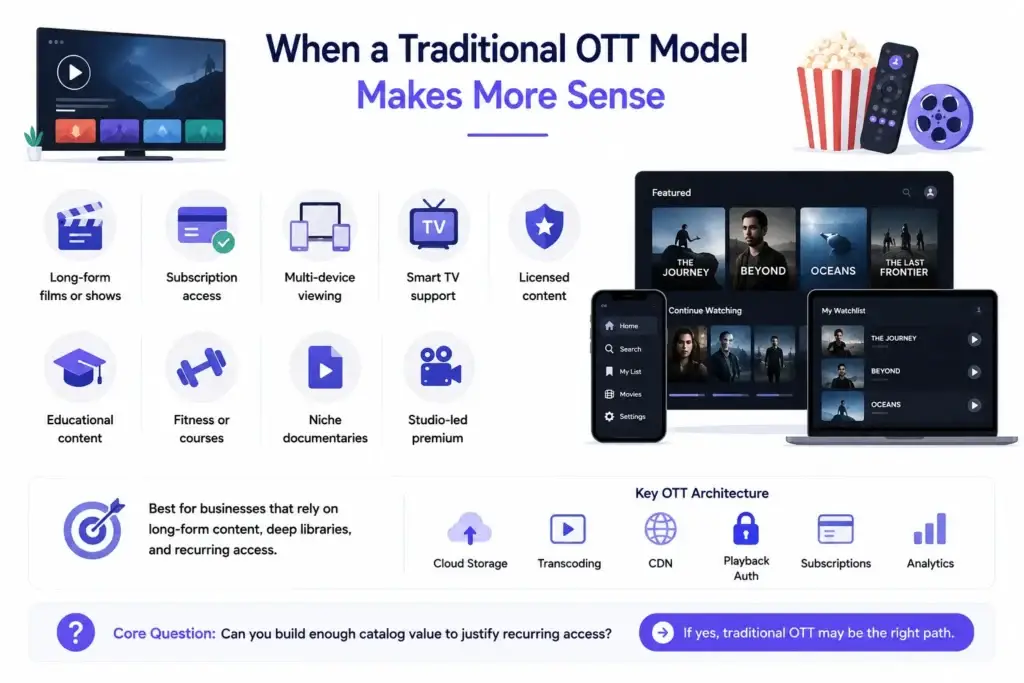
Image Source: AI-generated visual by Miracuves
A traditional OTT model may be better when the business is built around:
- Long-form films or shows
- Subscription-based catalog access
- Multi-device viewing
- Smart TV support
- Licensed content libraries
- Educational video libraries
- Fitness or course-style content
- Niche documentaries
- Studio-led premium content
In this model, users expect search, categories, watchlists, profiles, subscriptions, high-quality playback, and sometimes living-room viewing support. A subscription-based OTT platform is better suited to businesses that depend on long-form content, deep content libraries, recurring access, and multi-device viewing. The core business question is whether you can build enough long-term catalog value to justify recurring access. If the answer is yes, traditional OTT logic may be appropriate.
Founders choosing long-form streaming should also consider the technical requirements behind an OTT streaming architecture, including cloud storage, video transcoding, CDN distribution, playback authorization, subscriptions, recommendations, and analytics. These requirements become increasingly important when the platform serves larger content libraries and viewers across multiple devices.
When a Short Drama App Model Makes More Sense
A short drama model may be better when the business is built around:
- Mobile-first viewing
- Vertical drama episodes
- Fast story hooks
- Social teaser acquisition
- Cliffhanger-led retention
- Coin or episode unlocks
- Rewarded ads
- Regional language content
- Genre-specific drama communities
- Rapid content testing
In this model, users expect instant playback, fast episode flow, emotional hooks, and simple continuation. A mobile-first short drama platform can support this behavior through vertical episodes, cliffhanger-led progression, flexible content unlocks, and mobile-focused engagement flows. The core business question is whether you can turn story curiosity into repeat viewing and monetization. If the answer is yes, a short drama app model may be stronger than a traditional OTT structure.
Mistakes Founders Should Avoid
Building a Generic OTT App for a Short Drama Audience
Short drama viewers need fast hooks, episode flow, and continuation prompts. A slow catalog-first OTT layout can weaken mobile-first engagement.
Putting the Paywall Before Emotional Commitment
Users are more likely to unlock content after they care about the story. Monetization should be tested around cliffhanger strength and continuation intent.
Measuring Installs Without Watching Episode Behavior
Installs only show that the teaser created interest. Episode completion, next-episode starts, and unlock behavior show whether the story and product are working.
Ignoring Content Packaging
Titles, thumbnails, subtitles, teaser clips, and episode descriptions can change performance. A strong story can underperform if the packaging is weak.
Product Strategy Checklist for Founders
Before choosing between a traditional OTT model and a short drama app model, founders should answer these questions:
- Are users coming for planned viewing or impulse viewing?
- Is the content long-form or episode-led?
- Will users pay for a full catalog or unlock specific episodes?
- Does the business depend on subscriptions, ads, coins, or hybrid monetization?
- Will discovery happen inside the app or through external teaser campaigns?
- Does the platform need Smart TV support, or is mobile the priority?
- How important are push notifications and cliffhanger reminders?
- Can the team test multiple story hooks before scaling production?
- Does the admin panel allow content, pricing, and unlock changes without constant developer dependency?
- Does the platform support analytics at the story and episode level?
These answers will usually reveal which model fits the business.
How Miracuves Helps Founders Choose the Right Video Platform Foundation
The real decision is not whether short drama apps are better than OTT platforms. The real decision is which product model matches the founder’s audience, content strategy, monetization plan, and launch timeline.
Miracuves helps founders build ready-made and white-label app foundations for video, entertainment, and creator-led platforms. For founders planning a short drama product, the platform can be aligned around mobile-first viewing, episode access, branded design, admin control, monetization workflows, and faster launch.
For product-level details, founders can explore the short drama app solution. For content strategy planning, read the supporting guide on short drama story hook testing. To browse the wider catalogue, see all Miracuves solutions.
Final Thoughts: Choose the Model Based on Viewer Behavior
Short drama apps and traditional OTT platforms are both video businesses, but they are not built around the same user psychology.
OTT platforms serve planned viewing and long-form catalog value. Short drama apps serve mobile curiosity, emotional hooks, fast continuation, and flexible unlock-based monetization.
For founders, choosing the right model early prevents product confusion later. If the audience wants long-form catalog access, build around OTT logic. If the audience responds to teaser-led discovery, cliffhangers, and mobile-first episodes, build around short drama behavior.
The stronger strategy is not to copy a popular format blindly. It is to understand how viewers behave, how they continue watching, and what makes them return.
FAQs
What is the main difference between short drama apps and traditional OTT platforms?
The main difference is viewer behavior. Traditional OTT platforms focus on long-form planned viewing, while short drama apps focus on fast hooks, mobile-first episodes, cliffhangers, and continuation-based engagement.
Are short drama apps just smaller OTT platforms?
No. Short drama apps need different product logic, including episode unlocks, teaser-led discovery, fast playback, cliffhanger sequencing, rewarded ads, and mobile-first retention flows.
Which monetization model works better for short drama apps?
Short drama apps often use hybrid monetization such as free starter episodes, coin unlocks, rewarded ads, subscriptions, and premium access. The best model depends on audience behavior and content strategy.
When should a founder choose a traditional OTT platform?
A traditional OTT platform makes sense when the business depends on long-form videos, catalog depth, subscriptions, Smart TV access, licensed content, or planned viewing sessions.
When should a founder choose a short drama app model?
A short drama model makes sense when the business depends on mobile-first episodes, social teaser campaigns, dramatic hooks, fast continuation, and flexible episode-based monetization.
Why is episode-level analytics important for short drama apps?
Episode-level analytics help founders understand where users start, drop, continue, unlock, or return. This is more useful than only tracking installs or total watch time.
Can Miracuves help build a short drama app?
Yes. Miracuves helps founders build ready-made and white-label video platform foundations with branded design, admin control, source-code ownership, monetization workflows, and faster deployment.
Miracuves is an independent software development company. We are not affiliated with, connected to, sponsored by, or endorsed by any company or product named in this article.
Terms such as “X Clone” are used descriptively. It is how the software industry refers to building a platform with functionality comparable to a known service, and how clients search for it.
The entire design and codebase of our products is built by our own team. Our products contain no code, design, graphics, or content originating from any third-party website or applications.
All third-party names and marks referenced in this article are the property of their respective owners, referenced solely to identify the services discussed.