



















Key Takeaways
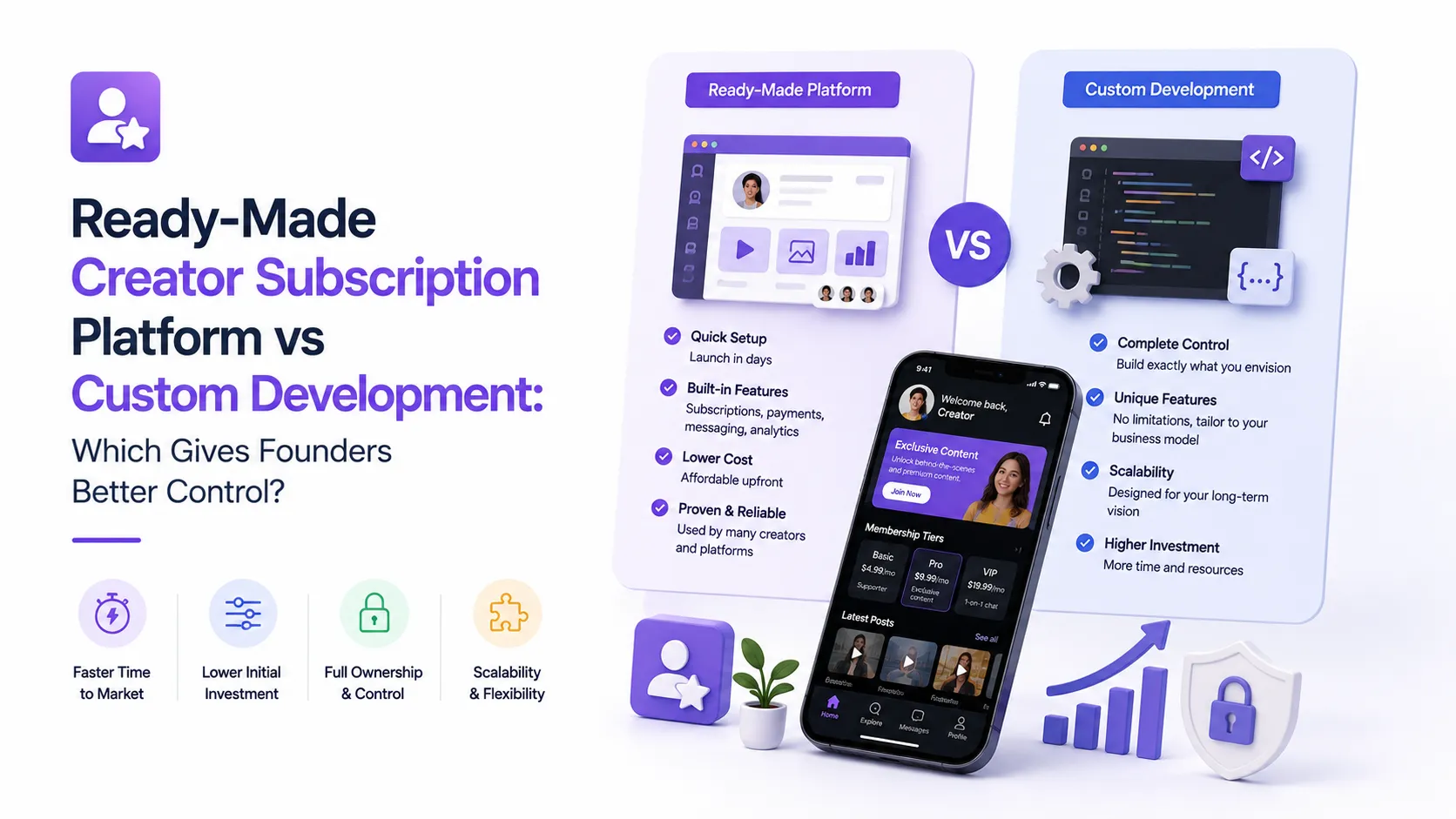
- A ready-made creator subscription platform provides prebuilt memberships, paid content, messaging, live streaming, payments, payouts, moderation, and admin workflows that founders can customize.
- Custom development offers deeper architectural freedom, but it also requires more planning around payments, content access, creator tools, security, infrastructure, and ongoing maintenance.
- Founder control depends less on whether software is ready-made or custom and more on source-code ownership, customization rights, integrations, hosting flexibility, data access, and platform governance.
Control & Development Signals
- Ready-made platforms can reduce repeated development work by providing creator profiles, subscription tiers, PPV content, messaging, live sessions, payments, payouts, and admin modules from the start.
- Custom development gives teams greater freedom over architecture, user experience, monetization logic, data models, integrations, infrastructure, and highly specialized creator workflows.
- Source-code access, API flexibility, payment gateway choice, branding control, feature extensibility, deployment options, and database ownership should be compared before selecting either approach.
Founder Decision Insights
- Founders should compare product complexity, differentiation needs, development resources, launch priorities, security requirements, scalability, maintenance, and long-term platform ownership.
- A customizable ready-made foundation can suit teams that want faster product validation without giving up control, while full custom development may fit highly differentiated business models.
- Miracuves develops customizable creator subscription platforms with source-code control, memberships, PPV content, live access, messaging, payments, creator payouts, analytics, moderation, and admin management.
For founders building a creator subscription business, control is often misunderstood.
Many founders assume custom development gives the most control because everything is built from scratch. That can be true when the product requires unusual workflows, proprietary architecture, or highly specific business logic. But for many creator subscription platform, the real control problem is not whether every screen is custom-built. It is whether the founder can control subscriptions, creator payouts, content rules, admin workflows, payment gateways, branding, user data, roadmap decisions, and future expansion without being trapped by slow development cycles.
That is where the comparison between a ready-made creator subscription platform and custom development becomes more strategic.
A ready-made platform can give founders faster operational control because the core fan, creator, payment, content, and admin workflows already exist. Custom development can give deeper architectural control, but it usually requires more time, more budget, more technical management, and more risk before the founder can even test the market.
For founders who want to launch a creator monetization business, the better question is not “Which option gives theoretical control?” The better question is “Which option gives useful control at the stage my business is actually in?”
For readers still studying the original platform model, this guide on what creator subscription platform is and how it works can provide useful context before comparing ready-made and custom development paths.
Miracuves helps founders answer that question by offering ready-made and white-label app foundations that can be customised around branding, monetization, admin operations, and source-code ownership.
What Founders Really Mean by “Control”
When founders say they want control, they usually mean more than design freedom.
They want to control how creators join the platform, how fans subscribe, how paid content is unlocked, how commissions are calculated, how payouts are approved, how disputes are handled, and how the business can grow after launch.
A creator subscription platform is not a basic content website. It is a monetization system with multiple moving parts. Fans pay creators. Creators upload premium content. The platform manages access rights. Admins monitor activity. Payments, refunds, chargebacks, content reports, subscriptions, wallet balances, and creator earnings all need structure.
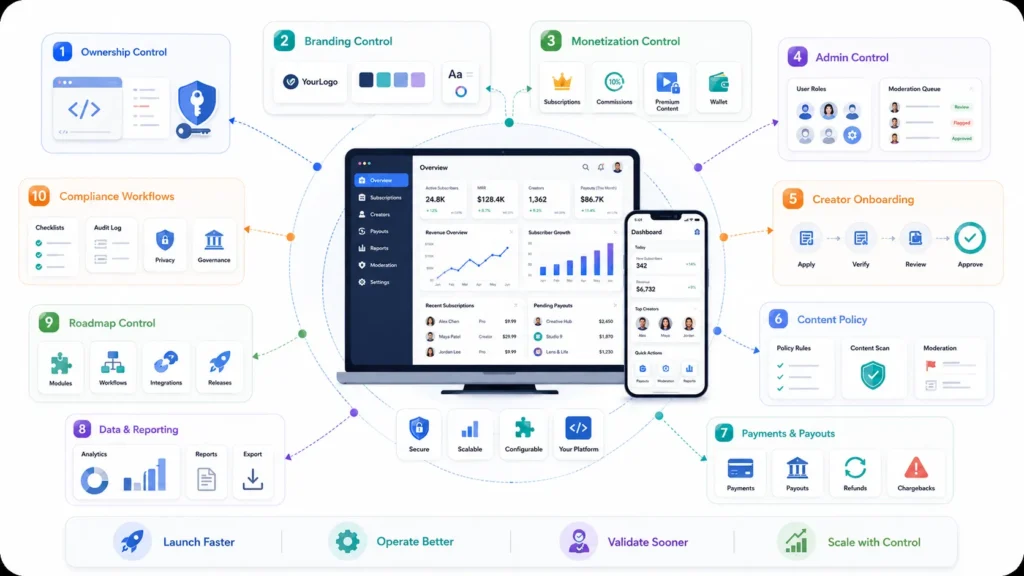
So control should be judged across these areas:
- Ownership control
- Branding control
- Monetization control
- Admin control
- Creator onboarding control
- Content policy control
- Payment and payout control
- Data and reporting control
- Roadmap control
- Compliance workflow control
Before comparing ready-made and custom development, founders should first understand the core creator subscription platform features that affect fan experience, creator workflows, paid content access, admin control, payouts, and long-term monetization.
A custom build may offer full control on paper, but it does not automatically give practical control from day one. A ready-made platform may not give unlimited architecture freedom, but it can give founders the control they need to launch, operate, and validate faster.
What a Ready-Made Creator Subscription Platform Gives Founders
A ready-made creator subscription platform is a pre-built product foundation designed for businesses that want to launch a paid creator community, fan subscription platform, premium content app, coaching membership platform, influencer marketplace, or niche creator monetization network.
The core workflows usually include creator profiles, fan accounts, subscriptions, premium content access, pay-per-view content, tips, messaging, live engagement, wallets, payment integrations, creator earnings, admin controls, content reporting, and analytics.
The biggest advantage is that founders do not have to spend months building standard creator platform modules before discovering whether the niche has demand.
With a ready-made foundation, the founder can focus earlier on the real business questions:
- Will creators join?
- Will fans pay?
- Which niche has better retention?
- Which subscription price works?
- Which creators need extra tools?
- Which payment gateway is suitable?
- Which content policies are required?
- Which features actually drive repeat revenue?
This is where a creator subscription platform can give founders better practical control. The platform already includes the operating foundation, while the founder customises the brand, audience, monetization rules, policies, and growth strategy.
What Custom Development Gives Founders
Custom development means building the creator subscription platform from the ground up.
This route gives stronger control over product architecture, unique user flows, backend logic, database design, creator tools, admin experiences, integrations, and roadmap decisions. It can be the right choice when the business model cannot fit within a ready-made foundation.
For example, custom development may be better when the platform needs:
- A completely new creator monetization model
- Complex enterprise integrations
- Unusual compliance workflows
- Proprietary recommendation logic
- Advanced creator agency management
- Deep AI-driven personalization
- A unique content licensing model
- A product experience that is intentionally different from existing creator platforms
But custom development also increases founder responsibility. The team must define the product, design the user experience, build every module, test every payment flow, manage bugs, handle infrastructure, prepare admin tools, and continue development before real market feedback arrives.
That is why custom development gives stronger technical control, but not always better business control for early-stage founders.
Ready-Made vs Custom Development: Control Comparison
| Control Area | Ready-Made Creator Subscription Platform | Custom Development | Better Choice |
|---|---|---|---|
| Launch control | Faster because core workflows already exist | Slower because everything must be designed and built | Ready-made |
| Branding control | Strong if white-label branding is included | Very strong because design starts from zero | Depends on brand depth |
| Source-code control | Strong when source code is included | Strong if contract gives full ownership | Depends on vendor agreement |
| Monetization control | Strong for subscriptions, PPV, tips, commissions, and payouts | Stronger for unusual monetization models | Ready-made for standard models, custom for unique models |
| Admin control | Faster access to dashboards and operating tools | Fully custom admin logic possible | Depends on complexity |
| Payment control | Faster gateway integration if supported | More flexible but slower to build | Depends on gateway needs |
| Creator onboarding control | Existing creator workflows reduce setup time | Fully custom onboarding possible | Ready-made for faster validation |
| Content policy control | Strong if moderation and reporting tools are configurable | Stronger if policy logic is highly specific | Depends on category risk |
| Roadmap control | Good when source code and customization are available | Highest long-term roadmap flexibility | Custom |
| Cost control | More predictable upfront scope | Can expand as requirements change | Ready-made |
| Market validation control | Strong because launch happens faster | Delayed until product is built | Ready-made |
The simple answer: ready-made platforms usually give better control for launch and validation. Custom development gives better control for deeply unique product architecture.
Why Ready-Made Platforms Often Give Better Early-Stage Control
For early-stage founders, control should not be confused with complexity.
A founder does not gain more control just because the product takes longer to build. Real control means being able to operate the business, test the market, onboard creators, monitor revenue, adjust pricing, improve retention, and respond to user behavior.
A ready-made creator subscription platform helps with this because the founder starts closer to the market.
Founders exploring similar launch-ready models can also browse Miracuves’ ready-made app insights to understand how different app categories use proven product foundations to reduce development effort and reach the market faster.
Instead of waiting for login systems, subscription flows, payment logic, media uploads, wallet modules, creator dashboards, and admin panels to be built from scratch, the founder can move into configuration, branding, niche positioning, creator acquisition, and monetization testing.
This matters because creator platforms are not won only by technology. They are won by creator supply, audience trust, content consistency, payment reliability, moderation quality, and community positioning.
If you need expert support choosing the right build route, Miracuves can help as a creator subscription app development company with ready-made and custom development options aligned with your platform goals.
Where Custom Development Gives Better Control
Custom development becomes more attractive when the founder already knows the platform needs something a ready-made foundation cannot support.
This may happen when the business is not simply a subscription content platform, but a new product category. For example, the platform may need complex creator collaboration, enterprise licensing, brand sponsorship workflows, AI-generated content review, advanced fan segmentation, proprietary content scoring, or specialized payout rules.
Custom development also makes sense when the product itself is the defensible asset. If the founder’s advantage depends on unique technology, custom architecture may be necessary.
But custom development should be chosen for a strong reason, not because it sounds more premium.
A founder should choose custom development when the business requires it, not when the real goal is simply to launch a branded creator platform with subscriptions, creator profiles, paid content, messaging, payments, payouts, and admin control.
The Control Layers Founders Should Evaluate Before Choosing
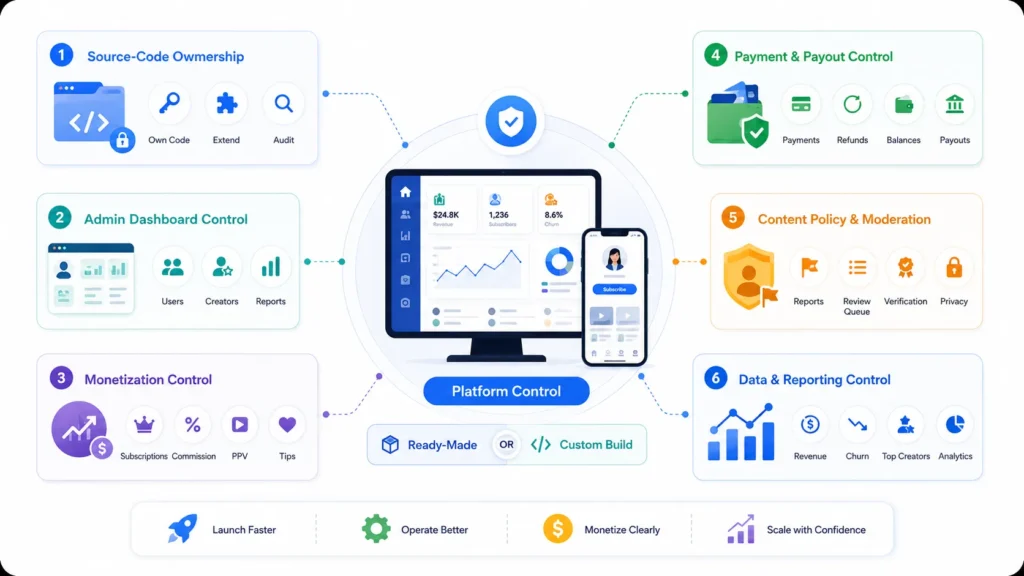
Before choosing ready-made or custom development, founders should evaluate control in layers.
1. Source-Code Ownership
Source-code ownership matters because it affects future flexibility.
If the founder owns the source code, the platform can be modified, extended, audited, migrated, and improved without being fully dependent on the original vendor. This is especially important for creator subscription businesses because monetization, content policies, payment rules, and creator tools may change as the platform grows.
A ready-made solution with source-code ownership can offer a strong middle path: faster launch without giving up long-term technical flexibility.
2. Admin Dashboard Control
The admin dashboard is where the business actually operates.
Founders need admin control over users, creators, content, subscriptions, payments, reports, disputes, commissions, categories, platform settings, and moderation queues. Without a strong admin layer, even a beautiful app becomes difficult to manage.
For creator platforms, admin control is not optional. It decides whether the founder can run the platform without calling developers for every small operational change.
3. Monetization Control
A creator subscription platform should support more than one revenue stream.
Common monetization options include:
- Monthly subscriptions
- Platform commission
- Pay-per-view content
- Tips
- Paid messages
- Live session access
- Creator storefronts
- Featured creator placements
- Premium memberships
- Agency or creator management plans
A ready-made platform is useful when these monetization flows are already structured. Custom development is useful when the revenue model is unusual or needs complex rules that standard systems cannot support.
For deeper monetization planning, founders can review Miracuves’ creator subscription business model guide.
For deeper monetization planning, founders can review the creator monetization model to understand how subscriptions, pay-per-view content, platform commissions, tips, creator payouts, and paid messaging can work together.
4. Payment and Payout Control
Payment control is one of the most important parts of a creator platform.
The platform must manage fan payments, recurring subscriptions, failed payments, refunds, creator balances, payout requests, platform commissions, transaction history, and reporting. Depending on the content category and country, payment gateway availability can also become a major operational decision.
A ready-made platform can reduce development time when standard payment and payout workflows already exist. Custom development may be needed when the payment structure is highly specific or requires rare integrations.
Founders should also avoid assuming that “payment integration” means the same thing in every market. Final payment setup depends on gateway approval, business category, geography, policies, documentation, and risk review.
5. Content Policy and Moderation Control
Creator platforms need clear control over what can be uploaded, reported, reviewed, hidden, approved, or removed.
Moderation is not only about safety. It affects creator trust, user trust, payment risk, brand reputation, and long-term platform stability. Founders should also understand creator platform content security because premium content access, leak prevention, reporting workflows, and admin review systems are part of real platform control.
Important controls include:
- Content reporting
- Abuse reporting
- Creator verification
- Age or identity verification where relevant
- Manual review queues
- Admin takedown tools
- Blocked keyword or category rules
- Privacy settings
- Community guidelines
- Dispute workflows
A ready-made platform gives founders a faster moderation foundation. Custom development gives more freedom when moderation rules are complex or category-specific.
6. Data and Reporting Control
Founders need visibility into what is happening inside the platform.
Useful reports include creator earnings, fan subscriptions, churn behavior, content engagement, top creators, payment failures, payout requests, refund patterns, user growth, and revenue by monetization stream.
Without reporting, the founder is guessing.
A ready-made platform should include enough analytics to support early decisions. Custom development can go deeper when the business needs advanced dashboards, predictive analytics, cohort analysis, or custom finance reporting.
Founder Decision Signals
Choose Ready-Made When Speed Matters
You need to launch, onboard creators, test subscriptions, and validate audience demand before spending heavily on custom product architecture.
Choose Custom When the Model Is Unique
Your product depends on original workflows, unusual payment logic, proprietary algorithms, or a user experience that cannot be adapted from an existing foundation.
Choose Source-Code Ownership When You Want Future Flexibility
A source-code-owned platform gives you room to modify, extend, and scale the product as your creator business evolves.
Choose Admin Strength Over Surface Design
A strong admin dashboard gives founders real operating control over creators, users, content, payments, payouts, disputes, and platform rules.
Mistakes Founders Should Avoid
Mistake 1: Thinking Custom Always Means More Control
Custom development can create more control, but only if the scope, team, architecture, contracts, and roadmap are managed well.
A poorly managed custom build can leave founders with delayed releases, unclear ownership, weak admin tools, untested payment flows, and rising costs.
Control comes from execution, not just from choosing custom development.
Mistake 2: Choosing Ready-Made Without Checking Source Code and Customization Rights
Not every ready-made platform gives the same level of control.
Before choosing a provider, founders should ask:
- Do we get source code?
- Can we customize the design?
- Can we adjust commission rules?
- Can we configure creator payouts?
- Can we add new modules later?
- Can we choose payment gateways?
- Can we control content policies?
- Can the platform scale beyond the first launch?
- A ready-made platform is strongest when it combines speed with ownership and customization.
Mistake 3: Ignoring the Admin Panel
Many founders focus too much on the fan app and creator app.
But the admin panel decides whether the business can run smoothly. If the admin system is weak, the founder may struggle with payout approval, content reports, subscription issues, creator disputes, refund tracking, and platform settings.
For a creator subscription business, admin control is business control.
Mistake 4: Building Too Many Features Before Testing Demand
Creator platforms need strong core workflows before advanced features.
The first market version should focus on creator onboarding, fan subscriptions, paid content access, messaging, payments, payouts, admin control, reporting, and moderation. Advanced discovery, AI recommendations, social commerce, agency tools, and creator automation can come later if the market proves demand.
A ready-made foundation can help founders avoid overbuilding before validation.
Mistake 5: Treating Compliance as a Final Step
Security and compliance workflows should be considered early.
Creator platforms may need identity verification, age-related workflows, payment risk controls, content moderation, audit logs, secure payment gateway integration, privacy-conscious data handling, and role-based admin access. Founders can also review this creator platform security guide to understand the safety layers that matter for paid creator platforms.
Final compliance depends on jurisdiction, legal review, payment partners, integrations, business category, and operating model. A platform can support compliance workflows, but it should not be treated as automatic legal approval.
When a Ready-Made Creator Subscription Platform Is the Better Choice
A ready-made creator subscription platform is usually better when the founder wants to launch faster, validate a niche, reduce development uncertainty, and keep control over the operating model.
It works especially well for:
- Influencer subscription platforms
- Premium fan communities
- Fitness creator platforms
- Coaching membership platforms
- Music creator communities
- Education-based creator platforms
- Regional creator monetization apps
- Agency-led creator platforms
- Private community subscription apps
This is also why niche creator platforms are becoming more attractive for founders. A focused creator community can build stronger loyalty, clearer positioning, better retention, and more relevant monetization than a broad platform trying to serve everyone.
In these cases, the founder usually does not need to invent the entire product architecture. The priority is to customise the positioning, creator category, subscription model, payment flow, content rules, and growth strategy.
Miracuves’ ready-made creator platform approach can help founders start with a launch-ready foundation instead of building every fan, creator, monetization, and admin workflow from zero.
When Custom Development Is the Better Choice
Custom development is better when the founder’s product vision cannot be supported by a ready-made foundation.
It may be the right path when:
- The platform has a unique technical moat
- The monetization model is not subscription-led
- The product requires complex enterprise workflows
- The platform needs unusual user roles
- The creator economy model is highly regulated
- The business requires uncommon payment infrastructure
- The founder has funding, time, and a strong product team
- The roadmap depends on proprietary technology
In this case, custom development gives the founder room to design everything from the ground up.
But the founder should enter custom development with clear specifications, ownership terms, technical milestones, testing plans, security requirements, and post-launch support expectations.
Ready-Made vs Custom: Which Gives Better Control?
The answer depends on the type of control the founder needs.
If the founder needs faster launch control, admin control, monetization control, branding control, and market validation control, a ready-made creator subscription platform is usually the stronger choice.
If the founder needs deep architecture control, unusual workflow control, proprietary technology control, and long-term product uniqueness, custom development may be better.
For most early-stage creator platform founders, the practical answer is clear:
Start with a ready-made, white-label, source-code-owned foundation when the core business model is already understood.
Choose custom development when the business model itself is new enough to justify building from zero.
How Miracuves Helps Founders Build With More Control
Miracuves helps founders launch creator subscription platforms with ready-made and white-label foundations that can be customised around branding, monetization, creator workflows, admin control, and business model requirements.
The goal is not to copy another platform blindly. The goal is to start with a proven creator monetization structure and shape it around a specific niche, audience, policy, and revenue strategy.
For founders who want faster execution, Miracuves can support:
- White-label branding
- Source-code ownership
- Creator and fan workflows
- Subscription and paid content modules
- Admin dashboard control
- Payment and payout workflows
- Content moderation support
- Reporting and analytics
- Custom feature expansion
- 6-day launch for ready-made solutions where applicable
Pricing depends on features, integrations, branding, deployment scope, and customization requirements. Founders should confirm the latest quote based on the selected modules and launch plan.
Related reading: Why Startups Prefer Ready-Made Apps Over Custom Development and Creator Subscription Platform Growth Strategy.
Final Thoughts
The strongest founder decision is not always the most custom decision.
A ready-made creator subscription platform can give founders better practical control because it moves the business closer to launch, creator onboarding, revenue testing, and real user feedback. Custom development gives deeper technical freedom, but that freedom becomes valuable only when the business model truly needs it.
For most founders, the right path is to control what matters first: ownership, branding, monetization, admin operations, payment flows, content policies, reporting, and future customization.
Build from zero when the product demands it.
Start ready-made when the market needs to be tested faster.
FAQs
What is a ready-made creator subscription platform?
A ready-made creator subscription platform is a pre-built product foundation that helps founders launch a paid creator community or fan subscription app. It usually includes creator profiles, fan accounts, subscriptions, paid content, messaging, payments, payouts, admin controls, and moderation workflows.
Is a ready-made creator subscription platform better than custom development?
It is better when the founder needs faster launch, lower development risk, and practical control over monetization, branding, admin workflows, and creator onboarding. Custom development is better when the platform requires unique architecture or complex product logic.
Does custom development give more control?
Custom development can give more architectural control, but it also requires more time, budget, planning, testing, and technical management. For early-stage founders, a source-code-owned ready-made platform may provide enough control to launch and validate faster.
What control should founders check before choosing a platform?
Founders should check source-code ownership, branding flexibility, admin dashboard depth, subscription controls, payment gateway options, creator payout workflows, content moderation tools, reporting, customization rights, and support terms.
Can a ready-made creator platform be customised?
Yes, a strong ready-made platform should support custom branding, feature adjustments, monetization settings, content rules, payment integrations, and future module expansion. The level of customization depends on the provider and source-code access.
When should a founder choose custom creator platform development?
A founder should choose custom development when the product needs unusual workflows, proprietary technology, complex integrations, uncommon payment logic, or a differentiated user experience that cannot be adapted from a ready-made foundation.
Why is admin control important in a creator subscription platform?
Admin control is important because the founder must manage users, creators, content, payments, payouts, subscriptions, reports, disputes, moderation, and platform rules. Without a strong admin dashboard, the business becomes difficult to operate at scale.
Does Miracuves offer ready-made creator subscription platform development?
Yes. Miracuves offers ready-made and white-label creator platform solutions that can support branding, creator monetization, source-code ownership, admin control, and faster deployment based on the selected scope.
Miracuves is an independent software development company. We are not affiliated with, connected to, sponsored by, or endorsed by any company or product named in this article.
Terms such as “X Clone” are used descriptively. It is how the software industry refers to building a platform with functionality comparable to a known service, and how clients search for it.
The entire design and codebase of our products is built by our own team. Our products contain no code, design, graphics, or content originating from any third-party website or applications.
All third-party names and marks referenced in this article are the property of their respective owners, referenced solely to identify the services discussed.