

Key Takeaways
- Short drama story hook testing helps founders validate audience interest before investing heavily in full production, paid acquisition, localization, or a large content library.
- A strong short drama hook creates immediate emotional tension through conflict, mystery, betrayal, romance, revenge, hidden identity, or an unanswered question.
- Founders can test five to ten story concepts using teaser creatives, opening scenes, landing pages, waitlists, or limited releases before scaling production.
- Installs alone are not enough; episode completion, episode-two starts, unlock behavior, watch time, and retention provide stronger signals of story-market fit.
- The strongest stories create a complete funnel from teaser interest to episode completion, continuation, monetization, and repeat viewing.
Testing Signals
- Test story premises, opening lines, emotional stakes, character introductions, visual settings, and cliffhanger endings before producing complete series.
- Teaser testing should compare multiple creative angles instead of relying on a single advertisement or story presentation.
- Track teaser click-through rate, episode-one completion, episode-two starts, average watch time, unlock rate, coin purchase intent, and retention.
- Place the first monetization trigger after viewers have developed enough emotional commitment to care about what happens next.
- Free episodes, coin unlocks, rewarded ads, VIP subscriptions, and pay-per-story access can be tested against actual viewer behavior.
Real Insights
- A large content catalog cannot compensate for a weak opening hook because short drama viewers often decide within seconds whether to continue watching.
- High teaser clicks with poor episode completion can indicate curiosity without genuine story fit.
- If viewers finish free episodes but stop at the paywall, founders should review unlock timing, pricing, rewards, or cliffhanger strength before increasing acquisition spend.
- Content, product, marketing, and monetization teams should use the same episode-level performance data to decide what needs improvement.
- The smartest scaling path is: audience targeting → story concept testing → teaser validation → watch behavior → unlock testing → retention → production scaling.
Short drama apps do not grow only because they have vertical video, paid episodes, or a polished mobile interface. They grow when the story creates instant curiosity.
For founders, this is the most important lesson before investing heavily in production, paid ads, localization, or platform customization. A short drama platform can have the right app foundation, smooth playback, wallet logic, subscriptions, and admin control, but if the first emotional hook fails, users will not stay long enough for the business model to work.
That is why story hook testing should happen before aggressive scaling.
Instead of launching with a broad content library and hoping one series performs, founders should test story concepts, teaser angles, opening scenes, cliffhanger points, and early viewing behavior. This helps identify which stories deserve production budget, ad spend, localization, and long-term release planning.
Miracuves helps founders build short drama and video content platforms with ready-made, White Label ReelShort App Development, but the platform is only one part of the business. The content strategy decides whether viewers continue watching, unlock the next episode, and return for future releases.
Why Story Hooks Matter More Than a Large Content Library
Many founders assume that a short drama platform needs a large catalog from day one. A large catalog can help later, but early growth usually depends on whether one story can create enough emotional tension to pull users into the next episode.
Short drama viewing is impulsive. Users often discover a teaser while scrolling through social media, watching short videos, or reacting to a dramatic clip. They are not always searching for a new streaming subscription. They respond to tension, mystery, betrayal, romance, revenge, status conflict, or a sudden twist.
That means the first growth question is not whether you have enough content. The better question is whether one story can make viewers care within seconds.
A focused story hook gives founders a clearer way to test demand. Instead of producing ten full series too early, founders can test five to ten story concepts through teaser creatives, short clips, landing pages, waitlists, or limited app releases.
This reduces the risk of spending on content that looks good internally but fails with real viewers.
What Makes a Short Drama Hook Work?
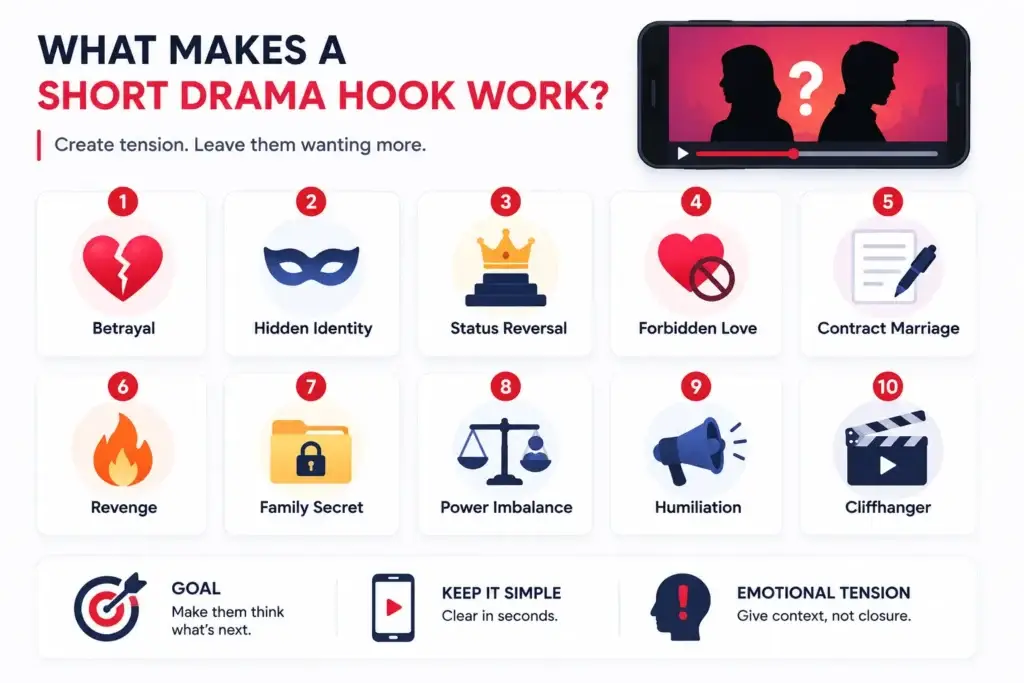
A strong hook creates unanswered emotional tension. It gives the viewer just enough context to understand the conflict, but not enough closure to feel satisfied.
Good short drama hooks often use:
- A sudden betrayal
- A hidden identity
- A social status reversal
- A forbidden relationship
- A contract marriage setup
- A revenge promise
- A family secret
- A power imbalance
- A public humiliation moment
- A cliffhanger that demands the next scene
The goal is not to make the story complicated. The goal is to make the viewer think about what happens next.
For mobile-first drama apps, simplicity matters. The viewer should understand the emotional conflict quickly, even with sound off, small screen size, subtitles, or a short ad placement.
The Founder’s Testing Framework for Short Drama Concepts
Before scaling production, founders should test story ideas in layers. Each layer answers a different business question.
Short Drama Testing Framework
| Testing Layer | What It Validates | Founder Decision |
|---|---|---|
| Story Concept | Whether the core idea has audience appeal. | Choose which stories deserve teaser production. |
| Opening Hook | Whether viewers understand the conflict quickly. | Improve the first scene before spending more on ads. |
| Teaser Creative | Which angle gets clicks, installs, or landing-page interest. | Pick the strongest ad narrative for launch campaigns. |
| Episode One Completion | Whether the story sustains attention after the first click. | Decide whether the script pacing needs revision. |
| Episode Two Start | Whether the first episode creates enough continuation intent. | Adjust the cliffhanger or episode sequence. |
| Unlock Intent | Whether viewers are willing to watch ads, use coins, or subscribe. | Test monetization timing and pricing logic. |
Step 1: Start With a Narrow Audience, Not Everyone Who Watches Drama
A short drama development app should not start by targeting every entertainment viewer. That makes creative testing expensive and confusing.
A stronger approach is to define a narrow launch audience. Examples include:
- Romance viewers who respond to betrayal and reconciliation stories
- Young working professionals who enjoy fast revenge plots
- Regional language viewers looking for mobile-first drama content
- Fans of billionaire romance, hidden identity, or family conflict arcs
- Viewers who prefer short episodes over long OTT-style formats
A focused audience helps founders write better hooks, choose better ad channels, select the right actors or voice styles, and localize content more intelligently.
The sharper the audience, the easier it becomes to understand why a story works or fails.
Step 2: Test Story Premises Before Producing Full Episodes
A story premise is the simplest version of the drama. For example: she married him to save her family, but he does not know she owns the company that controls his future.
That single premise can be tested before full production. Founders can create multiple versions of the same idea and measure which one creates stronger interest. Test variations may include:
- Different power dynamics
- Different emotional stakes
- Different opening lines
- Different character introductions
- Different conflict timing
- Different visual settings
- Different cliffhanger endings
This helps avoid a common founder mistake: falling in love with one script before the audience confirms interest.
A short drama app is a content business, but it should be operated with product discipline. Every story idea should be treated like a testable asset.
Step 3: Use Teaser Ads to Measure Curiosity
Teaser ads are one of the fastest ways to test whether a story hook has market pull. A teaser should not explain the whole plot. It should create enough tension for the viewer to take the next action.
A good teaser may test:
- The first three seconds of conflict
- The strongest emotional line
- Character reveal timing
- Subtitle readability
- Thumbnail expression
- Music intensity
- Ending cliffhanger
- Call-to-action wording
Founders should avoid testing only one creative. A better approach is to test multiple creative angles around the same story. For example, one story can be positioned as revenge drama, romance betrayal, hidden identity reveal, family power conflict, or a rich-versus-poor status reversal.
The winning angle should guide not only ad spend but also the app’s content positioning, thumbnails, episode descriptions, push notifications, and category labels.
Step 4: Measure Watch Behavior, Not Just Installs
Installs can be misleading. A dramatic ad may drive app downloads, but if viewers abandon the first episode, the story or onboarding flow is not strong enough.
Founders should track behavior after the first click. Important short drama metrics include:
- Teaser click-through rate
- App install rate
- First episode start rate
- First episode completion rate
- Episode two start rate
- Average watch time
- Cliffhanger drop-off point
- Free-to-paid unlock rate
- Rewarded ad usage
- Coin purchase intent
- Subscription trial starts
- Day-one and day-seven retention
The goal is not to collect every metric for reporting. The goal is to understand where the viewer loses interest.
If users click the teaser but do not start watching, the landing or onboarding flow may be weak. If users start episode one but do not finish, the story pacing may be weak. If users finish free episodes but do not unlock the next one, the monetization trigger may be too early, unclear, or poorly priced.
Step 5: Place the First Unlock After Emotional Commitment
Short drama monetization depends on timing. If the paywall appears too early, users may feel interrupted. If it appears too late, the platform may miss revenue opportunities.
The strongest unlock point usually appears after emotional commitment. That means the viewer should already care about the character, conflict, or unanswered question before being asked to unlock the next episode.
Founders can test different unlock models:
| Unlock Model | How It Works | Best Use Case |
|---|---|---|
| Free Starter Episodes | Viewers watch early episodes without payment. | Building trust and emotional investment. |
| Coin Unlocks | Viewers spend coins to open specific episodes. | Flexible monetization for high-intent viewers. |
| Rewarded Ads | Viewers watch ads to unlock content. | Monetizing users who are not ready to pay. |
| VIP Subscription | Viewers pay for broader access or fewer interruptions. | Building predictable recurring revenue. |
| Pay-Per-Story Access | Viewers unlock a complete series or bundle. | Testing premium story collections. |
The right model depends on audience behavior, region, content quality, and pricing expectations. A founder should not choose monetization based only on what another app uses. The decision should come from real viewer behavior.
Step 6: Build a Feedback Loop Between Content, Product, and Marketing
A short drama app performs better when the content team, product team, and marketing team work from the same data.
If the ad team sees high click-through but the product team sees low episode completion, the story may be overpromised in the teaser. If the content team sees strong completion but the monetization team sees weak unlocks, the cliffhanger point or pricing flow may need adjustment. If push notifications bring users back but they drop again quickly, the next episode may not satisfy the promise of the previous cliffhanger.
This is where admin dashboards, analytics, content management, and monetization controls become important. Founders need visibility into how each story performs, not just whether the app is live.
Founder Decision Signals
Speed
If the opportunity depends on a trending content format, validate the strongest story angles before spending months on a large content library.
Cost
If early story tests fail, reduce production waste by improving scripts, teasers, or audience targeting before scaling spend.
Scalability
If one story performs strongly, the platform must support playback spikes, unlock activity, notifications, and payment workflows.
Market Fit
If viewers finish free episodes and return for more, the founder has a stronger signal that the story format deserves expansion.
What to Test Before Scaling Paid Acquisition
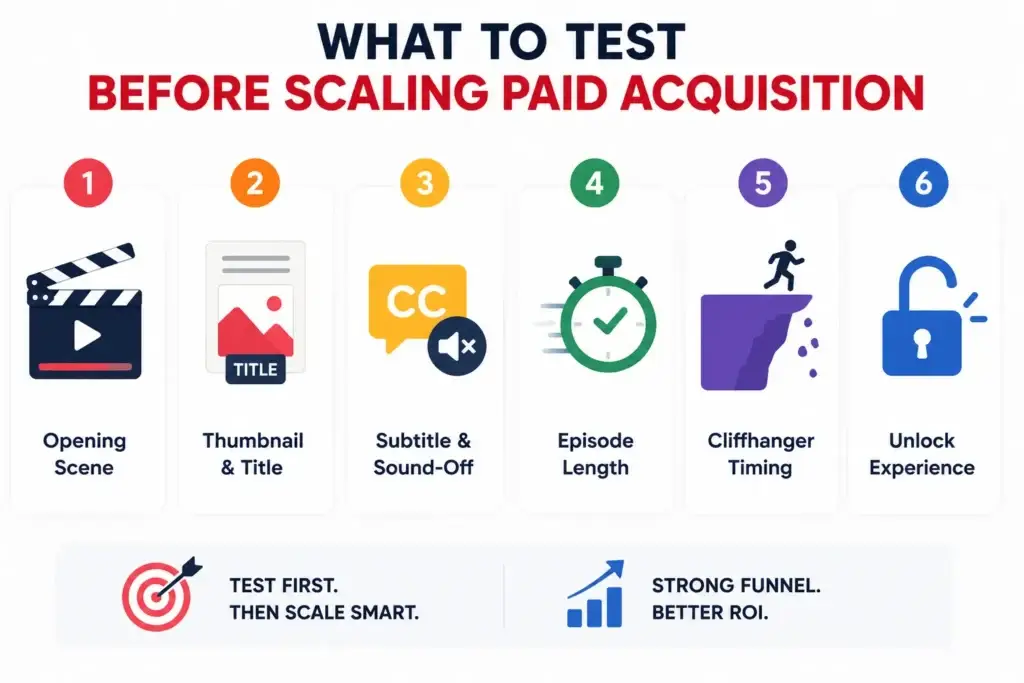
Paid acquisition can grow a short drama platform quickly, but it can also waste budget if the story funnel is weak. Before increasing ad spend, founders should test the following.
Opening Scene Strength
Does the first scene explain the emotional conflict quickly? If viewers need too much context, the story may be too slow for mobile-first discovery.
Thumbnail and Title Appeal
Does the title make the viewer curious? Titles should be dramatic, clear, and easy to understand without sounding generic.
Subtitle and Sound-Off Viewing
Many users see ads without sound. Subtitles, facial expressions, and visual tension should carry the hook.
Episode Length
Short drama episodes should feel fast, but not rushed. Test whether users complete the episode and continue to the next one.
Cliffhanger Timing
The cliffhanger should appear when the viewer is emotionally invested, not before they understand the story.
Unlock Experience
The unlock flow should feel simple. If users are confused by coins, rewards, or subscriptions, they may leave even if they like the story.
Common Mistakes Founders Should Avoid
Producing Too Much Content Before Testing Demand
A large catalog can look impressive, but if the core story angles do not convert, the production budget becomes difficult to recover. Test hooks first, then scale the winners.
Judging Success Only by Installs
Installs show interest in the ad, not necessarily interest in the story. Episode completion, continuation, unlocks, and retention provide stronger business signals.
Copying Popular Drama Themes Without Localizing the Hook
The same trope can perform differently across regions, languages, and audience groups. Local context, casting style, subtitles, and cultural tension matter.
Adding Monetization Before Emotional Commitment
If the first unlock appears before viewers care about the character or conflict, the payment flow feels like friction instead of continuation.
Product Capabilities That Support Story Testing
This article is not about listing every feature of a short drama app. That belongs on the product page. But founders should still understand which platform capabilities support better content testing.
A strong short drama product foundation should support:
- Episode-level analytics
- Watch history
- Content sequencing
- Coin wallet configuration
- Rewarded ad controls
- Subscription management
- Push notification campaigns
- User segmentation
- Regional content organization
- Admin content controls
- Secure payment gateway integration
- Creator or producer management where relevant
These modules help founders test and adjust the business model faster. Without them, the team may depend on developers for every small change, which slows learning.
For a deeper product-level view, founders can explore the short drama app solution from Miracuves.
How to Decide Which Story Deserves More Investment
After testing several story hooks, founders should compare them using a practical decision matrix.
| Signal | Weak Result | Strong Result | Founder Action |
|---|---|---|---|
| Teaser Engagement | Low clicks or weak watch-through | High click-through and strong comments | Produce more creative variations |
| Episode Completion | Viewers drop early | Viewers finish most of episode one | Improve or expand the script |
| Continuation Intent | Few users start episode two | Many users continue immediately | Strengthen cliffhanger strategy |
| Unlock Behavior | Users stop at paywall | Users unlock, watch ads, or subscribe | Test pricing and reward options |
| Retention | Users do not return | Users come back for new episodes | Plan more content in the same genre |
The strongest story is not always the one with the most clicks. A click-heavy teaser with poor episode completion may indicate curiosity without real story fit.
The best investment candidate is usually the story that creates a complete chain: teaser interest, then episode completion, then next episode start, then unlock action, then return visit.
Where Miracuves Fits Into the Short Drama Launch Journey
Founders planning a vertical entertainment platform need two things working together: a reliable app foundation and a strong content testing system.
The app foundation helps with playback, episode access, monetization, admin controls, analytics, and user experience. The content testing system helps decide which stories deserve more production, localization, and acquisition budget.
Miracuves can help founders launch faster with ready-made and white-label video content platforms that include source-code ownership, branded design, admin control, and monetization-ready workflows. This allows founders to spend more time testing content demand instead of rebuilding core infrastructure from zero.
For related planning, read the short drama versus traditional OTT platform comparison to understand why short drama apps behave differently from long-form streaming products. For the delivery layer underneath, see how to build video streaming infrastructure for short video apps and how to choose cloud infrastructure for a short video platform.
Final Thoughts: Validate the Hook Before Scaling the Platform
A short drama app does not win because it has more episodes than everyone else. It wins when the right story reaches the right audience with the right emotional hook at the right moment.
For founders, the smarter path is to validate before scaling. Test story concepts. Measure episode completion. Watch unlock behavior. Study retention. Improve the cliffhanger. Then invest more in the stories that prove demand.
The app foundation matters, but the story hook creates the first business signal. When product, content, monetization, and analytics work together, founders can move from guesswork to a repeatable short drama growth system.
Founders who want to browse the wider catalogue can explore all Miracuves solutions.
FAQs
What is short drama story hook testing?
Short drama story hook testing is the process of testing story ideas, teaser ads, opening scenes, cliffhangers, and viewer behavior before investing heavily in full production or paid acquisition.
Why should founders test short drama hooks before scaling?
Founders should test hooks first because short drama success depends on fast emotional engagement. Testing helps reduce wasted production spend and shows which stories can drive completion, unlocks, and retention.
What metrics matter most for a short drama app?
Important metrics include teaser click-through rate, first episode completion, episode two starts, unlock rate, rewarded ad usage, coin purchase intent, subscription starts, and user retention.
How many story concepts should a founder test?
A founder can start by testing five to ten story concepts. The goal is not volume alone. The goal is to find which emotional angle creates the strongest continuation intent.
What makes a short drama teaser effective?
An effective teaser creates fast tension, introduces a clear conflict, shows emotional stakes, and ends with enough curiosity to make the viewer want the next scene.
Should monetization be tested during early content validation?
Yes, but carefully. Founders should test whether users are willing to unlock episodes through coins, ads, or subscriptions after they already feel emotionally invested in the story.
Is a large content library necessary at launch?
Not always. A focused set of strong stories can be more useful than a large unfocused library. Early-stage founders should prioritize validated story hooks before scaling the catalog.
How can Miracuves help with a short drama platform?
Miracuves can help founders build a ready-made and white-label short drama app foundation with branded design, source-code ownership, admin control, monetization workflows, and faster deployment support.
Miracuves is an independent software development company. We are not affiliated with, connected to, sponsored by, or endorsed by any company or product named in this article.
Terms such as “X Clone” are used descriptively. It is how the software industry refers to building a platform with functionality comparable to a known service, and how clients search for it.
The entire design and codebase of our products is built by our own team. Our products contain no code, design, graphics, or content originating from any third-party website or applications.
All third-party names and marks referenced in this article are the property of their respective owners, referenced solely to identify the services discussed.