


















Key Takeaways
- A short drama engagement platform campaign strategy should focus on bringing viewers back through personalized content, unfinished stories, rewards, notifications, and timely episode updates.
- Re-engagement can combine push notifications, email, in-app messages, watch-history reminders, streak rewards, new episode alerts, and personalized recommendations instead of depending only on paid advertising.
- Strong campaigns connect each message to a clear viewing reason, such as continuing a cliffhanger, unlocking an episode, claiming a reward, or discovering a relevant new series.
Re-Engagement Campaign Signals
- Viewer segments can be created around unfinished series, inactive users, expired streaks, abandoned unlocks, completed dramas, genre preferences, and previous viewing frequency.
- Campaigns can use personalized episode reminders, new-season alerts, expiring coins, comeback bonuses, watch missions, recommendations, and limited-time unlock incentives.
- Frequency caps, send-time optimization, suppression rules, campaign attribution, and user preference controls help prevent notification fatigue while protecting engagement quality.
Retention & Growth Insights
- Operators should track campaign opens, episode resumes, return sessions, reward claims, unlock conversions, watch time, reactivation rate, and repeat viewing after each campaign.
- Content recommendations, referral loops, organic social sharing, creator promotions, loyalty mechanics, and lifecycle messaging can reduce dependence on continuous paid user acquisition.
- Miracuves develops customizable short drama platforms with re-engagement campaigns, personalized recommendations, daily rewards, notifications, episode unlocking, viewer segmentation, analytics, and admin controls.
Short drama platforms are built around fast emotional decisions. A viewer sees a betrayal, romance twist, revenge reveal, family conflict, or cliffhanger, then decides within seconds whether to continue. That makes paid acquisition powerful, but also risky.
Paid ads can bring a viewer into the first episode. They cannot guarantee that the viewer returns tomorrow, unlocks the next chapter, claims a reward, invites a friend, or buys coins later.
That is where a strong short drama re-engagement strategy matters.
Re-engagement focuses on bringing inactive, distracted, or unfinished viewers back into the app before they disappear completely. AppsFlyer defines re-engagement as encouraging inactive users or subscribers to resume activity, often through channels such as push notifications, ads, and email after a defined inactivity trigger.
For short drama founders, the deeper question is not only “How do we acquire more users?” It is:
How do we make already-acquired viewers return at a lower cost than buying new traffic every day?
A ShortMax like engagement platform needs more than video playback. It needs campaign logic, viewer segments, reward rules, in-app messaging, referral loops, coin balances, and analytics that show where viewers return, pay, or drop off.
Why Re-Engagement Matters More in Short Drama Than Traditional OTT
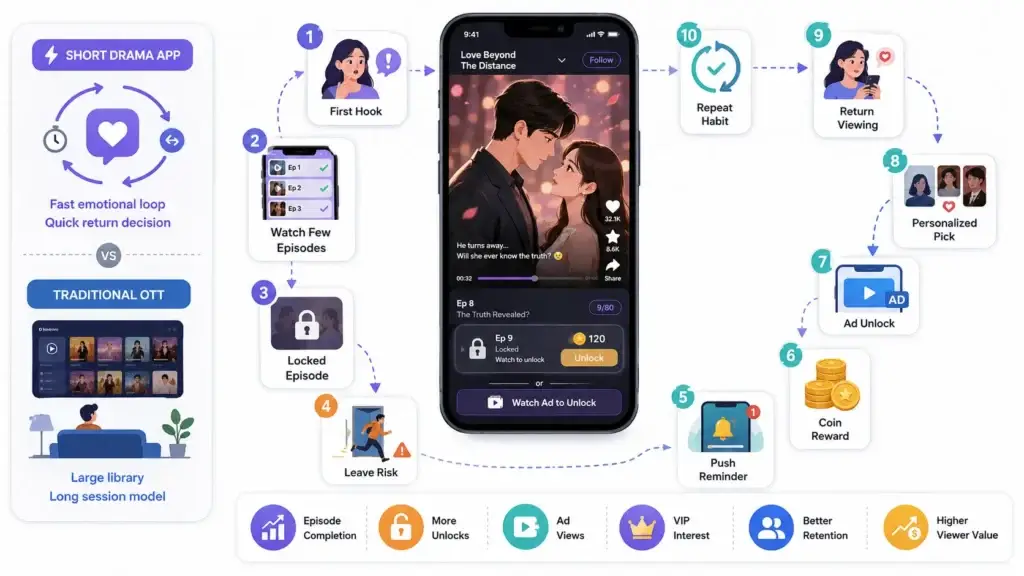
Traditional OTT platforms often rely on library depth, subscription value, and long viewing sessions. Short drama apps work differently.
A viewer may enter through one scene, watch a few short episodes, hit a locked episode, and then decide whether to pay, watch an ad, claim coins, or leave. The decision loop is faster, more emotional, and more fragile.
RevenueCat’s analysis of short-drama apps found that these apps can monetize installs earlier than broader entertainment apps, but also noted that first renewal is harder and longer-term retention can be weaker. That makes re-engagement especially important after the first burst of curiosity fades.
For founders building micro-content entertainment platforms, this creates a different growth challenge from traditional OTT. The product has to convert quick curiosity into repeat viewing through cliffhangers, rewards, episode unlocks, and lifecycle campaigns that keep viewers moving from one story moment to the next.
For founders, this creates a practical business lesson:
Short drama monetization starts with curiosity, but platform growth depends on repeat habit.
A user who leaves after episode three is not necessarily lost. They may need a reminder, a reward, a new hook, a personalized recommendation, or a lower-friction return path.
That is why re-engagement should not be treated as a marketing afterthought. It should be part of the product foundation.
Paid Ads Alone Create an Expensive Growth Loop
Paid acquisition is useful, especially when launching new titles, testing hooks, and entering new regions. But relying only on paid ads creates three problems.
First, paid media costs are controlled by auctions. The platform may not control cost per install, cost per paying viewer, or retargeting cost when competition increases.
Second, paid ads often solve only the first visit. They do not automatically fix mid-series abandonment, low wallet balance, post-paywall hesitation, or inactive VIP subscribers.
Third, short drama creative can fatigue quickly. Many campaigns depend on emotional hook scenes, cliffhanger cuts, and story curiosity. Once the same creative has been overused, performance may drop.
A stronger growth model combines paid ads with owned reactivation systems. Paid ads bring viewers in. Owned campaigns bring them back.
What a Short Drama Re-Engagement Campaign Should Actually Do
A good re-engagement campaign does not simply say, “Come back and watch.”
It answers a specific viewer hesitation.
Maybe the user left because they ran out of coins. Maybe they forgot the story. Maybe they hit the paywall too early. Maybe they completed one series and were never shown a relevant next title. Maybe they liked romance but were later pushed thriller content. Maybe they never claimed a daily reward.
A strong campaign should identify the reason for drop-off and respond with the right message, reward, and destination.
A practical short drama campaign should define:
- Who is being targeted: new viewer, lapsed viewer, payer, non-payer, VIP user, referral user, or high-intent viewer.
- What behavior triggered the campaign: unfinished episode, paywall exit, low coin balance, inactive streak, series completion, or abandoned purchase.
- What action the campaign wants: resume watching, claim coins, unlock an episode, watch an ad, start a new series, renew VIP, or invite a friend.
- What incentive is appropriate: bonus coins, free episode unlock, daily reward reminder, limited VIP window, referral bonus, or content recommendation.
- What metric proves success: reactivation rate, episode continuation, reward claim rate, coin purchase recovery, ad completion, or repeat viewing.
The best campaigns feel like part of the story experience, not a generic marketing blast.
Segment Viewers Before You Send Campaigns
Short drama audiences should not be treated as one list. Different viewers abandon for different reasons.
A user who watched 10 episodes and stopped at a paywall is more valuable than a user who opened the app once and left after 20 seconds. A VIP user who is close to expiry needs a different campaign than a non-paying viewer who watches rewarded ads daily.
Here is a useful segmentation model.
| Viewer Segment | Likely Behavior | Best Re-Engagement Campaign | Success Metric |
|---|---|---|---|
| First-session drop-off | Installed but did not finish early episodes | “Continue the first story” reminder with deep link | Episode 2 or 3 completion |
| Cliffhanger abandoner | Left at locked episode or major reveal | Bonus coin or limited free unlock | Episode continuation rate |
| Low-balance viewer | Watches often but lacks coins | Daily reward, ad-for-coins, small top-up offer | Reward claim or coin purchase |
| Rewarded-ad viewer | Engages but avoids payment | Capped ad unlock plus first-purchase nudge | Ad completion and first purchase |
| Completed-series viewer | Finished one title but did not start another | Similar series recommendation | Next-series start rate |
| Dormant payer | Previously purchased coins but inactive | Personalized return offer tied to unfinished story | Reactivated payer rate |
| VIP expiring user | Subscription window near end | Renewal reminder with upcoming titles | VIP renewal rate |
| Referral-friendly viewer | Heavy user with sharing behavior | Friend invite bonus | Referral signup rate |
Segmentation protects the viewer experience. Instead of sending the same message to everyone, the platform sends messages that match intent.
Use Story Momentum as the Core Campaign Trigger
Short drama engagement is built on unresolved tension. A generic “new content available” message is weaker than a message tied to a specific story moment.
The strongest re-engagement triggers usually come from the viewing journey.
1. Unfinished Episode Campaign
This campaign targets users who started an episode but did not complete it.
The message should remind them of the unfinished moment, not simply push the app.
Example angle:
“You stopped right before the reveal. Continue the episode now.”
This works because the viewer already showed interest. The goal is not to educate them again. It is to reconnect them with the emotional thread they left behind.
2. Cliffhanger Return Campaign
This targets viewers who stopped at a locked episode or a dramatic turning point.
The campaign can offer a small coin bonus, a temporary unlock, or a rewarded ad path. The value should be enough to remove friction, but not so generous that users stop buying coins altogether.
3. New Episode Drop Campaign
This works best for users who follow a specific series or genre.
The message should reference the story, character, or conflict. A short drama app should avoid treating new episodes like generic catalog updates. New drops should feel like a continuation of an emotional promise.
4. Similar Series Recommendation
When a viewer completes a romance revenge series, sending them a thriller recommendation may not work. Recommendation campaigns should use genre, completion behavior, watch depth, and spending behavior.
A completed-series user is a warm audience. The platform should immediately guide them into the next relevant story before the habit breaks.
5. Reward Reminder Campaign
Some viewers are not ready to pay, but they will return for coins, streaks, or ad-based unlocks.
Daily rewards can create habit when they are clearly explained and carefully capped. The campaign should make the user feel they are progressing, not being bribed.
Build Owned Channels Instead of Renting Every Return Visit
Paid retargeting can help, but it should not be the only way to bring users back.
Owned channels give the platform more control over cost, timing, and message relevance. Braze notes that mobile engagement involves channels such as push notifications, in-app messages, SMS, mobile email, Content Cards, and banners, and that these channels work best when coordinated around the customer journey rather than used in isolation.
For short drama platforms, each channel should have a specific job.
| Channel | Best Use in Short Drama | Risk If Misused |
|---|---|---|
| Push notifications | Bring viewers back to unfinished episodes, new drops, rewards, and paywall exits | Too many pushes can cause opt-outs or uninstalls |
| In-app inbox | Store personalized offers, reward reminders, episode updates, and campaign messages | Weak if users are not returning to the app |
| Reactivate users with longer story teasers, VIP offers, or content roundups | Lower urgency than mobile-native channels | |
| SMS or WhatsApp | Time-sensitive offers for opted-in users where appropriate | Can feel intrusive without strong consent and relevance |
| In-app banners | Promote rewards, new series, VIP plans, or limited campaigns during active sessions | Can interrupt viewing if overused |
The key is orchestration.
A viewer who abandons a locked episode might first receive a push notification. If they return, an in-app message can show a coin bonus. If they do not return after several days, email or another permission-based channel may explain the new episode or reward offer.
The goal is not to send more messages. The goal is to send the right message at the right stage.
Reward Loops Can Re-Engage Viewers Without Burning Cash
Short drama platforms often use coins, bonus credits, streak rewards, referral rewards, and rewarded ads to reduce friction. These tools can be powerful because they let the operator reactivate users using platform-controlled value rather than always buying external traffic.
Ficilcom’s short drama marketing guide highlights gamification elements such as daily login bonuses, consecutive viewing badges, and friend referral rewards as useful for retaining non-paying users.
But rewards need discipline.
For a deeper breakdown of check-ins, streaks, coin bonuses, and reward caps, Miracuves’ guide on daily reward loops for repeat viewing explains how incentive systems can support viewer habit without weakening paid unlocks or VIP upgrades.
If the platform gives too much away, users may delay purchases. If rewards are too hard to claim, they will not change behavior. If every user gets the same reward, the platform loses control over cost.
Useful re-engagement rewards include:
- Daily check-in coins
- Streak bonuses
- One-time comeback bonus
- Free episode unlock
- Watch-ad-to-continue option
- Referral credits
- First top-up bonus
- VIP trial window
- Limited-time genre campaign
- Completion reward after finishing a series
The reward should match the viewer’s intent. A dormant payer may not need a free unlock. They may need a reminder of an unfinished premium story. A non-paying daily viewer may need rewarded ads and small coin bonuses. A superfan may respond better to early access than discounts.
Founder Decision Signals for Re-Engagement Campaigns
Speed
If the platform cannot create campaigns quickly, the growth team loses the moment when viewer intent is strongest. Re-engagement needs admin-level campaign setup, scheduling, and audience selection.
Cost
If every returning viewer depends on paid retargeting, retention cost stays exposed to ad auctions. Reward loops, in-app inboxes, and push campaigns can help reduce dependence on paid channels.
Scalability
As the catalog grows, campaigns should work by series, genre, user segment, language, region, and monetization behavior. Manual one-off messaging becomes difficult to manage at scale.
Market Fit
Re-engagement data shows which stories, rewards, and unlock points actually bring viewers back. This helps founders understand demand beyond installs and first-session views.
Campaign depth also affects the cost of building a retention-ready vertical drama platform. Features such as audience segmentation, push workflows, reward logic, coin wallets, referral tracking, and analytics dashboards can change the final development scope, so founders should define their re-engagement priorities before estimating the build.
A Practical 14-Day Re-Engagement Campaign Framework
Founders do not need to start with a complicated automation system. They need a clear re-engagement ladder that responds to viewer behavior.
Here is a practical framework for a short drama platform.
| Timing | Trigger | Campaign Angle | Suggested Action |
|---|---|---|---|
| Same day | Viewer exits mid-episode | “Continue where you left off” | Deep link to unfinished episode |
| Day 1 | Viewer does not return | “Your next episode is waiting” | Push notification with story context |
| Day 2–3 | Viewer stopped at locked episode | “Claim coins to continue” | Bonus coins or rewarded ad option |
| Day 4–5 | Viewer watched multiple episodes but did not pay | “Unlock the next reveal” | First top-up offer or limited unlock |
| Day 7 | Viewer inactive for a week | “New episodes in your favorite genre” | Personalized series recommendation |
| Day 10 | Previous payer inactive | “You still have story progress” | Return campaign tied to unfinished title |
| Day 14 | Dormant viewer | “Last chance to keep your streak” | Comeback bonus with expiry |
| After return | Viewer resumes watching | “Keep your streak alive” | Daily check-in or next-series path |
This framework works because it does not treat inactivity as one problem. It treats inactivity as a sequence of signals.
A viewer inactive for one day needs a reminder. A viewer inactive for two weeks needs a stronger comeback reason.
Design Campaigns Around Viewing Behavior, Not Only User Status
A common mistake is segmenting users only as “active” or “inactive.”
That is too shallow for short drama.
A viewer’s story behavior matters more than their login status. Two users can both be inactive for seven days, but one stopped after episode one while the other stopped after episode seventeen. These users should not receive the same message.
Better campaign triggers include:
- Last watched series
- Last completed episode
- Episode where the user dropped off
- Whether the user hit a locked episode
- Coin balance at exit
- Previous purchases
- Reward claim history
- Genre preference
- Watch time depth
- VIP status
- Referral behavior
- Language preference
- Region or local payment behavior
This is where product architecture becomes important.
A campaign team cannot act on these signals unless the platform stores and exposes them through admin dashboards, analytics, and campaign tools.
What the Admin Console Should Let Growth Teams Control
Short drama re-engagement should not require developer tickets for every small change.
The growth team should be able to adjust campaigns, rewards, and user segments from the admin side. Otherwise, the platform becomes slow at exactly the moment it needs speed.
A strong campaign-ready admin console should support:
- Audience segmentation
- Campaign scheduling
- Push or in-app message creation
- In-app inbox messages
- Reward amount settings
- Daily reward caps
- Referral reward settings
- Coin wallet visibility
- Episode-level performance
- Series revenue breakdown
- Top revenue episodes
- User analytics
- Campaign statistics
- Notification history
- Language and regional settings
- Role-based admin access
Miracuves’ short drama solution page describes a platform with reward ladders, referral loops, campaign desk workflows, in-app inbox rows, coin ledger logic, and monetization analytics, which makes it a relevant next step for founders evaluating a <a href=”https://miracuves.com/shortmax-clone/“>campaign-ready short drama app foundation</a>.
Re-Engagement Campaign Ideas for Short Drama Platforms
Below are campaign ideas founders can adapt based on catalog, monetization model, and audience behavior.
1. “Finish the Reveal” Campaign
Best for: Users who abandoned a cliffhanger
Message angle: “You stopped before the truth came out.”
Offer: Free unlock, small coin bonus, or rewarded ad option
Goal: Bring users back to a high-intent episode
This campaign works best when the platform can deep link directly to the unfinished episode.
2. “Daily Coin Comeback” Campaign
Best for: Non-paying or price-sensitive viewers
Message angle: “Your daily coins are ready.”
Offer: Check-in reward or streak continuation
Goal: Build daily app habit
This should be capped carefully. The goal is to encourage return behavior, not replace all paid unlocks.
3. “New Season Drop” Campaign
Best for: Viewers who completed or followed a series
Message angle: “The next chapter is live.”
Offer: Early access, free first episode, or VIP preview
Goal: Move completed-series viewers into the next viewing loop
This campaign is stronger when personalized by genre or previous watch history.
4. “Low Balance Rescue” Campaign
Best for: Viewers who reached a locked episode with insufficient coins
Message angle: “Need coins to continue?”
Offer: Watch an ad, claim a bonus, or buy a small pack
Goal: Reduce paywall abandonment
This campaign should show multiple paths rather than a hard payment wall.
5. “VIP Window” Campaign
Best for: Heavy viewers or repeated coin buyers
Message angle: “Watch more with fewer interruptions.”
Offer: Short VIP trial, weekly pass, or limited upgrade
Goal: Convert frequent viewers into higher-value users
VIP should feel like convenience and priority access, not simply a discount.
6. “Referral Story Unlock” Campaign
Best for: Loyal users and socially active viewers
Message angle: “Invite a friend and unlock the next episode.”
Offer: Referral coins or free unlock after signup
Goal: Turn engaged viewers into acquisition partners
Referral campaigns work best when rewards are easy to understand and fraud controls are in place.
7. “Genre Comeback” Campaign
Best for: Dormant users with clear genre preference
Message angle: “A new revenge drama just dropped.”
Offer: Free opening episode or limited coin boost
Goal: Reactivate based on content taste
This is useful when your catalog includes romance, revenge, thriller, fantasy, family drama, or regional-language titles.
Balance Rewards With Monetization Discipline
Reward-based campaigns can reduce drop-off, but they can also damage revenue if they are not controlled.
A platform should not give unlimited free progression to users who would have paid. It should use rewards to remove friction at specific moments.
| Reward Type | Best Used For | Business Value | Risk If Misused |
|---|---|---|---|
| Daily check-in coins | Habit building | Increases repeat sessions | Too generous rewards reduce purchases |
| Free episode unlock | Paywall rescue | Saves high-intent users from dropping | Users may wait for free unlocks |
| Rewarded ad unlock | Non-payer retention | Monetizes users who avoid payment | Ad fatigue or lower paid conversion |
| Referral coins | Organic acquisition | Turns viewers into promoters | Fraud or low-quality invites |
| VIP trial | Heavy viewer upgrade | Moves frequent users toward subscription | Trial users may churn without catalog depth |
| First top-up bonus | First purchase conversion | Reduces payment hesitation | Discounts may become expected |
| Streak bonus | Daily engagement | Builds return habit | Users may disengage after streak loss |
The guiding rule is simple:
Use rewards to extend engagement, not to erase monetization.
A healthy short drama platform gives users a reason to return while still preserving the value of coins, VIP access, and premium episodes.
The Role of In-App Inbox Campaigns
Push notifications are useful, but they disappear quickly. In-app inbox campaigns give viewers a persistent place to find rewards, episode updates, referral bonuses, VIP offers, and campaign messages.
For short drama platforms, an in-app inbox can support:
- New episode announcements
- Reward claim reminders
- Personalized comeback offers
- Referral status updates
- VIP expiry notices
- Genre-based recommendations
- Free unlock campaigns
- Payment or coin purchase confirmations
- Campaign messages by region or language
This matters because not every user acts immediately. A viewer may ignore a push notification but later open the app and see the offer waiting inside the inbox.
An in-app inbox also gives the operator more control over campaign visibility without relying completely on external tools.
Measure Re-Engagement by Cohort, Not Just Total Opens
Campaign performance should not be judged only by notification open rate.
A viewer can open a message and still fail to watch, unlock, pay, or return again. For short drama platforms, the more useful metrics are connected to story continuation and monetization behavior.
Track these metrics:
| Metric | What It Reveals |
|---|---|
| Reactivation rate | Percentage of inactive users who return after campaign |
| Episode continuation rate | Whether viewers resume the story |
| Paywall recovery rate | Whether users return after leaving at a locked episode |
| Reward claim rate | Whether incentives are attractive enough |
| Coin purchase recovery | Whether campaigns restart spending behavior |
| Rewarded ad completion | Whether ad-based unlocks retain non-payers |
| Next-series start rate | Whether completed viewers continue into another title |
| D1, D3, D7, D30 retention | Whether users build repeat habit |
| VIP renewal rate | Whether subscription users see ongoing value |
| Push opt-out rate | Whether messaging frequency is too aggressive |
| Revenue per reactivated viewer | Whether re-engagement improves unit economics |
The most important insight is not whether a campaign got attention. It is whether the campaign created a valuable return session.
How to Avoid Notification Fatigue
Short drama platforms can easily over-message users because every episode, reward, cliffhanger, and offer feels urgent.
But mobile is personal. Too many irrelevant messages can train users to mute notifications or uninstall the app.
A strong re-engagement strategy should include:
- Frequency caps per user
- Quiet hours by region
- Genre-based personalization
- Suppression rules after purchase
- Different campaigns for payers and non-payers
- Deep links to the exact episode or reward
- A/B testing for message timing
- Opt-out monitoring
- Campaign-level performance review
Braze emphasizes that mobile engagement improves when teams test timing, content, and channel combinations regularly and measure at the segment level.
For short drama apps, this means campaign teams should not only ask, “Did we send the message?” They should ask, “Was this the right moment to interrupt the viewer?”
Re-Engagement Should Connect With Monetization Strategy
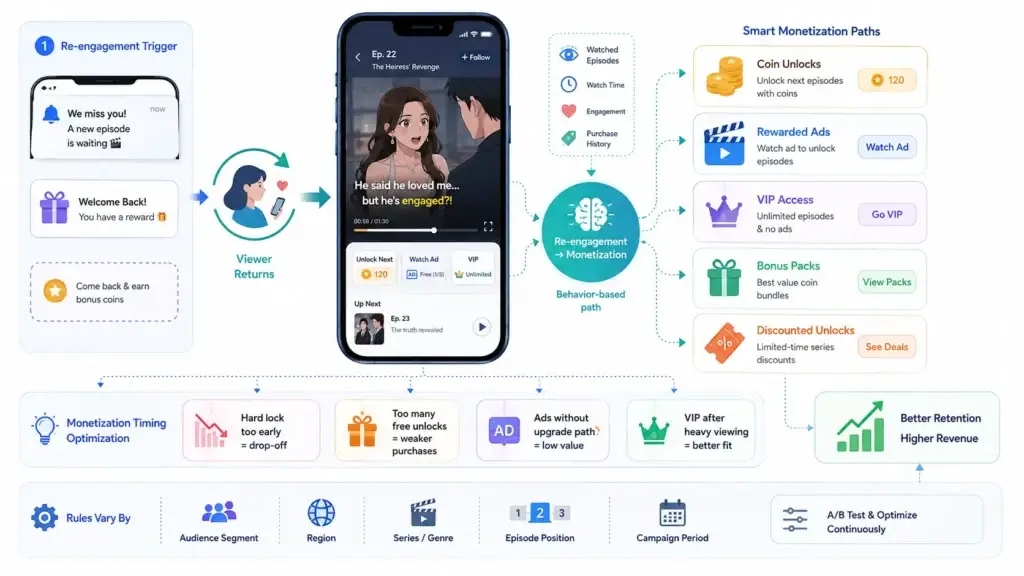
Re-engagement and monetization should not operate separately. A strong microdrama monetization model connects comeback campaigns with coins, rewarded ads, VIP access, referral incentives, and paid episode unlocks so returning viewers are guided into the right revenue path without feeling forced.
A viewer who returns after a reward campaign should enter a thoughtful monetization path. That path may include coin unlocks, rewarded ads, VIP access, bonus packs, or discounted series unlocks.
Miracuves’ short-drama monetization guide explains how coin unlocks, VIP access, and rewarded ads can work together to balance revenue, retention, and viewing momentum. It also emphasizes that monetization rules should remain configurable by audience segment, region, series, episode, and campaign period.
This is important because campaign success changes depending on where monetization appears.
For example:
- If a user returns and instantly hits another hard lock, they may leave again.
- If a user gets too many free unlocks, they may stop buying coins.
- If a user watches several rewarded ads with no upgrade path, ad revenue may stay low.
- If a user receives a VIP offer too early, they may ignore it.
- If a user receives a VIP offer after heavy viewing, it may feel useful.
The best strategy is to make re-engagement the bridge between viewing behavior and monetization readiness.
Where Miracuves Fits Into the Re-Engagement Stack
Building re-engagement manually after launch can create unnecessary delays. Founders may start with video uploads and payments, then later realize they need campaign tools, reward settings, referral tracking, in-app inboxes, and revenue analytics. This is where choosing a vertical drama platform development partner becomes important, because the growth layer should be planned into the product foundation rather than patched in after launch.
That usually creates avoidable rework.
Miracuves helps founders launch short drama and micro-content platforms with white-label branding, source-code ownership, admin control, and faster deployment. For teams that want re-engagement workflows from the start, a launch-ready vertical drama platform can provide a stronger foundation than building every campaign and reward module from zero.
The goal is not to copy another entertainment app blindly. The goal is to launch with the right growth surface: rewards, campaigns, analytics, wallet logic, and viewer lifecycle controls that help the business test retention in the real market.
For founders comparing platform options, Miracuves’ short drama app development service is also useful for understanding how video playback, coin monetization, creator workflows, and admin operations connect inside a production-ready build.
Common Mistakes Founders Should Avoid
Sending the Same Campaign to Every Viewer
A viewer who left after one episode should not receive the same message as a paying user who stopped after episode twenty. Poor segmentation wastes attention and weakens reactivation performance.
Using Rewards Without Caps
Reward campaigns should bring users back, not train them to avoid payment. Daily limits, expiry windows, and segment-based rewards help protect monetization.
Relying Only on Paid Retargeting
Paid retargeting can help, but it keeps return visits tied to ad spend. Owned channels such as push, in-app inbox, and email should be part of the platform strategy.
Ignoring the Episode Where Users Drop Off
Drop-off location tells the growth team whether the issue is weak storytelling, early monetization, low coin balance, or campaign timing. Without episode-level data, teams guess instead of optimize.
Related reading: Short Drama Engagement Platform Analytics and What Makes a Ready-Made Short Drama Engagement Platform a Practical Choice for Startups.
Final Thoughts: Re-Engagement Is the Difference Between Installs and a Real Audience
A short drama platform does not win because users install it once. It wins when viewers return to continue the story, claim rewards, unlock episodes, watch ads, invite friends, and start the next series.
Paid ads can create the first visit. Re-engagement creates the second, third, and tenth visit.
For founders, the smarter approach is to build the platform around viewer lifecycle logic from day one. That means campaign tools, reward settings, push and inbox workflows, coin balances, referral loops, and analytics should not be treated as later add-ons.
Miracuves helps founders launch retention-ready short drama platforms with white-label branding, source-code ownership, admin control, and faster deployment, so teams can focus on content, campaigns, and monetization instead of rebuilding the product foundation from scratch.
FAQs
What is a short drama re-engagement strategy?
A short drama re-engagement strategy is a structured plan to bring inactive or distracted viewers back into the platform. It can include push notifications, in-app inbox messages, rewards, bonus coins, referral campaigns, episode reminders, and personalized content recommendations.
Why should short drama platforms not depend only on paid ads?
Paid ads are useful for acquisition, but they can become expensive if every return visit requires more media spend. Re-engagement helps platforms bring back users who already installed the app, watched episodes, showed genre interest, or reached a monetization point.
What are the best re-engagement campaigns for microdrama apps?
Useful campaigns include unfinished episode reminders, cliffhanger comeback offers, daily coin rewards, new episode alerts, similar series recommendations, low-balance rescue campaigns, VIP renewal reminders, and referral bonus campaigns.
How do rewards help viewer retention?
Rewards reduce friction for users who are interested but not ready to pay. Daily check-ins, bonus coins, free unlocks, and rewarded ads can encourage viewers to return and continue watching. However, rewards should be capped so they do not weaken coin purchases or VIP upgrades.
What metrics should founders track for re-engagement?
Founders should track reactivation rate, episode continuation rate, paywall recovery, reward claim rate, coin purchase recovery, rewarded ad completion, VIP renewal, next-series start rate, push opt-outs, and revenue per reactivated viewer.
How can in-app inbox campaigns support short drama growth?
An in-app inbox gives users a persistent place to see rewards, episode updates, comeback offers, referral credits, and VIP reminders. It supports re-engagement because messages do not disappear as quickly as push notifications.
When should a platform send re-engagement messages?
Messages should be triggered by behavior, not random schedules. Strong triggers include unfinished episodes, paywall exits, low coin balance, reward inactivity, VIP expiry, completed series, or several days without opening the app.
What platform features are needed for viewer re-engagement?
A re-engagement-ready platform should include audience segmentation, campaign scheduling, push notifications, in-app inboxes, reward settings, coin wallets, referral tracking, episode analytics, monetization reports, and admin controls.
Miracuves is an independent software development company. We are not affiliated with, connected to, sponsored by, or endorsed by any company or product named in this article.
Terms such as “X Clone” are used descriptively. It is how the software industry refers to building a platform with functionality comparable to a known service, and how clients search for it.
The entire design and codebase of our products is built by our own team. Our products contain no code, design, graphics, or content originating from any third-party website or applications.
All third-party names and marks referenced in this article are the property of their respective owners, referenced solely to identify the services discussed.