













Key Takeaways
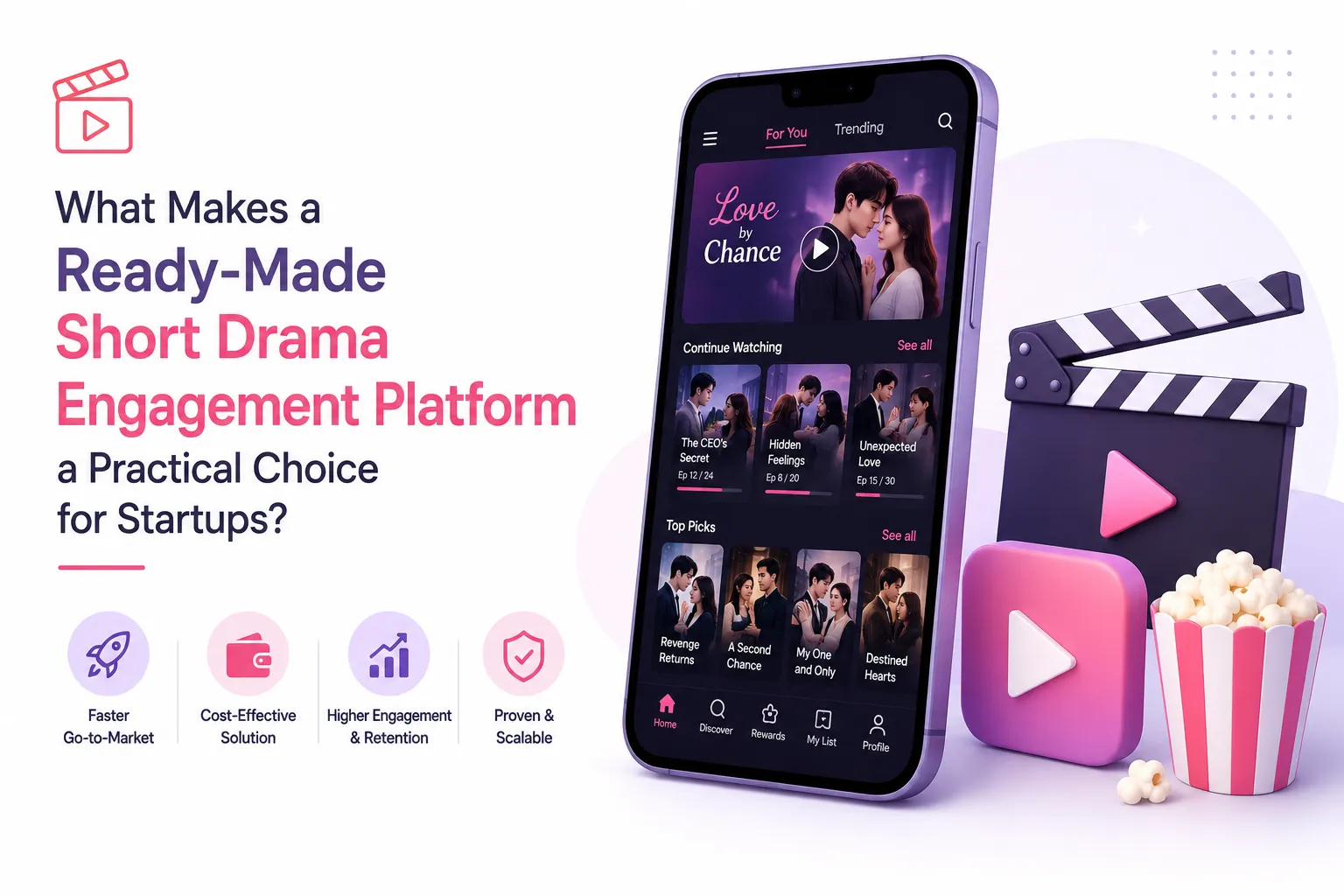
- A ready-made short drama engagement platform gives startups prebuilt modules for vertical video, episode feeds, content discovery, coin wallets, episode unlocking, rewards, subscriptions, and admin management.
- Using an existing platform foundation can reduce repeated development work while allowing founders to focus on content strategy, audience validation, monetization, and retention.
- Source-code control, customization flexibility, scalable infrastructure, integrations, analytics, and monetization options determine whether a ready-made solution can support long-term product growth.
Ready-Made Platform Signals
- Prebuilt vertical playback, series management, episode unlocking, personalized feeds, daily rewards, rewarded ads, notifications, and payment workflows cover many core short-drama operations.
- Founders can customize branding, content categories, coin pricing, subscription plans, unlock rules, reward logic, recommendation flows, and user engagement campaigns around their business model.
- Modular architecture makes it easier to add AI personalization, loyalty features, creator tools, advanced analytics, localization, additional payment methods, and new monetization models as usage grows.
Startup Decision Insights
- Startups should compare source-code ownership, customization depth, streaming performance, security, payment integrations, scalability, maintenance, and admin control before selecting a platform.
- A practical foundation should support rapid content and monetization testing without forcing founders to rebuild standard streaming, engagement, and payment modules from scratch.
- Miracuves develops customizable short drama engagement platforms with vertical streaming, episode unlocking, coin wallets, rewards, subscriptions, recommendations, analytics, notifications, and admin controls.
Short drama apps are not just smaller versions of OTT platforms. They are built around a different viewing habit: quick vertical episodes, emotional hooks, fast continuation, coin-based unlocks, daily rewards, and repeat engagement loops.
For startups, this creates both an opportunity and a challenge.
The opportunity is clear. Mobile-first audiences are already comfortable watching short, dramatic, cliffhanger-led content during breaks, commutes, and spare moments. Official app listings for leading short drama platforms highlight features such as bite-sized episodes, multilingual libraries, daily content updates, watchlists, recommendations, offline viewing, and genre-led discovery.
The challenge is that the platform is not only a video player. It needs a content engine, payment flow, reward system, admin dashboard, wallet logic, unlock rules, analytics, and re-engagement workflows working together from day one.
That is why many founders now evaluate a ready-made short drama engagement platform before committing to a long custom build. The goal is not to copy another entertainment app blindly. The goal is to start with a proven product foundation, customize it for a specific audience, and validate whether the content, monetization, and engagement loop can work in the target market.
Why Short Drama Engagement Platforms Are Attracting Startup Attention
Short drama content works because it compresses emotion into a small viewing window. A user does not need to commit to a 45-minute episode. They can watch a dramatic conflict, twist, reveal, or cliffhanger in one short session and immediately decide whether to continue.
For founders studying the wider opportunity around short drama and micro-content platforms, the real question is not only whether users will watch short episodes. The bigger decision is whether the platform can support repeat viewing, coin-based access, daily rewards, referrals, and monetization without making the product feel complicated.
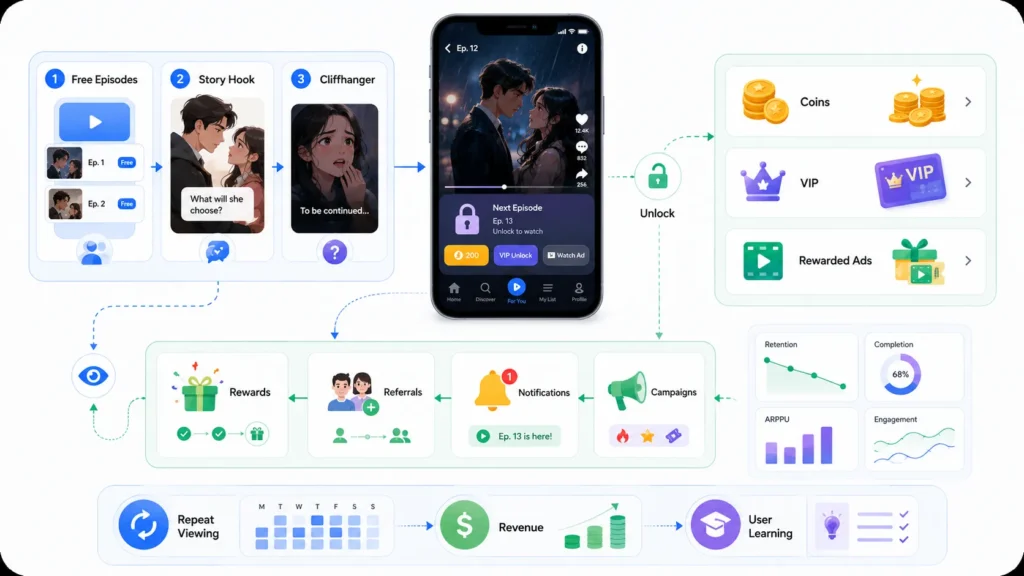
This format is especially attractive for startups because the product loop is easy to understand:
- A viewer watches free opening episodes.
- The story creates curiosity.
- The next episode is locked.
- The viewer unlocks it with coins, subscription access, or rewarded ads.
- Rewards, referrals, notifications, and campaigns bring the viewer back.
Competitor platforms in the microdrama space commonly position vertical episodes, coin wallets, subscriptions, ad-supported unlocks, and repeat engagement as core product layers, not optional extras.
For a startup, that matters because building only a video streaming app is not enough. The platform has to answer a harder question: how will users keep coming back, and how will each return session create revenue or learning?
What a Ready-Made Short Drama Engagement Platform Actually Includes
A ready-made platform is not just a pre-designed app screen. It should provide the operational foundation needed to run a short drama business under your own brand.
A practical foundation usually includes:
- Vertical video playback for mobile-first viewing
- Series and episode management
- Free episode windows
- Coin or wallet-based episode unlocks
- Subscription or VIP access
- Rewarded ad unlock options
- Daily rewards or check-in incentives
- Referral rewards
- Watchlists and viewing history
- Content categories and genre filters
- Admin dashboard for pricing, users, content, and reporting
- Payment gateway integration support
- Campaign or notification workflows
- Analytics for content, revenue, and user behavior
The important point is not whether the app has a long feature list. The real question is whether the core short drama platform features connect into a working engagement loop, where vertical playback, episode gating, wallet logic, rewards, referrals, content management, and analytics support one clear viewer journey.
A short drama platform should guide the viewer from discovery to emotional investment, then from emotional investment to unlock, and from unlock to repeat viewing. If those steps are disconnected, the app may look complete but fail commercially.
Why Startups Often Prefer Ready-Made Foundations Over Building From Zero
Custom development gives complete flexibility, but it also creates more unknowns. A startup may spend months building login, content upload, video playback, payment flows, wallets, admin controls, analytics, notifications, and app store builds before testing whether the audience wants the content.
A ready-made short drama engagement platform changes the order of risk. Instead of validating the technology first, the startup can validate the market first.
That is practical for founders because early success depends on questions like:
- Which genre gets viewers to episode three?
- Where should the paywall begin?
- Do viewers prefer coin unlocks, subscriptions, or ad unlocks?
- Which reward amount creates return visits without weakening the coin economy?
- Which markets respond to localized content?
- Which series generates the strongest completion and unlock behavior?
These are business questions, not just development questions. A launch-ready foundation helps founders reach those answers faster.
For founders comparing ready-made and custom development, it also helps to understand the cost factors behind a short drama platform. Customization scope, payment gateways, coin wallet logic, content workflows, localization, analytics, and launch requirements can all influence the final budget.
Engagement Mechanics That Matter More Than a Large Feature List
A short drama startup does not win because it has every possible feature. It wins when the core behavior is easy to repeat.
The most important engagement mechanics are the ones that reduce friction, create anticipation, and give users a reason to return.
1. Free Episodes That Create Emotional Investment
The first few episodes should reduce hesitation. Viewers need enough story context to care about the characters, conflict, and next reveal.
If the paywall appears too early, the user may leave before emotional investment forms. If it appears too late, the platform may give away too much value without monetization. A strong admin dashboard should let the operator test this balance.
2. Coin Unlocks That Feel Simple
Coins work well in short drama apps because they make small transactions feel lighter than full subscription decisions. A viewer may hesitate to buy a monthly plan but still unlock the next dramatic episode if the wallet flow is simple. Founders who want to understand this access layer more clearly can read Miracuves’ guide on vertical episode unlocking.
The wallet must be clear. Users should understand how many coins they have, how they earned them, how much an episode costs, and what happened after each unlock.
3. Daily Rewards That Build Habit
Daily rewards are not only a giveaway. They are a habit-building tool.
A check-in reward can bring users back even when they did not plan to watch. Once they return, the platform has another chance to push them toward a saved series, new release, campaign, or locked episode.
The reward should be controlled carefully. If the reward economy is too generous, users may stop purchasing coins. If it is too strict, rewards may not influence behavior.
Startups that want to build stronger return behavior can explore how daily rewards for viewer retention work across check-ins, streaks, bonus coins, referral credits, and reactivation campaigns.
4. Referral Rewards That Turn Viewers Into Acquisition Channels
Paid acquisition can be expensive for entertainment startups. Referral rewards give existing viewers a reason to bring in new users.
The key is attribution and trust. The referrer should clearly understand when the reward is credited, and the platform operator should be able to track referral activity inside the backend.
5. Campaigns and Notifications That Bring Users Back
Short drama content depends on release rhythm. New episodes, new series, bonus coins, limited unlock windows, and genre-specific promotions can all bring viewers back.
A practical platform should let operators communicate with users without asking developers to manually create every campaign.
6. Recommendations and Watchlists That Reduce Search Effort
Short drama viewing is impulse-led. The next title should be easy to discover. Watchlists, continue-watching flows, genre tags, and recommendation logic help viewers keep moving through the catalog.
This is why discovery is not a cosmetic layer. It directly affects watch time, unlocks, and repeat visits.
How Monetization Works Without Breaking the Viewing Experience
A short drama platform usually needs more than one revenue stream. Some users will pay. Some will watch ads. Some will return because of rewards. Some may only convert after several free episodes. For founders planning the revenue layer, Miracuves’ guide to vertical drama streaming app monetization explains how coins, VIP access, ads, and episode unlocks can work together.
A flexible monetization structure may include:
| Monetization Model | How It Works | Startup Value |
|---|---|---|
| Coin packs | Users buy coins and spend them on episode unlocks | Supports small, repeated transactions |
| VIP access | Users pay for broader access during a subscription window | Useful for heavy viewers |
| Rewarded ads | Users watch ads to unlock or earn coins | Monetizes non-paying users |
| Free-to-paid episodes | Early episodes are free, later episodes require access | Helps create emotional investment before monetization |
| Campaign-led offers | Operators promote bonus coins or limited access windows | Supports reactivation and testing |
| Regional pricing | Pricing varies by market or audience segment | Helps localize monetization strategy |
The founder’s job is to avoid forcing every viewer into one path. A practical coin unlock and VIP monetization model should let different user segments convert in different ways, whether they prefer paid coins, subscriptions, rewarded ads, referral credits, or campaign-based unlocks.
For example, a price-sensitive viewer may watch rewarded ads. A high-intent viewer may buy coins. A binge watcher may prefer VIP access. A returning viewer may respond to daily rewards. The stronger the platform is at handling these paths, the better the startup can learn from real behavior.
Founder Decision Signals: When a Ready-Made Platform Makes Sense
Speed
Choose a ready-made foundation when your biggest risk is delayed market entry, not lack of custom features. Short drama trends move quickly, and waiting too long can make content testing more expensive.
Cost
A ready-made route is practical when you want to control upfront development exposure while testing content-market fit, paywall placement, and monetization behavior.
Scalability
The platform should support video delivery, wallet records, content management, user activity, campaigns, and analytics without forcing manual operations at every step.
Market Fit
If your key question is whether a specific genre, region, language, or audience segment will engage, launch speed and measurement matter more than building every advanced feature first.
Founder Checklist: Launch Time, Ownership, Licensing, Costs, and Technical Risk
Choosing a ready-made short drama app is not simply about getting more features for a lower upfront price. Founders need to understand what they will own, how quickly the business can start operating, which costs continue after launch, and who is responsible when something breaks.
Before selecting a platform provider, evaluate these six business decisions.
1. Launch Timeline: What Does “Ready to Launch” Actually Mean?
A ready-made short drama app may reduce the time needed to develop standard streaming and monetization workflows. However, a working demonstration is not the same as a production-ready launch.
Founders should request a written delivery schedule covering branding, configuration, payment integration, content uploads, testing, deployment, and handover.
Ask the provider to distinguish between the software deployment date and the date when the business can accept real viewers and payments. Content licensing, payment-provider approval, and app store review may introduce dependencies outside the software team’s control.
Founder decision: Choose a launch timeline based on documented deliverables, dependencies, and acceptance criteria rather than an advertised number of days alone.
2. Source-Code Ownership: What Will the Startup Actually Control?
Ownership determines how easily a startup can change developers, modify its product, migrate hosting, or introduce new monetization workflows.
Founders should confirm whether the agreement includes the application source code, backend code, admin panel, deployment instructions, and access to the relevant repositories.
They should also establish who controls hosting accounts, app store accounts, payment accounts, domain names, and operational data.
Founder decision: Request written confirmation of code ownership, intellectual property rights, repository access, and the handover process before making a purchase.
3. Software Licensing: Are There Restrictions After Handover?
Software ownership and software licensing are related but different considerations.
A founder may receive source-code access while still facing restrictions on deployment, modification, redistribution, or use of third-party components.
Review whether the platform is supplied through a perpetual license, subscription, managed-service agreement, or intellectual property transfer.
Also verify the licensing obligations attached to third-party libraries, video infrastructure, analytics tools, and other integrations.
Founder decision: Understand which rights are transferred, which services require ongoing payment, and whether any contractual restrictions could limit future growth.
4. Maintenance and Support: Who Fixes Problems After Launch?
A ready-made platform still requires ongoing maintenance.
Payment integrations can change, operating systems release updates, app stores introduce new requirements, and security issues may need urgent attention.
Before signing, ask what support includes, how bugs are classified, how quickly critical issues are handled, and whether future updates are included or billed separately.
The agreement should distinguish between bug fixes, security patches, compatibility updates, infrastructure management, and new feature development.
Founder decision: Select a provider with a documented support scope, clear response expectations, and an agreed process for post-launch changes.
5. Operating Costs: What Will the App Cost Beyond Development?
The purchase price is only one part of the startup’s financial commitment.
| Cost Category | What Founders Should Budget For |
|---|---|
| Platform acquisition | Initial software purchase, setup, and agreed customization |
| Hosting and infrastructure | Servers, databases, storage, backups, and monitoring |
| Video delivery | Encoding, CDN bandwidth, streaming traffic, and content protection |
| Payment processing | Gateway charges, refunds, chargebacks, and currency conversion where applicable |
| Maintenance | Bug fixes, security updates, operating system compatibility, and technical support |
| Content operations | Licensing, production, subtitles, dubbing, and catalog management |
| Growth operations | Marketing, customer support, analytics, and retention campaigns |
A useful budget should estimate costs at launch and at higher viewing volumes.
For example, a platform with inexpensive initial deployment may become expensive if video bandwidth, infrastructure usage, or maintenance fees rise faster than revenue.
Founder decision: Compare the expected total cost of ownership over 12 months, not just the initial software quotation.
6. Technical Risk: What Could Delay or Disrupt the Business?
A ready-made platform reduces some development work, but it does not eliminate technical risk.
Founders should verify whether critical workflows have been tested, including episode playback, coin purchases, payment confirmation, refunds, subscription access, content restrictions, and account recovery.
They should also review backup procedures, security practices, performance under concurrent traffic, third-party service dependencies, and the process for resolving production incidents.
Request a working demonstration and define measurable acceptance criteria for the most important workflows.
Founder decision: Avoid committing to a platform without validating its critical business functions and understanding who is accountable for production issues.
Pre-Purchase Decision Checklist for Short Drama Startup Founders
- The launch scope, delivery milestones, and dependencies are documented.
- Source-code ownership and intellectual property rights are confirmed in writing.
- Software licensing terms and third-party restrictions are understood.
- Hosting, app store, payment, and repository account ownership is clear.
- Maintenance coverage, support duration, and update responsibilities are documented.
- Initial development costs and 12-month operating costs are estimated.
- Payment, wallet, episode unlocking, and streaming workflows have been tested.
- Security, backup, scalability, and incident-response responsibilities are agreed.
- The provider has explained what is included and what requires additional customization.
A ready-made short drama app becomes a practical startup investment when it provides more than a quick technical launch. It should give founders predictable responsibilities, manageable operating costs, clear ownership rights, and enough flexibility to improve the product as the business grows.
What Startups Should Still Plan Carefully
A ready-made short drama engagement platform can reduce development time, but it does not remove the need for strategy. Founders still need to make strong decisions before launch.
Startups should also evaluate whether their short drama platform development partner understands vertical episode pacing, coin wallet flows, reward economics, CMS control, payment setup, app deployment, and admin reporting. The right partner should connect engagement, monetization, and operations instead of only delivering app screens.
Content Supply
Short drama platforms need consistent content. A startup should decide whether it will use licensed content, produce original series, work with creators, or build around a regional niche.
The app can support publishing, but the business still needs a content pipeline.
Genre Positioning
Trying to serve every viewer from day one can weaken positioning. Many startups are better off starting with a clear genre or audience segment, such as romance, thriller, fantasy, family drama, regional-language stories, or creator-led episodic content.
A narrower content promise can make acquisition, recommendations, and retention easier to manage.
Unlock Economics
The platform operator should define how many episodes are free, how many coins each unlock requires, what users can earn through rewards, and how reward caps prevent abuse.
This is where admin control matters. If every change requires developer involvement, the startup loses agility.
Video Infrastructure
Short episodes may look lightweight, but video delivery still needs planning. Storage, bandwidth, CDN, adaptive playback, signed URLs, and content protection can affect both user experience and operating cost.
Analytics
A startup needs more than total views. It should track where users drop off, which episodes drive unlocks, which genres retain viewers, which campaigns reactivate users, and how rewards affect coin purchases.
Without analytics, the founder is guessing.
Why Admin Control Is a Startup Advantage
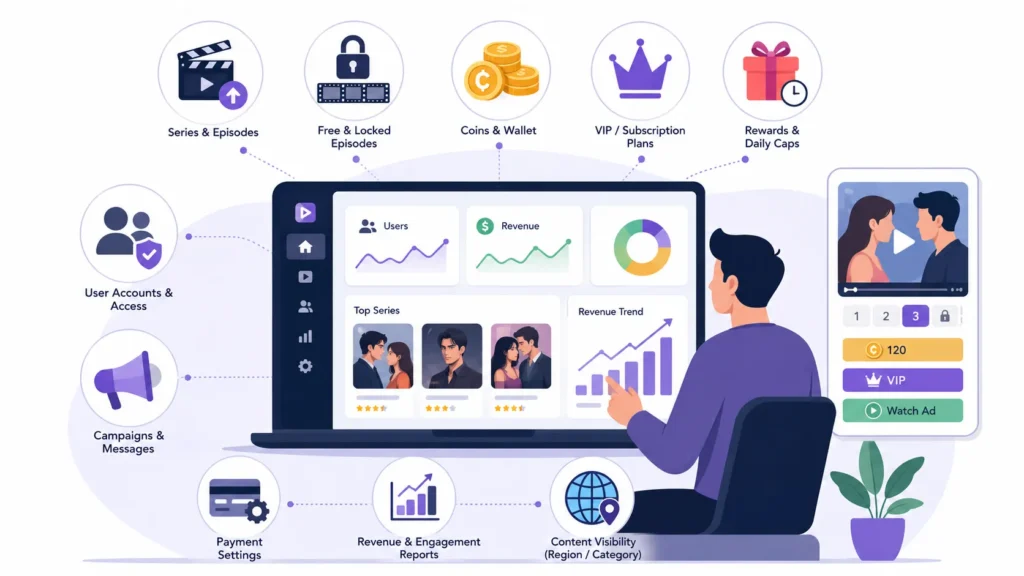
The admin dashboard is where the short drama business is actually managed.
A founder should be able to control:
- Series, seasons, and episode uploads
- Free and locked episode settings
- Coin pricing and wallet rules
- Subscription or VIP plans
- Reward amounts and daily caps
- User accounts and access controls
- Campaign messages
- Payment settings
- Revenue and engagement reporting
- Content visibility by region or category
This matters because early-stage startups need fast iteration. If viewers are dropping before the paywall, the operator may need to adjust the free episode window. If reward abuse appears, caps may need to change. If one genre performs better, the homepage may need to promote it more aggressively.
A ready-made platform is practical only when the operator can make these changes without waiting for a development cycle each time.
Where Miracuves Fits Into the Short Drama Startup Journey
Miracuves helps founders launch ready-made and white-label app solutions with source-code ownership, branded design, admin control, and monetization-ready workflows.
For a startup exploring the short drama category, the practical advantage is starting with a working foundation instead of building every module from zero. That foundation can then be customized around the founder’s content model, target geography, pricing strategy, and engagement loop.
Founders who are already evaluating a product-specific platform can explore Miracuves’ launch-ready short drama platform foundation to understand how a ready-made vertical drama solution can support coin unlocks, rewards, referrals, campaign workflows, and operator control.
For teams that need broader product planning, customization, deployment, or post-launch improvement, Miracuves also provides short drama app development support for vertical micro-drama platforms, engagement workflows, coin-based monetization, and launch-ready app execution.
Mistakes Founders Should Avoid
Building a video player instead of an engagement platform
A short drama startup needs playback, but playback alone does not create retention. The platform also needs unlock logic, rewards, referrals, recommendations, campaigns, and analytics.
Launching without clear paywall testing
The free-to-paid transition is one of the most important business decisions. If the paywall is placed poorly, the app may either lose viewers too early or under-monetize engaged users.
Giving away too many reward coins
Rewards should support habit formation, not destroy monetization. Founders should use caps, tracking, and wallet visibility to keep the coin economy healthy.
Ignoring localization
Short drama demand can vary heavily by language, culture, genre, and region. Localized subtitles, pricing, categories, and campaign copy can improve relevance.
Ready-Made Does Not Mean Generic
A common concern founders have is that ready-made software may feel too generic. That concern is valid if the platform only changes the logo and colors.
A practical ready-made short drama engagement platform should be customizable at the business level, not just the visual level.
That means the founder should be able to shape:
- The content categories
- The unlock model
- The reward structure
- The pricing logic
- The brand experience
- The payment setup
- The campaign strategy
- The content publishing workflow
- The admin permissions
- The analytics priorities
This is the difference between a simple template and a serious product foundation. A startup does not need every module custom-built from scratch, but it does need enough control to run a differentiated business.
Final Thoughts: A Practical Path for Faster Short Drama Validation
A ready-made short drama engagement platform is practical for startups because it helps shift effort away from basic engineering and toward the decisions that actually determine traction: content selection, paywall strategy, reward economics, retention, and monetization.
The strongest founders will not treat a ready-made platform as a shortcut around strategy. They will treat it as a faster route to real market learning.
Build the foundation quickly. Test the content. Measure the unlock path. Adjust the rewards. Watch retention. Improve the catalog. Then invest deeper once the audience behavior is clear.
Miracuves can support this path with a white-label, source-code-owned short drama app foundation designed for faster launch, admin control, and monetization-ready execution.
FAQs
What is a ready-made short drama engagement platform?
A ready-made short drama engagement platform is a pre-built app foundation for launching vertical episodic content with features such as video playback, episode unlocking, coin wallets, rewards, referrals, subscriptions, admin controls, and analytics. It helps startups avoid building every core workflow from zero.
Why is engagement so important in short drama apps?
Engagement is important because short drama revenue often depends on repeat viewing and episode continuation. If users do not return, they do not unlock more episodes, watch more ads, buy more coins, or respond to campaigns.
How do coin unlocks work in a short drama platform?
Coin unlocks allow users to buy or earn virtual coins and spend them to access locked episodes. This creates a flexible monetization path because users can make smaller purchases instead of committing to a full subscription immediately.
Is a ready-made platform suitable for a startup with original content?
Yes. A ready-made platform can be useful for startups with original content because it provides the publishing, monetization, and engagement foundation. The startup can focus more on storytelling, audience testing, and content release strategy.
What features should a short drama startup prioritize first?
A startup should prioritize vertical playback, fast onboarding, free episode windows, coin unlocks, wallet transparency, rewards, referrals, content management, payment integration, campaign tools, and analytics. Advanced features can be added once viewer behavior is clearer.
Can a ready-made short drama platform be customized?
Yes, a strong ready-made platform should support customization across branding, content structure, pricing, payment setup, reward rules, unlock logic, categories, and admin workflows. The goal is to launch faster without losing control over the business model.
How does a ready-made short drama platform reduce startup risk?
It reduces risk by allowing founders to validate content demand, monetization behavior, retention, and market fit before committing to a long custom development cycle. This helps the startup learn from real users sooner.
When should a startup choose custom development instead?
A startup should consider custom development when it needs highly unique product workflows, advanced rights management, complex creator revenue sharing, unusual integrations, or enterprise-level infrastructure that a ready-made foundation cannot support without major changes.
Miracuves is an independent software development company. We are not affiliated with, connected to, sponsored by, or endorsed by any company or product named in this article.
Terms such as “X Clone” are used descriptively. It is how the software industry refers to building a platform with functionality comparable to a known service, and how clients search for it.
The entire design and codebase of our products is built by our own team. Our products contain no code, design, graphics, or content originating from any third-party website or applications.
All third-party names and marks referenced in this article are the property of their respective owners, referenced solely to identify the services discussed.