Key Takeaways
- B2B Travel Booking Platform Cost is primarily influenced by the business model, travel categories, supplier integrations, agent workflows, corporate features, financial logic, customization, and administrative requirements.
- The number of screens is not the main cost driver. Different booking workflows, supplier APIs, credit systems, commissions, approvals, refunds, payouts, and settlements can increase development complexity significantly.
- Supplier API connections can require separate work for authentication, search, availability, booking, cancellation, refunds, webhooks, error handling, rate limits, and data normalization.
- Agent and corporate platforms introduce additional requirements such as client records, balances, credit limits, commissions, statements, employee roles, travel policies, approval chains, billing, and reporting.
- The final budget should also account for third-party services, hosting, payment gateway fees, supplier/API accounts, notifications, monitoring, support, security, and future customization rather than focusing only on software implementation.
Cost Signals
- Adding flights, hotels, buses, trains, cabs, packages, activities, homestays, and transfers can introduce different search, availability, pricing, booking, cancellation, refund, and supplier workflows.
- Advanced commission rules become more complex when pricing varies by partner, category, geography, volume, date, agent tier, or negotiated contract.
- Agent credit and prepaid balances require transaction histories, deposits, booking debits, refunds, adjustments, credit ceilings, authorization controls, and accurate reconciliation.
- Corporate workflows can expand scope through employee profiles, department budgets, travel policies, approval routing, booking restrictions, expenses, billing, and reporting.
- Supplier portals add onboarding, document workflows, inventory management, rate and availability controls, booking visibility, payouts, statements, and administrative review.
Real Insights
- A universal travel platform price can be misleading because cost depends on who uses the system, what they control, how inventory is sourced, and how money moves through the platform.
- A ready-made foundation can reduce ground-up development when standard booking, partner, financial, and administrative workflows already match the required business model.
- Infrastructure should be sized around actual usage such as concurrent agents, searches, supplier API traffic, bookings, background jobs, reports, settlement runs, and notification volume.
- Security should be included in the scope because B2B platforms can handle partner balances, credit information, supplier documents, traveler data, refunds, payouts, and staff permissions.
- The strongest budgeting approach is: define the operating model → identify users and workflows → select travel categories → map supplier integrations → define financial logic → prioritize required features → separate third-party costs → assess customization → estimate infrastructure and support → finalize the development scope.
Planning a B2B travel booking platform is not simply a question of choosing flights, hotels, and a payment gateway.
The cost and complexity are usually decided by what happens around the booking.
Can an agent book on behalf of a customer? Does the agent use a prepaid balance or approved credit? Does commission calculate automatically? Can a company enforce travel policies and approval chains? Can suppliers update inventory and rates? How are refunds, payouts, and monthly settlements reconciled?
Those operational requirements can change the scope far more than the number of screens in the app.
That is why founders should not begin with the question, “How much does a travel platform cost?”
Start with:
Which users need to perform which business operations?
Once that is clear, feature priorities, integration requirements, implementation complexity, and cost become much easier to understand.
Why Travel Platform Cost Starts With the Business Model
Two travel platforms can sell the same flights and hotels while requiring very different software.
Consider three business models.
A consumer booking platform may need travelers, search, checkout, bookings, refunds, offers, and support.
A travel-agent platform may additionally need:
- Agency onboarding
- Client profiles
- Agent balances
- Credit limits
- Commission
- Partner statements
- Trade pricing
- Agent CRM
A corporate travel platform may need:
- Company accounts
- Employee roles
- Travel policies
- Manager approvals
- Department reporting
- Expense records
- Corporate billing
A supplier-led marketplace adds another layer:
- Supplier applications
- Document workflows
- Inventory management
- Rate management
- Supplier payouts
- Settlement records
This is why asking for one universal “travel app price” can be misleading.
For founders who want to understand the underlying transaction flow before defining scope, this guide explains how a B2B travel booking platform works across agents, corporate accounts, suppliers, bookings, payments, and administrative operations.
Cost begins with who uses the system and what each user needs to control.
Feature Group 1: Travel Inventory and Booking Engines
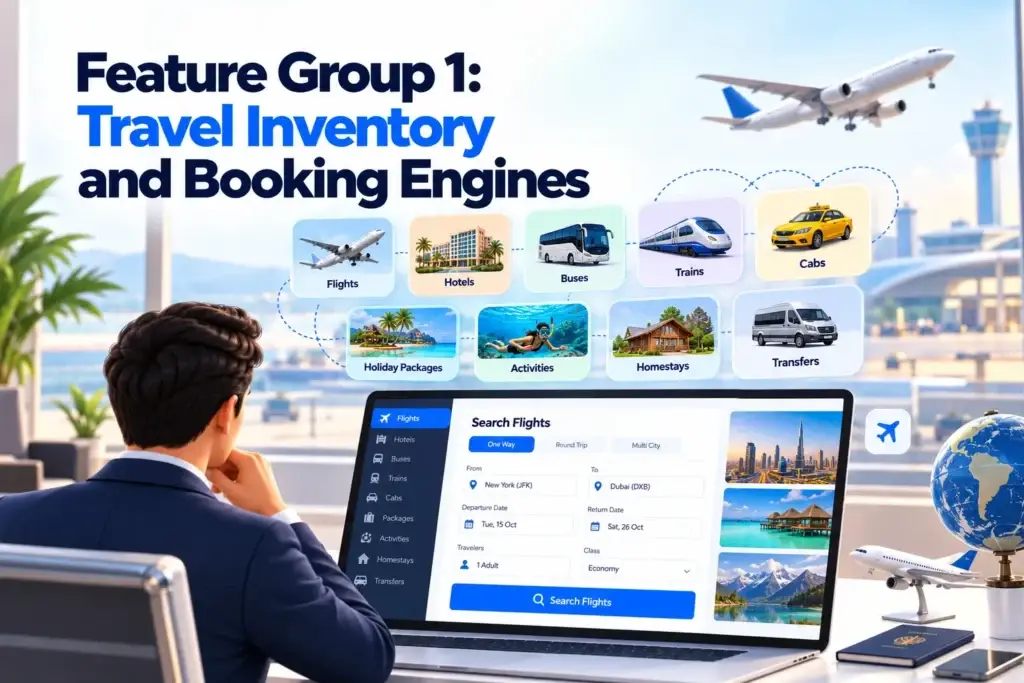
The booking engine is the core transaction layer.
Depending on the business, the platform may offer:
- Flights
- Hotels
- Buses
- Trains
- Cabs
- Holiday packages
- Activities
- Homestays
- Transfers
Not every startup needs every category at launch.
Each additional category can introduce its own:
- Search logic
- Filters
- availability structure
- fare or rate rules
- booking confirmation
- cancellation workflow
- refund logic
- supplier integration
- administrative settings
Cost impact
The important cost question is therefore not:
How many categories can we display?
It is:
How many different booking workflows must the platform actually operate?
Adding a simple manually managed tour category is very different from integrating another real-time inventory source with booking, cancellation, and refund APIs.
Feature Group 2: Supplier API Connections
Supplier connectivity is one of the biggest variables in travel technology.
A platform may obtain inventory through:
- Flight suppliers
- Hotel aggregators
- Bus inventory providers
- Rail integrations
- Cab providers
- Activity providers
- Direct hotel contracts
- Local tour operators
Different suppliers may return information in different structures.
One provider may describe a hotel room one way while another describes the same room differently. Cancellation policies, taxes, availability responses, booking confirmations, and refund processes may also vary.
If supplier connectivity, inventory aggregation, booking workflows, and multi-category travel operations are central to the project, Miracuves’ travel booking platform software provides a useful reference for the broader technology layer.
The platform therefore needs an integration layer that can normalize supplier data before showing it to users.
What affects integration effort?
Complexity may depend on:
- API documentation quality
- Authentication method
- Search endpoints
- Availability checks
- Booking confirmation rules
- Cancellation APIs
- Refund APIs
- Rate limits
- Testing environment
- Webhooks
- Error handling
- Reconciliation requirements
A founder should confirm which supplier accounts are actually needed before budgeting for integrations.
Connecting ten providers that offer similar inventory may add complexity without creating proportional business value.
Feature Group 3: Travel Agent Portal
If agents are a core distribution channel, the platform needs more than a consumer login.
A useful agent portal may include:
- Agent registration
- Business approval
- Client profiles
- Booking on behalf of customers
- Booking history
- Balance visibility
- Credit status
- Commission records
- Statements
- Support access
Why this affects cost
The agent portal introduces business logic around the relationship between:
platform → agent → traveler
The platform must know which agency owns the customer record, which booking belongs to the agent, what commercial terms apply, and which financial records the agent can see.
Founders planning agent accounts, client records, booking workflows, balances, credit, commissions, statements, and back-office control can also review the B2B travel platform features required for partner-led operations.
That is significantly different from a direct consumer transaction.
Feature Group 4: Prepaid Balances and Agent Credit
Agent credit is useful in many B2B travel models, but it is also a feature that deserves careful planning.
A balance or credit system may need to record:
- Opening balance
- Deposits
- Booking debits
- Credit ceiling
- Available credit
- Refund credits
- Manual adjustments
- Adjustment reason
- Transaction history
Sensitive balance adjustments should also be limited to authorized roles.
Why this is a meaningful cost factor
Financial records require more precision than ordinary profile data.
The system must avoid:
- duplicate debits
- inconsistent balances
- missing refund entries
- unauthorized adjustments
- mismatched booking records
The more sophisticated the credit rules become, the more backend and administrative logic is required.
Feature Group 5: Commission and Margin Rules
B2B travel businesses frequently need different commercial rules for agents, suppliers, categories, or corporate accounts.
Possible controls include:
- Agent commission percentage
- Supplier commission
- Booking margin
- Category-specific margin
- Service fee
- Corporate plan fee
- Promotional adjustments
More advanced businesses may eventually need:
- Agent tiers
- Region-specific commission
- Volume-based rules
- Sub-agent structures
- Partner-specific pricing
- Custom negotiated contracts
Cost impact
A single commission rule is relatively straightforward.
A configurable rules engine that changes by category, partner, geography, volume, or date requires significantly more planning.
To understand how agent commissions, supplier margins, corporate plans, booking revenue, settlements, and other monetization layers connect, review the B2B travel platform business model.
Founders should avoid building advanced commission logic before they know which rules the business will actually use.
Feature Group 6: Corporate Travel Accounts
Corporate travel adds another layer of user management.
A company may need:
- Corporate administrator
- Employees
- Travel coordinators
- Managers
- Approvers
- Finance users
It may also require:
- Employee profiles
- Travel policies
- Department budgets
- Approval routing
- Booking restrictions
- Expense records
- Company reports
- Billing history
Why corporate workflows increase scope
Consumer bookings are usually individual transactions.
Corporate bookings may move through several people before confirmation.
For example:
Employee → Manager → Travel Desk → Booking → Finance
The more configurable those approval paths need to be, the greater the workflow complexity.
Feature Group 7: Supplier Portal and Extranet
A supplier portal lets inventory partners manage their side of the marketplace.
Depending on the business model, suppliers may need:
- Registration
- Business-document upload
- Admin approval
- Property or service profiles
- Rates
- Availability
- Booking visibility
- Cancellation requests
- Payout history
- Statements
Verification requirements should be designed according to the business, jurisdiction, and supplier type rather than assuming one document workflow fits every market.
Cost impact
A supplier portal increases scope because the platform is no longer consuming only external API inventory.
It is operating its own supply marketplace.
That adds onboarding, permissions, inventory management, payouts, support, and administrative review.
Feature Group 8: Booking Lifecycle Management
The system should know what stage each booking is in.
Useful statuses may include:
- Pending
- Awaiting approval
- Awaiting payment
- Confirmed
- Failed
- Cancelled
- Refund pending
- Partially refunded
- Refunded
- Completed
A booking record should keep relevant relationships connected:
- Traveler
- Agent or corporate account
- Supplier
- Payment
- Commission
- Refund
- Settlement
- Support history
Cost impact
A simple booking confirmation screen is inexpensive compared with a complete lifecycle where several parties can take actions at different stages.
This is why operational requirements should be mapped before the build scope is finalized.
Feature Group 9: Payments, Refunds, and Reconciliation
The checkout process may appear simple to the traveler, but the backend can involve several financial records.
The platform may need:
- Payment gateway integration
- Payment verification
- Failed-payment handling
- Refund initiation
- Refund status
- Wallet or balance adjustments
- Agent commission reversal
- Supplier payout adjustment
- Transaction history
- Reconciliation reports
Payment gateways also have their own external fees and account requirements, which should be treated separately from software-development cost.
Feature Group 10: Settlement Management
Settlement becomes increasingly important as the B2B network grows.
The platform may need to calculate:
- What the agent earned
- What the supplier receives
- What the operator keeps
- What changed after cancellation
- What was refunded
- What remains payable
Useful capabilities can include:
- Agent statements
- Supplier statements
- Commission reconciliation
- Payout status
- Refund adjustments
- Exportable records
- Settlement history
Cost impact
Settlement logic becomes more complex as the number of commercial relationships increases.
A platform operating only direct consumer bookings may not need the same settlement depth as one supporting agents, suppliers, companies, and multiple revenue rules.
Feature Group 11: Back-Office Administration
Founders often focus on the customer interface and underestimate the admin layer.
The back office may need to control:
- Agent applications
- Supplier approvals
- Corporate accounts
- Bookings
- Credit limits
- Commission
- Refunds
- Payouts
- Settlements
- CRM
- Support
- Reports
- Staff roles
- Permissions
- Audit history
The more routine business actions administrators can perform safely themselves, the less the company needs developers for daily operations.
That makes admin control a business requirement, not a secondary feature.
Feature Group 12: Roles, Permissions, and Audit History
A small startup may begin with one administrator.
A growing B2B travel company may have:
- Sales
- Operations
- Finance
- Partner support
- Supplier onboarding
- Corporate account managers
- Management
These teams should not automatically have identical permissions.
For example:
- Support may view bookings but not increase credit.
- Finance may process adjustments but not edit supplier inventory.
- Operations may approve partners without accessing every financial control.
Role-based permissions and activity logs become more important as financial responsibility is divided across teams.
Feature Group 13: CRM and Partner Management
B2B travel is relationship-driven.
The platform may need to store:
- Partner contacts
- Account owner
- Commercial terms
- Booking activity
- Support history
- Notes
- Credit position
- Last interaction
- Account status
- Sales opportunities
A built-in or integrated CRM can reduce fragmentation between sales and operational data.
Cost impact
Founders should decide whether they need:
- Basic internal partner records
- Integration with an existing CRM
- A deeper built-in sales workflow
Building a complete CRM when the company already uses another system can create unnecessary scope.
What Actually Drives B2B Travel Platform Cost?
Major Cost Factors in a B2B Travel Booking Platform
| Cost Factor | Lower-Complexity Scope | Higher-Complexity Scope |
|---|---|---|
| Travel Categories | Limited categories with similar booking workflows. | Flights, hotels, buses, trains, cabs, packages, activities, and different transaction logic. |
| Supplier Integrations | A small number of well-documented providers. | Multiple suppliers with normalization, fallbacks, booking, cancellation, and refund APIs. |
| Agent Operations | Agent login and booking history. | Client records, balances, credit limits, commissions, statements, and tiered commercial rules. |
| Corporate Travel | Company accounts and basic employee booking. | Policies, approvals, departments, roles, budgets, expense records, and advanced reports. |
| Supplier Portal | Basic supplier account and listing control. | Document review, inventory, rates, availability, payouts, statements, and operational workflows. |
| Financial Logic | Simple payment and refund flow. | Credit, commission, wallet ledger, adjustments, payouts, reconciliation, and settlements. |
| Customization | Branding and minor configuration. | New business rules, integrations, modules, workflows, and custom user roles. |
Custom Development vs a Ready-Made Foundation
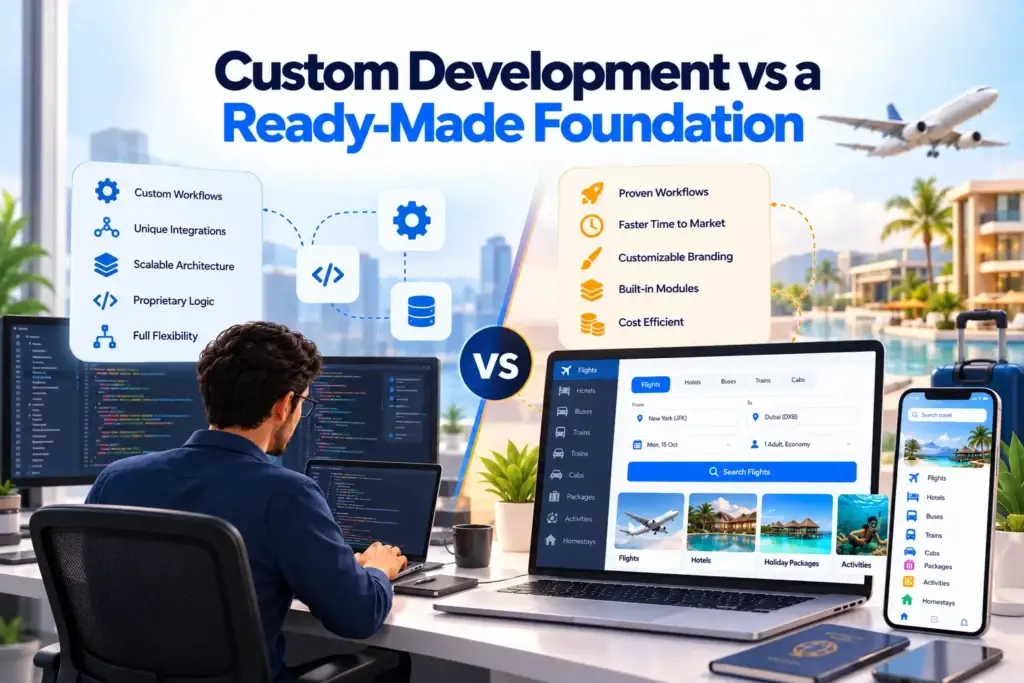
One of the biggest cost decisions is whether to build every module from zero or begin with an existing foundation.
Custom development may make sense when:
- The operating model is highly unusual.
- Existing products cannot support the required workflows.
- Proprietary travel logic is central to differentiation.
- The business has a long product roadmap and dedicated technology resources.
- Several uncommon integrations must be deeply embedded.
A ready-made foundation may make sense when:
- Core travel booking workflows are already understood.
- Agents, corporate users, suppliers, and admins need established patterns.
- The founder wants to validate market demand faster.
- Branding and selected workflows need customization rather than complete reinvention.
- Time to market matters.
Ready-made does not mean zero customization.
It means the business is not paying to rediscover every standard booking, partner, administrative, and financial workflow from scratch.
Miracuves Yatra-Like Platform Solution Cost and Tech Stack
Miracuves Pricing for a Yatra-Like B2B Travel Booking Platform developed in JavaScript For $3,999 USD (One-Time Price) in just 6 days
Get a fully developed, deployment-ready B2B travel booking platform modeled around Yatra-style travel distribution, agent booking, corporate travel, and supplier connectivity. Built on a modern JavaScript foundation, this complete package includes everything you need to launch and scale:
Core Workflows: Travel agent registration, corporate account setup, flight and hotel search, booking management, supplier connectivity, markup controls, credit balance management, cancellations, refunds, and booking notifications.
Built-in Revenue Logic: Agent markups, booking commissions, corporate service fees, subscription plans, supplier incentives, transaction charges, convenience fees, and premium travel service add-ons.
Management Hub: Centralized admin dashboard, agent management, corporate account controls, supplier management, booking monitoring, credit balance tracking, payment records, refund handling, settlement management, and travel analytics.
Launch-Ready: Fully prepared for your custom branding, configuration, payment gateway setup, travel API integration, agent onboarding, supplier setup, corporate account configuration, and immediate market entry.
Why Is Yatra-Like B2B Travel Platform Development More Affordable?
Most B2B travel booking platforms become expensive when businesses choose fully custom development from scratch. Building separate workflows for travel agents, corporate clients, suppliers, bookings, markups, credit balances, settlements, payments, cancellations, and admin controls can increase cost, timeline, and technical complexity.
We took a smarter, more practical approach:
You Aren’t Paying for Ground-Up Development: Our B2B travel booking engine is already developed, tested, and ready to deploy. You skip the inflated cost and long waiting period usually required to build a travel distribution platform from scratch.
The Power of JavaScript: We built this solution on a modern JavaScript architecture that supports fast travel searches, scalable booking workflows, agent dashboards, supplier API integrations, real-time booking updates, and smooth admin operations.
You get a launch-ready Yatra-like B2B travel booking platform with practical agent management, supplier connectivity, corporate booking, markup, credit, settlement, and monetization features, source code access, and faster deployment without the high custom development price tag.
Do Not Forget Third-Party and Operating Costs
Software implementation is only one part of the budget.
Founders should also plan for external operating expenses such as:
- Hosting or cloud infrastructure
- Supplier/API accounts
- Payment gateway fees
- Email delivery
- SMS or messaging
- Maps or location services
- Push notifications
- Monitoring
- Storage
- Domain and certificates
- Ongoing support
- Future customization
These costs vary by provider and usage.
They should not be confused with the one-time cost of obtaining or developing the software itself.
Hosting and Scale Should Follow Real Booking Volume
Founders sometimes over-engineer infrastructure before the platform has meaningful traffic.
Others underestimate it entirely.
A more practical approach is to size infrastructure according to:
- Concurrent agents
- Searches per minute
- Supplier API traffic
- Daily bookings
- Corporate user activity
- Background jobs
- Reports
- Settlement runs
- Notification volume
Early-stage infrastructure does not always need the architecture required for a national-scale travel network.
The better strategy is to design for growth while paying for scale as demand actually develops.
Security Features Are Part of Scope, Not an Optional Add-On
A B2B travel platform can handle:
- Partner balances
- Credit information
- Supplier documents
- Traveler information
- Corporate travel records
- Refunds
- Payouts
- Staff permissions
Useful security layers may include:
- Encrypted data transfer
- Secure API integrations
- Role-based access control
- Payment verification
- Activity logs
- Audit records
- Permission-controlled financial actions
- Secure document storage
- Fraud-monitoring signals
- Partner verification workflows
The final security and compliance requirements depend on the operating model, target jurisdiction, integrations, and legal requirements.
Founders should scope those requirements early because retrofitting important control layers later can add unnecessary complexity.
Founder Decision Signals
Agent-First Model
If agents will drive the majority of bookings, prioritize client records, balances, credit, commission, statements, booking history, and partner CRM before less important consumer extras.
Corporate-First Model
If companies are the primary buyers, prioritize employee roles, policy rules, approvals, billing visibility, department reporting, and account management.
Supplier-Heavy Model
If direct supplier relationships are central to your economics, budget for onboarding, verification workflows, inventory, rates, availability, payouts, and supplier support.
Integration-Heavy Model
If differentiation depends on many supplier connections, invest early in clean API architecture and data normalization rather than treating integrations as simple plug-ins.
Which Features Should Be Built First?
The first release should support the business model that creates the first bookings.
For an agent-led platform, that might mean:
- Agent registration
- Client records
- Travel search
- Booking
- Balance
- Credit
- Commission
- Statements
- Admin control
For a corporate-led platform:
- Company accounts
- Employee profiles
- Booking
- Travel policies
- Approvals
- Reports
- Billing records
For a supplier-led marketplace:
- Supplier onboarding
- Inventory
- Rates
- Availability
- Booking visibility
- Payout records
- Admin review
For a deeper role-based breakdown, this B2B travel platform feature checklist explains which workflows matter most for agents, corporate clients, suppliers, finance teams, and platform administrators.
Features such as complex partner hierarchies, advanced personalization, sophisticated loyalty engines, or highly customized reporting can be added when the business model proves they are needed.
Mistakes Founders Should Avoid
Asking for a Price Before Defining the Operating Model
A quote means little until the team understands whether the platform serves agents, corporate clients, suppliers, direct travelers, or several channels together.
Buying Features That Do Not Support the First Revenue Engine
Every extra module adds implementation, testing, training, and maintenance. Prioritize workflows that help create or support the first real bookings.
Underestimating Supplier Integration Work
Travel APIs differ in data structures, cancellation rules, error handling, and booking processes. Integration complexity should be reviewed before finalizing scope.
Treating the Admin Panel as a Secondary Feature
If administrators cannot manage partners, credit, commission, refunds, payouts, permissions, and reports, routine operations can remain dependent on developers or spreadsheets.
Founders can also review these B2B travel platform mistakes before finalizing supplier integrations, agent credit, corporate workflows, financial logic, and administrative controls.
Questions to Answer Before Requesting a Development Quote
Before comparing development options, document:
- Who are the primary users?
- Which travel categories are required?
- Which supplier APIs are already selected?
- Will agents book for their own customers?
- Do agents need prepaid balances?
- Is agent credit required?
- How will commission work?
- Are corporate accounts required?
- Do companies need approval workflows?
- Will suppliers manage inventory directly?
- Are payouts and settlements required?
- Which payment gateways are needed?
- How will refunds work?
- Which admin roles are required?
- What reports are essential?
- What needs to be customized?
- Which external services have recurring fees?
- What should launch now versus later?
Once the required modules and integrations are clear, review Miracuves’ guide to B2B travel platform development cost to understand how feature scope, integrations, branding, and customization influence budgeting.
A clear answer to these questions gives development teams a much better basis for estimating cost.
How Miracuves Helps Founders Reduce Unnecessary Build Scope
Miracuves helps travel businesses launch ready-made and white-label B2B booking platforms with agent, corporate, supplier, booking, financial, and administrative workflows.
For founders who do not want to build every standard travel workflow from zero, Miracuves’ B2B travel booking platform provides a launch-ready foundation that can be configured around the required business model.
Businesses exploring related travel marketplace models can also review Miracuves’ travel booking solutions for broader platform options.
For vendor evaluation, this guide on choosing a B2B travel development partner can help founders understand what to evaluate before selecting a team for integrations, customization, deployment, and ongoing development.
When the ready-made scope fits the project requirement, Miracuves can support 6-day solution delivery. Custom modules, additional integrations, and non-standard workflows should be scoped separately according to the final requirements.
Businesses can then focus customization budgets on the parts that actually differentiate their operation—such as supplier integrations, commercial rules, account structures, reporting, or market-specific workflows.
When the ready-made scope fits the project requirement, Miracuves can support 6-day solution delivery. Custom modules, additional integrations, and non-standard workflows should be scoped separately according to the final requirements.
Final Thoughts: Cost Follows Complexity, Not the Length of the Feature List
The most useful way to plan a B2B travel platform is not to collect every possible feature.
Start with the commercial model.
Identify who will book, who supplies inventory, how money moves, how partners earn, who approves transactions, and what the admin team needs to control.
From there, feature scope becomes clearer.
Agent credit matters when agents are central to distribution.
Corporate approvals matter when companies are central to demand.
Supplier portals matter when direct inventory relationships are part of the model.
Complex API architecture matters when the platform depends on multiple external inventory sources.
The strongest budget is therefore not the smallest or the largest.
It is the budget attached to a clearly defined operating model, realistic integrations, and a feature set that supports the first revenue engine without adding unnecessary complexity.
FAQs
What affects the cost of a B2B travel booking platform?
Cost is influenced by booking categories, supplier integrations, agent portals, corporate workflows, supplier management, payment logic, credit systems, commissions, settlements, admin controls, customization, infrastructure, and third-party services.
Are supplier APIs a major cost factor?
They can be. Integration effort depends on API documentation, authentication, search responses, availability checks, booking logic, cancellation, refunds, rate limits, testing environments, and data normalization.
Does an agent portal cost more than a normal traveler account?
An agent portal usually requires additional workflows such as client records, booking on behalf of customers, prepaid balances, credit limits, commission, statements, and partner-specific permissions.
What features are important for corporate travel?
Common features include company accounts, employee profiles, travel policies, approval workflows, booking restrictions, reports, expense records, billing visibility, and role-based permissions.
Why does settlement management matter?
B2B travel platforms may need to reconcile platform margin, agent commission, supplier payouts, cancellations, refunds, and adjustments. Structured settlement records reduce manual reconciliation.
Should a startup launch with every travel category?
Not necessarily. The first release should prioritize the categories that support actual target-market demand. More categories can be added as the business validates demand and supplier relationships.
Is a ready-made travel platform less expensive than starting from zero?
A ready-made foundation can reduce duplicated development work because common booking, partner, financial, and administrative workflows already exist. Final cost still depends on customization, integrations, branding, and launch requirements.
Can Miracuves launch a B2B travel platform in six days?
Miracuves can support 6-day solution delivery when the ready-made scope matches the required rollout. Custom modules, additional integrations, and non-standard business logic require separate scoping.
Miracuves is an independent software development company. We are not affiliated with, connected to, sponsored by, or endorsed by any company or product named in this article.
Terms such as “X Clone” are used descriptively. It is how the software industry refers to building a platform with functionality comparable to a known service, and how clients search for it.
The entire design and codebase of our products is built by our own team. Our products contain no code, design, graphics, or content originating from any third-party website or applications.
All third-party names and marks referenced in this article are the property of their respective owners, referenced solely to identify the services discussed.