


























Key Takeaways
- A B2B travel booking platform is designed for businesses that sell, manage, or distribute travel through agents, corporate accounts, resellers, suppliers, finance teams, and operations staff.
- The platform connects travel search and booking with trade pricing, agent balances, credit limits, commissions, supplier costs, refunds, statements, and settlement records.
- Agent workflows typically include client management, inventory search, trade pricing, balance or credit checks, booking confirmation, commission recording, and statement generation.
- Corporate travel introduces additional workflows such as employee profiles, travel policies, manager approvals, department structures, invoices, expenses, and reporting.
- Reliable B2B operations depend on connected financial records, supplier inventory, role-based permissions, reconciliation, audit history, and clear controls for sensitive actions.
Platform Signals
- Travel inventory can come from flight and hotel APIs, bus operators, package providers, activities, transfers, car rentals, direct contracts, and manually managed products.
- Agent credit should be maintained through transaction records covering deposits, booking deductions, refunds, adjustments, credit usage, repayments, and closing balances.
- Booking records should connect the agent, traveler, supplier, payment, commission, refund, settlement, and support history.
- Settlement workflows can reconcile agent commissions, supplier payouts, refunds, adjustments, credit usage, taxes, and platform margins.
- Separate permissions allow support, finance, operations, supplier onboarding, and management teams to access only the controls relevant to their responsibilities.
Real Insights
- A B2B platform is more than a consumer booking website with an agent login because trade relationships introduce financial, operational, and permission requirements.
- Treating agent balances as simple editable wallet numbers can create reconciliation problems when deposits, bookings, refunds, credit, and adjustments interact.
- Commission should remain connected to the original booking so agents and finance teams can reconcile the same transaction later.
- Settlement should be designed into the booking model from the beginning rather than relying on separate spreadsheets as transaction volume grows.
- The strongest B2B workflow is: onboard partners → connect inventory → configure trade pricing → manage balances or credit → process bookings → record commissions and margins → handle cancellations and refunds → generate statements → reconcile settlements → monitor operations.
A B2B travel booking platform is built for businesses that sell travel on behalf of other people.
Instead of relying only on travelers booking directly, the platform gives travel agents, corporate travel desks, resellers, suppliers, and operations teams their own controlled workflows.
An agent might book a flight and hotel for a customer. The booking may be paid from the agent’s prepaid balance. The platform may calculate the agent’s commission, apply the operator’s margin, record the supplier cost, and include the transaction in a monthly statement.
A corporate account may work differently. Employees may submit travel requests, managers may approve them, and the company may receive consolidated reports and invoices.
Behind both scenarios is the same principle: a B2B travel platform has to manage not just bookings, but also money movement, permissions, margins, commissions, credit, adjustments, refunds, and settlement records.
Founders exploring the wider product ecosystem can also review Miracuves’ travel booking platform software to understand how booking, trip planning, operations, and travel-commerce workflows can fit together.
What Is a B2B Travel Booking Platform?
A B2B travel booking platform is a travel-commerce system designed for trade partners rather than only individual travelers.
Typical users include:
- Independent travel agents
- Sub-agents
- Corporate travel desks
- Tour operators
- Travel resellers
- Hotels and other suppliers
- Finance teams
- Settlement teams
- Partner operations staff
- Platform administrators
The platform may still include direct consumer booking, but its B2B side works differently.
Travel agents need client records, trade pricing, credit, commissions, and statements. Corporate users need approvals, employee records, travel policies, invoices, and reports. Suppliers need inventory management and payout visibility. Finance teams need reconciliation.
This makes B2B travel architecture more operationally complex than a basic consumer booking website.
How an Agent Booking Works
An agent booking usually begins inside a dedicated agent portal.
The agent does not book as an anonymous traveler. The system already knows who the agent is, which commercial terms apply, how much credit or prepaid balance is available, and what commission rules should be used.
A typical booking flow looks like this:
- Agent logs into the partner portal.
- Agent selects or creates a client profile.
- Agent searches available flights, hotels, buses, or packages.
- Platform loads supplier availability and pricing.
- Trade markup or category margin is applied.
- Agent reviews the client price.
- Platform checks available balance or approved credit.
- Agent confirms the booking.
- Balance is reduced or credit is utilized.
- Commission is recorded.
- Supplier cost and platform margin are stored.
- Ticket, voucher, or confirmation is generated.
- The transaction appears in the agent statement.
That last step is important.
A B2B platform should not treat the booking as an isolated transaction. It should become part of the agent’s financial history.
What Is an Agent Credit Balance?
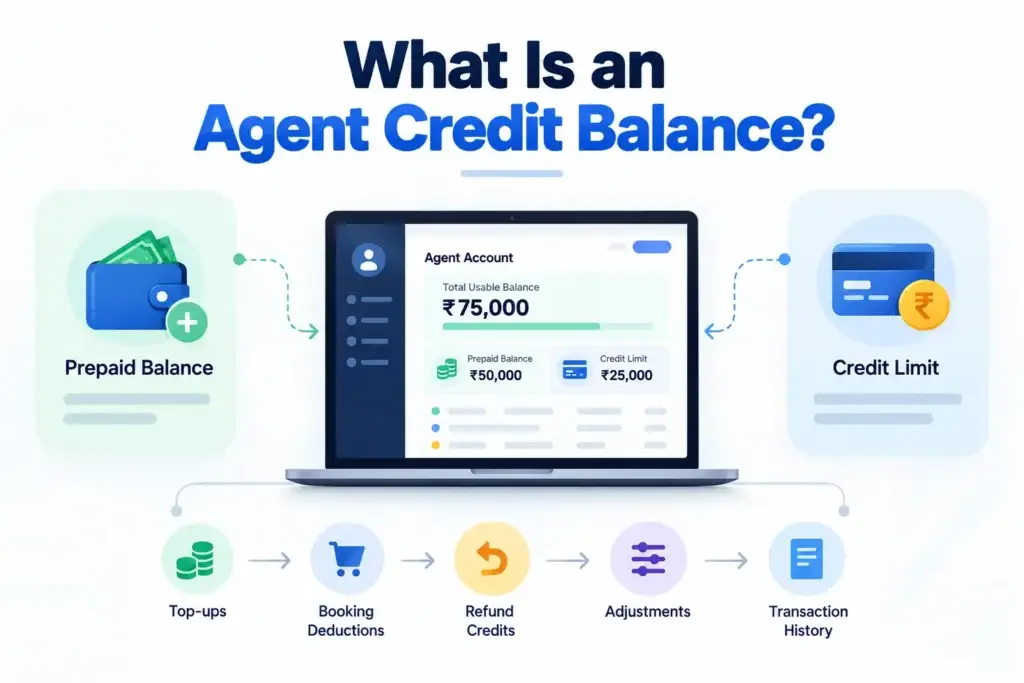
A travel agent credit balance allows an approved partner to book using funds or credit available inside their account.
There are usually two related concepts.
Prepaid Balance
The agent deposits funds before booking.
For example, an agent may top up ₹100,000. Each confirmed booking reduces the available balance.
This model gives the operator cash before future bookings and reduces payment friction for repeat agents.
Credit Limit
The operator may also approve a limited credit facility.
For example, an agent may have:
- Prepaid balance: ₹50,000
- Approved credit: ₹25,000
- Total usable amount: ₹75,000
The platform should check that ceiling before confirming the booking.
A credit system should never simply be an editable number on an agent profile. It needs transaction records.
The system should track:
- Opening balance
- Top-ups
- Booking deductions
- Refund credits
- Manual adjustments
- Credit usage
- Credit repayment
- Closing balance
- Adjustment reason
- Staff member who changed the balance
This gives agents and operators a common financial record.
Why Credit Ceilings Matter
Giving every agent unlimited booking ability would create unnecessary financial exposure.
Credit ceilings allow the operator to control how much exposure each partner can create.
A new agent may start with prepaid-only booking. A trusted agent may later receive limited credit. A large partner may have higher terms based on commercial agreements.
Credit policy can depend on:
- Agent history
- Monthly booking volume
- Previous settlement behavior
- Business verification
- Refund frequency
- Relationship length
- Contract terms
- Risk controls
The important part is that credit should be controlled through permissions and logs.
Not every support agent or administrator should be able to increase an agent’s credit.
How Agent Commission Works
Commission is the amount the travel agent earns from a booking under the platform’s trade rules.
The commission should be calculated automatically where possible.
Suppose a booking has:
- Supplier cost: ₹10,000
- Platform category margin: ₹800
- Agent commission: ₹400
- Final client price: based on configured commercial rules
The exact calculation will depend on the business model, but the platform should preserve each component.
A booking record may need to show:
- Supplier base cost
- Taxes
- Platform margin
- Agent markup
- Agent commission
- Gateway fee
- Coupon adjustment
- Refund adjustment
- Final payable amount
This makes settlement easier because the agent, finance team, and operator are all working from the same booking data.
Commission vs Markup: What Is the Difference?
Commission and markup are related, but they are not necessarily the same thing.
Commission is an amount the platform owes or credits to the agent under the commercial arrangement.
Markup is an additional amount added to a price before the client sees it.
An agent may have permission to set a markup on top of the platform’s trade price. The operator may separately pay or credit commission based on the booking category.
A strong system should define clearly:
- Who controls markup
- Maximum markup allowed
- Commission percentage
- Category-specific commission
- Flat vs percentage commission
- When commission becomes earned
- What happens after cancellation
- How refunded bookings affect commission
Without clear rules, disputes appear during settlement.
Booking Economics Inside the Platform
What One B2B Travel Booking Should Record
| Booking Record | Why It Matters | Who Uses It |
|---|---|---|
| Agent and client | Shows which partner made the booking and who traveled. | Agent, support, admin |
| Supplier cost | Shows what the underlying inventory cost the platform. | Finance, settlements, owner |
| Balance or credit used | Shows how the booking was funded. | Agent, finance, settlements |
| Agent commission | Shows what the partner earned from the booking. | Agent, settlements |
| Platform margin | Shows the platform’s commercial value from the booking. | Owner, finance |
| Refund or adjustment | Keeps cancellations and financial corrections connected to the original booking. | Finance, support, settlements |
| Statement reference | Connects the transaction to monthly reconciliation. | Agent, settlements, finance |
How Supplier Inventory Fits Into Agent Bookings
Agents cannot book without inventory.
A B2B travel platform may connect:
- Flight inventory
- Hotel inventory
- Bus operators
- Holiday packages
- Activities
- Transfers
- Car rentals
- Other travel services
Inventory may come from external supplier APIs, negotiated contracts, direct supplier listings, or manually managed packages.
The platform has to convert supplier inventory into trade inventory that agents can sell.
That may involve:
- Supplier price
- Operator margin
- Agent commission
- Agent markup
- Tax
- Availability
- Cancellation rules
- Booking deadline
- Blackout dates
- Payment terms
The agent should see a clean trade-facing result instead of raw supplier data.
What Happens When a Booking Is Canceled?
Cancellations make B2B booking operations more complicated because several balances may need adjustment.
Suppose an agent made a booking using prepaid funds and earned commission.
If the booking is later canceled, the platform may need to:
- Check supplier cancellation terms.
- Calculate refundable amount.
- Apply cancellation charge.
- Reverse all or part of the agent commission.
- Credit the correct amount back to the agent balance.
- Update platform margin.
- Update supplier payable amount.
- Record the adjustment.
- Add the correction to the settlement statement.
- Notify relevant users.
The booking should retain the full history instead of simply changing from “confirmed” to “canceled.”
Financial history is essential for reconciliation.
What Is a Settlement in B2B Travel?
Settlement is the process of closing financial records between the platform and its trade partners.
For agents, settlement may cover:
- Opening balance
- Deposits
- Bookings
- Commission
- Refunds
- Adjustments
- Credit used
- Credit repayment
- Closing balance
For suppliers, settlement may cover:
- Confirmed bookings
- Supplier share
- Commission deducted
- Refunds
- Adjustments
- Taxes
- Payout amount
- Payment status
Settlement gives everyone a shared financial record.
Without it, agents may keep one spreadsheet, suppliers another, and the operator a third. That creates disputes.
Monthly Agent Statements
A monthly statement helps the agent reconcile all activity during the period.
A useful statement can contain:
- Booking reference
- Booking date
- Client
- Travel category
- Booking value
- Balance deduction
- Credit utilization
- Commission earned
- Refund
- Adjustment
- Running balance
- Closing amount
The agent should be able to compare the platform statement with their own books.
Finance teams should also be able to filter the same data by partner, date, category, or transaction type.
Why a Dedicated Settlement Desk Helps

Settlement users do not necessarily need full admin access.
Their work is financial.
They may need to:
- Review agent statements
- Review supplier payouts
- Correct approved balance discrepancies
- Apply settlement adjustments
- Confirm refunds
- Compare commission reports
- Compare margin reports
- Export finance records
- Record adjustment reasons
They may not need permission to:
- Add suppliers
- Change inventory
- Edit travel products
- Approve agents
- Change content
- Configure the whole platform
Separating roles reduces operational risk.
Corporate Travel Works Differently
A B2B travel platform may also support company accounts.
Corporate travel users usually care less about agent commission and more about travel policy.
A corporate workflow can include:
- Company account
- Employee profiles
- Department hierarchy
- Travel policies
- Approval rules
- Booking requests
- Manager approval
- Corporate payment method
- Expense records
- Invoices
- Reports
For example, an employee may request a hotel booking above a company threshold. The system routes the request to the right manager before payment.
This is a different workflow from an agent booking for a retail customer, but both can use the same supplier inventory.
Revenue Model of a B2B Travel Booking Platform
A trade-focused platform can generate revenue through several routes.
Common revenue models include:
- Margin on agent bookings
- Supplier commission
- Corporate plan fees
- Direct consumer bookings
- Payment method fees
- Visa or insurance add-ons
- Foreign exchange services
- Package markup
- Partner subscriptions
- API access
Prepaid agent balances can also affect working capital because funds may enter the platform before supplier settlements become due.
The key is to model the complete booking economics before signing agents.
For a deeper look at trade margins, supplier commissions, corporate plans, prepaid balances, and additional revenue streams, review this B2B travel platform business model guide.
An attractive commission percentage is meaningless if supplier cost, gateway charges, refunds, support expense, and platform margin do not work together.
Founder Decision Signals
Agent Network
If your growth plan depends on travel agents or resellers, prioritize partner onboarding, client records, commission, balances, statements, and settlement workflows.
Credit Exposure
If agents can book using credit, define ceilings, approval authority, adjustment logs, and repayment rules before launch.
Settlement Complexity
If one booking affects the agent, supplier, platform margin, refund ledger, and tax records, build reconciliation into the booking model from the beginning.
Corporate Demand
If companies are part of your audience, add policies, manager approvals, employee roles, invoices, and reporting instead of treating corporate users like retail travelers.
Mistakes Founders Should Avoid
Treating Agent Balance as a Simple Wallet
A B2B balance may include deposits, booking deductions, refunds, credit usage, manual adjustments, and settlement corrections. Every movement should have a record.
Calculating Commission Outside the Booking
Commission should be attached to the booking transaction so agents and finance teams reconcile the same value later.
Allowing Unlimited Credit Changes
Credit ceilings should be permission-controlled, logged, and linked to clear partner policies instead of being editable by every admin user.
Building Settlements in Spreadsheets
Manual settlement becomes difficult when refunds, agent commissions, supplier payouts, credit adjustments, and category margins interact across hundreds of bookings.
For additional planning guidance, this breakdown of common B2B travel platform mistakes explains where startups often run into problems with product scope, operations, and launch planning.
B2B Travel Platform Operational Checklist
Before launching, founders should confirm:
- Agent onboarding is defined
- Partner verification workflow is available
- Client records can be managed by agents
- Supplier inventory is connected
- Trade pricing is configurable
- Agent markup rules are clear
- Commission rules are configured
- Prepaid balance records are auditable
- Credit ceilings are permission-controlled
- Booking deductions are automatic
- Refund credits follow cancellation rules
- Agent statements are generated
- Supplier payout records are available
- Settlement adjustments require reasons
- Finance roles are separate from partner operations
- Corporate travel policies are configured if needed
- Manager approval flows are available
- Reports show margin, commission, balance, and settlement data
- Audit logs exist for sensitive actions
Founders who want a broader product-level checklist can also review this travel booking platform feature checklist covering important user, partner, booking, and admin workflows.
The goal is not simply to process bookings. The goal is to make every commercial relationship reconcilable.
Once agent workflows, supplier operations, and settlement logic are ready, founders should also plan demand generation. This guide to B2B travel platform launch marketing explains what to prioritize before and after going live.
How Miracuves Helps Founders Launch B2B Travel Booking Platforms
Miracuves helps travel businesses launch ready-made and white-label B2B travel platforms with agent portals, corporate travel workflows, supplier management, prepaid balances, credit controls, commissions, settlement workflows, CRM, consumer booking channels, and operator dashboards.
Businesses comparing different travel marketplace and booking models can also explore Miracuves’ travel booking solutions for broader platform options.
For founders evaluating a ready-made trade platform, Miracuves’ B2B travel booking platform foundation can help review agent bookings, credit ceilings, supplier workflows, commission logic, monthly statements, corporate travel, and settlement operations.
For founders comparing budget, integrations, branding, and rollout scope, this guide to B2B travel platform development cost explains the main factors that influence pricing.
If you are also evaluating implementation partners, this guide on choosing a B2B travel platform development partner explains what to review before selecting a team.
When the ready-made scope matches the rollout requirement, Miracuves can support 6-day solution delivery, helping founders avoid rebuilding every agent, supplier, corporate, finance, and settlement workflow from zero.
Final Thoughts
A B2B travel booking platform is not simply a consumer booking app with an agent login added on top.
Its core value sits in trade operations.
Agents need balances, credit controls, commissions, client records, and statements. Corporate users need policies and approvals. Suppliers need inventory and payout visibility. Finance teams need settlement records. Operators need control over margin, partner permissions, refunds, and adjustments.
When these workflows are connected, each booking becomes easier to understand and reconcile.
That is what makes a B2B travel booking platform valuable: not just the ability to book travel, but the ability to manage the business relationships behind every booking.
FAQs
What is a B2B travel booking platform?
A B2B travel booking platform is software that lets travel agents, companies, resellers, suppliers, and travel operators manage bookings through business accounts with trade pricing, commissions, balances, credit, statements, and settlement workflows.
How does an agent booking work?
The agent logs in, selects a client, searches inventory, reviews trade pricing, uses available balance or credit, confirms the booking, and receives a commission record. The transaction later appears in the agent’s settlement statement.
What is an agent credit balance?
An agent credit balance combines available prepaid funds and any approved credit the operator allows the agent to use for bookings. Every deposit, booking deduction, refund, credit use, and adjustment should be recorded.
How is travel agent commission calculated?
Commission may be a flat amount or percentage depending on booking category and partner terms. It should be calculated on the platform and stored against the booking so the agent and finance team reconcile the same amount.
What is a travel booking settlement?
Settlement is the process of reconciling bookings, commissions, refunds, credit usage, adjustments, supplier payouts, and closing balances between the platform and its business partners.
Why are monthly agent statements important?
Monthly statements give agents and finance teams a common record of bookings, balance changes, commission, refunds, adjustments, and closing balance.
Can a B2B platform also support corporate travel?
Yes. Corporate travel workflows can include employee accounts, company travel policies, manager approvals, expense records, invoices, corporate plans, and reporting.
Can Miracuves help launch a B2B travel booking platform?
Yes. Miracuves supports ready-made and white-label B2B travel platforms with agent portals, credit controls, commission tracking, supplier operations, corporate travel, settlement workflows, source-code ownership, and admin controls. A 6-day delivery may apply when the ready-made scope fits the requirement.
Miracuves is an independent software development company. We are not affiliated with, connected to, sponsored by, or endorsed by any company or product named in this article.
Terms such as “X Clone” are used descriptively. It is how the software industry refers to building a platform with functionality comparable to a known service, and how clients search for it.
The entire design and codebase of our products is built by our own team. Our products contain no code, design, graphics, or content originating from any third-party website or applications.
All third-party names and marks referenced in this article are the property of their respective owners, referenced solely to identify the services discussed.