


















Key Takeaways
- The build-versus-buy decision should be based on differentiation, operational readiness, ownership, launch speed, and long-term flexibility.
- Custom development offers greater architectural freedom but requires more engineering, testing, maintenance, and internal technical capability.
- A white-label foundation reduces the need to rebuild established reservation, payment, cancellation, supplier, and administrative workflows.
- Source-code access, data ownership, hosting control, documentation, and modification rights determine long-term technical independence.
- A hybrid approach can combine reliable booking infrastructure with custom development in areas that create genuine competitive advantage.
Founder Decision Signals
- Build from scratch when proprietary technology or unusual booking workflows are central to the business proposition.
- Consider a white-label foundation when differentiation comes mainly from inventory, market focus, branding, distribution, or customer experience.
- Evaluate working search, reservation, payment, confirmation, cancellation, refund, supplier, and admin workflows.
- Confirm integration compatibility with suppliers, payment gateways, maps, communications, analytics, and other required services.
- Compare total ownership costs, including implementation, customization, infrastructure, APIs, maintenance, support, upgrades, and future modifications.
Real Insights
- Building standard functionality from zero does not automatically create more customer value or business control.
- Buying a ready-made foundation does not automatically create vendor lock-in when ownership and modification rights are clearly defined.
- The highest hidden cost can be spending months building advanced functionality before validating suppliers and customer demand.
- A polished traveler interface is incomplete without reliable exception handling, refunds, reconciliation, support tools, and back-office control.
- Miracuves provides white-label travel platforms with established booking workflows, customization flexibility, admin control, integrations, and source-code ownership.
Launching a travel startup creates an early technology decision that can shape almost everything that follows: should you build the booking technology from scratch, or start with an existing white-label platform and customize it around your business?
The question sounds technical, but it is really a business decision.
Building gives you control over how the product is engineered from day one. Buy a White-Label Travel Platform, which can reduce the amount of technology that has to be created before the business can start testing suppliers, bookings, customer acquisition, and operations.
Neither route is automatically right for every startup.
The better choice depends on where your differentiation actually sits, how quickly you need to launch, how unusual your workflows are, what technical resources you already have, and how much control you expect to need as the business grows.
This guide provides a practical framework for making that decision without reducing it to a simple comparison of upfront development prices.
Why Build vs Buy Is More Than a Software Cost Decision
Comparing two development quotes does not tell you the real cost of launching a booking business.
A travel startup also needs to consider the time spent defining booking states, connecting inventory, handling payments, testing supplier failures, designing cancellation flows, building internal operations, fixing production issues, maintaining integrations, and improving the product after launch.
That means the real question is not:
“Which option costs less to develop?”
It is:
“Which option gives our business the right combination of differentiation, control, launch speed, operating reliability, and future flexibility?”
That distinction matters because two travel startups can reach completely different answers even when they initially appear to need similar products.
A startup building an unusual trip-planning model with proprietary workflow logic may benefit from deeper custom engineering. A regional operator digitising relatively established search, reservation, payment, and supplier processes may have less reason to rebuild those foundations from zero.
What Does “Build” Mean for a Travel Startup?
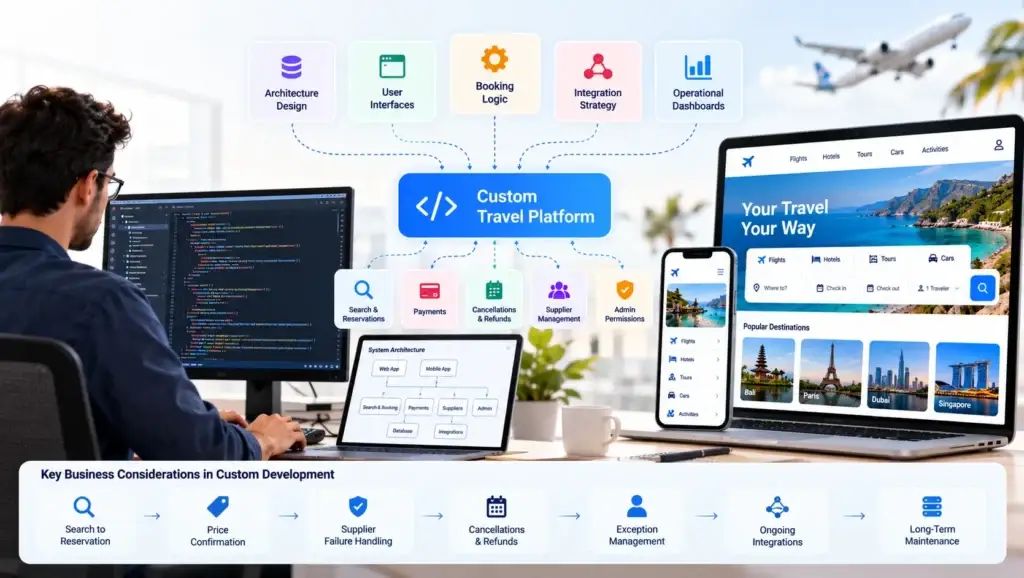
Building means engineering the core product around your requirements rather than adopting an existing product foundation.
This gives the business significant freedom. The architecture, database design, interfaces, booking logic, integration strategy, operational dashboards, and user experience can all be designed around the company’s roadmap.
That freedom is valuable when the software itself contains important intellectual property or when the business depends on workflows that standard booking systems cannot accommodate cleanly.
But a custom build also means owning the engineering problem from the beginning.
The team needs to determine how searches become reservations, how prices are confirmed, what happens when a supplier fails after payment, how cancellations affect the booking record, how refunds are tracked, how staff intervene in exceptions, and how integrations are maintained when external services change.
The development project therefore extends well beyond creating attractive search results and checkout screens.
Building Makes More Sense When Your Core Logic Is Genuinely Different
Custom development becomes more defensible when the business model depends on technology that cannot reasonably be configured into an existing foundation.
Examples could include a proprietary itinerary workflow, unusual inventory relationships, complex B2B contracting rules, specialized group-booking logic, or an operational process that materially differs from standard reservation patterns.
The key test is whether the custom functionality represents a genuine competitive advantage.
If most of the planned engineering is recreating established functions such as user accounts, search, booking records, payments, cancellations, notifications, supplier management, and admin permissions, the startup should ask whether building those components creates meaningful differentiation.
What Does “Buy” Mean in a White-Label Model?
Buying does not necessarily mean purchasing a rigid product that can never change.
A white-label model generally starts with an existing software foundation that is rebranded and configured for another business. Depending on the provider and agreement, customization may extend into workflows, integrations, interfaces, categories, business rules, and infrastructure.
For startups, the attraction is straightforward: the team can spend less of its initial execution cycle recreating common booking infrastructure.
That can move attention toward the parts customers actually associate with the new business—its inventory, destination strategy, supplier relationships, pricing, service quality, positioning, and customer acquisition.
However, “white-label” alone tells you very little about the quality of the underlying arrangement.
A startup still needs to establish what it owns, what it can modify, which integrations are supported, whether it receives source code, where the system is deployed, how data is handled, and what happens when the business needs functionality that is not currently available.
Founder Decision Signals
Build Signal
Your competitive advantage depends heavily on proprietary workflows or technology that existing foundations cannot support without major structural changes.
Buy Signal
Your core booking workflows are established patterns, while your differentiation comes primarily from market, inventory, brand, distribution, or customer experience.
Ownership Signal
You need long-term technical independence. Evaluate source code, data, hosting, documentation, modification rights, and migration before deciding.
Validation Signal
Your largest uncertainties concern customer demand and supplier economics rather than whether standard booking functionality can be built.
Build vs Buy: A Practical Comparison for Travel Startups
| Decision Area | Build From Scratch | Buy a White-Label Foundation |
|---|---|---|
| Initial Product Flexibility | Designed around your requirements | Starts from existing workflows and is customized |
| Launch Preparation | Requires the core system to be engineered and tested | Core foundation may already be available |
| Engineering Responsibility | Primarily sits with your development organization | Shared initially with the platform provider, depending on the agreement |
| Differentiation | Can extend throughout the technology stack | Usually concentrated on selected workflows, brand, inventory, experience, and market model |
| Source-Code Control | Depends on the development contract | Must be explicitly verified before purchase |
| Integration Flexibility | Can be designed around chosen providers | Depends on architecture and customization scope |
| Maintenance | Requires an internal or external engineering capability | Depends on ownership, handover, support, and hosting model |
| Best Fit | Highly differentiated technology requirements | Faster market entry using established booking patterns |
Founder takeaway: “Build” does not automatically mean control, and “buy” does not automatically mean lock-in. Contracts, source-code rights, infrastructure access, documentation, architecture, and handover conditions determine how much technical control the startup actually has.
The Seven Questions That Should Drive the Decision
1. Where Does Your Competitive Advantage Actually Live?
This is the most important question.
If the startup’s competitive advantage is proprietary technology, building more of the stack may be strategically justified.
But many travel businesses differentiate somewhere else.
They may win through regional inventory, exclusive supplier relationships, curated experiences, specialist destinations, customer service, packaging, pricing, a particular traveler segment, or distribution.
If those are the real advantages, spending a large part of the early execution cycle rebuilding standard booking infrastructure may not strengthen the proposition.
Founders should separate technology that differentiates the business from technology the business simply needs in order to operate.
2. How Much of Your Workflow Is Truly Unique?
Write down the complete customer and operational journey before deciding.
How does a traveler discover inventory? How is availability returned? When is the price confirmed? How is payment captured? What creates a confirmed reservation? What happens after a failed supplier response? Who processes changes or cancellations? How are refunds tracked? What can an administrator override?
Now identify which steps are genuinely unusual.
If only a small percentage of the workflow requires unique logic, a customizable foundation may be more practical than rebuilding the entire stack.
If the unusual logic touches almost every booking state, a deeper custom build deserves stronger consideration.
3. What Is the Cost of Delaying Market Learning?
Development time has an opportunity cost.
While the product is being built, the business is not yet learning from actual booking behaviour. Supplier assumptions remain assumptions. Acquisition economics remain projections. Support workflows remain theoretical.
A faster launch is valuable not merely because it is faster. It can bring real operational feedback earlier.
This is particularly important for startups whose largest uncertainties concern demand, inventory, distribution, or positioning rather than whether standard reservation technology can be engineered.
Miracuves’ ready-made model, for example, offers a 6-day delivery path for applicable white-label solutions. For a founder considering that route, the strategic value is the ability to move sooner into configuration, supplier preparation, testing, and market execution rather than treating delivery speed as an end in itself.
4. What Will You Need to Own?
Ownership should be examined before signing a software agreement, not after the startup has accumulated customers.
Ask specifically about:
- source-code ownership or access;
- database and customer-data control;
- hosting and deployment access;
- API credentials;
- documentation;
- third-party service accounts;
- the right to modify the software;
- migration options;
- maintenance responsibilities.
A low initial price can become strategically expensive if the business cannot modify, host, migrate, or maintain its own platform later.
Likewise, a custom development project does not guarantee ownership unless the contract actually transfers the relevant rights and assets.
5. What Integrations Does the Business Depend On?
Travel software rarely operates in isolation.
A startup may depend on supplier APIs, payment services, mapping, communications, analytics, identity services, or other external systems.
The build-vs-buy assessment should therefore include integration compatibility rather than focusing only on visible screens.
With custom development, the team can design integrations around its selected providers, but it also assumes responsibility for building, testing, monitoring, and maintaining those connections.
With a white-label foundation, some integration patterns may already exist. The important question is whether they fit the startup’s actual suppliers and commercial agreements.
Do not treat an integration logo on a feature list as proof that the connection fits your use case. Verify authentication, data mapping, booking states, errors, reconciliation, and ongoing support.
6. Who Will Maintain the Product After Launch?
Launching is only the beginning of the technology lifecycle.
External APIs change. Payment rules evolve. Mobile operating systems update. New business requirements appear. Customers expose edge cases that were invisible during QA.
A startup choosing custom development needs a realistic maintenance model: internal engineers, a retained development partner, or another support structure.
A startup choosing white-label software should ask equally serious questions about post-launch maintenance.
Who fixes defects? Who deploys updates? Can your own developers work on the source code? Is documentation included? What happens if you change hosting? How are customizations maintained?
The stronger option is the one whose post-launch ownership model matches the company’s actual technical capacity.
7. What Will You Need 12–24 Months After Launch?
Founders sometimes evaluate software against today’s feature checklist only.
A more useful exercise is to map likely future changes.
Could the business add another inventory category? Enter another geography? Introduce agents or B2B partners? Change payment providers? Add new supplier connections? Build mobile experiences? Introduce new pricing rules?
You do not need every future feature on day one.
You do need confidence that today’s technology decision does not make reasonable future changes unnecessarily difficult.
Should You Build or Buy?
Before committing to either path, evaluate your business against these eight questions.
Is proprietary technology central to our competitive advantage?
Are our booking workflows substantially different from established patterns?
Do we already have a capable technical organization?
Can we absorb a longer engineering and testing cycle before market learning begins?
Do we require unusual integrations or infrastructure?
Is full technical ownership important to our financing or operating strategy?
Can an existing foundation support most launch-critical requirements without structural compromises?
Would launching sooner materially improve supplier, customer, or business-model validation?
Strong “yes” answers to questions 1–6 increase the case for custom engineering.
Strong “yes” answers to questions 7–8 increase the case for evaluating a white-label foundation.
Do Not Compare Only the Initial Development Price
The old way of evaluating build vs buy is to put two numbers next to each other.
That misses much of the economics.
For a custom build, founders should consider product discovery, design, frontend and backend engineering, integrations, testing, deployment, project management, bug fixing, infrastructure, monitoring, and ongoing maintenance.
For a white-label purchase, founders should investigate the acquisition or implementation price plus customization, third-party integrations, infrastructure, external API charges, maintenance, support, and future modifications.
The right comparison is therefore total ownership and execution requirements, not simply the first invoice.
This is also why generic market-wide cost claims are rarely useful. Two startups can have radically different requirements even when both describe themselves as travel businesses.
The Hidden Cost That Matters Most: Building the Wrong Things
Technical waste does not happen only when a project goes over budget.
A startup can deliver exactly what it specified and still have built too much too early.
For example, a team might spend months engineering sophisticated functionality before learning that its real constraint is supplier coverage. Another might perfect an advanced loyalty system before establishing repeat booking behaviour.
The build-vs-buy decision should therefore be connected to uncertainty.
Ask:
What do we already know, and what do we still need the market to teach us?
If the biggest unanswered questions are commercial, getting a workable product into real operating conditions sooner can have significant strategic value.
If the unanswered questions are fundamentally technical—and solving them creates the company’s moat—custom development becomes easier to justify.
A Third Option: Buy the Foundation and Build the Differentiation
Build and buy do not always need to be treated as opposites.
A startup can begin with an existing foundation for established booking workflows and invest custom engineering in the areas that make its proposition distinctive.
That might mean retaining the core reservation and operational layer while customizing discovery, itinerary planning, supplier workflows, loyalty, regional requirements, or another strategically important layer.
This approach changes the question from:
“Should we build everything or buy everything?”
to:
“Which parts of our technology create competitive advantage, and which parts simply need to work reliably?”
For many early-stage businesses, that is a more useful architectural and capital-allocation question.
What Should You Verify Before Buying White-Label Software?
Buying faster should never mean evaluating less carefully.
Before selecting a white-label platform, founders should verify the actual system rather than relying only on feature lists or sales presentations.
Request a working demonstration. Follow a reservation through the system. Examine administrative controls. Ask what happens when a payment succeeds but supplier confirmation fails. Review cancellation and refund handling. Understand how new integrations are added.
Then examine ownership.
Confirm in writing what happens to source code, data, hosting, credentials, documentation, custom development, and future maintenance.
If you are moving from the strategic build-vs-buy decision into actual product evaluation, you can review Miracuves’ white-label booking system for travel businesses to see how a ready-made approach handles the operational side of reservations.
The purpose of that evaluation should not be to ask whether the platform has the longest feature list. It should be to determine whether its existing foundation fits your business closely enough that customization is more sensible than rebuilding.
Common Build-vs-Buy Mistakes Travel Founders Should Avoid
Choosing Based Only on the Cheapest Initial Quote
A low entry price says little about future customization, integrations, maintenance, ownership, or technical dependency.
Evaluate what the business will need to operate and evolve.
Treating Every Planned Feature as a Day-One Requirement
Long wish lists increase complexity regardless of whether you build or buy.
Separate launch-critical workflows from functionality that can be introduced after the business has real users and operational evidence.
Assuming White-Label Means Fully Customizable
Customization differs dramatically between products and agreements.
Ask what can be changed at the interface, workflow, integration, database, and infrastructure levels.
Assuming Custom Development Automatically Means Ownership
Ownership depends on contractual rights and technical handover.
Confirm source code, repositories, infrastructure, credentials, documentation, and intellectual-property terms.
Ignoring Back-Office Operations
Travelers see search and checkout. Your operations team sees failed confirmations, refund requests, supplier issues, reconciliation, support cases, and exceptions.
A product that looks polished but gives the business poor operational control can create expensive problems after launch.
Rebuilding Commodity Infrastructure for the Sake of Being “Custom”
Custom engineering is most valuable when it creates something strategically useful.
Writing unique code for a standard workflow does not automatically create a competitive advantage.
A Simple Decision Framework
Before committing to either path, score the business internally against these questions:
- Is proprietary technology central to our competitive advantage?
- Are our booking workflows substantially different from established patterns?
- Do we already have a capable technical organization?
- Can we absorb a longer engineering and testing cycle before market learning begins?
- Do we require unusual integrations or infrastructure?
- Is full technical ownership important to our financing or operating strategy?
- Can an existing foundation support most launch-critical requirements without structural compromises?
- Would launching sooner materially improve supplier, customer, or business-model validation?
A strong “yes” to the first six questions strengthens the case for custom engineering.
A strong “yes” to the final two strengthens the case for evaluating a white-label foundation.
Most importantly, document the reasons behind the decision. That prevents the team from choosing a technology model based on assumptions that nobody has tested.
Where Miracuves Fits Into the Buy Side of the Decision
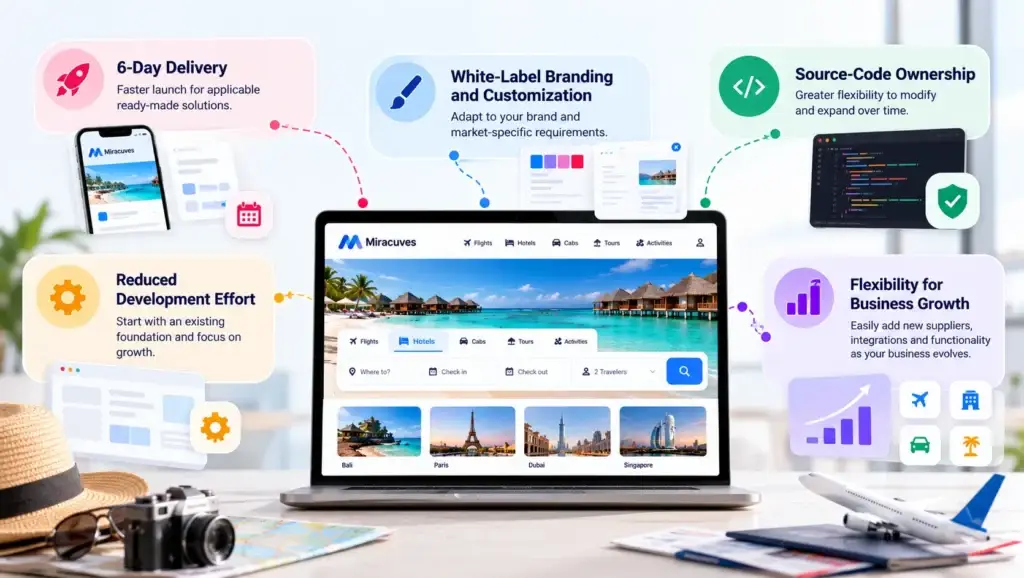
For travel startups choosing a ready-made foundation over custom development, Miracuves offers a white-label solution that helps reduce development effort, accelerate market entry, and maintain flexibility for future growth.
Instead of building standard booking functionality from scratch, founders can focus on supplier partnerships, customer acquisition, and business expansion.
How Miracuves Supports Travel Startups
1. Faster Launch With 6-Day Delivery
Miracuves offers a 6-day delivery path for applicable ready-made solutions, helping startups move toward launch faster. Additional integrations and custom requirements may extend the overall timeline.
2. White-Label Branding and Customization
Startups can adapt the solution to their brand identity and business requirements, including:
- Branding and interface customization.
- Market-specific booking workflows.
- Additional integrations and functionality where supported.
3. Source-Code Ownership
Miracuves provides a source-code-owned approach, allowing founders greater flexibility to modify and expand their software over time, subject to the agreed ownership terms.
4. Reduced Development Effort
By starting with an existing software foundation, startups can avoid recreating common booking processes and allocate more resources toward supplier relationships, marketing, and customer experience.
5. Flexibility for Business Growth
As business requirements evolve, founders can evaluate additional supplier integrations, operational improvements, and new functionality without necessarily rebuilding the entire platform.
When Is Miracuves a Good Fit?
Miracuves is worth considering when a startup wants to:
- Enter the market faster using established booking workflows.
- Build a branded travel business without starting from zero.
- Maintain source-code control and customization flexibility.
- Focus more resources on market validation and customer acquisition.
The key advantage is balancing faster delivery with long-term flexibility. Founders can explore Miracuves’ white-label booking solution for travel businesses to assess whether its existing foundation aligns with their operational requirements and growth plans.
Final Thoughts: Build What Makes You Different
The most useful build-vs-buy decision starts with one principle: do not confuse owning more custom code with creating more customer value.
Build from scratch when the technology itself needs to be fundamentally different and that difference matters to the business.
Consider a white-label foundation when the core workflows are established, your differentiation lies elsewhere, and reaching real customers and suppliers sooner is strategically valuable.
And consider a hybrid model when you need both: proven infrastructure underneath and custom differentiation where customers will actually notice it.
The objective is not to minimize the amount of software you build.
It is to invest engineering time, capital, and founder attention where they create the strongest business advantage.
FAQs
Is it better to build or buy booking software for a travel startup?
It depends on where the startup’s differentiation lies. Custom development can make sense when proprietary workflows or technology are central to the business. A white-label foundation can be more practical when most core workflows follow established reservation patterns and the startup wants to concentrate resources on suppliers, customers, branding, and market execution.
What is a white-label booking platform?
A white-label platform is an existing software foundation that can be branded and configured for another business. The exact level of customization, source-code access, hosting control, integrations, and ownership varies by provider and should be verified before purchase.
Does buying white-label software mean losing control?
Not necessarily. Control depends on the agreement and architecture. Founders should investigate source-code rights, data ownership, hosting, API access, modification rights, documentation, and migration options rather than assuming all white-label models work the same way.
When should a travel startup build from scratch?
Building becomes more relevant when unique technology is fundamental to the startup’s competitive advantage, existing products cannot support essential workflows without major compromises, and the business has the resources to manage a longer engineering and maintenance lifecycle.
What should startups check before buying a ready-made booking system?
Evaluate working booking flows, integrations, cancellation and refund logic, administrative controls, source-code terms, data ownership, hosting, documentation, customization boundaries, maintenance responsibilities, third-party costs, and post-launch support.
Can a startup combine white-label software with custom development?
Yes. A startup can use an existing foundation for established workflows and apply custom development to strategically important areas. This can prevent the team from rebuilding commodity infrastructure while still allowing the product to differentiate.
Why does source-code ownership matter?
Source-code ownership or appropriate source-code rights can affect how independently a business can modify, maintain, host, or migrate its product later. The exact rights should always be confirmed contractually rather than assumed.
How quickly can Miracuves deliver a ready-made solution?
Miracuves offers a 6-day delivery path for applicable ready-made solutions. The suitability of that route still depends on the startup’s customization, integrations, supplier model, and other launch requirements.
Miracuves is an independent software development company. We are not affiliated with, connected to, sponsored by, or endorsed by any company or product named in this article.
Terms such as “X Clone” are used descriptively. It is how the software industry refers to building a platform with functionality comparable to a known service, and how clients search for it.
The entire design and codebase of our products is built by our own team. Our products contain no code, design, graphics, or content originating from any third-party website or applications.
All third-party names and marks referenced in this article are the property of their respective owners, referenced solely to identify the services discussed.