






















Key Takeaways
- A Kundli algorithm converts birth details into horoscope data.
- Python can handle planetary calculations and chart logic.
- Accuracy depends on timezone, location, and ayanamsa.
- Julian Day is used for astronomical calculations.
- A strong engine supports Kundli, Dasha, Nakshatra, and reports.
Algorithm Signals
- Validate birth date, time, city, and country.
- Convert local birth time into UTC.
- Calculate Julian Day for planet positions.
- Map planets to Rashi, house, Nakshatra, and Pada.
- Render charts for web, mobile, and PDF reports.
Real Insights
- A Kundli engine is the core of astrology apps.
- Small time errors can change Lagna and Dasha results.
- Keep calculation and interpretation logic separate.
- AI can improve horoscope explanation and language output.
- Miracuves can help build astrology apps with Kundli and consultation features.
A Kundli generation system is not just a random horoscope text generator. It is a calculation engine that converts a person’s birth date, birth time, birth location, timezone, latitude, and longitude into planetary positions, houses, signs, Nakshatras, Dashas, and horoscope interpretations.
For a modern astrology app, this algorithm becomes the foundation of features like birth chart generation, daily horoscope, Kundli matching, Panchang, astrologer consultation, paid reports, and AI-powered astrology insights. It is also one of the core modules founders need when building an AstroTalk clone or any astrology consultation platform where users expect accurate Kundli results before connecting with astrologers.
Python is one of the most practical languages for building this type of system because it supports astronomical calculation libraries, API development, data processing, chart rendering, and AI integration. Libraries such as PySwissEph, PyJHora, VedicAstro, VedAstro, and Jyotichart can help developers build different parts of the Kundli generation workflow.
But building a Kundli app or AstroTalk clone requires more than installing a Python library. You need a clean algorithm flow, accurate timezone handling, planetary calculation logic, Vedic astrology rules, database structure, API architecture, and a reliable interpretation layer.
This guide explains how a Kundli and horoscope generation algorithm works in Python and how the same logic can be converted into a scalable astrology app or AstroTalk-like consultation platform.
What Is a Kundli Generation Algorithm?
A Kundli generation algorithm is the calculation logic that creates a birth chart from a person’s birth details. It uses inputs like date of birth, time of birth, birthplace, timezone, latitude, and longitude to calculate planetary positions, Lagna, Rashis, houses, Nakshatras, Dashas, and horoscope insights.
In simple terms, it works in two layers:
Astronomical calculation: The system calculates where the planets were at the exact time and place of birth.
Vedic astrology logic: The calculated planetary data is interpreted through rules related to signs, houses, Nakshatras, Dashas, Yogas, and transits.
A Kundli algorithm helps answer questions like:
- What was the planetary position at birth?
- What is the person’s Lagna or ascendant?
- Which Rashi and house does each planet fall into?
- What is the Moon sign and Nakshatra?
- Which Mahadasha and Antardasha periods are active?
- How can this data be converted into a readable horoscope report?
Accuracy is very important in Kundli generation. A small error in birth time, timezone, or location can affect Lagna, house placement, Nakshatra Pada, or Dasha balance. That is why a reliable system must carefully handle timezone conversion, latitude and longitude, ayanamsa selection, and planetary calculations.
In an astrology app, this algorithm becomes the core engine behind free Kundli generation, Janam Kundli, Kundli matching, daily horoscope, Panchang, career prediction, marriage prediction, Dasha analysis, transit reports, and paid astrology reports.
For developers, it is the technical calculation engine. For users, it creates personalized astrology insights. For founders, it becomes the main product logic behind a scalable astrology app.
Read more: What is AstroTalk and How Does It Work? Complete Guide 2026
Core Inputs Required for Kundli Generation
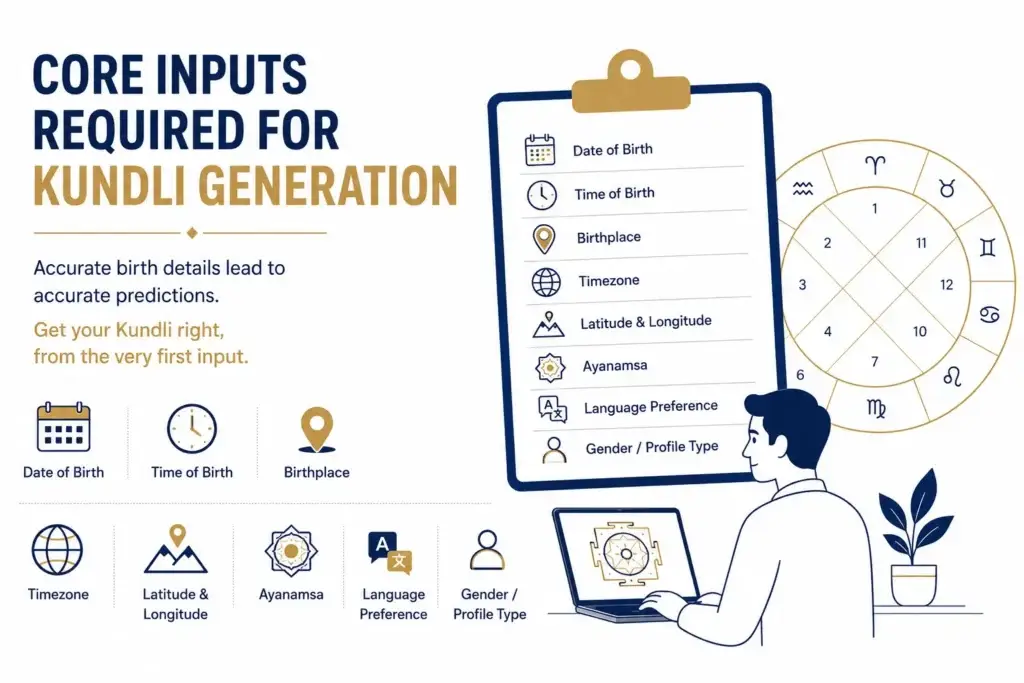
A Kundli system needs accurate birth information because even a small mistake in birth time or location can affect the ascendant, house placement, Moon sign, Nakshatra, or Dasha calculation.
The main inputs include:
Date of birth: Used to calculate planetary positions.
Time of birth: Required for Lagna, houses, and accurate chart calculation.
Birthplace: Needed to identify the correct latitude, longitude, and timezone.
Timezone: Converts local birth time into UTC for astronomical calculations.
Latitude and longitude: Required for ascendant and house placement accuracy.
Ayanamsa: Converts tropical planetary positions into sidereal Vedic positions.
Language preference: Helps generate horoscope reports in the user’s preferred language.
Gender or profile type: Optional, but useful for personalized reports or Kundli matching.
Among these inputs, exact birth time and birthplace are the most important. If the time is wrong by even a few minutes, the Lagna can shift in some cases. That is why astrology apps should validate birth details carefully before generating a Kundli.
How Kundli Generation Works: Step-by-Step Algorithm
A complete Kundli generation algorithm usually follows this flow:
Birth details → Geolocation → Timezone conversion → Julian Day → Planetary positions → Ayanamsa correction → Rashi mapping → Lagna calculation → House assignment → Nakshatra and Dasha calculation → Chart rendering → Horoscope interpretation.
Let’s break it down step by step.
Step 1: Collect Birth Details
The first step is to collect the user’s birth details through a form or app screen.
Common fields include name, date of birth, time of birth, birth city, country, gender, language preference, and report type.
In a production app, the system should not depend only on city text. It should convert the city into coordinates and timezone data through a geocoding service or internal city database.
For example, if the user enters Jaipur, India, the system should identify the correct latitude, longitude, timezone, and UTC offset before starting the calculation.
Step 2: Convert Birthplace into Coordinates
The birthplace must be converted into latitude and longitude.
This can be done using Google Maps API, OpenStreetMap, GeoNames database, an internal city database, or a custom location search API.
For astrology apps, it is better to store verified city data because users may enter different spellings of the same place. For example, “Varanasi,” “Banaras,” and “Kashi” may refer to the same location.
A good astrology app should also support city suggestions, country filtering, and location validation so users do not enter incomplete birth details.
Step 3: Convert Local Birth Time to UTC
Most astronomical calculations need time in UTC. The birth time entered by the user is local time, so the system must convert it properly.
For example, if a user was born in India at 10:30 AM IST, the system should convert that time into the correct UTC time before calculation.
This step is very important because incorrect timezone conversion can change the planetary positions, ascendant, house placement, and Dasha starting point.
The system should also handle historical timezone and daylight saving rules, especially for users born in countries where timezone changes happened over time.
Step 4: Calculate Julian Day
Julian Day is an astronomical time format used by ephemeris libraries. Instead of using only the normal calendar date and time, the engine converts the birth time into Julian Day for accurate planetary calculations.
In Python-based Kundli systems, this step can be handled through astrology calculation libraries such as PySwissEph. The main purpose is to create a standard astronomical time reference that the calculation engine can use consistently.
Once the Julian Day is calculated, it becomes the base time value for calculating planetary positions, Lagna, houses, Nakshatra, Dasha periods, and other Kundli-related data.
Step 5: Calculate Planetary Positions
After Julian Day is calculated, the system can calculate the positions of planets.
Common planets and points used in Kundli generation include Sun, Moon, Mars, Mercury, Jupiter, Venus, Saturn, Rahu, Ketu, and Ascendant or Lagna.
Some systems may also calculate Uranus, Neptune, Pluto, Gulika, Mandi, Chiron, or additional Vedic points depending on the astrology tradition.
For every planet, the system usually calculates longitude, sign, degree, speed, and retrograde status. In many Vedic systems, Ketu is calculated as 180 degrees opposite Rahu.
This gives the raw planetary data. The next step is to map this data into Rashi, degree, Nakshatra, and house.
Step 6: Apply Ayanamsa for Vedic Astrology
Western astrology usually uses the tropical zodiac. Vedic astrology uses the sidereal zodiac. Ayanamsa is the correction used to convert tropical positions into sidereal positions.
Common ayanamsa systems include Lahiri, Raman, KP, Krishnamurti, and Fagan Bradley.
For most Indian Kundli apps, Lahiri ayanamsa is commonly used.
Using a different ayanamsa can slightly change planetary positions and interpretation. That is why astrology apps should either use one default ayanamsa or allow advanced users to select their preferred ayanamsa.
Step 7: Map Planets to Rashis
The zodiac is divided into 12 signs. Each Rashi covers 30 degrees.
0° to 30° represents Aries or Mesh.
30° to 60° represents Taurus or Vrishabha.
60° to 90° represents Gemini or Mithuna.
90° to 120° represents Cancer or Karka.
120° to 150° represents Leo or Simha.
150° to 180° represents Virgo or Kanya.
180° to 210° represents Libra or Tula.
210° to 240° represents Scorpio or Vrischika.
240° to 270° represents Sagittarius or Dhanu.
270° to 300° represents Capricorn or Makara.
300° to 330° represents Aquarius or Kumbha.
330° to 360° represents Pisces or Meena.
This logic is applied to every planet. Once the longitude is known, the system identifies the Rashi and the degree inside that Rashi.
Step 8: Calculate Lagna or Ascendant
Lagna is one of the most important parts of a Kundli. It represents the rising sign at the exact time and place of birth.
Lagna depends on birth date, birth time, latitude, longitude, and timezone.
Because Lagna changes quickly, a small birth time error can affect the chart.
A Kundli system calculates the ascendant using the birth location and astronomical time reference. Once the ascendant longitude is found, it is mapped to a Rashi. That Rashi becomes the Lagna.
For Indian astrology apps, the house system should be clearly defined and kept consistent.
Step 9: Assign Planets to Houses
Once Lagna is known, houses can be assigned.
In many Vedic astrology systems, the Lagna sign becomes the first house. The next sign becomes the second house, and the sequence continues until the twelfth house.
For example, if the Lagna is Leo, then Leo becomes the first house, Virgo becomes the second house, Libra becomes the third house, Scorpio becomes the fourth house, Sagittarius becomes the fifth house, and so on.
This is a simplified whole-sign house approach. Production systems may need Bhav Chalit logic, Sripati houses, KP houses, or other advanced house calculation methods.
Step 10: Calculate Nakshatra and Pada
Nakshatra calculation is usually based on the Moon’s sidereal longitude.
There are 27 Nakshatras. Each Nakshatra covers 13°20’. Each Nakshatra has 4 Padas, and each Pada covers 3°20’.
Nakshatra and Pada are used in Dasha calculation, personality interpretation, marriage matching, naming syllables, and many Vedic astrology reports.
The 27 Nakshatras include Ashwini, Bharani, Krittika, Rohini, Mrigashira, Ardra, Punarvasu, Pushya, Ashlesha, Magha, Purva Phalguni, Uttara Phalguni, Hasta, Chitra, Swati, Vishakha, Anuradha, Jyeshtha, Mula, Purva Ashadha, Uttara Ashadha, Shravana, Dhanishta, Shatabhisha, Purva Bhadrapada, Uttara Bhadrapada, and Revati.
Step 11: Calculate Vimshottari Dasha
Vimshottari Dasha is one of the most popular Dasha systems in Vedic astrology. It is based on the Moon’s Nakshatra at birth.
The Dasha sequence is Ketu, Venus, Sun, Moon, Mars, Rahu, Jupiter, Saturn, and Mercury.
Each planet has a fixed Mahadasha duration.
Ketu has 7 years.
Venus has 20 years.
Sun has 6 years.
Moon has 10 years.
Mars has 7 years.
Rahu has 18 years.
Jupiter has 16 years.
Saturn has 19 years.
Mercury has 17 years.
A full production Dasha engine must calculate the birth Nakshatra lord, balance Dasha at birth, Mahadasha periods, Antardasha periods, Pratyantardasha periods, current running Dasha, and future Dasha timeline.
This part is more complex than simple zodiac mapping because it needs precise Moon position and date period calculation.
Step 12: Generate Kundli Charts
Once planetary positions, Rashis, houses, and Lagna are calculated, the system can generate visual Kundli charts. These charts make the calculated astrology data easier for users and astrologers to understand.
Common chart types include Lagna chart, Moon chart, Navamsha chart, Bhav Chalit chart, Dasha chart, South Indian chart, and North Indian chart.
Chart rendering can be done using SVG, HTML/CSS, Canvas, image generation libraries, or frontend chart components. The app can also return chart data as structured output so the frontend can display it inside a mobile app, web dashboard, PDF report, or astrology consultation screen.
For a better user experience, the chart layout should be clean, readable, and responsive across mobile and desktop screens. This is especially important for astrology apps where users may compare charts, download reports, or share Kundli details with astrologers.
Step 13: Generate Horoscope Interpretation
The calculation engine only produces structured astrology data. The interpretation layer converts that data into readable horoscope content.
A horoscope interpretation layer may include personality analysis, career prediction, marriage prediction, finance prediction, health insights, education insights, Dasha impact, transit impact, compatibility reports, remedies, lucky number, lucky color, and lucky day.
There are two common ways to generate interpretations: rule-based interpretation and AI-assisted interpretation.
The best approach is usually hybrid. The app should use rule-based astrology logic for factual interpretation and AI for readable explanations.
Python Libraries Used for Kundli and Horoscope Generation
Python has several libraries, frameworks, and backend tools that can support Kundli and horoscope generation. Some tools help with planetary calculations, while others support chart rendering, API development, database storage, caching, and background processing.
| Library / Tool | Main Use | Best For |
|---|---|---|
| PySwissEph | Ephemeris-based planetary calculations | Accurate planet positions, longitude, speed, and retrograde status |
| PyJHora | Vedic astrology calculations | Kundali, Panchang, Hora, Dasha, and traditional Vedic astrology logic |
| VedicAstro | Vedic and KP astrology data | Chart data, planetary position analysis, and Vedic research use cases |
| VedAstro | Astrology calculation library/API | Faster integration and wide astrology calculation coverage |
| Jyotichart | Chart rendering | North Indian and South Indian Kundli chart visuals |
| FastAPI | Python API development | High-performance backend APIs for astrology apps |
| Django | Web backend framework | Authentication, admin panels, user management, and structured backend development |
| PostgreSQL / MySQL | Database storage | User profiles, birth details, Kundli reports, payments, and chart data |
| Redis | Caching | Repeated chart calculations and faster API responses |
| Celery | Background task processing | PDF reports, notifications, batch calculations, and heavy processing tasks |
For a basic Kundli calculator, PySwissEph or PyJHora may be enough. But for a full astrology app, the system usually needs a combination of calculation libraries, backend APIs, databases, caching, and background workers.
For example, PySwissEph can calculate planetary positions, FastAPI can expose the Kundli logic as an API, PostgreSQL can store user profiles and reports, Redis can improve response speed, and Celery can generate PDF reports or notifications in the background.
Read more: Best AstroTalk Clone Script in 2026: Features & Pricing Compared
Kundli Generation System Architecture
A scalable Kundli and horoscope app should separate calculation, storage, interpretation, and user-facing features. This makes the system easier to maintain, faster to scale, and more reliable for high user activity.
The usual architecture works like this:
- User enters birth details such as date of birth, time of birth, birthplace, language preference, and profile information.
- The system validates the birth data and checks whether the date, time, location, and timezone are correct.
- The geolocation and timezone engine identifies latitude, longitude, timezone, and UTC offset for the birth location.
- The system converts local birth time into UTC and calculates Julian Day as the main astronomical time reference.
- The ephemeris calculation engine calculates planetary positions, longitude, speed, and retrograde status.
- Ayanamsa and sidereal conversion are applied for Vedic astrology calculations.
- Planets are mapped to Rashi, house, degree, Nakshatra, and Pada.
- The Dasha, Yoga, and Panchang engines process Mahadasha, Antardasha, planetary combinations, Tithi, Nakshatra, Yoga, Karana, and weekday.
- The interpretation layer converts structured Kundli data into readable horoscope insights for career, marriage, finance, health, personality, compatibility, and life events.
- The chart rendering layer creates visual Kundli charts such as Lagna chart, Moon chart, Navamsha chart, and Bhav Chalit chart.
- The database stores user profiles, birth details, planetary data, chart records, reports, and payment history.
- The cache layer stores repeated calculations to improve app speed and reduce server load.
- The output layer shows the final result as a mobile app screen, web output, downloadable PDF report, or API response.
This layered architecture helps astrology apps deliver accurate Kundli results while supporting advanced features like paid reports, AI horoscope explanations, astrologer consultations, push notifications, and admin dashboards. Kundli results while supporting advanced features like paid reports, AI horoscope explanations, astrologer consultations, push notifications, and admin dashboards.
Recommended Backend Architecture for an Astrology App
A modern astrology app backend can be built using Python frameworks like FastAPI or Django, depending on the size, speed, and structure required for the platform. The mobile app or web app works as the user-facing layer where users generate Kundli, view horoscope reports, chat with astrologers, join calls, make payments, and access their saved profiles.
Behind this interface, the API gateway manages user requests, login, authentication, and communication between different backend services. The Kundli calculation service handles the core astrology logic, including planetary positions, Lagna, Dashas, Nakshatras, houses, and chart data. Once the calculation is complete, the interpretation service converts structured Kundli data into readable horoscope reports for users.
For monetization and consultation features, the backend also needs an astrologer consultation module. This module manages chat, voice calls, video calls, queues, wallet deductions, and session history. The payment module handles paid reports, wallet recharge, consultation payments, subscriptions, and transaction records.
The admin dashboard gives the business team control over users, astrologers, pricing, reports, payments, content, and platform settings. The database stores user profiles, birth details, Kundli charts, reports, payments, chat sessions, and consultation history. To improve performance, the cache layer stores repeated calculations and popular reports, while the queue system handles heavy tasks like PDF generation, notifications, bulk calculations, and background processing.
This type of backend architecture helps an astrology app deliver fast Kundli results, manage paid consultations, support report generation, and scale smoothly as user activity grows.
Database Schema for a Kundli App
A Kundli app database should not store only basic user details. It should also manage birth profiles, planetary positions, chart data, horoscope reports, payments, consultations, astrologer profiles, and notification records. A well-planned database structure helps the app generate accurate reports, store user history, manage paid services, and support future features like Kundli matching, AI reports, and live consultations.
| Table Name | Purpose |
|---|---|
| users | Stores user account details such as name, email, phone number, login method, and profile status. |
| birth_profiles | Stores birth details such as name, date of birth, birth time, birthplace, latitude, longitude, and timezone. |
| planetary_positions | Stores planet longitude, Rashi, house, degree, Nakshatra, speed, and retrograde status. |
| kundli_charts | Stores Lagna chart, Moon chart, Navamsha chart, Bhav Chalit chart, and other chart data. |
| dasha_periods | Stores Mahadasha, Antardasha, Pratyantardasha, current Dasha, and future Dasha timelines. |
| horoscope_reports | Stores generated horoscope reports for career, marriage, finance, health, yearly predictions, and other categories. |
| compatibility_reports | Stores Kundli matching results, Guna Milan score, compatibility notes, and relationship insights. |
| panchang_data | Stores daily Panchang elements such as Tithi, Nakshatra, Yoga, Karana, weekday, sunrise, and sunset details. |
| astrologer_profiles | Stores astrologer details, skills, experience, pricing, availability, language, and consultation type. |
| chat_sessions | Stores user-astrologer chat sessions, message history, timestamps, and session status. |
| call_sessions | Stores voice and video consultation records, call duration, charges, and session history. |
| payments | Stores paid reports, wallet recharge, subscriptions, consultation payments, refunds, and transaction status. |
| notifications | Stores push notification, email, SMS, reminder, and report delivery records. |
This type of database structure helps a Kundli app work as a complete astrology platform instead of just a basic chart generator. It supports free Kundli creation, paid reports, astrologer consultations, wallet payments, compatibility matching, Panchang, notifications, and long-term user profile management.
How to Add AI to Kundli and Horoscope Generation
AI can improve the user experience of a Kundli and horoscope app, but it should not replace the core calculation engine. The calculation engine should remain responsible for accurate planetary positions, Lagna, houses, Nakshatra, Dasha periods, Yogas, and transit data.
A common mistake is asking AI to generate horoscope predictions directly without structured Kundli data. This can lead to generic or inaccurate results because AI may guess planetary positions instead of using real birth chart calculations.
A better approach is to use AI as an interpretation layer. The system should first calculate the Kundli using a reliable astrology engine. Then it should send structured chart data to the AI so it can explain the results in simple, personalized language.
The ideal flow looks like this:
Astronomical calculation engine → Structured Kundli data → Rule-based astrology logic → AI interpretation layer → Personalized horoscope report.
For example, the calculation engine can provide details such as Lagna, Moon sign, Sun sign, planetary positions, house placements, Nakshatra, Pada, Dasha periods, Yogas, and transit data. AI can then convert this data into readable insights for career, marriage, finance, health, personality, compatibility, and yearly predictions.
This approach helps reduce hallucination, improves consistency, and makes the horoscope report easier for users to understand. It also allows astrology apps to offer modern features like AI horoscope summaries, personalized report explanations, chatbot-style guidance, and multilingual astrology insights without compromising calculation accuracy.
Build From Scratch vs Astrology API vs Ready-Made Astrology App
Founders usually have three main options when building a Kundli or horoscope app: build the calculation engine from scratch, use an astrology API, or choose a ready-made astrology app solution. The right option depends on budget, timeline, customization needs, and long-term product goals.
| Approach | Best For | Main Advantage | Main Limitation |
|---|---|---|---|
| Build from scratch in Python | Custom astrology engines and research-based products | Full control over calculation logic, features, and architecture | Takes more time and requires astrology plus engineering expertise |
| Use an astrology API | Faster app development with external calculation support | Quick integration and lower initial technical complexity | API dependency, recurring cost, and limited customization |
| Use a ready-made astrology app | Fast commercial launch with existing features | Faster market entry with Kundli, reports, consultation, payments, and admin features | Founders must verify source code access, scalability, and customization options |
Building from scratch in Python is useful when the goal is to create a proprietary astrology engine with custom rules, advanced calculations, or research-based logic. However, it requires more development time, testing, and domain expertise.
Using an astrology API can speed up development because the app does not need to build every calculation from the beginning. This approach works well for basic Kundli, horoscope, Panchang, or matching features, but it may limit flexibility if the business later needs custom logic or deeper control.
A ready-made astrology app is usually the fastest option for founders who want to launch a commercial product quickly. It can include Kundli generation, horoscope reports, astrologer chat, voice/video calls, payments, wallet, user profiles, and admin dashboard from the beginning. This approach is especially useful for founders planning an AstroTalk-style astrology platform with both automated horoscope features and live consultation workflows.
If the goal is technical control, building from scratch may be the better route. If the goal is fast market launch, a ready-made astrology app solution can save development time and help founders start testing the business model sooner.
Challenges in Building a Kundli Algorithm
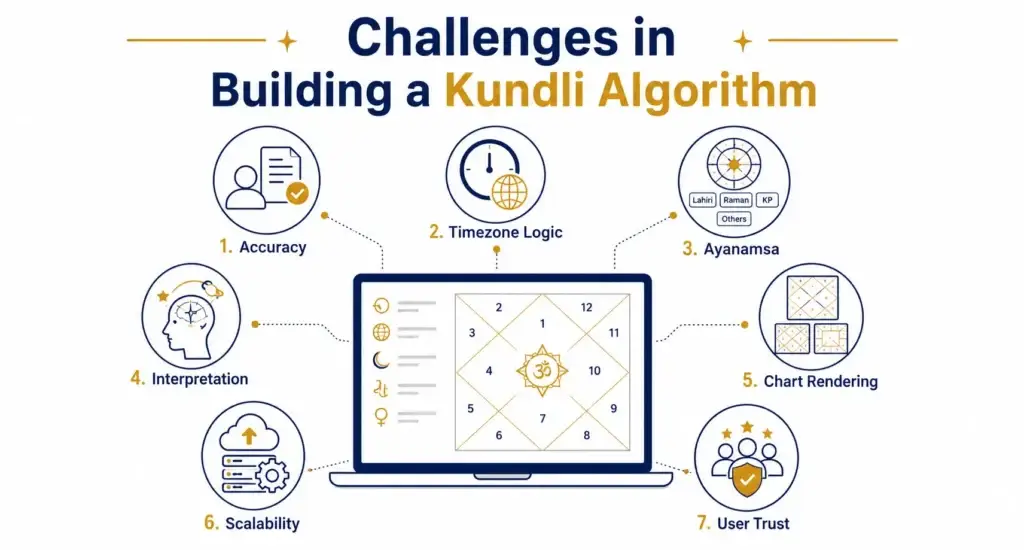
Building a Kundli algorithm requires more than planetary calculations. The system must handle accuracy, timezone logic, astrology rules, chart rendering, scalability, and user trust.
The main challenges include:
Accuracy of birth details: Kundli accuracy depends on correct birth time, birthplace, timezone, latitude, longitude, and ayanamsa. Even a small error can affect Lagna, house placement, Nakshatra, or Dasha balance.
Timezone handling: Local birth time must be converted into UTC correctly. Historical timezone changes and daylight saving rules should also be handled carefully.
Ayanamsa differences: Different astrologers may use Lahiri, Raman, KP, or other ayanamsa systems, which can create slight differences in chart results.
Interpretation complexity: Planetary positions are mathematical, but horoscope interpretation needs layered astrology rules involving houses, signs, Dashas, Yogas, and transits.
Chart rendering: North Indian, South Indian, and East Indian Kundli charts need different visual layouts for mobile, web, and PDF reports.
Scalability: A production app needs caching, optimized APIs, queue workers, and report storage to support many users at the same time.
User trust: Users expect fast results, accurate charts, clean visuals, and personalized explanations. A strong Kundli engine must also deliver a smooth user experience.
Features a Kundli and Horoscope App Should Include
A Kundli and horoscope app should include features that support user acquisition, engagement, monetization, and long-term retention. The goal is not only to generate charts but also to create a complete astrology platform where users can access reports, consult astrologers, receive predictions, and return regularly.
| Feature | Purpose |
|---|---|
| Free Kundli Generation | Helps attract users and lets them create basic birth charts quickly. |
| Daily Horoscope | Improves repeat engagement and brings users back to the app regularly. |
| Kundli Matching | Supports marriage, relationship, and compatibility use cases. |
| Live Astrologer Chat | Allows users to ask questions through paid chat consultation sessions. |
| Voice and Video Consultation | Creates premium revenue opportunities for astrologers and the platform. |
| PDF Horoscope Reports | Offers detailed paid reports for career, marriage, finance, health, yearly predictions, and compatibility. |
| AI Astrology Chatbot | Improves user experience with instant answers and personalized horoscope explanations. |
| Panchang | Provides daily astrology details such as Tithi, Nakshatra, Yoga, Karana, and auspicious timings. |
| Dasha Analysis | Gives users deeper Vedic astrology insights based on Mahadasha and Antardasha periods. |
| Transit Reports | Provides recurring astrology insights based on current planetary movements. |
| Wallet System | Supports chat, calls, paid reports, subscriptions, and in-app purchases. |
| Push Notifications | Improves retention through daily horoscope alerts, report updates, offers, and consultation reminders. |
| Admin Dashboard | Helps manage users, astrologers, reports, payments, pricing, content, notifications, and platform settings. |
These features help turn a basic Kundli calculator into a complete astrology app with engagement, consultation, reporting, and monetization capabilities.
Monetization Models for Kundli and Horoscope Apps
A Kundli and horoscope app can generate revenue through multiple monetization models. The best approach is usually a hybrid model that combines reports, consultations, subscriptions, wallet payments, and premium features.
- Paid Kundli reports allow users to buy detailed birth chart reports, career reports, marriage reports, yearly predictions, finance reports, health reports, and compatibility reports.
- Astrologer consultation helps the app earn through paid chat, voice call, and video consultation sessions with astrologers.
- Wallet recharge allows users to add balance and spend it on reports, live consultations, premium features, and in-app services.
- Subscription plans can include daily predictions, premium horoscope insights, transit updates, advanced reports, and priority consultation access.
- Kundli matching reports are useful for marriage, relationship, and compatibility use cases, especially in markets where horoscope matching is popular.
- AI horoscope chatbot can be offered as a premium feature when connected with accurate Kundli data and personalized astrology logic.
- Featured astrologer listings allow astrologers to pay for better visibility, higher ranking, or promoted placement inside the app.
- Premium notifications can alert users about important transits, Dasha changes, auspicious dates, and personalized astrology updates.
- Festival and Panchang-based services can support paid reminders, Muhurat reports, daily Panchang insights, and special occasion reports.
Using multiple revenue streams helps astrology apps reduce dependency on one income source and create stronger long-term monetization.
Security and Compliance Considerations
Astrology apps collect personal birth data, user profiles, payment details, chat history, and private consultation records. Because this information is sensitive, security should be planned from the beginning.
The app should include secure login through OTP, email, phone, or social login. User data such as birth details, reports, payment records, and consultation history should be encrypted and protected from unauthorized access.
Payment security is also important because astrology apps often include wallet recharge, paid reports, subscriptions, and live consultations. The platform should use trusted payment gateways and avoid storing sensitive payment details directly.
Role-based access control should be added to the admin dashboard so admins, astrologers, support teams, and content managers only access the data they need. Chat, voice, and video consultation records should also be protected with proper privacy controls.
A reliable astrology app should include secure APIs, audit logs, data backup, privacy settings, and user consent for storing birth profiles. Strong security helps protect user trust, reduce business risk, and support long-term platform growth.
How Miracuves Can Help Build a Kundli and Horoscope App
Miracuves can help businesses build astrology platforms with Kundli generation, horoscope reports, astrologer consultation, chat, voice/video calling, payment integration, user profiles, admin dashboards, wallet systems, and scalable backend architecture.
For founders, the real value is not only generating a chart. The business opportunity comes from combining accurate Kundli calculations with consultation workflows, monetization modules, user retention features, mobile-first design, and admin control.
A well-built astrology app can support multiple revenue channels, including paid reports, live consultation, subscriptions, compatibility reports, AI astrology chat, and premium horoscope insights.
Read more: Business Model of Astrotalk : Complete Strategy Breakdown 2026
Conclusion
Building a Kundli and horoscope generation algorithm in Python requires more than a simple zodiac calculator. A complete system must handle birth data validation, timezone conversion, Julian Day calculation, planetary positions, ayanamsa, Lagna, houses, Nakshatras, Dashas, chart rendering, and interpretation.
Python makes this process easier because it supports astrology libraries, API frameworks, database integration, and AI-based report generation. But for a commercial astrology app or AstroTalk clone, the algorithm is only one part of the product.
The final app also needs user profiles, astrologer dashboards, chat and call features, voice/video consultation, wallet payments, paid reports, push notifications, admin control, and scalability. These features help turn a basic Kundli calculator into a complete astrology consultation platform.
For founders, the best approach depends on the goal. If you want full control, you can build a custom Python-based astrology engine. If you want faster launch, you can use APIs or a ready-made astrology app solution.
The winning product is the one that combines accurate Kundli calculations with strong user experience, astrologer consultation workflows, monetization, and long-term scalability.
Ready to build a Kundli and horoscope app with accurate chart generation, astrologer consultation, paid reports, and scalable backend features? Contact Miracuves today to discuss your astrology app idea and launch plan.
FAQs
What is a Kundli generation algorithm?
A Kundli generation algorithm is a calculation process that converts birth date, birth time, birthplace, timezone, latitude, and longitude into planetary positions, Lagna, houses, Rashis, Nakshatras, Dashas, and horoscope interpretations.
Can Python be used to generate Kundli?
Yes. Python can be used to generate Kundli charts using libraries such as PySwissEph, PyJHora, VedicAstro, VedAstro, and chart rendering tools.
Which Python library is best for Kundli generation?
PySwissEph is useful for planetary calculations, while PyJHora and VedicAstro are more focused on Vedic astrology calculations. The best choice depends on whether you need raw ephemeris data, complete Vedic logic, or faster app integration.
What data is required to generate a Kundli?
A Kundli requires date of birth, exact time of birth, birthplace, timezone, latitude, and longitude. Optional fields include name, gender, language, and report type.
What is the role of Swiss Ephemeris in Kundli generation?
Swiss Ephemeris helps calculate accurate planetary positions. Python developers often use PySwissEph as a Python wrapper for Swiss Ephemeris.
How is Lagna calculated in a Kundli app?
Lagna is calculated using birth time, latitude, longitude, and astronomical house calculation methods. Since Lagna changes quickly, accurate birth time is important.
Can AI generate horoscope predictions?
AI can generate readable horoscope explanations, but it should use structured Kundli data from a reliable calculation engine instead of guessing planetary positions.
Miracuves is an independent software development company. We are not affiliated with, connected to, sponsored by, or endorsed by any company or product named in this article.
Terms such as “X Clone” are used descriptively. It is how the software industry refers to building a platform with functionality comparable to a known service, and how clients search for it.
The entire design and codebase of our products is built by our own team. Our products contain no code, design, graphics, or content originating from any third-party website or applications.
All third-party names and marks referenced in this article are the property of their respective owners, referenced solely to identify the services discussed.