





















Key Takeaways
- A short drama engagement platform can use rewarded ads to give viewers limited access to coins, episode unlocks, or bonus content without making paid options feel unnecessary.
- Rewarded ads work best when they support free-user retention while subscriptions, coin packs, VIP access, and paid episode unlocks remain clearly more convenient or valuable.
- The goal is to balance ad rewards, viewing frequency, unlock limits, premium benefits, and user segmentation so ad monetization does not weaken paid conversion.
Rewarded Ad Signals
- Rewarded ads can unlock selected episodes, grant limited coins, restore streaks, or provide temporary bonuses instead of replacing every premium access point.
- Daily ad caps, cooldown periods, episode-level eligibility, reward limits, and user-segment rules help prevent excessive free access across the viewing journey.
- Ad completion rate, reward claims, episode continuation, unlock behavior, coin purchases, subscription upgrades, and repeat viewing show whether incentives are supporting healthy engagement.
Conversion Protection Insights
- Paid plans should preserve stronger benefits such as ad-free viewing, instant unlocks, larger content access, premium rewards, or better viewing convenience than the rewarded-ad path.
- Operators should compare ad-heavy users with paying viewers and track conversion rate, ARPU, ad revenue, coin purchases, subscription upgrades, and churn before changing reward generosity.
- Miracuves develops customizable short drama platforms with rewarded ads, coin wallets, episode unlocking, subscriptions, VIP access, segmentation, monetization analytics, and admin controls.
Short drama platforms live inside a fast emotional loop.
A viewer watches a dramatic opening scene, gets pulled into the story, reaches a cliffhanger, and then faces a decision: unlock the next episode, buy coins, upgrade to VIP, watch an ad, or leave.
This is where rewarded ads become powerful—and risky.
Used well, rewarded ads help a short drama engagement platform retain users who are not ready to pay yet. Used carelessly, they train users to avoid coin purchases, delay VIP upgrades, and wait for free access instead of spending.
The goal is not to remove rewarded ads. The goal is to design them as a conversion bridge.
For founders building a short-drama platform, the real question is not “Should we use rewarded ads?” The better question is: “Where can rewarded ads protect engagement without replacing paid behavior?”
Why Rewarded Ads Are Different in Short Drama Apps
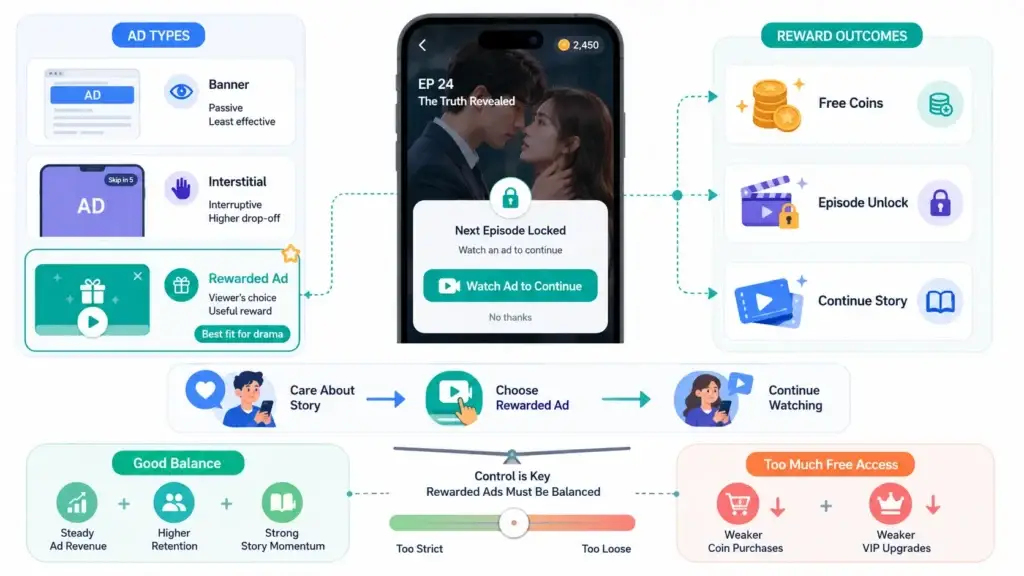
Rewarded ads are not ordinary ads.
A banner interrupts attention. An interstitial often appears when the platform decides to show it. A rewarded ad is different because the viewer chooses to watch it in exchange for something useful. For founders building short drama and micro-content platforms, this format works best when ads support the viewing journey without replacing paid access.
In a short drama app, that reward is usually one of three things:
- Free coins
- One episode unlock
- Temporary access to continue a series
That makes rewarded ads feel fair when the value exchange is clear. The viewer understands the deal: watch an ad, continue the story.
But short drama monetization is not only about attention. It is about controlled access. The app earns when viewers care enough about a story to unlock what happens next. If rewarded ads unlock too much, the platform weakens the exact urgency that makes coin purchases and VIP upgrades work.
The Right Role of Rewarded Ads in a Short Drama Engagement Platform
Rewarded ads should act as a safety net.
They should catch users who might otherwise abandon the app at the paywall. They should not replace the paid path for users who are already willing to buy.
A healthy short drama monetization system usually has three layers:
| Monetization Layer | Best Role | Ideal User Type | Risk If Misused |
|---|---|---|---|
| Coin unlocks | Direct episode revenue | High-intent viewers | Can feel too restrictive if introduced too early |
| VIP access | Convenience and loyalty | Frequent viewers | Can reduce coin revenue if unlimited access is too broad |
| Rewarded ads | Retention and sampling | New, hesitant, or low-balance users | Can reduce paid conversion if unlimited |
Rewarded ads are strongest when they solve a specific friction moment.
For example, a viewer reaches episode four, has watched the free opening episodes, and has no coins left. Instead of forcing a hard stop, the app can offer one rewarded ad to continue. That keeps the user inside the story.
The mistake is letting the same viewer unlock every premium episode through ads without limits. At that point, rewarded ads stop supporting conversion and start competing with it.
Where Rewarded Ads Should Appear
Placement decides whether rewarded ads help or hurt paid conversion.
The best placements are moments where the user is already engaged but may not be ready to pay.
After the Free Hook Window
Most short drama platforms need a free opening window. The viewer should see enough of the story to understand the conflict, characters, and emotional stakes.
After that, the platform can introduce paid or reward-based access.
A smart flow looks like this:
| Viewer Stage | Recommended Access Logic |
|---|---|
| Episode 1–2 | Free discovery |
| First major cliffhanger | Soft unlock prompt |
| Low coin balance | Rewarded ad option |
| Strong mid-series tension | Coin unlock becomes primary |
| Repeat viewing behavior | VIP offer appears |
| Premium finale or exclusive scene | Paid-first access |
Rewarded ads work well near the transition between free discovery and paid access. They help users sample the value of continuation before asking them to spend.
When the User Has Low or Zero Coins
A low-balance moment is one of the best places to offer rewarded ads.
The viewer has already reached a locked episode. They want to continue but cannot or will not top up immediately. A rewarded ad gives them a temporary path forward.
The key is to show the paid option beside the ad option.
For example:
“Unlock now with 30 coins, watch one ad to earn 10 coins, or upgrade to VIP for smoother access.”
This keeps the paid path visible. Rewarded ads should not hide coin packs or VIP offers.
During Re-Engagement Campaigns
Rewarded ads can also bring inactive users back.
A dormant user may not return just because the app sends a generic notification. But a message such as “Watch one ad today and continue your saved series” creates a specific reason to reopen the app.
This works especially well when connected to unfinished viewing behavior:
- Continue the series you started
- Unlock the next episode with a bonus reward
- Claim reward coins before they expire
- Resume from your last cliffhanger
Rewarded ads become stronger when they work with daily rewards for short drama retention, because both systems give viewers a reason to return after a locked episode, continue a saved series, or claim limited-time reward coins.
The reward should push the user back into content, not just into the wallet screen.
How to Prevent Rewarded Ads From Reducing Coin Purchases
Rewarded ads hurt paid conversion when they become too generous, too frequent, or too easy to predict.
If users learn that they can always watch ads instead of buying coins, they may stop seeing coins as necessary. The platform then becomes dependent on ad revenue even when some users would have paid.
The solution is controlled generosity.
Use Daily Ad Limits
Daily limits protect the coin economy.
For example, a platform might allow:
- 2 rewarded ads per day for new users
- 1 ad unlock for selected episodes
- Bonus reward ads during campaigns only
- No ad unlocks for premium finales or exclusive releases
The exact number should be tested, but the principle is simple: rewarded ads should create momentum, not unlimited access.
Separate Reward Coins From Purchased Coins
A strong wallet system should distinguish between purchased coins and reward coins.
Purchased coins come from real payment. Reward coins come from ads, daily check-ins, referrals, or campaigns. Both may appear in one wallet balance for the user, but the admin system should track them separately.
This matters because reward coins can have different rules:
| Coin Type | Source | Suggested Rule |
|---|---|---|
| Purchased coins | Coin packs | No short expiry, usable on most locked episodes |
| Reward coins | Ads, check-ins, campaigns | May expire, capped daily, limited for premium access |
| Bonus coins | Promotional bundles | Campaign-based, tracked separately |
This protects the perceived value of paid coins.
If reward coins behave exactly like purchased coins without limits, users may wait for free rewards instead of buying.
Limit Ad Unlocks on High-Value Episodes
Not every episode should be ad-unlock eligible.
Short drama monetization depends on emotional peaks. If the most important episodes are always available through rewarded ads, the platform gives away its highest-conversion moments.
A practical setup:
| Episode Type | Rewarded Ad Eligibility |
|---|---|
| Opening episodes | Usually free |
| Early locked episodes | Rewarded ad allowed |
| Mid-series episodes | Limited ad unlocks |
| High-demand cliffhangers | Coin-first |
| Finale or bonus ending | Paid or VIP-first |
| New premium release | No ad unlock at launch |
This does not mean premium users should be blocked. It means the app should protect the moments most likely to convert.
How Rewarded Ads Can Actually Improve Paid Conversion
Rewarded ads do not always reduce paid conversion. In many cases, they can improve it.
They can help users experience the value of premium access before they pay. A viewer who watches an ad to continue one episode may become more emotionally invested in the story. After that, buying coins becomes easier.
The key is sequencing.
Rewarded ads should give users a taste of continuation, not the whole meal.
For a deeper view of how coins, VIP access, ads, free episodes, and episode locks work together, founders can also explore Miracuves’ guide on vertical drama streaming app monetization.
A useful pattern:
- The user watches free opening episodes.
- The user reaches a locked episode.
- The app offers one rewarded ad unlock or small reward coin amount.
- The user continues and becomes more invested.
- The next high-value moment presents coins or VIP more strongly.
- The app explains that VIP removes friction and creates smoother viewing.
This turns rewarded ads into a bridge between free attention and paid intent.
Segment Users Instead of Showing the Same Ad Rules to Everyone
The biggest mistake is applying one rewarded ad rule to every viewer.
Different users need different monetization treatment.
New Users
New users need confidence. They are still learning the app, the story format, and the value of the content.
Rewarded ads can help them continue without forcing payment too early.
Good rule: give limited rewarded access after the free hook window.
Repeat Non-Payers
Repeat non-payers are valuable, but risky.
They return often but avoid payment. Rewarded ads can monetize them, but the app should avoid giving them full premium access for free.
Good rule: cap ad unlocks and test small coin pack offers.
High-Intent Viewers
High-intent viewers complete episodes, reach cliffhangers, and repeatedly continue the same series.
This group should see coin packs and VIP offers more often than rewarded ads.
Good rule: keep rewarded ads available as backup, but make paid access the faster path.
Existing Payers
Existing payers should not be overloaded with ads.
If someone has already bought coins or VIP access, too many ad prompts can reduce trust. For this segment, rewarded ads should be optional and limited.
Good rule: prioritize smooth paid viewing, bonus offers, and loyalty rewards.
Dormant Users
Dormant users may need a reason to return.
Rewarded ads can support reactivation campaigns by giving them a low-friction way to resume a saved story.
Good rule: offer limited-time reward coins tied to a specific series.
Founder Decision Signals
| Signal | What It Means | What to Adjust |
|---|---|---|
| Ad usage is high but purchases are low | Rewarded ads may be too generous | Lower reward value or reduce eligible episodes |
| Users leave at the first lock | Paywall may appear too early | Extend free hook or add one ad-supported unlock |
| VIP conversion is weak | VIP value may not feel different | Add ad-free viewing, bonus coins, or early access |
| Coin buyers churn after purchase | Episode pricing may feel unfair | Review unlock costs and paid coin value |
| Rewarded ad completion is low | Reward is not attractive enough | Improve prompt, placement, or reward clarity |
| Revenue rises but retention drops | Monetization pressure may be too aggressive | Soften early paywalls and test segmented access |
What the Admin Panel Must Control
Rewarded ads cannot be managed properly if every change requires development work. For a reward-led short drama platform, the admin panel should allow the platform operator to control ad limits, reward values, episode eligibility, coin rules, VIP access, and campaign settings without depending on developers for every small change.
A short drama engagement platform needs admin-level control over:
- Rewarded ad availability
- Reward coin value
- Daily ad limits
- Episode-level ad eligibility
- Series-level monetization rules
- Free episode thresholds
- Coin pack pricing
- VIP plan benefits
- Campaign bonuses
- User segment rules
- Region-specific monetization settings
- Ad completion tracking
- Coin ledger history
- Revenue analytics
This is where platform architecture matters.
Founders also need to understand short drama platform development cost because reward logic, coin ledgers, ad unlock rules, VIP plans, and admin controls directly affect the final build scope.
Miracuves’ short drama app development approach is built around monetization workflows such as episode paywalls, coin wallets, creator CMS, admin moderation, and configurable launch logic. Founders can use this type of foundation to test rewarded ads, coins, and VIP rules faster instead of building every monetization module from zero.
A Practical Rewarded Ad Framework for Short Drama Platforms
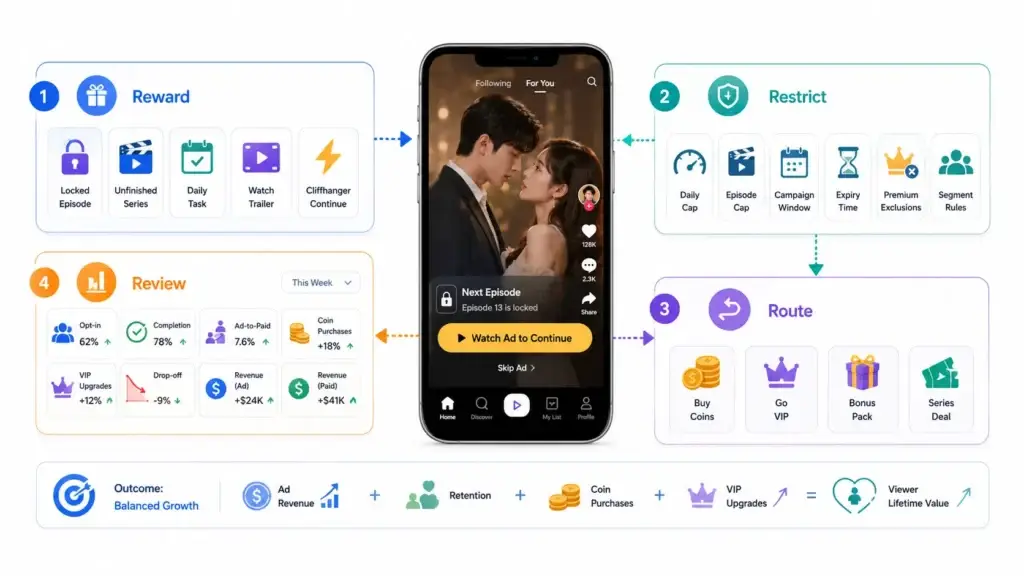
A simple framework is: reward, restrict, route, and review.
1. Reward the Right Behavior
Do not reward users only for opening the app.
Reward actions that move users toward deeper engagement:
- Reaching a locked episode
- Returning to an unfinished series
- Completing a daily viewing task
- Watching a new series trailer
- Continuing after a cliffhanger
The reward should bring the viewer closer to the story.
2. Restrict the Reward
Rewarded ads should have limits.
A good reward system may include:
- Daily caps
- Episode caps
- Campaign windows
- Expiry rules
- Premium-content exclusions
- Segment-based availability
The viewer should feel helped, not given unlimited free access.
3. Route Users Toward Paid Options
Every rewarded ad flow should still keep the paid path visible.
After a user watches several rewarded ads, the app can show:
- “Buy coins to continue faster”
- “Upgrade to VIP for ad-free viewing”
- “Get bonus coins with this pack”
- “Unlock the full series with a limited offer”
This turns ad engagement into paid intent.
4. Review the Data Weekly
Rewarded ad strategy should not stay fixed.
Founders should track:
| Metric | Why It Matters |
|---|---|
| Rewarded ad opt-in rate | Shows whether users accept the value exchange |
| Ad completion rate | Shows whether the reward is worth the time |
| Free-to-paid conversion | Shows whether ads are supporting or hurting payment |
| Coin purchase rate after ad use | Shows whether ad users later convert |
| VIP upgrade rate after repeated ad views | Shows whether heavy ad users want convenience |
| Episode drop-off after ad unlock | Shows whether rewarded access improves continuation |
| Revenue per viewer by segment | Shows which user groups need different rules |
The goal is not just more ad revenue. The goal is higher total lifetime value across ads, coins, and VIP.
How to Test Rewarded Ad Limits Without Reducing Paid Conversions
Rewarded ads should not be optimized only for ad views or completion rates. Short drama platforms must also measure whether free rewards affect coin purchases, VIP upgrades, and total revenue.
A practical approach is to test different ad limits with comparable viewer groups before applying changes to the entire platform.
Set Different Ad Frequency Limits
Start by testing three reward configurations:
- Group A: No rewarded ad unlocks, serving as the control group.
- Group B: One rewarded ad unlock per day.
- Group C: Three rewarded ad unlocks per day.
These are experimental settings, not universal recommendations. Randomly assign eligible viewers to the groups and keep episode prices, VIP offers, and other conditions consistent.
Define Reward Eligibility Rules
Not every viewer or episode needs the same rewards. Platforms can define eligibility based on:
- User status: new, returning, non-paying, or paying.
- Daily reward limits and cooldown periods.
- Eligible episodes and premium-content restrictions.
- Rewarded-ad completion verification.
- Available reward balance and campaign conditions.
The platform should explain these rules clearly so viewers understand when they can earn or use rewards.
Measure the Impact on Purchases
Track the following metrics for each test group:
| Metric | What to check |
|---|---|
| Coin purchase rate | Are fewer viewers purchasing coins? |
| VIP conversion rate | Are subscriptions increasing or decreasing? |
| Rewarded ad revenue | How much additional revenue do ads generate? |
| Total revenue per eligible user | Does combined ad and purchase revenue improve? |
| Episode continuation | Do rewarded ads help viewers continue watching? |
| Viewer retention | Are viewers returning more frequently? |
Measure conversion over the same time window for each group, such as seven days after assignment.
Choose the Right Reward Limit
If a higher ad limit increases ad revenue but reduces coin purchases by a greater amount, it may be weakening monetization.
For example, if ads generate an additional $100 but paid purchases decrease by $150, total revenue falls by $50.
On the other hand, if limited rewarded access improves retention and total revenue without harming purchase conversion, the platform may benefit from keeping that configuration.
The best ad limit is not necessarily the one producing the most ad views. It is the one that improves overall viewer value while protecting the paid experience.
Rewarded Ads vs Coin Packs vs VIP: How to Position Each Offer
Users should clearly understand the difference between the three paths. A strong short drama app business model separates rewarded ads, coin unlocks, and VIP access so each revenue path has a clear purpose instead of competing with the others.
| Offer | User Message | Business Goal |
|---|---|---|
| Rewarded ad | “Watch to continue for free today.” | Save the session and monetize non-payers |
| Coin pack | “Unlock instantly whenever you want.” | Convert high-intent viewers |
| VIP access | “Watch with fewer interruptions and more convenience.” | Build repeat revenue from heavy users |
This clarity matters.
If the app makes rewarded ads feel equal to paid coins, users may avoid spending. If it makes VIP feel only slightly better than free access, users may ignore it. If it makes coins feel confusing, users may hesitate at checkout.
The strongest platforms make each option useful but not interchangeable.
Mistakes Founders Should Avoid
Giving Unlimited Ad Unlocks
Unlimited rewarded ads can train users to wait instead of pay. It may increase watch time but weaken direct revenue.
Showing Ads Before Story Interest Exists
If rewarded ads appear before the viewer cares about the story, they feel like friction. Place them after emotional interest begins.
Hiding Paid Options Behind Free Rewards
Rewarded ads should not replace coin packs or VIP offers on the unlock screen. Paid options should remain visible.
Treating Every Region the Same
Some markets may respond better to ads. Others may support stronger coin purchases or VIP plans. Pricing, reward value, and ad frequency should be tested by region.
Ignoring Existing Payers
Paid users should feel respected. If they already bought coins or VIP access, excessive ad prompts can damage trust.
Another mistake is choosing a short drama development company that can add rewarded ads visually but cannot track coin economics, reward caps, wallet history, or paid conversion impact from the admin side.
Where Miracuves Fits
Building rewarded ads into a short drama platform is not just an ad integration task.
The platform needs a wallet, reward ledger, episode lock system, paid unlock rules, VIP access, admin controls, and analytics. Without these layers, the business cannot see whether rewarded ads are helping retention or hurting paid conversion.
Miracuves helps founders with short drama app development that connects coin wallets, rewarded-ad unlocks, VIP access, creator CMS, admin moderation, and source-code ownership into one monetization-ready platform. This gives founders a faster way to test rewarded ads, paid unlocks, and VIP conversion while keeping control over branding, content, and pricing logic.
Related reading: How Should Short-Drama Platforms Structure Free Episodes Before Introducing Paid Access and From Viewer Spending to Series Revenue.
Final Thoughts
Rewarded ads can be valuable for a micro drama engagement platform, but only when they are designed with discipline.
They should help hesitant users continue, bring dormant users back, and give non-payers a limited way to experience more content. They should not replace coin packs, weaken VIP access, or give away the highest-value episodes without control.
For founders, the strongest rewarded ad strategy is simple: use ads to protect engagement, use coins to monetize high intent, and use VIP to reward frequent viewers.
The business wins when all three models work together.
FAQs
How can short drama platforms use rewarded ads without hurting paid conversion?
Short drama platforms can protect paid conversion by limiting rewarded ads by user segment, episode type, daily frequency, and reward value. Rewarded ads should help users continue when they hesitate, but coin packs and VIP access should remain the faster and more valuable options.
Should rewarded ads unlock full premium episodes?
Rewarded ads can unlock selected episodes, but they should not unlock every premium episode without limits. High-value cliffhangers, finales, exclusive scenes, and new premium releases should usually remain coin-first or VIP-first.
Do rewarded ads reduce coin purchases?
They can reduce coin purchases if users can earn too much free access. However, when capped properly, rewarded ads can increase engagement and give users more time to become invested before buying coins.
What is the best placement for rewarded ads in a short drama app?
The best placements are after the free hook window, when the user has low coins, during re-engagement campaigns, or after the viewer has shown interest in a specific series. Ads should not interrupt emotional story moments too early.
Should VIP users see rewarded ads?
VIP users should usually see fewer ad prompts or no ads, depending on the plan benefits. VIP should feel like a smoother premium experience. Rewarded ads may still be optional for bonus coins, but they should not interrupt paid viewing.
How many rewarded ads should a short drama platform allow per day?
There is no universal number. A founder can start with a limited daily cap, then test based on ad completion, retention, coin purchases, VIP upgrades, and revenue per viewer. The goal is to support engagement without creating unlimited free access.
What metrics show whether rewarded ads are hurting paid conversion?
Important metrics include coin purchase rate after ad usage, VIP upgrade rate, rewarded ad completion, free-to-paid conversion, episode drop-off, ad revenue per viewer, and total revenue per cohort. If ad-heavy users never convert, the reward model may be too generous.
Why does admin control matter for rewarded ads?
Admin control lets the platform operator adjust ad limits, reward value, episode eligibility, coin rules, VIP benefits, and campaign offers without waiting for developers. This is important because monetization strategy changes after real users start watching.
Miracuves is an independent software development company. We are not affiliated with, connected to, sponsored by, or endorsed by any company or product named in this article.
Terms such as “X Clone” are used descriptively. It is how the software industry refers to building a platform with functionality comparable to a known service, and how clients search for it.
The entire design and codebase of our products is built by our own team. Our products contain no code, design, graphics, or content originating from any third-party website or applications.
All third-party names and marks referenced in this article are the property of their respective owners, referenced solely to identify the services discussed.