




















Key Takeaways
- Free episodes should establish the characters, conflict, emotional stakes, and reason to continue watching.
- Paid access works best after viewers become emotionally invested and reach a high-curiosity moment.
- The ideal free episode count depends on genre, story pacing, episode length, audience behavior, and acquisition source.
- Coins, subscriptions, rewarded ads, and full-series passes should provide clear continuation paths for different viewer segments.
- Founders should test free-access windows instead of applying one fixed rule across every series.
Free Episode Strategy Signals
- Place the first paywall after the story promise becomes clear but before the main emotional question is resolved.
- Use longer sampling windows for slower genres and shorter windows for stories that establish tension quickly.
- Explain coin balances, VIP benefits, ad unlocks, and other access options before the first locked episode.
- Give administrators control over free episodes by series, genre, user segment, region, campaign, and subscription status.
- Track episode completion, pre-paywall drop-off, locked-episode taps, unlock conversion, revenue per series, and post-purchase retention.
Real Insights
- A paywall placed before viewers care feels like an interruption rather than a natural continuation.
- If viewers leave before reaching the lock, the problem may involve story pacing, content quality, onboarding, or acquisition mismatch.
- If viewers complete the free section but do not unlock, pricing, payment options, or paywall messaging may need improvement.
- Too many continuation choices on one screen can create hesitation, so the platform should emphasize one primary action.
- Miracuves develops configurable short-drama platforms with flexible episode access, coin wallets, VIP plans, rewarded ads, analytics, and admin controls.
Short-drama platforms live or die by timing.
The first few episodes must do more than introduce a story. They need to build trust, create emotional tension, prove production quality, and make the viewer feel that the next episode is worth unlocking. If paid access appears too early, users may leave before they care. If it appears too late, the platform gives away too much value and weakens monetization.
That is why a short drama free episode strategy is not just a content decision. It is a product, pricing, retention, and revenue decision.
For founders building vertical drama platforms, the real question is not simply, “How many episodes should be free?” The better question is, “At what point does the viewer care enough to continue?”
This blog explains how short-drama platforms can structure free episodes before introducing coins, subscriptions, rewarded ads, or paid episode unlocks.
Why Free Episodes Matter More in Short Drama Than Traditional OTT
Traditional OTT platforms usually sell access to a library. Users subscribe because they expect a wide selection of movies, shows, originals, or live content.
Short-drama platforms work differently.
The user often arrives through a specific story hook: a betrayal scene, revenge moment, romantic twist, family conflict, CEO drama, fantasy reveal, or high-emotion cliffhanger. The viewer may not care about the entire app yet. They care about what happens next.
That means the first free episodes perform several jobs at once:
- They reduce hesitation for first-time users.
- They prove the content quality quickly.
- They introduce the main character and conflict.
- They create urgency for the next episode.
- They teach the user how the platform experience works.
- They prepare the viewer for the first unlock decision.
A weak free episode structure can damage both retention and revenue. If the free section feels slow, users may never reach the paywall. If the paywall appears before the emotional hook lands, users may feel blocked rather than motivated.
The goal is not to make every user pay instantly. The goal is to move the right users from curiosity to commitment.
The Core Rule: Do Not Place the Paywall Before the Story Promise Is Clear
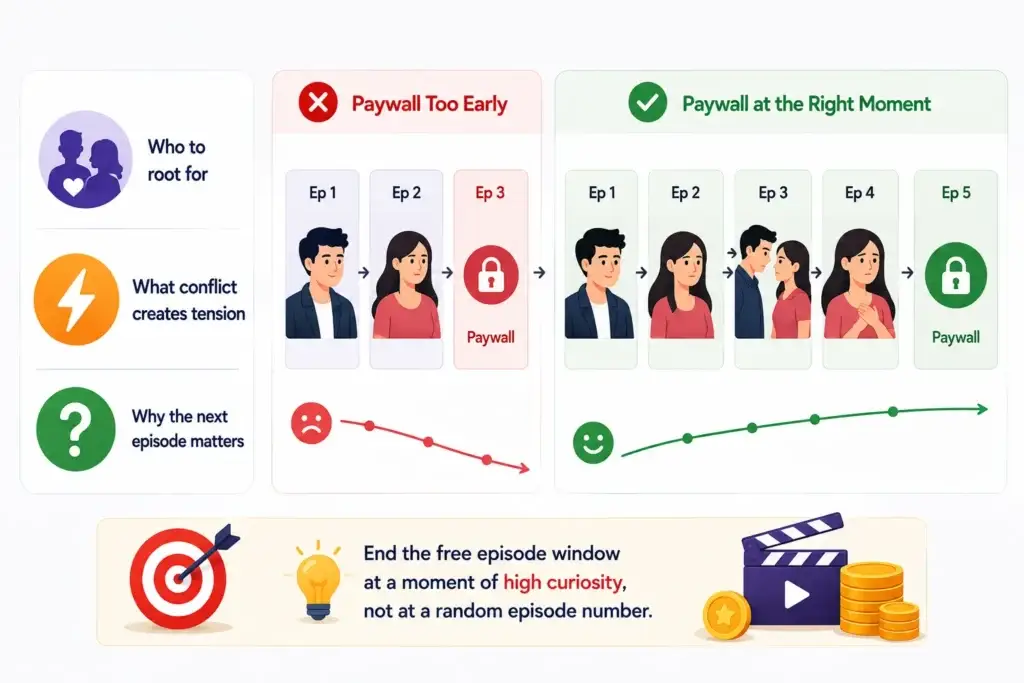
Image Source: AI-generated visual by Miracuves
A short-drama paywall works best when the viewer already understands three things:
- Who they are rooting for
- What conflict is creating tension
- Why the next episode matters
If the user has not reached that point, paid access feels premature. They may see the unlock prompt as friction instead of continuation.
For example, if a romance short drama locks after episode two but the emotional conflict has not fully appeared, the user has no strong reason to continue. But if the free section shows the betrayal, the misunderstanding, the comeback goal, and then cuts before the confrontation, the unlock prompt feels more natural.
In other words, the free episode window should end at a moment of high curiosity, not at a random episode number.
Read More: How Should a Short-Drama Platform Balance Coin Unlocks, VIP Access, and Rewarded Ads?
How Many Episodes Should Be Free in a Short-Drama Platform?
There is no universal number of free episodes that works for every short-drama platform. Many platforms test the first few episodes as a free sampling window before introducing paid access. Modern short-drama monetization often combines coin-based episode unlocks, in-app purchases, subscriptions, rewarded ads, and limited-time access offers instead of depending on one revenue model. The right free episode count should be decided by story pacing, viewer engagement, genre, completion rate, and how strongly the next episode creates curiosity.
For most platforms, the free episode count should depend on:
- Genre pacing
- Episode length
- Story complexity
- Audience price sensitivity
- Paid acquisition cost
- Content quality
- Monetization model
- Local market behavior
- First-session watch depth
- Completion rate before the first lock
A fast revenge drama may build tension in three episodes. A fantasy or family drama may need more setup. A regional drama with new actors may need extra free exposure to build trust. A platform acquiring users through paid ads may need a tighter free-to-paid path to recover acquisition costs.
The better approach is to start with a testable structure rather than a fixed assumption.
A Practical Free Episode Framework for Short-Drama Apps
A useful way to design the free section is to divide it into four stages: entry, hook, escalation, and unlock.
| Free Window Stage | What It Should Do | Founder Decision Logic |
|---|---|---|
| Episode 1 | Deliver instant context and emotional entry | The viewer should understand the genre and situation quickly |
| Episode 2 | Introduce conflict, betrayal, desire, or tension | The story should now have a reason to continue |
| Episode 3 | Escalate stakes and deepen curiosity | The user should begin forming emotional investment |
| Episode 4 or later | End near a high-intent cliffhanger | Paid access should feel like continuation, not interruption |
This does not mean every platform must offer four free episodes. It means the free window should complete a strategic job before paid access appears.
A founder should ask: “Has the user seen enough to want the next answer?”
If the answer is no, the paywall is too early.
Free Episode Strategy by Short-Drama Genre
Different genres create emotional investment at different speeds. A fixed paywall rule across every series can limit monetization because each story has its own pacing.
Free Episode Strategy by Genre
| Genre | Free Episode Goal | Paid Access Timing |
|---|---|---|
| Romance Drama | Introduce attraction, misunderstanding, betrayal, or emotional tension. | After the viewer understands the relationship conflict. |
| Revenge Drama | Show injustice, humiliation, or the trigger event. | Before the first major comeback or reveal. |
| CEO / Luxury Drama | Establish power imbalance, status conflict, and emotional hook. | After the first high-status twist or confrontation. |
| Fantasy / Supernatural | Explain the world, ability, curse, or mystery clearly. | After the viewer understands the fantasy rule and wants the reveal. |
| Thriller / Mystery | Create suspense and introduce the central question. | Just before the first clue, chase, or reveal payoff. |
| Family Drama | Build empathy and show the emotional stakes. | After the conflict becomes personal enough to continue. |
The key insight is simple: genre controls paywall readiness.
A thriller viewer may pay to reveal information. A romance viewer may pay to resolve tension. A revenge viewer may pay to witness justice. The platform should understand what emotional payoff the audience is chasing before deciding where to lock access.
The Best Paywall Point Is Usually a “Question Moment”
Short-drama monetization depends on unanswered questions.
A strong unlock point often appears after a question has been created but before the answer is delivered.
Examples:
- Will the character discover the betrayal?
- Will the hidden identity be revealed?
- Will the rejected lead return with power?
- Will the villain be exposed?
- Will the couple reunite or separate?
- Will the fantasy rule change the story?
- Will the family secret come out?
This is why the paywall should not be placed after a complete emotional resolution. Once the viewer feels satisfied, payment urgency drops.
The paid access prompt should appear when the viewer thinks, “I need to know what happens next.”
Free Episodes Should Also Teach the Monetization System
A short-drama platform should not surprise users with confusing payment logic.
Before paid access appears, users should understand the platform’s access options. This can be done through subtle onboarding, wallet visibility, reward prompts, or small interface cues.
Common access options include:
- Free starter episodes
- Coin-based episode unlocks
- Rewarded ad unlocks
- Daily check-in rewards
- Subscription access
- Full-series pass
- Limited-time promotional unlocks
- VIP episode windows
The monetization experience should feel simple. If users do not understand whether they need coins, a subscription, or an ad unlock, they may abandon the flow even if they like the story.
For founders, this means the free window is also a product education window. The viewer should enter the paywall moment knowing what to do next.
Coins, Subscriptions, and Rewarded Ads Should Not Compete With Each Other
Many short-drama platforms use hybrid monetization. The challenge is not adding multiple revenue options. The challenge is arranging them without confusing the viewer.
Each access method should serve a different user type.
| Access Method | Best For | Why It Works |
|---|---|---|
| Coin Unlock | High-intent users who want specific episodes | Flexible payment without forcing a subscription |
| Subscription | Binge viewers who want unlimited or broader access | Converts strong interest into recurring access |
| Rewarded Ads | Price-sensitive viewers who still want to continue | Generates revenue without requiring direct payment |
| Full-Series Unlock | Users who are committed to one story | Increases convenience and reduces repeated prompts |
| Daily Rewards | Habit-building users | Encourages return sessions and repeat engagement |
A platform should avoid presenting every option with equal weight every time. The first unlock prompt should usually highlight the simplest next action. Secondary options can appear below it or after the user hesitates.
The product goal is to keep the story moving.
Read More: Short Drama Apps vs Traditional OTT Platforms: Why Viewer Behavior Changes the Product Strategy
Founder Decision Signals: When Is Your Platform Ready to Charge?
Story Momentum
If users are completing the free episodes and immediately tapping the next episode, your first lock point may be placed correctly. If viewers drop before the lock, the free section may be too slow or unclear.
Payment Readiness
If users understand coins, subscriptions, or rewarded ads before the first lock, the paid access prompt feels easier to complete. Confusion at this stage reduces conversion.
Genre Fit
Some stories need more free setup than others. Romance, revenge, thriller, and fantasy content should not always use the same free episode count.
Admin Control
Founders should be able to adjust free episode windows, coin pricing, ad unlock rules, and VIP access without asking developers to change code every time.
Why Admin Control Matters More Than a Fixed Free Episode Rule
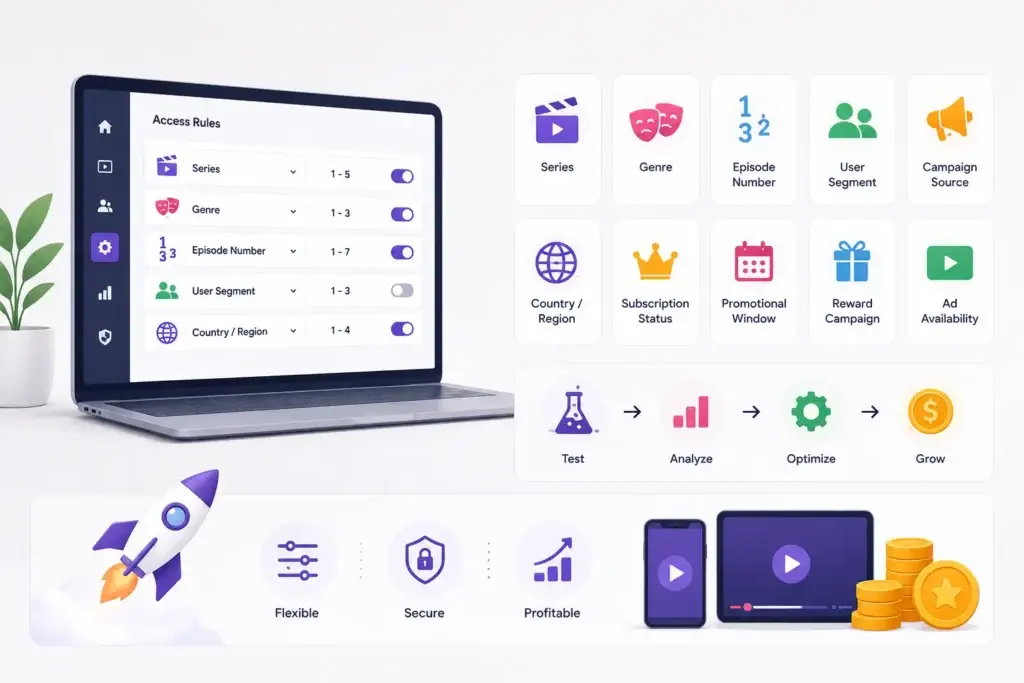
Image Source: AI-generated visual by Miracuves
Founders should avoid building a short-drama platform where the free episode count is hard-coded.
A strong admin dashboard should allow the platform operator to manage access rules by:
- Series
- Genre
- Episode number
- User segment
- Campaign source
- Country or region
- Subscription status
- Promotional window
- Reward campaign
- Ad availability
This matters because monetization is not a one-time decision. A founder may start with five free episodes, test three, then increase to seven for a slower genre. A platform may offer more free access during launch week, then tighten the free window after a campaign proves successful.
The money is in the testing layer.
For founders exploring a launch-ready short-drama platform, Miracuves offers a configurable product foundation where episode access, coin logic, VIP windows, and admin controls can support monetization experiments without starting from zero.
Common Free Episode Structures Founders Can Test
A short-drama platform can test different free episode structures depending on content type and revenue goals.
1. The Short Hook Model
This model gives users a small number of free episodes before asking them to unlock.
It works when:
- Episode one is strong.
- The story hook appears quickly.
- The audience already understands the genre.
- Paid acquisition campaigns send users to a specific series.
- The first cliffhanger appears early.
The risk is that the platform may lock too soon. If the viewer does not care yet, conversion drops.
2. The Story Setup Model
This model gives users enough free episodes to understand the characters, conflict, and emotional stakes.
It works when:
- The story has a slower emotional build.
- The audience is unfamiliar with the platform.
- Production quality needs time to prove itself.
- The platform wants better retention before monetization.
The risk is giving away too much before the first payment opportunity.
3. The Ad-Supported Warmup Model
This model allows users to continue through rewarded ads before introducing direct paid access.
It works when:
- The audience is price-sensitive.
- The platform is entering a new market.
- Users may prefer attention-based access before spending money.
- The platform wants to monetize non-paying users.
The risk is ad fatigue. If ads feel heavier than the content, users may leave.
4. The Hybrid Unlock Model
This model gives users multiple continuation choices: spend coins, watch an ad, subscribe, or use rewards.
It works when:
- The platform has different user segments.
- Some users are willing to pay directly.
- Some users prefer ads.
- Some users binge enough to subscribe.
The risk is interface complexity. Too many choices at the wrong time can slow conversion.
What Metrics Should Decide the Free Episode Window?
A founder should not rely only on opinion. The platform should track episode-level behavior and use data to adjust access rules.
Important metrics include:
- Episode 1 start rate
- Episode 1 completion rate
- Free episode completion rate
- Drop-off before first lock
- Tap rate on locked episode
- Coin purchase conversion
- Rewarded ad completion
- Subscription trial or purchase rate
- Full-series unlock rate
- Return rate after first unlock
- Revenue per series
- Revenue per acquired user
- Refund or complaint rate
- Watch depth by genre
- Push notification return rate
The most important signal is often the gap between free completion and first unlock action.
If many users finish the free section but do not unlock, the paywall message, pricing, or payment method may need adjustment. If users drop before finishing the free section, the issue may be story pacing, video quality, onboarding, or acquisition mismatch.
Mistakes Founders Should Avoid
Locking Episodes Before Viewers Care
A paywall placed too early can make the app feel aggressive. The viewer should understand the story promise before being asked to pay, subscribe, or watch an ad.
Using the Same Free Window for Every Series
Different genres create emotional investment at different speeds. A revenge drama, romance story, and fantasy series may need different free episode structures.
Making the Unlock Prompt Too Complicated
If the user sees coins, ads, subscription, rewards, and bundles without a clear recommendation, they may hesitate. The platform should guide the next action clearly.
Ignoring Non-Paying Users
Not every viewer will buy coins immediately. Rewarded ads, daily rewards, and limited unlocks can help monetize or retain users who are not ready to pay directly.
How to Introduce Paid Access Without Breaking Viewer Flow
The unlock moment should feel like part of the story experience, not a hard stop.
A strong paid access screen should include:
- The next episode title or preview
- Clear coin price or access requirement
- One primary action
- Optional alternatives such as rewarded ad or subscription
- Wallet balance visibility
- Bonus coin or first-purchase offer where relevant
- Fast unlock confirmation
- Immediate continuation into playback
The language should focus on continuation.
Instead of making the viewer feel blocked, the app should make the next action feel simple: unlock, continue, and keep watching.
For example:
“Episode 6 is ready. Unlock now to continue the story.”
This feels better than a generic “Payment required” message.
Short-drama monetization depends on emotional momentum. The product should not interrupt that momentum with unclear pricing or slow payment steps.
How Free Episodes Support Paid User Acquisition
Many short-drama apps use emotional story clips as acquisition creatives across social platforms. A viewer sees a dramatic moment, installs the app, and expects to continue that specific story.
That means the free episode window must align with the ad promise.
If the ad shows a major conflict but the first free episodes do not reach that tension quickly, users may feel misled. If the paywall appears immediately after install, users may feel trapped. If the free section continues the ad’s emotional promise and then stops at a high-curiosity moment, the paid access decision feels more natural.
Founders should map the journey like this:
- Ad creative creates curiosity
- App opens to the relevant series
- Free episodes continue the hook
- Paywall appears at a high-intent moment
- User chooses coins, ads, or subscription
- Platform tracks conversion and retention
The free episode strategy should not be separated from marketing. It should be designed with acquisition, content pacing, and monetization together.
Why Short-Drama Platforms Need Flexible Access Rules
A platform may need different access rules for different business situations.
For example:
- New users may receive more free episodes.
- Returning users may see tighter unlock prompts.
- Paid users may receive bonus access.
- Certain genres may use longer free windows.
- New series may launch with promotional free access.
- Older series may be monetized through ads.
- Premium series may use coins or VIP-only windows.
- Regional campaigns may use localized pricing or rewards.
This is why the platform backend matters. A simple video app may let users watch content, but a monetization-ready short-drama platform needs wallet logic, access control, catalog rules, rewards, analytics, and admin settings working together.
Miracuves helps founders build branded, source-code-owned short-drama platforms with configurable monetization workflows, so operators can test access models instead of being locked into one fixed structure.
Recommended Free Episode Testing Plan for New Platforms
For a new short-drama platform, the smartest path is structured testing.
Phase 1: Start With a Clear Baseline
Choose a default free episode window for each major genre. Do not overcomplicate the first launch. The goal is to create a measurable baseline.
Track:
- Free episode completion
- First lock tap rate
- Unlock conversion
- User complaints
- Revenue per series
- Watch depth
Phase 2: Test Paywall Placement by Series
Move the first lock point earlier or later based on performance.
If users drop before the paywall, improve content pacing or extend the free section. If users watch deep but do not pay, test pricing, reward options, ad unlocks, or clearer prompts.
Phase 3: Segment New and Returning Users
New users may need more trust. Returning users may accept paid access sooner because they already understand the platform.
This is especially useful when building habit loops through daily rewards, watch history, push notifications, and personalized recommendations.
Phase 4: Add Alternative Unlock Paths
Once coin purchases are working, test:
- Rewarded ad unlocks
- Weekly access plans
- Bonus coin packs
- Full-series unlocks
- Limited-time episode passes
- Loyalty rewards
The goal is to let different users continue in different ways without damaging the main experience.
Phase 5: Review by Genre and Campaign
A campaign bringing high-intent users from a specific story hook may tolerate an earlier paywall. Organic users browsing the app may need more free exploration.
Founders should review monetization by both content and acquisition source.
How to A/B Test Free Episode Limits and Measure Paid Conversion
Short-drama founders should compare different free-episode limits through controlled experiments instead of assuming that one paywall position works for every series.
A simple experiment can compare three different free-access windows.
Step 1: Create Three Testing Groups
Randomly divide eligible viewers into three groups:
- Group A: 3 free episodes before the first paywall.
- Group B: 5 free episodes before the first paywall.
- Group C: 7 free episodes before the first paywall.
These episode counts are illustrative test configurations, not proven industry benchmarks.
Keep episode pricing, payment methods, reward offers, and other conditions consistent across the groups. Run the test on the same series and comparable viewer segments.
Step 2: Track the Complete Free-to-Paid Journey
Measure the following actions separately:
- Viewer starts the first free episode.
- Viewer completes the available free episodes.
- Viewer reaches the first paywall.
- Viewer clicks the paid unlock option.
- Viewer completes the first paid purchase.
- Viewer starts watching the unlocked episode.
Also track rewarded-ad unlocks and VIP access separately so they are not incorrectly counted as new paid purchases.
Step 3: Calculate Free-to-Paid Conversion
Use this formula:
Free-to-Paid Conversion Rate = (Viewers Completing Their First Paid Purchase ÷ Viewers Who Started Episode 1) × 100
For example, consider the following hypothetical test results:
| Test group | Episode 1 viewers | First-time purchasers | Conversion rate |
|---|---|---|---|
| 3 free episodes | 1,000 | 90 | 9% |
| 5 free episodes | 1,000 | 120 | 12% |
| 7 free episodes | 1,000 | 100 | 10% |
In this example, the five-free-episode group has the highest first-purchase conversion rate.
However, founders should also consider revenue per viewer, paid episode completion, refund rates, and retention before choosing the final configuration.
Step 4: Identify Where Viewers Drop Off
Different results suggest different problems:
- Low free episode completion: The story hook, pacing, or viewing experience may need improvement.
- High completion but low paywall clicks: The unlock offer, pricing, or paywall timing may be unsuitable.
- High unlock clicks but low payment success: Checkout friction or payment failures may be responsible.
- High purchases but low continued viewing: Content quality, playback problems, or repeated paywalls may be reducing retention.
Founders should compare these stages across all testing groups to identify the actual cause of lost conversions.
Step 5: Select the Best Free Episode Window
Choose the configuration that delivers the strongest balance of:
- Free-to-paid conversion.
- Revenue per eligible viewer.
- Paid episode continuation.
- Viewer retention.
- Customer acquisition cost recovery.
Run the experiment for a sufficiently long period, use adequate sample sizes, and avoid changing other monetization settings during the test.
Once the results are reliable, operators can apply the better-performing free episode window to similar series and continue testing by genre, region, and acquisition channel.
The Ideal Free-to-Paid Journey for a Short-Drama Viewer
A well-structured journey may look like this:
- The viewer discovers a dramatic story hook.
- The app opens directly into the relevant series.
- The first episode confirms the genre and emotional promise.
- The next few episodes build tension.
- The viewer reaches a cliffhanger.
- The next episode is locked.
- The app shows a clear unlock option.
- The viewer can spend coins, watch an ad, subscribe, or use rewards.
- The episode unlocks instantly.
- The platform continues the binge flow.
This journey works because it respects both sides of the business.
The user gets enough free value to care.
The platform gets a monetization opportunity while interest is high.
Where Miracuves Fits Into This Strategy
A short-drama platform is not just a video player with a payment button. It needs a complete access system that can manage free windows, paid episodes, coin wallets, ad unlocks, VIP plans, rewards, analytics, catalog operations, and admin controls.
For founders who want to launch faster, a ready-made foundation can reduce avoidable development effort and help the team focus on content, audience, localization, and monetization testing.
Miracuves supports founders with a launch-ready short-drama app foundation designed for branded deployment, admin control, source-code ownership, and flexible monetization workflows. Instead of hard-coding one free episode rule, founders can build around a product structure that supports testing and iteration.
Final Thoughts: Free Episodes Should Build Desire Before Monetization
The best short drama free episode strategy is not about giving away the same number of episodes in every series. It is about understanding when the viewer becomes emotionally invested enough to continue.
Free episodes should introduce the story, build trust, create tension, and guide the user toward the next action. Paid access should appear when curiosity is high and the path to continue is simple.
For founders, the winning approach is flexibility. Test free windows by genre. Track where users drop. Offer coins, subscriptions, rewards, and ads intelligently. Most importantly, build the platform with enough admin control to adjust monetization without depending on developers for every experiment.
Short-drama platforms win when storytelling, product flow, and access logic work together.
FAQs
How many episodes should be free in a short-drama app?
There is no fixed number. The right free episode count depends on genre, story pacing, audience behavior, episode length, and monetization model. The free window should last long enough to create emotional investment before the first paid access prompt appears.
When should a short-drama platform introduce paid access?
Paid access should appear after the viewer understands the main conflict and wants to know what happens next. The best moment is usually a cliffhanger, reveal, confrontation, or unresolved emotional question.
Should short-drama apps use coins or subscriptions?
Both can work. Coins are useful for users who want to unlock individual episodes, while subscriptions are better for binge viewers who want broader access. Many platforms use both, along with rewarded ads and promotional rewards.
Are rewarded ads useful for short-drama monetization?
Yes, rewarded ads can help monetize users who are not ready to pay directly. They are especially useful in price-sensitive markets, but they should not interrupt the story too aggressively.
Should every series have the same free episode window?
No. Different genres need different setup time. A revenge drama may create urgency quickly, while fantasy or family drama may need more free episodes to establish the story.
What metrics should founders track before changing the free episode count?
Important metrics include episode completion, drop-off before the first lock, tap rate on locked episodes, coin purchase conversion, rewarded ad completion, subscription conversion, revenue per series, and retention after first unlock.
How can a short-drama platform avoid frustrating users with paywalls?
The platform should offer enough free content to build interest, make unlock options clear, keep payment steps fast, and provide alternatives such as rewarded ads, coins, subscriptions, or daily rewards.
Can Miracuves help build a short-drama platform with flexible episode access?
Yes. Miracuves helps founders build branded short-drama platforms with vertical playback, episode unlocking, coin wallets, rewarded ads, VIP access, admin controls, and source-code ownership.
Miracuves is an independent software development company. We are not affiliated with, connected to, sponsored by, or endorsed by any company or product named in this article.
Terms such as “X Clone” are used descriptively. It is how the software industry refers to building a platform with functionality comparable to a known service, and how clients search for it.
The entire design and codebase of our products is built by our own team. Our products contain no code, design, graphics, or content originating from any third-party website or applications.
All third-party names and marks referenced in this article are the property of their respective owners, referenced solely to identify the services discussed.