

Key Takeaways
- A ready-made sports betting platform can provide prebuilt user accounts, sportsbook management, odds integration, payments, reporting, risk controls, and admin workflows for a faster development path.
- Custom sportsbook development offers greater architectural freedom but requires more work across betting logic, data feeds, payments, security, compliance, integrations, and backend operations.
- Startup control depends on source-code ownership, customization flexibility, data access, hosting options, API integrations, payment control, and the ability to modify platform workflows over time.
Control & Development Signals
- Ready-made sportsbook software can reduce repeated development by providing event management, odds feeds, bet slips, wallets, transaction records, user management, and administrative modules.
- Custom development gives founders deeper control over platform architecture, user experience, betting markets, integrations, risk rules, reporting, localization, and operational workflows.
- Both approaches should be evaluated for security, regulatory requirements, responsible-gambling controls, scalability, data-feed reliability, payment integrations, and ongoing maintenance.
Startup Decision Insights
- Startups should compare target markets, licensing requirements, product differentiation, development resources, launch priorities, operational complexity, and long-term ownership before choosing an approach.
- A customizable ready-made foundation can suit teams prioritizing faster validation, while custom sportsbook development may fit businesses requiring highly specialized workflows or technology architecture.
- Miracuves develops customizable sports betting platforms with sportsbook management, odds integrations, wallets, payments, risk controls, reporting, analytics, responsible-gambling features, and admin management.
For a startup entering the betting market, the biggest decision is not only what features to build. The real decision is how much control the business needs on day one, how fast it needs to launch, and how much technical risk it can afford before the first user places a bet.
A ready-made sports betting platform gives founders a faster route to market because the core betting flows, wallet, odds integration, admin dashboard, and settlement logic are already available. For founders who want this foundation without building every module from zero, a ready-made betting and gaming platform can be the stronger starting point. Custom sportsbook development gives deeper flexibility, but it usually requires more planning, more engineering time, and a stronger internal team.
The smarter choice depends on your licence position, market strategy, technical team, funding stage, and long-term control requirements. This guide compares both paths from a founder’s point of view.
What Is a Ready-Made Sports Betting Platform?
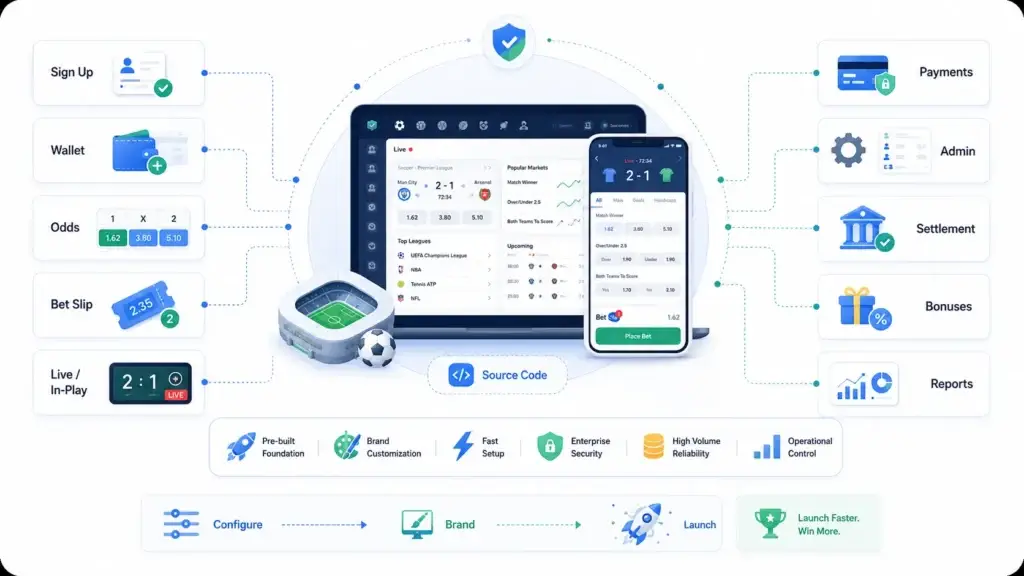
A ready-made sports betting platform is a pre-built sportsbook foundation that can be branded, configured, deployed, and customised for a startup’s target market. Instead of building the betting engine from zero, founders begin with existing modules such as user registration, wallet, odds display, bet slip, in-play markets, admin controls, payment integrations, and settlement workflows.
This matters because a sportsbook is not just a mobile app. It is a transaction-heavy system where every balance movement, bet placement, market suspension, payout, bonus rule, and user restriction must work correctly.
For startups, the main advantage is speed. A ready-made platform lets the business focus earlier on licensing, market positioning, player acquisition, payment readiness, and operational setup instead of spending months building core product plumbing.
Miracuves offers a ready-made Betting & Gaming platform approach where founders can launch a branded betting platform with source-code ownership, admin controls, wallet flows, live odds, in-play markets, and automated settlement logic.
What Is Custom Sportsbook Development?
Custom sportsbook development means building the betting platform around your exact product vision, business rules, integrations, market structure, and operational workflows. This route gives the most flexibility because every part of the product can be shaped from the ground up.
A custom sportsbook may make sense when the startup has a unique betting model, proprietary odds logic, unusual risk-management workflows, deep data partnerships, custom bonus rules, or multi-jurisdiction requirements that cannot be handled through configuration.
The tradeoff is time and execution risk. Custom development requires product discovery, architecture planning, backend development, mobile/web apps, admin dashboards, wallet design, odds-feed integrations, testing, security review, compliance workflow preparation, and post-launch iteration.
For funded operators with a strong technical team and a differentiated product thesis, custom development can be the right long-term move. For early-stage founders still validating demand, it can delay market learning.
Sports Betting Platform vs Custom Sportsbook Development: Quick Comparison
| Decision Factor | Ready-Made Sports Betting Platform | Custom Sportsbook Development |
|---|---|---|
| Launch speed | Faster because core modules already exist | Slower because architecture and modules are built from scratch |
| Initial cost logic | More cost-efficient for startup validation | Higher upfront investment due to custom engineering |
| Product control | Strong if source code and admin access are included | Highest control if built and owned properly |
| Branding | White-label branding is usually faster | Fully custom UI/UX possible |
| Betting engine | Pre-built odds, bet slip, wallet, and settlement workflows | Built around custom betting rules |
| Compliance workflows | Can support KYC, limits, audit logs, and responsible gaming workflows | Can be designed around exact jurisdiction rules |
| Scalability | Depends on platform quality and backend architecture | Can be engineered for highly specific scaling needs |
| Best for | Startups, agencies, regional operators, licensed founders seeking faster launch | Funded operators, complex products, proprietary sportsbook models |
After founders compare launch speed, ownership, and operational control, the next question is how the platform will actually make money. A strong sportsbook business model should account for margin settings, wallet activity, promotional offers, player retention, commission logic, and risk exposure before launch.
Which Option Gives Startups Better Launch Speed?
A ready-made sports betting platform usually gives startups better launch speed because the most time-consuming modules are already built. These include account flows, wallet, bet slip, odds display, admin controls, user management, market management, payment workflows, and settlement logic.
In custom sportsbook development, even a basic product requires multiple technical layers to work together. The team must build and test the player app, web platform, admin panel, wallet ledger, odds-feed connection, settlement flow, responsible gaming settings, user verification, reporting, and security controls.
For founders, this means betting and gaming platform development should support compliance workflows from the beginning. Important modules may include age and identity checks, KYC workflows, AML workflow support, transaction monitoring, deposit limits, self-exclusion, audit logs, role-based admin access, fraud signals, and reporting tools.
Before choosing the faster route, founders should also understand what modern sports betting platform planning actually includes, from real-time odds and bet slip validation to wallet ledger accuracy, settlement workflows, cash-out logic, and operator risk controls.
A ready-made platform is usually better when the goal is to enter the market faster, validate user demand, and improve the product based on real betting behaviour.
Which Option Gives Better Control?
Custom sportsbook development gives maximum theoretical control, but only if the startup has the budget, technical leadership, and operating maturity to use that control properly.
For most startups, the more practical question is different: “Can I control the parts of the product that affect my business?”
Those parts include:
- User onboarding and verification
- Wallet and transaction visibility
- Betting market configuration
- Risk and exposure settings
- Commission or margin structure
- Bonus and promotion rules
- Admin dashboard permissions
- Payment and payout workflows
- Responsible gaming controls
- Data access and reporting
- Source-code ownership
A ready-made platform can still give strong control if it is not a locked SaaS product. This is where source-code ownership becomes important. If the founder receives full source code, the platform can be extended, audited, customised, and improved by Miracuves or another technical team later.
A vendor-controlled white-label sportsbook may launch quickly but limit deeper control. A source-code-owned ready-made platform gives startups a stronger balance between speed and flexibility.
Founder Decision Signals
Choose Ready-Made
You need to launch fast, validate a market, control budget, and start with proven sportsbook modules instead of building every workflow from zero.
Choose Custom
You have a unique betting model, proprietary risk logic, deep funding, and enough time to build and test a platform from the ground up.
Prioritise Ownership
If speed matters but lock-in is risky, choose a source-code-owned platform rather than a closed vendor-managed system.
Check Compliance Fit
Your licence, target jurisdiction, payment rails, player protection rules, and reporting needs should shape the platform decision before launch.
Why Control Means More Than Branding
Many founders think control means changing the logo, colour palette, homepage layout, and app screens. In sportsbook development, that is only surface-level control.
Real control sits inside the operating layer.
That is why founders should evaluate betting platform features based on wallet visibility, market controls, exposure settings, admin roles, settlement workflows, reporting access, and responsible-gaming tools rather than only front-end design.
A sportsbook operator needs visibility into deposits, withdrawals, unsettled bets, suspended markets, exposure by event, user restrictions, bonus usage, payout status, and admin actions. Without this layer, the founder may own the brand but not the business engine.
This is why a serious betting platform should include a strong admin dashboard. The admin panel is where the operator manages users, markets, odds settings, reports, risk exposure, payment issues, disputes, promotions, and responsible gaming controls.
If the platform cannot give the founder operational control, a fast launch can become a long-term limitation.
Compliance and Responsible Gaming Should Be Planned Early
Sports betting platforms operate in regulated environments. The exact rules depend on the target market, licence type, payment setup, and operating model. A software platform alone does not make a betting business compliant.
The UK Gambling Commission publishes remote gambling and software technical standards for licensed operators, and its guidance includes requirements around remote gambling technology, testing, security, and social responsibility. The Malta Gaming Authority also highlights player protection and responsible gambling as important responsibilities shared by operators, players, and the regulator.
For founders, this means betting and gaming platform development should support compliance workflows from the beginning. Important modules may include age and identity checks, KYC workflows, AML workflow support, transaction monitoring, deposit limits, self-exclusion, audit logs, role-based admin access, fraud signals, and reporting tools.
Final compliance depends on jurisdiction, legal review, licensing, integrations, and how the operator runs the business. The right development partner should be clear about that boundary.
When a Ready-Made Sports Betting Platform Is the Better Choice
A ready-made sports betting platform is usually the better choice when the startup wants to move fast without spending months on the first product version.
This route is useful when the founder already understands the target market and wants to test positioning, player acquisition, retention, payment behaviour, and promotional strategy quickly.
For early-stage operators, controlling betting app development cost is not only about reducing software spend. It is about saving budget for licensing, liquidity planning, payment setup, compliance review, marketing, and user acquisition.
It also works well for regional operators that do not need to reinvent the sportsbook engine. If the business model is based on local sports coverage, language, payment rails, affiliate partnerships, or niche audience access, then building the entire platform from scratch may not be the smartest use of capital.
Ready-made makes sense when:
- You need faster market entry.
- You want to reduce development uncertainty.
- You need core sportsbook modules already available.
- You want white-label branding.
- You want source-code ownership.
- You want admin control from day one.
- You want to invest more budget into licensing, marketing, and operations.
Miracuves helps founders with this route by offering launch-ready betting platform foundations that can be branded, deployed, and customised based on business scope.
When Custom Sportsbook Development Is the Better Choice
Custom sportsbook development is the stronger path when the sportsbook itself is the main innovation.
For example, if your business depends on proprietary trading logic, advanced bet builders, highly specific in-play experiences, complex loyalty systems, multi-jurisdiction rule engines, or deeply customised data partnerships, custom development may be necessary.
It is also better when the operator already has funding, a technical team, a compliance roadmap, and a long-term product vision that cannot fit into a ready-made foundation.
Custom makes sense when:
- Your sportsbook model is structurally different.
- You need unique betting markets or trading workflows.
- You have a long launch runway.
- You can support deeper QA and security testing.
- You want a fully bespoke architecture.
- You have internal product and engineering leadership.
- You are building for complex regulated expansion.
The risk is that startups may spend too much time building before proving demand. Custom development gives control, but control only creates value when the market thesis is already strong.
The Middle Path: Launch Fast, Then Customise Deeper
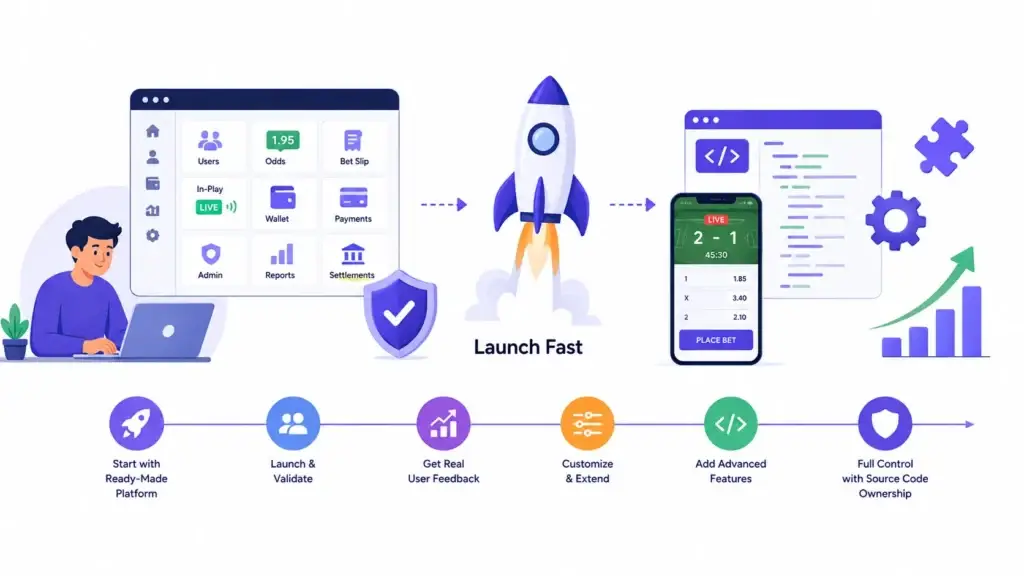
For many startups, the best approach is not purely ready-made or purely custom. The stronger path is to start with a ready-made platform that includes source-code ownership, then customise deeper after the business validates demand.
This gives founders two advantages.
First, they can launch faster and learn from real users. Second, they do not lose the ability to extend the product later.
This is different from a closed white-label sportsbook where the operator depends on the vendor’s roadmap. With source-code ownership, the founder has more flexibility to improve the platform, integrate new services, refine the UI, add local payment methods, adjust admin workflows, and build custom features over time.
For startups, this is often the best balance between control and launch speed.
Mistakes Founders Should Avoid
Choosing the Fastest Launch Without Checking Ownership
A fast launch is valuable only if the founder can control the platform after launch. Before choosing a sportsbook development partner, check whether you receive source code, admin access, deployment ownership, documentation, settlement transparency, and customisation flexibility.
Treating Sportsbook Development Like a Normal App
A sportsbook is not only a user interface. It includes wallet logic, market data, odds movement, risk controls, bet settlement, reporting, responsible gaming tools, and payment workflows. Ignoring these layers creates operational risk.
Delaying Compliance Workflow Planning
Compliance cannot be added as a cosmetic layer at the end. The platform should be planned with user verification, limits, self-exclusion, audit logs, reporting, and admin permissions from the beginning.
Overbuilding Before Market Validation
Some founders choose full custom development too early. If the startup has not yet validated its audience, acquisition channel, payment flow, or betting niche, a long custom build can burn time before the business has evidence.
Ignoring Admin Dashboard Depth
A weak admin dashboard creates daily operational problems. The operator should be able to manage users, payments, markets, disputes, promotions, reporting, and risk signals without depending on developers for every small change.
Miracuves Perspective: Speed Should Not Remove Control
The strongest startup path is not simply the fastest path. It is the path that gets the business live quickly while preserving enough control to improve, customise, and scale.
Miracuves’ source-code-owned betting platform approach is designed for founders who want faster deployment, white-label branding, admin control, and long-term customisation flexibility. That matters because betting startups need more than a front-end app. They need the product foundation that supports wallets, markets, settlement, payments, reporting, and operational decisions.
For founders comparing a ready-made sports betting platform vs custom sportsbook development, the practical answer is this:
- Choose ready-made when speed, validation, and cost-efficient launch matter most.
- Choose custom when the sportsbook model itself is unique and worth a longer build.
- Choose source-code-owned ready-made when you want the startup advantage of speed without giving up long-term flexibility.
Final Verdict: Which Gives Startups Better Control and Launch Speed?
For most startups, a source-code-owned ready-made sports betting platform gives the better balance of control and launch speed.
Custom sportsbook development gives the highest level of control, but it also requires more time, funding, technical planning, and operational maturity. That makes it better for complex, well-funded operators rather than early-stage founders trying to validate a betting market.
A ready-made platform gives startups a faster start. The key is to avoid closed systems that limit ownership. If the platform includes full source code, admin control, wallet workflows, risk tools, and customisation flexibility, founders can launch quickly and still keep a path toward deeper product differentiation.
The right decision is not ready-made versus custom in isolation. The right decision is choosing the development path that matches your startup’s stage, licence position, budget, technical confidence, and market timing.
Related reading: How Does a Sports Betting Platform Manage Odds, Markets, Bets, and Payouts in Real Time and Sports Betting Platform vs Traditional Sportsbook Software.
FAQs
What is the main difference between a sports betting platform and custom sportsbook development?
A ready-made sports betting platform gives founders a pre-built foundation with core modules such as user accounts, wallet, odds, bet slip, admin dashboard, and settlement workflows. Custom sportsbook development builds the platform from scratch around specific business rules, integrations, and product requirements.
Is a ready-made sports betting platform better for startups?
For many startups, yes. A ready-made platform is often better when the goal is faster launch, lower initial complexity, and quicker market validation. The founder should still check source-code ownership, admin control, compliance workflow support, and customisation flexibility.
Does custom sportsbook development give more control?
Custom sportsbook development gives the highest level of product control because the architecture, features, workflows, and integrations are designed specifically for the operator. However, it also requires more time, budget, testing, and technical management.
Can a ready-made sportsbook platform be customised?
Yes, if the platform is built for customisation and includes source-code ownership. A source-code-owned platform can be rebranded, extended, integrated with new services, and improved over time based on the startup’s needs.
What features should a sports betting platform include?
A strong sports betting platform should include user registration, KYC workflows, wallet, deposits, withdrawals, pre-match betting, in-play betting, bet slip, odds integration, automated settlement, admin dashboard, risk controls, reporting, payment integrations, responsible gaming tools, and audit logs.
Is compliance included in sportsbook software?
No software platform can guarantee compliance by itself. Compliance depends on the target jurisdiction, licence, legal review, operating model, payment providers, and regulatory requirements. A good platform can support compliance workflows such as KYC, AML workflow support, self-exclusion, limits, audit logs, and reporting.
Which option is faster: ready-made sports betting platform or custom sportsbook development?
A ready-made sports betting platform is usually faster because the core product foundation already exists. Custom sportsbook development takes longer because the system must be planned, designed, built, integrated, tested, and reviewed from the ground up.
Why is source-code ownership important for betting startups?
Source-code ownership gives startups more long-term flexibility. It reduces vendor lock-in, allows deeper customisation, supports future integrations, and lets the founder continue development with Miracuves or another technical team.
Miracuves is an independent software development company. We are not affiliated with, connected to, sponsored by, or endorsed by any company or product named in this article.
Terms such as “X Clone” are used descriptively. It is how the software industry refers to building a platform with functionality comparable to a known service, and how clients search for it.
The entire design and codebase of our products is built by our own team. Our products contain no code, design, graphics, or content originating from any third-party website or applications.
All third-party names and marks referenced in this article are the property of their respective owners, referenced solely to identify the services discussed.