Key Takeaways
- B2B Travel Booking Platform Revenue can come from agent markups, supplier commissions, corporate plans, service fees, API access, ancillary services, and sponsored supplier visibility.
- Agent distribution can generate repeated booking volume because one travel partner may serve dozens or hundreds of end customers.
- Corporate travel accounts can create recurring revenue through subscriptions, managed travel services, reporting, approval workflows, and account support.
- Prepaid wallets, credit limits, commissions, refunds, and settlements require accurate ledger and reconciliation systems to protect revenue.
- A sustainable revenue model should clearly track supplier cost, selling price, agent earnings, platform margin, discounts, refunds, commissions, and final retained revenue.
Revenue Signals
- Markup rules can support fixed, percentage-based, category-specific, agent-specific, supplier-specific, seasonal, corporate, and sub-agent pricing.
- Supplier commissions can vary by travel category, supplier agreement, booking volume, season, market, cancellation policy, and inventory type.
- Corporate revenue can include monthly or annual plans, per-booking charges, managed travel services, premium reporting, dedicated support, and custom integrations.
- API and reseller access can generate revenue through access fees, transaction charges, booking fees, minimum-volume commitments, or premium support.
- Ancillary products such as insurance, transfers, visa support, foreign exchange, activities, upgrades, and other relevant services can increase revenue per booking.
Real Insights
- High booking volume does not automatically mean strong retained revenue because incorrect commissions, refunds, discounts, supplier price changes, and unpaid invoices can create margin leakage.
- Prepaid agent balances can simplify repeated bookings, but every recharge, deduction, refund, adjustment, commission, and reversal should remain traceable.
- Different agents may require different commercial terms based on their agreements, booking volume, customer segments, and credit arrangements.
- Adding multiple revenue streams too early can complicate operations, so monetization should follow actual partner behavior and clearly understood booking economics.
- The strongest revenue path is: establish supplier access → onboard agents and corporate clients → define markups and commissions → manage wallets or credit → process bookings → add services and API channels → control margin leakage → reconcile every transaction → optimize retained revenue.
A B2B travel booking platform earns differently from a consumer travel app.
Instead of relying only on individual travelers making occasional bookings, a B2B platform serves travel agents, corporate travel desks, sub-agents, resellers, tour operators, and business clients who may generate multiple bookings every month.
That changes the economics.
One agent can book for dozens or hundreds of travelers. One corporate account can manage travel for an entire workforce. One supplier relationship can feed inventory to agents, corporate users, and direct customers at the same time.
For founders, this creates several possible revenue streams: markups, supplier commissions, corporate subscriptions, service fees, prepaid balances, ancillary products, API access, and partner services.
The challenge is not finding ways to charge. The challenge is building a revenue model where agents, suppliers, corporate clients, and the platform operator all understand who earns what.
What Is a B2B Travel Booking Platform?
A B2B travel booking platform is a system that allows travel businesses and corporate users to search inventory, create bookings, manage travelers, apply markups, track commissions, manage wallets or credit limits, and access settlement records.
Typical platform users include:
- Travel agents
- Sub-agents
- Corporate travel desks
- Tour operators
- Resellers
- Franchise partners
- Supplier partners
- Finance teams
- Travel administrators
Unlike a purely consumer-facing booking app, the platform is designed around repeat business relationships.
The operator may provide agents with access to flight, hotel, bus, car, tour, or package inventory. The agent then sells that inventory to its own customers while earning an agreed markup or commission.
For readers who want to understand the booking flow before exploring revenue strategy, this guide explains how a B2B travel booking platform works across search, supplier inventory, booking, payments, agent workflows, and admin control.
This makes distribution one of the most important parts of the business model.
Revenue Stream 1: Markups on Agent Bookings
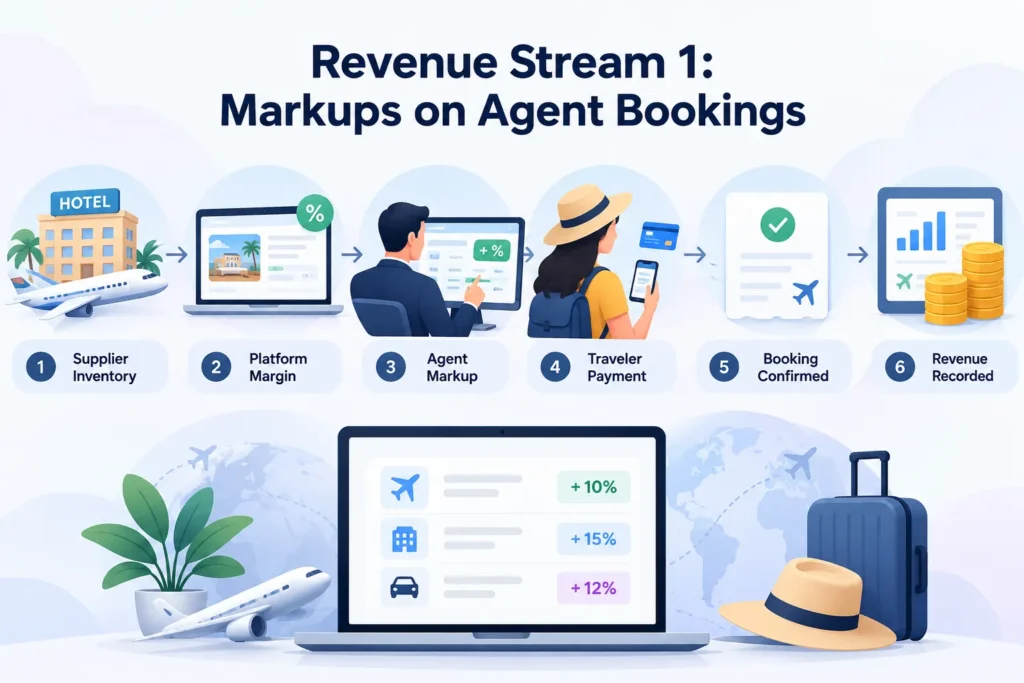
Markups are one of the clearest revenue streams in a B2B travel platform.
The platform receives or sets a base rate. The agent or operator then adds a markup before selling the booking to the traveler.
For example, a booking workflow may look like:
- Supplier provides base inventory.
- Platform applies operator margin.
- Agent applies approved markup.
- Traveler pays the final amount.
- Booking is confirmed.
- Platform records supplier cost, operator margin, and agent earning.
The platform may support:
- Fixed markups
- Percentage markups
- Category-specific markups
- Agent-specific markups
- Corporate pricing
- Seasonal adjustments
- Supplier-specific margin
- Sub-agent markup limits
Markup controls should sit inside the admin and agent portals.
For a deeper view of commissions, agent markups, supplier revenue, corporate plans, prepaid balances, and ancillary income, review the travel platform business model.
If every pricing change requires a developer, the business becomes difficult to operate.
Revenue Stream 2: Supplier Commissions
Travel suppliers may pay commission for bookings generated through the platform.
Suppliers can include:
- Hotels
- Airlines
- Bus operators
- Cab providers
- Tour operators
- Activity providers
- Insurance partners
- Package suppliers
- Local travel vendors
The commission may depend on:
- Booking category
- Supplier agreement
- Booking volume
- Season
- Market
- Cancellation policy
- Inventory type
Hotels and activities may use different commission structures from flights or transport.
That is why founders should avoid using one revenue rule across every travel category.
A good travel platform should allow category-level and supplier-level commission configuration.
Revenue Stream 3: Corporate Travel Plans
Corporate travel can create more predictable revenue because one business account may generate repeated bookings.
A corporate travel module may include:
- Employee traveler profiles
- Approval workflows
- Travel policies
- Department budgets
- Preferred suppliers
- Centralized booking records
- Invoice generation
- Spending reports
- Corporate payment methods
- Admin roles
- Travel history
- Reporting
Revenue may come from:
- Monthly account fees
- Annual plans
- Per-booking charges
- Managed travel service fees
- Premium reporting
- Dedicated account support
- Policy management
- Custom integrations
Corporate clients are different from leisure travelers.
They care less about flashy offers and more about control, documentation, reporting, traveler safety, approval workflows, and account management.
Revenue Stream 4: Agent Wallets and Prepaid Balances
A prepaid agent wallet can improve B2B booking operations.
Instead of making a separate payment for every booking, an agent deposits money into a platform balance and uses that balance to confirm bookings.
A wallet system may include:
- Recharge balance
- Available balance
- Credit balance
- Booking deductions
- Refund credits
- Commission credits
- Settlement adjustments
- Transaction history
- Admin adjustments
- Agent statements
From the business side, prepaid balances can improve booking speed and reduce payment friction.
The platform operator must still maintain accurate ledger records.
Every recharge, deduction, refund, adjustment, commission, and reversal should be traceable.
Revenue Stream 5: Service and Convenience Fees
B2B travel platforms can also charge service fees around booking operations.
Examples include:
- Booking fee
- Cancellation processing fee
- Rescheduling fee
- Priority support fee
- Ticket issuance fee
- Corporate service fee
- Special handling charge
- Manual booking assistance
- Group booking support
These fees should be transparent.
Agents and corporate clients should know what is included in their margin and what is charged separately.
Confusing fee structures create reconciliation problems and damage partner relationships.
Revenue Stream 6: API and Reseller Access
A mature B2B platform can generate revenue by letting other businesses access travel inventory through APIs or white-label portals.
Potential customers include:
- Small travel agencies
- Regional booking websites
- Corporate travel systems
- Tour operators
- Resellers
- Niche travel marketplaces
API-based monetization can include:
- Monthly access fee
- Per-booking fee
- Transaction fee
- Minimum volume commitment
- Premium support plan
- Supplier-access fee
This model allows the platform to become infrastructure for other travel businesses instead of relying only on its own website or app.
Revenue Stream 7: Ancillary Travel Services
The main booking does not have to be the final transaction.
Travelers and agents may also need:
- Travel insurance
- Airport transfer
- Visa support
- Foreign exchange
- Local transport
- Activities
- Tours
- Meal plans
- Seat upgrades
- Hotel upgrades
- Priority support
Ancillary services can increase average revenue per booking without requiring the platform to own the core travel asset.
The important rule is relevance.
Add-ons should match the trip instead of appearing as random upsells.
Revenue Stream 8: Supplier Promotions and Featured Visibility
Suppliers may pay for greater visibility inside a travel marketplace.
This could include:
- Featured hotel placement
- Sponsored packages
- Preferred supplier badge
- Destination promotion
- Homepage campaigns
- Seasonal offers
- Agent-only promotions
This revenue model becomes stronger once the platform has meaningful traffic or partner usage.
Founders should clearly separate sponsored visibility from organic recommendation logic so agents and travelers understand what they are seeing.
B2B Travel Revenue Model at a Glance
How B2B Travel Booking Platforms Make Money
| Revenue Stream | Who Pays | How It Works |
|---|---|---|
| Agent Markup | Traveler / agent customer | A controlled markup is added above the base booking rate. |
| Supplier Commission | Hotel, airline, transport, or travel supplier | The platform earns an agreed commission for generating a confirmed booking. |
| Corporate Plans | Businesses | Companies pay for managed travel, approval workflows, reporting, invoicing, or support. |
| Service Fees | Agent, business, or traveler | The platform charges for booking, cancellation, rescheduling, support, or handling. |
| API Access | Resellers and travel businesses | Partners pay for inventory access or booking infrastructure. |
| Ancillary Services | Traveler or agent customer | The platform earns from insurance, transfers, activities, upgrades, and other add-ons. |
| Featured Placement | Suppliers | Suppliers pay for promotional visibility, campaigns, or preferred placement. |
Why Agent Distribution Can Be More Efficient Than Direct Acquisition
Consumer travel platforms often have to acquire travelers one booking at a time.
A B2B travel platform can acquire one agent and gain access to that agent’s full customer base.
That changes the growth model.
An agent may make bookings every day for multiple travelers. A corporate account may book continuously throughout the year. A reseller may generate bookings from an entire local market.
This can reduce dependence on:
- Paid consumer advertising
- Coupon-heavy acquisition
- App-install campaigns
- Constant discounting
- Consumer remarketing
It does not eliminate marketing. It changes where marketing effort goes.
The B2B operator needs strong partner acquisition, onboarding, training, account management, and settlement reliability.
Why Corporate Travel Can Strengthen Revenue Stability

Corporate travel can add recurring usage to a platform.
A corporate client may book:
- Employee flights
- Hotels
- Airport transfers
- Group travel
- Conferences
- Long-stay accommodation
- Project travel
The value is not only booking volume.
Corporate users also need:
- Approval rules
- Expense visibility
- Invoices
- Cost centers
- Traveler profiles
- Account permissions
- Reports
- Negotiated rates
- Support
These workflows can create recurring service revenue beyond simple booking commission.
Margin Leakage: The Revenue Problem Founders Often Miss
Revenue streams are only useful if the platform controls leakage.
Margin can disappear through:
- Incorrect agent commission
- Manual wallet adjustments
- Duplicate discounts
- Untracked refunds
- Supplier price changes
- Unreconciled transactions
- Incorrect corporate pricing
- Excessive promotional offers
- Uncollected invoices
A strong revenue model therefore needs finance controls.
The operator should be able to compare:
- Supplier cost
- Selling price
- Agent markup
- Platform margin
- Coupon discount
- Refund value
- Commission paid
- Final retained revenue
Revenue tells you what the platform generated.
Reconciliation tells you what the platform actually kept.
Founder Decision Signals
Agent Network
If you already have travel agents, resellers, or local travel partners, prioritize agent portals, markups, wallets, commissions, and settlements.
Corporate Demand
If businesses need managed travel, focus on approvals, policies, invoicing, account roles, reports, and recurring corporate plans.
Supplier Economics
If hotel, flight, transport, or tour suppliers are central to the model, build category-level commission and margin controls instead of one pricing rule.
Finance Operations
If prepaid balances, commissions, credit limits, refunds, and settlements are involved, prioritize ledger accuracy, reconciliation, and admin visibility.
What Features Support a B2B Travel Revenue Model?
The platform should connect monetization rules with actual operational features.
Useful modules include:
- Agent registration
- Sub-agent management
- Agent wallet
- Credit limit
- Markup configuration
- Commission tracking
- Corporate accounts
- Approval workflows
- Supplier integrations
- Booking engine
- Payment gateway
- Refund handling
- Settlement statements
- Invoice generation
- Booking reports
- Finance reports
- Role-based access
- API access
- Admin controls
Founders planning agent credit, commissions, supplier workflows, KYC processes, settlement records, booking controls, and admin operations can review the B2B travel platform features needed to support these revenue streams.
The current Miracuves travel solution includes user, agent, supplier, employee, and admin-facing surfaces alongside flight, hotel, car, and tour booking workflows.
For a broader feature-level breakdown, this guide on travel booking app features explains the user, agent, supplier, booking, payment, and admin modules founders should consider.
Mistakes Founders Should Avoid
Using One Margin Rule for Every Agent
Different agents may have different volumes, agreements, credit terms, and customer segments. Markup and commission controls should be configurable.
Ignoring Agent Settlement
A booking platform may show strong sales while finance teams struggle with unpaid commissions, wallet adjustments, refunds, and settlement mismatches.
Building Corporate Travel Like Consumer Booking
Corporate users need policies, approval flows, invoices, reports, traveler records, and account roles that normal consumer booking flows do not require.
Adding Too Many Revenue Streams Too Early
Start with the revenue paths that match real user behavior. Additional fees, API plans, promotions, and ancillaries should come after core booking economics are clear.
Founders can also review these mistakes travel platform founders should avoid before finalizing agent workflows, supplier integrations, commissions, settlements, and finance operations.
How Miracuves Helps Founders Launch B2B Travel Platforms
Miracuves helps founders, travel agencies, resellers, and corporate travel operators launch ready-made and white-label travel booking systems with agent workflows, supplier integrations, booking modules, payment support, reporting, and admin control.
For founders evaluating a launch-ready travel product, Miracuves’ B2B travel booking platform foundation can help review flight, hotel, tour, supplier, agent, payment, and administrative workflows.
For founders evaluating a launch-ready travel product, Miracuves’ B2B travel booking platform foundation can help review agent portals, supplier connections, bookings, markups, commissions, corporate travel workflows, payments, and admin control.
Businesses exploring broader travel and hospitality models can also review Miracuves’ travel booking solutions for related launch paths. If you are comparing budget and rollout scope, review the B2B travel platform development cost.
For vendor evaluation, this guide on choosing a travel platform development partner can help you understand what to check before selecting a team.
Founders who want a deeper look at partner controls can review the B2B travel platform features around agent credit, commissions, supplier operations, and settlement workflows.
For a deeper monetization breakdown, the travel platform business model page explains margin on trade bookings, supplier commissions, corporate plans, prepaid agent balances, direct consumer sales, and ancillary revenue.
Where the ready-made scope fits the rollout requirement, Miracuves can support rapid deployment, helping founders avoid rebuilding every booking, agent, supplier, wallet, commission, settlement, and admin workflow from zero.
Final Thoughts: B2B Travel Revenue Comes From Distribution and Control
A B2B travel platform is not simply a consumer booking app with an agent login added.
Its economics depend on repeat partner activity.
Agents generate bookings. Suppliers provide inventory. Corporate accounts create recurring demand. Wallets simplify transactions. Markups and commissions create margin. Reports and settlement tools keep finance operations under control.
Founders comparing broader travel infrastructure can also explore Miracuves’ travel booking platform software for booking, supplier, payment, and trip-management workflows.
The strongest model is usually the one that keeps those relationships clear.
Founders should know:
- Who owns the inventory?
- Who controls the markup?
- Who earns commission?
- Who funds the booking?
- When is the supplier paid?
- How is the agent settled?
- What happens after a refund?
- Which revenue stream belongs to the platform?
When those rules are built into the software, monetization becomes easier to manage as the network grows.
FAQs
How does a B2B travel booking platform make money?
A B2B travel booking platform can earn through agent markups, supplier commissions, corporate travel plans, service fees, API access, ancillary travel products, and promotional supplier placements.
What is an agent markup in a travel platform?
An agent markup is an amount added above the base travel inventory price. It may be fixed or percentage-based and can vary by agent, supplier, category, or agreement.
How do corporate travel platforms generate revenue?
Corporate travel platforms can earn through account subscriptions, managed booking fees, reporting tools, approval workflows, dedicated support, and per-booking charges.
Why are prepaid agent wallets useful?
Prepaid wallets allow agents to fund their account in advance and use the balance for repeated bookings. They simplify booking payments and help centralize transaction records.
What is supplier commission in travel booking?
Supplier commission is revenue paid by a hotel, airline, transport provider, tour operator, or other travel supplier when the platform generates a confirmed booking.
Can a B2B travel platform support sub-agents?
Yes. A platform can support agents and sub-agents with separate accounts, markup controls, wallet balances, commission logic, booking records, and settlement reports.
Why is reconciliation important in a B2B travel business?
Reconciliation helps the operator match supplier costs, traveler payments, agent markups, commissions, refunds, wallet adjustments, and final retained revenue.
Can Miracuves help launch a B2B travel booking platform?
Yes. Miracuves offers travel booking workflows covering agents, suppliers, user booking, admin operations, payments, and related travel modules. The final launch scope and delivery depend on the selected features, integrations, and customization requirements.
Miracuves is an independent software development company. We are not affiliated with, connected to, sponsored by, or endorsed by any company or product named in this article.
Terms such as “X Clone” are used descriptively. It is how the software industry refers to building a platform with functionality comparable to a known service, and how clients search for it.
The entire design and codebase of our products is built by our own team. Our products contain no code, design, graphics, or content originating from any third-party website or applications.
All third-party names and marks referenced in this article are the property of their respective owners, referenced solely to identify the services discussed.