




















Key Takeaways
- B2B Travel Booking Platform Growth Strategy should focus on acquiring productive agents and corporate accounts, strengthening supplier coverage, and increasing booking volume from existing partners.
- Agent growth should be measured through activation, first bookings, repeat bookings, booking value, credit usage, and retention rather than registrations alone.
- Corporate acquisition should emphasize approvals, travel policies, employee management, reporting, invoices, and account control alongside travel pricing.
- Supplier coverage directly affects growth because relevant inventory, availability, pricing, and confirmation rates influence partner confidence and booking conversion.
- A sustainable growth model connects partner acquisition, activation, supplier depth, account expansion, repeat bookings, and retention instead of treating each activity separately.
Growth Signals
- Agent acquisition can be segmented by business type, such as flight-focused agencies, hotel sellers, package operators, corporate agencies, destination specialists, and regional travel businesses.
- Commission and credit can support partner activation, but commercial terms should reflect booking behavior, account history, payment reliability, and business value.
- Existing partners can generate more volume through additional travel categories, saved traveler details, quick rebooking, wallet visibility, credit access, and relevant supplier inventory.
- Dormant partners should be reactivated based on the reason for inactivity, such as weak pricing, insufficient inventory, limited credit, slow support, or seasonal demand.
- Growth dashboards should connect partner leads and approvals with activation, booking volume, margins, credit utilization, supplier confirmation, cancellations, refunds, and retention.
Real Insights
- A large number of registered agents does not necessarily indicate strong B2B growth; active partners and repeat booking behavior provide more useful signals.
- Acquiring demand before building sufficient supplier coverage can increase acquisition costs while leaving agents and corporate clients unable to find suitable inventory.
- Account expansion can increase booking volume by adding relevant destinations, employees, departments, travel categories, or supplier options to already-active partners.
- A practical 90-day approach is to build the partner pipeline first, optimize activation next, and then focus on category expansion, dormant-agent reactivation, supplier coverage, and repeat bookings.
- The strongest growth path is: identify target partners → acquire qualified agents and corporate accounts → activate first bookings → strengthen supplier coverage → increase booking frequency → expand accounts → reactivate dormant partners → improve retention and repeat transactions.
Growing a B2B travel booking platform is different from growing a consumer travel app.
A consumer platform may measure success through downloads, website traffic, app installs, and individual bookings. A B2B platform grows through relationships.
One productive travel agent can bring dozens or hundreds of traveler bookings. One corporate account can generate recurring hotel, flight, transport, and business-trip demand throughout the year. One strong supplier connection can improve availability across an entire partner network.
That changes the growth strategy.
The goal is not simply to acquire more users. It is to acquire the right agents, corporate travel accounts, distributors, and suppliers—and then increase the booking volume generated by each relationship.
For founders, this means growth should be measured through partner activation, booking frequency, wallet or credit usage, corporate account adoption, supplier coverage, repeat transactions, and retention.
Why B2B Travel Growth Works Differently
A B2B travel platform usually sits between inventory and distribution.
On one side are airlines, hotels, transport providers, activity suppliers, package operators, and other travel inventory sources.
On the other side are:
- Independent travel agents
- Travel agencies
- Corporate travel desks
- Resellers
- Regional distributors
- Tour operators
- Business travel managers
The platform creates value by helping those partners access inventory, manage travelers, book faster, control margins, track commissions, and organize financial records.
That means growth comes from three connected engines:
- Acquire productive partners.
- Give those partners enough inventory and operational support to transact.
- Increase booking frequency and value over time.
If any one of these fails, growth slows.
For readers who want to understand the underlying workflows first, this guide explains how a B2B travel booking platform works across agent access, bookings, payments, supplier inventory, and back-office control.
Thousands of inactive agent registrations do not create a strong B2B travel business. A smaller network of active partners can be far more valuable.
Growth Engine 1: Acquire the Right Travel Agents
Agent acquisition should begin with segmentation.
Not every travel agent has the same customer base, booking frequency, destination demand, or product mix.
Useful agent segments may include:
- Flight-focused agencies
- Hotel-focused agencies
- Holiday package sellers
- Corporate travel agencies
- Pilgrimage travel specialists
- Student travel agents
- Visa and international travel agencies
- Bus and domestic transport agents
- Group-tour operators
- Destination specialists
This segmentation improves acquisition because the message can match the agent’s real business.
A flight-heavy agent may care about fare availability and fast confirmation. A package seller may care about hotel inventory, transport, and custom quotes. A corporate-focused agency may care about invoices, approvals, and reports.
Generic “join our travel platform” messaging is weaker than role-specific value.
Build an Agent Acquisition Funnel

Agent acquisition should work like a sales funnel rather than a consumer signup flow.
A practical funnel can look like:
- Agent discovers the platform.
- Agent lands on a dedicated partner page.
- Agent sees relevant inventory and commercial benefits.
- Agent submits business details.
- Operations reviews the application.
- Agent receives login access.
- Agent funds a balance or receives approved credit.
- Agent completes the first booking.
- Account manager monitors early activity.
- Agent becomes a repeat booker.
Each stage should have a measurable conversion rate.
For example, founders should know:
- How many agencies visit the partner page?
- How many apply?
- How many are approved?
- How many fund their account?
- How many complete their first booking?
- How many make a second booking?
- How many remain active after 30, 60, or 90 days?
Founders planning agent onboarding, credit controls, commissions, supplier inventory, bookings, and back-office workflows can review the B2B travel platform features needed to support partner-led growth.
This shows where growth is actually breaking.
For a deeper feature-level breakdown, this guide on travel agent platform features explains the user, agent, supplier, corporate, and admin modules that support day-to-day operations.
Do Not Measure Agent Growth by Registrations Alone
A registration is not revenue.
The better metrics are:
- Approved agents
- Funded agents
- First-booking rate
- Active booking agents
- Monthly bookings per agent
- Gross booking value per agent
- Average commission per active agent
- Repeat-booking frequency
- Agent retention
- Dormant-agent reactivation
- Agent support load
- Credit utilization
A platform with 5,000 registered agents and 100 active bookers may be weaker than a platform with 800 agents and 500 active bookers.
Growth teams should optimize activation, not vanity numbers.
Use Commission and Credit Strategically
Agents need a commercial reason to shift bookings onto a platform.
Two important growth levers are commission and credit.
Commission can reward booking activity. Credit can reduce friction when agents need to confirm reservations before receiving money from their own customers.
But both should be controlled.
Commission structures may consider:
- Travel category
- Booking value
- Agent tier
- Booking frequency
- Sales targets
- Promotion periods
- Supplier margin
- Refund behavior
Credit policies may consider:
- Account history
- Deposit behavior
- Booking volume
- Payment reliability
- Outstanding balance
- Internal risk rules
To connect agent commissions, credit limits, supplier margins, corporate plans, settlements, and booking revenue, review the B2B travel platform business model.
Offering generous terms to every new agent may increase signups but create financial risk. Strong growth comes from giving better terms to proven partners.
Growth Engine 2: Acquire Corporate Travel Accounts
Corporate travel accounts behave differently from travel agents.
A corporate customer does not necessarily want to resell travel. It wants to organize employee travel.
The platform must solve business problems such as:
- Who is allowed to book?
- Which employees can travel?
- What hotels or fare classes are permitted?
- Who approves the booking?
- Which department pays?
- Where is the invoice?
- How much did the company spend this month?
- Which employee submitted an expense?
- Can finance export booking records?
This changes the acquisition message.
Do not sell corporate accounts only on discounted travel.
Sell control, reporting, approvals, policy enforcement, and convenience.
Build a Corporate Account Sales Funnel
Corporate travel acquisition usually requires more direct sales than consumer acquisition.
A useful process can be:
- Identify target companies.
- Segment by employee count and travel frequency.
- Contact HR, finance, procurement, administration, or travel managers.
- Demonstrate policy and approval workflows.
- Map existing booking problems.
- Configure account roles.
- Add employees or traveler profiles.
- Activate the first department.
- Review booking activity.
- Expand usage across teams.
The goal is account expansion.
One department may begin with hotel bookings. Later, the same company may add flights, cabs, travel policies, expenses, and additional employee groups.
Corporate Data Should Improve Account Growth
B2B travel platforms can collect valuable operational data, but the purpose should be useful account management—not simply collecting more information.
Useful corporate metrics include:
- Active employees
- Trips per month
- Booking value
- Most-booked routes
- Hotel spend
- Approval turnaround time
- Cancellation frequency
- Policy violations
- Department-level travel spend
- Booking lead time
- Preferred travel categories
- Account growth over time
This helps the account team identify expansion opportunities.
For example, if a company already books hotels frequently but not airport transfers, the account manager can introduce transport options. If approval delays are high, workflow configuration may need improvement.
Corporate data becomes valuable when it improves service and account retention.
Growth Engine 3: Increase Booking Volume per Partner
Acquiring partners is expensive.
Once an agent or corporate account is active, the next growth opportunity is increasing booking volume.
There are several ways to do this.
Expand Travel Categories
An agent who only books flights may also need:
- Hotels
- Cabs
- Holiday packages
- Bus tickets
- Activities
- Travel insurance
- Visa support
- Forex-related services
The platform should identify category gaps and introduce relevant services rather than showing every product at once.
Improve Repeat Booking Speed
Repeat partners value speed.
Useful features include:
- Saved customer profiles
- Saved traveler details
- Frequent routes
- Booking history
- Quick rebooking
- Wallet balance
- Credit visibility
- Saved corporate travelers
- Previous invoices
- Commission history
The easier it is to repeat a familiar booking, the more likely partners are to stay active.
Reactivate Dormant Partners
Not every inactive agent is lost.
Partners may stop booking because:
- Prices became less competitive.
- Inventory was weak.
- Credit was insufficient.
- Support was slow.
- Another supplier offered better terms.
- Their market became seasonal.
- They did not understand available categories.
A reactivation campaign should be based on the reason for inactivity.
Do not send the same discount message to every dormant partner.
Growth Engine 4: Strengthen Supplier Connections
Booking volume depends on what partners can sell.
Agent acquisition without strong inventory creates frustration. Corporate acquisition without reliable hotels, flights, or negotiated options creates churn.
Supplier strategy should therefore support growth.
Relevant supplier categories may include:
- Airlines
- Hotels
- Homestays
- Bus operators
- Cab providers
- Activity suppliers
- Tour operators
- Package suppliers
- Insurance partners
- Visa partners
- Transfer providers
Better supplier coverage can improve:
- Availability
- Pricing
- destination coverage
- confirmation rates
- travel-category breadth
- agent confidence
- corporate adoption
If supplier connectivity, inventory aggregation, booking workflows, and multi-category travel operations are central to your growth plan, Miracuves’ travel booking platform software can support the broader transaction and booking layer.
The aim is not simply “more suppliers.” It is the right suppliers for partner demand.
Use Partner Demand to Guide Supplier Expansion
Supplier onboarding should follow booking data.
If agents repeatedly search for hotels in a region but cannot find suitable availability, that is a supplier acquisition signal.
If corporate accounts repeatedly request a particular business destination, that destination deserves deeper hotel and transport inventory.
Useful supplier-demand signals include:
- Search volume without booking
- No-result searches
- High cancellation routes
- Poor confirmation rates
- Repeated support requests
- Frequently requested destinations
- Popular travel dates
- Agent feedback
- Corporate route demand
This connects supplier growth to actual demand rather than assumptions.
The Role of CRM in B2B Travel Growth
A B2B travel platform needs more than booking records.
It needs relationship history.
A partner CRM should help teams understand:
- Who owns the account
- Last communication
- Recent bookings
- Booking volume
- Credit position
- Support history
- Commission terms
- Corporate plan
- Supplier status
- Open issues
- Renewal opportunities
- Dormancy risk
This gives sales, operations, finance, and support teams the same account context.
Without CRM visibility, B2B growth often becomes fragmented across spreadsheets, calls, messaging apps, and personal notes.
Agent Acquisition vs Corporate Account Growth
Agent Acquisition vs Corporate Account Growth
| Growth Area | Travel Agents | Corporate Accounts |
|---|---|---|
| Primary value | Inventory, commission, booking speed, credit, and client management. | Policy control, approvals, employee travel, invoices, and reporting. |
| Acquisition channel | Agent outreach, associations, trade groups, regional sales, referrals, and partner campaigns. | Direct sales, business networks, outbound outreach, procurement contacts, and demos. |
| Activation event | First funded or credit-backed booking. | First approved employee booking. |
| Retention driver | Inventory quality, commissions, credit, fast support, and settlement clarity. | Policy control, reporting, account management, negotiated travel, and easy approvals. |
| Growth metric | Bookings and gross booking value per active agent. | Active travelers, trips, booking value, and account expansion. |
Founder Decision Signals
Partner Quality
If registrations are growing but bookings are not, stop optimizing signup volume and focus on agencies and companies with real recurring travel demand.
Booking Activation
If approved partners are inactive, inspect onboarding, balance funding, credit access, inventory quality, pricing, and first-booking support.
Account Expansion
If existing partners book consistently, grow revenue by adding relevant travel categories, employees, departments, destinations, or supplier inventory.
Supplier Depth
If searches are high but conversion is weak, investigate availability, confirmation rates, pricing, and destination coverage before spending more on acquisition.
Metrics a B2B Travel Growth Team Should Track
A B2B travel growth dashboard should connect acquisition with transaction behavior.
Track:
- Partner leads
- Agent applications
- Approval rate
- Agent activation rate
- First-booking conversion
- Corporate leads
- Corporate account activation
- Active agents
- Active corporate accounts
- Bookings per active partner
- Gross booking value
- Average booking value
- Commission cost
- Margin per booking
- Credit utilization
- Wallet balance activity
- Repeat-booking rate
- Dormant partners
- Reactivated partners
- Supplier confirmation rate
- Cancellation rate
- Refund rate
- Support tickets per active partner
A useful growth dashboard does not only say how many partners joined. It explains whether those partners are creating sustainable booking volume.
Mistakes Founders Should Avoid
Chasing Agent Signups Instead of Active Bookers
Large registration numbers look good in reports but do not create revenue unless partners complete bookings repeatedly.
Selling Corporate Accounts Only on Discounts
Businesses also care about approvals, policy controls, reporting, employee management, invoices, and account support.
Growing Demand Before Supplier Coverage
Agent and corporate acquisition becomes expensive when inventory, availability, destination coverage, or confirmation reliability is weak.
Giving Every Agent the Same Commercial Terms
Commission and credit should reflect booking behavior, account quality, payment history, category performance, and commercial value.
Founders can also review these B2B travel platform mistakes before scaling agent credit, supplier coverage, corporate workflows, and booking operations.
A Practical 90-Day Growth Framework
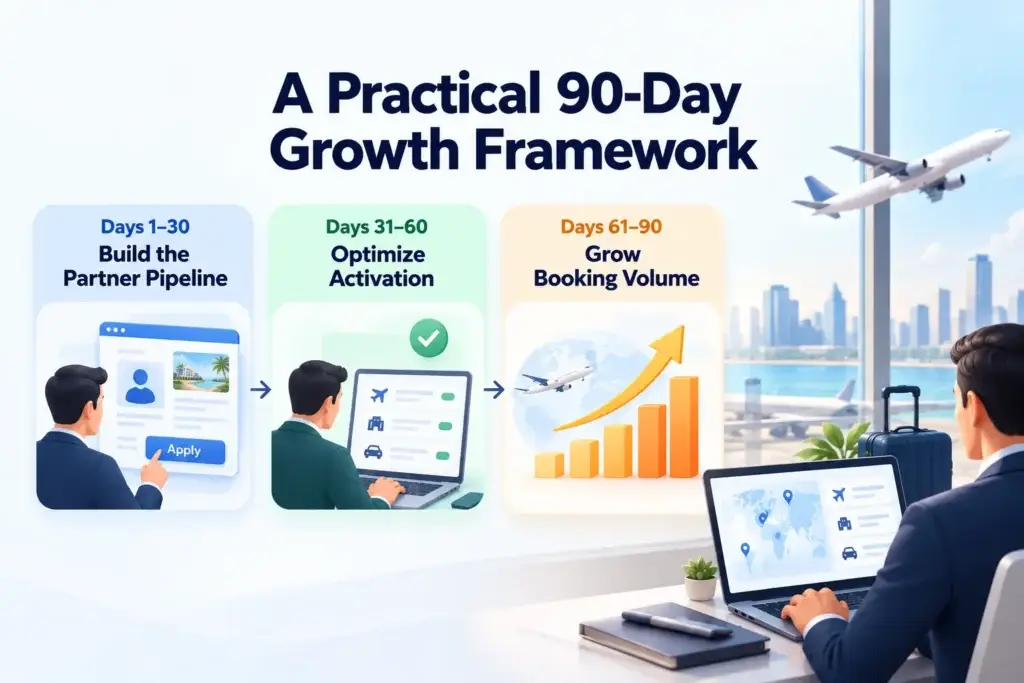
Days 1–30: Build the Partner Pipeline
Focus on:
- Defining target agent segments
- Creating agent acquisition pages
- Building corporate prospect lists
- Creating partner onboarding workflows
- Mapping supplier gaps
- Preparing account-manager scripts
- Setting activation metrics
The goal is not scale yet. It is finding the partner profile most likely to transact.
Days 31–60: Optimize Activation
Focus on:
- First-booking conversion
- Agent wallet or credit activation
- Corporate employee onboarding
- First supplier bookings
- Account-manager follow-up
- Training material
- Support response
- Lost-booking analysis
The goal is converting approved accounts into real booking activity.
Days 61–90: Grow Booking Volume
Focus on:
- Category expansion
- Dormant-agent reactivation
- Corporate account expansion
- Commission campaigns
- Supplier coverage
- High-demand destinations
- Partner retention
- Repeat-booking automation
The goal is turning early activity into predictable volume.
How Miracuves Supports B2B Travel Platform Growth
Growth strategy works better when the underlying platform can support the relationships being acquired.
A B2B travel business needs more than traveler search and checkout. It may require agent accounts, corporate users, partner balances, credit controls, commission records, supplier workflows, booking visibility, settlements, and role-based operations.
For founders evaluating that infrastructure, Miracuves’ B2B travel booking platform can support agent, corporate, supplier, booking, finance, and back-office workflows under one branded system.
Businesses exploring broader travel and hospitality models can also review Miracuves’ travel booking solutions for related platform opportunities.
If you are comparing budget and rollout scope, review Miracuves’ guide on B2B travel platform development cost.
For vendor evaluation, this page on choosing a B2B travel development partner can help you understand what to evaluate before selecting a team.
The platform foundation can support growth teams by keeping partner information, booking records, commissions, credit activity, supplier operations, and settlement workflows connected rather than scattered across spreadsheets and disconnected tools.
When the ready-made scope fits the rollout requirement, Miracuves can support 6-day solution delivery so founders can begin partner acquisition and market validation without building every core B2B travel workflow from zero.
Related reading: B2B travel booking platform architecture.
Final Thoughts: Grow Productive Relationships, Not Just Accounts
A B2B travel booking platform grows through productive relationships.
Agents need inventory, commissions, credit clarity, and reliable support. Corporate clients need approvals, traveler management, reporting, and account control. Suppliers need distribution and predictable booking operations.
The founder’s job is to connect these groups in a way that creates repeat bookings.
That means measuring more than registrations.
Track which agents actually book. Track which corporate accounts expand. Track which suppliers improve conversion. Track which destinations generate demand. Track which dormant accounts can be recovered.
When acquisition, activation, supplier coverage, and booking volume work together, a B2B travel platform can grow through partner networks rather than depending only on individual traveler acquisition.
FAQs
What is the best growth strategy for a B2B travel booking platform?
Start by acquiring travel agents and corporate accounts with recurring booking demand. Then improve activation, supplier coverage, repeat booking speed, account management, and partner retention.
How can a B2B travel platform acquire travel agents?
Use regional sales, agency networks, travel associations, referrals, targeted partner pages, direct outreach, demonstrations, and agent-specific commercial offers. Measure successful first bookings rather than registrations alone.
How can a travel platform attract corporate clients?
Target finance, HR, procurement, administration, and travel managers. Position the platform around policy controls, approvals, employee travel, reporting, invoices, account support, and travel visibility rather than discounts alone.
What metrics should a B2B travel platform track?
Important metrics include active agents, corporate account activation, first-booking conversion, bookings per active partner, gross booking value, repeat-booking rate, credit utilization, supplier confirmation rate, cancellations, refunds, and partner retention.
Why are supplier connections important for growth?
Partners can only book what the platform can reliably offer. Better supplier coverage can improve destination availability, pricing, confirmation rates, category breadth, and partner confidence.
How can a B2B travel platform increase booking volume?
Increase booking volume by improving repeat-booking speed, expanding relevant categories, strengthening supplier coverage, optimizing commission terms, reactivating dormant partners, and expanding active corporate accounts.
Should every travel agent receive the same commission and credit?
Not necessarily. Terms can be based on booking activity, account quality, payment history, category mix, risk controls, and commercial strategy.
Can Miracuves help launch a B2B travel booking platform?
Yes. Miracuves helps founders launch ready-made travel booking platforms with agent, corporate, supplier, booking, finance, and admin workflows. A 6-day launch may apply when the ready-made scope matches the project requirements.
Miracuves is an independent software development company. We are not affiliated with, connected to, sponsored by, or endorsed by any company or product named in this article.
Terms such as “X Clone” are used descriptively. It is how the software industry refers to building a platform with functionality comparable to a known service, and how clients search for it.
The entire design and codebase of our products is built by our own team. Our products contain no code, design, graphics, or content originating from any third-party website or applications.
All third-party names and marks referenced in this article are the property of their respective owners, referenced solely to identify the services discussed.