




















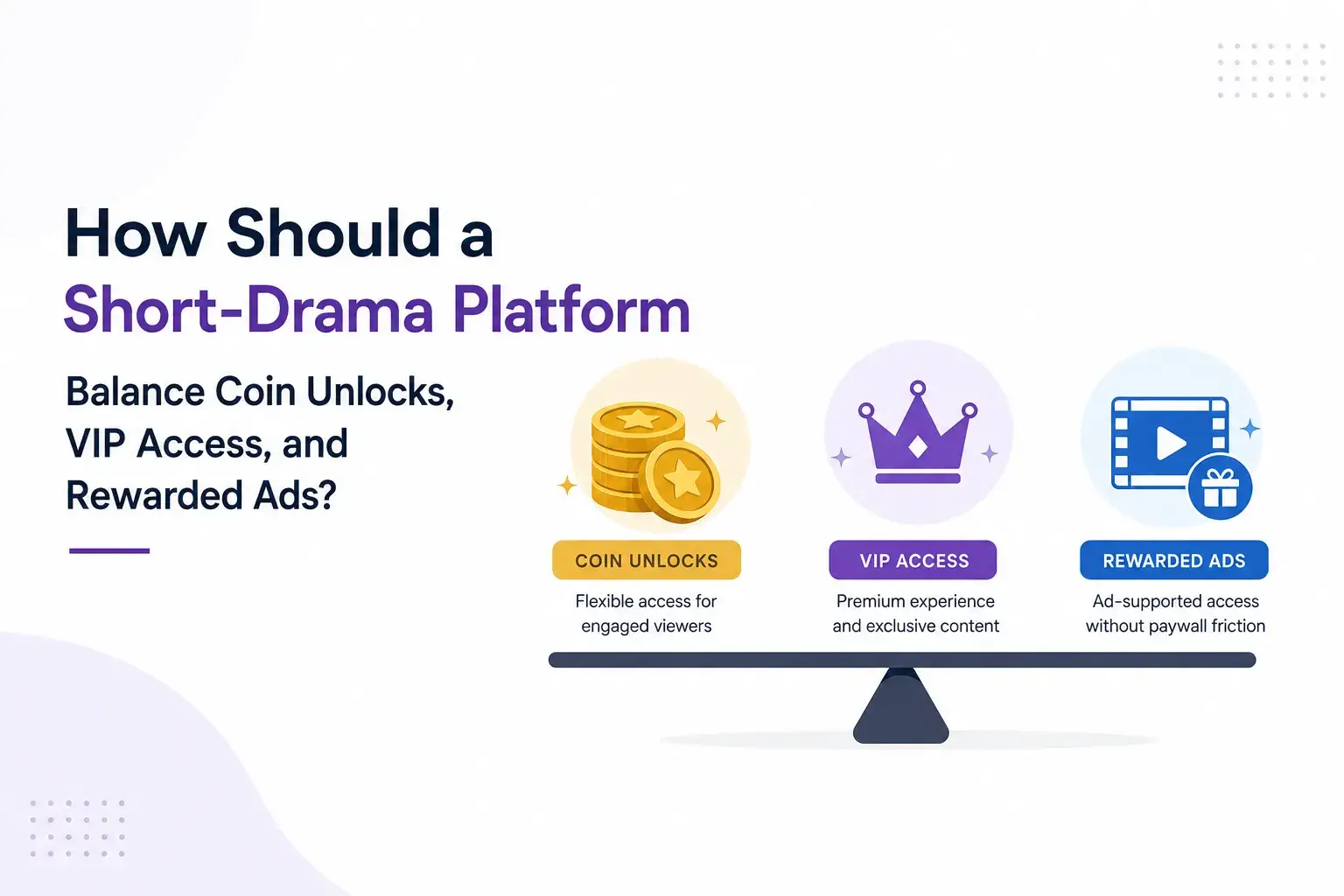
Key Takeaways
- Coin unlocks monetize emotionally engaged viewers who want to continue after a strong episode cliffhanger.
- VIP access works best for frequent viewers who value convenience, exclusive content, and fewer interruptions.
- Rewarded ads give price-sensitive users another way to continue watching without immediately leaving the platform.
- A balanced short-drama monetization strategy should combine revenue generation with sampling, retention, and viewing momentum.
- Monetization rules should remain configurable by series, episode, audience segment, region, and campaign period.
Monetization Strategy Signals
- Use free opening episodes to establish the story, characters, emotional stakes, and viewing habit.
- Introduce coin unlocks after viewers demonstrate meaningful interest rather than locking content too early.
- Present VIP offers to repeat viewers who regularly unlock episodes or consume several series.
- Offer rewarded ads selectively when they can prevent abandonment without replacing paid consumption completely.
- Track free-to-paid conversion, episode completion, coin spending, VIP upgrades, ad usage, retention, and revenue per viewer.
Real Insights
- A paywall cannot compensate for a weak story hook or low viewer interest.
- Excessively generous ad rewards can reduce coin purchases and weaken the perceived value of VIP access.
- VIP plans need clear benefits such as ad-free viewing, bonus coins, early access, or exclusive episodes.
- Using identical monetization rules across every series ignores differences in genre, popularity, audience, and viewing behavior.
- Miracuves develops configurable short-drama platforms with coin wallets, episode paywalls, VIP plans, rewarded ads, analytics, and admin-level monetization controls.
Short-drama platforms are not monetized like traditional OTT apps.
A Netflix-style subscription model asks users to pay for access to a large content library. A short-drama platform usually works differently. It captures attention through fast vertical episodes, emotional cliffhangers, and serialized storytelling. The monetization layer then decides whether users unlock the next episode with coins, upgrade to VIP access, or watch rewarded ads to continue.
That balance matters.
If coin unlocks are too aggressive, users may abandon the series. If VIP access is too generous, the platform may lose per-episode revenue. If rewarded ads are overused, the app may train users to avoid spending altogether.
For founders building a short-drama app, the real question is not “Which monetization model is best?” The better question is: How should coins, VIP access, and rewarded ads work together without damaging retention, revenue, or user trust?
This guide breaks down the strategy behind a healthy short-drama monetization system and explains how founders can design a model that supports both growth and profitability.
Why Short-Drama Monetization Needs a Different Strategy
Short-drama viewers behave differently from long-form streaming audiences.
They often enter through a strong hook: a betrayal scene, revenge arc, romance twist, hidden identity reveal, or cliffhanger. Episodes are short, emotional, and designed for quick continuation. That means monetization happens inside a fast decision loop.
A viewer may ask:
“Do I spend coins now?”
“Do I watch an ad to continue?”
“Is VIP worth it?”
“Should I come back tomorrow for free rewards?”
“Is this story good enough to pay for?”
This creates both opportunity and risk.
The opportunity is that users can convert quickly when the story is compelling. The risk is that poor paywall timing can interrupt emotional momentum and push users away.
A short-drama monetization model should therefore protect three things:
| Monetization Goal | Why It Matters |
|---|---|
| Revenue per engaged viewer | The platform must earn when users are highly invested in a series. |
| Retention | Users should not feel blocked too early or too often. |
| Trust | Pricing, rewards, and access rules should feel clear and fair. |
The strongest platforms do not simply lock content. They design a progression from free discovery to paid access, with rewarded ads and VIP options acting as supporting paths.
Read More:How Can a Microdrama Streaming Platform Expand Into Multiple Language Markets?
The Role of Coin Unlocks in a Short-Drama Platform
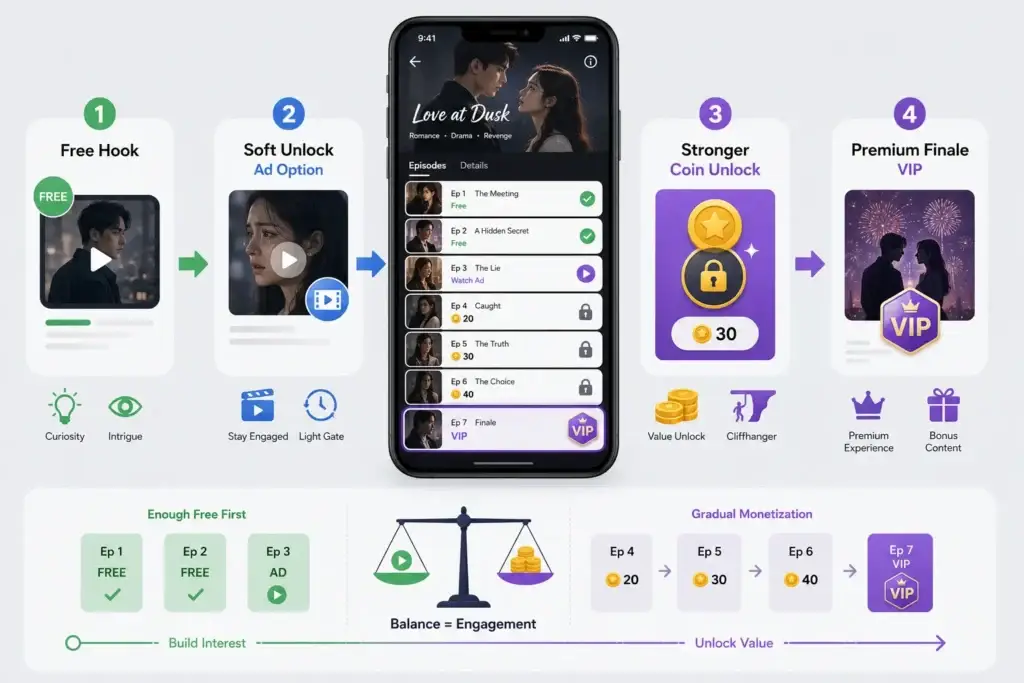
Image Source: AI-generated visual by Miracuves
Coin unlocks are usually the core monetization engine for short-drama apps.
Instead of charging users for the entire platform upfront, the app allows viewers to unlock individual episodes or scenes using virtual coins. This works well because short-drama viewing is driven by immediate curiosity. If the viewer wants to know what happens next, a small coin spend feels easier than a full subscription commitment.
Why Coin Unlocks Work
Coin unlocks are powerful because they match the psychology of serialized storytelling.
The user does not think in terms of “buying a subscription.” They think in terms of “unlocking the next emotional payoff.”
That makes coins useful for:
- Per-episode monetization
- Premium episode access
- High-demand series
- Early access releases
- Special episodes or bonus endings
- Limited-time content promotions
However, coin unlocks must be handled carefully. If users feel every important moment is locked too aggressively, they may stop trusting the app.
Where Coin Paywalls Should Appear
The most common mistake is placing the paywall too early.
A new viewer needs enough free content to understand the story, connect with the characters, and feel curiosity about what happens next. If the first locked episode appears before emotional investment is created, the platform is asking for payment before proving value.
A better approach is to use a free hook phase.
For example:
| Episode Stage | Recommended Monetization Role |
|---|---|
| First 1–3 episodes | Free access to build emotional investment |
| Early cliffhanger episodes | Soft coin unlock or rewarded ad option |
| Mid-series tension point | Coin unlock becomes stronger |
| Finale or bonus scenes | Premium unlock, VIP access, or higher coin value |
The exact threshold depends on the genre, episode length, content quality, and target market. Romance, revenge, fantasy, crime, and billionaire-drama formats may all monetize differently because the emotional pacing is different.
Read More:Short Drama Apps vs Traditional OTT Platforms: Why Viewer Behavior Changes the Product Strategy
The Role of VIP Access in Short-Drama Monetization
VIP access should not simply mean “everything is free.”
If VIP removes every monetization trigger, it can weaken coin revenue. But if VIP offers too little value, users will not subscribe. The goal is to position VIP as a convenience and loyalty layer, not a replacement for the entire coin economy.
A good VIP model can include:
- Ad-free viewing
- Daily bonus coins
- Early access to new episodes
- Discounted episode unlocks
- Exclusive series access
- Faster unlock limits
- Premium support or viewing benefits
- Offline downloads for unlocked content
VIP works best when it appeals to frequent viewers. These are users who return often, follow multiple series, and dislike repeated friction. They may not want to buy coin packs every few episodes. VIP gives them a smoother experience while still preserving the platform’s broader monetization structure.
VIP Should Segment Users by Viewing Behavior
Not every user should be pushed toward VIP immediately.
A casual viewer may prefer rewarded ads. A high-intent viewer may buy coins. A heavy viewer may subscribe to VIP after realizing they consume content frequently.
This creates a simple monetization ladder:
| Viewer Type | Best Monetization Path |
|---|---|
| New viewer | Free episodes and light rewarded ads |
| Curious viewer | Small coin unlocks |
| Returning viewer | Coin packs and limited offers |
| Heavy viewer | VIP subscription |
| Superfan | VIP plus premium unlocks or exclusive content |
The founder’s job is to let users move naturally through this ladder without forcing one model too soon.
The Role of Rewarded Ads in Short-Drama Apps
Rewarded ads can be extremely useful for short-drama platforms because they reduce abandonment.
A user who does not want to pay may still be willing to watch an ad to unlock an episode, earn coins, or continue a series. This keeps them inside the app instead of losing them completely.
Rewarded ads are especially helpful for:
- New users who are not ready to spend
- Price-sensitive users
- Regions where paid conversion is lower
- Daily engagement loops
- Coin earning systems
- Re-engagement campaigns
- Free-to-watch content strategies
But rewarded ads come with a strategic risk.
If users can unlock too much through ads, they may never buy coins or VIP access. The platform can become dependent on ad revenue even when some users would have paid. That is why rewarded ads should be designed as a support mechanism, not the primary value exchange for every viewer.
Where Rewarded Ads Fit Best
Rewarded ads work best when they are used to save the user from churn.
For example, if a viewer reaches a locked episode but has zero coins, the app can offer:
- Watch one ad to earn a few coins
- Watch an ad to unlock this episode
- Come back tomorrow for daily rewards
- Buy a small coin pack for instant access
- Upgrade to VIP for smoother viewing
This gives the user options instead of a hard stop.
The key is to control frequency. Rewarded ads should feel like a helpful alternative, not an unlimited free path
Coin Unlocks vs VIP Access vs Rewarded Ads: How They Should Work Together
The smartest monetization strategy is not choosing one model. It is assigning each model a clear role.
| Monetization Model | Primary Role | Best Used For | Risk If Misused |
|---|---|---|---|
| Coin unlocks | Direct episode revenue | High-intent story moments | Can feel expensive or frustrating |
| VIP access | Loyalty and convenience | Frequent viewers | Can weaken coin revenue if too generous |
| Rewarded ads | Retention and free progression | Non-paying or early-stage users | Can reduce paid conversion if unlimited |
A balanced short-drama platform usually follows this logic:
- Let users watch enough free content to become emotionally invested.
- Introduce coin unlocks at strong continuation points.
- Offer rewarded ads as a backup path for users who hesitate to pay.
- Use VIP access for frequent viewers who want convenience.
- Adjust rules based on retention, unlock rate, ad completion, and purchase behavior.
This is why the admin panel matters so much. Founders should not need developers every time they want to adjust coin pricing, ad rewards, or VIP benefits.
A launch-ready short-drama platform from Miracuves can help founders start with these monetization workflows already structured instead of building the payment logic from zero.
Founder Decision Signals: When to Prioritize Each Model
Founders should not treat all monetization models equally from day one. The right priority depends on the platform’s content supply, audience type, and launch market.
Prioritize Coin Unlocks When Content Has Strong Cliffhangers
Coin unlocks work best when each episode naturally creates urgency.
If your content has strong hooks, emotional twists, unresolved conflicts, and clear next-episode curiosity, users are more likely to pay per unlock. This model is especially useful when the platform owns or licenses high-quality serialized content.
Prioritize VIP When You Expect Heavy Repeat Viewing
VIP works best when users are likely to watch many episodes across multiple series.
If your catalogue is large, updated frequently, or built around binge-style viewing, VIP can increase predictable recurring revenue. But the subscription must provide real value beyond removing ads.
Prioritize Rewarded Ads When You Need Retention Before Monetization
Rewarded ads are useful when the platform is still building audience behavior.
If users are new to short-drama apps or reluctant to spend, ads can keep them engaged long enough to build habit. Over time, some of these users may convert into coin buyers or VIP subscribers.
A Practical Monetization Framework for Short-Drama Platforms
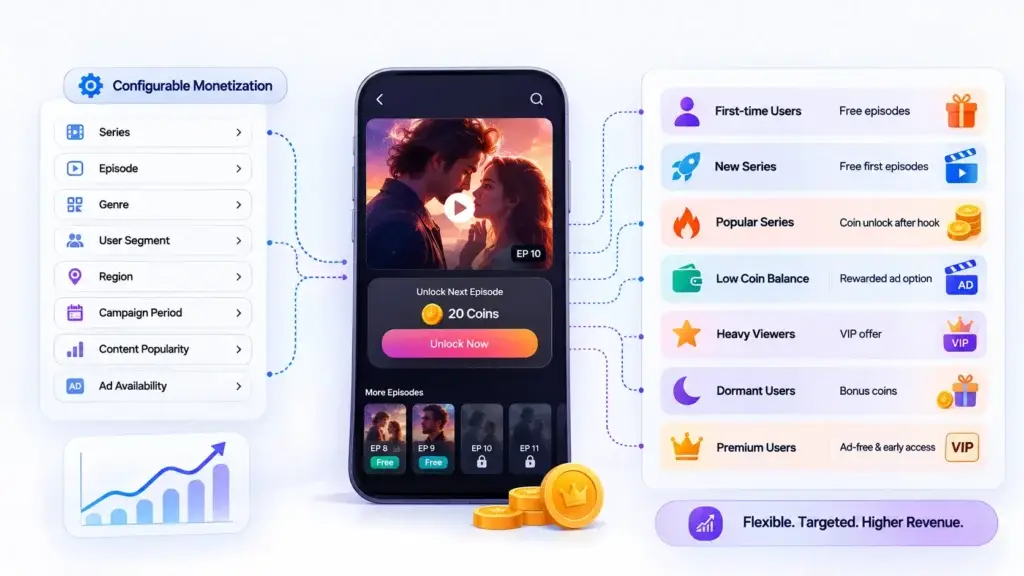
Image Source: AI-generated visual by Miracuves
A strong short-drama monetization system should be configurable at multiple levels.
The founder should be able to adjust monetization by:
- Series
- Episode
- Genre
- User segment
- Region
- New vs returning users
- VIP vs non-VIP users
- Campaign period
- Content popularity
- Ad availability
This creates flexibility. A high-performing romance series may justify earlier coin unlocks. A new regional series may need more free episodes to build traction. A premium exclusive series may sit behind VIP access. A low-intent user segment may receive rewarded ad options more often.
Example Monetization Setup
| Platform Layer | Suggested Rule |
|---|---|
| First-time users | Free opening episodes and onboarding rewards |
| New series launch | Free first episodes to encourage sampling |
| Popular series | Coin unlocks after emotional hook point |
| Low coin balance users | Rewarded ad option to continue |
| Heavy viewers | VIP offer after repeated unlock behavior |
| Dormant users | Bonus coins or free episode campaign |
| Premium users | Ad-free viewing and early access |
This type of system helps founders avoid one-size-fits-all monetization.
Read More: How to Test Short Drama Story Hooks Before Scaling a Vertical Entertainment App
What Metrics Should Founders Track?
A monetization model should never be static.
Once the platform launches, founders should track how viewers respond to unlock rules, VIP offers, and rewarded ads. The goal is to identify where users continue, where they pay, and where they drop off.
Important metrics include:
| Metric | What It Reveals |
|---|---|
| Free-to-locked episode conversion | Whether users are invested before the paywall appears |
| Coin purchase rate | How many viewers are willing to pay |
| Coin spend per series | Which content drives real revenue |
| Rewarded ad completion rate | Whether users accept ad-based unlocks |
| VIP conversion rate | Whether heavy users see subscription value |
| Episode drop-off rate | Where monetization friction becomes too high |
| Refund or complaint patterns | Whether pricing feels unfair |
| Repeat viewing frequency | Whether users are building habit |
The most important insight is not just revenue. It is the relationship between revenue and retention.
A platform that earns aggressively in week one but loses users quickly may struggle to scale. A platform that gives too much away may grow engagement but fail to monetize. The right balance is found through testing.
Common Mistakes Founders Should Avoid
Locking Episodes Before the Viewer Cares
A paywall only works after the user feels curiosity. Locking content too early interrupts discovery and reduces trust.
Making Rewarded Ads Too Generous
Rewarded ads should help users continue, but they should not replace every paid action. Unlimited ad unlocks can train users to avoid coins and VIP access.
Offering VIP Without Clear Benefits
VIP should feel meaningfully better than free access. If it only removes minor friction, users may ignore it.
Using the Same Monetization Rules for Every Series
Different genres behave differently. A revenge drama, romance drama, fantasy story, and regional family drama may need different unlock points and pricing rules.
Not Giving Admin Teams Enough Control
If every pricing or unlock change requires development work, the business becomes slow. Short-drama platforms need admin-level control over coin packs, episode gates, rewarded ad limits, VIP plans, coupons, and campaign rules.
Why Admin Control Is Critical for Monetization
A short-drama app is not just a video player. It is a monetization engine.
The admin dashboard should help the platform operator manage:
- Coin pack pricing
- Episode unlock cost
- Free episode thresholds
- VIP plan benefits
- Rewarded ad coin value
- Daily reward limits
- Promotional campaigns
- Regional pricing
- Series-level access rules
- Revenue analytics
- User complaints and refund signals
- Creator or content-owner payouts
This matters because monetization changes after launch.
A founder may discover that users in one region prefer rewarded ads, while users in another region buy coin packs. One genre may convert better through VIP access, while another performs better through per-episode unlocks.
Without admin flexibility, the platform cannot respond quickly.
Miracuves builds short-drama app solutions with monetization-focused admin workflows so founders can manage episode access, coin logic, and user progression more practically after launch.
How to Balance User Experience With Revenue
The best short-drama monetization systems feel fair.
Users are more likely to pay when they understand what they are getting, why an episode is locked, and what options they have. They are more likely to leave when the platform feels confusing, manipulative, or too restrictive.
A healthy monetization experience should include:
- Clear coin cost before unlock
- Transparent VIP benefits
- Visible coin balance
- Simple top-up flow
- Rewarded ad option where appropriate
- No surprise charges
- Easy access to purchase history
- Support for failed payments
- Clear refund and help policies
- Fair free-viewing opportunities
Short-drama platforms should monetize emotional momentum, not exploit confusion.
That difference is important for long-term brand trust.
Recommended Monetization Mix by Launch Stage
Founders can adjust the mix as the platform matures.
| Launch Stage | Coin Unlocks | VIP Access | Rewarded Ads |
|---|---|---|---|
| Early launch | Moderate | Light | Strong for retention |
| Growth stage | Stronger | Introduce bundles | Controlled frequency |
| Mature stage | Series-specific | Strong loyalty layer | Segmented by user type |
| Premium content phase | High-value unlocks | Exclusive access | Limited or promotional |
In the early stage, rewarded ads can help users explore the app. As content quality, catalog depth, and user habit improve, coins and VIP access can become stronger revenue drivers.
Where a Ready-Made Platform Helps Founders Move Faster
Building a short-drama monetization system from scratch can become complex quickly.
The app needs more than video uploads and playback. It needs wallets, episode gates, purchase logic, VIP rules, rewarded ad controls, analytics, creator or content management, admin settings, and payment workflows.
For founders who want to launch faster, using a vertical drama streaming app foundation can reduce avoidable development effort. Instead of building every monetization module from zero, the team can focus on branding, content strategy, pricing experiments, and user acquisition.
A short-drama app solution by Miracuves can support coin unlocks, VIP access, rewarded ads, and admin-controlled monetization rules for founders planning to enter the vertical drama market with a launch-ready product base.
Related reading: AI Personalization in Short-Drama Platforms and From Viewer Spending to Series Revenue.
Final Thoughts: Monetization Balance Decides Platform Health
Short-drama monetization is a balancing act.
Coins drive direct revenue. VIP access creates convenience and loyalty. Rewarded ads protect retention and give non-paying users a way to continue. But none of these models should operate in isolation.
The strongest strategy is to let each model serve a different user behavior:
- Coins for high-intent unlocks
- VIP for frequent viewers
- Rewarded ads for retention and sampling
Founders should focus on flexibility, testing, and user trust. A monetization model that can be adjusted from the admin panel is far more valuable than a rigid setup that looks good at launch but cannot adapt to real viewer behavior.
Miracuves helps founders build monetization-ready short-drama platforms with white-label branding, source-code ownership, admin control, and faster deployment, so the business can test pricing, content, and access models without starting from zero.
FAQs
What is the best monetization model for a short-drama platform?
The best model usually combines coin unlocks, VIP access, and rewarded ads. Coin unlocks generate per-episode revenue, VIP access supports frequent viewers, and rewarded ads help retain users who are not ready to pay.
How many free episodes should a short-drama app offer before locking content?
There is no fixed number for every platform. Many founders start by offering enough free episodes to build emotional investment before introducing a paywall. The right threshold depends on genre, episode length, story pacing, and viewer behavior.
Are rewarded ads good for short-drama apps?
Yes, rewarded ads can help reduce drop-offs and keep non-paying users engaged. However, they should be capped carefully. If users can unlock too much through ads, coin purchases and VIP upgrades may decline.
Should VIP users get unlimited episode access?
Not always. Unlimited access can work for some platforms, but it may reduce coin revenue. A balanced VIP plan may include ad-free viewing, daily bonus coins, early access, discounted unlocks, or exclusive content instead of removing every paid trigger.
Why are coin unlocks popular in short-drama apps?
Coin unlocks work because short-drama viewing is driven by curiosity and cliffhangers. Users are often willing to spend small amounts to continue a story they are emotionally invested in.
What features should a short-drama monetization system include?
A strong system should include coin wallets, episode unlock rules, rewarded ads, VIP plans, admin pricing controls, purchase history, campaign settings, revenue analytics, and user-level access management.
Can different series have different monetization rules?
Yes. Different genres and audience segments may perform better with different rules. A platform should ideally allow series-level or episode-level monetization settings from the admin panel.
How can founders avoid hurting retention with paywalls?
Founders should avoid locking content too early, provide clear pricing, offer rewarded ad alternatives, track episode drop-offs, and adjust unlock rules based on user behavior.
Miracuves is an independent software development company. We are not affiliated with, connected to, sponsored by, or endorsed by any company or product named in this article.
Terms such as “X Clone” are used descriptively. It is how the software industry refers to building a platform with functionality comparable to a known service, and how clients search for it.
The entire design and codebase of our products is built by our own team. Our products contain no code, design, graphics, or content originating from any third-party website or applications.
All third-party names and marks referenced in this article are the property of their respective owners, referenced solely to identify the services discussed.