
















Key Takeaways
- A ready-made online travel agency platform provides an existing foundation for standard travel workflows such as inventory search, booking, payments, traveler management, administration, and post-booking operations.
- Using an existing OTA foundation can reduce the amount of standard infrastructure that needs to be engineered before a startup can begin market validation.
- Ready-made software still requires implementation work, including branding, supplier setup, payment configuration, testing, deployment, content, analytics, and potentially additional integrations.
- The approach is most useful when the startup’s core requirements already match established OTA workflows and differentiation can come from inventory, pricing, partnerships, customer experience, or distribution.
- Founders should verify source-code access, customization scope, supplier connectivity, third-party costs, ownership, support, and scalability before selecting a ready-made platform.
Platform Fit Signals
- A suitable foundation should already support the core transaction, including search, availability, traveler details, checkout, payment, confirmation, itinerary, cancellation, and administration where required.
- Existing supplier integrations can reduce implementation effort, but supplier agreements, credentials, approvals, and commercial arrangements may still be required.
- Customization should focus on genuine differentiation rather than rebuilding standard booking infrastructure that the existing platform already handles adequately.
- Source-code delivery, documentation, hosting access, third-party dependencies, deployment configuration, and future development responsibility should be clearly understood.
- A hybrid approach can combine an existing OTA foundation with custom integrations, market-specific workflows, and proprietary modules where they create strategic value.
Real Insights
- A ready-made platform does not automatically mean a business is ready to launch; operational configuration, supplier access, payments, testing, support, and market-specific requirements still need attention.
- The biggest benefit can be faster learning because founders may reach real-user testing sooner and gather evidence about demand, conversion, inventory gaps, support issues, and repeat usage.
- Heavy customization can reduce the advantage of a ready-made approach when large parts of the search, booking, payment, or data architecture need to be replaced.
- The technology decision should be based on what the startup needs to prove, how much of the required workflow already exists, and where engineering creates meaningful differentiation.
- The strongest evaluation path is: define the business hypothesis → map standard OTA requirements → verify platform fit → review supplier and payment integrations → assess customization → confirm ownership → calculate total costs → test real booking scenarios → launch and customize based on evidence.
Launching an online travel agency platform involves considerably more than building a search page and connecting a payment gateway.
A working OTA may need to coordinate supplier inventory, availability, pricing, traveler details, booking states, payments, confirmations, cancellations, refunds, itineraries, notifications, administrative operations, and customer support.
For a startup, that creates an important technology decision:
Should we engineer the entire travel platform from the ground up, or start with a ready-made OTA foundation and customize the parts that differentiate our business?
Neither approach is automatically right for every startup.
Custom development provides greater freedom over architecture and unusual workflows. A ready-made platform can reduce the amount of standard travel-booking infrastructure that needs to be engineered before the business reaches the market.
The better decision depends on what the startup is actually trying to prove.
If the biggest uncertainty is whether customers want the travel proposition, spending months proving that the team can build a booking engine may not be the best first experiment.
If the technology itself is the innovation, custom development may deserve a much larger role.
Here is how founders can make that distinction.
Ready-Made OTA vs Custom Development at a Glance
Ready-Made OTA vs Custom Development
| Decision Area | Ready-Made Foundation | Custom Development |
|---|---|---|
| Starting Point | Existing booking and operational foundation | Requirements and architecture begin largely from zero |
| Launch Strategy | Configure, brand, integrate, test, and deploy | Design, engineer, integrate, test, and deploy |
| Early Validation | Can reach real-user testing sooner when standard workflows fit | More product engineering may happen before market validation |
| Customization | Best when the existing foundation covers most core requirements | Best when unusual workflows are fundamental to the product |
| Technical Freedom | Influenced by the existing architecture | Architecture can be designed around specific requirements |
| Investment Focus | More early resources can remain available for supply, acquisition, and differentiation | A larger share of early investment may go toward engineering |
Start With What Your Startup Actually Needs to Prove
The first question is not whether ready-made software is better than custom software.
It is:
What is the biggest uncertainty in the business?
For many early-stage travel businesses, the unknowns are commercial.
Can the startup acquire useful inventory?
Can it attract travelers?
Will customers complete bookings?
Can the business generate sufficient margin?
Will travelers return?
Those questions cannot be answered by software development alone.
If standard OTA technology can support the initial proposition, using an existing foundation can allow the startup to test those commercial assumptions sooner.
But if the startup’s core thesis depends on proprietary booking logic, unusual distribution, a fundamentally different traveler experience, or specialized infrastructure, custom engineering may be central to the experiment itself.
The technology strategy should follow the business hypothesis.
Standard OTA Infrastructure Rarely Creates the Differentiation
Consider how much infrastructure sits underneath an ordinary travel booking.
A traveler searches.
Inventory is retrieved.
Results are normalized.
Availability and pricing are displayed.
The traveler selects an option.
Details are collected.
Payment is initiated.
A supplier reservation is requested.
Confirmation is recorded.
An itinerary becomes available.
Notifications are sent.
The booking may later be changed, cancelled, or refunded.
These capabilities are essential.
But implementing standard booking states from scratch does not necessarily make a travel startup unique.
Differentiation may instead come from which market the startup serves, its inventory strategy, pricing, customer acquisition model, service experience, partnerships, packaging, specialization, or distribution.
Founders deciding what should be built versus reused can first understand how an online travel platform works across search, comparison, booking, payments, confirmation, and reservation management. Mapping that complete journey helps separate standard OTA infrastructure from the capabilities that genuinely need proprietary development.
That creates a useful founder question:
Which technology must be unique, and which technology simply needs to work reliably?
Ready-Made Platforms Can Reduce the Pre-Launch Engineering Cycle
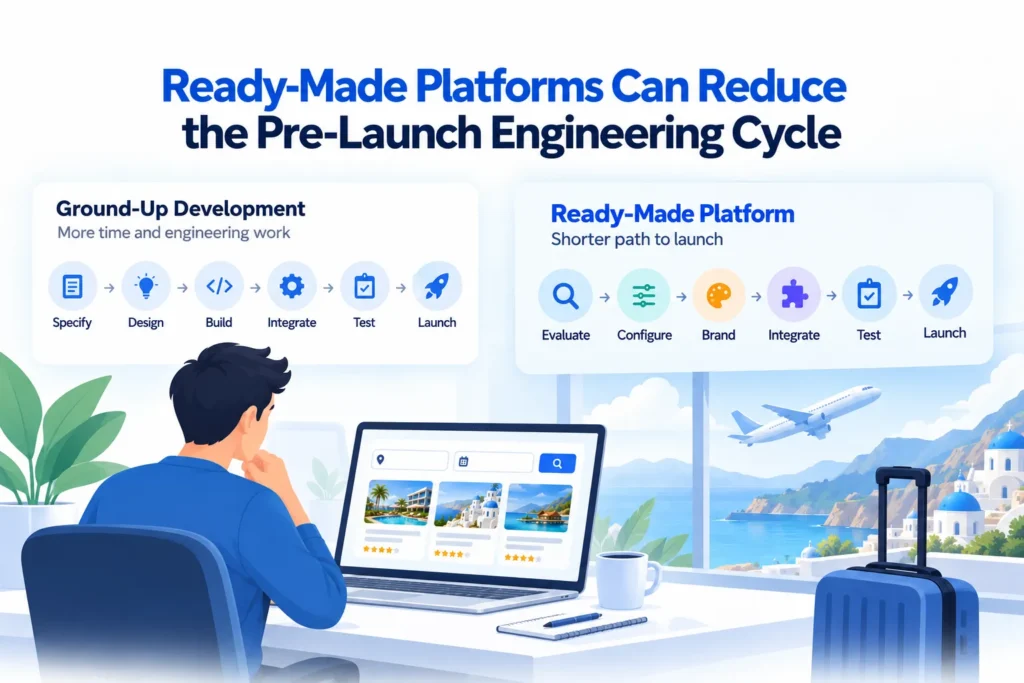
Ground-up development requires more than writing code.
Teams need to define requirements, design architecture, build interfaces, develop backend services, implement administrative workflows, connect external systems, test booking states, resolve edge cases, deploy infrastructure, and stabilize the product.
That work can be justified when the resulting technology creates meaningful differentiation.
It becomes harder to justify when the team is rebuilding standard functionality that an existing foundation already provides adequately.
A ready-made approach changes the sequence.
Instead of:
specify → design → build → integrate → test → launch
the project can move closer to:
evaluate → configure → brand → integrate → test → launch
The engineering difference becomes clearer when founders examine the underlying online travel agency platform architecture. Supplier APIs, inventory processing, booking engines, payments, reservation states, and fulfillment all need to work together, which helps explain why recreating standard OTA infrastructure can consume a substantial part of a custom-development roadmap.
There is still implementation work.
The difference is the amount of standard infrastructure that must be created before implementation begins.
Faster Launch Means Faster Learning
Speed-to-market is valuable because it shortens the distance between assumptions and evidence.
Before launch, founders operate largely on hypotheses.
They can estimate which destinations customers want.
They can predict which filters matter.
They can assume which acquisition channels will work.
They can model conversion rates.
Real customers provide better information.
Once the product is in use, the startup can observe searches, inventory gaps, abandoned journeys, booking conversion, support issues, payment behavior, repeat usage, and other operational signals.
A faster launch is therefore useful when it produces faster validated learning, not merely an earlier launch announcement.
A Ready-Made Foundation Can Preserve Capital for Non-Technical Constraints
Software is only one investment required to launch an OTA.
Startups may also need capital for supplier relationships, API access, payment setup, branding, legal work, customer acquisition, content, customer support, operations, cloud infrastructure, partnerships, and market expansion.
A startup that allocates most of its early budget to rebuilding standard booking infrastructure can leave itself with a technically functional product and insufficient resources to create demand around it.
This is why founders should compare total launch allocation, not simply development quotations.
Ask:
After the technology is ready, how much capital remains to operate and grow the marketplace?
That question can be more useful than minimizing software cost in isolation.
Founders who want to quantify the technology side of that decision can examine travel platform development cost factors in more detail. Supplier integrations, booking modules, mobile applications, payment requirements, customization, infrastructure, and market-specific functionality can all influence the investment required beyond the initial software price.
Technology investment should also be evaluated against the online travel agency business model the startup intends to operate. Commissions, markups, service fees, supplier economics, ancillary revenue, and other monetization approaches influence how much capital the business can justify allocating to technology, customer acquisition, and marketplace operations.
Ready-Made Does Not Mean Zero Implementation
One misconception is that purchasing an existing platform eliminates implementation work.
It does not.
A travel business may still need branding, supplier credentials, payment configuration, domain and infrastructure setup, market-specific content, testing, analytics, operational configuration, and potentially additional integrations.
The advantage is that the startup may not need to build every standard workflow before beginning those tasks.
Founders should therefore distinguish between:
software already developed and business ready to launch.
They are related, but they are not identical.
Supplier Integrations Can Be a Bigger Constraint Than the User Interface
A travel marketplace depends on supply.
Flights, hotels, transfers, vehicles, activities, and other products may come from different suppliers or distribution systems.
Each connection can introduce its own data formats, authentication, pricing, booking flows, cancellation rules, timeouts, and commercial requirements.
That means a startup can have an attractive frontend while still being far from operational readiness.
When comparing ready-made and custom approaches, evaluate the supplier layer carefully.
Ask whether the required integrations already exist, require configuration, or need to be developed.
Also separate technical integration from commercial supplier access. A software platform may support a connection, while the travel business still needs its own supplier agreement, credentials, approval, or commercial arrangement.
Existing Booking Workflows Can Reduce Reinvention
Booking systems need to account for more than successful transactions.
What happens when the price changes?
What happens when availability disappears?
What if payment succeeds but supplier confirmation does not?
What happens when a supplier times out?
How are cancellations represented?
How is refund status tracked?
How does an administrator find and resolve an exception?
A custom system needs these states to be designed and tested.
An established ready-made foundation can provide a starting structure for common booking workflows, although founders should still verify whether those workflows match the intended suppliers and operating model.
The benefit is not that edge cases disappear.
It is that the team may begin with an existing transaction model rather than discovering every state from zero.
Ready-Made Platforms Make the Most Sense When Most Requirements Are Standard
The economics of ready-made software improve when the startup’s core requirements already resemble the platform’s existing capabilities.
Suppose a startup needs:
- Travel search
- Supplier inventory
- Availability
- Traveler accounts
- Booking
- Payments
- Confirmations
- Itinerary management
- Admin controls
- Basic promotions
- Notifications
Those are broadly established OTA requirements.
If an existing platform already covers most of them, rebuilding everything from zero may not provide proportional strategic value.
Once the startup has identified which workflows are standard, it can compare them against a broader set of travel platform features covering supplier connectivity, booking operations, payments, traveler experiences, administration, and marketplace management. The purpose is not to select every available capability, but to confirm that the foundation covers the requirements the startup would otherwise need to build.
The startup can instead focus customization on the areas where its business actually differs.
Customization Should Create Differentiation
A ready-made foundation should not mean launching an indistinguishable business.
Brand identity can change.
User journeys can evolve.
Supplier strategies can differ.
Revenue logic can be configured.
New integrations can be introduced.
Specialized functionality can be added.
The important distinction is between customizing for differentiation and custom-building everything by default.
Startups should identify the relatively small number of capabilities that create their competitive proposition and concentrate custom engineering there.
That can produce a more focused technology roadmap.
But Heavy Customization Can Eliminate the Ready-Made Advantage
There is a point where modifying an existing system stops being efficient.
Imagine a startup needs to replace most of the search architecture, redesign the booking model, introduce an unusual supplier structure, rebuild payments, replace the administrative model, and fundamentally change the data architecture.
At that point, the team is no longer configuring a foundation.
It is effectively rebuilding it.
This is where founders need discipline.
Before purchasing a ready-made platform, estimate how much of the standard product can remain intact.
If extensive portions need replacement, compare that implementation honestly against custom development.
The correct question is not:
“Can this platform be customized?”
Almost anything can be changed with enough engineering.
The better question is:
“How much customization can we justify before this stops being the efficient route?”
Source-Code Access Changes the Build-vs-Buy Conversation
Traditional software procurement can create concern about dependency on the original vendor.
Source-code delivery changes part of that equation.
If the startup receives the relevant codebase and appropriate technical access, it may have more freedom to maintain, extend, host, or transfer development responsibility later.
But founders should verify what “source-code ownership” actually includes.
Ask about repositories, documentation, third-party dependencies, credentials, licensing, custom modifications, deployment configuration, and the ability for another technical team to work on the product.
Owning code and being able to maintain code are not automatically the same thing.
Technical Debt Exists in Both Approaches
Ready-made software is sometimes criticized because founders fear inheriting technical debt.
That is a legitimate diligence question.
But custom development does not eliminate technical debt.
A rushed custom MVP can accumulate architectural compromises, inconsistent implementation, incomplete tests, weak documentation, and dependencies on the original development team.
The correct comparison is therefore not:
ready-made = technical debt
custom = clean architecture
Instead evaluate the actual codebase, architecture, documentation, maintainability, testing, dependencies, deployment process, and extension model of whichever approach is being considered.
Security Should Not Be Rebuilt as a Marketing Feature
Travel platforms may handle personal information, account access, booking records, administrative permissions, supplier integrations, and payment-related workflows.
A startup should not treat security as something to “add later.”
Whether using ready-made or custom development, evaluate authentication, authorization, data handling, secure transport, administrative access, secrets management, logging, backups, dependencies, and infrastructure practices where relevant.
A ready-made platform can provide a compliance-ready foundation, but final compliance depends on jurisdiction, hosting, integrations, policies, business processes, legal requirements, and how the deployed system is operated.
The same principle applies to custom development.
Compliance is an operating responsibility, not a checkbox attached to a codebase.
Product-Market Fit Should Influence How Much You Customize Early
Early-stage founders frequently design for customers they have not yet acquired.
That creates a risk of overbuilding.
A team may spend months creating sophisticated personalization, loyalty mechanics, package builders, complex dashboards, or advanced automation before knowing whether travelers value the core proposition.
A ready-made foundation can support a different sequence:
launch core proposition → observe users → identify friction → prioritize differentiation → customize based on evidence.
That does not mean innovation should be postponed indefinitely.
It means evidence can determine where innovation deserves engineering resources.
A Faster Launch Can Improve the Quality of the Roadmap
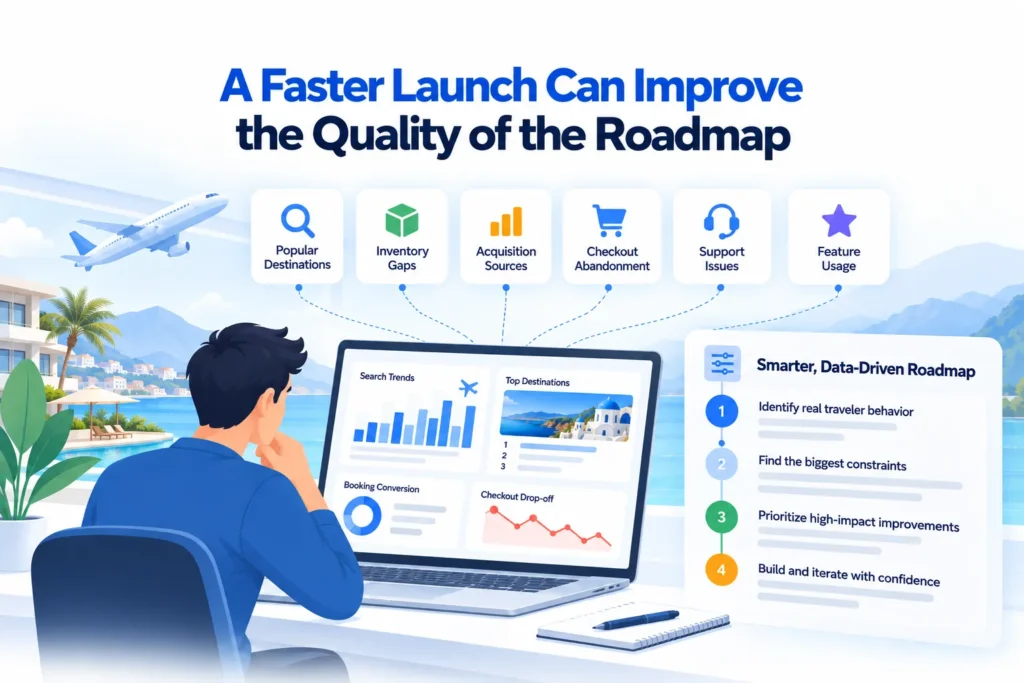
AI-generated visual by Miracuves.
Roadmaps written entirely before launch are dominated by assumptions.
Post-launch roadmaps can incorporate behavior.
Which destinations are searched most frequently?
Where does inventory fail to satisfy demand?
Which acquisition sources generate confirmed bookings?
Where do travelers abandon checkout?
Which support problems occur repeatedly?
Which features are actually used?
What do operators repeatedly do manually?
Those signals can produce a much more defensible customization roadmap.
Instead of asking:
“What else can we build?”
the team can ask:
“Which improvement removes the largest demonstrated constraint?”
Ready-Made and Custom Are Not Always Binary Choices
Founders sometimes frame the decision as if they must choose between a completely standardized platform and a completely custom product.
In practice, a hybrid approach can be more useful.
Use existing infrastructure for standard functions.
Customize the customer experience where differentiation matters.
Add market-specific integrations.
Develop proprietary modules where they create real advantage.
Replace components later if scale or strategy requires it.
This turns the ready-made foundation into a starting architecture rather than the final limit of the product.
When Does Custom Development Make More Sense?
Custom development deserves serious consideration when the product’s differentiating technology cannot be accommodated efficiently by an existing foundation.
Examples can include:
- Fundamentally unusual booking workflows
- Proprietary inventory or distribution models
- Specialized pricing architecture
- Complex enterprise processes
- Unique data models
- Deeply specialized regulatory requirements
- Proprietary optimization technology
- Architecture requirements that conflict with the existing foundation
Custom development can also make sense when the company already has a capable technical organization and intentionally wants complete architectural control from the beginning.
The key is that the additional engineering should create strategic value.
Building from zero is not inherently superior simply because it is custom.
When Does a Ready-Made OTA Platform Make More Sense?
A ready-made foundation becomes particularly attractive when the startup needs established travel-booking workflows but intends to differentiate elsewhere.
Signals That a Ready-Made OTA Foundation May Fit
Search, inventory, checkout, payment, confirmation, itinerary, cancellation, and administration make up most of the required transaction.
The startup needs to validate supply, customer demand, conversion, or unit economics without waiting for the complete platform to be engineered from zero.
The business competes through its niche, inventory, distribution, service, packages, pricing, partnerships, or customer experience.
Resources need to remain available for supplier acquisition, marketing, operations, support, and post-launch iteration.
Customization can concentrate on high-value differences instead of replacing the majority of the standard platform.
The more of these conditions apply, the stronger the case for evaluating an existing platform before commissioning a ground-up build.
Compare Total Startup Cost, Not Development Cost Alone
Technology decisions should be evaluated against the complete launch.
Consider the capital required for:
software + integrations + infrastructure + suppliers + payment setup + operations + marketing + support + maintenance + future development.
A custom build might justify greater upfront engineering investment when proprietary technology creates meaningful strategic value.
A ready-made foundation may be more efficient when standard OTA infrastructure would otherwise consume capital without creating much differentiation.
This is why the cheapest development quotation is not automatically the lowest-cost startup strategy.
Time, opportunity cost, operational readiness, and the ability to validate the market also matter.
Compare the Two Approaches With the Same Requirements
Founders should avoid comparing a fully specified custom platform with a vaguely defined ready-made product.
Use one requirements document for both.
Founder Build-vs-Buy Decision Framework
| Question | What to Determine |
|---|---|
| Core Fit | How much of the required booking and operational workflow already exists? |
| Differentiation | Which capabilities genuinely need proprietary engineering? |
| Integrations | Which suppliers, payments, and external systems must be connected? |
| Customization | What can be configured and what requires new engineering? |
| Time | When does the business need to begin real market validation? |
| Capital | How much budget must remain for supply, acquisition, operations, and growth? |
| Ownership | What code, data, infrastructure, documentation, and technical access will the company control? |
| Long-Term Plan | Can the architecture support the next realistic stage of the business? |
This produces a much more useful decision than comparing marketing claims.
What a Startup Should Verify Before Choosing a Ready-Made Platform
Before committing to any existing OTA foundation, verify the areas that could materially affect launch.
Review the actual booking workflow.
Inspect the administrative system.
Understand supplier connectivity.
Clarify payment requirements.
Confirm mobile scope.
Understand what customization is included.
Review source-code and deployment terms.
Identify third-party costs.
Clarify post-launch support.
Document anything that requires additional engineering.
Startups moving from the build-vs-buy decision into vendor evaluation can use this guide to compare OTA platform features and cost factors across supplier integrations, booking workflows, payments, ownership, customization, implementation, and ongoing expenses before making an investme
The same requirements can then be used when evaluating a travel platform development partner. Rather than choosing a provider only by delivery time or headline price, founders can assess its ability to handle supplier connectivity, booking states, payments, customization, deployment, source-code handover, and post-launch requirements.
Most importantly, determine whether the existing platform fits the startup’s first realistic version, rather than an imaginary product roadmap five years into the future.
Moving From Build-vs-Buy Analysis to Implementation
Once the startup has separated standard infrastructure from genuine differentiation, the technology decision becomes easier.
If most requirements are unusual and proprietary, custom development may be justified.
If most requirements are established OTA workflows, an existing foundation deserves serious evaluation.
For startups taking the second route, Miracuves provides a ready-made online travel agency platform designed around established travel marketplace workflows, with options for branding, supplier setup, integrations, project-specific configuration, and source-code delivery.
For suitable ready-made solution scopes, Miracuves offers a 6-day solution delivery path. Additional supplier integrations, substantial feature changes, specialized market requirements, and other custom engineering should be scoped separately.
The objective is not to avoid custom development.
It is to avoid spending custom-development resources on infrastructure that does not differentiate the business.
Start with the proven foundation where it fits.
Once the startup has decided that an existing foundation fits its strategy, the next step is to evaluate the requirements of a complete travel booking platform, where inventory, supplier connectivity, search, reservations, payments, administration, and post-booking operations need to function as one coordinated system.
Customize where customers or operations genuinely benefit.
Startups still comparing different marketplace structures can also explore Miracuves’ travel booking solutions to evaluate ready-made travel concepts against their intended inventory, target customers, booking journey, monetization model, and operational requirements.
Build from scratch where proprietary technology creates meaningful strategic value.
That is a much more useful startup technology strategy than assuming everything must be custom—or everything must remain standard.
Final Thoughts
Ready-made OTA platforms and custom development are tools, not business strategies.
The right choice depends on what the startup needs to learn, what needs to be unique, how quickly it needs market evidence, and where limited capital can create the greatest advantage.
For many travel startups, the strongest argument for a ready-made foundation is not simply that it can reduce development effort.
It changes where the startup spends its first months.
Instead of dedicating the entire early cycle to rebuilding standard booking infrastructure, the team can potentially spend more time acquiring suppliers, understanding travelers, testing acquisition, improving conversion, refining operations, and discovering which custom capabilities are actually worth building.
For other businesses, proprietary technology is the product—and custom development is therefore essential.
The founder’s job is to know which situation applies.
FAQs
What is a ready-made online travel agency platform?
A ready-made OTA platform is an existing software foundation for common travel marketplace workflows such as inventory search, booking, payments, traveler management, administration, and post-booking operations. Businesses configure and customize that foundation around their brand and operating model.
Is ready-made OTA software fully customizable?
Customization depends on the platform and project scope. Branding, interfaces, integrations, workflows, and functionality may be modified, but extensive changes can reduce the economic advantage of starting with an existing foundation.
When should a travel startup choose custom development?
Custom development can make more sense when proprietary technology, unusual booking logic, specialized architecture, unique data models, or other non-standard requirements are central to the business proposition.
Is a ready-made platform always cheaper than custom development?
Custom development can make more sense when proprietary technology, unusual booking logic, specialized architecture, unique data models, or other non-standard requirements are central to the business proposition.
Can a startup validate product-market fit with a ready-made platform?
It can be useful for validation when the platform already supports the transaction the startup needs to test. Faster access to real users can help founders gather evidence about inventory demand, conversion, customer behavior, and operational requirements.
Does ready-made software eliminate supplier integration work?
No. Existing integrations can reduce technical work, but the startup may still need supplier accounts, agreements, credentials, configuration, certification, or new integration work depending on its inventory strategy.
Does Miracuves provide source code with its ready-made travel solution?
Yes, provided the selected architecture supports the intended changes. This hybrid strategy can allow a startup to use standard infrastructure initially and direct later engineering toward functionality justified by customer, operational, or market evidence.
Miracuves is an independent software development company. We are not affiliated with, connected to, sponsored by, or endorsed by any company or product named in this article.
Terms such as “X Clone” are used descriptively. It is how the software industry refers to building a platform with functionality comparable to a known service, and how clients search for it.
The entire design and codebase of our products is built by our own team. Our products contain no code, design, graphics, or content originating from any third-party website or applications.
All third-party names and marks referenced in this article are the property of their respective owners, referenced solely to identify the services discussed.