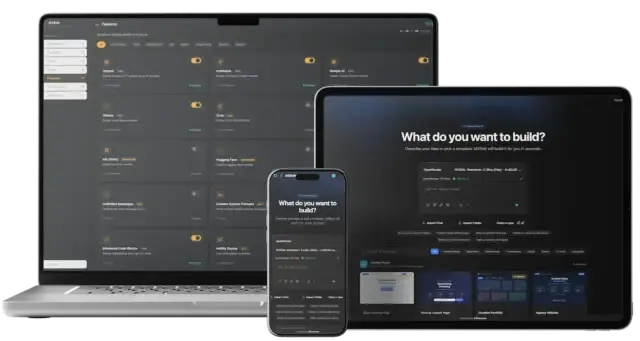
White Label Messaging App Features: Chat, Calls and Console
This is the platform underneath the messaging clones we sell, described feature by feature. A member sees delivery ticks, a ringing phone and a story tray. An operator sees a report queue, a language switch and a dashboard. Both halves ship in one build that runs on servers you choose: encrypted private and group chat, voice and video between devices, twelve message types, and a console where branding, rules and keys are forms rather than releases.
Request a Live Demo →Full OverviewWho Uses What: The Feature Set by Role
Six people touch the platform. Each gets a complete toolset, all of it served by one Node.js API.
The Member
Joins with a phone number and a one-time code, or with email, Apple, Google or Facebook. The phone book is matched against your user base, contacts can be renamed privately, and strangers can be found by name or number. In a thread: ticks that move from delivered to read, a typing signal, online status, last seen and in-conversation search.
The Group Admin
Creates a named group with a photo, invites people, promotes co-admins and removes anyone who should not be there. Groups can be opened to the public so newcomers find them. Inside a busy thread there are replies, emoji reactions, forwarding and polls whose tallies move as people vote.
The Caller
Rings one person or a whole group by voice or video and gets a full incoming-call screen with a ringtone, even with the app closed. Each call lands in a history as missed, answered or declined, with its length, and the list can be narrowed by type.
The Desk User
The browser client carries the full product rather than a trimmed view: the same threads, calls, stories and settings. One account holds several live connections, so a message lands on phone and laptop together and opening it in one place clears the badge in the other.
The Moderator
Works two queues, one for reported people and one for reported groups. Every entry names the reporter, the target, the reason chosen and the conversation involved. An account or an entire group can be blocked, and reviewed items are flagged so colleagues skip them.
The Operator
Reads fifteen live figures, sees who is online now and within the last half hour, checks the phone-versus-browser split and learns which sign-in route members pick, which tells you whether SMS codes deserve their cost. The same person edits branding, languages and integration keys through forms.
Operator logins sit on their own credentials and a separate privilege tier, so console access is never a setting on a member's chat profile.
Rented Platform vs One-Time Script vs Miracuves Platform
White label messaging software is sold three different ways. The differences surface after launch rather than in a demo.
| What decides it | Rented or hosted platform | One-time script | Miracuves platform |
|---|---|---|---|
| How you pay | A recurring fee, often counted per active user or per message | One payment, roughly $250 to $1,500 on the open market | $3,099, once |
| Source code | Kept by the vendor | Varies, and some vendors withhold it from every published tier | Handed over in full, no license strings |
| The apps | The vendor's own client or a kit to embed | Cheaper tiers often ship web-view apps rather than native ones | Flutter apps for iPhone and Android, a browser client and a console |
| Where conversations sit | On the vendor's infrastructure | Wherever you host it, once you hold the code | Your servers, in the jurisdiction you pick |
| Voice and video | Frequently metered, or sold as a separate module | Often absent, or tied to a paid calling vendor | Device to device, so minutes are not billed |
| Moderation | Depends on the plan | Often little beyond a block button | Report queues for people and groups, with reasons you write |
| Changing the brand | Set by the vendor's plan | Usually a code edit and a rebuild | Console forms, no store resubmission for wording |
| If you stop paying | The service can stop with the invoice | Nothing, apart from hosting | Nothing switches off |
Rented platforms suit a team that wants chat inside another product this month and is happy to pay by usage. If the conversation itself is the asset, the columns that matter are who holds the data and what happens on the day payment stops. Money is covered on the Development Cost page.
One Member's Path, From First Code to a Blocked Account
Seven moments, every one a working part of the platform and none a mock-up.
A code opens the door
Sign-in runs on a one-time code sent to a phone or an email, or on a social account. No member password exists to leak. Which routes are offered is a console choice, not a development decision.
Friends appear
The app matches numbers from the address book against your user base and shows who is already inside. A member can attach a private label to any contact, and can still search for people who are not saved.
Words travel over a live socket
Messages ride a persistent connection instead of being polled for, so ticks, typing and presence are events that fire as they happen. Content is end-to-end encrypted: it crosses the network and rests in your database as ciphertext.
Media rides the same road
Photos and clips come from camera or gallery, voice notes are recorded inside the app, and documents, GIFs, location pins and contact cards join them. Video is shrunk and given a thumbnail on the handset first, which keeps uploads moving on a poor signal.
Two people become a group
A private chat and a group are one kind of object distinguished by a flag. Delivery, permissions, moderation and clean-up therefore follow identical rules, and there is no second code path to drift out of step.
A call rings through
Audio and video travel straight between the two handsets using WebRTC. A relay steps in only where a strict network blocks the direct path. The ring itself is signaled over the connection that already carries chat.
A report leads to action
The report arrives in the correct queue with a reason picked from your own list, the reporter and the conversation attached. The moderator blocks the account or the whole group, and the reviewed flag tells the next person to move on.
A scheduled job runs every hour and deletes stories older than a day and pins past their expiry, so temporary content is actually removed and not merely hidden.
Why Each Design Choice Is in the Base Build
Every row is here because a messenger misbehaves without it, whatever the feature lists of other products say.
| Design choice | What it protects you from |
|---|---|
| Peer-to-peer calling with a fallback relay | A calling service bought from a vendor makes the bill climb whenever usage does. Sending audio and video between devices leaves only the occasional relayed call as a server cost. |
| Chats and groups as one object | Modelling groups separately doubles the work on delivery, access and retention, and invites bugs where a group quietly behaves differently from a chat. |
| Personal actions kept per person | Starring, pinning, archiving and delete-for-me are stored against the user, not the message. Clearing your own copy therefore cannot erase the other person's. |
| Presence written to the database | If live connections lived only in one server's memory, adding a second server would mean a redesign. Stored centrally, it means an adapter and a load balancer. |
| Media saved with relative paths | A change of domain, or a later move to object storage, does not require editing every stored row. |
| Operator-written report reasons | A queue is only useful when its categories match your community's real problems. You write them, separately for people and for groups. |
| Reviewed marker on each report | Moderators work under pressure. A visible marker stops two of them handling one case while a third goes unread. |
| Hourly expiry job | Ephemeral content is a promise to members. A job that really deletes it keeps that promise, where hiding it from view would not. |
Sixteen interface languages arrive translated, right-to-left layouts included, and the console can add more. Wording is data read from the server, so a change needs no store resubmission.
The Technology Under the Feature List
Ordinary on purpose, so a capable Node and Flutter team can maintain it without needing us.
One Node.js application owns the rules, and the four clients only present them. Because there is one deploy and one schema, the surfaces cannot slowly disagree about what a message is.
What Is Not Included in the Base Package
White label here has edges. These are the boundaries, set down before purchase.
Not a hosted chat SDK or a tenancy
You receive code and run it. Nothing in the delivery is a subscription seat that lapses, which is the point of owning the platform underneath. The accounts behind it stay yours as well: your SMS, push, maps and email credentials, and your Apple and Google developer identities.
Encryption ships, key recovery does not
End-to-end encrypted chat is part of delivery. The layer around the keys is separate scoped work: encrypted backup and restore across a new phone, and a recovery route for someone who loses theirs.
No payment processing or billing
Neither is in the base build, and the right provider depends on your market. Paid tiers, in-app purchases or transfers between members are an integration against your own merchant accounts, quoted separately.
The hardening pass is still owed
Before the public arrives you still need TLS termination, global rate limiting, upload size and type limits, secret vaulting, security headers, a locked-down console and a backup restore someone has actually tested. We complete it with you as scoped work.
Grow-into items and enterprise sign-on
Corporate single sign-on with directory sync, a real-time adapter spanning several servers, media on object storage with a CDN, append-only audit logs forwarded to a SIEM, and outbound webhooks for bots. Each is quoted against your plan.
Your community stays your responsibility
No members, contacts or phone numbers are supplied. Data retention, lawful-access duties, age and consent rules, moderation decisions, SMS sender registration and the privacy and telecoms law of each market you serve rest with you.
Documentation is written for your engineers: requirements, the data model, an API reference, a developer and security handbook and a VAPT compliance reference. It is not a certificate, and nothing here claims to be one.
Weigh Miracuves against rentals, scripts and agencies
Nine questions to put to any seller, the delivery steps, the warning signs and a modelled scenario are gathered on the Provider page.
Frequently Asked Questions
Do voice and video calls carry a per-minute fee?
Is chat really end-to-end encrypted?
What can an operator change without a developer?
Can one member use a phone and a browser together?
Is this a subscription or a hosted service?
Which accounts stay in my name?
Message yourself across two accounts
A messenger only proves itself with two people in the thread. Load one demo account normally and the other in a private window, then watch the ticks and the typing signal.
Explore the White Label Messaging App
Four surfaces. One API. Every setting in your hands.
iPhone, Android, browser and an operator console over a single Node.js application, with branding, languages, limits and rules held as configuration that your own team controls.
Talk to Us →Miracuves is an independent software development company. We are not affiliated with, connected to, sponsored by, or endorsed by WhatsApp, or any other messaging, chat or calling service.
“White label messaging app” describes a category of product, not any one company. Brand names appear elsewhere on this site only to describe the kind of platform being built and the terms buyers search for.
The entire design and codebase is built by our own team. The product contains no code, design, graphics, or content originating from any third-party messaging website or application.
No users, contacts or phone numbers are supplied with the platform. Data retention and lawful-access obligations, age and consent rules, content moderation, SMS sender registration, and the privacy and telecoms rules in every market you operate in are your responsibility. All third-party names and marks are the property of their respective owners.